
Retevis RT95
4.4Editor score
Dual-band VHF and UHF
CHIRP-compatible programming
Rotatable color TFT display
Explore the best Ham Radio Base Station Starter Kit options, comparing dual-band, 10-meter, HF, and premium transceivers for home and mobile use.
A Ham Radio Base Station Starter Kit should provide a dependable foundation for home communication, emergency preparation, club activity, and everyday operating. The right combination depends on local coverage, operating modes, antenna plans, programming needs, available space, and whether the radio must also serve in a vehicle.
This guide compares ten mobile and base-station-capable transceivers across frequency coverage, output power, display design, audio features, memory channels, programming options, mounting hardware, and included accessories. It includes compact dual-band units, powerful 10-meter radios, compact HF transceivers, and feature-rich premium models.
Each pick reveals which operators it is best suited for, from beginners building a first station to experienced users wanting a dedicated home radio. Product details and availability can change, so verify the latest specifications, regulations, accessories, and current seller information before purchasing.
4.4Editor score

4.5Editor score

5.0Editor score
The following side-by-side overview highlights each radio's major operating bands, power class, display, programming approach, and intended station role, helping readers narrow the field before evaluating included accessories and installation needs.




The Retevis RT95 is a compact dual-band mobile transceiver that can also serve as a home base station, and it carries a 4.4 rating in the supplied catalog. Its strongest appeal is flexibility: operators can use it in a vehicle, install it at a desk, and move it between locations without working around a bulky fixed-station chassis.
We may earn a commission when you buy through this link, at no additional cost to you.
The radio covers the 2-meter and 70-centimeter amateur bands and can monitor two frequencies at once. Its rotatable color TFT display, adjustable brightness, illuminated controls, and dual speaker arrangement improve readability and audio access. CHIRP compatibility, VFO mode, 200 memory channels, CTCSS, DCS, DTMF, and adjustable power add useful control for a starter installation.
The main compromise is output power. A compact radio in this class is better suited to local contacts, repeater use, simplex conversations, and portable operation than to overpowering a large fixed antenna system. A suitable 13.8-volt, 10-amp power source is also needed for full operation at home, and that supply is not included in the stated package.
This is a compelling choice for a new operator who wants an inexpensive introduction to dual-band radio without giving up programmable channels, a readable display, or the ability to operate from multiple locations. It is less appropriate for anyone whose primary goal is long-distance HF operation or sustained high-power base-station work.
The combination of 2-meter and 70-centimeter coverage gives the RT95 broad usefulness for local repeaters, point-to-point simplex contacts, event coordination, and emergency communication. Dual-watch capability also allows an operator to monitor two signals rather than continually switching between them.
CHIRP compatibility can simplify channel creation and management for users familiar with open-source radio programming. The 200-channel memory provides room for local favorites, emergency groups, and travel destinations without requiring constant manual retuning.
We may earn a commission when you buy through this link, at no additional cost to you.
The BTECH UV-50X2 is a second-generation 50-watt dual-band mobile radio with a 4.1 rating. It is designed for operators who need more transmit capability than a compact handheld-style mobile can provide while retaining the flexibility to move the radio between a vehicle and a home operating position.
We may earn a commission when you buy through this link, at no additional cost to you.
Its second-generation design adds audio input and output through the RJ45 microphone port, and the included K1 adapter opens access to a large range of aftermarket audio accessories. The radio can select one VHF or UHF channel as its main transmit and receive band while watching up to three other frequencies or channels. It can also be configured for simultaneous VHF-to-VHF or UHF-to-UHF operation.
The package includes the radio, speaker microphone, RJ45-to-K1 adapter, power cable, radio and microphone brackets, mounting hardware, and a user guide. A home power supply, magnetic antenna, and PC04 FTDI programming cable are recommended additions rather than included components. That distinction matters when budgeting for a complete station.
The UV-50X2 is a strong choice for mobile operators who want substantial output and broad accessory compatibility. For a first fixed station, buyers should confirm that they already have a regulated home supply, an appropriate antenna, and a way to program the radio before considering it a turnkey starter kit.
The RJ45 microphone connection and included K1 adapter are especially useful for operators who want to add external speakers, filtering, or other audio accessories. This makes the radio more adaptable to different vehicles and home-station layouts than a fixed proprietary connection would.
The ability to designate one band as the main operating band while watching other frequencies is practical for net control and local monitoring. It can reduce the need to move repeatedly through channels when several club or emergency groups are active.
We may earn a commission when you buy through this link, at no additional cost to you.
The Retevis Ailunce HS4 is a 10-meter radio supporting CW, SSB in USB and LSB, FM, AM, and PA modes, and it has a 4.5 rating. This mode variety gives it a different role from ordinary VHF/UHF mobile radios, making it especially relevant to operators interested in sideband, contest activity, local 10-meter contacts, and longer-distance opportunities when propagation cooperates.
We may earn a commission when you buy through this link, at no additional cost to you.
Advanced noise reduction, automatic squelch, adjustable RF gain, dual watch, and CTCSS or DCS help improve reception and signal selection. A large backlit LCD, quick VFO tuning, and hands-free VOX support easier operation. Intelligent SWR monitoring and protection across a 13.8-to-15.9-volt range add safeguards for vehicle and fixed-station use.
The radio is large enough to function as a home base station but can also be installed in a vehicle. Its broad selection of A-through-F frequency bands and 60 channels per band offer considerable tuning flexibility. However, a 10-meter radio does not cover the broader HF bands that many new operators imagine when they begin shopping for a home station.
The HS4 is best for an operator who specifically wants 10-meter SSB, CW, AM, and FM capability with a high-power mobile-style platform. It is less suitable for someone seeking an all-purpose HF station, although its capable base-station features make it useful for clubs, events, and portable installations.
Support for SSB, CW, AM, and FM means the HS4 can follow several popular operating styles. That makes it more useful than a conventional FM-only mobile radio for operators who want to explore 10-meter propagation, make CW contacts, or run local sideband conversations.
Voltage protection is valuable in a vehicle, while SWR protection helps reduce the consequences of an antenna mismatch. These safeguards are particularly relevant for a higher-output radio that may be connected to different antennas in different locations.
We may earn a commission when you buy through this link, at no additional cost to you.
The AnyTone AT-778UV II is a dual-band mobile transceiver with a 4.5 rating and a feature set aimed at operators who want more control than a basic FM radio offers. It supports 25-, 15-, and 5-watt output settings, 200 memory channels, VOX, selectable bandwidth, a rotatable TFT display, and both amateur and professional operating modes.
We may earn a commission when you buy through this link, at no additional cost to you.
The radio includes a speaker microphone, fused power cable, mounting brackets, screws, and a user manual. It also supports single call, group call, selective call, emergency call, keypad lockout, squelch adjustment, display brightness control, voltage protection, and automatic power functions. These controls make it useful for organized clubs, public-service groups, and users who handle several different traffic patterns.
Programming is a significant consideration because the supplied information specifically states that CHIRP is not supported. A programming cable is also not included, although the free AnyTone programming software is available through the manufacturer's website. Buyers who rely on CHIRP or expect a fully supplied programming setup may prefer another model.
The AT-778UV II is a good match for an operator who values display readability, voice features, and flexible operating modes. It can function at home with a proper power supply and suitable antenna, while its detachable-style mobile control arrangement and included mounting hardware support installation in a vehicle.
Group, selective, and emergency call options can simplify common net-control tasks. The broad feature set is useful for clubs and event teams that need more structured traffic handling than basic manual channel changes can offer.
The rotatable TFT screen and adjustable brightness make status information easier to read from different mounting positions. Separate bandwidth settings for each channel also allow the operator to preserve preferred settings instead of reconfiguring them every time a favorite channel is selected.
We may earn a commission when you buy through this link, at no additional cost to you.
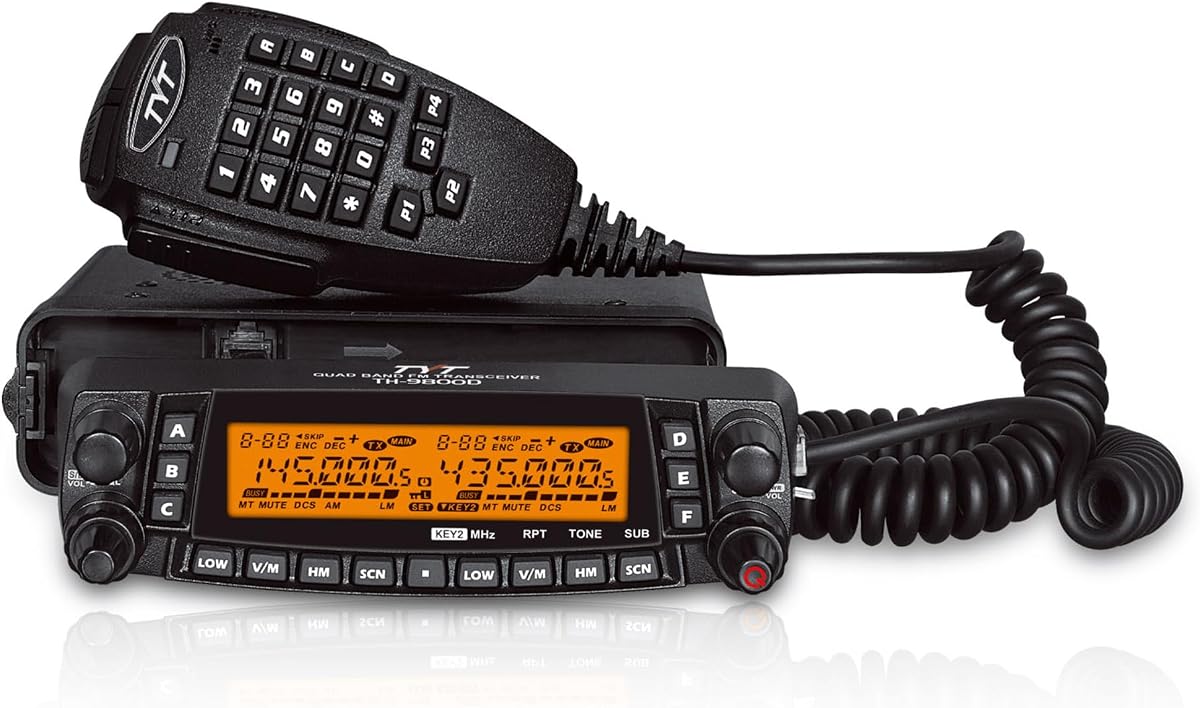
The TH-9800D is a quad-band mobile radio with a 4.0 rating. It covers 28–29.7, 50–54, 144–148, and 420–450 MHz for transmission, giving it access to 10-meter, 6-meter, 2-meter, and 70-centimeter amateur activity. That broad selection makes it a strong candidate for operators whose local club activity spans multiple bands.
We may earn a commission when you buy through this link, at no additional cost to you.
The radio can display two frequencies simultaneously, includes a cross-band repeat function, and offers high, medium, and low output settings. Its detachable control head supports remote-mount installation, which can be helpful when the radio body needs to sit in a separate compartment from the operator-facing controls. Memory capacity extends to 800 alphanumeric channels.
A programming cable and software are included, and the radio is compatible with CHIRP. This makes channel setup more convenient for users who want either the supplied software or open-source programming. The combination of memory capacity and multiple bands also offers good flexibility for repeaters, cross-band routes, and regional traveling.
The TH-9800D is a sensible option for a mobile operator who wants one radio to cover several ham bands. As a home starter, it is best paired with a stable base antenna and regulated supply. Because the supplied specifications do not describe every control or accessory, buyers should review the manual and confirm their programming preferences before finalizing the purchase.
Quad-band coverage can simplify an installation when an operator regularly moves among 10-meter, 6-meter, 2-meter, and 70-centimeter activity. The availability of multiple power levels and a dual display adds further operating flexibility.
The detachable control head separates the operator-facing panel from the radio body. In a crowded vehicle or a home desk setup, that separation can make controls easier to reach while leaving the main unit in a protected or ventilated position.
We may earn a commission when you buy through this link, at no additional cost to you.
The Radioddity QT40 is a 40-watt 10-meter mobile radio with a 4.6 rating. It supports SSB, AM, FM, and PA operation across 28.000–29.695 MHz, providing a useful mix of long-distance and local modes for 10-meter enthusiasts, mobile operators, outdoor users, truckers, and emergency communicators.
We may earn a commission when you buy through this link, at no additional cost to you.
Digital noise reduction is available for both transmit and receive, helping improve intelligibility in noisy environments. The PWR and RX RSSI signal meter gives the operator a more useful view of relative signal strength, while adjustable RF gain, automatic squelch, squelch control, time-out timer, VOX, high-cut, echo, CTCSS, and DCS provide a broad set of operating adjustments.
A particularly useful home-station feature is the weather-band reception and NOAA alert capability. Those functions are not substitutes for official emergency alerts, but they can provide valuable situational awareness during travel, camping, and outdoor activities. The radio can be mounted in a vehicle or used at home with a suitable regulated supply and antenna.
The QT40 is a strong all-around choice for an operator focused on 10-meter SSB or traditional AM communication. Its high rating, noise controls, signal meter, and weather features make it appealing, though buyers seeking local VHF/UHF repeater operation or broad HF coverage should choose a different platform.
Digital noise reduction on both receive and transmit, combined with adjustable RF gain and automatic squelch, can make voices easier to understand. These controls are especially useful in vehicles, outdoor events, and other environments with significant background sound.
Built-in weather-band access and NOAA alerts add situational awareness that goes beyond ordinary voice contacts. The feature is most useful to mobile and portable operators who may encounter changing conditions away from a fixed location.
We may earn a commission when you buy through this link, at no additional cost to you.
The Icom IC-9700 is a dedicated VHF, UHF, and 1.2 GHz D-STAR base-station transceiver with a 5.0 rating. It represents a different approach from the mobile-first products in this guide: the radio is designed specifically for fixed-station operation, making it appealing to operators who want extensive local-band coverage and digital voice capability.
We may earn a commission when you buy through this link, at no additional cost to you.
The combination of conventional and D-STAR operation broadens the types of stations and contacts available. VHF and UHF coverage supports familiar repeater, satellite, and local communication work, while the 1.2 GHz band adds another operating area. Its multi-receiver architecture is relevant to operators who value simultaneous monitoring and detailed signal management.
The supplied product information does not describe the included accessories, so buyers should check the current package contents carefully. A dedicated base transceiver also requires appropriate station-level power, grounding, ventilation, antenna interfaces, and operating knowledge. Those requirements make it less convenient as a first all-in-one radio than a simpler mobile unit.
The IC-9700 is best for an experienced or aspirational VHF/UHF operator building a serious home station. It is especially relevant to D-STAR users, repeater trustees, satellite communicators, and technically inclined operators. The high rating reflects its strong position, although a complete starter system also needs suitable power and antenna equipment.
D-STAR capability gives the IC-9700 a role in modern digital voice networks, while conventional operation remains important for repeaters and local analog contacts. Supporting both approaches makes the radio adaptable to different station requirements and community resources.
Unlike a mobile radio adapted for occasional desk use, the IC-9700 is conceived as a base-station transceiver. That focus can make more sense for an operator who will build a permanent operating position, use multiple antennas, and value sophisticated control over local and digital traffic.
We may earn a commission when you buy through this link, at no additional cost to you.
The Radioddity QT80 is an 80-watt 10-meter mobile radio with a 4.5 rating. It is built for operators who want a strong signal on 10 meters and appreciate the ability to use FM, AM, SSB with USB or LSB, and PA modes from one radio. Its high output separates it clearly from lower-power 10-meter alternatives.
We may earn a commission when you buy through this link, at no additional cost to you.
Adjustable transmit and receive noise reduction helps improve voice clarity, while automatic squelch control reduces the need for manual adjustment in changing signal conditions. A seven-color LCD allows the operator to choose a display tone suited to the environment. CTCSS and DCS provide additional control when managing conventional channels and avoiding unwanted interference.
The QT80 requires careful antenna and power planning. High output does not guarantee better reception or stronger received signals, and a mismatched or unsuitable antenna can contribute to reflected power. Operators should confirm that their antenna, feed line, mounting, and grounding arrangement are appropriate for the radio's power class and operating modes.
This is an excellent choice for a dedicated 10-meter operator, sideband enthusiast, or mobile station that also needs a home installation. It is less appropriate for a first-time buyer who wants local VHF/UHF repeaters or general HF coverage. Within the 10-meter category, however, its power and mode flexibility make it particularly compelling.
The 80-watt output class gives the QT80 an advantage when paired with an appropriate directional antenna. It can be useful for working stations across a region during favorable 10-meter openings or for establishing a robust local sideband signal from a fixed site.
Adjustable receive noise reduction and automatic squelch help create a quieter, easier-to-follow listening environment. The color display also adds practical visibility options, allowing different color schemes for day, night, or changing operating conditions.
We may earn a commission when you buy through this link, at no additional cost to you.
The Icom IC-7300 is a 100-watt HF and 50 MHz base transceiver with a 5.0 rating. It is a particularly compelling center-of-station option for operators who want all-mode HF capability in a compact chassis and prefer a modern touchscreen interface over a traditional control panel.
We may earn a commission when you buy through this link, at no additional cost to you.
HF and 50 MHz coverage makes it suitable for long-distance communication across amateur bands, while the 100-watt output provides meaningful power for a fixed installation. The radio also serves as a strong foundation for contests, emergency nets, DX work, and everyday station operation. Its compact form can be easier to accommodate than a large traditional HF transceiver.
The bundle adds a Nifty! mini manual and a Ham Guides quick reference card, which can help new owners learn essential functions. Even so, an antenna, feed line, station power, and proper grounding remain necessary for a complete installation. Operators should also confirm the latest licensing, band, and operating requirements for their location.
The IC-7300 is the premium pick in this guide for a good reason: it combines high ratings, broad HF access, high output, and a compact modern platform. It is best for operators willing to build a proper HF station and invest time in learning its controls rather than seeking a simple first radio with minimal setup.
A 100-watt HF transceiver in a compact base-station format balances useful output with a manageable footprint. That makes it suitable for an apartment, spare room, garage, or club station where a full-size contest-class radio would be difficult to place.
The mini manual and quick reference card provide an accessible starting point for understanding common functions. They are especially valuable for new operators who want structured references while learning bands, operating modes, menus, and station controls.
We may earn a commission when you buy through this link, at no additional cost to you.
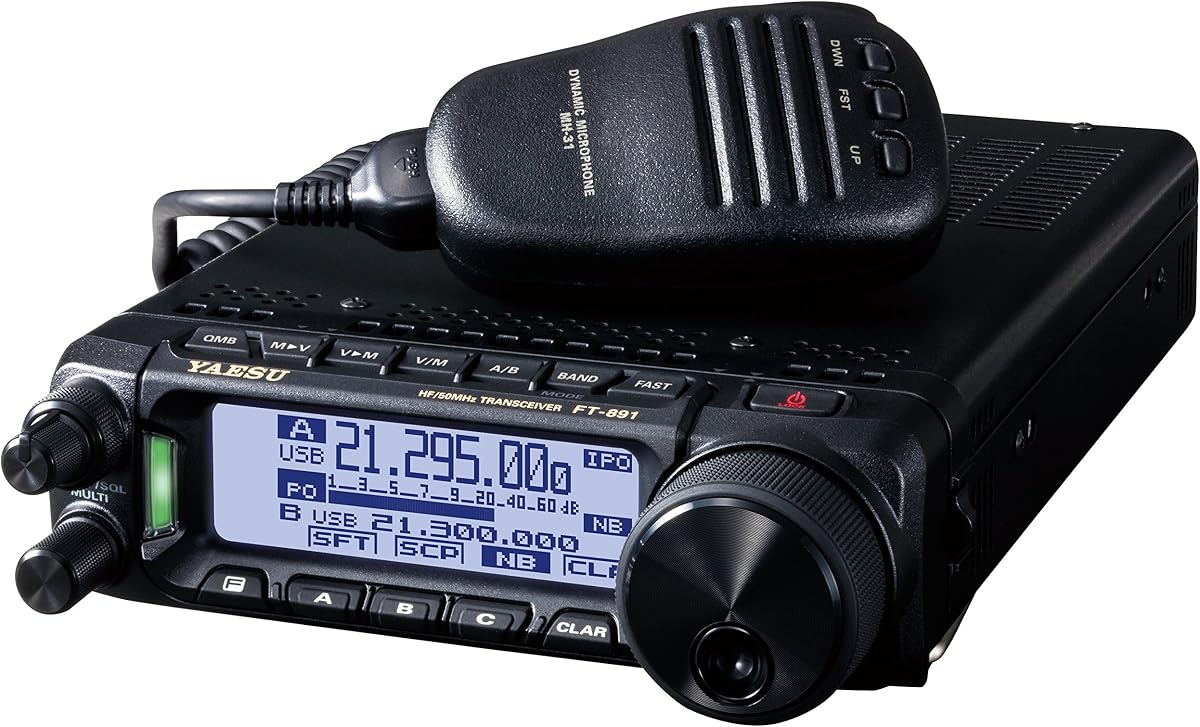
The Yaesu FT-891 is an ultra-compact HF and 50 MHz all-mode analog transceiver with a 4.6 rating. It provides 100 watts of output across AM, FM, SSB, and CW, giving new and experienced operators a broad set of traditional amateur radio modes in a unit designed for either a vehicle or a home station.
We may earn a commission when you buy through this link, at no additional cost to you.
Its compact size is the defining advantage. The FT-891 can be mounted in a small vehicle without taking over the dashboard, yet it can also serve as a fixed HF station when paired with a suitable supply and antenna. The 50 MHz band gives users access to another useful propagation area beyond the traditional HF ranges.
The radio is also compatible with the ATAS-120A automatic tune antenna, according to the supplied information. Automatic antenna systems can simplify operation when changing between widely separated HF frequencies, although they add another component and consideration to a first station build.
The FT-891 is a good fit for an operator who wants a traditional all-mode analog radio in a compact package. It may lack some conveniences found in newer touch-driven platforms, and no digital-mode details are provided, but its straightforward modes, 100-watt output, and mobile-base flexibility remain attractive for portable and home use.
The FT-891's compact form lets an operator take the same radio from a vehicle to a home desk. That flexibility can reduce the need to maintain separate mobile and fixed-station transceivers, especially for users with limited space.
AM, FM, SSB, and CW support covers the primary analog modes used on amateur HF bands. This makes the radio approachable for operators focused on traditional voice and Morse activity rather than a digital platform.
We may earn a commission when you buy through this link, at no additional cost to you.
The best starter system is the one that matches your bands, operating style, antenna plans, and experience. Consider radio capabilities and included accessories separately, because a capable transceiver does not automatically include every item required for a complete home station.
Begin with the amateur bands and modes you expect to use. VHF and UHF radios are well suited to local repeaters, emergency coordination, clubs, and handheld-style community contacts. Ten-meter radios can provide regional and occasional long-distance communication through SSB, AM, CW, or FM. HF/50 MHz transceivers open broad long-distance operating opportunities, while the Icom IC-9700 adds 1.2 GHz and D-STAR capabilities. A radio that sounds advanced will not satisfy every operator if its frequency coverage misses the activities that matter to them.
Choose coverage first, then confirm that every mode you want is usable. FM-only equipment is versatile locally, but SSB, CW, and digital modes can expand operating opportunities. Match the radio to your actual plans rather than selecting solely by output wattage or display size.
Higher transmit power can improve your signal when paired with the correct antenna, but it does not make a poor antenna system better. Compact mobile radios may provide modest output suited to local work, while 25- to 50-watt models offer more margin for wider-area contacts. The QT80 reaches the highest listed 10-meter output in this group, whereas the IC-7300 and FT-891 provide 100 watts for HF. Always consider antenna gain, feed-line loss, SWR, and local rules rather than treating wattage as a stand-alone performance score.
For a first station, moderate power often proves more practical than maximum power. A modest radio paired with a well-installed antenna is usually a better starting point than a high-output set connected to an unsuitable or poorly grounded system.
A complete starter kit still needs an appropriate antenna system. Local VHF/UHF operation may suit a modest vertical or mounted discone, while HF usually requires a resonant dipole, inverted-V, loop, or other band-appropriate antenna. Consider indoor versus outdoor installation, available space, nearby structures, and whether a roof or tower mount is realistic. A high-quality feed line and sound grounding are especially important for higher-power radios, because loss and poor return paths reduce the practical advantage of additional output.
Plan the antenna before finalizing the radio. The best transceiver cannot compensate for an antenna that cannot operate cleanly on the intended frequencies or reach the location where you need to communicate.
Mobile radios generally expect a nominal 13.8-volt DC source, but fixed operation also requires a stable, properly sized supply. Some products explicitly mention a home power supply as optional, while the Retevis RT95 identifies a 13.8-volt, 10-amp source as necessary for full power without including it. Check the radio's tolerance, current draw, cooling requirements, connector type, and grounding recommendations. Never improvise an unsafe mains connection or assume a generic adapter is electrically equivalent to a purpose-built station supply.
Treat power as part of the radio purchase, not an afterthought. A reliable supply reduces voltage instability, protects the transceiver, and makes long listening or transmitting sessions more consistent.
Programming support determines how easily you can create channels, manage CTCSS or DCS tones, set offsets, and organize local repeaters. CHIRP compatibility appears on the Retevis RT95 and TH-9800D, while the AnyTone AT-778UV II explicitly does not support CHIRP and does not include a USB programming cable. Other radios may use their own software or a supplied cable. Consider whether you prefer open-source tools, manufacturer utilities, touch-screen configuration, or simple button-and-mic keypad control.
Choose the programming method you are willing to learn. A radio with extensive memory and excellent controls can still be frustrating if its software workflow does not match your experience or if a required cable is missing from the box.
The operator interface matters during repeated use. Rotatable TFT screens on the Retevis RT95 and AnyTone AT-778UV II can improve viewing angles, while the TH-9800D's detachable head supports remote installation. The QT80 provides a seven-color LCD, and the Icom IC-7300 uses a modern touchscreen layout. Audio features also vary: the BTECH UV-50X2 supports expanded accessories through its RJ45 microphone port, and several radios include dual speakers, microphone gain, automatic squelch, or digital noise reduction.
Choose controls that remain comfortable in your operating position. Large text, intuitive menus, accessible microphones, and clear indicators are often more valuable than a long feature list when a net is busy.
Several radios in this list are described as mobile units that can also work as base stations. That versatility is useful for emergency operators, club members, travelers, and anyone who wants one transceiver to serve multiple roles. However, the platform's cooling, connector security, display angle, and control-head arrangement should suit the planned installation. Dedicated base transceivers such as the Icom IC-9700 are better aligned with permanent desk positions, while the FT-891 and several other mobile radios bridge both roles.
Consider where the radio will live most of the time. A permanent base setup can justify better ventilation and a larger control panel, while frequent mobile use favors a compact chassis, remote mounting, and a rugged microphone.
A listing that says starter kit does not always contain a complete antenna, station power supply, programming cable, mounting hardware, and all necessary adapters. The BTECH UV-50X2 includes several mounting and audio components but lists its power supply and recommended accessories separately. The AnyTone package warns that a USB programming cable is not included. By contrast, the TH-9800D includes programming cable and software, while the IC-7300 bundle adds learning references. Inventory the box before buying anything else, then list the missing station components.
A complete-system budget is more useful than focusing only on the radio. Antenna, feed line, power, connectors, coax adapters, a good microphone if needed, and any required programming hardware can be essential parts of the finished installation.
Begin with a safe, correctly sized DC supply and a compatible antenna. Confirm the radio's required voltage, current capacity, connector polarity, and grounding requirements before powering it. Install a fuse appropriate for the cable and equipment, check every connection, and avoid placing the transceiver in a closed space that prevents ventilation. For a mobile installation, secure the radio and microphone so they cannot become projectiles or distract the operator.
Set up the radio from a low output level if the controls allow it. Use the manufacturer or supported programming software to enter locally valid frequencies, offsets, tones, and call signs. Program favorite channels before relying on the radio operationally, and save a separate copy of the settings. Test receive audio, microphone gain, squelch, display brightness, VOX, emergency features, and transmitter operation into a suitable dummy load or antenna system with an appropriate connector.
For care, keep the radio dry and free of dust, use a soft cloth rather than harsh cleaners, and inspect connectors and coax for damage. Do not transmit without a suitable antenna because reflected power can stress the radio. Periodically verify SWR, power-supply output, fuses, feed-line condition, and grounding, especially after moving a mobile radio into a home station.
A useful first setup includes the transceiver, a suitable antenna, feed line, regulated power supply, mounting hardware, and any required programming cable. The exact package varies, so check the listing carefully rather than assuming that every radio labeled as a starter kit includes every accessory. Operators should also budget for good connectors and any additional microphone or audio equipment their setup requires.
Yes, many mobile transceivers operate effectively from a home desk when paired with a proper DC supply and antenna. Mobile-based designs are often compact, flexible, and easier to move between a vehicle and station position. For a permanent installation, consider ventilation, connector security, grounding, display access, and whether a dedicated base radio would offer more useful controls.
VHF/UHF is often more accessible for local repeaters, clubs, and emergency communications, while HF offers much broader long-distance opportunities. A 10-meter radio provides a middle ground for operators interested in SSB, CW, AM, and FM on one band. The best choice depends on local activity, propagation, available antennas, and the operating modes the user wants to explore.
No. Transmit power can improve the strength of the signal you send, but it generally does not make the radio hear weak incoming stations better. Receiver design, noise reduction, antenna height, feed-line loss, local interference, and antenna direction are more important for reception. A well-chosen lower-power radio may outperform a higher-power model with a poor antenna installation.
The easiest choice depends on your experience and the radio. Some models support CHIRP, while others rely on manufacturer software, and the AT-778UV II specifically does not support CHIRP according to the supplied information. If you prefer open-source tools, verify compatibility first. If you are comfortable with a dedicated application, manufacturer software may provide a more direct setup experience.
Most of the mobile-capable radios in this guide can do both, provided the power source and antenna are changed appropriately. The Retevis RT95, BTECH UV-50X2, AnyTone AT-778UV II, TH-9800D, Radioddity models, and Yaesu FT-891 all have a mobile-oriented design. The Icom IC-7300 is a compact base transceiver, while the IC-9700 is specifically designed as a dedicated base station.
The best antenna is one that covers the intended bands, matches the available space, and can be mounted safely with a good ground and feed line. Local VHF/UHF operators may use a suitable vertical or discone, while HF stations often use a resonant dipole, loop, or another band-specific design. Avoid choosing an antenna only by gain; installation height, surrounding structures, cable loss, and SWR all affect results.
Usually, yes. A mobile radio is designed primarily for vehicle DC power, so a stable home power supply of the correct voltage and current rating is normally needed. Some listings mention this as optional or excluded. Confirm the radio's requirements and use a properly fused, regulated supply rather than assuming a wall adapter included with another product will work.
The Retevis RT95 stands out as the best budget pick because it combines dual-band monitoring, a color display, 200 channels, CHIRP support, and mobile-to-home flexibility in a compact design. The Radioddity QT80 is the editor's choice for operators seeking powerful 10-meter SSB, CW, AM, and FM operation, while the Icom IC-7300 offers the most polished premium HF foundation with 100 watts of output and useful learning references.
Prioritize the bands and modes you will actually use, then give equal attention to the antenna, power supply, programming method, and available station space. A modest radio with a correctly installed antenna can be more useful than a high-output model connected to an unsuitable antenna system. Likewise, a listing that omits a programming cable or home power supply should be evaluated as a radio plus selected accessories, not as a fully complete station.
Specifications, package contents, and seller information can change, so check the current listing and manufacturer documentation before ordering. Also confirm licensing, band, and operating rules for your location. With those checks completed, the right Ham Radio Base Station Starter Kit can provide a satisfying path into local, regional, emergency, and long-distance amateur radio communication.