
Art Projector for Tracing and Drawing
4.5Editor score
App-free browser control
Dual-band WiFi
Adjustable projection stand
Our Art Tracing Projector guide compares ten options for resolution, focus, connectivity, stands, and tracing workflows, helping you choose the right model for
An art tracing projector places a reference image on a canvas, wall, paper, or craft surface so artists can transfer shapes, lettering, and fine details with less guesswork. The most useful model combines a bright, sharp projection with dependable focus, straightforward image loading, and a stand that can hold the right angle.
This guide compares ten art tracing projectors based on resolution, brightness, projection range, focus controls, image-transfer options, offline usability, physical adjustment, and intended creative applications. It covers digital projectors that accept phone or computer images as well as a dedicated optical model designed specifically for tracing printed line art.
Each pick highlights the characteristics that distinguish it from the alternatives, from app-free browser control and offline drawing tools to 1080P clarity, portable battery operation, and dedicated opaque projection. Ratings reflect the supplied customer feedback, while current prices and availability can change at any time.
4.5Editor score

4.0Editor score

5.0Editor score
The comparison below organizes every projector by its core capabilities, including visual resolution, brightness, projection method, connection options, and physical setup. It makes it easier to distinguish a dedicated optical tracer from WiFi-enabled digital models and identify the controls that best support a particular art workflow.

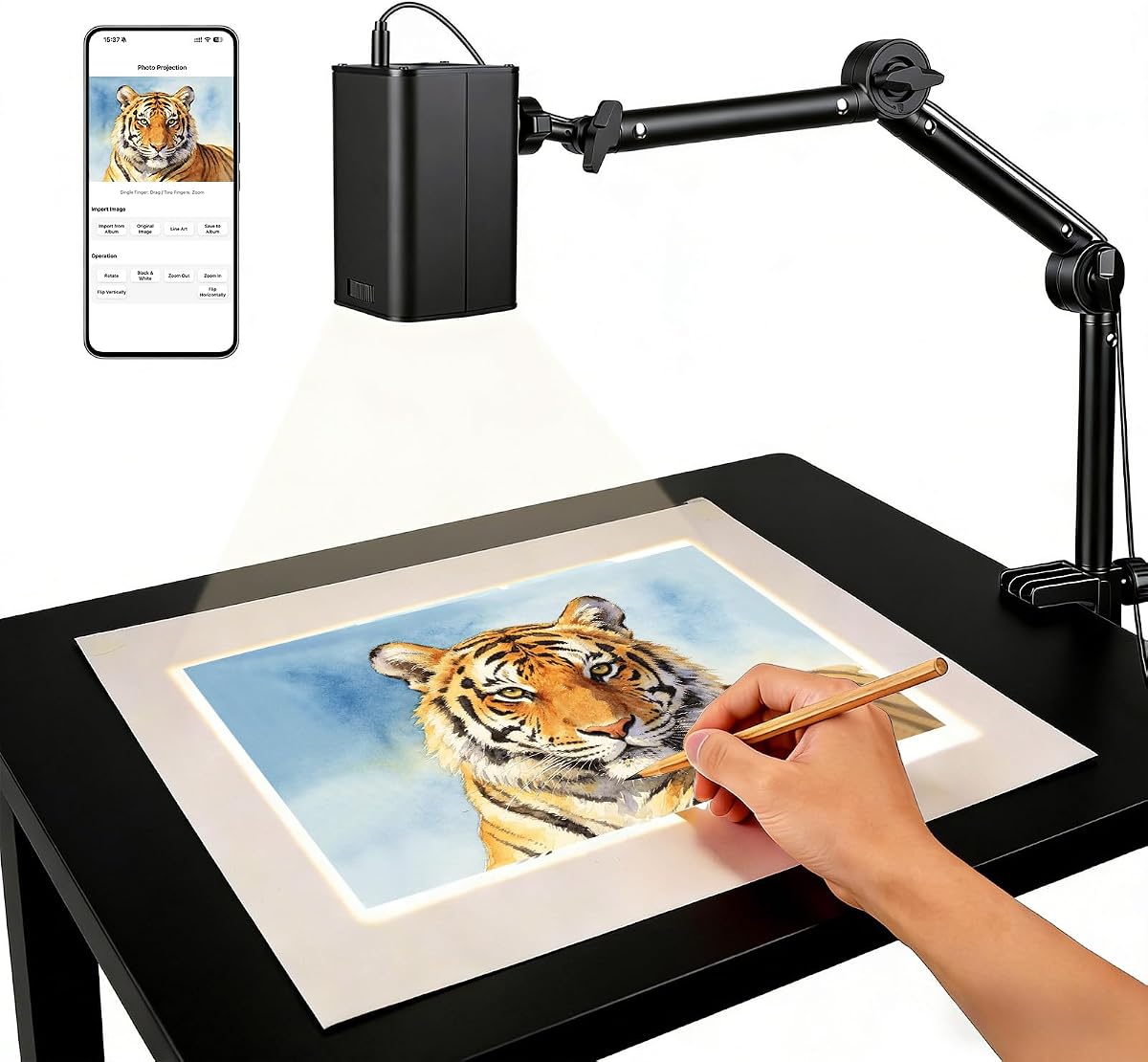


The Art Projector for Tracing and Drawing is a practical choice for artists who want phone-based reference projection without navigating a separate application. It carries a 4.5 customer rating, placing it among the stronger-reviewed choices in this guide. Its defining feature is browser-based control that works with both iOS and Android devices.
We may earn a commission when you buy through this link, at no additional cost to you.
The projector uses dual-band WiFi to mirror intricate lines and complex sketches with low latency. A QR code opens the web controls, where users can rotate and scale the projected image, while a physical focus button helps produce a sharp outline. The adjustable stand changes height and angle, allowing the projector to work on horizontal canvases, vertical walls, and smaller craft projects.
Offline operation is another strength. Artists can work in studios, classrooms, or remote locations without depending on a continuous internet connection, although the exact method of loading local content is not fully described in the supplied information. There is also no listed native resolution, digital art mode, or keystone specification, so buyers wanting advanced image processing should look elsewhere.
This model is best for beginners, students, and mobile-first creators who value easy browser control, offline flexibility, and an adjustable stand more than specialized digital art tools. It is our best budget selection because it covers the essential tracing workflow with relatively few setup complications.
Scanning a QR code opens the controls in a phone browser, removing the need to install an app. Users can adjust projection settings, rotation, and scale directly from the device they are already using to source the reference image.
The included stand adjusts both height and tilt. That versatility makes the projector practical for tracing onto canvas, decorating cookies, teaching art, or reproducing architectural plans without requiring a separate mounting solution.
We may earn a commission when you buy through this link, at no additional cost to you.
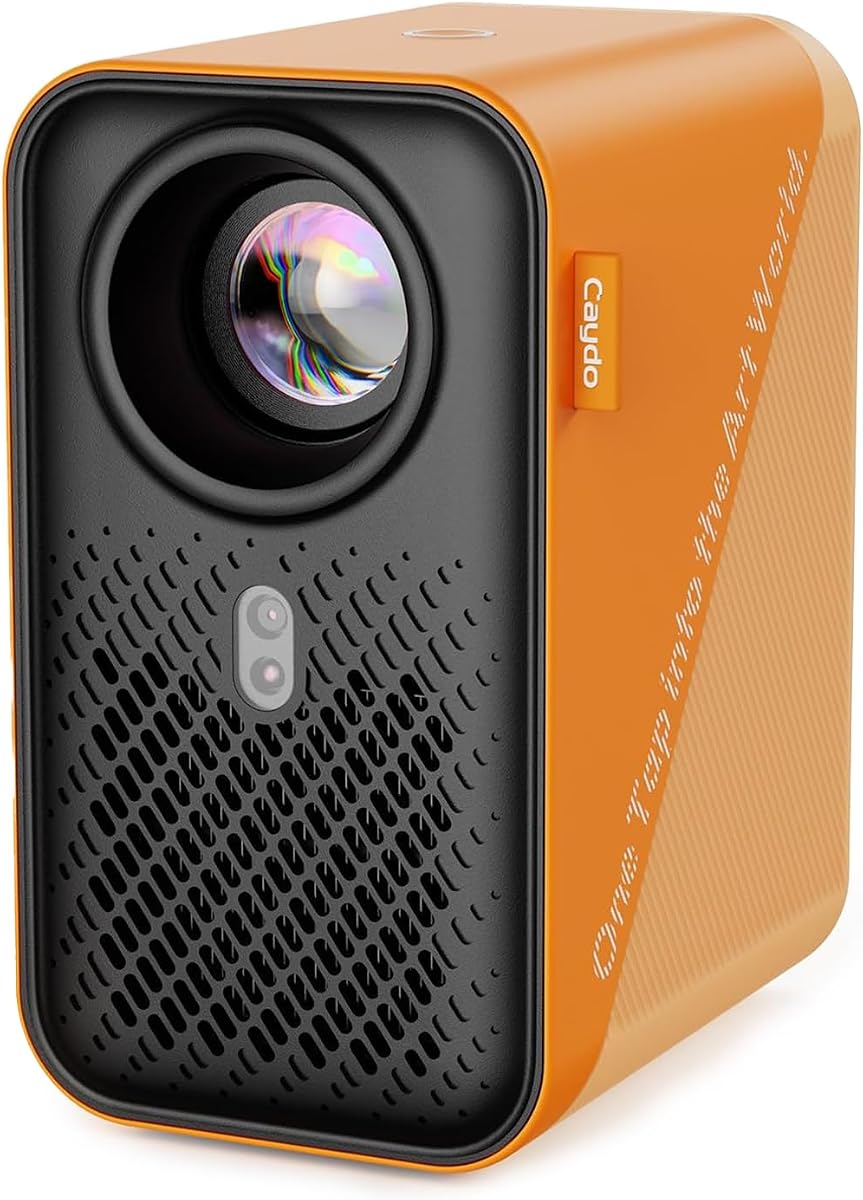
The Caydo P3 Art Projector is the most feature-complete general-purpose model in this roundup, combining native 1080P resolution, 400 ANSI lumens, and a dedicated drawing assistant. Its 4.0 customer rating is solid, and the device is designed to work as both a tracing tool and a conventional smart projector.
We may earn a commission when you buy through this link, at no additional cost to you.
Its drawing assistant offers 0–200% zoom, 360-degree rotation, 3×3 grids, three background colors, and four artistic modes: Gridify, Sketchify, Comicize, and Monochromize. These functions help change a reference image without requiring separate editing software. The rotating base adds further placement flexibility, allowing projection onto walls, easels, chalkboards, and ceilings.
Images can be transferred through a QR code or the included 8GB USB drive, which makes the P3 more practical for unreliable internet connections. Automatic focus, keystone correction, 3.6-to-8.7-foot projection support, and 4K video playback broaden its appeal. The main limitations are that copyrighted streaming services cannot be mirrored and remote batteries are not included.
Artists who want detailed digital controls, strong brightness, and a mature accessory package should give the P3 particular attention. It is our editor's choice because it balances resolution, specialized art functions, offline support, and flexible positioning better than the simpler digital alternatives.
Zoom, rotation, grid overlays, background choices, and visual modes make it easier to adapt a photograph or illustration before tracing. These controls are especially useful when the original image needs to be simplified or matched to a particular canvas ratio.
Native 1080P resolution and 400 ANSI lumens provide a clear working image with enough brightness for many studio conditions. The specification also makes the P3 useful for video playback when an artist wants to use the same equipment for reference viewing.
We may earn a commission when you buy through this link, at no additional cost to you.
The Caydo S1 Art Projector takes a different approach by functioning as a dedicated optical projector rather than a digital display device. It has a 5.0 customer rating and is built for tracing printed hand-drawn line art. A printed image goes beneath the 5-by-5-inch copy area, and the projection enlarges it onto the work surface.
We may earn a commission when you buy through this link, at no additional cost to you.
No wireless module, HDMI input, or USB input is included, which removes account setup, app downloads, latency, and connection problems. The S1 enlarges originals from 2.5x to 11x, creating images from 20 inches up to 80 inches diagonally. A smooth top-mounted focus knob allows quick sharpening whenever the unit is repositioned.
Its most important limitation is environmental. Like a traditional opaque projector, the S1 performs best in a darkened room with curtains closed and overhead lights turned off. It cannot mirror a phone, display photographs from a flash drive, or provide digital art modes. However, for users who want dependable physical-image tracing, that limitation can also be a welcome simplification.
This projector is ideal for students, muralists, and artists who already have printed line-art references and prefer a plug-in-and-create process. It is especially appealing for workshops and classrooms where multiple users need a straightforward tool without managing wireless networks.
The S1 works directly with a physical print placed under its copying stage. That means there is no need to transfer files, pair a phone, or maintain an internet connection during a tracing session.
Moving the unit farther from the surface expands the projected image, allowing a small sketch to become an outline as large as 80 inches diagonally. Refocusing after each major reposition keeps the result crisp.
We may earn a commission when you buy through this link, at no additional cost to you.
The Caydo P1 Art Projector is a digital tracing solution with a built-in drawing app, automatic focus, and screen-fitting tools. Its 3.8 customer rating places it in the middle of the group, but the feature set is broad enough for artists who want dedicated image controls without depending entirely on live phone mirroring.
We may earn a commission when you buy through this link, at no additional cost to you.
The application supports zooming, 360-degree rotation, 3×3 grids, three background colors, and Gridify, Sketchify, Comicize, and Monochromize modes. Reference images can be transferred by QR code or USB drive, and the app can function without a stable internet connection. EShare, AirPlay, and Miracast provide additional screen-mirroring options for compatible devices.
Automatic focus and keystone correction help maintain a proportional image, while the listed projection range extends from 3.1 to 10.5 feet. The P1 also supports 4K video playback, though its stated lamp life is 10,000 hours, shorter than the 30,000-hour figures given for the P2 and P3. Copyrighted content from major streaming platforms cannot be mirrored or cast.
This projector suits artists who prefer a guided drawing interface and want offline transfer options. It may be less compelling for users who need native 1080P imagery, 360-degree swivel positioning, or the longer lamp-life specification offered by Caydo's newer models.
The built-in application puts zoom, rotation, grids, backgrounds, and stylistic modes in one place. This is more specialized than general smart-projector software and reduces the steps required to prepare a reference for tracing.
QR-code or USB transfers do not require every operation to happen through a live network. Once the file is loaded, artists can continue working even when the studio or classroom has a weak or unavailable connection.
We may earn a commission when you buy through this link, at no additional cost to you.
This Art Projector for Tracing and Drawing is built around fast 5GHz dual-band WiFi and app-free browser control. Its 3.5 rating is the lowest among the first five products, so buyers should weigh the convenient setup against fewer published specifications. The core workflow remains focused on mobile and tablet references.
We may earn a commission when you buy through this link, at no additional cost to you.
After scanning a QR code, users can manage projection settings, rotation, and scaling through a phone browser. A focus adjustment button is available for manual correction, and the stand can be raised or tilted to suit horizontal canvases, vertical walls, and smaller DIY projects. The product also supports local offline connections for locations without reliable WiFi.
Compared with app-based competitors, the browser interface reduces software friction. Its FCC-certified dual-band module is designed for more stable, low-latency transmission of intricate outlines. However, the supplied information does not state native resolution, brightness, or digital drawing modes, making it difficult to compare the final image quality with the 1080P Caydo models.
The projector is most suitable for beginners, students, and artists who want a phone-centered workflow without installing an app. Those who need precise image-processing features, documented brightness, or advanced composition tools should consider a model with more detailed specifications.
The browser-based interface is useful for artists who do not want another mobile application or who need to control the projector from a different device. Rotation and scaling are available directly from the web controls.
The 5GHz and 2.4GHz options can select a less congested wireless band in a busy studio or home. Faster, steadier transmission is especially valuable when fine outlines must remain stable while an artist traces.
We may earn a commission when you buy through this link, at no additional cost to you.
The HI-REEKE Art Projector distinguishes itself with a 32.3-inch, three-section metal stand and a wide 9.5-to-150-inch projection range. Its 3.7 rating is moderate, but the physical design is especially relevant to mural work, embroidery, and oversized craft projects where a compact desktop stand may not provide enough height.
We may earn a commission when you buy through this link, at no additional cost to you.
Native 1280-by-720 resolution supports line art, while manual focus, keystone correction, and image zoom help align references on paper, canvas, fabric, wood, or leather. Content can be sent through 2.4GHz WiFi, USB, or HDMI. Compatible iOS and Android devices can act as image sources, and the remote provides additional control.
The projector weighs approximately three pounds, making it manageable to reposition, while the stand rotates for overhead or angled placement. It can be attached to the metal stand or placed on the included base. Compared with dual-band models, its 2.4GHz WiFi may offer less bandwidth in crowded wireless environments, and it does not have a listed digital drawing assistant.
This is a strong option for artists who need a large stand and broad projection-size choices more than specialized drawing filters. It is particularly relevant to muralists, cake decorators, textile craftspeople, and makers working on surfaces that require an overhead or steeply angled projector position.
The 32.3-inch three-section stand offers considerably more vertical reach than a typical desktop model. Its rotating design supports overhead placement as well as angled projection onto walls and worktables.
WiFi provides convenient phone access, while USB and HDMI support direct media sources. That combination makes the projector adaptable to different reference files and reduces dependence on one type of device or connection.
We may earn a commission when you buy through this link, at no additional cost to you.
The Caydo P2 Art Projector combines native 1080P resolution with a 250-ANSI-lumen light source and offline drawing tools. Its 3.8 rating is solid but trails the P3's feature set. It is a particularly coherent option for artists who want digital preparation controls and a generous lamp-life specification.
We may earn a commission when you buy through this link, at no additional cost to you.
The drawing app includes 0–200% zoom, 360-degree rotation, 3×3 grids, three background colors, and four artistic modes. Images can be loaded by QR code or USB, after which the drawing tools continue to function without an internet connection. The rotating base allows placement on walls, ceilings, tabletops, or tilted canvases without an additional stand.
Automatic focus, manual focus, and keystone correction help maintain clarity and proportion. Projection works from 2.3 to 5.8 feet and creates images between 40 and 100 inches. The listed 30,000-hour lamp life is a major strength, although the 250-ANSI-lumen output is lower than the Caydo P3's 400 ANSI lumens.
Buy the P2 if native resolution, offline art controls, and a long working life matter more than maximum brightness or a very long throw distance. It is a balanced choice for regular studio use, home art spaces, and artists who transfer references rather than relying exclusively on wireless mirroring.
Once a reference is transferred, zoom, rotation, grids, and artistic modes remain available without an internet connection. That makes the P2 useful in basements, rural studios, and other places where streaming or live mirroring could be unreliable.
The stated 30,000-hour lamp life supports extended use without routine bulb changes. Combined with automatic focus, it reduces the maintenance and setup tasks that can interrupt a detailed drawing session.
We may earn a commission when you buy through this link, at no additional cost to you.
The Art Projector for Tracing, Drawing & Painting is a flexible 720P model with a 4.1 customer rating. It supports phone-to-projector uploads, HDMI, USB plug-and-play, and wireless phone mirroring, making it one of the more connection-inclusive projectors in the guide.
We may earn a commission when you buy through this link, at no additional cost to you.
Its team-developed image-processing tool includes keystone correction, rotation, zoom, line-art extraction, and right-angle marking. These features support practical preparation of illustrations, sewing patterns, and mural references. The projector can display images from smartphone size up to approximately a 27-inch iMac screen on a desktop, while wall projection can approach twin-size-bed dimensions.
A four-section telescopic stand extends from 15 to 40 inches, with a clamp that requires a tabletop edge no more than 2.4 inches thick or protruding. An included USB drive supports offline work. The listed 1280-by-720 resolution is suitable for line art, but brightness is not specified, so performance in bright rooms may be less predictable than on the P2 or P3.
This model is appealing to beginners and versatile crafters who want broad connectivity and useful processing tools. It is well suited to drawing, mural painting, banners, cookie decorating, sewing, teaching, and presentations, especially when an artist wants to move between phone, computer, and offline media sources.
Phone uploads, HDMI, USB, and wireless mirroring cover most common reference sources. An included USB drive also gives artists a straightforward way to work with files away from a network.
Line-art extraction and right-angle marking are particularly useful for reducing photos into clearer guides. Rotation, zoom, and keystone correction further help prepare images for tracing on surfaces that are not perfectly square.
We may earn a commission when you buy through this link, at no additional cost to you.
The KODAK Luma 150 Mini Projector Kit combines a 5.0 customer rating with a compact DLP design and a 60-ANSI-lumen engine. It is a premium option not because it has a specialized drawing application, but because of its portable construction, wireless streaming support, battery runtime, and included overhead mounting hardware.
We may earn a commission when you buy through this link, at no additional cost to you.
The kit includes an adjustable overhead tripod and an articulating arm clamp for precise positioning. This is valuable for artists who want to project directly downward onto a worktable or use the arm to align an image at an unusual angle. AirPlay and Miracast provide wireless streaming from compatible iOS, Android, and Windows devices.
The projector offers up to 2.5 hours of battery life, allowing tracing and presentation sessions away from a wall outlet. HDMI, USB, and microSD inputs provide flexible media connections, while the 60-ANSI-lumen DLP engine is designed to remain clear in bright and dim environments. It does not list dedicated zoom, grid, rotation, or line-art modes.
This is the best choice for mobile artists, classroom instructors, and makers who need a compact overhead projector with untethered operation. It is particularly useful when working away from a studio, presenting hands-on lessons, or projecting onto a table in a location where power and stable mounting surfaces are limited.
Up to 2.5 hours of battery life allows an artist to start a project in a studio and continue it outdoors, in a classroom, or around the home. It also reduces the need to position the projector immediately beside an outlet.
The included tripod and articulating arm clamp make overhead placement more precise. These accessories are particularly valuable for tracing onto paper, lightboxes, or a flat table and for instructional demonstrations.
We may earn a commission when you buy through this link, at no additional cost to you.
The Art Projector for Tracing Drawing Painting is an entry-level option aimed at beginners, children, and casual crafters. Its 3.4 customer rating is the lowest in this group, and its 480P resolution is less suitable for extremely fine artwork than the 720P and 1080P alternatives.
We may earn a commission when you buy through this link, at no additional cost to you.
Wireless projection is limited to compatible iPhones and iPads using AirPlay or AirDrop-style device support, while USB and HDMI inputs provide alternatives for direct files. The adjustable focus lens works across a stated 11-to-80-inch distance and an effective projection area from 6-by-10 inches to 60-by-90 inches.
Its height-adjustable stand and 360-degree direction control make it easy to aim at a desk, wall, or canvas. The foldable, lightweight construction supports storage and transport. Brightness and keystone correction are not specified, which limits assessment of performance in rooms with ambient light or at sharply angled positions.
The projector can be a reasonable choice for a child learning to trace or for a hobbyist who primarily uses an iPhone and does not need detailed line-art processing. Adults creating detailed drawings, muralists, and Android users will likely benefit more from a model with higher resolution and broader wireless compatibility.
Compatible Apple devices can mirror or send images without a specialized projector application. USB and HDMI inputs offer additional ways to use files, but Android users should not expect the listed wireless workflow to work.
The stand changes height while its holder rotates through 360 degrees. A foldable body makes the projector easier to carry between craft sessions, classrooms, or different work areas around the home.
We may earn a commission when you buy through this link, at no additional cost to you.
Choosing an art tracing projector means balancing image clarity, placement flexibility, connection method, and the size of the work. The best choice is not always the most technically advanced model; it is the projector that makes your references load reliably and project clearly in the space where you work.
The first decision is whether you need a digital projector or a dedicated optical tracer. Digital models accept photographs, illustrations, and files through WiFi, USB, HDMI, phone mirroring, or a built-in application. The Caydo S1 instead projects a printed reference directly through a 5-by-5-inch copy area, with no wireless module, HDMI, or USB input. Optical tracing is simple and dependable, but it cannot display a phone screen or apply digital drawing modes.
Choose a digital model if your source material is stored on a phone, tablet, computer, or flash drive. Choose an optical model if you mainly trace printed line art and value a minimal setup with no network or file workflow.
Resolution determines how much fine detail remains visible in the projected reference. The Caydo P2 and P3 offer native 1080P, the HI-REEKE and phone-compatible tracing projector use 1280-by-720, and the entry-level model provides 480P. A projector that is bright and convenient is still less useful if delicate facial features, lettering, or thin construction lines become blurred. For intricate illustration, portraiture, and small lettering, native 1080P is the stronger choice in this group.
In short, more resolution generally helps preserve fine lines, but focus, lighting, and distance also determine the clarity of the final trace. Match the projector to the level of detail in your typical references.
Brightness is especially important because a pale outline can disappear under ambient light. The Caydo P3 is rated at 400 ANSI lumens, the P2 at 250 ANSI lumens, and the KODAK Luma 150 at 60 ANSI lumens. The other listed products do not provide comparable brightness figures in the supplied data. ANSI ratings are useful when comparing models that state them, but a projector with an unknown rating should not automatically be assumed to be as bright.
For controlled indoor work, a darker room improves contrast on every model. If you plan to trace in a naturally lit studio, give priority to a documented high-lumen model and plan to control glare on the working surface.
Manual focus, automatic focus, and keystone correction solve different problems. Focus determines whether the projected reference is sharp, while keystone correction compensates for a tilted projector and helps preserve the image's proportions. The Caydo P2 and P3 include automatic focus and keystone correction, and the HI-REEKE provides manual focus with keystone correction. Several app-free models also include a physical focus button or knob.
Look for automatic adjustment if you expect to move the projector often or work at steep angles. Keep manual controls available as a backup, because a perfectly sharp screen and a correctly proportioned screen are not always the same thing.
The simplest workflows combine wireless control with an offline method. The rank-one and rank-five projectors use app-free browser controls through a QR code and support local offline operation. The Caydo P1, P2, and P3 add QR-code and USB transfers alongside drawing applications. The HI-REEKE supports 2.4GHz WiFi, USB, and HDMI, while the KODAK kit adds microSD and wireless AirPlay or Miracast.
Check both device compatibility and the availability of a direct file option. Wireless mirroring is convenient, but USB storage or a local transfer method can be more dependable in a busy studio or when the internet is unavailable.
A projector may produce a sharp image but still be difficult to use if it cannot be positioned correctly. The Caydo models use rotating bases for walls, ceilings, easels, and tabletops. The HI-REEKE's 32.3-inch three-section metal stand offers greater height and supports overhead placement. The phone-compatible model has a 15-to-40-inch telescopic stand, while the KODAK kit includes an overhead tripod and articulating arm clamp.
For desktop sketches, prioritize compact placement and fine angle control. For murals, banners, and large canvases, prioritize throw distance, stand height, and the ability to position the unit above the work surface.
Digital art assistants can simplify a reference before it reaches the canvas. The Caydo P1, P2, and P3 include zoom, 360-degree rotation, 3×3 grids, background colors, and Gridify, Sketchify, Comicize, and Monochromize modes. The HI-REEKE-style product line adds line-art extraction and right-angle marking, which can help with patterns and technical outlines. App-free models generally focus on projection, rotation, scaling, and focus instead.
These tools are valuable when the original reference needs simplification or when the projected image must fit a particular surface. If you already work with carefully prepared files, they may be optional rather than essential.
Portability depends on more than size. It includes weight, stand design, power requirements, and whether the projector can operate without a wall outlet. The KODAK Luma 150 is the clearest portable option because its battery can run for up to 2.5 hours and its overhead mount supports flexible positioning. Other models are primarily designed for stationary studio use, and the dedicated Caydo S1 offers a convenient handle, a non-slip base, and cord storage.
If you work in different rooms, travel to workshops, or teach away from outlets, prioritize battery operation and a compact mount. For a permanent studio setup, image quality, correction tools, and workflow features may matter more.
Begin by choosing a suitable surface and testing the projection before committing to a full project. Load the reference through the method supported by your model, then set the projector at a safe distance from the canvas, wall, paper, or craft surface. Turn off unwanted ambient lighting, place the reference within the projected field, and adjust focus until the smallest important lines look crisp.
Next, correct the image geometry. Use rotation to orient the reference, zoom to match the intended size, and keystone correction or screen fitting to reduce distortion caused by an angled projector. For a digital model, use grids, line-art extraction, or other art modes when they help simplify the source. If using the Caydo S1, place the printed image beneath the 5-by-5-inch copy area and adjust the focus knob after moving the unit.
Trace lightly with a pencil or suitable marking tool, checking key landmarks instead of following every line mechanically. Keep the projector stable, avoid touching the lens, and let the unit cool naturally after long sessions. Clean the lens and vents as directed in the manual, store the cord without sharp bends, and use the supplied case or stable surface when transporting a compact model.
That depends on the model. The dedicated Caydo S1 works directly with printed line art and does not need a network. Several digital projectors support USB or local file transfers and can continue operating offline, while models that rely only on live phone mirroring may need an active connection. Check the transfer options before beginning work in a location with unreliable internet.
It is helpful but not essential for every project. 1080P can preserve more information in fine lettering, facial details, and intricate line art, especially when the projected image is large. A well-focused 720P projector can still work for bold shapes, simple patterns, and medium-sized drawings. The required resolution ultimately depends on how detailed the reference is and how large the final image will be.
A darker room generally produces a clearer and higher-contrast outline. Brightness ratings suggest how well a model may perform with ambient light, but wall color, projector placement, and image size also affect visibility. The optical Caydo S1 is especially dependent on a darkened room because its contrast depends on the physical print being projected. Digital models with higher stated brightness offer more flexibility.
A digital tracing projector displays a reference imported from a phone, computer, or storage device. An opaque projector physically enlarges a printed image placed on its glass surface. The optical approach needs no software or connection and is ideal for printed line art, while a digital projector offers image rotation, grids, filters, and other tools that can simplify or transform a reference.
Yes, provided the projection range, stand height, and brightness suit the work. The HI-REEKE offers a large stand and projection range, the Caydo P2 supports images up to 100 inches, and the Caydo S1 can enlarge physical artwork to an 80-inch diagonal image. Large or brightly lit walls require careful placement, a stable mount, and a darkened room for the clearest outlines.
A locally transferred file is usually more dependable than live wireless mirroring because it avoids network lag and app interruptions. USB transfer is available on many digital models, while the Caydo S1 avoids file transfer altogether. Wireless control remains useful for quick adjustments, but artists doing long or highly detailed sessions should keep a direct-source option available.
A grid helps divide a complex image into smaller regions and helps an artist judge placement and scale. Line-art modes can reduce visual information so important contours stand out from shadows and color. These tools do not draw the image automatically, but they can make manual tracing more consistent and reduce the need to repeatedly refer to the original.
The listed models primarily use LED light sources, including the dedicated S1 with a stated life of up to 20,000 hours. The Caydo P2 and P3 list lamp lives of 30,000 hours, while the P1 lists 10,000 hours. Actual lifespan varies with use and operating conditions, and it is still wise to follow the manufacturer's handling, ventilation, and cleaning instructions.
The best overall choice is the Caydo P3 for its native 1080P image, 400 ANSI lumens, offline drawing assistant, and flexible swivel base. The Art Projector for Tracing and Drawing offers the most approachable budget option with app-free browser control, and the KODAK Luma 150 stands out for portable battery operation and precise overhead mounting.
Prioritize the workflow that matches your references. Choose a digital model for photographs, phone-based files, grids, and image processing; choose the Caydo S1 for simple physical tracing without connections. Resolution, brightness, stand reach, and offline file support should be balanced against the size and detail of your usual artwork.
Before purchasing, verify device compatibility, projection distance, surface size, and whether the included accessories meet your setup needs. Current prices, promotions, and availability can change, so check the latest listing information and customer feedback before making a final decision.