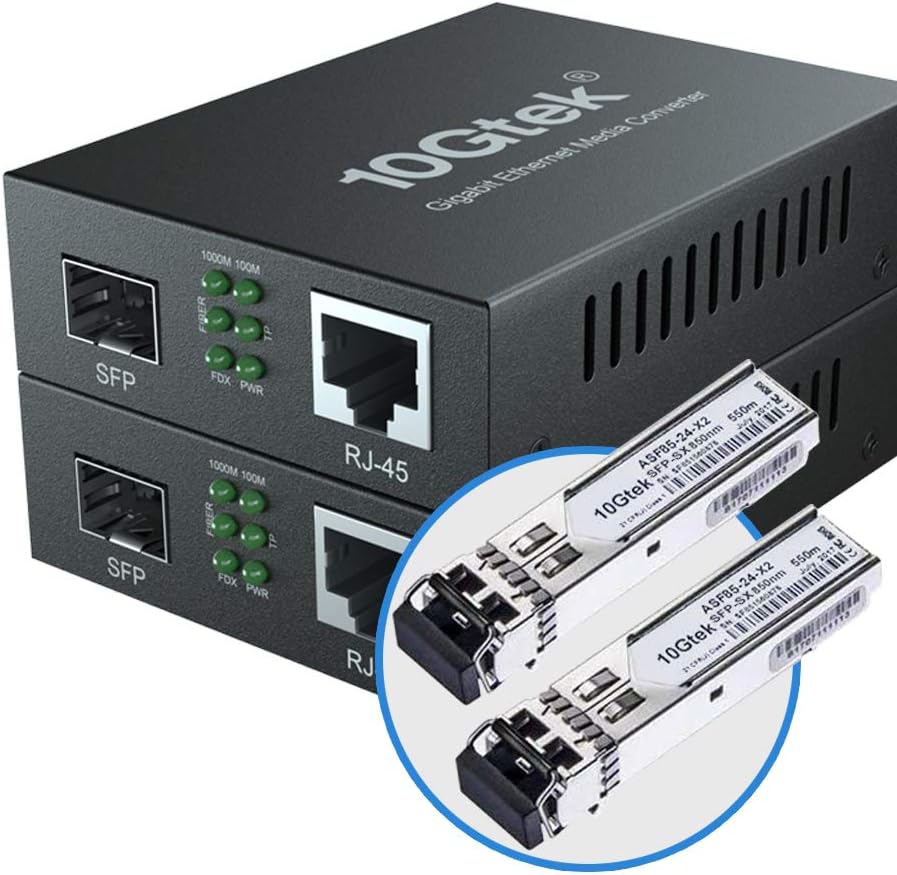
10Gtek Gigabit Ethernet Media Converter
4.7Editor score
Dual LC multimode connectivity
Includes matched SFP modules
Supports Gigabit Ethernet links
This Ethernet Fiber Media Converter guide compares ten options for speed, distance, fiber type, connectors, SFP support, and practical installation needs.
Ethernet fiber media converters bridge conventional RJ45 copper connections and fiber-optic links, making them useful for extending networks across buildings, linking separate equipment rooms, or overcoming the distance limitations of Ethernet cabling. A capable converter should match the network speed, optical type, connector, and transmission range required by the installation.
The products in this guide were compared using the supplied specifications, focusing on copper-port capabilities, fiber distance, multimode or single-mode support, included transceivers, SFP flexibility, management features, operating conditions, and installation extras. The list covers fixed-connector bundles, open-SFP designs, paired converters, and options for both Gigabit and 10 Gigabit networks.
Each review shows which use case the converter best serves, along with its important limitations and setup requirements. The top selections include practical budget, versatile, and premium choices, while the full ranking helps identify alternatives for short multimode runs, longer single-mode links, or installations that need adaptable transceiver support. Prices and availability can change.
4.7Editor score

4.7Editor score

5.0Editor score
The table below compares all ten converters by network speed, optical reach, connector arrangement, transceiver design, and notable management or installation features.


This 10Gtek converter pair is a strong all-around option for organizations that need to bridge short Gigabit Ethernet links to multimode fiber without sourcing optics separately. It carries a 4.7 rating and stands out because the package includes two converters and compatible 850 nm multimode SFP transceivers. The optical side uses dual LC connectors and supports runs of up to 550 meters, while the copper side provides one RJ45 port.
We may earn a commission when you buy through this link, at no additional cost to you.
The supplied modules are rated at 1.25G and are intended for 1000Base-SX multimode operation. On the copper side, the RJ45 port supports 10, 100, and 1000 Mbps with full- and half-duplex auto-negotiation plus auto MDI/MDIX crossover. Cat.5e or better UTP or STP cabling can provide a copper run of up to 100 meters, and the converter uses a UL-certified 5V 1A supply.
The main constraint is the fixed multimode configuration. It is well suited to local building links, data centers, and equipment rooms where the available fiber is 850 nm multimode, but it cannot directly accommodate a 1310 nm single-mode run without changing the optical arrangement. It also lacks the deeper configuration options associated with open-SFP models, such as forced fiber speed or a selectable optical standard.
This is a practical recommendation for buyers who want ready-made endpoint pairs and value a straightforward Gigabit bridge. Choose it when both ends of the installation use compatible dual-LC multimode infrastructure and the required distance is within 550 meters. The matched pair reduces the need to plan transceiver procurement independently for each side.
The pack contains two media converters and matching 850 nm multimode SFP modules, making it easier to deploy both ends of a fiber link. It is particularly useful when existing endpoints use compatible LC fiber rather than SC connectors.
Auto-negotiation across 10, 100, and 1000 Mbps allows the converter to connect with switches, routers, cameras, and other Ethernet equipment. Auto MDI/MDIX also removes the need for a crossover cable.
We may earn a commission when you buy through this link, at no additional cost to you.
The Omada MC220L is a flexible Gigabit media converter for installations where the correct optical module is not yet determined. It has a 4.7 rating and supports conversion between 1000BASE-SX or LX fiber and 1000Base-T copper, in either direction. Rather than fixing the converter to one connector and fiber type, it uses a hot-swappable SFP port.
We may earn a commission when you buy through this link, at no additional cost to you.
The open transceiver approach lets administrators choose single-mode or multimode modules according to the available path. With compatible optics, the stated transmission distance reaches 20 kilometers for single-mode and 550 meters for multimode. The RJ45 side supports 10, 100, and 1000Base-T connections, half- or full-duplex modes, and automatic MDI/MDIX crossover, which simplifies connection to switches, routers, and other network devices.
The principal drawback is that the module is not listed as included, making this a less self-contained solution than several fixed-SFP products in the ranking. The buyer must select a compatible SFP and may also need appropriate fiber patch cords. It is also a basic converter rather than a managed device, so the SFP choice determines many of the physical-link characteristics.
This model is ideal for a network installer who already knows the required wavelength, reach, and connector, or who wants the freedom to change modules between short and long fiber paths. It is also a sensible option for organizations that prefer a standardized transceiver format over permanently installed optics. For a plug-and-play bundle, one of the converters with an included module will be simpler.
The open SFP interface can accept suitable single-mode or multimode Gigabit modules. This makes the converter useful when a site may have different fiber infrastructure at each endpoint or when the reach requirements are still being evaluated.
No software installation or configuration is required. Once the appropriate module and cabling are connected, auto-negotiation handles supported copper speeds and MDI/MDIX behavior.
We may earn a commission when you buy through this link, at no additional cost to you.
This paired BiDi Gigabit converter set is designed for straightforward dual-LC multimode deployments. It carries a 4.5 rating and includes two 1.25G SFP media converters, two BiDi LC dual transceivers, two AC/DC power supplies, and a user manual. The copper ports negotiate 10, 100, or 1000 Mbps and support full- or half-duplex operation with automatic MDI/MDIX crossover.
We may earn a commission when you buy through this link, at no additional cost to you.
The optical modules use a 1.25Gbps interface and support multimode links of up to 550 meters. Cat.5e UTP or STP supports the copper segment for up to 100 meters. Status indicators cover transmit, fiber link and activity, power, and full-duplex operation, giving installers useful confirmation that each stage of the link is active. The converters also support jumbo frames up to 9K bytes.
Its limitations reflect the specialized bundle. It is restricted to the included multimode BiDi modules rather than offering the broad optical choices possible with an open SFP cage. The product description also notes an operating range from 0°C to 60°C, which may be less generous than the 0°C to 70°C ranges listed for some alternatives. A 4.5 rating also places it below several higher-rated choices.
The set is a sensible choice for installers who want both endpoint units and both transceivers in one package. It works particularly well for local campus, office, or equipment-room links that use compatible multimode fiber and need a 550-meter maximum. Buyers should verify that the existing patch cords and fiber arrangement match the included BiDi LC modules before ordering.
Two converters, two optical modules, and two power supplies reduce the number of separate items needed for a point-to-point installation. The included manual adds setup guidance for the complete package.
LEDs for transmit, fiber link and activity, power, and duplex status help distinguish a dormant converter from an active link. These indicators are particularly helpful when commissioning several endpoints.
We may earn a commission when you buy through this link, at no additional cost to you.
This 10 Gigabit media converter is the clear high-speed option in the ranking, with a 4.6 rating and support for modern 10GBase-T networks. It combines an RJ45 copper port that can auto-adapt to 100M, 1G, 2.5G, 5G, and 10G with an SFP+ slot designed specifically for 10 Gigabit optical modules.
We may earn a commission when you buy through this link, at no additional cost to you.
The SFP+ side accepts compatible 10G transceivers such as 10GBase-SR or 10GBase-LR optics. Auto MDI/MDIX simplifies copper connections, while LED indicators expose diagnostic information and DIP-switch configuration status. The unit can operate standalone or be installed in a compatible one-rack-unit chassis with 12 slots, making it more appropriate for structured racks than a simple fixed desktop appliance.
This specialization also creates the main trade-off. The SFP+ port accepts only 10 Gigabit transceivers, so it cannot use ordinary Gigabit SX or LX SFP modules. A suitable 10G module is not listed among the included accessories, which are the converter, an adapter, and a manual. The product also advertises optional LFP, ALS, and fiber-speed functions controlled through its configuration interface, so buyers should verify the desired behavior for their deployment.
This converter is a strong recommendation for data centers, server rooms, and high-throughput links that need 10G fiber rather than ordinary Gigabit Ethernet. It is less appropriate for a modest 1G home or small-office extension where paying for 10G optics and specialized configuration would add unnecessary complexity.
Auto-sensing allows the RJ45 side to work with devices operating from 100 Mbps through 10G. This is useful in mixed environments where the converter must bridge a high-speed uplink without requiring a separate copper adaptor.
The converter can serve as a standalone unit or fit into a compatible 12-slot chassis. Rack integration is valuable when a network room needs several fiber endpoints in a limited footprint.
We may earn a commission when you buy through this link, at no additional cost to you.
This 10Gtek pair is a focused solution for long Gigabit links over 1310 nm single-mode fiber with SC connectors. Its 4.8 rating is the second-highest among the products reviewed, and the package includes two converters. Each unit has one 1.25G SC optical port and one auto-negotiating 10, 100, or 1000 Mbps RJ45 port.
We may earn a commission when you buy through this link, at no additional cost to you.
The optical specification supports 1000Base-LX over single-mode fiber for distances of up to 20 kilometers. On the copper side, the converter supports full- and half-duplex auto-negotiation, automatic MDI/MDIX crossover, and Cat.5e or better UTP or STP cable runs of up to 100 meters. It uses a UL-certified 5V 1A power supply.
The fixed SC interface is the decisive trade-off. SC connectors are not interchangeable with the more common LC form used by many current transceivers, and the unit cannot switch to multimode. That makes it a better fit for an established installation with known SC single-mode infrastructure than for a site whose fiber termination is still undecided.
This converter pair is an excellent recommendation for campus buildings, warehouses, or facilities with established 1310 nm single-mode runs. The two-unit format simplifies symmetrical endpoint deployment, while the 20 kilometer reach provides considerable margin for standard single-mode links. Confirm SC connectors and the required optical standard before purchasing.
The 20 kilometer capability makes this pair suitable for linking network areas separated by considerably more distance than copper Ethernet can cover. Existing single-mode infrastructure is the essential requirement.
Supplying two units is convenient for point-to-point projects. Each converter includes the same SC optical arrangement and auto-negotiating copper behavior, reducing the chance of endpoint mismatches.
We may earn a commission when you buy through this link, at no additional cost to you.
This two-converter bundle ranks among the strongest choices for an already-defined Gigabit single-mode installation. It has a 4.9 rating, the second-highest shown, and includes 1000Base-LX modules with 1310 nm single-mode optics. The optical connection uses dual LC fiber and supports distances up to 20 kilometers.
We may earn a commission when you buy through this link, at no additional cost to you.
Each converter's RJ45 port delivers Gigabit Ethernet and remains backward compatible with 10 and 100 Mbps copper links. Full- and half-duplex operation and jumbo frames up to 9K bytes are supported. Status LEDs make it easier to monitor link activity, while the plug-and-play approach means no software installation or configuration is needed.
Like the SC-focused 10Gtek option, this design is specialized. Its built-in 1000Base-LX single-mode configuration is not a general-purpose open-SFP cage, so users cannot simply substitute a multimode module for a shorter local run. The package also lists a wide 100V-240V input range for the power system, but actual installation still requires suitable single-mode fiber and the appropriate LC connectivity.
This pair is a compelling recommendation for administrators who have confirmed 1310 nm single-mode LC infrastructure and need a ready-made 20 kilometer link. It minimizes separate procurement by including both converters and matching SFP modules. It is less suitable for users who need one converter, mixed fiber types, or a field-replaceable open transceiver slot.
The included 1000Base-LX SFP modules remove the need to choose a compatible transceiver independently. The pair is especially convenient for installers creating a complete point-to-point link.
Status indicators provide quick confirmation of network activity. For installations spread across buildings or equipment rooms, this visual feedback can simplify commissioning and troubleshooting.
We may earn a commission when you buy through this link, at no additional cost to you.
This LC Gigabit converter is the editor's choice because it combines a ready-to-link optical module with unusually broad configuration and installation support. It has a 4.7 rating and ships with a fitted 1310 nm 1000Base-LX SFP for single-mode duplex fiber. The unit also includes a power adapter, Cat6 patch cable, wall-mount ears, and a cable clip.
We may earn a commission when you buy through this link, at no additional cost to you.
The RJ45 port automatically negotiates 10Base-T, 100Base-TX, and 1000Base-T with auto MDI/MDI-X, making it suitable for switches, cameras, network video recorders, routers, and computers. A rear DIP block can select 1000Base-LX or 100Base-LX on the fiber side and provides controls for link fault pass-through, broadcast storm control, and forced speeds on both ports.
Link fault pass-through is particularly valuable in professional installations: when enabled, a break on the fiber side also drops the copper link, allowing the remote switch to recognize that the port is no longer usable rather than leaving a seemingly active dead connection. Jumbo-frame support is included for storage and backup traffic. The fanless enclosure is rated from 0°C to 70°C and may be placed on a desk or mounted on a wall.
This is the most balanced choice for a new Gigabit single-mode endpoint that benefits from richer controls than a basic fixed converter. It is less suitable for buyers who need two complete endpoints in one package, or who intend to use the included 1310 nm single-mode SFP on a multimode path. With careful SFP selection when needed, it offers an unusually complete installation kit.
DIP settings for fiber speed, copper speed, link fault pass-through, and broadcast storm control give administrators options that basic converters often omit. The selectable 100Base-LX mode also supports legacy Fast Ethernet fiber equipment.
The included optical module, power adapter, Cat6 patch cable, mounting ears, and cable clip cover most of the hardware needed for one side of a link. A compatible fiber patch cord remains an external requirement.
We may earn a commission when you buy through this link, at no additional cost to you.
The StarTech MCM1110SFP is a professional open-SFP converter for installations that value optical choice and structured-rack integration. It has a 4.7 rating and converts between a 10/100/1000 Mbps RJ45 network and a compatible MSA-compliant fiber transceiver. Because the SFP slot is open, the selected module determines the available distance and fiber type.
We may earn a commission when you buy through this link, at no additional cost to you.
Auto-negotiation allows the copper side to connect with different supported Ethernet speeds, and link fault pass-through helps improve troubleshooting and uptime in mission-critical deployments. The converter also supports IEEE 802.1q VLAN tag pass-through and jumbo frames up to 9K bytes, which is useful when preserving tagged traffic or moving larger frames between distant network segments.
Its physical design is a major advantage for organized deployments. The converter can be placed almost anywhere with little configuration and can also mount in the MCM7-MEDIA-CHASSIS or MCM15-MEDIA-CHASSIS. That makes it easier to consolidate multiple fiber endpoints in a server room or data center instead of leaving separate units scattered around the facility.
The trade-off is that a suitable MSA-compliant multimode or single-mode SFP is not included. The buyer therefore has more responsibility for optical compatibility and must source the appropriate transceiver separately. This converter is an excellent recommendation for network professionals who want long-term flexibility, structured installation, and reliable link-fault behavior rather than a self-contained low-cost bundle.
An MSA-compliant SFP can be selected for the required fiber type, connector, wavelength, and distance. This avoids locking the installation to a fixed optical interface.
Compatibility with the MCM7 and MCM15 media chassis creates a clean option for data centers and server rooms. Multiple converter endpoints can be organized within a dedicated rack structure.
We may earn a commission when you buy through this link, at no additional cost to you.
This multimode converter is a detailed endpoint solution for Gigabit networks using 850 nm LC fiber. It has a 4.5 rating and comes with a factory-matched 1.25G 1000Base-SX module already installed in its SFP cage. That arrangement allows the optical side to be ready for connection without requiring buyers to find and match a separate transceiver.
We may earn a commission when you buy through this link, at no additional cost to you.
The converter works with 62.5/125 OM1 and 50/125 OM2, OM3, OM4, and OM5 fiber. The stated 550-meter reach applies to OM2 and better, while OM1 supports Gigabit for approximately 275 meters under IEEE 802.3z. Its RJ45 side auto-negotiates 10, 100, and 1000Base-T and supports auto MDI/MDIX with Cat5e or Cat6 UTP cabling.
This model provides four rear DIP switches for link-loss forwarding, broadcast storm control, forced 100Base-SX on the fiber port, and forced 100 Mbps on the copper port. It also supports 9,000-byte jumbo frames and transparently carries stacked 802.1Q tags. The supplied package includes the converter, power adapter, Cat6 patch cord, wall-mount ears, rubber feet, and LC dust caps.
This is a good recommendation for installers who have local multimode infrastructure and value explicit configuration controls. It is less suitable for a long single-mode run, and users on OM1 should not assume that the headline 550-meter rating applies to their fiber grade. The included accessories make it particularly complete for a single endpoint.
The module supports common OM1 through OM5 multimode types, but distance varies by grade. OM2 and better can use the full 550-meter reach, while OM1 is limited to roughly 275 meters for Gigabit operation.
Support for 9K jumbo frames and transparent QinQ or 802.1Q stacked VLAN tags helps preserve traffic characteristics across the fiber boundary. The four DIP switches allow administrators to adjust link behavior when legacy equipment requires it.
We may earn a commission when you buy through this link, at no additional cost to you.
The StarTech ET91000SFP2 is the premium selection in this guide and carries a perfect 5.0 rating. It is designed as a Gigabit Ethernet-over-fiber bridge with an open SFP slot, allowing the user to choose an MSA-compliant single-mode or multimode transceiver and adapt the optical reach to the deployment rather than relying on a permanently fixed module.
We may earn a commission when you buy through this link, at no additional cost to you.
Beyond basic conversion, the unit provides link-loss forwarding, remote monitor status, and support for two frame lengths. Full- or half-duplex operation and jumbo frame support broaden its suitability for structured networks. It can extend a Gigabit connection between buildings or connect data-center and server-room Ethernet infrastructure over fiber while preserving an open transceiver ecosystem.
A compatible SFP is not included, and the optical path also requires the appropriate fiber type, connector, and patch cords. As a result, this is not the simplest choice for a beginner assembling a basic link from scratch. Its advantages are more apparent to a professional buyer who values remote status visibility, link-fault behavior, long-term transceiver flexibility, and the ability to choose optics according to changing infrastructure needs.
This converter is an excellent recommendation for professional edge networks, on-premises deployments, data centers, and campus links where standards-based SFP selection matters. It is the strongest premium pick in the ranking because it combines the highest rating with unusually broad operational features. Buyers should obtain a compatible MSA-compliant Gigabit SFP and confirm that its connector matches the physical fiber infrastructure.
Remote monitor status can help administrators observe link conditions without relying solely on local indicator lights. Link-loss forwarding also supports more accurate fault detection in managed network environments.
The open SFP slot supports MSA-compliant Gigabit modules from different vendors, allowing distance, fiber type, and connector requirements to guide the selection. This avoids tying the converter to one included optical module.
We may earn a commission when you buy through this link, at no additional cost to you.
The right media converter depends on the copper network speed, optical standard, distance, connectors, available SFP modules, and whether it must operate independently or inside a rack. These factors should be matched before comparing features or convenience.
Begin with the highest speed used by the devices on the copper side. Most products in this ranking support 10, 100, and 1000 Mbps with auto-negotiation, which makes them suitable for switches, routers, cameras, and conventional computers. The 10G RJ45-to-SFP+ model expands the upper end to 100M, 1G, 2.5G, 5G, and 10GBase-T, but its optical module must also be 10G compatible.
Choose a converter whose copper port matches the actual endpoint speed. Auto-negotiation is valuable, but a faster port does not make slower linked equipment perform faster.
Multimode fiber is commonly used for shorter local links, while single-mode fiber supports longer runs and is frequently found between buildings. The products identified as multimode generally specify 850 nm optics and a maximum of 550 meters, although OM1 has a lower Gigabit reach of about 275 meters. Single-mode options use 1310 nm optics and support distances of up to 20 kilometers.
Match the converter to the fiber already installed, not merely to the desired distance. A longer-range single-mode converter cannot simply be substituted for a multimode unit without the correct optical module and compatible infrastructure.
Fiber connectors must match the patch cords and existing termination plan. LC is used by several included-SFP products, while the 10Gtek long-reach bundle uses dual SC connectors. An SFP module may present LC, SC, or another connector depending on the selected optic, so both the module and cable need to be planned as a single system.
For an existing installation, inventory the connector type before ordering. For a new installation, compare the convenience of the available patch cords and confirm whether fiber cords are included; several converters require them as external accessories.
A converter with an included module is convenient when the fiber type, distance, and connector are already known. It reduces procurement and avoids mismatched optics. An open-SFP converter offers more flexibility, allowing an installer to select the exact reach, wavelength, and fiber standard, but the transceiver must be sourced separately and checked for compatibility.
Choose included optics for speed and simplicity; choose an open cage when the optical design may evolve, multiple fiber types must be supported, or standard procurement of MSA-compliant modules is preferred.
Distance is determined by the optical standard, fiber grade, transceiver, and the quality of the installed path. The multimode products in this list support up to 550 meters under appropriate conditions, with OM1 multimode having a shorter effective Gigabit range. The single-mode products support up to 20 kilometers, making them more suitable for building-to-building or campus connections.
Do not base the purchase solely on the longest headline distance. A shorter supported distance can be more appropriate if it matches the installed fiber and avoids paying for unnecessary optical capability.
Status LEDs are valuable for confirming power, link, activity, speed, and duplex conditions during installation. More advanced models also provide link fault pass-through, which propagates a fiber-side outage to the copper side so downstream equipment can recognize the failed link. Some products also offer broadcast storm control, remote monitor status, VLAN pass-through, and configurable forced speeds.
Prioritize diagnostic features in managed offices, data centers, and installations where an apparently active but unusable port would slow troubleshooting. Simpler point-to-point links may not need every control.
The physical form matters for long-term installation quality. Several products can sit on a desktop or mount on a wall using included ears, while the StarTech MCM1110SFP can fit compatible media chassis. The 10G converter also supports standalone use or a compatible 12-slot chassis. These options help organize converters in server rooms and data centers.
Choose wall mounting for a single permanent endpoint and chassis support when several fiber links need to be consolidated. Confirm the dimensions, power requirements, and available rack space before installation.
Operating temperature can matter in equipment rooms, utility closets, and outdoor-adjacent spaces. Several featured converters are rated from 0°C to 70°C and use fanless enclosures, while one paired BiDi product lists a 0°C to 60°C range. Power arrangements also vary, with 5V 1A adapters common and one product specifying a 100V-240V wide input range.
Check the enclosure, temperature rating, and power supply at the actual installation site. A converter that is comfortable in a climate-controlled server room may need additional protection in a warmer or harsher enclosure.
First, inventory both ends of the intended link. Confirm the copper device speed, the fiber type, connector arrangement, optical wavelength, maximum distance, and whether the converter includes a compatible SFP. The converter, transceiver, copper cable, and fiber patch cords must form a matched path, with the same optical standard used at each endpoint.
Next, power down where appropriate and connect the equipment. Attach the appropriate SFP or fixed fiber interface, connect the optical patch cord, and secure the fiber path without creating sharp bends or stress on the connector. Connect the RJ45 side to the network device, install the power adapter, and then power the converter. Once both endpoints are operating, check the power, link, activity, speed, and duplex LEDs.
For routine care, keep the converter and power supply in a dry, ventilated location within the specified temperature range. Inspect dust caps and connectors, and avoid touching exposed fiber or transceiver tips. If a link fails, check power, the selected DIP settings, transceiver compatibility, connector cleanliness, and whether either endpoint negotiated an unexpected speed before replacing equipment.
Yes, provided the selected converter and fiber optics match the required distance and fiber type. Single-mode products in this guide support up to 20 kilometers, while multimode solutions are generally intended for shorter local paths. Building-to-building installations also need suitable fiber cabling, appropriate surge and grounding protection, and compliance with local electrical and networking rules.
Usually, a point-to-point link needs a converter at each end because each unit bridges copper Ethernet and fiber. A complete link generally requires two converters, two compatible optical modules or fixed optical interfaces, suitable fiber patch cords, and copper connections to the network devices. Some listings conveniently package both endpoint converters together.
LC and SC are different connector formats used on fiber patch cords and optical interfaces. LC is compact and common in modern transceiver systems, while SC uses a larger push-pull connector. They are not directly interchangeable, so the converter's connector must match the installed fiber and the selected patch cords.
An open-SFP converter can support either type, but the converter itself does not make every fiber path compatible. The installed SFP must use the correct fiber type, wavelength, distance, and connector. Compatibility with MSA-compliant modules provides more selection freedom, but the chosen module still has to meet the required network standard.
The featured 850 nm multimode converters list a maximum of 550 meters, generally applying to OM2 and better fiber. OM1 multimode typically supports Gigabit Ethernet for approximately 275 meters under IEEE 802.3z. Actual reach can also be affected by the transceiver, patch cords, connectors, and installation quality.
Most models are designed for plug-and-play operation, and their basic copper and optical links do not require software installation. Converters with DIP switches or optional management functions do offer physical configuration controls, but these are generally used for speed, fault behavior, and other options rather than routine software-based setup.
Link fault pass-through propagates a fault detected on the fiber side to the copper side. Instead of presenting a seemingly active copper port while the optical path is broken, the converter can drop that link so connected equipment recognizes the outage. This is especially useful in managed networks where accurate fault reporting matters.
Not with the featured 10G RJ45-to-SFP+ converter because its optical slot accepts only 10 Gigabit SFP+ modules. A converter with a standard open SFP cage can accept a compatible Gigabit module, but it will only provide the speed supported by that module and the connected equipment.
The 10Gtek multimode pair offers the best balanced budget option for short dual-LC Gigabit links, while the feature-rich single-mode LC converter earns the editor's choice for its 20 kilometer reach, DIP controls, link fault pass-through, and complete accessory package. The StarTech ET91000SFP2 is the premium selection because its open SFP design, remote status monitoring, and 5.0 rating offer broad flexibility for professional deployments.
For most buyers, the fiber infrastructure should drive the decision more than the converter's feature list. Confirm single-mode or multimode, connector type, required distance, and whether a transceiver is included before considering extras. Paired bundles are convenient for complete point-to-point links, while open-SFP models are better when optical standards may vary or professional procurement flexibility matters.
Finally, check current prices, availability, included accessories, and warranty terms before ordering. Prices and product bundles can change, but the correct match among copper speed, optical standard, distance, and connector will remain the most important part of a successful Ethernet fiber media converter installation.