
Proster BM4070
4.5Editor score
Wide component measurement ranges
Capacitance zero adjustment
Complete portable testing kit
Compare the best Lcr Meter options for accuracy, frequency range, display quality, component coverage, sorting features, and practical electronics testing.
An Lcr Meter provides a more reliable way to measure inductance, capacitance, resistance, and related component characteristics than many general-purpose multimeters. The right model depends on component size, test frequency, accuracy, secondary readings, calibration needs, and whether you prefer a handheld, benchtop, or tweezer-style design.
We compared ten Lcr Meter models using their published specifications, measurement ranges, supported frequencies, display layouts, component types, sorting functions, accessories, and intended work environments. The list covers affordable tools for hobbyists, portable models for field work, precision instruments for quality control, and benchtop units for laboratory workflows.
Each review explains the strongest reasons to consider a particular meter while noting meaningful limitations. Ratings reflect the supplied customer feedback, and the recommendations emphasize practical fit rather than treating one product as ideal for every task. Product availability, features, and prices can change over time.
4.5Editor score

4.7Editor score

4.4Editor score
The table below compares all ten models by their primary measurement strengths, frequency coverage, portability, and specialized capabilities, making it easier to identify the right instrument for bench work, component screening, repairs, or electronics education.

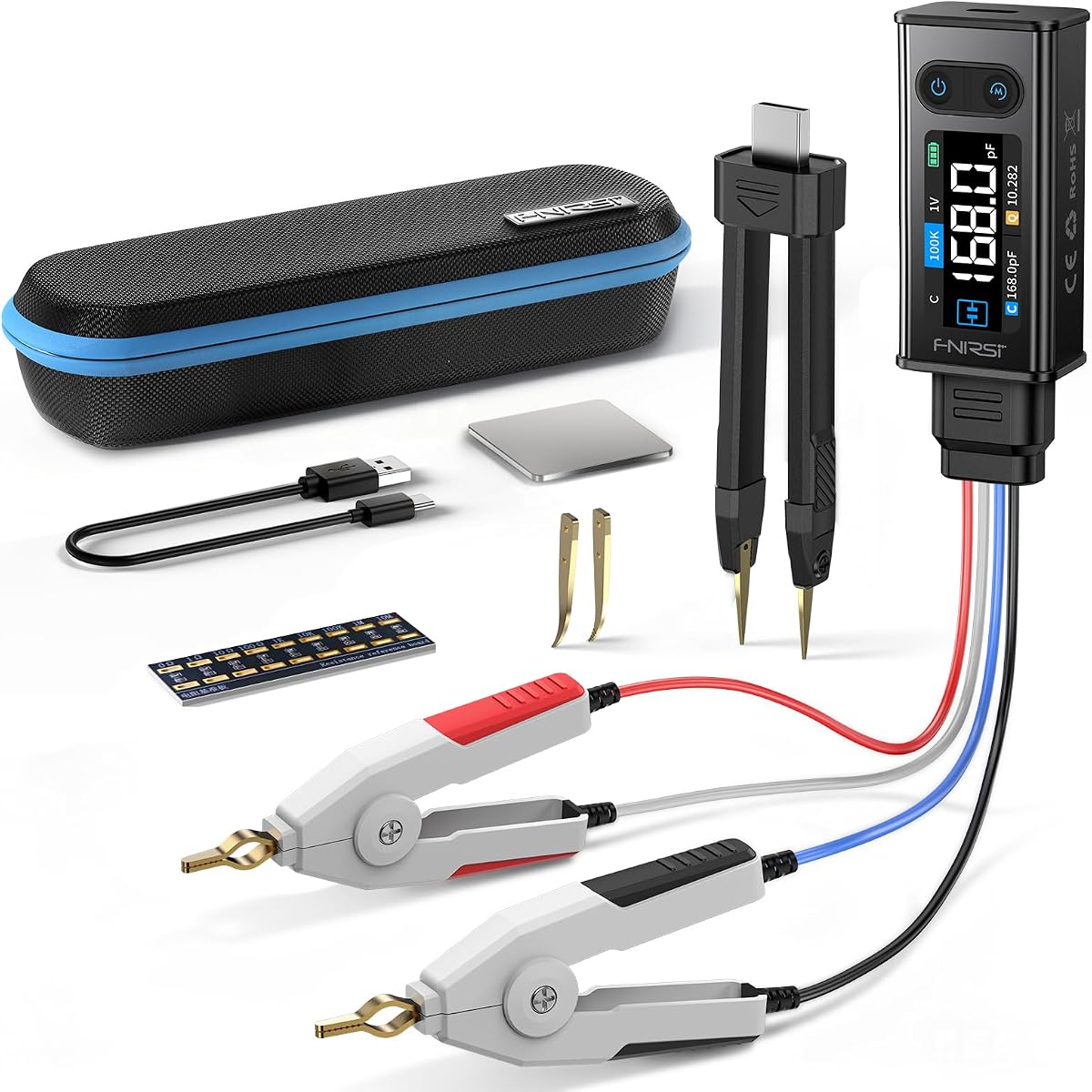


The FNIRSI LC1020E is a feature-rich handheld Lcr Meter with a 4.7 customer rating. It combines automatic component detection, a 19,999-count display, a 2.8-inch color TFT, and support for measurements up to 100kHz. The result is an unusually capable instrument for component identification, troubleshooting, and batch screening rather than merely a basic three-function tester.
We may earn a commission when you buy through this link, at no additional cost to you.
Its most useful strength is the dual-parameter display. A primary value such as capacitance, resistance, or inductance can be shown alongside X, D, Q, phase angle, or ESR. This makes it easier to evaluate real component behavior, especially capacitors whose effective series resistance and dissipation factor are important to circuit performance. The sorting mode compares parts against a selected nominal value and tolerance, while audible and LED alerts support faster component inspection.
The model also provides five test frequencies, adjustable test voltage, internal bias options, three measurement speeds, data hold, and pass/fail counters. Its stated ranges span 1pF to 100mF for capacitance, 10mΩ to 10MΩ for resistance, and 1µH to 100H for inductance. Four-terminal measurement fixtures, a three-pin socket, five-slot jacks, and a 100Ω output indicate that the instrument is designed for more careful fixture-based work than the simplest hobby models.
The trade-offs are operational rather than fundamental. Open and short calibration should be performed before measurements, capacitors and inductors must be discharged, and onboard components require the circuit to be powered off. Its broad feature set can also feel denser than a simple meter. Even so, the combination of color visualization, flexible measurement parameters, and efficient sorting makes this the most balanced recommendation for serious hobbyists, technicians, and bench users.
Choose the LC1020E when you want one portable instrument that can identify components, evaluate secondary characteristics, test across several frequencies, and screen batches without moving to a full laboratory bridge. It is especially attractive for electronics repair work where ESR, Q, or phase information adds useful context beyond a basic resistance or capacitance reading.
Showing ESR, Q, D, phase angle, and reactance beside the primary value gives a clearer view of component condition. That extra information is particularly useful when assessing capacitors, comparing matched parts, and investigating readings that appear correct but do not behave as expected in a circuit.
Preset nominal values and tolerances from 0.1% to 99.9% allow batches of components to be checked quickly. Audible and LED pass indicators, along with success and failure counts, reduce the need to interpret every reading manually.
We may earn a commission when you buy through this link, at no additional cost to you.
The DE-5000 Handheld Lcr Meter has a 4.6 rating and offers a balanced combination of automatic testing, broad secondary measurements, and field-friendly accessories. Its dual display can show 19,999 or 9,999 counts, while AUTO-LCR mode automatically recognizes the connected component and applies an appropriate series or parallel measurement configuration.
We may earn a commission when you buy through this link, at no additional cost to you.
Five frequencies from 100Hz through 100kHz make it possible to observe how inductance, capacitance, resistance, ESR, and other electrical characteristics respond to the applied test condition. Primary measurements include inductance, capacitance, and resistance, while the secondary display can report dissipation factor, quality factor, phase angle, equivalent series resistance, and equivalent parallel resistance.
For practical bench use, the sorting mode helps organize a group of components without recording every value individually. The supplied accessories strengthen that usefulness: the package includes an English PDF manual, a 9V battery, an alligator test-lead case, SMD tweezers, and a guard line. These allow the instrument to handle both conventional leaded parts and surface-mounted components without relying entirely on improvised connections.
The main limitation is its age and comparatively conventional screen. It lacks the color display, rechargeable Type-C battery, multiple brightness levels, and advanced voltage or bias options found in newer devices. The optional IR-to-USB cable is also not included, so PC communication should be treated as an accessory rather than a standard feature.
The DE-5000 is a strong fit for repair technicians and advanced hobbyists who want automatic identification, multiple test modes, and useful secondary readings in a handheld format. It is less compelling for users who prioritize modern connectivity or a bright graphical screen, but its core measurement functions and included probe set remain versatile.
AUTO-LCR mode reduces the need to choose a measurement function before every test. The instrument recognizes the component and determines whether a series or parallel configuration is more appropriate, which helps keep routine bench measurements consistent.
Alligator leads, SMD tweezers, and a guard line support leaded, surface-mounted, and guarded measurements. The included set makes the meter more practical for a repair bench without requiring a separate collection of fixtures for basic work.
We may earn a commission when you buy through this link, at no additional cost to you.
The MATRIX MCR5200 is the most specialized instrument in this roundup, with a 4.4 rating and a clear emphasis on laboratory, production, and quality-control work. It provides 41 selectable frequency points from 40Hz to 200kHz, a five-digit display, basic accuracy of 0.1%, and a four-terminal test cord for bench measurements.
We may earn a commission when you buy through this link, at no additional cost to you.
Its measurement coverage is extensive. Inductance extends from 0.01µH to 99,999H, capacitance from 0.01pF to 9.9999F, and resistance, impedance, reactance, and ESR from 0.1mΩ to 99.999MΩ. Dissipation factor, quality factor, phase angle in degrees, and phase angle in radians can all be evaluated, making it useful for deeper component characterization.
Computer connectivity separates this model from most handheld choices. SCPI and GPIB support, USB Host and RS232C interfaces, a handler port, and supplied software allow measurement data to be saved to a computer or USB drive. FAT16 and FAT32 support expands the available storage workflow, while three measurement speeds—30, 10, and 3 readings per second—can match the needs of rapid screening or careful averaging.
This is a benchtop instrument, so its size and fixed setup make it less convenient for mobile repair work. Manual, hold, and automatic range modes, calibration procedures, and computer communication also create a steeper learning curve. Even so, the combination of frequency control, broad ranges, comparator modes, data retention, and automated documentation is compelling for users who repeatedly measure components rather than occasionally checking one part.
Buy the MCR5200 if your work involves R&D, production testing, formal quality control, or collecting large sets of measurements for analysis. It is overkill for a simple electronics course, but it offers the controls and interfaces expected in a professional benchtop LCR bridge.
Forty-one points between 40Hz and 200kHz offer much finer control than the common five-frequency arrangement used by many handheld meters. This is valuable when studying frequency-dependent behavior or matching components under a defined test condition.
SCPI, GPIB, USB, and RS232C options make captured results easier to incorporate into a controlled test process. Automatic range, comparator grading, averaging, and delayed test settings complement the computer interfaces for production and laboratory use.
We may earn a commission when you buy through this link, at no additional cost to you.
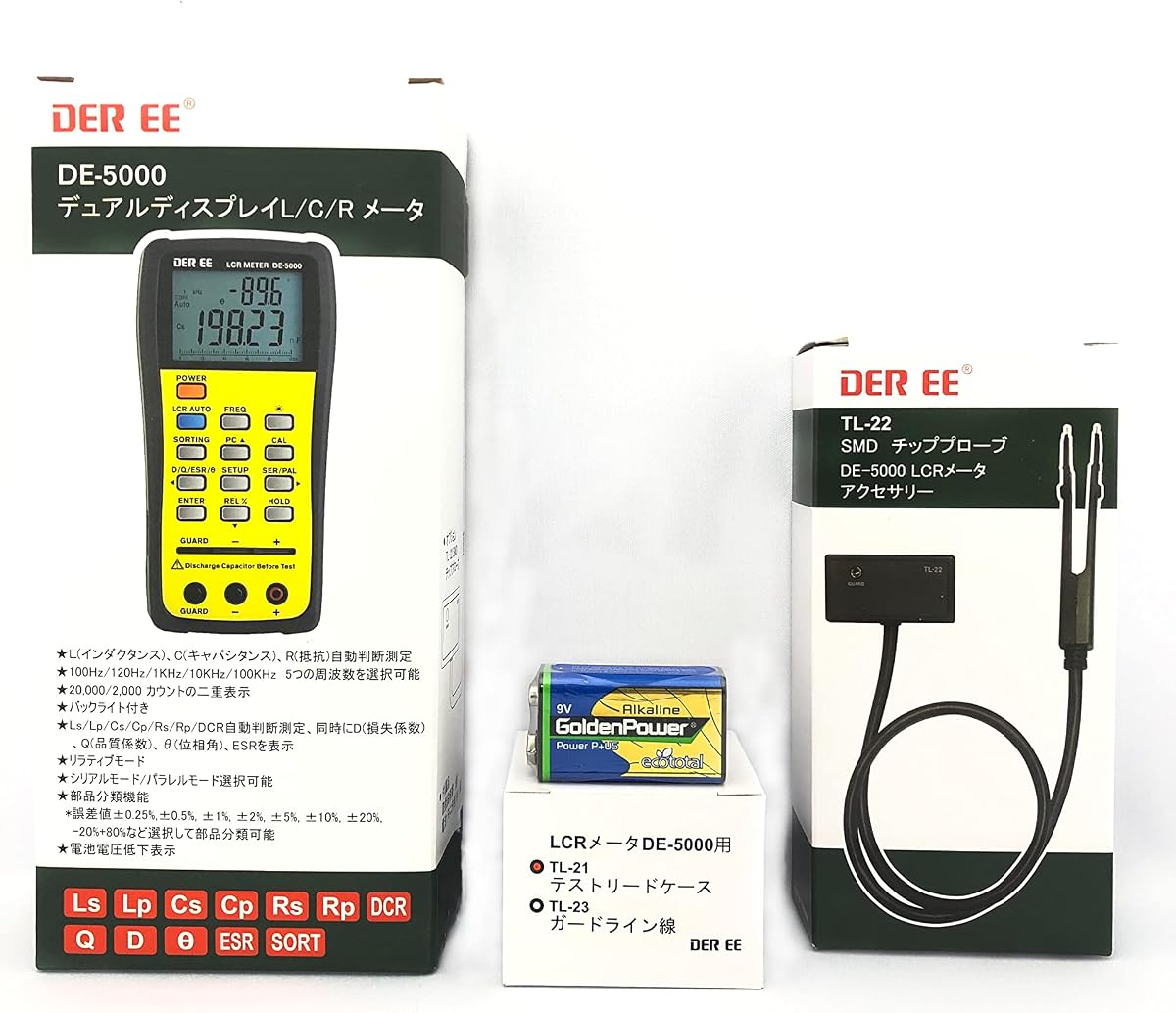
The De-5000 Complete Set has a 4.6 rating and is built around a high-resolution handheld Lcr Meter with a 20,000-count or 2,000-count display. It supports inductance, capacitance, and resistance measurements across 100Hz, 120Hz, 1kHz, 10kHz, and 100kHz, while a backlit screen helps maintain visibility in different working environments.
We may earn a commission when you buy through this link, at no additional cost to you.
The measurement modes cover both serial and parallel equivalents: Ls, Lp, Cs, Cp, Rs, Rp, and DCR. Secondary parameters include D, Q, phase angle, and ESR. A relative mode supports differential measurements, and the sorting function helps users organize a batch of parts according to a selected standard.
Its complete-set approach is the defining feature. The package includes the meter, TL-21 alligator test leads, TL-22 SMD test leads, and a protective carrying case. This is a convenient arrangement for technicians who want a portable kit ready for both conventional through-hole work and smaller surface-mounted components.
Tolerance settings range from 0.25% and 0.5% through 1%, 2%, 5%, 10%, 20%, and -20% +80%. That range supports both tight component matching and looser acceptance criteria. The main drawbacks are the lack of an included computer interface and the similarity of this product to the other DE-5000 listing: buyers should confirm the exact accessory and mode requirements before choosing between them.
This set is a good match for mobile repair work, education, and component sorting where a protective case and multiple probe styles matter. It provides the principal measurements expected from a serious handheld LCR instrument without moving into a full benchtop bridge.
Eight selectable tolerance profiles accommodate both precision matching and broad inspection requirements. The sorting function and relative mode help users identify deviations without relying on a single manually calculated comparison.
The included alligator leads, SMD test leads, and carrying case make the meter easy to transport between a workbench and a service location. The package supports different connection styles without requiring the user to build a custom probe collection.
We may earn a commission when you buy through this link, at no additional cost to you.
The Proster BM4070 is a budget-focused Lcr Meter and Multimeter with a 4.5 customer rating. It gives hobbyists and electronics students a dedicated way to measure inductance, capacitance, resistance, and diode forward voltage without relying on a general-purpose multimeter for functions it may not handle accurately.
We may earn a commission when you buy through this link, at no additional cost to you.
Its capacitance section covers eight ranges from 200pF to 2000µF, with a zero adjustment intended to remove stray lead and circuit capacitance. That is a valuable feature for small ceramic capacitors, where fixture capacitance can otherwise influence the displayed result. Inductance spans six ranges from 200µH to 20H, while resistance is measured across five ranges from 200Ω to 20MΩ.
The 1,999-count, 3.5-digit LCD is less detailed than the high-count screens found on premium instruments, and the model does not offer the same broad menu of secondary parameters. Its strengths instead lie in straightforward range coverage, diode testing, data hold, auto power-off, and a sampling rate of three readings per second.
A rotatable screen is a surprisingly valuable feature for a portable meter. It allows the display to be viewed at different angles on a workbench or while the meter rests in a less conventional position. The included crocodile clips, mini alligator clips, test leads, mini screwdriver, 9V battery, manual, and storage bag make the package ready for immediate use.
The BM4070 is best for education, hobby projects, basic repair, and component identification where accessible pricing matters more than laboratory-grade resolution. Buyers should accept its lower count display and more limited analysis functions, but for fundamental L, C, and R testing it delivers unusually broad entry-level coverage.
The ZERO ADJ control can compensate for stray capacitance introduced by the leads and connected fixture. This is especially important when working with small ceramic or film capacitors whose expected values approach the measurement noise of simpler meters.
The eight capacitance, six inductance, and five resistance ranges cover many parts encountered in hobby electronics. Separate diode testing, data hold, and an over-range indicator help make the instrument useful beyond one component category.
We may earn a commission when you buy through this link, at no additional cost to you.
The FNIRSI LCR-ST2 is a compact tweezer-style Lcr Meter designed to make SMD testing less cumbersome. It carries a 4.3 rating and combines automatic component sorting with measurements for resistors, capacitors, inductors, diodes, continuity, and voltage. The format is especially useful for dense boards and tiny components that are difficult to probe with conventional clips.
We may earn a commission when you buy through this link, at no additional cost to you.
It supports frequencies from 100Hz to 100kHz and four RMS test levels at 0.1V, 0.3V, 0.6V, and 1.0V. Series or parallel modes can be chosen to reduce the influence of parasitic effects, while the display presents primary R, C, L, or Z values alongside X, D, Q, and phase information.
The stated ranges are wide for a portable tweezer meter: capacitance extends from 1pF to 22mF, resistance from 10mΩ to 10MΩ, and inductance from 1µH to 10H. Diode testing covers values up to 0.7V, voltage measurement spans ±30V, and continuity is included for general troubleshooting.
Its 1.47-inch screen is smaller than the displays offered by some handheld rivals, and the 10H inductance ceiling is more modest than some alternatives. Nevertheless, the rechargeable 300mAh battery, Type-C charging, adjustable brightness, auto power-off, left- and right-hand modes, and strong rear magnet create a tool that is easy to position and use hands-free.
The LCR-ST2 is a compelling choice for smartphone and board repair, SMD inspection, and component sorting. It is less suitable as a general-purpose bench bridge or for very large inductors, but its probe format and mixed-component support are excellent for compact electronics.
Gold-plated tweezer tips make contact with compact SMD components more direct than long meter leads. Kelvin clips and hooks add flexibility when different package sizes or connection styles need to be tested.
Four RMS levels and selectable series or parallel modes let the user account for different component behavior and fixture parasitics. Automatic identification and abnormal-component sorting reduce the time spent manually confirming each part.
We may earn a commission when you buy through this link, at no additional cost to you.
The Peak Atlas LCR45 earns the highest customer rating in this list at 4.8. It is a handheld LCR and impedance meter focused on straightforward operation, fluid measurement, and a compact design. Component type and test frequency can be selected manually or handled automatically, giving users flexibility without forcing a fixed workflow.
We may earn a commission when you buy through this link, at no additional cost to you.
Available test frequencies include DC, 1kHz, 15kHz, and 200kHz. The 200kHz option is higher than the common 100kHz ceiling found in many competing models and can be useful for examining components at a more demanding test condition. The stated enhanced resolution reaches 0.2µH, 0.2pF, and 0.2Ω.
Its menu system is designed to make settings accessible, and a hold function freezes the current reading for reference. Those qualities make the LCR45 appealing to users who want a meter that does not demand extensive training. It is also a natural choice for technicians who need a compact instrument for diagnosing a suspect component outside a fully equipped laboratory.
The supplied information is comparatively brief and does not describe automated sorting, detailed secondary parameter coverage, or computer connectivity. It therefore should not automatically be assumed to match the feature density of the MATRIX MCR5200, FNIRSI LC1020E, or Extech LCR200. A buyer focused on tolerance grading or automated data capture should confirm the exact workflow before purchasing.
Despite those limitations, the LCR45's 4.8 rating, frequency choice, automatic controls, hold function, and warranty make it a strong general-purpose recommendation. It suits users who prioritize clarity and straightforward handling over extensive menus and laboratory integration.
Automatic component and frequency options reduce setup time, while manual control remains available for repeatable procedures. This combination is useful for both quick diagnosis and users who want a consistent test method.
The handheld design is appropriate for a technician moving between devices or an enthusiast troubleshooting at a bench. The hold function and clear menu structure help keep the instrument practical in those environments.
We may earn a commission when you buy through this link, at no additional cost to you.
The B&K Precision 879B is a handheld universal Lcr Meter built around a dual backlit display. It has a 4.5 customer rating and follows a conventional professional-instrument format, using familiar banana-style connections and supplied banana-to-alligator leads. The physical dimensions of 190mm by 90mm by 41mm and weight of 330g place it between a pocket meter and a fixed bench instrument.
We may earn a commission when you buy through this link, at no additional cost to you.
The dual display is the central feature. It can present a main measurement alongside a related parameter, reducing the need to switch screens when checking a component. The backlight improves readability in dim service environments, while the larger body offers room for a more substantial interface than the smallest budget models.
The supplied kit includes banana-to-alligator test leads, a 9V battery, a Mini USB interface cable, and an AC adapter for the 879B configuration. Those accessories support both standalone testing and potential computer-assisted workflows, although the provided product information does not specify the full range of automated data functions.
The important limitation is the limited technical detail supplied for this particular listing. It does not provide the model’s frequency options, measurement ranges, accuracy figures, or complete secondary parameter list. Buyers comparing specifications should therefore verify the current manufacturer documentation and confirm that the required measurement ranges and interfaces match their work.
The 879B is a sensible option for a technician who values a robust handheld format, backlit dual display, conventional connections, and included charging or interface accessories. It may be less attractive than models with fully published 100kHz capability, detailed range specifications, or obvious automated sorting, but its established design and favorable rating support inclusion in a broad comparison.
Showing primary and secondary information at once lets users evaluate a component without repeatedly changing modes. The backlit screen also makes the instrument practical for service work where lighting may be inconsistent.
Banana-style terminals and the included alligator adapter provide a familiar way to connect probes. A Mini USB cable and AC adapter add convenience, although buyers should confirm the exact current data-management capabilities.
We may earn a commission when you buy through this link, at no additional cost to you.
The Extech LCR200 is a passive-component Lcr Meter with a 4.4 rating and a 20,000-count or 2,000-count dual backlit display. It measures inductance, capacitance, and resistance while also showing quality factor, dissipation, phase, and equivalent series resistance, offering a well-rounded view of each component.
We may earn a commission when you buy through this link, at no additional cost to you.
Five test frequencies—100Hz, 120Hz, 1kHz, 10kHz, and 100kHz—cover the range commonly used for general component assessment. Users can select series or parallel circuit measurement modes, and the limit function accepts high/low boundaries using either absolute values or percentages. These features make it useful for inspection as well as isolated measurement.
Open and short calibration helps remove stray impedance from the fixture and leads. The package includes a built-in test fixture, external test leads, and a 9V battery. Auto power-off can be overridden when continuous work is required, and a low-battery indicator provides a useful status warning.
Its main limitations are the conventional nine-volt battery arrangement and the absence of any stated computer connectivity. For users who need automated documentation, more than five frequencies, or very broad range specifications, a benchtop or newer networked instrument may be a better fit. It also lacks the rechargeable convenience seen in some recent handheld competitors.
The LCR200 is a strong general-purpose choice for repair, education, and incoming inspection where multiple secondary parameters, calibration, and limit testing matter. Its built-in fixture simplifies repeat measurements, while external leads offer flexibility for components that need different contact arrangements.
Open and short calibration can compensate for impedance introduced by the test fixture and connected leads. This is especially helpful when comparing smaller components whose values are close to the residual measurement effect.
High and low thresholds can be expressed as absolute values or percentages. The dual display keeps the primary measurement visible while users determine whether a part falls within the expected limits.
We may earn a commission when you buy through this link, at no additional cost to you.
The Pro1-100KHz combines a meter with smart SMD tweezers and carries a perfect 5.0 customer rating in the supplied data. Its stated basic accuracy is 0.1% for resistance, 0.2% for inductance, and 0.2% for capacitance. That combination of precision, compact testing, and favorable feedback makes it an attractive specialist option.
We may earn a commission when you buy through this link, at no additional cost to you.
The meter offers five test frequencies at 100Hz, 120Hz, 1kHz, 10kHz, and 100kHz. Users can also select among three test voltages: 0.2Vrms, 0.5Vrms, and 1.0Vrms. Adjustable excitation is useful when comparing component behavior or working with parts that respond differently under different stimulus levels.
The measurement range covers resistance from 20mΩ to 10MΩ, capacitance from 0.1pF to 10mF, and inductance from 10nH to 1H. A diode test is also included, while the smart tweezers provide a convenient way to contact small surface-mounted components. The one-year warranty and lifetime support offer additional reassurance for ongoing use.
The range limitations deserve attention. An inductance maximum of 1H excludes larger chokes and transformers, while the 10mF capacitance ceiling is lower than the maxima offered by several other meters in this roundup. The 20mΩ lower resistance limit is also narrower than the 10mΩ figure listed for some FNIRSI models.
This product is best suited to precision electronics, board-level repair, and users who work frequently with small SMD parts. It is a particularly compelling choice when 0.1% resistance accuracy and dedicated smart tweezers matter more than very large component ranges or benchtop data logging.
Stated accuracy of 0.1% for resistance, 0.2% for inductance, and 0.2% for capacitance is well suited to precision component matching. The figures also make the meter appropriate for users who want confidence when differences between parts are small.
Integrated SMD tweezers make direct contact with compact components easier than long loose leads. The format reduces handling friction during board repair, inspection, and identification of unmarked or suspect parts.
We may earn a commission when you buy through this link, at no additional cost to you.
The best Lcr Meter for one user may be inadequate for another, so the decision should begin with the components, frequencies, accuracy, and workflows involved in your work. The following factors help separate basic value instruments from precision and laboratory-oriented models.
Begin with the smallest and largest capacitance, inductance, and resistance values you expect to test. Some budget meters cover common mid-sized parts but stop below 1nF or above several henries, while specialized instruments can measure picofarad capacitors or very large inductors. A compact electronics repair kit may need only a few nF to tens of microfarads, whereas a power-supply repair bench may require substantial inductance range. Choose limits that comfortably surround your normal workload rather than selecting a meter that barely reaches the most common value.
Test frequency affects how an inductor or capacitor responds, and different applications place different importance on specific values. The common 100Hz, 120Hz, 1kHz, 10kHz, and 100kHz set is versatile for general diagnostics, while the MATRIX MCR5200 offers 41 points from 40Hz to 200kHz. The Peak Atlas LCR45 also reaches 200kHz. Consider whether you need several discrete frequencies for comparison or fine-grained control for component characterization and repeatable production testing.
Resolution determines how many digits the display can show, while accuracy describes how closely the result should agree with the true value. A high-count display is not automatically an accuracy guarantee, so compare the published basic accuracy for resistance, capacitance, and inductance. The MCR5200 lists 0.1% basic accuracy, and the Pro1-100KHz lists 0.1% for resistance and 0.2% for inductance and capacitance. Budget units such as the BM4070 provide a 1,999-count display and are better suited to broad checks than exact matching.
A useful Lcr Meter can display more than a single resistance, capacitance, or inductance value. ESR reveals capacitor loss, Q indicates the inverse of loss in many reactive components, D expresses dissipation, and phase angle describes the relationship between voltage and current. Models such as the LC1020E, DE-5000, Extech LCR200, and LCR-ST2 support several of these secondary readings. They are particularly helpful during troubleshooting because a part can have an acceptable nominal value but still behave poorly in a circuit.
The correct connection method can influence accuracy and convenience. Four-terminal fixtures reduce unwanted lead impedance, SMD tweezers make tiny board components easier to contact, and alligator leads suit larger leaded parts. The LC1020E provides three-pin sockets and five-slot jacks for Kelvin-style measurements, the LCR-ST2 uses tweezers with interchangeable tips, and the Extech LCR200 includes a built-in fixture. Match the fixture to your component sizes and consider whether guarding or a four-wire connection is important.
Sorting, comparison, and limit modes turn a meter into a faster inspection tool. The LC1020E accepts nominal values and tolerances from 0.1% to 99.9%, the De-5000 Complete Set offers several preset tolerance levels, and the Extech LCR200 supports high and low absolute or percentage limits. The MCR5200 includes a flexible comparator for pass-and-fail work. These features are valuable when checking many components, but they are less essential for occasional measurements of a single part.
A handheld meter should be comfortable to carry, readable in the intended environment, and able to stay powered through a normal workday. The LC1020E and LCR-ST2 use rechargeable Type-C batteries, while the DE-5000, Proster BM4070, and Extech LCR200 use 9V batteries. Color or backlit displays help in poor lighting, and larger bodies can be easier to operate with gloves. The MCR5200 is designed to remain on the bench, so power portability matters less than connection options and data control.
Computer control becomes important when measurements must be stored, compared, or included in a quality-control record. The MCR5200 supports SCPI, GPIB, USB, and RS232C and includes software for saving results. The B&K Precision 879B includes a Mini USB cable, although the supplied information does not detail its complete data capabilities. If automated documentation is essential, verify the interface, command set, storage format, and included software before buying. For casual use, a hold function and internal sorting may be entirely sufficient.
Begin with a stable, safe test setup. Identify whether the component should be measured in series or parallel configuration, select the appropriate test frequency and voltage, and use leads or tweezers that make secure contact without forcing delicate terminals. Before taking a reading, perform the meter’s open and short calibration procedure where applicable. Remove the component from an active circuit whenever possible, since surrounding circuitry and energized nodes can distort readings or damage the instrument.
Discharge capacitors and inductors before connecting them. A charged capacitor can affect the result, while residual energy in an inductor may create a hazard or damage a sensitive meter. Confirm that a board is powered off and isolate the component when its surrounding circuit would otherwise influence the measurement. For small SMD parts, use a stable fixture or the supplied tweezers so the connection does not change between trials.
Care for the instrument by keeping its sockets, probes, and tweezer tips clean, and store it in a dry environment away from impact and extreme heat. Replace the 9V battery when the low-battery indicator appears, and use the specified charging method on rechargeable models. Recalibrate after changing fixtures or test leads, compare suspect readings with a second method when accuracy is critical, and follow the manufacturer’s current safety and firmware guidance.
An Lcr Meter measures inductance, capacitance, and resistance under a controlled test frequency and voltage. It can also report secondary characteristics such as ESR, quality factor, dissipation factor, reactance, and phase angle. These measurements help identify components, compare matched parts, sort production batches, and diagnose components that may have an incorrect nominal value but still perform poorly.
It can be, especially when the multimeter’s capacitance range and resolution are limited or the test signal is poorly suited to the component. A dedicated Lcr Meter applies a defined frequency and often provides calibration, series or parallel modes, and more detailed readings. The best option still depends on the meter’s specified accuracy, fixture quality, and the component being tested.
ESR stands for equivalent series resistance, which represents the resistive loss associated with a capacitor or inductor under the selected test condition. A rising ESR can indicate aging or deterioration even when a capacitor’s capacitance remains close to its expected value. For meaningful comparisons, use the same frequency, test voltage, connection method, and measurement mode for every part.
Whenever possible, isolate the component before testing. Parallel paths, solder residue, adjacent components, and powered circuitry can alter the measurement, while an energized board may also harm the meter. At minimum, power the circuit off and discharge stored energy. If a board-level reading is necessary, understand that the result may represent the component plus the surrounding network rather than the component alone.
The best frequency depends on the component and the purpose of the measurement. A low frequency is often useful for examining larger inductive or capacitive behavior, while higher frequencies can reveal different losses and parasitics. For comparisons, remain consistent with one frequency unless the goal is specifically to study frequency dependence. Bench models with many selectable points are better suited to that kind of investigation.
Open and short calibration compensates for stray capacitance, resistance, and inductance introduced by the meter, fixture, and leads. Those effects can be substantial when measuring small capacitors, very low resistances, or high inductances. Calibration is especially important after changing the fixture or test leads and should be repeated according to the manufacturer’s instructions.
Many models can, but the connection method matters. SMD tweezers or fine probe tips make it easier to contact small capacitors, resistors, and inductors without creating unstable connections. The FNIRSI LCR-ST2 and Pro1-100KHz include smart tweezers, while other meters can use compatible external accessories. Secure contact and the correct series or parallel setting are essential for reliable results.
Series mode treats the component and the relevant test impedance as a series arrangement, while parallel mode uses a parallel equivalent. Depending on the component and fixture, one mode may provide a more useful representation of its behavior. Trying both can help reveal inconsistencies, but comparisons should use the same mode and frequency for each part.
The Proster BM4070 stands out as the best budget choice for hobbyists, students, and basic component testing, while the FNIRSI LC1020E offers the strongest all-around balance for serious hobby and repair work. The MATRIX MCR5200 is the best premium recommendation for users who need extensive frequency control, computer connectivity, data logging, and laboratory-oriented measurement workflows.
Before buying, prioritize the component ranges and frequencies you actually need, then decide whether secondary parameters, calibration, sorting, or computer control will materially improve your work. A simpler meter is often more useful when its limits fit the job, while precision and automation become worthwhile when matching parts, inspecting batches, or documenting repeated measurements.
Finally, check the current manufacturer specifications, accessory contents, calibration procedures, and product availability before purchasing. Meter features and package contents can change, and current prices fluctuate. Selecting the instrument that matches your components, workflow, and accuracy requirements is the surest route to a satisfying Lcr Meter investment.