
Rockford Fosgate Power T1500-1bdCP
4.7Editor score
Constant Power amplification
1500 watts at one ohm
18 dB Punch EQ
Balanced differential outputs
Our 1500 Watt Car Amp guide compares ten powerful monoblocks and multi-channel amplifiers, helping you match output, controls, and installation needs confidentl
A 1500 watt car amplifier can transform a subwoofer system, but headline wattage alone does not reveal output at the impedance of your speakers, available installation space, or the controls needed to integrate cleanly with your vehicle. The strongest choice balances usable power, thermal design, protection, wiring features, and system compatibility rather than focusing on one impressive specification.
This guide compares ten 1500-watt-capable car amplifiers using their published power ratings, channel configurations, impedance support, crossover and bass controls, protection features, physical dimensions, and included accessories. It includes dedicated monoblocks for subwoofers, bridgeable two-channel designs, and amplifiers intended for a broader range of mobile-audio installations.
Each review explains the product's strongest benefits, practical trade-offs, and ideal system role, helping distinguish a compact daily-driver amplifier from a highly featured premium unit. Ratings and specifications reflect the supplied product information, while product availability, configuration details, and pricing can change, so confirm the current listing before purchasing.
4.7Editor score

4.9Editor score

4.4Editor score
The table below places all ten amplifiers side by side, highlighting channel format, rated output, principal controls, and the type of installation each model is best suited to support.


The Skar Audio RP-1500.1D is a straightforward Class D monoblock for shoppers who want meaningful subwoofer power without a long list of specialist controls. Its supplied rating is 4.4, while the headline 1500-watt figure corresponds to 1500 watts RMS into a one-ohm load. That distinction matters because RMS power describes sustained output more effectively than a peak-power number.
We may earn a commission when you buy through this link, at no additional cost to you.
The amplifier is stable at one ohm and includes an onboard bass EQ switch offering either plus 6 or plus 12 dB of boost around 45Hz. A remote subwoofer level control makes it convenient to adjust bass from the driver's seat. Four-way protection circuitry and four-gauge power and ground terminals support both reliable operation and practical high-current installation.
Its main limitation is the comparatively simple tuning section. The listed 20Hz to 250Hz frequency response is appropriate for subwoofer use, but there is no indication of a continuously variable low-pass filter, subsonic filter, or phase adjustment. The selectable bass boost is useful for quick shaping, although it is less precise than the continuous controls found on several premium designs.
This is a compelling recommendation for a straightforward one-ohm subwoofer installation where straightforward operation, remote level adjustment, and substantial RMS output matter more than elaborate signal processing. Installers can take more control from the source unit, but adding an external low-pass filter could provide finer integration if the vehicle's existing audio chain does not offer adequate adjustment.
Overall, the RP-1500.1D earns its place as a budget-focused recommendation because it delivers a clear and useful set of features rather than relying on inflated headline specifications. Its efficient Class D design, stable one-ohm operation, and robust terminal layout make it a practical starting point for a serious but uncomplicated car bass system.
The remote level control and two-position bass EQ cover the adjustments many subwoofer systems need, while the broad 20Hz to 250Hz range gives the amplifier a dedicated low-frequency role. This keeps the installation simple without leaving out the controls that matter most on the road.
Four-gauge power and ground terminals are appropriate for an amplifier capable of substantial one-ohm output. Pairing those terminals with correctly rated wiring and a suitable electrical-system upgrade is essential to realizing the amplifier's potential.
We may earn a commission when you buy through this link, at no additional cost to you.
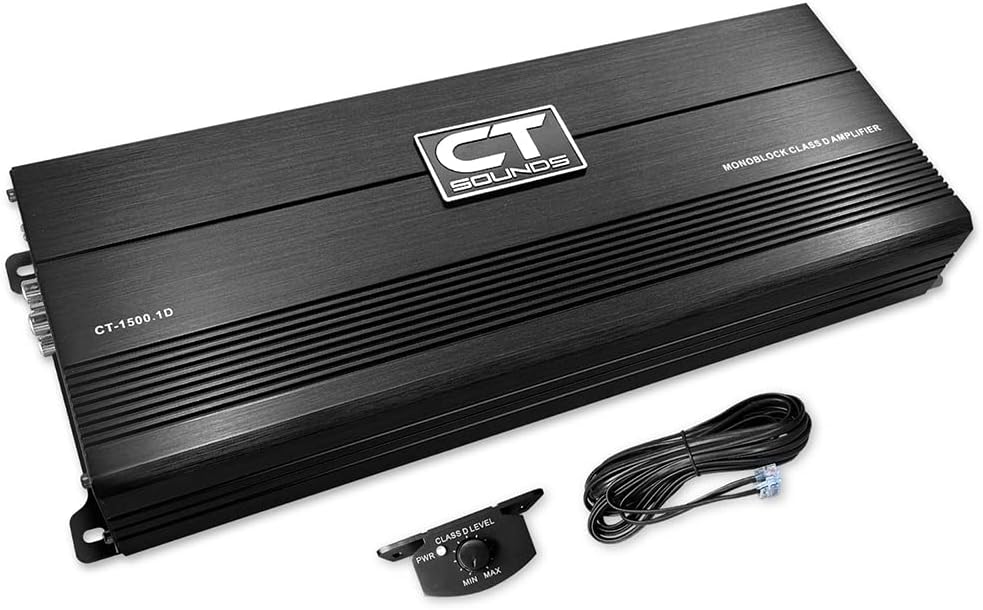
The CT Sounds CT-1500.1D offers a strong combination of compact construction and clearly stated output, earning a 4.5 rating in the supplied data. It delivers 1500 watts RMS at one ohm, 850 watts RMS at two ohms, and 450 watts RMS at four ohms when tested at 14.4 volts. This makes it easier to compare the amplifier with a subwoofer's actual wiring configuration.
We may earn a commission when you buy through this link, at no additional cost to you.
Its MOSFET pulse-width-modulated power supply and proprietary heat-dissipation design are intended to support efficiency and consistent operation. Four-way protection covers high voltage, low voltage, overcurrent, and high temperature, addressing the four conditions most likely to interrupt a car-audio installation. The compact chassis is especially helpful where trunk or under-seat space is limited.
The supplied specifications do not describe a variable low-pass filter, subsonic control, or phase adjustment, so buyers should not assume those functions are present. The listed response extends from 0 to 320Hz and the product includes a bass knob, but the available adjustment beyond that remote level is not fully described.
It is best suited to installers who value clear one-ohm output, compact dimensions, and robust protection over a large collection of filters. With a one-ohm subwoofer, the amplifier can deliver its headline RMS figure; with two or four ohms, it still provides useful power while offering more installation flexibility.
The CT-1500.1D is a balanced recommendation for a compact daily-driver system. It does not need a complex feature list to be convincing: its defined power curve, efficient design, protective circuitry, and space-conscious format are the decisive attributes for a straightforward subwoofer installation.
The difference between 1500, 850, and 450 watts across one, two, and four ohms makes this amplifier easier to match responsibly. Select the output rating that corresponds to the final parallel or series wiring rather than choosing solely from the largest number.
The compact chassis reduces the space required in crowded vehicles, while high-voltage, low-voltage, overcurrent, and thermal protection help guard against installation or operating faults. These protections do not replace correct wiring, but they add a useful safety layer.
We may earn a commission when you buy through this link, at no additional cost to you.
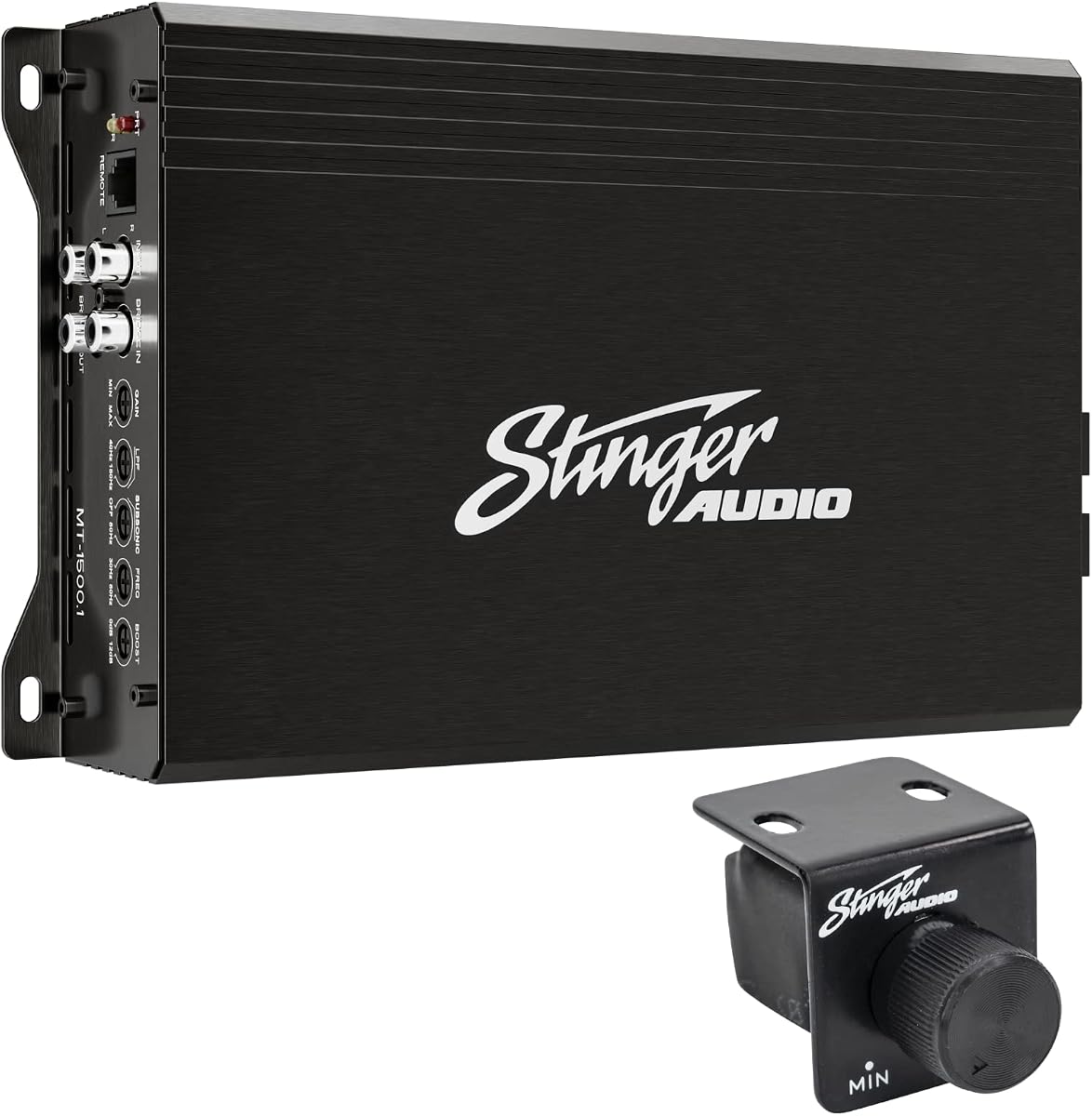
The Stinger Audio MT15001 is a compact Class D monoblock aimed at installers who want several adjustment options in a limited footprint. It has a 4.2 rating and measures 6.10 inches long, 10.16 inches wide, and 2.09 inches high according to the supplied information. That long, shallow format may be easier to accommodate than a deeper square enclosure.
We may earn a commission when you buy through this link, at no additional cost to you.
The amplifier supports one-, two-, and four-ohm operation and lists 1000 watts RMS at two ohms and 550 watts RMS at four ohms. A stated signal-to-noise ratio of minus 93dB indicates attention to noise control. Controls include 0dB to 12dB of bass boost, and the included remote controller can be mounted in a dashboard bracket or fitted flush into a custom panel.
Its most notable feature is the supplied information about selectable strap impedance. However, the listing also states an unusually high bridged output, making it particularly important for buyers to verify the exact configuration, load rating, and test conditions. A high headline figure should never be treated as equivalent to sustained one-ohm RMS power.
The MT15001 is most appropriate for a compact installation with a two-ohm or four-ohm subwoofer system and a preference for a feature-rich control panel. It can also suit one-ohm applications, but the advertised output is lower than the headline 1500-watt designation suggests at that impedance.
It remains a worthwhile option for space-conscious users, especially because the remote mounting hardware supports a clean factory-style installation. The main reason to pause is specification ambiguity, so detailed confirmation of the manufacturer's load chart is the most important purchasing step.
A shallow 2.09-inch height can be valuable in trunks with carpeting, under seats, or in tight equipment enclosures. Measure the available area and account for ventilation, terminal clearance, and the depth of attached wiring before choosing it.
The supplied dash bracket and flush-mounting option make the remote control easier to integrate than a basic panel-mount potentiometer. This is useful when the amplifier is mounted away from the driver's seat.
We may earn a commission when you buy through this link, at no additional cost to you.
The Sundown Audio SFB-1500D is a feature-oriented monoblock with a 4.5 rating and strong output across common subwoofer impedances. It produces 1500 watts RMS at one ohm, 1200 watts RMS at two ohms, and 650 watts RMS at four ohms, giving buyers a clear picture of how output changes with load.
We may earn a commission when you buy through this link, at no additional cost to you.
Its tuning controls are a major strength. A variable 12dB-per-octave low-pass filter, a high-pass filter, and 0-to-12dB bass boost allow the amplifier to be matched to a range of subwoofer systems. The wired remote includes a clipping indicator, which helps users identify excessive gain without relying only on sound quality.
Thermal management is handled by a smart three-speed cooling fan, while four-way protection covers thermal, voltage, speaker-short, and DC-offset conditions. The dual MOS-FET pulse-width-modulated power supply, 140A fuse rating, and 100dB signal-to-noise ratio add further detail to an otherwise installation-focused design.
The main practical concern is the need to preserve airflow around the active cooling system. Despite its compact 7.25 by 6.75 by 2.5-inch chassis, it should not be buried against carpeting or enclosed in a sealed compartment without checking thermal requirements.
This is an excellent all-around recommendation for a dedicated subwoofer amplifier when the buyer wants meaningful output plus more precise tuning than basic EQ-only models. It suits one-, two-, or four-ohm configurations and offers a stronger control package than many competing mid-range monoblocks.
The adjustable low-pass and high-pass filters provide more control over which frequencies reach the subwoofer and how the system blends with front speakers. This is especially useful in installations where a factory head unit offers few processing options.
A clipping indicator on the wired remote gives the driver immediate feedback when gain is too high. It is a practical safeguard against clipping and helps make gain-setting less guesswork.
We may earn a commission when you buy through this link, at no additional cost to you.
The Crunch Ground Pounder GP-1500.2 is a two-channel amplifier for shoppers who want one box to cover several speaker configurations. It has a 4.1 rating and supplies 750 watts per channel at two ohms or 325 watts per channel at four ohms. In bridged mono mode, the listed maximum is 1500 watts into four ohms.
We may earn a commission when you buy through this link, at no additional cost to you.
The amplifier can operate in stereo, bridged mono, or a combination of stereo and bridged mono simultaneously. This is useful for a system that combines front speakers and a subwoofer without immediately adding a separate monoblock. Its variable 12dB-per-octave electronic crossover provides basic frequency division between system sections.
Because it is not a dedicated one-ohm subwoofer monoblock, it should not be compared directly with the products rated 1500 watts RMS at one ohm. The 1500-watt designation in this model represents a bridged configuration at four ohms, so system design and channel allocation matter more than the headline number.
It is best for a flexible installation serving full-range speakers and a bridged subwoofer, especially where amplifier count and installation simplicity are priorities. Users should confirm that the amplifier's mixed-mode operation meets their chosen crossover requirements and that each channel's load remains within specification.
The GP-1500.2 is a useful all-in-one alternative for straightforward mobile-audio layouts, though it is less appropriate for a high-power, low-impedance subwoofer installation. Its strength is versatility rather than specialized one-ohm bass amplification.
Stereo, bridged, and mixed operation let the amplifier follow different system plans as needs change. That flexibility can reduce installation complexity, although each mode has distinct load and output requirements.
This model reaches its headline figure in bridged mono operation at four ohms. The output is not equivalent to 1500 watts RMS into one ohm, so shoppers should compare the same impedance and configuration across products.
We may earn a commission when you buy through this link, at no additional cost to you.
The Audiobank P1502 is a bridgeable Class AB two-channel amplifier with a 4.0 rating. Unlike many monoblocks in this roundup, it is designed to serve component speakers, coaxial speakers, or a bridged subwoofer. Its maximum output is listed as 1500 watts, but the listing does not provide the same detailed RMS-at-impedance figures for every configuration.
We may earn a commission when you buy through this link, at no additional cost to you.
It supports separate left and right channels, bridge the channels for a single-speaker arrangement, or use tri-mode operation. Being 2-ohm stable broadens the range of compatible speaker loads. A continuously variable low-pass filter spans 40Hz to 300Hz, while the high-pass adjustment covers 80Hz to 4kHz, providing useful control for a complete multi-speaker system.
Input flexibility is another advantage. Nickel-plated RCA and speaker-level inputs allow connection to aftermarket head units or factory-style sources, and the remote turn-on circuit coordinates amplifier activation with the rest of the vehicle audio system. Bass boost ranges from 0 to plus 12dB, with adjustable gain for matching the source.
Compared with a compact Class D monoblock, a Class AB design can produce more heat and may require more deliberate mounting and ventilation. The maximum-output label also calls for careful comparison with RMS ratings. It should not automatically be considered stronger than a dedicated 1500-watt RMS monoblock.
The P1502 is most appealing to installers building a full system rather than a subwoofer-only arrangement. Its crossover controls, broad input selection, and support for multiple operating modes make it a practical choice for cars, trucks, motorcycles, recreational vehicles, boats, and other mobile installations.
RCA and speaker-level inputs make it easier to use the amplifier with modern aftermarket units or vehicles equipped with factory audio. Speaker-level input can simplify integration when a suitable signal is available.
Variable high- and low-pass filters, tri-mode capability, and two-ohm stability make this more flexible than a dedicated subwoofer monoblock. It is a compelling choice for multi-speaker systems where one amplifier must perform several jobs.
We may earn a commission when you buy through this link, at no additional cost to you.
The Skar Audio SA-1500.1D is a high-performance Class D monoblock with a 4.6 rating. It produces 1550 watts RMS and 2800 watts peak at one ohm, giving it the highest listed RMS figure among the dedicated monoblocks in this guide. Its 10Hz to 250Hz frequency response covers the typical operating range of a subwoofer amplifier.
We may earn a commission when you buy through this link, at no additional cost to you.
Its standout feature is the collection of controls. Adjustable bass gain, a subsonic filter, a low-pass filter, and bass boost provide a more complete tuning package than many budget monoblocks. The subsonic filter is particularly valuable for limiting very low-frequency content that can cause excursion or waste amplifier power without adding audible bass.
Convenience features include automatic remote turn-on, an LED status indicator, and a quick-disconnect terminal plug. The power and ground input size is listed as 4 AWG, appropriate for the current demands of a high-output Class D design. The included controls make the amplifier easier to configure without relying entirely on the source unit.
The main caution is that multiple bass-shaping tools can create problems when they are all applied aggressively. Bass boost and low-pass settings should be adjusted systematically, and the subsonic cutoff should match the subwoofer's usable range. More controls are not automatically better if the installer lacks a disciplined tuning process.
The SA-1500.1D is a strong recommendation for buyers who want a modern dedicated monoblock with substantial one-ohm output and useful filtering. It is particularly well suited to a single high-power subwoofer or a carefully configured multi-sub system using a safe combined load.
The dedicated low-pass and subsonic controls let the installer separate the subwoofer from the rest of the system while protecting it from implausibly low frequencies. These controls are particularly useful with a subwoofer that has a defined mechanical limit.
Automatic remote turn-on reduces trigger-configuration effort, while the LED gives a quick visual status reference. The quick-disconnect plug may simplify service or temporary removal, provided it is used only within the manufacturer's wiring guidance.
We may earn a commission when you buy through this link, at no additional cost to you.
The Rockford Fosgate Power T1500-1bdCP is a premium mono amplifier with a 4.7 rating. Its Constant Power approach is designed to maintain useful output as impedance changes, with supplied figures of 1000 watts at four ohms, 1500 watts at two ohms, and 1500 watts at one ohm. That consistency makes it easier to match the amplifier to a range of subwoofer loads.
We may earn a commission when you buy through this link, at no additional cost to you.
The full chassis measures 2.14 by 8.14 by 14.91 inches, so installation space is the most obvious constraint. It is clearly intended for a dedicated car or truck audio installation where a trunk, under-seat location, or equipment enclosure can accommodate its depth. Four-gauge-class installation practices are appropriate for a high-current premium unit, subject to the manufacturer's wiring recommendations.
Audio integration is a major strength. Balanced differential RCA pass-through outputs support flexible signal routing, while the onboard Punch EQ provides up to plus 18dB of boost at 45Hz. A 24dB-per-octave Butterworth crossover offers a steep, controlled low-pass slope for reducing overlap with front speakers.
The Class BD design is intended to provide high output with reduced strain on the vehicle's electrical system, but adequate power and grounding remain essential. A premium amplifier cannot compensate for an undersized cable, weak ground, or a battery and alternator system unable to support peak demand.
This amplifier is best for a serious subwoofer build where power consistency, robust construction, and refined integration matter. It is less attractive for a small daily-driver system because of its size and likely electrical requirements, but for a properly engineered installation it represents one of the most complete options in the guide.
Constant Power is the key technical distinction. Instead of treating maximum output as a single headline condition, the design is presented as maintaining useful output across multiple impedances, which can simplify subwoofer matching.
Balanced differential pass-through outputs and a steep 24dB-per-octave Butterworth crossover provide sophisticated control over system boundaries. The 18dB Punch EQ adds low-frequency impact, though it should be adjusted carefully to avoid masking the crossover setting.
We may earn a commission when you buy through this link, at no additional cost to you.
The Alpine R2-A150M has a 4.9 rating, the highest among the ten products included here, and is designed around Alpine's R-Series subwoofer ecosystem. It is intended to match the power handling of two 10-inch or 12-inch R-Series subwoofers, as well as four 8-inch R-Series subwoofers, with the latter configuration listed at 1200 watts into two ohms.
We may earn a commission when you buy through this link, at no additional cost to you.
Its 1500-watt one-ohm capability makes it appropriate for a substantial dedicated bass system. Alpine's Class D amplifier circuit is presented as combining sound quality and efficiency, which benefits vehicles with limited installation space and electrical capacity. The amplifier is configured to drive a large subwoofer arrangement through one mono channel.
Installation is unusually convenient. All speaker connections are placed on one side, and amplifier controls are moved to the top beneath a removable plate. This keeps the adjustment area accessible even when the chassis is mounted in a tight location. Integrated mounting brackets eliminate the need to fabricate separate brackets for many installations.
The main limitation is specialization. Alpine states that the amplifier is designed to match particular R-Series subwoofers, so buyers with other premium subwoofers should verify every electrical and compatibility specification rather than assuming it will pair well with any model. One-ohm operation also requires a correctly wired subwoofer configuration.
For a compatible Alpine R-Series build, the R2-A150M is a refined and remarkably practical recommendation. Its combination of strong output, accessible controls, efficient topology, and integrated mounting hardware makes it particularly compelling for installers who want thoughtful factory integration.
The stated pairing with two R-Series 10-inch or 12-inch subwoofers, or four 8-inch models, gives buyers a clear design target. Matching the amplifier to the intended speakers is more meaningful than simply matching a nominal wattage number.
One-sided speaker connections and top-mounted controls improve access during installation and adjustment. Integrated brackets further reduce the need for separate mounting hardware, although final fitment still depends on the vehicle's available space.
We may earn a commission when you buy through this link, at no additional cost to you.
The Sundown Audio SAEv4-1500D is a feature-rich Class D monoblock rated 4.5. It produces 1500 watts RMS at one ohm, 800 watts RMS at two ohms, and 450 watts RMS at four ohms, providing a clearly defined output curve for matching different subwoofer configurations.
We may earn a commission when you buy through this link, at no additional cost to you.
The most advanced tuning feature is 0-to-180-degree phase shift control. A variable 40Hz to 180Hz low-pass filter handles the upper cutoff, while a 10Hz to 40Hz subsonic filter helps protect the subwoofer from excessively low content. Together, these controls allow a more careful match between the subwoofer and front speakers.
A dual MOS-FET pulse-width-modulated power supply and heavy-duty aluminum heat sink support efficient power delivery and thermal control. Protection circuitry covers thermal, voltage, speaker-short, and DC-offset faults. Power, clipping, and protection indicators provide real-time status information, adding visibility during setup and operation.
The included wired remote includes a clipping indicator, allowing the driver to recognize excessive gain. That feature is useful, but the range of phase, crossover, subsonic, and gain adjustments can be overwhelming for a first-time installer. Correct setup requires patience, test tones, and a repeatable process.
The SAEv4-1500D is best suited to an enthusiast who wants precise low-frequency integration and values phase control. It is also appropriate for simpler one-ohm systems, though its broad adjustment package distinguishes it from models designed primarily around compactness or basic level control.
The 0-to-180-degree phase adjustment can improve alignment between the subwoofer and front speakers when the system is installed in a challenging vehicle cabin. It should be tuned by listening and measurement rather than set automatically.
Separate power, clipping, and protection indicators help distinguish normal output from an overload or fault. Combined with the remote's clipping indicator, this gives the installer useful feedback before the problem becomes audible.
We may earn a commission when you buy through this link, at no additional cost to you.
Choosing a 1500-watt car amplifier involves matching power ratings to the intended speaker load, choosing the right channel architecture, and accounting for electrical, thermal, and installation requirements. The most important specifications must be compared in equivalent configurations.
RMS power is the more useful figure for sustained amplifier output, while peak power describes a short-term maximum. A product marketed as 1500 watts may reach that number through peak output at one ohm, RMS output at one ohm, maximum output in a bridged four-ohm arrangement, or another specified condition. These ratings are not interchangeable. Match the amplifier's output at the exact impedance produced by the final subwoofer wiring, because adding or removing a parallel speaker changes the load and can reduce available power.
Compare like-for-like impedance and test conditions. Prioritize a clearly stated RMS rating at the intended load, then treat peak and maximum figures as supplementary information.
Check the subwoofer manufacturer's recommended impedance and the amplifier's minimum stable load. A one-ohm-capable amplifier provides the most flexibility for certain multi-sub configurations, but it also demands more current from the vehicle's electrical system. Two- and four-ohm loads reduce current demand and may be easier to power safely. Confirm the final combined impedance with the speakers disconnected, rather than estimating from the number of subwoofers alone.
Choose a stable amplifier that covers the final load without forcing a fragile configuration. Safety and electrical headroom matter more than obtaining the largest possible headline rating.
A monoblock is purpose-built for a subwoofer and usually concentrates its power handling into one low-frequency channel. A two-channel amplifier can serve front speakers, a bridged subwoofer, or both in supported mixed configurations. The Audiobank and Crunch models in this guide provide broader flexibility, while the dedicated monoblocks concentrate their features around bass-system tuning.
Choose a monoblock for a straightforward subwoofer-focused build. Choose a multi-channel amplifier when one unit must handle several speaker groups and the installation benefits from shared wiring and controls.
A low-pass filter sets the upper frequency limit for the subwoofer, while a subsonic filter removes content below the speaker's safe or useful operating range. Variable high-pass filters help a multi-speaker system separate overlapping frequencies. Phase control can improve integration, and bass boost or bass EQ provides quick tonal emphasis, although excessive boost can increase distortion and consume amplifier headroom. A fixed-response amplifier may be adequate when a high-quality external processor handles system tuning.
Prioritize a variable low-pass filter and a properly configured subsonic filter. Treat bass boost and phase controls as refinement tools, not substitutes for correct gain, crossover, and speaker-load matching.
A high-output amplifier can draw enough current to overwork stock wiring, grounds, or an aging alternator. Use appropriately sized power and ground cables, a correctly rated fuse near the battery, and a clean connection to the chassis. For a serious installation, a secondary battery, capacitor, or electrical-system upgrade may be appropriate, depending on vehicle and amplifier requirements. The amplifier's power figure is only useful when the rest of the electrical path can support it.
Budget for the complete power path rather than the amplifier alone. Correct cables, protection, grounding, and battery charging capacity can cost as much as the amplifier and are essential to reliable operation.
Measure the installation area before choosing, including the depth of terminals, wire bend radius, ventilation, and the space required by a remote or control plate. Large premium amplifiers may offer impressive output but require a dedicated trunk location, while compact models can fit under seats or in tighter compartments. Pay special attention to active fan systems and heat sinks, which need clearance and airflow. An amplifier that cannot dissipate heat reliably may shut down or fail during sustained use.
Choose a chassis that fits with ventilation to spare. A smaller amplifier that is poorly ventilated can be less dependable than a larger model mounted with proper clearance.
Useful protection includes thermal, over-voltage, under-voltage, overcurrent, short-circuit, and DC-offset coverage, although not every amplifier implements every function. Status LEDs and clipping indicators provide additional visibility during installation. They are particularly helpful when setting gain or operating near the limits of the speaker and electrical system. Protection circuits should supplement sound installation practices rather than be treated as permission to use undersized wiring.
Look for protection that matches the product's architecture and understandable indicators for routine monitoring. A clear fault indication can prevent a minor issue from becoming a larger installation problem.
RCA inputs suit aftermarket head units and signal processors, while speaker-level inputs can simplify connections to factory systems. A remote subwoofer level control is useful in a daily-driven vehicle because it lets the driver reduce bass without changing the head unit. Automatic remote turn-on can reduce setup complexity. A wired remote with a clipping indicator is even more useful because it combines convenience with setup feedback.
Confirm that the supplied cables and controls fit your vehicle. A feature is valuable only when its mounting, wiring, and signal compatibility align with the rest of the system.
Begin with a safe electrical plan. Disconnect the battery before working on power wiring, identify a clean chassis ground, and install the appropriate fuse near the battery. Route correctly sized power and ground cables away from sources of electrical noise. Verify the subwoofer's final impedance and confirm that it is stable on the amplifier before connecting speaker wires.
Set controls conservatively during installation. Begin with gain, bass boost, low-pass, high-pass, subsonic, and phase at neutral positions where possible. Connect the amplifier after completing the wiring, then restore power and set gain using a suitable test method. Adjust the low-pass filter to blend the subwoofer with the front speakers, and use the subsonic filter to remain within the subwoofer's recommended range.
Give the amplifier an initial break-in period at moderate volume and closely monitor for heat, noise, or protection indicators. Keep ventilation paths open, securely fasten the chassis, and inspect connections periodically. If the amplifier enters protection, reduce the load or check voltage, grounding, gain, and speaker wiring rather than immediately increasing the fuse rating.
No. Output usually changes with speaker impedance, and a headline rating may describe peak, maximum, or RMS power under a specific condition. Check the rated output at the exact load created by the final subwoofer wiring. An amplifier that produces 1500 watts RMS at one ohm may deliver less when connected to two or four ohms.
Not automatically. One-ohm capability allows certain multi-subwoofer configurations and can provide additional power, but it also increases current demand and makes correct power wiring more important. Use a stable one-ohm amplifier when the subwoofer configuration requires it and the vehicle's electrical system can support it.
Yes, if the amplifier supports bridged mono operation and the resulting load falls within its specifications. A bridged configuration can provide more output than one channel operating alone, but the signal connection and impedance requirements differ from normal stereo wiring. Follow the amplifier's wiring diagram carefully.
Bass boost increases the level of specific low frequencies, while a low-pass filter removes higher frequencies above a chosen cutoff. Boost can make bass sound louder but may increase distortion and reduce headroom. The low-pass filter defines how the subwoofer blends with the rest of the audio system.
A subsonic filter is highly useful because it limits content below the subwoofer's safe or useful range. It can reduce unwanted cone movement and help the amplifier direct more useful energy into the audible bass region. Set the cutoff according to the subwoofer manufacturer's recommendations rather than using an arbitrary value.
Protection can activate because of thermal stress, low vehicle voltage, speaker or output faults, excessive current, or DC offset. Check the protection indicator, wiring, fuse, grounding, ventilation, and subwoofer impedance before changing components. Continuing to operate the amplifier in a repeated protection state can create additional problems.
Requirements depend on actual RMS output, load, vehicle voltage, and installation length. The correct cable size must support sustained current without excessive voltage drop, and the fuse must be appropriately rated and located near the battery. Follow the amplifier manufacturer's recommendations or consult a qualified installation specialist for a high-current build.
A monoblock is usually the better dedicated choice for one or more subwoofers because its power and controls are focused on low-frequency use. A multi-channel amplifier can be more practical when it must also power front speakers or support a simpler shared installation. Match the channel design to the entire system rather than choosing only from the wattage label.
The Alpine R2-A150M stands out for its 4.9 rating, Hi-Res positioning, accessible controls, and deliberate design for R-Series subwoofers. The Rockford Fosgate Power T1500-1bdCP is the premium choice for buyers seeking Constant Power behavior, refined crossover integration, and a full-chassis construction, while the Skar RP-1500.1D provides the best budget-oriented path to 1500 watts RMS at one ohm.
For most subwoofer-focused systems, prioritize stable operation at the final speaker load, meaningful RMS output, a properly adjusted low-pass filter, a useful subsonic filter, and reliable protection. Advanced phase, bass-boost, and remote features are worthwhile only when the installer understands how they interact. A larger or more expensive amplifier is not automatically the right choice if its output does not match the speakers.
Before buying, verify the current product details, impedance ratings, dimensions, included accessories, and warranty terms. Product configurations and prices can change, so use the guide to identify the required performance and installation features, then check the latest listing before making a final purchasing decision.