
Sky-Watcher Heritage 130mm Tabletop Dobsonian
4.5Editor score
Compact all-in-one tabletop design
Includes two eyepieces and finder
Requires no basic assembly
Dobsonian telescopes pair a Newtonian reflector with a smooth, intuitive altazimuth base, making them one of the most effective ways to explore the night sky. A good model balances aperture, stability, portability, accessories, and simple operation, with larger instruments revealing substantially more detail when conditions allow.
This guide compares ten featured telescopes using the supplied specifications, emphasizing the factors that affect real-world observing. It covers compact tabletop reflectors, full-size traditional Dobsonians, collapsible designs, smartphone-guided models, and one computerized Schmidt-Cassegrain included as an alternative for observers who value automated pointing.
Each numbered review explains the telescope’s strongest benefits, practical trade-offs, and best audience. The list also identifies three standout choices: a budget-friendly Heritage 130mm, an app-enabled Celestron StarSense Explorer 10-inch, and the feature-rich Sky-Watcher Virtuoso GTI 150P. Prices and availability can change, so check current listings before buying.
4.5Editor score

4.4Editor score

4.3Editor score
As an Amazon Associate we earn from qualifying purchases.
The comparison below organizes the featured instruments by optical design, aperture, base style, guidance system, portability, and supplied accessories. Although the final entry is a Schmidt-Cassegrain rather than a Dobsonian, it provides a useful automated alternative for shoppers whose priorities differ from those of a traditional Dobsonian buyer.




The Sky-Watcher Heritage 150 Tabletop Dobsonian combines a 150mm aperture with a compact, collapsible tube and a straightforward tabletop base. Its 4.2 rating reflects a practical balance of capability and convenience, while the fast f/5 design makes it useful for lunar and planetary observations as well as brighter deep-sky targets.
We may earn a commission when you buy through this link, at no additional cost to you.
The principal attraction is the combination of 150mm aperture and 750mm focal length. A relatively short optical tube produces brighter, wider views than a long-focal-length reflector, which can make the telescope enjoyable for sweeping the Moon, inspecting planetary detail, and locating larger deep-sky objects. The borosilicate parabolic primary and Radiant Aluminum Quartz treatment support the telescope’s practical performance-oriented design.
Portability is handled by the collapsible tube, which is designed to retain collimation while reducing the space needed for storage. The 1.25-inch helical focuser provides a straightforward focusing solution, and the rubber feet help reduce vibration while increasing stability on a suitable table. It does not have electronic pointing, motorized tracking, or a smartphone interface, so finding faint targets remains entirely manual.
This is a strong choice for beginners who want more collecting area than a very small tabletop reflector without moving to a full-size 8-inch Dobsonian. It also suits observers with limited storage space. For people who want automatic GoTo positioning or maximum faint-object resolution, one of the app-enabled or larger-aperture models in the list may be more appropriate.
The 150mm aperture gives this compact reflector meaningful light-gathering capability while retaining the convenience of a tabletop instrument. Its fast focal ratio also supports broad, bright views that can be especially satisfying for lunar work and bright planets.
The collapsible optical tube reduces storage and carrying demands without requiring a permanent observing station. That makes the Heritage 150 practical for renters, apartment dwellers, and anyone who wants to move outside when the sky conditions are favorable.
We may earn a commission when you buy through this link, at no additional cost to you.
The Celestron StarSense Explorer 10-inch is the most capable traditional Dobsonian in this group, combining a 254mm Newtonian reflector with app-assisted sky navigation. Its 4.4 rating and extensive feature set make it an attractive all-around choice for observers who want substantial aperture without a computerized equatorial mount.
We may earn a commission when you buy through this link, at no additional cost to you.
StarSense technology analyzes recognizable star patterns in the sky and uses the phone to determine the telescope’s position. The app then supplies a list of suitable targets for the current time and location and provides arrows that guide manual movement of the telescope. This removes much of the learning curve associated with naked-eye star hopping while preserving the simplicity of a Dobsonian base.
The 10-inch reflector offers a major step in light-gathering power over the 4.5-inch and 5-inch instruments listed. That extra aperture can reveal finer lunar features, improve the appearance of planets such as Jupiter and Saturn, and make targets including the Orion Nebula and Andromeda Galaxy more accessible. The XLT coatings, ultra-stable altazimuth base, and smooth manual tracking help make that capability usable.
The main limitation is that the mount is not motorized. Users must still move the telescope manually, although the app makes that movement more systematic. Its larger optical tube and base also take up more room than tabletop models. Even with those trade-offs, it is the most balanced choice here for a buyer who values both aperture and guided target discovery.
The StarSense app is most valuable when a beginner is learning the sky. Its arrows and bullseye instructions create a repeatable process for moving from a bright target to a less obvious object while leaving the observer in control of the telescope.
The 254mm reflector gathers considerably more light than the smaller tabletop models. Under darker conditions, that difference can translate into clearer planetary detail, better-defined lunar contrast, and a more convincing view of larger deep-sky objects.
We may earn a commission when you buy through this link, at no additional cost to you.
The Celestron StarSense Explorer 114AZ offers a guided alternative to a conventional tabletop Dobsonian. Its 114mm, or 4.5-inch, Newtonian reflector is supported by an app that recognizes the sky, identifies the telescope’s position, and suggests targets suited to the current date and observing location.
We may earn a commission when you buy through this link, at no additional cost to you.
The principal benefit is accessibility. Instead of requiring a new observer to learn a star chart and estimate the movement of the telescope, the app supplies directional instructions until the target sits in the bullseye. It also generates a curated list of planets, nebulae, galaxies, and clusters that may be visible from the observer’s location.
The telescope itself remains conventional in its controls. The manual altazimuth tabletop base uses familiar up-and-left-and-right movement, and the reflector’s high-reflectivity coatings are designed to provide sharp views of the Moon, Jupiter, Saturn, the Orion Nebula, and the Andromeda Galaxy. It is therefore a good middle ground between a fully manual beginner scope and a computerized telescope.
Its main limitation is aperture. The 114mm mirror will not match the light-gathering capability of the 10-inch StarSense Explorer, the Heritage 150, or either 8-inch Sky-Watcher. It is best suited to buyers who prioritize compact storage, modern guidance, and simple operation over observing the faintest possible targets.
The app-guided process makes this a practical first telescope for people who may feel daunted by conventional star hopping. It supports the same broad visual goals as a manual Dobsonian while providing a more structured way to locate objects.
The 114AZ avoids the bulk of a full Dobsonian while adding more electronic assistance than the smallest traditional tabletop reflectors. That balance makes it convenient for casual observing, travel, and use from a patio or balcony.
We may earn a commission when you buy through this link, at no additional cost to you.
The Sky-Watcher Heritage 130mm Tabletop Dobsonian is an appealing first telescope because it combines a relatively large 130mm aperture with a ready-to-use compact design. Its 4.5 rating is the highest listed here, and the supplied package includes the essentials a new observer needs for a first night under the stars.
We may earn a commission when you buy through this link, at no additional cost to you.
Rather than separating the optical tube from a large base, the Heritage 130 combines both elements in one portable tabletop package. It arrives fully assembled and needs no basic assembly, reducing the barrier between unpacking a telescope and beginning to observe. The 10mm and 25mm eyepieces provide useful magnification options, while the star-pointer finderscope assists with initial target location.
The 130mm primary mirror offers more collecting area than the 114mm Celestron models and the compact Celestron FirstScope, but it cannot equal the resolution and faint-object reach of the 8-inch or 10-inch instruments. The Radiant Aluminum Quartz coatings and collapsible overall design reinforce the telescope’s focus on practical use and portability rather than motorized conveniences.
This is the best budget-oriented pick in the list for beginners, families, and anyone who values a complete package without advanced electronics. Manual star hopping will take practice, but that can be an enjoyable part of learning astronomy. Buyers who expect to hunt extremely faint galaxies from the outset should consider a larger aperture or an app-guided model.
The fully assembled format and included eyepieces remove several common sources of early frustration. A new owner can learn the telescope’s basic movements and immediately begin with familiar targets such as the Moon.
The Heritage 130 delivers a meaningful step up in aperture while preserving the compact footprint of a tabletop Dobsonian. Its all-in-one construction makes it easier to carry between indoor storage and an observing location.
We may earn a commission when you buy through this link, at no additional cost to you.
The Sky-Watcher Classic 200 Dobsonian is a traditional 8-inch reflector on a full-size altazimuth base. Its 3.9 rating is the lowest in the group, but the underlying design remains appealing for observers who want a straightforward, capable instrument with no electronic dependencies.
We may earn a commission when you buy through this link, at no additional cost to you.
With a 203mm aperture, the Classic 200 offers significantly more light-gathering capability than the 4.5-inch and 5-inch tabletop scopes. The parabolic primary mirror and fully multi-coated borosilicate primary and secondary mirrors are intended to produce bright, contrast-rich views, with a listed faintest stellar magnitude of 14.2. The telescope’s 1,200mm maximum focal length supports conventional planetary observing as well as deep-sky use.
Movement is aided by patented tension-control handles and proprietary Teflon bearings in the azimuth axis. The supplied accessories include a 2-inch Crayford-style focuser with a 1.25-inch adapter, 25mm and 10mm super wide-angle eyepieces, and a 9×50 straight-through finder scope. The 45-pound assembled weight is substantial, but the listed 20-pound tube and 25-pound base make the two sections easier to handle separately.
This model makes the most sense for a buyer who wants a large aperture, enjoys manual operation, and can accommodate a permanent or semi-permanent observing setup. Compared with the StarSense Explorer 10-inch, it lacks app guidance; compared with the Flextube 200, it does not collapse for transport. Its simplicity and optical capability are still substantial strengths.
The Classic 200 avoids electronics and uses a familiar direct-drive altazimuth layout. For practiced observers, the straightforward operation can feel more immediate than working through a phone, while the 8-inch mirror remains capable for detailed visual observing.
A 2-inch focuser, eyepiece adapter, two wide-angle eyepieces, and a finder scope give the buyer a usable core setup. The accessory selection supports both wide-field views and higher-power planetary inspection.
We may earn a commission when you buy through this link, at no additional cost to you.
The Celestron StarSense Explorer LT 114AZ combines a 114mm Newtonian reflector with smartphone guidance and a manual altazimuth mount. Its 4.1 rating reflects a useful combination of modern assistance and familiar telescope control, although it is not one of the traditional all-in-one tabletop Dobs in the list.
We may earn a commission when you buy through this link, at no additional cost to you.
The StarSense app identifies star patterns overhead, determines the telescope’s position, and recommends visible targets based on time and location. This makes the system approachable for users who want guided discovery without moving to a fully computerized equatorial or altitude-azimuth mount.
Unlike the StarSense Explorer 114AZ tabletop model, the LT version uses an altazimuth mount with an altitude slow-motion adjustment controlled by a sliding rod. That refinement is useful when a target is close to the meridian and coarse movement alone may be less convenient. The 4.5-inch reflector uses high-reflectivity coatings for the Moon, bright planets, and recognizable deep-sky objects.
Choose this model if you value the StarSense workflow and the added altitude control but do not need a large 8-inch or 10-inch aperture. It is less compact than a tabletop Dobsonian and provides fewer faint-object details than the larger reflectors. The included two-year warranty and Celestron support add reassurance for a first guided telescope.
The sliding-rod slow-motion adjustment can make fine altitude changes easier to manage. It is particularly helpful once the telescope is near a target and the observer needs smaller corrections than the main movement provides.
StarSense turns a smartphone into a celestial navigation aid by analyzing the overhead star field. The resulting target list and directional guidance shorten the process of learning where notable objects are located.
We may earn a commission when you buy through this link, at no additional cost to you.
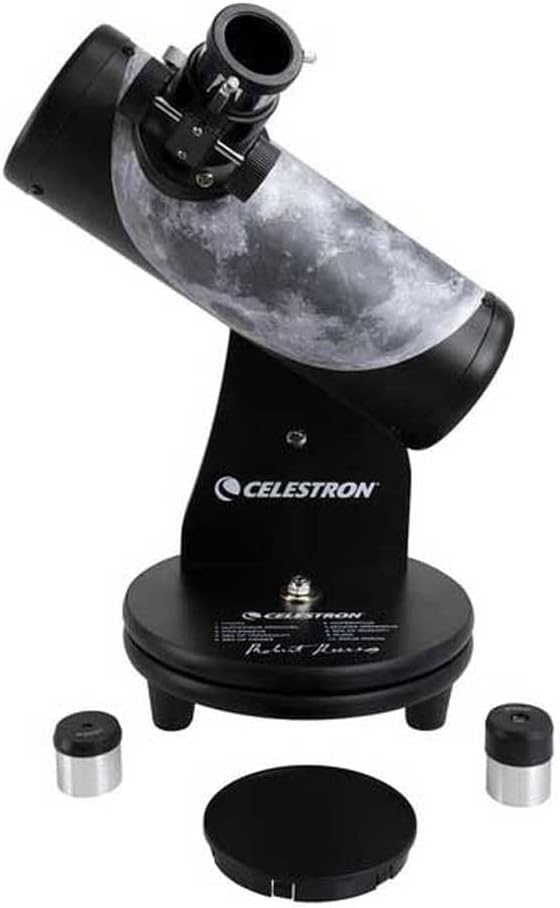
The Celestron FirstScope Signature Series Moon Tabletop Dobsonian is designed as an approachable compact instrument for beginning observers. Its 4.3 rating is favorable, and the straightforward tabletop format minimizes both physical bulk and operational complexity.
We may earn a commission when you buy through this link, at no additional cost to you.
The telescope is centered on the Moon, which remains one of the easiest and most rewarding targets for a new observer. Bright lunar features can reveal the effects of aperture, focus, and magnification without requiring advanced knowledge of faint deep-sky objects or detailed star charts.
What the supplied product information does not list is a complete set of optical and accessory specifications, so this review does not infer dimensions, focal length, eyepiece inclusion, or other technical details that have not been provided. It is nevertheless clear that the FirstScope Signature Series occupies the compact tabletop position within Celestron’s beginner-oriented range.
The telescope is best suited to a casual buyer who wants a simple Moon-viewing instrument and values the established warranty and support resources of Celestron. Observers interested in planets, smaller deep-sky objects, or broader long-term capability should compare it with the 114mm StarSense Explorer or the larger-aperture Heritage models before deciding.
A compact tabletop Dobsonian reduces the number of physical controls and setup concerns for a first-time owner. The result is an instrument that can be introduced with a focus on the Moon rather than complex alignment procedures.
The purchase includes a two-year warranty and access to Celestron’s United States-based support team. That support can be valuable when learning basic focusing, target selection, and telescope care.
We may earn a commission when you buy through this link, at no additional cost to you.
The Sky-Watcher Flextube 200 Dobsonian combines the light-gathering capability of an 8-inch reflector with a collapsible optical tube. Its 4.0 rating places it in the middle of the group, but the design stands out for buyers who want more aperture than a tabletop model without storing a full-length rigid tube.
We may earn a commission when you buy through this link, at no additional cost to you.
The unique strut system allows the optical tube to collapse for transport while maintaining collimation. That feature is more important than it may initially appear, because repeated separation and reassembly of some telescope tubes can make alignment less predictable. The Flextube’s structure is explicitly designed to preserve the telescope’s setup.
The 203mm primary and fully multi-coated borosilicate primary and secondary mirrors deliver the broad light-gathering benefit associated with an 8-inch Dobsonian. Teflon bearings support smooth azimuth movement, while the included 2-inch Crayford-style focuser, 1.25-inch adapter, 25mm and 10mm super wide-angle eyepieces, and 8×50 right-angle finder provide a versatile observing package.
The listed 40-pound assembled weight is divided between a 24-pound tube and 26-pound base, allowing the observer to transport the instrument in two main sections. It is still heavier than every tabletop option, but far more manageable than treating an 8-inch Dobsonian as a permanently installed instrument. It is ideal for observers who travel between dark-sky locations.
The collapsible tube addresses one of the traditional objections to larger Dobsonians: awkward storage and transport. Its strut-based structure offers a way to protect the optical setup while reducing the tube’s packed length.
Teflon bearings and tension-control handles support controlled movement when centering objects. These features are especially useful with a larger mirror, where smooth handling helps maintain a steady view.
We may earn a commission when you buy through this link, at no additional cost to you.
The Sky-Watcher Virtuoso GTI 150P is the most electronically advanced tabletop Dobsonian in the list. It combines a 150mm, 750mm focal-length reflector with full GoTo operation through the SynScan Pro app, while its dual encoders preserve the ability to move the telescope manually after alignment.
We may earn a commission when you buy through this link, at no additional cost to you.
The fast f/5 optical system is intended to produce bright, broad views of the Moon, planets, galaxies, and nebulae. Its 150mm aperture gives it a useful advantage over smaller 4.5-inch reflectors while remaining far more compact than an 8-inch or 10-inch full-size Dobsonian.
Built-in Wi-Fi removes the need for a separate external control device in the stated configuration. Users can select objects through the app, and the telescope can slew toward them after alignment. The patented Freedom Find technology is particularly important because it allows manual repositioning without losing the stored alignment, making it possible to center an object and then return to electronic navigation.
The collapsible tabletop design strengthens the Virtuoso GTI 150P’s premium appeal, combining portability with automated pointing. It is best for a buyer who wants a modern observing workflow but does not want the size and weight of a full Dobsonian. The trade-off is a more involved initial setup and a dependence on the app and alignment process compared with a purely manual reflector.
Dual encoders give the mount the unusual ability to retain alignment after the observer physically moves the telescope. This hybrid workflow is useful for quickly finding an object and then fine-tuning it by hand.
Built-in Wi-Fi and the collapsible tube make the Virtuoso GTI 150P unusually adaptable. It can serve casual visual observers, urban users who want guided targets, and anyone who wants substantial aperture without a large floor-standing base.
We may earn a commission when you buy through this link, at no additional cost to you.
The Celestron NexStar 8SE is not a Dobsonian telescope, but it is a relevant alternative for readers whose priorities are automation, tracking, and a compact optical design. Its 4.3 rating and fully computerized GoTo platform distinguish it from every manual or app-guided altazimuth model in the comparison.
We may earn a commission when you buy through this link, at no additional cost to you.
The 8-inch Schmidt-Cassegrain uses an aperture comparable to a large Dobsonian but presents it in a shorter, highly recognizable optical tube. It is intended to reveal fine lunar detail, cloud bands on Jupiter, galaxies, and globular clusters while remaining relatively portable compared with a full-size Newtonian on a conventional Dobsonian base.
The NexStar+ hand control provides access to a database of more than 40,000 objects, automatically slews the telescope to a selection, and tracks it continuously. SkyAlign asks the observer to center three bright stars or planets; the system then calculates the observing position and completes the alignment without requiring the user to know the objects’ names.
This model is the pick for an observer who wants a Celestron telescope to grow with, especially if automated positioning and tracking matter more than the intuitive, fully manual nature of a Dobsonian. It is heavier, more complex, and more dependent on electronics than the other options. Traditional Dobsonian buyers should regard it as an alternative rather than a direct category match.
The large object database, automatic slewing, and motorized tracking allow observers to spend more time looking through the eyepiece and less time manually positioning the tube. It is particularly appealing to users who already know many of the sky’s target names.
SkyAlign can use any three bright stars or planets that the observer can center, removing the need to identify exact alignment stars in advance. The process is designed to get the mount ready quickly for a normal observing session.
We may earn a commission when you buy through this link, at no additional cost to you.
The best Dobsonian telescope is the one that matches your available space, observing experience, and preferred targets. Aperture matters most for visual performance, but portability, guidance, accessories, and the type of mount can be equally important to how often you will actually use the instrument.
Aperture is the diameter of the primary mirror and is the strongest predictor of how much light a telescope can collect. A larger aperture generally reveals finer lunar details, separates planetary features more clearly, and makes faint galaxies and nebulae easier to see. The featured models range from the compact Celestron FirstScope to 8-inch and 10-inch instruments, creating a meaningful difference in capability.
Choose aperture based on both observing goals and logistics. Larger scopes are more rewarding under dark skies but are heavier, occupy more storage space, and can be less convenient for casual balcony sessions. A 4.5-inch to 5-inch model is appropriate for the Moon, bright planets, and learning the sky, while an 8-inch or 10-inch reflector is better for dedicated deep-sky observing.
Focal length determines how the optical system magnifies light and influences the width of the view. The Heritage 150 and Virtuoso GTI 150P use a 750mm focal length with a fast f/5 ratio, favoring broad, bright views. The Classic 200 lists a 1,200mm maximum focal length, which is better suited to detailed inspection of smaller planetary features when appropriate magnification is used.
A shorter focal length and wider field can make target acquisition and large deep-sky objects easier to see. A longer focal length increases magnification potential but narrows the field. Match the telescope to the accessories included and plan to use different eyepieces for wide views and detailed observations rather than relying on one magnification for every target.
A traditional Dobsonian base uses smooth altazimuth movement: the tube swings left and right in azimuth and tilts up and down in altitude. This direct, intuitive system requires no polar alignment and is one of the category’s main advantages. Tabletop bases reduce footprint, while full-size bases provide steadier support for larger optical tubes.
The NexStar 8SE represents a very different approach with a fully computerized altazimuth mount, automatic slewing, and tracking. That system is useful for observers who prioritize automation, but it is not a traditional Dobsonian and introduces more electronics, setup, and maintenance. Choose the base that matches your preferred observing workflow rather than assuming more automation is always necessary.
Portability depends on more than total weight. The Heritage 150 and Virtuoso GTI 150P use collapsible tubes, and the Heritage 130 combines its tube and base in one compact package. The Flextube 200 folds down but still has a 24-pound tube and 26-pound base. Full-size traditional Dobs are more suitable for a dedicated observing area or a vehicle with generous cargo room.
Consider where the telescope will live between sessions, whether you can carry it alone, and whether your observing site requires stairs or long walks. A highly portable scope that you are willing to use under a dark sky can provide more satisfaction than a larger instrument that remains inconvenient to move.
Manual Dobsonians are refreshingly simple, and learning to navigate the sky can become a rewarding part of the hobby. App-guided models such as the Celestron StarSense Explorer series use sky recognition to identify the telescope’s position and provide instructions for reaching targets. GoTo models automate slewing, while the Virtuoso GTI 150P adds the ability to move manually without losing alignment.
If you are buying a telescope for a child or a complete beginner, guidance can reduce frustration and make the first observing session more productive. If you enjoy learning a star chart and navigating independently, a manual scope is simpler and less dependent on a phone, software, or power. The best choice is the one you will understand and want to use.
Eyepieces determine magnification and apparent field of view, while a finder scope helps locate targets before looking through the main telescope. The Heritage 130 includes 10mm and 25mm eyepieces plus a star-pointer finder. The Classic 200 and Flextube 200 include 25mm and 10mm wide-angle eyepieces, a Crayford-style focuser with a 1.25-inch adapter, and a finderscope.
A useful starter package should provide both a low-power eyepiece for finding and a higher-power option for lunar and planetary detail. Check the focuser format as well, especially when comparing a 1.25-inch helical focuser with a 2-inch Crayford-style design. Accessories included at purchase can make the telescope immediately usable, but they are no substitute for choosing the correct magnification for a given target.
Mirror coatings improve light transmission and surface protection, while a parabolic primary can deliver sharper results than a spherical design when properly aligned. The Sky-Watcher models described here use Radiant Aluminum Quartz treatments, and the Celestron 10-inch uses high-reflectivity XLT coatings. The Classic 200 combines a parabolic primary with fully multi-coated borosilicate mirrors.
A smooth focuser makes fine adjustments easier and reduces the chance of frustrating jumps in focus. The included 2-inch Crayford-style focusers on the two 8-inch Sky-Watcher Dobs suit users who may later add eyepieces and accessories, while the 1.25-inch helical focuser on the Heritage 150 prioritizes simplicity and compactness. Consider upgrades only after confirming that the included setup meets your needs.
A warranty provides protection against manufacturing defects, but practical support can be just as useful for first-time owners. Celestron lists a two-year warranty and unlimited access to its United States-based experts for the StarSense Explorer, FirstScope Signature Series, and NexStar 8SE. The Heritage 130 also carries a two-year Sky-Watcher warranty.
Support is especially valuable when learning collimation, interpreting finder readings, or choosing eyepieces. Before purchasing, review the manufacturer’s warranty terms, replacement-part availability, and support channels. A well-supported telescope is easier to maintain and more likely to remain in regular use rather than sitting in storage after the first observing session.
Set up on a level, stable surface away from direct foot traffic and allow the telescope to acclimate to outdoor temperatures before focusing. For a tabletop model, use a sturdy table that can support the base without wobbling. For a full-size Dobsonian, assemble the base level and position the tube in its highest resting position before attaching the focuser and finder.
Begin with the lowest-power eyepiece and a bright, familiar target such as the Moon. Adjust the finder until its view is centered on the same object seen through the main eyepiece, then use the finder to locate other targets. For app-guided and GoTo models, complete the required alignment before trusting directional instructions or automatic slewing. Once a target is centered, switch to a higher-power eyepiece and use fine focus adjustments carefully.
After observing, remove the telescope from any damp location before covering it, and allow moisture to dissipate before storing it. Clean the objective or primary mirror only with an approved lens-cleaning fluid and a clean, lint-free cloth; avoid wiping the mirror with a dry tissue. Keep caps and lens covers on during storage, check that the base is locked and the tube is secure, and follow the manufacturer’s collimation and storage guidance for collapsible models.
A 4.5-inch or 5-inch model is usually the most practical starting point because it is manageable, versatile, and capable of satisfying views of the Moon and bright planets. An 8-inch or 10-inch model reveals more detail and faint objects, but it also requires more space and effort to move. Choose the largest telescope you can comfortably transport and use rather than focusing only on maximum aperture.
Yes. Their altazimuth bases move in the same intuitive directions as the observer’s head, and they do not require polar alignment. Many models also include eyepieces, finders, and simple manual controls. App-guided alternatives can make target finding even easier, but learning basic sky navigation remains a useful and enjoyable part of the hobby.
That depends on your storage, transport, and observing setup. A 10-inch telescope such as the Celestron StarSense Explorer 10-inch offers excellent light-gathering capability but is bulkier than a tabletop model. It is best for people with a dedicated observing area, a suitable vehicle, and the ability to move the instrument without regularly carrying it upstairs or across uneven ground.
GoTo is convenient when you want automated target selection, while a manual Dobsonian is simpler and often less expensive. App-guided StarSense models provide a middle ground by helping you locate objects while retaining manual movement. The best option depends on whether you value faster guided acquisition or the straightforward experience of learning to navigate the sky yourself.
Move the optical tube and base separately when possible, protect the mirror from bumps, and carry the instrument in padded sections. The Sky-Watcher Flextube 200 lists a 24-pound tube and 26-pound base, making two-piece transport practical, but the sections are still substantial. A collapsible model is a better choice when frequent transport or compact storage is the priority.
Yes. Dobsonians are excellent lunar telescopes, and larger apertures can reveal useful planetary color and detail on targets such as Jupiter and Saturn. Start with the lowest-power eyepiece to locate the object, then increase magnification gradually. Atmospheric seeing and excessive magnification can reduce the clarity of planetary views.
A well-aligned telescope can remain usable for many observing sessions, but transport, bumps, and changing temperatures may require occasional checks. Models with collapsible-tube systems are specifically designed to retain collimation when collapsed. If images appear consistently soft or doubled, check the finder alignment, focus, and optical collimation before assuming the telescope’s aperture is inadequate.
A tabletop Dobsonian is easier to store, carry, and set up on a balcony or patio, making it a practical choice for casual observers. A full-size model usually has a larger aperture and provides better performance on faint deep-sky objects, but it takes more space and effort. Consider how often you can realistically use the telescope under a darker sky.
The best overall choice in this guide is the Celestron StarSense Explorer 10-inch because it combines substantial aperture with approachable smartphone guidance and a stable altazimuth base. The Sky-Watcher Heritage 130mm stands out as the best budget pick, offering a complete, compact package for beginners, while the Virtuoso GTI 150P is the premium selection for buyers who want compact GoTo pointing with manual control.
Most shoppers should prioritize aperture, portability, and the level of guidance they actually want. Manual scopes are dependable and rewarding to learn, app-assisted models reduce early frustration, and fully computerized alternatives suit observers who value automation. The traditional Sky-Watcher 8-inch models and Celestron NexStar 8SE also deserve consideration when deeper detail, accessory support, or tracking outweigh bulk and complexity.
Before making a final purchase, verify the current listing, included accessories, warranty terms, compatibility requirements, and available space. Prices, promotions, and bundle contents can change, and the right telescope is ultimately the one that fits your observing habits, storage situation, and target list.