
Televes Ellipse Mix
4.6Editor score
High VHF and UHF optimization
Compact triple-boom directional design
Flexible attic or outdoor placement
This Deep Fringe TV Antenna guide compares 10 outdoor and indoor antennas for range, gain, filtering, channel coverage, installation, and reliable reception.
A deep fringe TV antenna is built for viewers who live far from broadcast towers or face heavy interference from buildings, hills, trees, and other obstructions. Unlike a basic indoor antenna, a capable fringe model combines broad frequency coverage, directional gain, low-noise amplification, and filtering to preserve weak over-the-air signals across both VHF and UHF stations.
This guide compares ten antennas using the information supplied by their manufacturers and sellers, including supported frequencies, amplification, filtering, claimed range, mounting options, included accessories, and intended installation environment. It covers indoor, attic, rooftop, and mast-mounted designs, emphasizing that an advertised range is only one part of a successful over-the-air setup.
Each review explains the strongest reasons to consider a particular model, along with practical limitations and installation considerations. The Televes DAT BOSS Mix stands out for advanced long-range reception, the Ellipse Mix offers a compact premium alternative, and the Stellar Labs bowtie is a straightforward option for conventional deep-fringe use. Product availability and prices can change, so confirm current details before purchasing.
4.6Editor score

4.6Editor score

4.2Editor score
The comparison below highlights each antenna's placement, gain strategy, frequency coverage, and distinguishing features, helping readers narrow the field before considering the more detailed reviews.



The Stellar Labs HDTV 80 Mile Deep Fringe Bowtie is a purpose-built option for households dealing with weak or distant over-the-air broadcasts. It carries a 4.2 rating and its defining attraction is a traditional bowtie configuration designed around directional reception rather than the broad, omnidirectional capture associated with many indoor antennas. The 80-mile claim makes it particularly relevant to rural viewers, but actual channel availability still depends on tower distance, terrain, obstructions, and transmitter power.
We may earn a commission when you buy through this link, at no additional cost to you.
The strongest quality of this antenna is its focused approach. A directional bowtie can concentrate reception toward a known group of broadcast towers, potentially producing a stronger signal-to-noise ratio than a less disciplined indoor setup. That makes the model a sensible starting point for viewers who have identified their local transmitters and can mount the antenna outdoors with a clear orientation. It avoids the complexity of multi-panel rotation or digital gain management while still targeting the core need of a deep fringe installation.
The main trade-off is that the supplied product information is much less detailed than that of the Televes models in this guide. It does not describe automatic band-specific gain, cellular filtering, a passive operating mode, or a comprehensive mounting kit. A shopper who values those specific engineering features may prefer a more extensively documented antenna. Those who want a direct, recognizable fringe solution and can handle precise positioning will find the simpler design easier to understand.
This is a strong recommendation for first-time fringe-TV shoppers looking for an outdoor bowtie with a long-range claim without moving to a multi-component motorized system. It is less suitable for viewers who need reception from towers spread in several directions or want automatic adjustment as signal conditions change. Confirm the local channel map before installation, then aim the antenna toward the strongest cluster of stations and rescan after any adjustment.
A directional bowtie is most useful when the desired stations occupy a similar bearing. Concentrating the antenna toward that direction can improve the useful signal arriving from those towers while limiting noise and unwanted signals from other areas.
The product is especially relevant for homes beyond ordinary indoor antenna territory. Its dedicated fringe positioning makes it easier to justify an outdoor installation than purchasing a basic flat panel that is unlikely to handle severe obstruction or distance.
We may earn a commission when you buy through this link, at no additional cost to you.
The GE Outdoor HD Digital TV Antenna is a versatile long-range option for viewers who want one product to work in an attic, on a roof, or on another suitable exterior mounting point. It has a 4.4 rating, a claimed reception distance of more than 70 miles, and broad VHF and UHF support. Its compatibility with standard coax connections makes it broadly useful with modern televisions, older sets equipped with compatible tuners, and converter boxes.
We may earn a commission when you buy through this link, at no additional cost to you.
Its most attractive feature is installation flexibility. An attic can provide a protected but elevated location, while outdoor placement may offer a clearer path to transmitters. The antenna is described as weather resistant and suitable for roof or mast mounting, so consumers are not locked into a single approach. NextGen TV support where available and support for current HD, 4K, and 8K UHD broadcast standards also make it a future-conscious choice.
There is less information about the amplification system than the Televes products provide. In particular, the supplied data does not describe independent High VHF and UHF gain adjustment, overload protection, passive operation, or cellular filtering. That makes the GE less obviously tailored to highly technical fringe installations, though its long-range positioning remains attractive. Correct aim and a high-quality connection remain just as important as the antenna itself.
The GE Outdoor model is a good match for suburban and rural households that want flexible mounting and broad compatibility. It is especially appropriate when an attic installation is convenient and outdoor wiring is not initially desired. Choose it over a premium engineered model when straightforward setup and general long-range reception matter more than advanced signal management. Review the channel map first and rescan whenever the antenna is moved or reoriented.
The ability to start in an attic and later move outside gives users a practical path for improving reception. Height and a clearer line of sight often matter more than making a complex adjustment to a modest indoor antenna.
Standard coax connectivity broadens the range of televisions and converter boxes that can be used. This reduces friction for households that already own compatible equipment and want to retain familiar setup routines.
We may earn a commission when you buy through this link, at no additional cost to you.
The Televes DAT BOSS Mix LR is the most technically comprehensive antenna in this group, combining a stacked triple-boom design, a built-in TForce preamplifier, automatic band-specific gain control, and filtering for FM and cellular signals. Its 4.6 rating reflects strong user reception, and the stated range of up to 100 miles makes it a natural fit for genuinely difficult fringe locations where every fraction of usable gain matters.
We may earn a commission when you buy through this link, at no additional cost to you.
The intelligent gain system is the model's defining feature. Instead of applying one fixed boost across every frequency, the BOSS-Tech system reportedly adjusts High VHF and UHF amplification independently. That approach is valuable in fringe areas because it can preserve weak signals while reducing the chance of overload from stronger nearby stations. The integrated LTE, 4G, 5G, and FM filtering also addresses a common source of instability: interference that is not originating from a television broadcaster.
Its directional triple-boom layout favors performance over compactness. Multiple directors and reflectors focus reception toward towers, and the listed front-to-back ratios help reject signals arriving from other directions. The antenna can operate in powered amplified mode or continue passing signals passively if power is unavailable, which adds resilience. A UL-listed dual-output power inserter, mast clamps, wrench, weather boot, and broad mast compatibility make installation more complete, although outdoor mounting still requires care and appropriate hardware.
This is the best overall recommendation for a challenging deep fringe installation where both VHF and UHF signals must be handled, interference is present, and the user wants more control than a basic antenna provides. It is less appropriate for a simple indoor setup or for viewers unwilling to aim and mount a directional outdoor antenna. Confirm tower direction, use quality coax, weatherproof connections, and scan channels again after fine-tuning.
Independent High VHF and UHF adjustment can keep output stable as different bands vary in strength. This is more nuanced than simply turning up a booster and may be particularly useful when weak stations coexist with much stronger transmitters.
Integrated rejection of cellular and FM interference helps preserve the quality of television signals before they reach the tuner. In a crowded environment, reducing non-broadcast noise can be as important as adding raw amplification.
The ability to pass signals in passive mode when power is unavailable provides a useful fallback. The integrated preamplifier and included power inserter also simplify the system compared with adding separate components.
We may earn a commission when you buy through this link, at no additional cost to you.
The Televes Ellipse Mix offers a balanced combination of advanced signal processing and a relatively compact installation footprint. It has a 4.6 rating, a claimed range of up to 75 miles, and a triple-boom layout designed around High VHF and UHF broadcast reception. For fringe households that want the benefits of intelligent amplification without the larger proportions of the DAT BOSS Mix LR, this is a particularly compelling premium option.
We may earn a commission when you buy through this link, at no additional cost to you.
The built-in TForce preamplifier uses automatic gain control that adjusts High VHF and UHF bands independently. The listed gain figures are lower than those of the DAT BOSS Mix, but lower amplification is not automatically a disadvantage in every environment. Controlled gain can reduce overload, while integrated FM and cellular filtering helps protect the signal from interference. The antenna also supports passive operation if power cannot be supplied.
Its curved reflectors focus reception toward towers and help reject multipath interference, while the stated dimensions make it easier to accommodate than many full-size outdoor arrays. It can be installed on a rooftop, wall, balcony, or in an attic. The package includes a UL-listed dual-output power inserter and mast clamp, and the stated assembly process takes less than a minute without tools. One consideration is that the mast itself is not presented as an included complete mounting system.
The Ellipse Mix is best for viewers who need premium fringe features but have limited roof or wall space. It may also suit users who prefer the DAT BOSS's intelligent behavior but do not need its larger gain or more extensive directional array. Choose a dedicated outdoor position with a clear view toward the towers, keep the included power inserter dry, and use high-quality shielded coax for the longest runs.
The Ellipse Mix brings the same broad design philosophy as the larger DAT model into a more compact format. It balances gain, filtering, and directional performance rather than relying only on raw amplification.
Rooftop, balcony, wall, and attic options give households several ways to improve the signal path. The compact 38.8 by 34 by 27-inch listed dimensions make planning the location more manageable.
We may earn a commission when you buy through this link, at no additional cost to you.
The Televes 8-Bay BOSS Mix is designed for fringe locations where signals may arrive from more than one direction. Its two independent panels each contain four stacked dipoles and flat reflectors, allowing both to be aimed together for maximum gain or one to be rotated toward a separate transmitter cluster. It carries a 4.3 rating and includes a built-in TForce preamplifier with automatic, band-specific gain control.
We may earn a commission when you buy through this link, at no additional cost to you.
This rotating dual-panel arrangement is the antenna's primary advantage over single-direction designs. Households that want several stations from the same general direction can align both panels for concentrated performance, while viewers whose desired channels come from separated locations can use one panel for each area. The design also includes proper High VHF elements for channels 7 through 13, addressing a weakness of many modern antennas that focus heavily on UHF.
The system lists total gain of up to 36 dBi for High VHF and 44 dBi for UHF, combining passive antenna gain with intelligent amplification. LTE, 4G, and 5G filtering helps reduce non-broadcast interference, and the preamp continues operating in passive mode when power is unavailable. Weather-resistant aluminum, ABS components, and mounting hardware support outdoor use, although a mast is not included and must be accounted for separately.
This model is an excellent choice for fringe households with stations in two geographic directions or for users who want the option to optimize two panels separately. It may be excessive for a single-tower market or a small indoor space, and its size calls for more involved setup. Plan both panel directions before mounting, install at a location with the clearest sight lines, and rescan whenever either panel is rotated.
The independent rotation is particularly useful when local stations are not all located in one compass direction. A shared aim maximizes gain, while separate aims can bring weaker groups into view without relocating the entire antenna.
The inclusion of dedicated High VHF elements matters for viewers who still rely on stations in channels 7 through 13. Broad UHF-only coverage can look strong on paper while leaving important broadcasts difficult to receive.
We may earn a commission when you buy through this link, at no additional cost to you.
The Ophirs 7500+ Mile indoor and outdoor antenna is an approachable, flexible option for viewers who want to experiment with placement before committing to a permanent mast installation. It carries a 3.7 rating and is centered on a 212-square-inch receiving surface, an integrated amplifier with selectable short- and long-range modes, and a 52-foot coaxial cable. The unusual 7,500-plus-mile claim should be treated as a marketing specification rather than a guaranteed real-world distance.
We may earn a commission when you buy through this link, at no additional cost to you.
The product is designed for both indoor and outdoor placement, and the supplied data notes a waterproof, moisture-resistant cover. It can be positioned horizontally or vertically and mounted on walls, windows, cabinets, outdoor railings, or other suitable structures. A 360-degree receiving design and the long cable make it easy to search for a better signal without moving a complex array. Cellular and FM filtering is also included to reduce common interference.
Its lower rating and extraordinary range language warrant more caution than the measured and professional specifications found among competing products. The listing also includes unusual channel abbreviations and marketing phrasing, which can make the technical presentation harder to interpret. A 52-foot run can introduce losses, and an indoor signal path remains vulnerable to walls, floors, metal objects, and household electronics. The built-in smart chip and adjustable amplification may help, but they cannot remove the effect of severe obstructions.
The Ophirs model is best for renters, apartment residents, and people who want a relatively simple indoor-to-outdoor experiment. It may be less attractive for a demanding permanent fringe installation where precise gain control, durable outdoor hardware, and documented directional performance are priorities. Start with the short-range amplifier setting, move the antenna toward windows, use a rescan after each change, and consult the local broadcast map before buying.
The long cable lets users place the antenna in several rooms or near different exterior points without immediately buying more equipment. This makes the model practical where permanent roof mounting is not an option.
Beginning with the short-range setting can help avoid overload close to strong transmitters. Moving to long-range mode and rescanning is a practical way to determine which mode suits the current location and obstruction pattern.
We may earn a commission when you buy through this link, at no additional cost to you.
The Five Star Outdoor Yagi combines a long directional element array with an included 20-inch mounting pole and 40-foot coaxial cable. It has a 4.3 rating and is marketed for reception as far as 200 miles, making it one of the most substantial conventional Yagi-style options in the guide. It is intended for VHF and UHF television reception and can also operate as a radio and FM antenna.
We may earn a commission when you buy through this link, at no additional cost to you.
The extended design uses longer and larger receiving elements than many competing Yagi antennas. Because a Yagi concentrates energy toward its front, it can deliver useful gain when pointed accurately at a transmitter. The supplied information says the construction is designed to withstand wind, heavy rain, and extended outdoor exposure, with lightning protection included. That makes it a practical choice for rooftops, chimneys, eaves, attics, and exterior masts where a flat indoor panel would struggle.
The headline 200-mile figure should be read as an idealized maximum rather than a guarantee. Distance from the tower, terrain, foliage, buildings, transmitter direction, and the quality of the coax connection all affect the result. The package also requires some assembly, so buyers should be comfortable with basic outdoor setup. It does not provide the detailed automatic gain management or cellular filtering specifications found in the Televes models.
This Yagi is a good value-oriented choice for viewers who already know where their transmitters are and want a strong directional signal without a motorized rotating system. It also works for people interested in FM reception. It is less suitable for weak-signal environments with stations in several directions, where a multi-panel antenna would be easier to tune. Mount it securely, aim it toward the strongest cluster of towers, and perform a full channel rescan after positioning it.
The extended Yagi layout is intended to collect and focus a larger share of incoming signal. That directional concentration can make a known tower direction easier to receive than with a broad indoor antenna.
A pole and 40-foot cable reduce the need to source immediate accessories. The package is still designed for outdoor placement, so weatherproofing and secure mounting are important parts of the installation.
We may earn a commission when you buy through this link, at no additional cost to you.
The Antennas Direct ClearStream 4V uses four patented loops, dedicated Hi-VHF elements, and reflectors to receive over-the-air television signals. Its 4.4 rating and multi-directional 43-degree horizontal reception pattern make it a versatile option for suburban, rural, and fringe locations. It can be mounted indoors, in an attic, or outdoors, giving users some freedom over appearance and placement.
We may earn a commission when you buy through this link, at no additional cost to you.
One of its more useful traits is the inclusion of separate UHF and Hi-VHF elements rather than concentrating solely on one band. This supports a broader mix of broadcast stations, including the VHF channels that are sometimes omitted by modern compact antennas. Reflectors increase forward gain and focus incoming signals, which can reduce interference and pixelation. The listed dimensions are 17.4 inches high by 27.8 inches wide by 6 inches deep.
The ClearStream 4V is not described as having the sophisticated automatic band-specific amplification found in the Televes products. Its strength instead comes from passive antenna design, multi-directional capture, and a focused reception pattern. The complete package includes reflectors, a Hi-VHF kit, a 20-inch mast with a pivoting base, all-weather mounting hardware, an adjustable mast clamp, and instructions. The manufacturer lifetime warranty adds confidence to the ownership experience.
This antenna suits households that want one well-rounded design for either an attic or exterior mount, especially when tower locations are not tightly concentrated. It is a good alternative for viewers who prefer a non-motorized solution but want dedicated VHF coverage. Because reception still depends on placement, compare it against the local channel map and avoid expecting cable-style channel selection. It receives broadcast stations, not a complete cable lineup.
Separating the High VHF and UHF elements supports a wider mix of local stations. This is useful in markets where a UHF-only design misses channels 7 through 13 or struggles with them.
The included mast, pivoting base, reflectors, clamps, and weather-resistant hardware reduce the number of separate purchases required. The pivoting base also permits vertical or horizontal installation choices.
We may earn a commission when you buy through this link, at no additional cost to you.
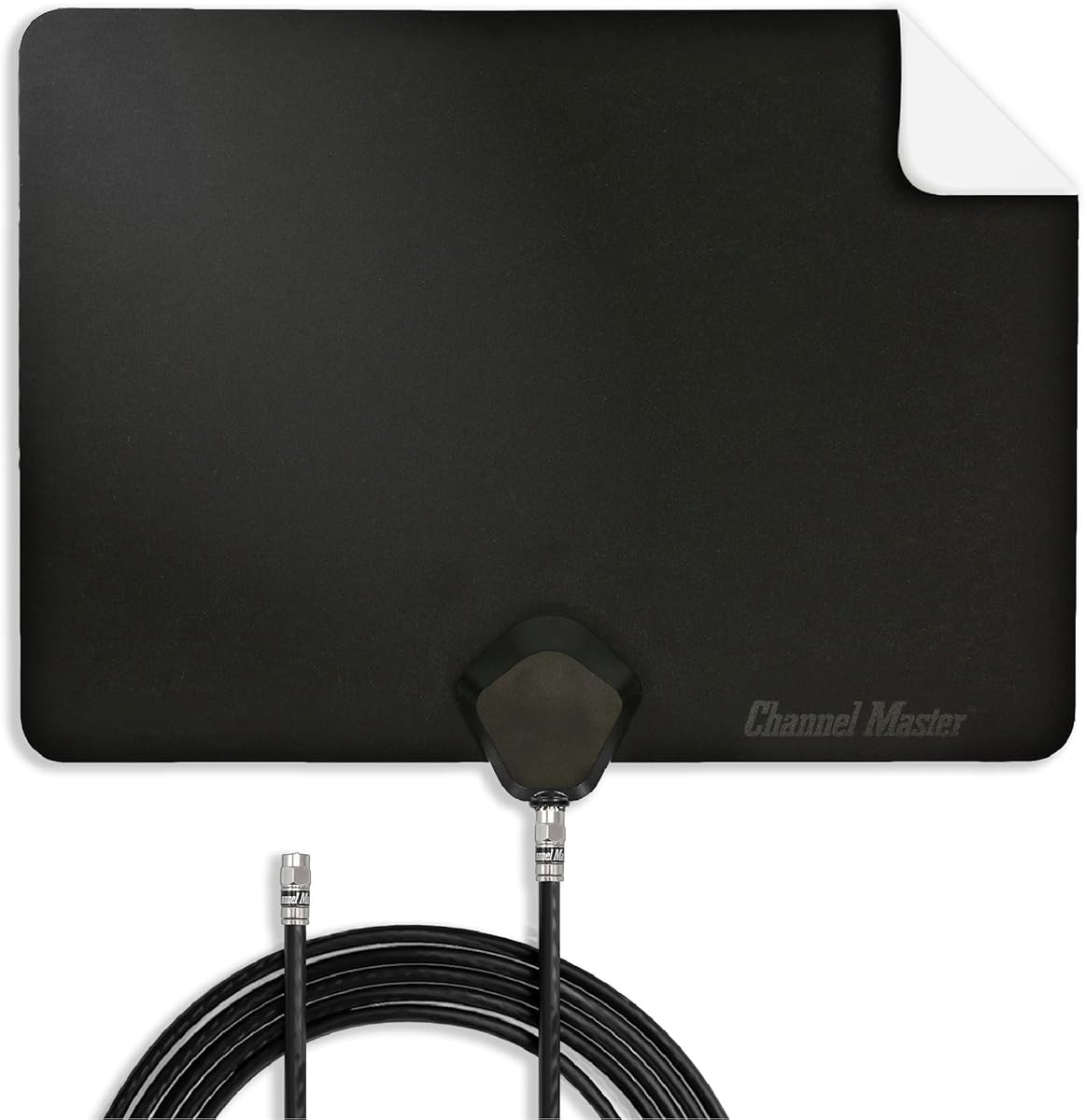
The Channel Master FLATenna is an indoor-focused option for viewers within roughly 35 miles of broadcast towers, according to the supplied description. It has a 4.1 rating, a thin and lightweight reversible panel, and a 12-foot professional-grade RG6 coaxial cable. It supports HD and digital broadcasts, 4K, and ATSC 3.0 NextGen TV where the latter is available.
We may earn a commission when you buy through this link, at no additional cost to you.
Its strongest benefit is ease of integration into a home. The reversible black-and-white face allows it to blend into different rooms, and it can be placed on a tabletop, attached to a wall, or positioned near a window. The product information emphasizes a realistic range that accounts for real-world obstructions and interference, which is a more grounded approach than claiming a single distance will work everywhere.
Compared with the outdoor arrays in this guide, the FLATenna has obvious limitations. Its 35-mile stated range is the shortest among the products listed, and it does not include a powered booster or advanced directional array. Indoor walls, furniture, and household electronics can still weaken signals. A user can overcome some of these issues by moving the panel higher, changing its orientation, or placing it near a window, but the final result remains more sensitive to placement than a mounted outdoor antenna.
The FLATenna is best for urban or suburban homes with clear tower access, renters, and anyone seeking a discreet indoor setup without a separate power supply. It is less suitable for severe fringe locations where the required towers are distant, blocked by terrain, or spread across different directions. Start with a channel scan, note which stations fail, and reposition the antenna before buying a larger external system.
The thin, reversible panel avoids the visual bulk of a rooftop array or powered indoor antenna. It is easy to move between a tabletop, wall, or window while testing reception.
The included 12-foot RG6 cable connects through standard coax and avoids the need for a separate amplifier or USB power supply. Simpler power requirements can make the antenna a convenient first attempt.
We may earn a commission when you buy through this link, at no additional cost to you.
The PBD Amplified Outdoor TV Antenna is designed for fringe households that need to explore different tower directions without climbing a roof or manually rotating the antenna each time. It has a 4.3 rating, a built-in high-gain and low-noise amplifier, and a 360-degree motorized rotation system controlled by a wireless remote. The stated reception distance is up to 150 miles, subject to the usual real-world limitations.
We may earn a commission when you buy through this link, at no additional cost to you.
Remote rotation is the defining convenience. The user can adjust the antenna while watching a channel scan, stop when signal quality improves, and retain the chosen position. Weatherproof construction is intended for year-round outdoor use in both urban and rural settings. The product also includes two television outputs, allowing two compatible screens to be connected without buying a separate splitter, which is convenient for households with multiple televisions.
The 40-foot RG6 coaxial cable and detailed installation guide make the package reasonably complete, but the motorized system adds electrical and mechanical complexity compared with a fixed Yagi or bowtie. Users also need suitable mounting hardware and a stable location with the best possible view. The stated range and signal quality still depend on tower distance, terrain, obstructions, broadcast power, and the quality of the TV tuner. NEXTGEN TV readiness is described in terms of compatibility where the service is available.
The PBD antenna is a good choice for viewers who have stations in several directions and want effortless remote adjustment. It is especially helpful if physical access to the antenna is difficult. Those seeking a simpler permanent installation may prefer the Five Star or Stellar Labs designs, while buyers who prioritize advanced per-band gain control may favor the Televes models. Mount the unit securely, protect the power connections from moisture, and allow time for a full scan at each position.
Motorized rotation makes directional testing far more convenient, especially on a roof or high mast. Viewers can scan channels, adjust the angle, and compare results without accessing the mounting point.
The two television outputs support a more flexible household setup than a single-output antenna. Both connected televisions should be within a reasonable distance of the antenna and use compatible over-the-air tuners.
We may earn a commission when you buy through this link, at no additional cost to you.
The right deep fringe antenna depends on tower distance, terrain, broadcast frequencies, obstruction levels, available mounting space, and how much control you want during setup. The following factors help narrow the choices without treating a headline range number as a guarantee.
Begin with the official digital television map for your address and note the available stations, their virtual channel numbers, and the direction of their transmitters. A strong directional antenna is most effective when the desired stations cluster in one direction, while a multi-panel or motorized model is preferable when signals originate in several locations. Also check whether the stations you want are broadcast in High VHF, UHF, or both. This information establishes realistic goals and prevents a consumer from expecting an antenna to deliver stations that are not available locally over the air.
Advertised distances are usually maximum laboratory or marketing figures rather than guaranteed coverage radii. Real reception depends on transmitter power, antenna height, terrain, foliage, building materials, polarization, cable losses, and tuner sensitivity. An 80-mile bowtie may outperform a model claiming 200 miles if the former is aimed accurately and positioned higher. Conversely, a technically efficient 75-mile antenna can fail where a much longer claim would succeed if the advertised product includes better gain control and filtering.
Many digital antennas emphasize UHF because it covers the largest share of current broadcast stations. However, High VHF channels 7 through 13 remain important, and some compact designs receive them less effectively. A fringe model with dedicated High VHF elements, such as the Antennas Direct ClearStream 4V or the Televes 8-Bay BOSS Mix, may be more dependable when local network affiliates occupy those channels. Check the product's frequency specification and avoid assuming that a station carrying a low channel number is automatically easy to receive.
Amplification is most useful when a usable signal reaches the antenna but is too weak for the tuner. It is less useful when the problem is severe blockage, incorrect polarization, or a signal that never reaches the antenna at all. Intelligent gain control can also reduce overload from exceptionally strong nearby stations. Homes surrounded by cellular towers or FM transmitters may benefit greatly from dedicated filtering, while a simpler installation away from those sources may not require premium interference protection.
Indoor antennas are easier to install, less visible, and usually suitable for urban or suburban areas with nearby towers. The Channel Master FLATenna fits this category, while the Ophirs model can transition between indoor and outdoor locations. Outdoor antennas provide better elevation and fewer building obstructions, making them the standard choice for deep fringe service. Roof, mast, wall, and attic installation each have different aesthetic and exposure considerations, so measure the location and confirm that the antenna can be aimed correctly.
A fixed Yagi, bowtie, or triple-boom is efficient because it concentrates reception toward a known bearing. It is a good fit when all desired towers are clustered. Motorized and dual-panel systems provide flexibility when stations occupy different directions, but they are larger, more complex, and sometimes less efficient than a properly aimed fixed array. The Televes 8-Bay BOSS Mix can point both panels in one direction or separate them, while the PBD model rotates remotely through a full circle.
Antennas with integrated preamplifiers require power, usually through a power inserter placed near the television. A dual-output inserter can serve more than one television, but cable length and quality still influence the result. Compare included items such as coax, mast clamps, reflectors, power supplies, weather boots, and mounting hardware. The Televes DAT BOSS Mix LR provides a particularly complete accessory set, whereas the Televes 8-Bay explicitly does not include a mast. Outdoor connectors should be weatherproofed regardless of the antenna's stated construction.
Install the antenna as high and as unobstructed as practical, using the official broadcast map to establish the direction of the desired towers. For a directional model, begin with the panel or boom facing the main transmitter cluster. Connect the coax securely to the television or tuner, power the integrated amplifier if the model requires it, and complete a fresh channel scan. If important stations are missing, make small aiming adjustments and scan again rather than repeatedly powering the amplifier.
Outdoor antennas need secure mounting and dependable weather protection. Use suitable brackets, mast hardware, grounding guidance appropriate to the installation, and UV-resistant or properly sealed connectors. Keep the power inserter and any non-rated connection indoors and dry. Check the mounting after severe weather, and do not allow tree limbs, new roof materials, or later landscaping to obscure the signal path. Indoor models need similar attention: place them near a window, away from computers, LED lighting, and metal objects.
Rescan whenever the antenna is moved, the television's input changes, or nearby construction alters the signal environment. A channel scan evaluates available broadcasts, but picture stability should also be checked across the day because atmospheric and multipath conditions can vary. Clean removable dust from indoor panels, inspect outdoor cable connections for corrosion, and tighten mounting hardware without crushing the coax. Avoid unnecessary changes to amplification settings; begin at the lower setting recommended by the manufacturer and increase it only when reception requires it.
There is no single guaranteed distance because transmitter power, terrain, trees, buildings, antenna height, and the television tuner all matter. The stated range on a product listing should be treated as a maximum estimate rather than a promise. A well-aimed outdoor antenna with good filtering can outperform a higher-claim model in a favorable location, while terrain may block signals regardless of the antenna's stated range.
Outdoor placement usually provides a better signal because it reduces interference from walls, appliances, and floors. It can also be mounted higher and aimed more precisely at transmitters. However, an indoor antenna remains suitable for nearby towers and urban locations, and an outdoor installation requires secure mounting, weatherproof connections, and a safe cable route.
An amplifier helps when a weak but otherwise reachable signal arrives at the antenna. It cannot recover a station that is completely blocked by terrain or severe obstructions, and excessive gain can overload a tuner near very strong transmitters. Models with automatic band-specific gain are useful when VHF and UHF strengths differ substantially. Otherwise, start with the lowest useful amplification setting and rescan.
VHF and UHF are the two main broadcast bands used by digital television stations. High VHF generally covers channels 7 through 13, while UHF covers the higher-frequency channels that make up most of the remaining broadcast lineup. A balanced antenna gives you more choices when a market includes both types of stations. It is particularly important to check VHF coverage rather than assuming every modern antenna handles it equally well.
A scan can detect a signal that is marginal for the tuner, but stable viewing requires a stronger and cleaner signal. The problem may come from an inaccurate aim, weak amplification, excessive amplification, long or poor-quality coax, multipath interference, or movement near the antenna. Reposition the antenna, check connections, reduce gain if the signal is extremely strong, and rescan after each change.
A motorized model can be convenient when desired stations are separated geographically because it allows remote aiming without repeated roof access. A multi-panel antenna may offer a similar advantage by dedicating one panel to a different direction. If all stations are clustered, a fixed directional array can be simpler and may use space more efficiently. Consider the available mounting area, power requirements, and how often you expect to change direction.
No. These antennas receive local over-the-air broadcasts available in the area, which include many major network stations but not every channel carried by a paid television service. The official digital broadcast map is the best way to identify available stations. If the goal is to access channels that are not broadcast locally, an internet television service is a separate solution.
Inspect the mounting and cable connections periodically, especially after high winds or severe weather. Keep the antenna aimed toward the same tower cluster and remove branches or new obstructions that develop around it. Seal exposed connectors with a suitable weatherproof method and keep the power inserter indoors. Rescan if reception changes, since a physical shift or environmental change may have altered the signal path.
The Televes DAT BOSS Mix LR is the strongest all-around choice for a difficult installation because it combines band-specific automatic gain, a directional stacked triple-boom design, cellular and FM filtering, and passive fallback operation. The Televes Ellipse Mix provides much of the same intelligent signal handling in a more compact body, while the Stellar Labs bowtie is a straightforward budget-oriented option for viewers who can aim a dedicated outdoor antenna.
Prioritize the factors that match your environment rather than choosing solely by the largest advertised range. Tower direction, VHF and UHF coverage, interference, mounting height, and control over gain can matter more than a distance figure. Fixed directional arrays are efficient when stations are clustered, while motorized and dual-panel systems are more adaptable when towers are spread out. Indoor models are appropriate for nearby broadcasts, but severe fringe conditions usually justify an outdoor installation.
Finally, check the official channel map, confirm that the antenna includes the bands your local stations require, and review the mounting and power accessories before buying. Product specifications, seller bundles, and prices can change, so verify the current listing and included components at the time of purchase. With the right aiming, high-quality connections, and realistic expectations, an OTA antenna can provide a dependable alternative to monthly television service.