
Cooler Master Q300L V1
4.5Editor score
Micro-ATX and Mini-ITX support
Open perforated thermal design
Modular repositionable I/O panel
Our Gray PC Case guide compares 10 gray and neutral-toned computer cases across cooling, motherboard support, GPU clearance, ease of use, and build quality.
A gray PC case can give a finished build a restrained, professional look while still accommodating the hardware, airflow, and expansion needs of a modern gaming system. The right enclosure balances motherboard support, cooling options, component clearance, accessibility, cable management, and a visual treatment that complements your desk or gaming setup.
This guide compares ten cases offered in gray, charcoal, iron-gray, light gray, titanium gray, white, or similarly neutral finishes. We evaluated their documented motherboard compatibility, graphics card clearance, cooling capacity, included fans, construction, accessibility features, and suitability for different build sizes and priorities.
The picks range from compact Micro-ATX and Mini-ITX designs to full-size ATX and tower cases, with options for air cooling, liquid cooling, panoramic viewing, back-connect motherboards, and vertically mounted graphics cards. Product details and pricing can change, so confirm the current specifications and listing information before purchasing.
4.5Editor score

4.7Editor score

4.5Editor score
The comparison below places the ten cases side by side by format, motherboard support, cooling provisions, graphics card room, and standout usability features. It is designed to help builders identify the most appropriate enclosure before checking current listing details.


The JONSBO X400 combines a gray industrial-mecha aesthetic with the component flexibility expected from a full ATX mid-tower. Its 4.5 rating reflects a design that is especially appealing to builders who want extensive cooling positions, a visible interior, and dedicated support for modern back-connect motherboards.
We may earn a commission when you buy through this link, at no additional cost to you.
Its standout feature is the breadth of the cooling layout. The documented configuration allows 120mm fans across the top, back, sides, and bottom, plus 240mm, 280mm, and 360mm AIO options in the top and a 360mm AIO option at the side. A patented motherboard auxiliary airflow system adds another route for directing air into the motherboard compartment.
Hardware clearance is also generous. The case supports graphics cards up to 427mm, power supplies up to 180mm, ATX or Micro-ATX back-connect motherboards, and air coolers up to 176mm. Tool-free top, side, and bottom access simplifies installation, although vertical GPU placement requires a conversion bracket and PCI Express extension cable purchased separately.
This is the premium choice for a showpiece system with demanding thermal requirements. It suits builders who value cooling flexibility, specialized motherboard support, and a dramatic design more than a compact footprint or a completely self-contained vertical GPU package.
The unusually large number of optional fan positions makes the X400 adaptable to changing hardware and thermal demands. Builders can combine AIO radiators with additional case fans while preserving several open mounting locations for future upgrades.
Tool-free panels reduce the friction of initial assembly and routine maintenance. Back-connect motherboard support can also produce a cleaner internal appearance by moving cable connections toward the rear of the enclosure.
We may earn a commission when you buy through this link, at no additional cost to you.
The Cooler Master Q300L V1 is a practical gray-toned option for builders creating a Micro-ATX or Mini-ITX system. Its 4.5 rating and affordable positioning make it a useful entry point for compact builds that still need reasonable graphics card room and flexible cooling options.
We may earn a commission when you buy through this link, at no additional cost to you.
The interior accommodates processors with air coolers up to 159mm, graphics cards up to 360mm, and power supplies up to 160mm. Cooling support extends to a 240mm liquid cooler and up to five fans, allowing a compact system to use a more capable thermal configuration than its exterior dimensions might suggest.
An open perforated design promotes airflow from multiple sides, while the transparent side panel allows builders to view the internal components. The modular I/O panel can be positioned at the front, top, or bottom on either side, which is particularly useful when case orientation changes during installation.
Choose the Q300L V1 when your motherboard is Micro-ATX or Mini-ITX and you value airflow, flexible positioning, and dust filtration more than full ATX support. It is a sensible budget case for a capable compact gaming or general-purpose system.
Despite its compact format, the enclosure supports a 360mm graphics card and a 240mm liquid cooler. These allowances provide a practical upgrade path for powerful components that might otherwise seem too large for a smaller build.
Perforation across multiple sides promotes air movement through the chassis. Magnetic dust filters help limit the accumulation of debris while preserving a simple removal process for routine cleaning.
We may earn a commission when you buy through this link, at no additional cost to you.
The Fractal Design Mood is a light-gray Mini-ITX case for builders who prefer a quiet visual language over the exposed mechanical styling common in gaming chassis. Its 4.4 rating reflects a compact but carefully considered design with fabric panels, accessible components, and sensible cooling provisions.
We may earn a commission when you buy through this link, at no additional cost to you.
The fabric enclosure slides away to provide full access during assembly and maintenance, reducing the need to work around fixed panels. A large 180mm fan is included at the top, and the chassis supports radiators up to 280mm for builders who prefer a liquid-cooling configuration.
Hardware limitations are worth considering. The case is intended for Mini-ITX motherboards, supports graphics cards up to 325mm, and accommodates CPU air coolers up to 114mm. Its included PCIe 4.0 riser provides an alternative mounting approach for compatible graphics cards.
The Mood is most attractive to compact-system builders who value materials, visual subtlety, and easy access. It works well for a polished desk setup, provided your processor cooler and graphics card fall within the documented clearance limits.
The woven fabric exterior differentiates the Mood from conventional metal-and-glass cases. Its light-gray finish can blend neatly into a workstation, office, or understated gaming environment.
The included 180mm fan moves a substantial volume of air while occupying a single mounting position. Sliding access makes it easier to connect components and adjust the layout during the build.
We may earn a commission when you buy through this link, at no additional cost to you.
The NZXT H5 Flow is an especially balanced compact ATX mid-tower, earning a 4.7 rating in the supplied comparison. Its restrained dark appearance, preinstalled fans, clean cable routing, and generous radiator support make it straightforward to recommend for conventional gaming builds.
We may earn a commission when you buy through this link, at no additional cost to you.
Fine mesh across the top, front, and side panels supports airflow while filtering dust. Two 120mm airflow fans are installed at the front and rear, providing immediate cooling without requiring a separate fan purchase for a basic configuration.
Liquid-cooling builders can install a radiator up to 360mm at the front and up to 240mm at the top. The perforated PSU shroud can draw air from both its side and underside, with two 120mm fans supported in those positions. Wide routing channels, hooks, and straps help conceal cables behind the motherboard tray.
The H5 Flow suits builders who want a manageable ATX enclosure without giving up modern cooling options. Its higher rating makes it a strong all-around choice, although the available specification does not list a front USB Type-C port, so verify connector requirements before building.
Preinstalled fans make the case useful immediately, while the radiator allowances allow a straightforward transition to a larger liquid cooler. This flexibility is valuable for builders who may change their cooling strategy later.
The restrained panel design keeps visual distractions low, and dedicated channels help keep wiring out of the main viewing area. The result is a case that can look tidy without extensive aftermarket cable-management accessories.
We may earn a commission when you buy through this link, at no additional cost to you.
The Cooler Master QUBE 540 is a modern ATX mid-tower with a flexible orientation design, full mesh front, tempered glass presentation, and room for substantial graphics hardware. Its 4.4 rating makes it a versatile selection for builders who want both standard ATX support and E-ATX flexibility.
We may earn a commission when you buy through this link, at no additional cost to you.
Motherboard support extends from ITX and ATX to E-ATX models up to 11 inches wide. Graphics card clearance reaches 415mm without a front fan, allowing very long cards to fit. The reversible I/O panel and movable handles let builders choose horizontal or vertical positioning and adapt the case to the available space.
A preinstalled SickleFlow 120mm fan works with the mesh-optimized front panel to encourage airflow. The front I/O includes two USB 3.2 Gen 1 ports and one USB 3.2 Gen 2 Type-C port, providing a useful mix of legacy and modern connectivity.
The QUBE 540 is well suited to a large graphics card and flexible build arrangement. Prospective buyers should account for the front-fan clearance requirement when using a very long graphics card and decide early whether the case will stand upright or lie horizontally.
A documented 415mm GPU allowance gives builders more freedom than many compact mid-towers. The tradeoff is that the front fan must be omitted when using the case at its maximum graphics clearance.
Horizontal and vertical operation is valuable in narrow or crowded spaces. The reversible panel and movable handles support that flexibility, although component planning is essential to avoid conflicts.
We may earn a commission when you buy through this link, at no additional cost to you.
The CORSAIR 3500X RS ARGB is a white panoramic mid-tower for showcase builds where visibility and coordinated lighting matter. Its 4.6 rating reflects a strong balance of component support, cooling capacity, and accessible construction.
We may earn a commission when you buy through this link, at no additional cost to you.
Three RS120-R ARGB fans are included and controlled through a 5V ARGB header on the motherboard. Side, roof, and power-supply fan locations allow the case to accommodate as many as ten 120mm fans, offering considerable room for a quiet or high-airflow configuration.
The enclosure supports motherboard formats from Mini-ITX through EATX, and the wraparound glass presentation provides a broad view of the internal components. Removable front and side tempered glass panels make initial construction and later maintenance easier than a fully closed design.
This case is ideal for builders who want a bright, coordinated display and already intend to use addressable RGB hardware. Keep cables and power-supply wiring orderly, because the panoramic design naturally draws attention to both the components and their placement.
The three included fans use a standard 5V ARGB connection, making them convenient for systems with compatible motherboard headers. Their placement provides an immediate lighting foundation for the panoramic panels.
Mini-ITX through EATX support opens the case to a wide range of builds. Removable glass panels reduce the effort required when installing components or reaching cables.
We may earn a commission when you buy through this link, at no additional cost to you.
The Lian Li O11 Vision Compact is a white showcase case centered on uninterrupted component visibility. Its 4.5 rating reflects a strong combination of three-panel tempered glass, practical ATX layout, and support for contemporary back-connect motherboards.
We may earn a commission when you buy through this link, at no additional cost to you.
Tempered glass covers the front, top, and left side, creating a three-dimensional view of the system. A separate top mesh panel is provided for installing a 360mm AIO, allowing the cooling hardware to remain visible while preserving useful radiator capacity.
The case is compatible with back-connect motherboards, which can improve the internal appearance by moving connector access to the rear. It also uses a dual-chamber concept to conceal AIO tubing when the cooler is positioned on the side, helping maintain a clean visual presentation.
Choose the O11 Vision Compact for a minimalist white build in which the hardware is the centerpiece. It is particularly attractive when paired with coordinated cooling hardware, although buyers should check exact motherboard, cooler, and accessory dimensions before finalizing the installation.
The patented three-panel tempered glass arrangement gives the system a near-continuous showcase area. This is useful for displaying coordinated components, illuminated parts, and a tidy cable layout.
Back-connect motherboard support can reduce visible wiring, while the secondary chamber hides tubing from a side-mounted AIO. The top mesh preserves a dedicated location for a large radiator.
We may earn a commission when you buy through this link, at no additional cost to you.
The Cougar Gemini M is an iron-gray mini-tower that combines a brushed metal-like front with integrated addressable RGB lighting. Its 4.2 rating is the lowest in this group, but the case remains distinctive for builders who want lighting and a gaming-focused appearance in a compact enclosure.
We may earn a commission when you buy through this link, at no additional cost to you.
The integrated Tre lux system displays fourteen lighting effects and can be controlled through the lighting button. It supports synchronization with Asus Aura Sync, Gigabyte RGB Fusion, MSI Mystic Light Sync, and ASRock Polychrome Sync, reducing the need to operate the lighting as an isolated feature.
A full tempered glass side window exposes the interior, while the documented graphics support allows up to two 330mm cards. That multi-GPU capability is unusual for a compact case and may appeal to builders planning a multi-card workstation, subject to the remaining physical and power requirements.
The Gemini M makes sense for a smaller gaming system where a restrained gray front panel and integrated RGB are priorities. Its lower rating and mini-tower format make it less compelling for builders seeking the newest layout features or extensive expansion room.
The built-in lighting system simplifies the appearance of a coordinated gaming setup. Compatibility with major motherboard ecosystems also makes synchronization relatively straightforward.
Supporting as many as two 330mm graphics cards distinguishes the Gemini M from many modern compact cases. Builders should still verify slot spacing, power connectors, and thermal requirements before committing to a multi-card configuration.
We may earn a commission when you buy through this link, at no additional cost to you.
The InWin Dubili is a titanium-gray full tower built from modular parts for builders who prioritize space, transportability, and organized wiring. Its 4.4 rating reflects a substantial chassis that favors expansive configurations over the compactness offered by most ATX mid-towers.
We may earn a commission when you buy through this link, at no additional cost to you.
The modular structure means major sections can be handled more conveniently, while reversible handles and feet are designed to make the completed system sturdy enough for transportation. This is a meaningful advantage for builders who move their PC between locations, events, or computer rooms.
Ventilation is incorporated throughout the enclosure, with versatile cooling options supported by a substantial chassis. Four ARGB fans are preinstalled, providing both airflow and illumination, and an enhanced cable-management kit helps organize the wiring in such a large interior.
The Dubili is appropriate for elaborate systems needing maximum expansion potential, multiple graphics cards, extensive storage, or large cooling hardware. Because the supplied specifications do not list exact motherboard or graphics card limits, buyers should confirm detailed fitment and available room for the required configuration.
A full tower provides more usable volume than a conventional mid-tower. The modular construction makes that volume easier to manage during both assembly and transport.
The cable-management kit is especially relevant in a spacious chassis where many wires could otherwise become visually distracting. Four included ARGB fans add a ready-made cooling and lighting foundation.
We may earn a commission when you buy through this link, at no additional cost to you.
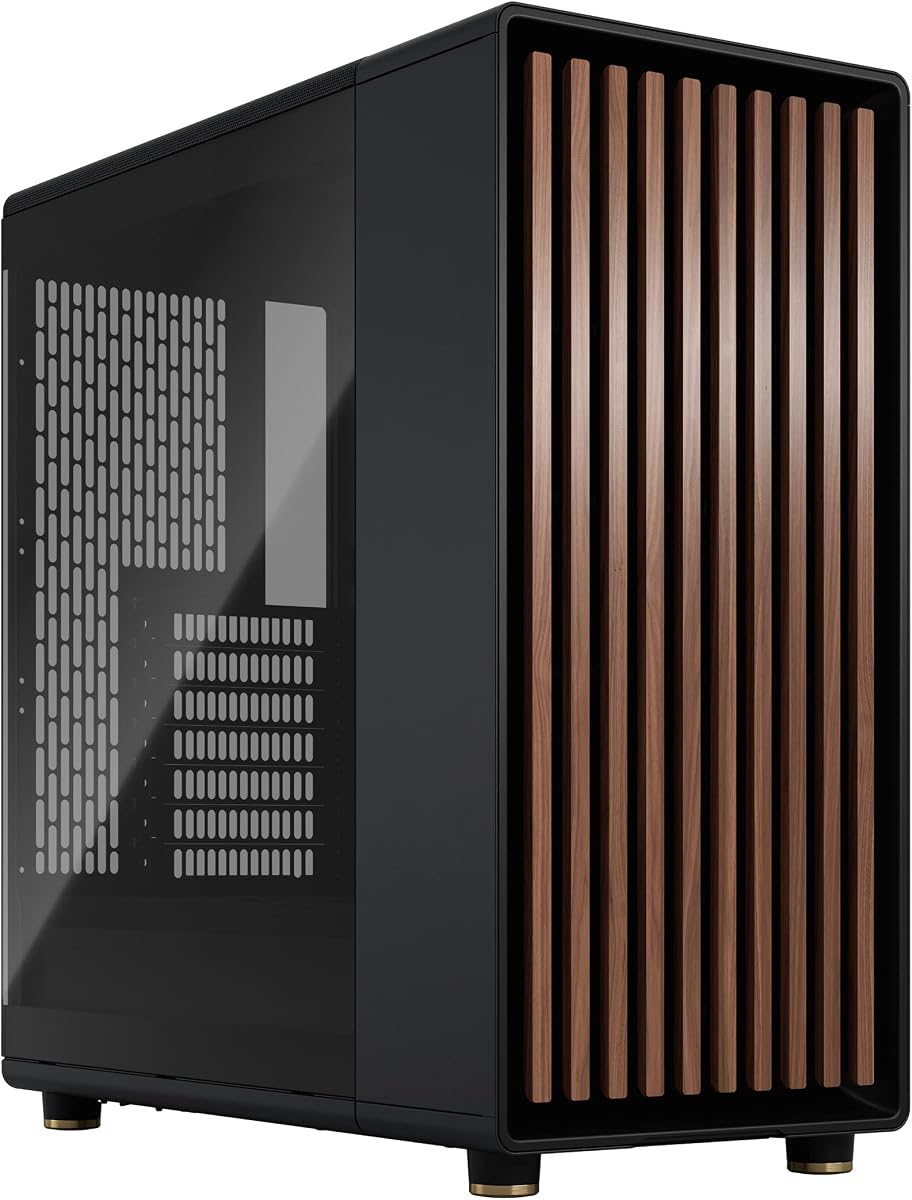
The Fractal Design North is a charcoal-black ATX mid-tower with a genuine walnut wood front, tempered glass side, and a more natural approach to gaming-case styling. Its 4.7 rating makes it one of the strongest rated options in the comparison and a particularly attractive choice for warm or wood-accented setups.
We may earn a commission when you buy through this link, at no additional cost to you.
An open front and integrated mesh promote natural ventilation. Two 140mm Aspect PWM fans are included, offering useful airflow without requiring the builder to select every fan before the initial installation. The case supports ATX, Micro-ATX, and ITX motherboards.
Graphics card clearance reaches 355mm, reducing to 300mm when a 360mm front radiator is installed. The front panel bars are made from sustainably sourced oak or walnut, while the clear tempered glass side panel provides scratch resistance and a broad view of the completed system.
Choose the North when your build should feel more like a design object than a brightly illuminated gaming machine. It offers balanced hardware support, good airflow, front Type-C connectivity, and removable panels, but the wood aesthetic may not suit a strictly monochromatic setup.
The walnut front introduces warmth and texture that conventional steel panels cannot replicate. It pairs effectively with muted components, warm desk lighting, and a neutral room design.
The open front and included 140mm fans encourage airflow around demanding components. The chassis still provides a tempered glass view and straightforward access through removable panels.
We may earn a commission when you buy through this link, at no additional cost to you.
Choosing a gray PC case involves balancing appearance with practical constraints. Motherboard format, graphics card size, cooling strategy, drive needs, and available space should be checked before selecting a model based on color or styling alone.
Begin with the exact motherboard standard, because it determines which cases can be used. Full ATX and E-ATX builds need corresponding chassis support, while Micro-ATX and Mini-ITX systems can use smaller enclosures. Back-connect motherboard support is a separate compatibility issue: a case may accept standard ATX boards without accepting a board whose cables connect on the back.
Match the board before anything else. A physically compact case that does not support the intended motherboard is not a better space-saving option; it is an incompatible one.
Compare the case's documented maximum graphics card length with the dimensions of your card. The length can vary dramatically among high-end models, and the available room may shrink when front fans or a large radiator are installed. The Fractal Design North illustrates this trade-off, with different clearances depending on whether a 360mm front radiator is present.
Check both the base rating and the configuration that includes your cooling hardware. Leave room for the power connector and any side-mounted cable bend, not just the bare card.
A visually open case is not automatically well cooled, so examine fan mounts, included fans, mesh openings, and radiator positions. Air-cooled systems benefit from intake and exhaust fans, while liquid-cooled builds need a radiator location with sufficient surface area and unobstructed tubing routes.
Prioritize balanced airflow and compatibility with your chosen cooler. More mounting positions offer future flexibility, but adequate space and a practical fan arrangement matter more than a high count in isolation.
Tower-style air coolers can be substantially taller than low-profile models. Compare the processor cooler's height with the case limit; examples in this guide range from 114mm in the Fractal Design Mood to 176mm in the JONSBO X400. Low-profile coolers can provide an alternative when the case has limited clearance.
Buying a larger case and a modest air cooler can reduce acoustic expectations compared with a full-height tower. Plan the complete cooling configuration rather than treating the cooler as an isolated component.
Power supplies vary in length, and modular units may use a different shape from integrated models. Check the case's documented PSU allowance, which is 180mm for the JONSBO X400 and 160mm for the Cooler Master Q300L V1, against the exact model you intend to install.
A close fit can also restrict cable routing around the drive area. Consider the length of the power leads and the need for right-angle connectors when the enclosure or desk space is tight.
Storage needs vary with a system's purpose. Some cases provide combinations of 2.5-inch and 3.5-inch mounts, while others emphasize a cleaner interior and rely on M.2 storage. The JONSBO X400 lists one 2.5-inch SSD position and two 3.5-inch drive bays, whereas the Fractal Design North includes combined and dedicated 2.5-inch mounts.
Count every storage device, including backup drives and external media, then confirm the mounting hardware. Full-tower cases generally offer more room, but the exact expansion details still matter.
Tool-free panels, removable glass, sliding covers, and repositionable I/O modules can make assembly and maintenance easier. Cable channels, straps, and dedicated management areas help produce a clean result, particularly in cases with transparent panels. Back-connect motherboard support may also reduce visible wiring.
Choose a layout that matches your comfort with building. A case that is easier to open is valuable for upgrades, while a well-planned cable route can make even a complex system look orderly.
Gray enclosures range from understated professional finishes to fabric textures, panoramic glass, wood details, and integrated RGB. Decide whether the case should blend into the room, display illuminated components, or make a stronger statement. The Fractal Design Mood, InWin Dubili, and NZXT H5 Flow illustrate substantially different interpretations of a restrained appearance.
Measure the available area and account for airflow clearance around vents. Orientation can also affect accessibility, so consider where the case will sit relative to the desk, wall, and floor.
Before installing components, remove the side or access panels, inspect the case for loose screws or packaging, and verify that every planned part meets the documented clearance limits. Install the power supply, motherboard, storage, graphics card, and cooling hardware in an order that gives you comfortable access to connectors. Keep protective films on tempered glass until the build is complete.
After assembly, confirm that intake and exhaust fans are configured to move air consistently through the chassis. Secure cables with the supplied hooks, straps, or channels, but avoid forcing excess cable into tight spaces. Connect front-panel cables according to the motherboard manual and confirm that power, reset, audio, and USB connections are correctly seated.
For maintenance, power the system down and disconnect its power source before opening the case. Clean removable dust filters periodically, using a soft brush or a suitable low-pressure method, and inspect unobstructed mesh panels for buildup. Keep the exterior clean with a dry microfiber cloth, and avoid aggressive chemicals on fabric, wood, glass, or coated metal surfaces.
Check the exact board standard, such as ATX, Micro-ATX, Mini-ITX, or E-ATX, and compare it with the case specification. Also verify whether the motherboard uses back-connect or rear-facing connectors, because that layout requires explicit case support. A smaller board may fit in a larger case, but the reverse is not always true.
Compare the card's total length with the case's stated GPU clearance. Remember that adding a front fan or radiator can reduce available space, as reflected in the different clearances listed for the Fractal Design North. Also consider the side power connector and the space needed to bend its cable.
No. Fan-mount count is only one part of the thermal equation. Builders should consider included fans, mesh openings, radiator positions, component clearance, and the intended intake and exhaust arrangement. A smaller set of correctly positioned fans can be more effective than several poorly directed mounts.
They are distinct neutral or near-neutral finishes rather than identical color categories. Lighting, surrounding materials, and panel texture can affect how each appears. If appearance is important, compare the case in different lighting and consider whether coordinated components will complement the finish.
Color does not determine dust protection. Mesh panels, removable filters, and covered intake areas matter more. Cases with fine mesh can restrict larger particles while allowing air through, and removable filters are easier to clean than fixed screens.
Only if the radiator size and mounting location match the case. The guide lists liquid-cooling support of up to 360mm in some models, up to 280mm in the Fractal Design Mood, and up to 240mm in the Q300L V1. CPU pump mounting and tubing clearance should also be verified.
A back-connect motherboard moves its external ports toward the rear, allowing the case to manage those cables in the rear space. This can create a cleaner interior because fewer wires need to cross the main viewing chamber. Compatibility is model-specific, so a back-connect board requires a case that explicitly supports it.
Choose a compact model for a smaller desk footprint, simpler hardware configuration, or Mini-ITX-focused build. Choose a larger mid-tower or full tower when you need more expansion room, larger cooling hardware, extensive storage, or multiple graphics cards. The most important starting point is the hardware you already own or firmly plan to install.
The Cooler Master Q300L V1 offers the most approachable route into a smaller gray build, while the NZXT H5 Flow stands out as a balanced all-rounder with preinstalled fans, strong radiator support, and effective cable management. The JONSBO X400 is the feature-heavy premium selection, offering extensive fan positioning, generous graphics clearance, tool-free access, and back-connect motherboard support.
For other needs, the Fractal Design Mood favors minimalist texture and compact builds, the Fractal Design North introduces natural wood styling, and the Cooler Master QUBE 540 prioritizes flexible orientation. The Lian Li O11 Vision Compact and CORSAIR 3500X RS ARGB target display-focused systems, while the Cougar Gemini M, InWin Dubili, and CORSAIR 3500X RS ARGB emphasize integrated lighting, maximum space, or panoramic presentation.
Start with motherboard format, graphics card dimensions, CPU cooler height, radiator support, and PSU length, then choose the gray finish and visual treatment that suit your setup. Product specifications, included accessories, and prices can change, so verify the current listing before making a final purchase.