Salt Free Water Softener System
5.0Editor score
0.5-micron filtration
15-gallon-per-minute flow
Multiple connector sizes
Our Salt Free Water Softeners guide compares ten whole-home filtration and scale-prevention systems, helping you choose the right salt-free solution.
Salt-free water softeners offer a practical way to address hard-water scale without exchanging calcium and magnesium for sodium or producing brine. The right system combines appropriate flow capacity, contaminant filtration, mineral retention, straightforward installation, and dependable cartridge-based maintenance.
We compared ten products using their published specifications, feature descriptions, ratings, installation details, and filtration capabilities. The guide covers point-of-entry filtration systems, scale-inhibiting media, electronic descalers, and citrus-based softening, with special attention to household coverage and operating requirements.
Each review explains what distinguishes the product, where it fits, and which trade-offs deserve consideration. Ratings reflect the supplied customer feedback, while features and specifications are based on available product information. Product availability and pricing can change, so confirm current details before purchasing.
5.0Editor score

4.5Editor score

4.7Editor score
The table below compares filtration capability, treatment method, flow or coverage, and maintenance features across all ten salt-free water softener options.




The Kind Water Systems E-3000 combines sediment filtration, carbon block filtration, and salt-free softening in one compact point-of-entry system. It carries a 4.5 rating, making it a well-rounded option for households that want more than simple scale inhibition. Its strongest attraction is the integration of several filtration functions without requiring salt, electricity, a brine drain, or a bulky softening tank.
We may earn a commission when you buy through this link, at no additional cost to you.
The manufacturer says the system targets up to 95% of sediment and more than 155 chemical contaminants, including chlorine, chloramine, VOCs, and pesticides. That broader contaminant focus sets it apart from media-based products devoted mainly to hardness and scale. The salt-free treatment is intended to reduce scale formation while retaining calcium and magnesium, offering a different approach from ion-exchange systems that replace those minerals with sodium.
As an alternative to a conventional softener, the E-3000 does not remove hardness in the same way, and the supplied information does not establish a universal removal percentage for hardness itself. It is also specifically designed for city-water applications. Those points matter to buyers whose water source, plumbing layout, or treatment goals are more specialized than the system assumes.
This is our Editor's Choice for buyers seeking a balanced whole-home system that combines filtration, taste improvement, and scale protection in one housing. It suits households with municipal water who want reduced salt use and no wastewater discharge. Installation planning should account for available space, required plumbing connections, and the replacement schedule for the included filtration stages.
Combining sediment and carbon block stages with scale-inhibiting media makes this more versatile than a standalone descaler. It is a practical choice when odor, taste, sediment, and scale are all household priorities.
The system preserves calcium and magnesium instead of exchanging them for sodium. That also means a conventional hardness tester may not show the same reduction expected from a true ion-exchange softener.
We may earn a commission when you buy through this link, at no additional cost to you.
The NU Aqua 4-Stage Salt Free Water Softener Whole House Water Filter System brings scale prevention and several filtration functions together. Its 4.5 rating and point-of-entry design make it a strong candidate for households seeking treatment at the main water line. The system targets scale buildup, sediment, chlorine, VOCs, odors, and taste while retaining beneficial minerals.
We may earn a commission when you buy through this link, at no additional cost to you.
One notable capability is claimed reduction of heavy metals such as lead, mercury, and arsenic. That makes the system more relevant to buyers who want filtration in addition to hardness-related scale control. Its advanced scale media is designed to reduce hard-water buildup without salt, while the carbon stage addresses chlorine, VOCs, unpleasant odors, and bad taste.
The operational advantages are just as important as the filtration list. The system needs no electricity, backflushing, or brine discharge, avoiding several common burdens associated with traditional softeners. Installation at the point of entry extends treatment to bathrooms, kitchens, laundry rooms, and outdoor spigots, creating a consistent approach throughout the home.
This model is best for municipal-water households that want one salt-free system to address several water-quality concerns. It should not be treated as a substitute for certified lead reduction without reviewing the relevant certification details, and buyers with well water should verify compatibility before installation. Overall, it is a versatile option with a particularly useful filtration-stage combination.
Sediment removal, carbon filtration, and claimed heavy-metal reduction give this model a broader role than a basic electronic descaler. Buyers should still verify certification and local testing needs for specific contaminants.
No electricity, backwashing, or brine discharge keeps operation straightforward. Routine cartridge maintenance remains necessary, but the system avoids the water waste and salt handling associated with regenerative softeners.
We may earn a commission when you buy through this link, at no additional cost to you.
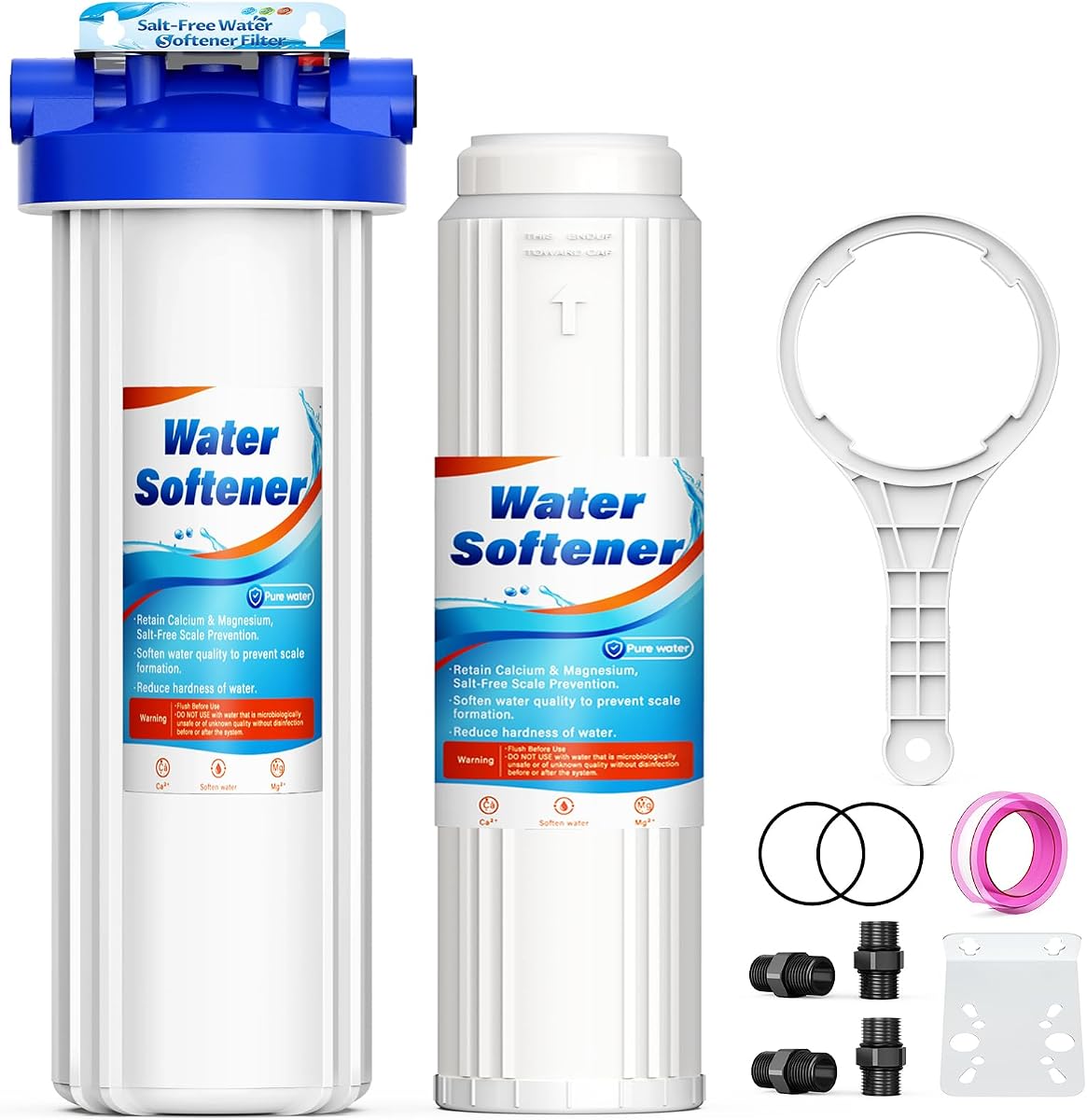
This 3/4-inch FNPT whole-house salt-free system is our Best Budget pick for a reason: it combines a 5.0 rating with a stated 15-gallon-per-minute flow rate. The 0.5-micron filtration is designed to capture fine sediment, while the scale-control media helps reduce limescale, chlorine, and odor throughout the property.
We may earn a commission when you buy through this link, at no additional cost to you.
The included accessories make the package versatile for common installations. It contains one filter housing, one softener filter, a wrench, thread tape, two 3/4-inch faucet connectors, two 1/2-inch faucet connectors, and a user manual. The choice of connector sizes is especially helpful for households with differently sized supply lines, although the buyer should verify actual plumbing dimensions before ordering.
The primary maintenance commitment is replacing the cartridge every four to six months, as stated in the product information. A 15-GPM rating can accommodate multiple rooms and strong household demand, but real-world performance depends on pipe size, plumbing layout, and local pressure. The system also preserves minerals, so changes in total dissolved solids will not be evident with a water-quality tester.
This is a compelling choice for buyers who want substantial flow, fine sediment filtration, and salt-free scale management without paying for a large multi-stage premium system. It is best suited to straightforward whole-house installations with accessible shutoff valves and sufficient service space. Those who want microorganisms treated or broader certified contaminant removal should choose a more specialized system.
A stated 15-GPM capacity is a major strength for homes where multiple showers, laundry cycles, and appliances may operate at once. Plumbing design and local pressure will still determine how effectively that rating is realized.
The stated four-to-six-month cartridge replacement interval requires planning and access to the housing. Keeping a replacement on hand helps prevent gaps in filtration performance.
We may earn a commission when you buy through this link, at no additional cost to you.
The Whole House Salt Free Water Softener is built around scale prevention rather than conventional hardness removal. Its 5.0 rating reflects strong customer feedback, while the supplied description highlights an advanced ion-exchange resin that inhibits scale formation without removing calcium and magnesium. It is intended to protect pipes, water heaters, dishwashers, faucets, and showers.
We may earn a commission when you buy through this link, at no additional cost to you.
This product includes a filter housing, softener filter, CTO filter, wrench, thread tape, two 1-inch-to-3/4-inch faucet connectors, two 1-inch-to-1-inch faucet connectors, and a user manual. The CTO component adds carbon filtration to the scale-inhibiting treatment, offering a broader package than a single-cartridge descaler.
Its zero-wastewater and no-electricity operation are clear selling points. The system also produces no brine discharge, making it appealing to households seeking a lower-impact alternative to traditional regeneration. Maintenance is simpler than maintaining a salt-based softener, though the resin filter still needs replacement every six to twelve months according to the product information.
This system is best for owners focused on scale control and mineral retention who also want carbon filtration. It may suit large homes because it is marketed for high household demand, although no specific flow rate is provided. Buyers should therefore check their required flow and available installation clearance before selecting it.
The resin is designed to inhibit deposits while keeping calcium and magnesium in the water. This preserves water chemistry but means a TDS meter will not provide a useful measurement of hardness reduction.
A dedicated softener filter and CTO filter create a more comprehensive setup than a basic scale-prevention cartridge. The included adapters provide useful flexibility, though proper sizing remains essential.
We may earn a commission when you buy through this link, at no additional cost to you.
The Kind Water Systems E-3000UV extends the basic E-3000 concept by adding ultraviolet treatment. Its 4.7 rating is the second-highest listed among the filtration-oriented choices, and the combination of sediment filtration, carbon block filtration, salt-free softening, and UV gives it the broadest treatment architecture in this roundup.
We may earn a commission when you buy through this link, at no additional cost to you.
Kind says the system targets up to 95% of sediment and more than 155 chemical contaminants, including chlorine, chloramine, VOCs, and pesticides. The UV stage uses chemical-free light to help neutralize up to 99.9% of common waterborne microorganisms. Together, these claims position it as a broad whole-home treatment option for city water where both chemical and microbiological concerns matter.
Scale protection remains central, and the design avoids salt, brine discharge, electricity, and bulky tanks. That makes the system operationally lighter than many conventional treatment trains, even though the multi-stage configuration is more involved than a single-cartridge descaler. A 120-day satisfaction guarantee adds some reassurance for buyers evaluating an unfamiliar treatment approach.
This is our Best Premium pick for a homeowner who wants extensive filtration and scale prevention in one system, with UV added for microbial treatment. It is best suited to municipal-water applications, and a professional installer may be appropriate depending on the plumbing configuration. It is less compelling for buyers seeking only basic scale control or a simple electronic descaler.
The UV stage provides a treatment mechanism that carbon and sediment filters do not address. It is particularly relevant for buyers who want additional microorganism treatment in a city-water installation.
The broad contaminant target, including VOCs, pesticides, chlorine, and chloramine, makes this one of the more filtration-forward products here. Verify local water conditions and certification details to confirm the stage is appropriate.
We may earn a commission when you buy through this link, at no additional cost to you.
The Compact Scale Preventer takes a focused approach to hard-water problems. It uses ion-exchange media to inhibit scale formation while retaining calcium and magnesium, and it carries a 5.0 rating. This makes it an attractive choice for households primarily concerned with scale in plumbing, water heaters, dishwashers, faucets, and showers.
We may earn a commission when you buy through this link, at no additional cost to you.
The system operates without electricity, brine, or wastewater. It uses standard fittings and is marketed for straightforward installation, avoiding the need to integrate a conventional salt reservoir, control valve, and drain line. It is also described as suitable for high household demand, although the supplied information does not provide a specific flow rate for comparison.
Maintenance is significantly less involved than caring for a traditional softener because there are no salt bags to lift or refill. However, the resin filter is still replaced every six to twelve months. Buyers should treat the device as a maintained filtration product rather than a permanently installed appliance with no consumables.
This is a good option for buyers who prioritize scale prevention, mineral retention, and a simple operating profile. It is less appropriate for someone who wants substantial sediment filtration, carbon treatment, UV, or certified heavy-metal removal. Confirm the connection size and available service space before installation, especially in tightly packed mechanical rooms.
The system concentrates on inhibiting scale rather than acting as a general contaminant filter. It is best for homes with manageable sediment levels and a primary need to protect plumbing and appliances.
No salt, power, or drain line simplifies everyday use considerably. Periodic replacement of the resin filter remains necessary, but routine operation requires little attention.
We may earn a commission when you buy through this link, at no additional cost to you.
The Kind Water Systems whole-house salt-free alternative is designed around two core jobs: filtering dirt and debris and protecting plumbing from hard-water scale. It has a 4.4 rating and emphasizes easy installation, low maintenance, and zero water waste. It is a comparatively simple option for buyers who do not need UV or extensive carbon filtration.
We may earn a commission when you buy through this link, at no additional cost to you.
Its reusable sediment cartridge is intended to intercept dirt, sand, silt, clay, rust, and other debris. That makes the system useful where sediment is a visible concern and helps protect downstream components from particulate buildup. The scale-protection side is marketed as an alternative to a traditional softener, with no salt or wastewater discharge.
The product avoids the operational complexity of a regenerative ion-exchange system. There is no brine tank or drain line, and the reusable cartridge approach can reduce the frequency of disposable filter purchases. Nevertheless, actual maintenance depends on local sediment levels, and a heavily burdened cartridge may need cleaning sooner than expected.
This is a sensible pick for a household seeking basic whole-house sediment filtration and scale protection with minimal infrastructure. It is less suitable for buyers seeking heavy-metal reduction, carbon treatment, or UV. A 120-day satisfaction guarantee provides a limited trial period, while installation should follow the manufacturer's connection and clearance guidance.
The reusable cartridge distinguishes this unit from systems built around regularly discarded sediment filters. It is particularly useful when the primary concern is sand, silt, rust, and other visible debris.
Salt-free scale protection avoids brine and water waste while keeping the installation compact. It is a practical alternative for households primarily concerned with mineral deposits and sediment.
We may earn a commission when you buy through this link, at no additional cost to you.
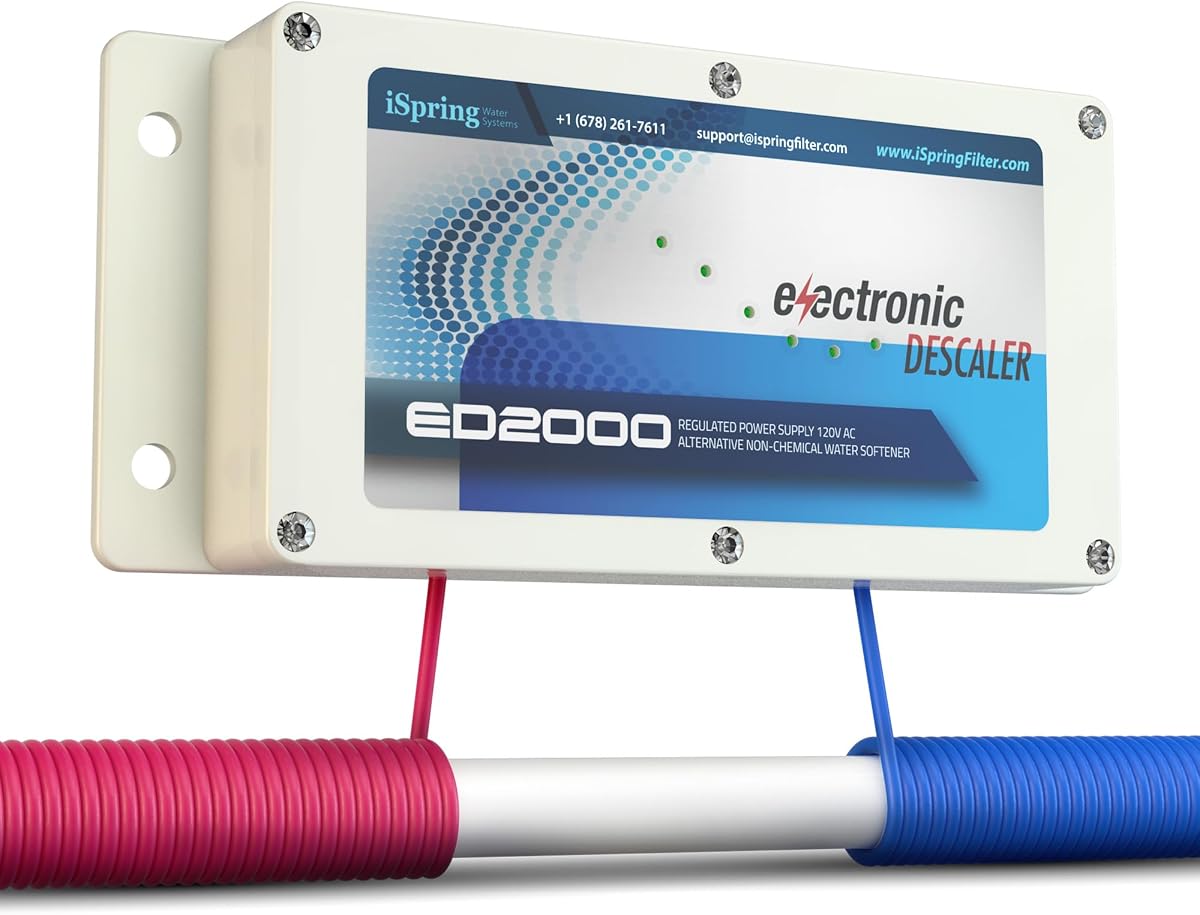
The iSpring ED2000 is an electronic descaler rather than a filter-and-media system. It receives a 4.1 rating and is designed for homes in very hard-water areas, specifically areas with 10 to 19 grains per gallon. Its purpose is to reduce scale deposits and help existing buildup break down without changing the underlying chemistry of the water.
We may earn a commission when you buy through this link, at no additional cost to you.
Installation is unusually simple because the product requires no plumbing modifications and works with any pipe, including PEX and PVC. It also requires no chemicals, salt, or routine maintenance. A one-year money-back guarantee and lifetime technical support provide some reassurance, though electronic performance claims should be evaluated in the context of the specific plumbing system and degree of hardness.
The key distinction is that the ED2000 conditions water rather than filtering it. It will not capture sediment, chlorine, VOCs, heavy metals, or microorganisms, and it does not reduce hardness in the measurable way an ion-exchange softener does. It is best understood as a scale-management tool for pipes and appliances, not a complete water-quality treatment system.
This model suits owners who want an uncomplicated, low-consumption approach to limescale and who do not need contaminant filtration. It is also useful where avoiding pipe modifications is important. Those wanting genuinely softer water, clearer output, or broad filtration should consider one of the media-based systems in this guide instead.
The ED2000 focuses on scale formation and existing deposits while leaving mineral chemistry unchanged. It should not be selected when sediment or chemical removal is a central requirement.
Compatibility with common pipe materials and the no-modification installation approach make this flexible. The compact electronic format also avoids the footprint of a salt tank and control assembly.
We may earn a commission when you buy through this link, at no additional cost to you.
The iSpring EDV2 is a more powerful electronic descaler than a basic scale conditioner, using a battery that delivers up to 12 watts. It shares the same 4.1 rating as the ED2000 and preserves water chemistry, making it another option for scale control rather than actual softening or filtration.
We may earn a commission when you buy through this link, at no additional cost to you.
Its aluminum alloy construction is designed for durability and resistance to corrosion. The product description also says it can reduce scale throughout pipes and help lower energy consumption associated with scale-covered water heaters. That makes it relevant to households focused on extending appliance life and maintaining efficient heating equipment.
Installation remains maintenance-free with respect to filters, salt, and plumbing modifications, and it is compatible with pipe types including PEX and PVC. The electronic nature means the device still has a battery and other powered components, so it is not entirely passive even though it does not require a household electrical outlet. A one-year limited manufacturer warranty applies when the product is registered.
The EDV2 is best for buyers who want electronic scale management with stronger advertised output and a durable housing. It is not appropriate when the goal is to remove sediment, chemicals, or measurable hardness, nor for households seeking a cartridge-based filtration system. Compare the installation location carefully because electronic descalers are intended to treat water before it reaches scale-prone parts of the home.
The stated 12-watt output is the defining feature and differentiates the EDV2 from simpler electronic conditioners. It remains a scale-management device rather than a filter or conventional softener.
The aluminum alloy body is intended to withstand long-term plumbing use and resist corrosion. Its pipe compatibility also simplifies retrofits in homes with PEX or PVC supply lines.
We may earn a commission when you buy through this link, at no additional cost to you.
The NuvoH2O Citrus-Based Salt-Free Water Filter System uses CitraCharge technology to soften water without salt while retaining minerals such as calcium and magnesium. Its 3.9 rating is the lowest among the ten products, so buyers should weigh the system's established feature set carefully against newer options with stronger customer feedback.
We may earn a commission when you buy through this link, at no additional cost to you.
It is designed to prevent and actively remove existing hard-water scale, which can help protect water heaters, plumbing, and appliances. The filtration component is also marketed as removing harsh chemicals to improve taste. This combination makes the system more than a simple scale inhibitor, although it still does not function like a conventional sodium-exchange softener.
Operation is clean and compact: no salt, phosphates, wastewater, or electricity is required. Quick-connect, self-contained cartridges are said to last up to six months, simplifying replacement and keeping installation approachable. The lack of a drain line also opens up installation locations that would be difficult for a regenerative softener.
The NuvoH2O system is best for buyers who prioritize mineral retention, a smaller footprint, and simple cartridge-based care. It is worth comparing closely with higher-rated alternatives before purchase. Those needing broad sediment filtration, UV treatment, or certified contaminant removal will likely find a more specialized product elsewhere in this guide.
CitraCharge offers salt-free softening while avoiding the sodium exchange performed by conventional systems. It is intended to reduce the slick feeling and mineral impacts associated with conventional treatment.
Quick-connect cartridges and a stated life of up to six months make the system convenient to maintain. No salt, wastewater, or electricity further reduces its operational demands.
We may earn a commission when you buy through this link, at no additional cost to you.
Choosing a salt-free water softener requires separating true filtration, scale conditioning, and mineral-retaining softening, then matching the chosen method to your water source, plumbing, flow needs, and maintenance preferences.
Begin by identifying the problem you expect the system to solve. A household struggling with limescale on faucets and inside a water heater may need only scale conditioning, while another concerned about chlorine taste or sediment may benefit from sediment and carbon filtration. A buyer who wants measurable hardness reduction should understand that salt-free scale media, electronic descalers, and citrus-based systems do not exchange calcium and magnesium in the same way as an ion-exchange softener.
Some products are expressly designed for city or municipal water, while others are described for general whole-house use. Well water may contain sediment, iron, bacteria, and other contaminants that require different treatment media or additional disinfection. The supplied information for the Kind E-3000 and E-3000UV specifically identifies city water as their intended application, so buyers with private wells should seek confirmation before choosing either model.
Whole-house equipment should be able to support simultaneous use from showers, faucets, laundry equipment, and appliances. Among the products reviewed, the 3/4-inch system with a stated 15-gallon-per-minute flow rate provides one of the clearest capacity figures. Some competing products are marketed for high demand without publishing a comparable flow rating. Buyers should evaluate available pipe diameter, pressure, and simultaneous household use when flow data is not provided.
Filtration stages serve different purposes. Sediment cartridges trap dirt, sand, silt, clay, and rust. Carbon block stages can reduce chlorine, taste, odor, VOCs, and certain chemicals. Scale media conditions water to inhibit deposits while retaining minerals. UV adds microorganism treatment, while heavy-metal reduction requires media verified for that purpose. The most capable option here, the Kind E-3000UV, combines sediment, carbon, scale treatment, and UV in one housing.
Point-of-entry systems need adequate space, accessible shutoff valves, suitable connection sizes, and a drain plan if any component requires one. The salt-free systems reviewed generally avoid drain lines, while electronic descalers avoid plumbing modifications. Several media systems include adapters in different sizes, but the package contents do not guarantee compatibility with every installation. Check pipe diameter, wall clearance, and service access before ordering.
Salt-free does not mean maintenance-free. Filter-based systems require periodic cleaning or replacement, with stated intervals ranging from four to six months for the 0.5-micron system to six to twelve months for the resin-based scale products. NuvoH2O cartridges are said to last up to six months. Electronic descalers eliminate cartridge replacement but depend on batteries and electrical components. Choose a system whose upkeep matches the household's willingness to monitor it.
Many salt-free products preserve calcium and magnesium rather than replacing them with sodium. That can be valuable for buyers focused on maintaining natural water chemistry, and it also means a total dissolved solids meter may not register a visible change. Electronic descalers likewise leave chemistry untouched. Buyers who specifically need sodium reduction or conventional hardness exchange should treat a salt-based ion-exchange softener as a different category.
All ten products avoid the routine salt consumption of traditional softeners, and the media-based options avoid brine discharge and electricity. The electronic descalers are especially compact and require no drain, while filter systems need replacement consumables. The lowest-impact choice depends on household priorities: a descaler has fewer consumables, whereas a multi-stage filter provides broader water treatment in exchange for cartridge maintenance.
Install the system at the primary cold-water entry point, following the manufacturer's diagram and local plumbing requirements. Turn off the water, relieve pressure, confirm adequate clearance, and use compatible adapters. Electronic descalers generally require less pipe alteration, while filter housings must be oriented as directed and securely sealed to prevent leaks.
Flush any new media or carbon cartridge according to the manual before drawing water for drinking or cooking. This step helps clear loose particles and prepares the media for service. After installation, check connections periodically, especially during the first use, and verify that flow and pressure remain normal throughout the property.
Establish a maintenance reminder based on the cartridge interval stated for your model, local water conditions, and observed flow changes. Clean reusable sediment cartridges as needed, replace disposable media on schedule, and monitor batteries in electronic models. Never assume unchanged TDS readings indicate a failure: several mineral-retaining products are specifically designed not to alter measurable dissolved solids.
Most salt-free alternatives do not remove hardness in the same way a traditional sodium-exchange softener does. They typically inhibit scale, condition water, or use alternative mineral-preserving media while retaining calcium and magnesium. A TDS meter may therefore show little or no change even when scale-control performance is working. Buyers who need a measurable reduction in hardness should confirm the treatment method before purchasing.
A traditional ion-exchange softener replaces hardness minerals with sodium and regenerates using salt and water. A descaler does not exchange minerals; it is intended to reduce or discourage mineral deposits through electronic treatment. This distinction also means a descaler will not improve clarity or remove sediment, chlorine, heavy metals, or microorganisms like a filtration system can.
They avoid the salt consumption and brine discharge associated with many conventional softeners, and most also operate without electricity. Some models use replaceable cartridges, which introduces ongoing material use, while electronic descalers avoid cartridge waste. Environmental impact depends on the treatment method, household water use, replacement practices, and the contaminants each system is designed to address.
It depends entirely on the system and the well's water analysis. Some products are specifically designed for city water, while others may be appropriate for general whole-house use if they target the contaminants present. Well water may require sediment, iron, or disinfection treatment in addition to scale control. Confirm the manufacturer's guidance and obtain a representative water test before installation.
Replacement intervals vary by product and local water conditions. The reviewed 0.5-micron system recommends replacement every four to six months, the resin-based scale products state six to twelve months, and the NuvoH2O cartridges are advertised as lasting up to six months. Faster flow loss, unusual sediment, or a change in odor and taste can indicate that earlier attention is needed.
It depends on the treatment stage. Carbon filtration can reduce chlorine, odors, VOCs, and some unpleasant tastes, while sediment filters improve clarity by trapping particles. A scale-inhibiting medium or electronic descaler may improve the sensation of water without directly addressing taste. Choose the system around the specific complaint rather than assuming every salt-free model provides comprehensive filtration.
The salt-free filtration and conditioning products in this guide are designed to operate without brine discharge, so they do not require a wastewater drain. Installation still requires adequate space and secure plumbing connections. Electronic descalers are especially simple in this regard because they need no cartridges, salt tank, or regenerative drain assembly.
Many of the included filter systems are described as straightforward or do-it-yourself installations, while electronic descalers require no major plumbing modifications. Experience with household plumbing, local codes, and the manufacturer's instructions still matter. If the installation involves moving the main shutoff, adapting unusual pipe sizes, or adding new valves, hiring a qualified plumber is prudent.
The Kind Water Systems E-3000 is the most balanced all-around choice for city water, combining sediment filtration, carbon treatment, and salt-free scale protection without electricity or brine. The 3/4-inch system with a 15-GPM rating stands out as the best budget option for high-flow households, while the Kind E-3000UV takes filtration further with a dedicated UV stage.
The right choice ultimately depends on what your water needs. Media systems are more appropriate for sediment, taste, odor, or broader contaminant concerns; electronic descalers suit straightforward scale management with minimal maintenance; and the NuvoH2O system appeals to buyers seeking citrus-based softening and mineral retention. Verify source compatibility, flow, connections, certifications, and cartridge replacement needs before ordering.
Product features, availability, customer ratings, and pricing can change over time, so confirm the current listing and manufacturer details before making a final purchase. Use this guide to narrow the field by treatment method and household requirements, then compare the live product page for the most current information.