
HONKID Keyboard Switch Lube GPL 205G0
4.6Editor score
205G0 synthetic switch grease
Suitable for stabilizers
Includes precision brush
Covers 300–400 switches
Lube for Keyboard Switches Stabilizers is compared for viscosity, precision, coverage, and ease of use to help you choose the right lubricant.
Lube for keyboard switches and stabilizers can transform a scratchy, rattling mechanical keyboard into a smoother and quieter daily driver. The right lubricant reduces friction at contact points, softens spring sounds, and helps stabilizers settle more cleanly, but too much lubricant can make keys feel slow or unstable.
This guide compares ten options based on their stated viscosity, intended applications, container format, included accessories, lubricant coverage, temperature stability, and suitability for switches or stabilizers. It includes jars, syringes, a two-grease set, and a complete maintenance kit, giving beginners and experienced builders useful options.
The ranking highlights a straightforward 205G0 jar, a versatile universal lubricant, a value-focused grease with pens, and precision syringe options. Product specifications come from the supplied listings, while availability and prices can change. Readers should check the current listing before ordering.
4.6Editor score

4.6Editor score

4.7Editor score
The comparison covers lubricant format, intended contact points, accessory inclusion, stated capacity, and practical ease of application so you can match each product to your keyboard project.


HONKID’s 10g GPL 205G0 package holds a 4.6 customer rating and stands out as an economical way to lubricate a mechanical keyboard. The listing identifies the product as a nonvolatile, nonflammable synthetic grease intended for switches, satellite stems, and balance bars, covering the two contact areas most likely to create scratchy sounds and uneven stabilizer movement.
We may earn a commission when you buy through this link, at no additional cost to you.
The included small brush is a notable advantage because lubricant can be transferred to narrow housings and metal contact points more accurately with a fine applicator. The packaging is also designed to help prevent contamination, which matters when a keyboard project involves many switches and repeated handling. At 10g, the stated coverage of approximately 300–400 switches makes the jar practical for both a new build and a maintenance pass.
The main limitation is that this is a single-grease approach rather than a matched system. It does not include the thinner 105 grease sometimes used on springs, so users seeking more extensive acoustic tuning may need another product. The manufacturer also emphasizes applying only a very thin layer, since excess lubricant can transfer to keycaps and interfere with the intended feel.
This is a strong choice for someone who wants a focused stabilizer-and-switch upgrade without buying a full tool collection. It should particularly appeal to first-time builders who value a simple jar, a usable brush, and enough lubricant for a substantial keyboard. For most users, it offers the most practical balance of coverage, packaging, and focused functionality.
The protective packaging and small brush make it easier to keep the grease controlled while working around stems, rails, and stabilizer bars. That precision is particularly valuable because successful lubrication depends more on a thin, consistent coating than on using a large quantity.
The listed coverage of roughly 300–400 switches makes the 10g jar suitable for common compact and full-size builds. Actual consumption varies with application technique, but the stated range provides a useful guide for deciding whether one jar is enough.
We may earn a commission when you buy through this link, at no additional cost to you.
GLORIOUS G-Lube carries a 4.6 customer rating and earns the Editor’s Choice distinction for its unusually broad stated compatibility. It is designed for plastic-on-metal and plastic-on-plastic contact points, making it suitable for mechanical switch housings, stems, leaves, and stabilizers without requiring a different lubricant for each switch category.
We may earn a commission when you buy through this link, at no additional cost to you.
The listing specifically describes the formula as neither too thick nor too thin, which is a useful quality for builders switching among linear, tactile, and clicky mechanisms. Its operating range is listed from -50°C to 130°C, and the synthetic grease is described as stable and nonflammable. Those characteristics suggest a versatile product for normal keyboard use rather than a narrowly specialized treatment.
One 10g vial is stated to cover roughly 500 switches, depending on application, giving it a generous capacity estimate among the single-container choices. The trade-off is that the package does not mention an included brush, so users will need an applicator already. Since the formula is intentionally universal, it may also be less specialized than a dedicated spring grease or a highly controlled syringe for individual stabilizers.
G-Lube is best for builders who want one lubricant for several keyboard projects or an entire mixed-switch board. It is also attractive to newcomers because it removes the need to research viscosity combinations first. For a general-purpose product that covers switches and stabilizers in a familiar 10g format, it remains one of the most balanced choices in this guide.
Compatibility with linear, tactile, and clicky switches makes G-Lube convenient for boards that contain different mechanisms. Users can keep one lubricant on hand without managing several formulas for routine stabilization and switch care.
The listed temperature range and stable synthetic base make the product suitable for ordinary operating conditions. The formulation is also presented as safe for long-term contact with switch plastics, metal leaves, stems, and stabilizer components when used as directed.
We may earn a commission when you buy through this link, at no additional cost to you.
This GPL 205g0 package has a 4.7 customer rating, placing it among the most well-reviewed products in the roundup. It includes 205G0 grease and two lubrication pens, creating a convenient setup for applying small amounts to switch housings, stabilizer components, and springs without relying on a separate brush.
We may earn a commission when you buy through this link, at no additional cost to you.
The lubricant is described as suitable for mechanical keyboard switches, stabilizers, springs, and other moving parts. Its intended effect is to enhance keyboard flexibility, reduce binding or jamming, and improve the feel of switch movement. The pens are particularly helpful for controlled application around small stems and housings, where an oversized brush can distribute too much material.
Coverage is listed at approximately 300 switches, so the amount is sufficient for a large build but not as extensive as products claiming 400–500 switches. Buyers should also note that the pictured switch opener, switches, and springs are for display only; the included items are the grease and two pens. That distinction keeps the package focused rather than presenting itself as a full assembly station.
This product is an excellent match for builders who value precision tools and want to lubricate several different contact points. It is particularly useful when a conventional brush feels cumbersome. The combination of a strong rating, dedicated pens, and stated spring and stabilizer compatibility justifies its place as a premium, application-focused pick.
A pen can place lubricant directly near stems, rails, and spring contact areas while giving the builder more control than a broad brush. The result is easier to keep the application thin and localized.
The stated compatibility with switches, springs, and stabilizers means the package is not confined to a single stage of a build. That versatility can simplify maintenance and reduce the need to stock several separate products for routine keyboard care.
We may earn a commission when you buy through this link, at no additional cost to you.
The two-grease GPL 205G0 and GPL 105 set earns a 4.6 rating and offers one of the most complete tuning combinations in the roundup. It supplies 10g of 205G0 for switches and stabilizers alongside 10g of 105 for springs, allowing users to address the heavier contact points and the lighter spring movement with different viscosities.
We may earn a commission when you buy through this link, at no additional cost to you.
According to the listing, 205G0 is a factory blend of 105 and 205 in a seven-to-three ratio using a perfluorinated base oil. Its stated density is 1.95g/ml, its operating range extends from -40°C to 350°C, and its viscosity is listed at 522cSt at 20°C and 160cSt at 40°C. These specifications make it a technically defined option for consistent switch and stabilizer lubrication.
The paired formulas offer useful acoustic control. The listing explains that a thicker application produces a more muffled sound, while a thinner one creates a more brittle or crisp tone. The included nylon-bristle brush is described as durable and suitable for controlled work. The one-time sealing cap must be torn from the side when first opened, which is convenient but requires attention during initial use.
This set is best for builders who want both 205G0 and 105 available rather than committing to one viscosity. It suits larger builds, spring tuning, and users who expect to maintain more than one keyboard. The extra grease may be unnecessary for a small project, but the matched system provides more control than a single jar.
Using 205G0 on housings and stabilizers while reserving 105 for springs reflects a more deliberate lubrication strategy. The separation allows each contact area to receive a formula suited to its movement and acoustic requirements.
The listing provides base-oil, density, viscosity, and temperature information rather than leaving the formula completely undefined. Builders who prioritize repeatable application conditions can use those specifications to compare the set with other 205G0 options.
We may earn a commission when you buy through this link, at no additional cost to you.
The 3.5ml GPL 205G0 syringe has a 4.6 rating and is built for situations where every drop matters. Its high-viscosity lubricant is optimized for silencing stabilizers, while the narrow syringe tip can place material directly along the rails and around the stem where wire-on-plastic friction occurs.
We may earn a commission when you buy through this link, at no additional cost to you.
The listing says the applicator works with Mx-style stabilizers in which a metal wire contacts a plastic housing. To use it, the user removes the stabilizer keycap and nearby keycaps, lifts the stabilizer shaft slightly, and inserts the tip into the available space. This direct route is more precise than brushing broadly over the assembly and can help prevent lubricant from spreading beyond the intended contact area.
There is an important trade-off in the instructions: users must avoid excessive lubricant because too much can produce sluggish stabilizers. A syringe makes overapplication easier to detect and correct, but the operator still needs to exercise restraint. The stated capacity of approximately 280 switches or more is lower than several jars, which reflects the highly targeted nature of the package.
This product is best for builders who work on high-visibility keys such as the space bar, Enter, Backspace, and Shift, where stabilizer performance strongly affects the typing experience. It is less convenient for lubricating hundreds of switches at once, but its control makes it a valuable addition to a careful keyboard-maintenance setup.
A narrow tip reaches the rail area beneath the stem, where a brush may struggle to distribute lubricant evenly. Lifting the shaft creates space for controlled placement at the actual wire-and-housing interface.
Because a syringe dispenses small, visible amounts, it makes it easier to avoid a heavy coating. That precision is important for stabilizers, where surplus lubricant can collect around moving parts and create a slow or uneven response.
We may earn a commission when you buy through this link, at no additional cost to you.
The Krytox 205g0 GPL syringe carries a 5.0 rating and offers a compact, controlled way to apply lubricant. Its 3ml Luer-lock syringe contains a semi-fluid grade-zero lubricant intended for switches and stabilizers, with the listing recommending it particularly for linear switches while allowing light use on other mechanisms.
We may earn a commission when you buy through this link, at no additional cost to you.
The syringe format is the defining feature. It allows a builder to place a small amount at the stem rails, spring seat, or stabilizer contact point and then spread that amount with a brush or another tool. The stated coverage of approximately 250 switches or more makes it more of a focused maintenance product than a high-volume building supply, particularly for full builds or frequent switch-lubing sessions.
Because the formula is semi-fluid, it needs to be applied sparingly. The product information explicitly advises a light, thin layer, and a user who deposits too much in one location may have excess lubricant spread beyond the intended contact point. Its Luer-lock packaging also requires deliberate handling to avoid unintended displacement during storage or transport.
This syringe is an excellent choice for precision maintenance, a rebuilt key, or a small batch of high-quality switches. It is especially attractive to users who favor linear switches and want measured dispensing. The perfect rating should not be treated as proof of universal performance, but the listed consistency, packaging, and application method make it a compelling specialty option.
The listing explicitly recommends the lubricant for linear switches, where a light film can improve travel consistency without the weight of a heavier application. It can still be used on other switch types when the amount is kept thin.
At 3ml, the syringe prioritizes a small working quantity over bulk storage. That makes it practical for maintaining selected keys or adding a controlled final layer to a small group of switches.
We may earn a commission when you buy through this link, at no additional cost to you.
RUNJRX’s 15g GPL 205G0 grease earns a 4.7 rating and is aimed at builders who want a larger supply for switches, stabilizers, or routine maintenance. The listing states that the formula can cover approximately 400–450 switches, providing a useful capacity advantage over the 10g products and smaller syringes.
We may earn a commission when you buy through this link, at no additional cost to you.
The grease is described as having good arc resistance, water and moisture resistance, and a low tendency to volatilize. It also has high temperature and oxidative stability, along with compatibility suited to mechanical keyboard maintenance. Those properties make it a sensible option for switches exposed to repeated movement and for general precision-part care.
The stated benefits include improving weak rebound, reducing jamming and unsmooth movement, and dulling unwanted rattling or switch noise. Two brushes are included, which gives users a spare for different areas of a build. The trade-off is that brushes provide less direct dosage control than syringes, and the single 205G0 format does not offer a dedicated thinner grease for spring-focused tuning.
This product is best for larger keyboards, multiple builds, or owners who expect to maintain several boards over time. The 15g container and two-brush set reduce the need for repeat purchases during extensive projects. Users who value fine dosing over total capacity may prefer a syringe, but for broad lubrication work, RUNJRX offers a generous and well-specified option.
A 15g container is substantial for a single keyboard project and can be useful across several maintenance sessions. The stated 400–450 switch coverage gives buyers a clearer idea of how far the product may extend with proper application.
Oxidative stability, moisture resistance, and high temperature stability support long-term use in precision contact areas. These listed qualities are particularly relevant for switches that move frequently and remain installed for extended periods.
We may earn a commission when you buy through this link, at no additional cost to you.
The complete keyboard lube kit is the broadest package in the roundup, combining two lubricants with a dedicated station and several handling tools. It includes 10g of GPL 205G0, 10g of GPL 105, three brushes, a lube station with a switch opener, a lubricant debugging plate, tweezers, and a four-jaw gripper.
We may earn a commission when you buy through this link, at no additional cost to you.
That accessory mix can make a substantial difference in workflow. The station provides a place to open, store, and organize switch parts, while the tweezers help position small components without handling them directly. The debugging plate and gripper add ways to inspect or hold parts during assembly, making the set more suitable for a complete build or regular maintenance bench than a simple one-product purchase.
The lubricant pairing follows a practical division: 205G0 is intended for switches and stabilizers, while 105 is intended for springs. The package can therefore support multiple contact areas without requiring separate containers. Its drawback is redundancy for a narrow project. Someone lubricating only a few stabilizer assemblies does not need the station, gripper, and multiple brushes, and the listing provides no customer rating for comparison.
This kit is best for a new enthusiast who wants an organized workspace and a broad set of tools in one package. It also suits builders maintaining several keyboards or performing frequent switch work. For a one-time stabilizer touch-up, a smaller grease or syringe would be more focused, but for an all-around maintenance setup, the kit has the strongest breadth.
The lube station is designed to keep small components together during opening, lubrication, and reassembly. That organization reduces the chance of losing stems or confusing similarly sized switch parts during a lengthy build.
Tweezers and a four-jaw gripper provide additional control around tiny parts. The debugging plate and switch opener round out the set for builders who want tools dedicated to inspection and disassembly rather than using improvised household implements.
We may earn a commission when you buy through this link, at no additional cost to you.
The GPL 205G0 Switch Lube holds a 5.0 customer rating and provides a technically detailed single-grease option. The listing identifies the formula as a proprietary seven-to-three blend of 105 and 205 greases using a high-density perfluorinated base oil, which gives buyers useful context beyond a product name alone.
We may earn a commission when you buy through this link, at no additional cost to you.
Its listed operating range extends from -40°C to 350°C, while viscosity is specified at 522cSt at 20°C and 160cSt at 40°C. The product is intended for keyboard switches, stabilizer balance rods, and precision components. Its 10g quantity is stated to cover 300–350 switches when applied properly, placing it between smaller syringes and the higher-capacity jars.
The included nylon-bristle brush is described as durable and resistant to deformation. The one-time sealing cap opens from the side and is intended to preserve the product before first use. A limitation is that the package contains only 205G0, so users who want to customize spring treatment with separate 105 grease will need to purchase it separately.
This is a strong choice for a builder who wants one defined grease for both switches and stabilizers without needing a full workstation. The perfect rating and detailed specifications make it appealing for carefully researched projects. It is also a solid option for maintaining a board, where a 10g container provides a practical amount for hundreds of switch applications.
Publishing viscosity, density-related details, blend ratios, and temperature limits makes comparison easier for informed buyers. The formula remains recognizable as 205G0 while providing a more complete performance description.
Stabilizer balance rods are included among the stated compatible parts, making the grease useful beyond the switch housing. Users can apply the same material to the relevant switch and stabilizer contact points for a more unified build.
We may earn a commission when you buy through this link, at no additional cost to you.
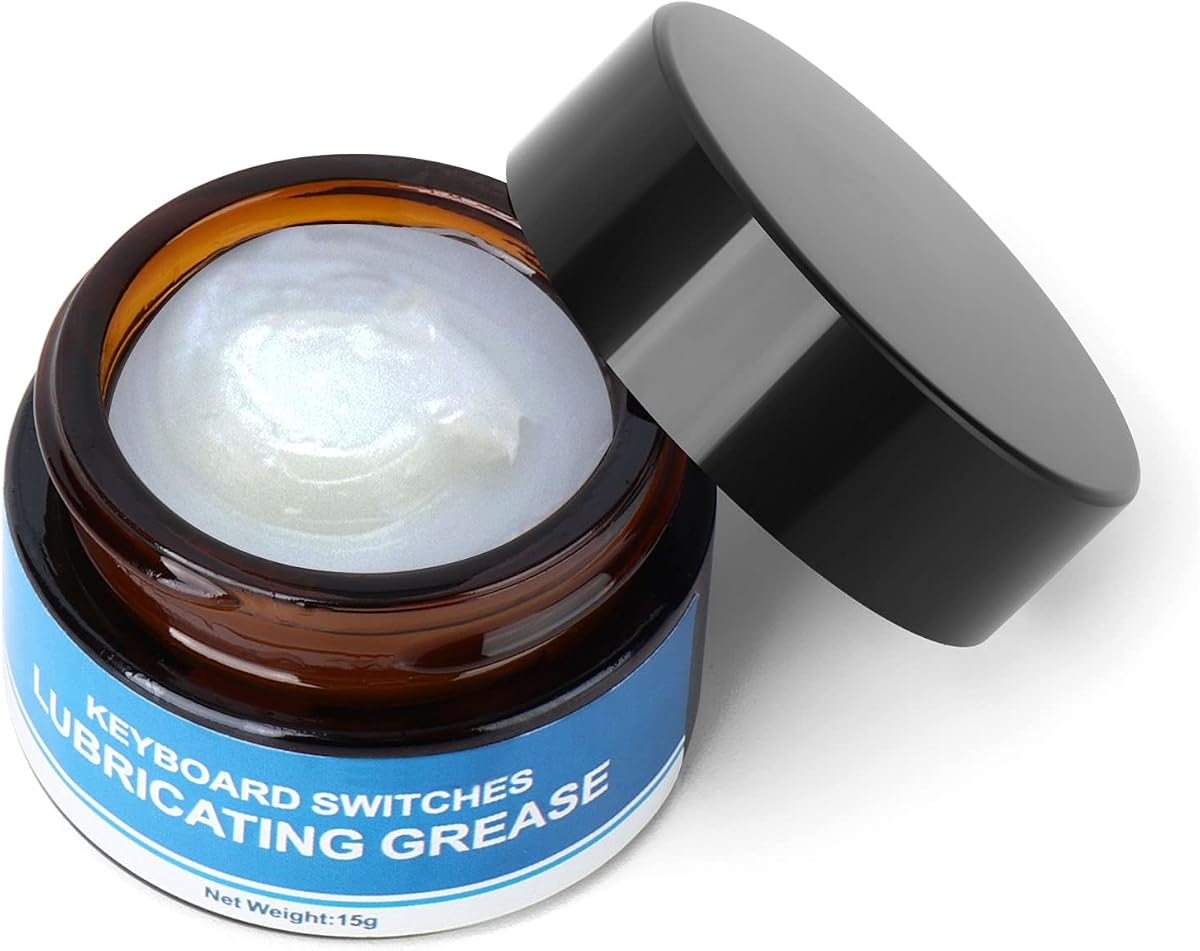
This 15g keyboard switch grease has a 4.3 customer rating and offers a straightforward, single-bottle approach to switch and stabilizer maintenance. The product is packaged in glass and contains a net weight of 15g, with a stated capacity of approximately 450 switches.
We may earn a commission when you buy through this link, at no additional cost to you.
The listing emphasizes oxidative stability, mechanical stability, colloidal stability, and water resistance. These qualities make it relevant not only to keyboards but also to bearings, instruments, and other precision parts. That broader compatibility can be helpful for a technician or hobbyist who wants one grease for several small mechanical applications.
Only the bottle is included, so users need their own brush, syringe, or other applicator. The package also provides less formulation-specific information than the other well-documented 205G0 options, making it harder to compare its exact viscosity and intended switch categories. Its 4.3 rating is also the lowest among the listed products, although that should be understood as a comparative signal rather than a prediction that the product will underperform.
This grease is best for a simple project where a user already owns application tools and wants a generous quantity for switches, stabilizers, bearings, or precision components. It may appeal to beginners because the package contains no extra parts or complicated instructions. For a specifically documented switch-lubing system, one of the more fully specified 205G0 products may be easier to evaluate.
The stated compatibility extends from keyboard parts to bearings, instruments, and other precision components. That versatility makes the bottle more useful outside a single keyboard build, provided the application area is appropriate for the grease.
A stated capacity of 450 switches and a 15g net weight offer substantial coverage without adding extra tools. Users who already have a preferred brush can focus on the lubricant itself rather than assembling a new application setup.
We may earn a commission when you buy through this link, at no additional cost to you.
Choosing keyboard lubricant requires balancing lubricant consistency, application control, intended contact area, and package capacity. The best option is not necessarily the one with the most grease; it is the one that helps you apply a controlled amount to the parts that need it.
Viscosity determines how readily a lubricant flows and how much it can reduce friction at a contact point. A heavier grease can stay in place around housings, rails, and springs, while a thinner formula is easier to distribute through confined spaces. The products in this guide are predominantly associated with 205G0, described as a seven-to-three blend of 105 and 205 greases, and some include separate 105 for spring work. Buyers should consider whether they need one general formula or a matched pair with more control over acoustic character.
Stabilizers, switch housings, stems, leaves, and springs do not experience identical friction. Stabilizer grease must reduce wire-on-housing drag without making the assembly sluggish. Switch lubricant should address contact points inside the housing, while spring-focused products aim to reduce scratchy spring movement. Several listings explicitly cover both switches and stabilizers, and one set divides 205G0 and 105 between different applications. Check the stated uses before buying so the product aligns with the parts in your keyboard.
The most common application mistake is using too much lubricant. Excess material can migrate onto keycaps, collect around a stabilizer wire, or create a heavy initial feel. Syringes provide measured, localized dispensing, while small brushes and pens are useful for placing a thin film around stems, rails, and spring seats. If precision is important, a narrow syringe may be more suitable than a broad jar. If you lubricate hundreds of switches quickly, a brush-equipped jar will usually be more efficient.
A useful brush can make a simple jar considerably more practical. The HONKID option includes a small brush, the RUNJRX package includes two, and the two-grease set includes a nylon-bristle brush. The keyboard lube set supplies three brushes plus tweezers, a station, a debugging plate, a switch opener, and a gripper. Conversely, some products include only the lubricant container. Check whether you already own an applicator before paying for a package that may duplicate equipment you already have.
Coverage figures are useful for estimating quantity, but they depend on application technique and the number of lubricated contact points per switch. Listed estimates range from approximately 250 switches for the smallest syringes to roughly 500 for G-Lube. A stabilizer-focused application may consume less than lubricating every housing and spring, while a thick or repeated application can use much more. Treat capacity numbers as practical guides rather than exact guarantees, and consider the size of your project before choosing.
Jars are practical for repeated brush applications, but they expose the lubricant to more handling and possible contamination. Syringes create a seal and offer better dose control, making them attractive for focused stabilizer work. Glass bottles can be effective for storing grease, while multi-grease packages use separate containers. The all-in-one kit goes further with an organized station for parts and tools. Choose the format that matches your workspace, handling habits, and whether you need to carry lubricant between locations.
A keyboard may experience changing temperatures in a home, office, or portable setup. Stability helps the lubricant continue functioning without becoming too fluid, separating, or difficult to apply. Listed specifications range from -50°C to 130°C for G-Lube and -40°C to 350°C for the more technically specified GPL 205G0 products. Other listings emphasize oxidative, mechanical, colloidal, and water stability. These claims are most relevant if you expect long service intervals or operate in a variable environment.
A single jar or syringe is usually enough for a focused stabilizer touch-up or a moderate switch project. A two-grease set adds spring-specific tuning, while the complete kit supports a broader, more organized workflow. Larger kits can be worthwhile for frequent builders because they include station hardware, brushes, and handling tools. For occasional maintenance, however, the extra equipment may remain unused. Consider both the number of boards you maintain and whether you enjoy switch opening and fine-tuning as part of the hobby.
Start by identifying the part that needs attention. For a switch, remove the keycap and switch as appropriate, open the housing carefully, and identify the rails, stem contact areas, spring seat, and leaves. For a stabilizer, remove the keycap and nearby keycaps, then inspect the wire and plastic housing where they contact. Work on a clean surface, keep small components organized, and do not force a component that does not release easily.
Apply the smallest useful amount. A syringe offers the highest control, while a pen or small brush can place a thin film on the intended contact point. Spread the lubricant lightly rather than flooding an area, and avoid coating surfaces where it could spread onto the keycap. Clean the applicator before moving to another area so old lubricant does not contaminate the container or create uneven deposits. A thin, consistent layer is generally more useful than a visibly heavy coating.
Reassemble and test the keyboard one section at a time. A switch should move freely without feeling unusually slow, while a stabilized key should settle without a persistent rattle or wobble. If a stabilizer feels sluggish, remove the keycap and clean away excess lubricant before adding more. Keep containers closed, store them away from excessive heat, and use clean tools around the opening so the remaining grease stays uncontaminated.
Yes. Every product in this roundup that identifies the lubricant as GPL 205G0 describes it as suitable for keyboard switches, stabilizers, or both. The application should remain thin because excess lubricant can make a stabilizer sluggish. Using a separate spring grease can provide additional control, but it is not required for basic switch and stabilizer maintenance.
A stabilizer lubricant can reduce rattling caused by friction between the metal wire and the plastic housing. It may not resolve a rattle caused by a bent wire, a cracked housing, a missing component, or a keycap that is not seated correctly. Inspect the assembly before applying lubricant, and use only a small amount at the contact points.
A syringe provides more precise dosing and is useful for placing lubricant inside a confined stabilizer housing. A small brush is easier for broad or less delicate application and can be more efficient for many switches. If you lubricate only a few stabilizers, a syringe may offer the most control; if you are working on an entire board, a brush-equipped jar is usually more convenient.
Use only a thin layer on the friction points, such as the stem rails, spring seat, or relevant leaves depending on the switch design. The product listings emphasize light application because too much can transfer onto the keycap and create a heavy feel. Start with the smallest amount, test the switch, and add more only if necessary.
Separate 105 grease is optional rather than essential. It becomes useful when you want more detailed spring tuning, a thinner application, or a matched system that separates housing and stabilizer grease from spring care. Builders seeking a straightforward result can use a versatile 205G0 product across the relevant contact areas.
Yes, especially if the lubricant is applied too heavily or allowed to spread beyond the intended contact point. Over-lubricated stabilizers can feel slow or sticky, and excess grease on a switch may create a heavier initial response. Use a controlled application, reassemble one section at a time, and remove surplus lubricant if the feel is not right.
A lube jar primarily provides lubricant and sometimes a small brush for applying it. A lube station kit also includes a work surface, switch-opening tools, tweezers, brushes, and other accessories for organizing and handling small components. A station is more useful for frequent switch work, while a jar is usually sufficient for routine maintenance.
Keep the container closed when it is not being used, and store it in a clean, dry place away from excessive heat. Avoid touching the inside of the cap or the applicator, since contamination can affect the remaining lubricant. For syringes, keep the tip covered or carefully closed to reduce accidental dispensing and keep the lubricant clean.
The HONKID GPL 205G0 is the best budget-focused choice for a straightforward 10g jar with a precision brush and stated coverage for 300–400 switches. GLORIOUS G-Lube stands out for universal switch compatibility and a listed capacity of roughly 500 switches. The Keyboard Lube GPL 205g0 set offers a higher-rated 4.7 and two pens, making it an attractive precision option for builders who want controlled access to multiple contact areas.
Whichever product you choose, prioritize controlled application over quantity. Match the format to the job: use a syringe for individual stabilizers and measured drops, a brush for efficient full-board work, a two-grease set for spring-specific tuning, and a station kit for a regular maintenance setup. The correct lubricant should reduce friction without changing the intended character of the switch or making a stabilizer feel slow.
Before ordering, verify the current product details, package contents, customer feedback, and price on the retailer listing. Lubricant formats, included accessories, and availability can change, and each keyboard responds differently. A cautious, thin application followed by testing each section is the most reliable way to achieve a smoother and quieter result.