
Adjustable Soldering Clamp PCB Holder Frame and Clamping Kit
4.2Editor score
Wide 20cm board accommodation
360-degree rotating handle
Rubber feet for stability
Discover the best soldering clamps for electronics, PCB repair, jewelry, and crafts, with detailed comparisons of stability, grip, arms, and lighting.
Soldering clamps provide the steady third hand that makes precision work safer and easier. A good model keeps wires, circuit boards, tools, and small components aligned while both hands remain available for the task. The right choice depends on grip style, base stability, reach, heat resistance, lighting, and portability.
This guide compares ten soldering clamps and helping-hands stations using the specifications and features listed for each product. It covers dedicated wire clamps, magnetic PCB holders, multi-arm stations, magnifier-equipped benches, and portable frames, showing which option suits electronics repair, jewelry making, prototyping, or general workshop use.
Each review explains the standout design, practical advantages, and limitations so you can compare the options without relying on vague recommendations. Ratings and product details reflect the supplied listings, while availability and pricing can change, so confirm the current listing and specifications before purchasing.
4.2Editor score

4.9Editor score

4.7Editor score
The table below compares all ten soldering clamps by format, holding capacity, supporting features, and intended work. It highlights the difference between a focused wire-holding clamp, compact PCB station, multi-arm helping-hands system, magnifier-equipped bench, and adjustable board frame.



The Heavy Duty Aluminum Soldering Clamp with Ceramic Jaw is a purpose-built wire holder with a 4.9 rating, the highest among the products in this guide. Its defining combination is a rigid 6061 aluminum frame, double-layer ceramic jaws, an adjustable 11mm opening, and resistance to temperatures up to 500°F. Rather than trying to be an all-purpose bench station, it concentrates on holding wires and small electronic components accurately near a soldering joint.
We may earn a commission when you buy through this link, at no additional cost to you.
The ceramic jaw is especially relevant during hot work because it provides a non-slip surface while helping protect the item from scratches and direct contact with the metal frame. The supplied listing identifies the clamp as suitable for electronic components, including LED diodes, capacitors, and resistors, as well as wires ranging from 40 to 0000 AWG and Dupont wires with connectors. The broad opening allows different conductors to be accommodated without forcing the setup into an awkward angle.
There are some limitations. This is not a multi-arm station with PCB clips, a magnifier, or a rotating tool holder, so it cannot replace a complete helping-hands system. Its 11mm maximum opening also makes it more specialized than a wide PCB frame. Nevertheless, those constraints are reasonable for a clamp whose purpose is secure, heat-resistant positioning of wires and small components. The adjustability, ceramic protection, and strong temperature tolerance make it particularly well suited to soldering, jewelry stations, automotive electrical repairs, and prototype work.
Choose this clamp when your priority is a stable holder for a wire, lead, connector, or small component rather than a multi-purpose workstation. It offers the most focused and technically distinctive approach in this group, while its high rating and specialized ceramic construction make it an especially compelling recommendation for precision soldering.
The aluminum body is listed for sustained temperatures up to 500°F, making the clamp suitable for close positioning beside soldering work. The ceramic jaws also help create a controlled barrier between the held item and the metal frame.
An 11mm opening accommodates a broad mix of wire sizes, from very fine conductors through larger AWG wires. Adjustability lets the user change the hold while preserving the alignment of the workpiece.
We may earn a commission when you buy through this link, at no additional cost to you.
This compact yellow-and-black helping-hands stand combines two quick-release clamps with adjustable arms and a small weighted base. Its 4.8 rating reflects a generally favorable position among the products reviewed. The quick-release feature is especially useful when a user repeatedly changes wires, connectors, and boards, while the second clamp allows a board and a wire to be held at the same time.
We may earn a commission when you buy through this link, at no additional cost to you.
The supplied features emphasize secure screw locking, a 3.94 by 3.94-inch iron base, a non-slip pad, and rubber-coated jaws. That combination targets a common problem in electronics and craft work: a helper that slides across the bench or leaves marks on a finished surface. The soft jaws provide a firm hold for circuit boards, wires, and jewelry, while the arms rotate to change the clamping position.
Its main limitation is capacity compared with larger helping-hands systems. It provides two working clamps rather than four, six, or a larger collection of components, and it does not include magnification or illumination. The compact footprint also means less reach across a large project. Even so, that trade-off is beneficial for mobile repair work, crowded benches, and small work areas where a larger steel base would be inconvenient.
This is a strong choice for electronics hobbyists, repair technicians, jewelry makers, and crafters who need a compact two-handed holding solution. It is particularly attractive when quick release matters more than maximum reach. For users who regularly work on full-size circuit boards or want to illuminate tiny joints, one of the larger stations may be a better fit.
A press-operated release mechanism allows the held item to be removed without repeatedly working a screw clamp. That makes the station efficient for jobs involving multiple components or frequent board changes.
Rubber-coated jaws help avoid the scratches and dents that harsh bare-metal clips can leave on circuit boards, wires, and jewelry. The soft surface still provides a firm, controlled hold.
We may earn a commission when you buy through this link, at no additional cost to you.
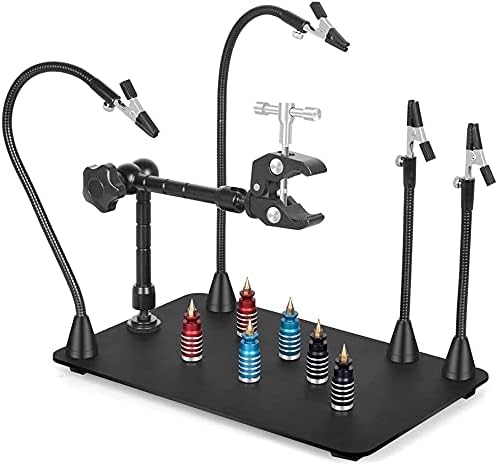
The NOEVSBIG Magnetic Helping Hands Soldering Station is built for users who want a large, stable workbench platform rather than a minimal holder. It carries a 4.8 rating and combines a powder-coated steel base, six flexible arms, four PCB holders, four alligator clips, and a 360-degree rotating hot-air gun frame. The breadth of the package gives it a different role from compact two-clamp designs.
We may earn a commission when you buy through this link, at no additional cost to you.
Its 11.4 by 7.1-inch steel base weighs more than three pounds, giving it a substantial feel and helping resist tipping. Rubber feet protect the worktop while adding grip. Two arms measure 11 inches and two measure 4.7 inches, while the additional pillar holders and magnetic bases allow components to be repositioned across the platform. The 2.16-inch jaw opening on the tool frame can accommodate soldering tools, heat guns, and components.
The main drawback is physical scale. A station this large is less convenient for field repairs or packed workbenches, and its multiple arms require more organization than a compact clamp. The rotating hot-air gun feature may also be unnecessary for users focused strictly on conventional soldering. Even so, the stability, reach, magnetic positioning, and included PCB clips are compelling for electronics repair, jewelry work, and larger projects.
Choose this station when you have a dedicated bench and need several points of support. It is a stronger fit for sustained hobby or professional work than for quick household repairs. The large base and dense collection of holders make it one of the most complete conventional helping-hands arrangements in this comparison.
The weighted steel base resists movement when components are positioned or a soldering tool is set down. Rubber feet also help prevent scuffing the bench surface while improving grip.
Six flexible arms, pillar holders, and magnetic bases can be moved to suit different project sizes. This arrangement supports several held items at once and reduces the need to reposition a fixed clamp repeatedly.
We may earn a commission when you buy through this link, at no additional cost to you.
The Helping Hands Soldering Station Clamp Set has a 5.0 rating, making it the highest-rated option in the supplied data. Its design is deliberately focused: a compact 4.72 by 4.72-inch steel base, two magnetic spring clamps, flexible alligator clip arms, and rubber-coated jaws. The result is a compact station for positioning a PCB, wire, connector, or small part during detailed work.
We may earn a commission when you buy through this link, at no additional cost to you.
The spring-loaded clamps can serve as PCB or circuit-board holders, while the flexible clip arms can secure a lead, wire, or connector. Magnetic attachment makes it possible to move each holder across the base as the job changes. The compact footprint also fits neatly on a workbench, repair mat, or portable project station, making this set more versatile than the larger magnetic station in terms of storage and transport.
This product does not offer the reach, lighting, or number of arms found in premium magnifier-equipped systems. Its base creates a defined workspace but cannot support sprawling, multi-board assemblies as easily. The included clips may also be less suitable for unusually large components than a wide PCB frame. For ordinary electronics repair, small assembly work, jewelry tasks, and model projects, however, the simpler arrangement is easy to understand and use.
The recommendation is strongest for users who want a compact and dedicated PCB holder rather than a full station. Its 5.0 rating, straightforward magnetic setup, and protected gripping surfaces make it a particularly attractive option for precise small-scale work. It also provides a useful balance between stability and portability.
The compact base creates a defined area for a circuit board and nearby leads. Magnetic spring holders keep the board supported while leaving the clip arms available for a wire or connector.
Because the holders attach magnetically, they can be moved without dismantling the setup. This makes it easy to alter the working angle as access requirements change.
We may earn a commission when you buy through this link, at no additional cost to you.
The KOTTO Helping Hands tool is a four-arm station designed for more than electronics. Its 4.6 rating and broad application list make it a practical option for soldering, assembly, repair, fishing-lure making, jewelry, crafts, model painting, and product prototyping. The tool combines a weighted base, rubber feet, flexible gooseneck arms, and stainless steel alligator tips.
We may earn a commission when you buy through this link, at no additional cost to you.
Each arm can be adjusted and rotated through 360 degrees, allowing the clamps to approach a workpiece from different directions. That flexibility is valuable when the project is not a flat circuit board. Jewelry pieces, small models, craft assemblies, and irregularly shaped components can all benefit from independently positioned supports. The weighted base helps the station remain still, while the rubber feet reduce slipping and protect the bench from scuffs.
The stainless steel tips are robust, but they are not described as having the soft coating found on several competing stations. A user working on polished jewelry or a finish that must remain unmarked may want to test contact carefully or use a protective layer. There is also no built-in magnifier or lighting, so very small joints may still require separate task illumination. These are modest limitations given the tool's broad mechanical flexibility.
This is a strong recommendation for hobbyists who move between electronics, crafts, models, and jewelry and want one mechanical helper for all of them. The four-arm format offers more holding points than a two-clamp station, while the absence of electronics-specific extras keeps the concept straightforward. It is especially appealing for users who value flexible positioning over integrated lighting.
The adjustable arms support tasks ranging from solder joints and circuit boards to jewelry and model-painting projects. This broad utility makes the station useful outside a dedicated electronics bench.
Four independently positioned clamps can secure different parts of a larger assembly. The weighted base helps prevent the station from shifting while those arms are under load.
We may earn a commission when you buy through this link, at no additional cost to you.
The XYK Helping Hands Soldering Station is a four-arm station aimed at electronics, jewelry, crafts, and general repair. Its 4.5 rating places it behind several alternatives in the group, but the core design remains effective. It includes a painted steel base, four flexible metal arms, alligator clips with rubber sleeves, four Phillips screws, and a miniature screwdriver for assembly.
We may earn a commission when you buy through this link, at no additional cost to you.
The arms arrive in two different lengths, measuring 9.44 and 7.08 inches. They lock tightly to the base with screws, providing a more direct positioning method than magnetic attachment. Every clip can rotate 360 degrees, and the rubber sleeves are intended to prevent scratching polished jewelry or creating an electrical short on a circuit board. The 7.87 by 5.51-inch base gives the station a moderate footprint, while four rubber pads help prevent sliding.
Compared with a magnetic design, the screw-mounted arms may require more effort to reposition. For a user who expects to change positions frequently, that is a meaningful inconvenience. The 4.5 rating also warrants checking recent customer feedback before buying. The station offers no lighting or magnification, and its relatively compact base does not cover as much bench area as the larger heavy-duty models.
Despite those caveats, the XYK is a practical option for users who work on jewelry and circuits and want protected clip surfaces. Mixed arm lengths offer useful positioning range, while the included screwdriver simplifies initial setup. It works best when the configuration can be established for a project and then left in place during the soldering or assembly process.
The insulated sleeves help protect polished jewelry and reduce the likelihood of a bare clip damaging a circuit board. That makes the alligator-style arms practical for mixed craft and electronics tasks.
Two longer and two shorter arms create a useful combination of reach and compact positioning. Each arm can be adjusted and locked to suit the dimensions of the workpiece.
We may earn a commission when you buy through this link, at no additional cost to you.
The NOEVSBIG Helping Hands Soldering Station with 5X Magnifying Lamp is the most feature-oriented premium option in this roundup. It earns a 4.7 rating and combines a glass magnifier, LED illumination, four helping-hands clamps, flexible arms, and a 2.16-inch super clamp. It is designed for users who want more than a passive holder and need clear visual access to tiny components.
We may earn a commission when you buy through this link, at no additional cost to you.
The 5X glass magnifier makes solder joints, tiny components, and dense circuit layouts easier to inspect. Built-in lighting provides illumination directly over the work area, reducing reliance on general room lighting. The parallel clamps apply even pressure across a circuit board, which the product description says helps reduce scratches, bent edges, and damage compared with traditional alligator clips. Magnetic holders can then be repositioned as a project changes.
The rotating super clamp adds another layer of utility. Its 2.16-inch opening can hold soldering tools, heat guns, and components, while dual mounting screws and compatibility with 1/4-inch and 3/8-inch threads make it adaptable to different arm arrangements. One-hand adjustment is another convenience, although users should still verify that every screw and connection is tight before beginning heat work.
Choose this station if magnification, bright task lighting, and flexible board holding justify a larger, more complex setup. It is well suited to detailed electronics repair, inspection, and DIY work where visual clarity affects results. Although it is not the only choice for simple soldering, it offers the strongest integrated feature set in this comparison for users building a more complete workbench.
The 5X glass magnifier enlarges small solder joints and components without requiring a separate loupe. Combined with LED illumination, it helps reveal details in dense or poorly lit work areas.
The board clamps distribute contact more evenly than a narrow alligator clip. That supports a stable grip and helps reduce scratching or edge damage during soldering and rework.
We may earn a commission when you buy through this link, at no additional cost to you.
The NOEVSBIG Dual-Head Ultra-Grip is a compact two-clamp holder designed for small electronics, crafts, PCB repair, and other precise tasks. Its 4.8 rating places it among the strongest performers in the list. The core setup consists of a quick-release clamp for one workpiece, a second clamp for another, adjustable arms, and a rubber-coated gripping surface.
We may earn a commission when you buy through this link, at no additional cost to you.
One notable feature is the ability to hold a PCB in one clamp and a wire in the other simultaneously. The quick-release mechanism reduces the time spent loosening and tightening a conventional screw clamp when components need to change. Secure screw locking keeps the arm positions steady, while the dual-head design is intended to provide a firm grip. A 3.94 by 3.94-inch iron base and non-slip pad help keep the stand in place.
The compact size is both a strength and a limitation. It is easy to carry for off-site car, electronics, or craft repairs and will not dominate a crowded bench. At the same time, it offers less reach and fewer work zones than a four-arm or large magnetic station. The absence of magnification and lighting may also make extremely small work less comfortable.
This is a good recommendation for users seeking a portable third hand with fast component changes and protected surfaces. It suits small boards, wires, connectors, jewelry, and detailed hobby work particularly well. Choose it when convenience and quick setup matter more than a large, illuminated, multi-arm workbench.
Pressing the release mechanism makes it easy to swap held pieces without manipulating a threaded grip. This is useful for repeated soldering or assembly tasks involving different components.
The small base and lightweight construction make the station easier to pack for field repairs. It can provide a stable holding point away from a permanent electronics bench.
We may earn a commission when you buy through this link, at no additional cost to you.
The NOEVSBIG Heavy-Duty Magnifying-Lamp Station combines a large base, four PCB holders, flexible arms, and an upgraded 5X lamp. Its 4.8 rating makes it one of the highest-rated options in the guide. It is designed for detailed soldering, jewelry inspection, and electronics work where a user benefits from both a stable mechanical support system and enhanced visibility.
We may earn a commission when you buy through this link, at no additional cost to you.
The 11 by 7-inch powder-coated steel base provides a broad, stable platform, and rubber feet help prevent movement while protecting the work surface. The 3.2-inch lens uses optical glass and is paired with 62 high-CRI LEDs. Fifty lighting modes allow a choice between warm 4500K and cool 6200K illumination, making it possible to tailor the visible color temperature to the task.
A 2.16-inch friction soldering clamp includes 1/4-inch screws and supports 1/4-inch and 3/8-inch threads. The arm is listed as supporting up to 4.4 pounds, while the four steel arms come in 14-inch and 9.8-inch lengths. Those holders and the four PCB clips provide several ways to secure work. The included power adapter is an additional operational consideration, and the large base is not ideal for a cramped or portable workspace.
This station is a strong all-around choice for a dedicated bench where visibility and holding flexibility are priorities. It offers more board-specific support and lighting control than conventional helping-hands products. If detailed inspection is important but the footprint seems excessive, the other magnifier-equipped station provides a more compact alternative.
Fifty modes spanning 4500K to 6200K let the user shift between warm and cool illumination. This flexibility can make tiny components and reflective work surfaces easier to evaluate.
Four PCB holders, four flexible arms, and a magnetic clamp create several possible support points. The wide steel base gives those components room to be arranged around a project.
We may earn a commission when you buy through this link, at no additional cost to you.
The Adjustable Soldering Clamp PCB Holder Frame is a simple, dedicated board holder rather than a full helping-hands station. It has a 4.2 rating, the lowest in this group, but its straightforward construction remains useful for electronics repair. The frame uses quality metal, an ABS side stand, and four anti-slip rubber feet to provide support during soldering and rework.
We may earn a commission when you buy through this link, at no additional cost to you.
Its key advantage is broad PCB accommodation. The kit provides four thickness settings, and the adjustable maximum opening reaches 20cm. A side stand made from ABS slides smoothly as the width changes. The handle rotates 360 degrees, giving access to both sides of a board without requiring the user to move the entire frame. Loosening and tightening a knob controls the handle angle.
Two iron pen racks are built into the design, providing a convenient place for soldering tools. That keeps them within reach while reducing bench clutter. The trade-offs are the absence of multiple flexible arms, alligator clips, magnetic repositioning, and lighting. The 4.2 rating also suggests checking recent customer feedback for any fit or finishing concerns relevant to a particular board.
Choose this frame when you need a straightforward PCB holder for repairs and want broad size compatibility without a larger helping-hands system. It is a practical budget-oriented option for mobile-phone, computer, electronic-toy, and general circuit-board work. Its strongest features are width flexibility and rotating access, while users should not expect the multi-point holding capacity of the larger stations.
Four thickness settings and an opening of up to 20cm cover a varied range of circuit boards. The sliding side stand makes width changes more direct than on a fixed-size holder.
A 360-degree handle can swing around to expose both sides of the workpiece. This improves access during soldering, desoldering, inspection, and rework.
We may earn a commission when you buy through this link, at no additional cost to you.
A useful soldering clamp should hold the workpiece securely without damaging it, remain stable near heat, and fit the scale and portability of your work. The most important factors are the type of material being held, available reach, base stability, adjustment method, and whether the task requires illumination or magnification.
Dedicated wire clamps are ideal when the main goal is to position a conductor or small component accurately beside a joint. Multi-arm helping-hands stations are more useful when several parts must remain aligned at once, while wide PCB frames focus on supporting a single circuit board with access to both sides. Magnetic stations are particularly convenient when you expect to rearrange holders frequently, and magnifier-equipped systems suit detailed inspection work.
A broad, weighted steel base is useful when several arms carry a project or when a soldering tool may accidentally be knocked against the station. Rubber feet help prevent sliding and protect the bench. Compact stations are easier to store and carry, but they provide less reach and fewer separate work zones. Consider the physical space available, the size of your typical projects, and whether the unit will remain on one permanent bench.
The material contacting the workpiece matters. Ceramic jaws offer heat resistance and a non-slip surface, rubber-coated jaws help protect boards, wires, and jewelry, while bare stainless steel clips are durable but may mark polished or delicate items. Check the stated maximum opening, adjustment range, and whether the grip applies broad, even pressure or concentrates force at a narrow contact point.
A clamp positioned close to a soldering operation should tolerate the heat generated in the work area. The aluminum clamp in this guide is specified for temperatures up to 500°F, while ceramic jaws provide a useful heat-resistant contact surface. For other stations, consider material construction and the distance between the holder and the heated tool. A metal frame is generally reassuring, but stable positioning matters just as much as heat tolerance.
Useful arms should move smoothly, lock securely, and reach the workpiece without forcing an awkward angle. Gooseneck arms and 360-degree clips offer three-dimensional positioning, while quick-release mechanisms speed component changes. Magnetic holders are easy to relocate but depend on a suitable metal base. Screw-locked arms are stable once configured but take more effort to move.
Magnifier-equipped stations are valuable when tiny components, dense boards, or reflective jewelry need closer inspection. A 5X optical lens paired with bright LED illumination can reduce eye strain and make small joints easier to see. If your work mainly involves larger components or well-lit simple joints, the extra size and power requirements may not be necessary, and a standard helping-hands station may be more convenient.
Some stations include PCB clips, alligator clips, flexible arms, a rotating tool holder, and a user manual. Others focus on a single clamp or frame. More accessories provide more ways to support a project, but they can also add setup complexity. Check whether the included parts match your usual workload, such as repeated phone repairs, jewelry assembly, prototyping, or general electronics repair.
A stable holder reduces the chance that a hot tool will drop onto a component, but it does not replace sensible soldering practice. Place the station on a level, heat-appropriate surface, position the work before heating the iron, and keep the clamp away from cables or flammable items. Check screws and arm locks before use, especially on a station with magnetic components or a heated tool holder.
Begin by placing the base on a level, stable work surface. For a magnetic station, make sure the steel base is seated properly and that each magnetic holder is fully attached. For a screw-locked helping-hands tool, tighten the arm fasteners before placing the workpiece, then position and lock the clamp with only enough force to avoid damaging the material.
Place the board, wire, connector, or component in the holder before heating the soldering iron. Adjust the arms so the work faces the user and the joint is accessible from multiple sides. PCB frames benefit from rotating the handle to check both sides, while magnifier stations should have the lens and LED positioned directly over the work. Confirm that the tool or workpiece will not shift when touched lightly.
After use, allow the heated tool and any hot component to cool before removing them. Wipe the jaws with a cool, clean cloth if residue is present, but avoid immersing the assembly or using harsh chemicals that could damage coatings, insulation, or adhesives. Inspect screw locks, magnetic joints, and rubber feet periodically, and replace the station if a grip becomes loose or a protective surface becomes damaged.
A soldering clamp usually concentrates on holding one wire, lead, or small component in a precise position. A helping-hands station includes a base and multiple flexible arms, giving you more ways to support a board, wire, tool, or several parts at once. The best choice depends on whether you need one controlled grip or a flexible multi-point workstation.
Ceramic jaws are especially useful when a holder must operate close to heat because they resist high temperatures and provide a controlled gripping surface. The aluminum clamp in this guide is rated for temperatures up to 500°F and uses double-layer ceramic jaws. They are also useful for protecting small components from direct contact with the metal frame.
It can if the contact surface is hard, narrow, or tightened too aggressively. Rubber-coated jaws, ceramic surfaces, and parallel board clamps are better choices for delicate PCBs because they are intended to reduce scratching or edge damage. Always use the lightest secure hold and check that no component is being pulled out of its socket.
A magnifier is helpful when you work on tiny components, dense solder joints, reflective jewelry, or poorly lit areas. The 5X glass magnifier and LED illumination in two of the featured stations are intended to improve visibility. For larger boards and straightforward through-hole work, a standard mechanical helping-hands station may provide sufficient visibility without taking up more space.
They can be, particularly when the arms are correctly positioned on a sturdy steel base and the magnetic connections are clean and fully seated. Strong magnets help prevent slipping, while flexible arms and clamp tips control the workpiece. Always tighten the arm's locking hardware and avoid pulling the arm while it is carrying a load.
The compact two-clamp and dual-head magnetic stations have small square bases and are the most portable options in this guide. The Adjustable PCB Clamp Frame is also manageable because it has a simple open structure, although it still requires a stable surface. Large stations with long arms, broad steel bases, magnifiers, and power adapters are better suited to a permanent bench.
Yes, if it has at least two independently positioned holding points. Several featured stations can hold a circuit board in one clamp and a wire in another, which is useful when the wire must remain aligned with a specific pad or component. A single-jaw design may be sufficient for one wire, but it offers less flexibility for mixed connections.
Let the clamp and any attached workpiece cool before cleaning, then wipe the gripping surfaces with a cool, clean cloth. Avoid soaking the base or immersing electrical accessories, and do not use harsh solvents on rubber coatings or other protective finishes. If flux or residue accumulates, check the product instructions for an approved cleaning method.
The Heavy Duty Aluminum Soldering Clamp with Ceramic Jaw stands out for focused wire holding, heat resistance, and protective ceramic jaws. The Adjustable PCB Clamp Frame provides a simple and adaptable solution for circuit-board work, while the NOEVSBIG station with a 5X magnifying lamp offers the most integrated premium setup for detailed work.
Prioritize the type of workpiece you hold most often, then choose stability, reach, and contact materials around that need. A dedicated ceramic clamp suits wires and small parts, a wide PCB frame is useful for board repair, and multi-arm stations help with larger assemblies. Add magnification when visual inspection is genuinely difficult, but do not choose a larger station if portability matters more.
Ratings, product configurations, and specifications can change, and marketplace listings may offer different variants over time. Before buying, confirm the current dimensions, included accessories, material details, and compatibility with your project. Checking the latest listing and customer feedback will help ensure that the selected soldering clamp matches both your workflow and your workspace.