Garmin Approach CT10 Starter Kit
4.5Editor score
Three tracking sensors included
Compatible Garmin watch pairing
Automatic distance and club data
Our expert guide compares 10 smart golf game tracking systems, including automatic sensors, GPS watches, smart grips, club tags, and portable launch monitors.
A smart golf game tracking system can turn an ordinary round into a detailed performance report, revealing club distances, shot accuracy, putting results, and patterns that are otherwise difficult to notice. The strongest systems combine reliable data capture with a useful app, clear course mapping, and analytics that help golfers make better decisions.
This guide compares ten products that support different parts of game tracking, including sensor systems, smart grips, NFC club tags, a GPS golf watch, and a portable launch monitor. We evaluated the stated features, compatibility requirements, tracking method, analytics, and practical limitations, while recognizing that automatic tracking and phone-tap systems create different experiences.
Each review identifies the product's standout capabilities, ideal use case, and trade-offs. The first three recommendations represent our best overall, budget, and premium selections, while the remaining entries show how the category varies by installation, compatibility, and data focus. As with all shopping features, availability and pricing can change, so verify current details before buying.
4.5Editor score

4.1Editor score
4.4Editor score
This side-by-side comparison highlights the most important differences among the ten products, including their tracking methods, device requirements, analytical strengths, and ideal users.




The Arccos Smart Sensors Gen 4 is the strongest all-around system in this guide for golfers who want detailed tracking without touching a phone or watch before every shot. It receives a 4.1 rating and includes 15 regular club sensors plus a dedicated putter sensor. The complete club coverage is especially useful for golfers who want more than driving and approach statistics.
We may earn a commission when you buy through this link, at no additional cost to you.
Its defining advantage is fully automatic data capture. Once the sensors are assigned to the correct clubs, the system can record shots and relate them to the Arccos app without requiring a pre-shot routine. The AI-powered GPS rangefinder adjusts yardages in real time for wind, including gusts, elevation, temperature, humidity, and altitude, giving golfers context beyond a single distance number.
The trade-offs involve planning and the ongoing app ecosystem. Users must distribute the lightweight, weather-resistant sensors among their clubs correctly, and the included first-year membership applies only to new users before a subscription becomes necessary. Those considerations may discourage golfers who want a simple passive tag with no recurring service, but they are reasonable for a system offering this much automatic analysis.
This is our top overall recommendation for golfers who value low-interruption tracking, comprehensive statistics, and intelligent course guidance. It is particularly suited to regular players who want to identify repeatable distance gaps, analyze approach performance, and improve strategy without manually entering shots. Verify app requirements and sensor coverage before purchase, but for hands-free analytics it remains the most complete choice here.
The primary benefit is the absence of a pre-shot tapping habit. Sensors recognize club use while the app builds a round record, making this system appealing to golfers who dislike interrupting their setup for every stroke.
The rangefinder accounts for several environmental variables rather than presenting only a static satellite distance. That added context can make the number more useful when wind, elevation, or altitude materially affect a shot.
We may earn a commission when you buy through this link, at no additional cost to you.
This Arccos Smart Sensors listing shares the Gen 4 hardware concept but places greater emphasis on personalized strategy, strokes gained, and comparison with professional players. It carries a 4.1 rating and includes 15 standard sensors, one putter sensor, weather-resistant construction, and a long-lasting battery with a two-year warranty.
We may earn a commission when you buy through this link, at no additional cost to you.
The analytical experience is the key attraction. Personal AI Caddie advice offers real-time insights, alternative strategies, and outcome predictions for individual shots. Strokes gained analysis compares performance against a target handicap, while the Plays Like feature and smart club distances help golfers understand their own results and how they compare with tour-level benchmarks.
As with the first-ranked listing, users should account for the app membership after the included first year. The annual sensor renewal program is another program-specific detail that should be reviewed carefully, especially for golfers who already own sensors or need replacements over time. Otherwise, the sensors are described as ultra-light, weather-resistant, and backed by a two-year warranty.
Choose this version if AI-assisted strategy and professional comparison data are your priorities. It is best for golfers who want the system to explain not just what happened but what may work better next time. Confirm the current membership terms, warranty coverage, and renewal conditions, then pair the system with a compatible phone for the fullest experience.
The AI caddie features are designed to translate shot data into decisions. For golfers focused on strategy rather than simply collecting distances, this adds meaningful value to each tracked round.
Strokes gained and tour comparisons can reveal whether progress comes from better contact, smarter club selection, or improved performance under specific conditions. The value lies in reviewing trends rather than reacting to a single result.
We may earn a commission when you buy through this link, at no additional cost to you.
Golf Pad TAGS offers an approachable approach to golf tracking for golfers who want distance, accuracy, club, and putting information without installing electronics inside their grips. It receives a 4.0 rating and uses lightweight NFC tags attached to club grips. The tags require no charging or syncing cable, simplifying both storage and maintenance.
We may earn a commission when you buy through this link, at no additional cost to you.
Tracking works by tapping the relevant club tag to a compatible phone before each shot. Golf Pad then records the distance, accuracy, and club used, while its game-analysis features cover club averages, putting statistics, accuracy percentages, and scoring trends. Rounds can be edited, exported, and shared with friends or a coach, which is useful for golfers already comfortable with phone-based tools.
The primary disadvantage is the need to tap before each shot. That requirement is less seamless than automatic sensor systems and could become a source of missed shots if the routine is not established. Compatibility is also narrower than the product category's broader ecosystem: it works with NFC-enabled Android devices and iPhone 7 or later, excluding the original iPhone SE.
Golf Pad TAGS is a practical choice for golfers who value a simple system, low-maintenance tags, and shareable analysis more than completely automatic capture. It works particularly well for players who already use their phone at the tee and teeing off. New users should confirm that their phone supports the required NFC functionality and practice the tap habit before relying on the data for coaching.
The tags contain no rechargeable components, so there is no charging routine to remember. That simplicity makes the system approachable, although the phone remains central to every entry.
Editable rounds, export options, and sharing functions make the analysis easier to use with a coach. Golfers can focus on specific stats instead of treating every recorded metric as equally important.
We may earn a commission when you buy through this link, at no additional cost to you.
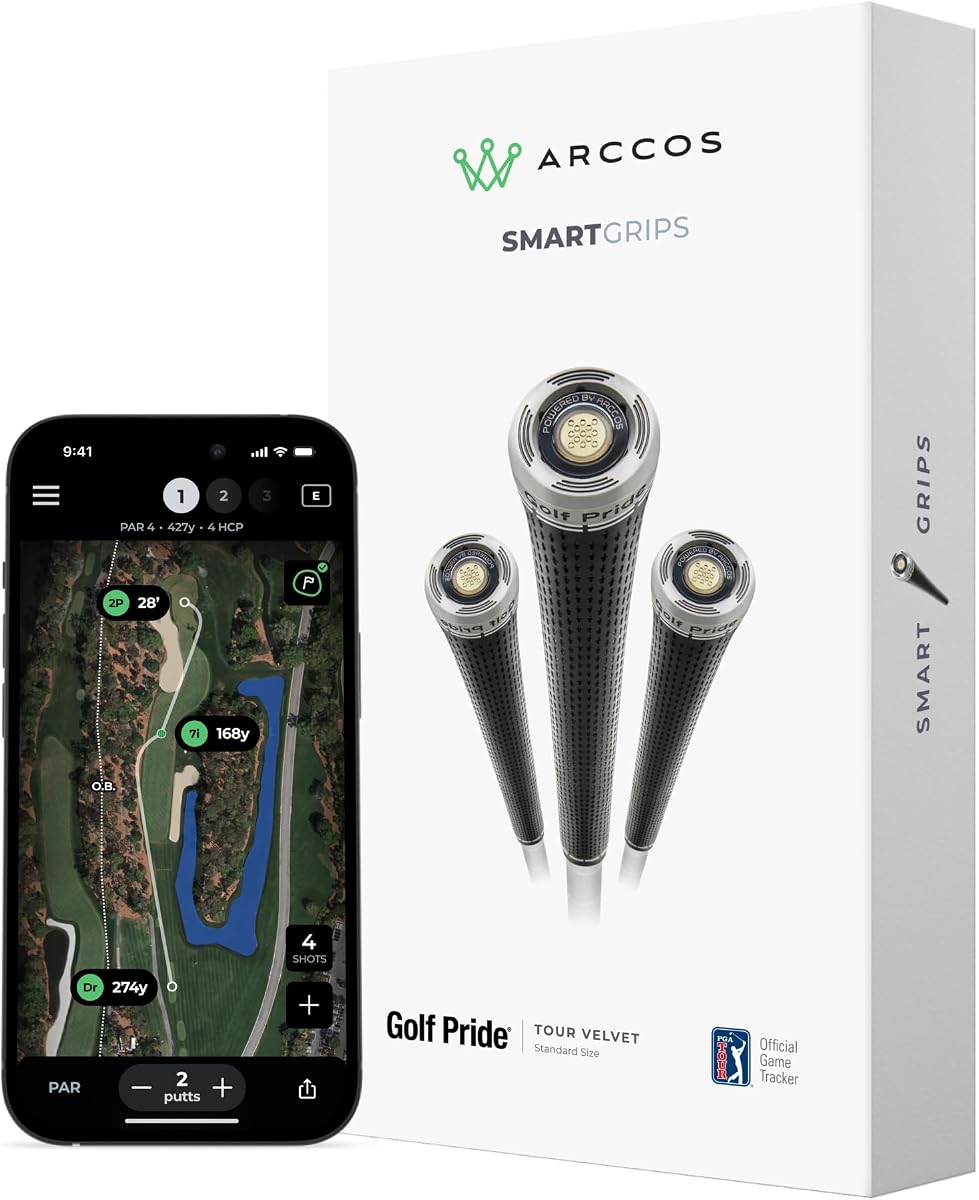
The Arccos Smart Grips Tour Velvet set integrates tracking into a complete set of 13 Golf Pride MCC Plus4 standard grips and a screw-in putter sensor. It receives a 4.4 rating and suits golfers who want automatic capture without visible tag tapping. The embedded sensors are described as ultra-light and weather-resistant, with power-saving operation and a two-year warranty.
We may earn a commission when you buy through this link, at no additional cost to you.
Installation is a major part of the proposition. The grips can be installed on an existing club set without special tools or specialized processes, making the system more integrated than clip-on accessories. Once installed, the app provides automatic shot tracking, an AI-powered GPS rangefinder, Plays Like distances, and smart club distance calculations.
The decision is essentially whether golfers want tracking built into a full grip replacement rather than a sensor that attaches temporarily. Existing grip wear, regripping preferences, and club-handling comfort all influence the outcome. The included first-year app membership supports initial setup and full performance tracking, but access beyond that period depends on the current membership terms.
This is our premium selection because it combines the visual simplicity of embedded technology with automatic data capture and a complete grip set. It is a strong fit for golfers who regrip regularly and want their equipment to serve as the tracking platform. Those who do not want to replace their grips or who prefer removable tags should consider a more modular alternative.
Embedding sensors into the grips creates a cleaner round with no tags to tap and no separate sensors to distribute among the bag. It also makes regripping a recurring maintenance task that golfers should understand before selecting the system.
The combination of AI GPS yardages, Plays Like distances, and calculated club averages goes beyond a basic shot log. It is intended to help golfers connect course conditions and strategy with actual results.
We may earn a commission when you buy through this link, at no additional cost to you.
The Arccos Caddie Smart Grips set combines 13 standard Golf Pride MCC Plus4 grips with a screw-in Arccos Putter Sensor. It has a 4.4 rating and is designed to record and analyze every shot automatically, without tagging, tapping, or other actions between shots. That makes it a streamlined alternative for golfers who want data collection to happen in the background.
We may earn a commission when you buy through this link, at no additional cost to you.
The app supplies the main analytical value, including AI-based insights, GPS rangefinding, Smart Distance club averages, and strokes gained analytics. These features are designed to show where performance is strong and where specific work may produce the greatest benefit. The integrated approach also avoids the visual clutter and handling demands associated with loose tags.
One important limitation is size. This listing specifically provides standard-size MCC Plus4 grips, so golfers who prefer midsize options need to choose the corresponding set. The included first-year membership also means the long-term experience depends on the service terms available when the system is activated.
This is a strong option for golfers with standard-size grips who prioritize automatic capture and detailed analysis. Installation is described as straightforward, but golfers should confirm grip size and be comfortable with replacing their grips. The system is best treated as a complete equipment upgrade rather than a temporary add-on, particularly for players who want their existing clubs to become the tracker.
Automatic recording preserves the natural pace of a round. A golfer can focus on club selection and execution without opening an app or touching a tag before every shot.
Strokes gained can translate many individual measurements into a clearer picture of overall performance. Reviewing trends over several rounds is more useful than overreacting to one unusually good or poor hole.
We may earn a commission when you buy through this link, at no additional cost to you.
The Arccos Smart Grips MCC Plus4 Midsize Set is the midsize counterpart for golfers who prefer a fuller-feeling grip. It receives a 4.4 rating and includes 13 midsize Golf Pride MCC Plus4 grips along with a screw-in putter sensor. The embedded system automatically records shots without requiring tags, taps, or other interruptions during play.
We may earn a commission when you buy through this link, at no additional cost to you.
Its app combines AI-powered performance insights, a GPS rangefinder, Smart Distance averages, and strokes gained analytics. Because the sensors are integrated into the grips, club identification happens naturally as the equipment is used. The system is therefore most attractive to regular golfers who want broad analysis but dislike maintaining a collection of loose accessories.
The main commitment is the regrip itself. Even though installation does not require special tools, it still changes the feel of every club in the bag, and golfers with a preference for standard sizing should not choose this set. The included first-year membership provides access to performance features, while longer-term use depends on the membership available after that period.
This set is best for golfers who specifically want midsize grips and prefer permanently integrated tracking. It supports both recreational improvement and more structured analysis of club performance, provided the player is comfortable with a full grip upgrade. Confirm sizing, installation expectations, and current membership terms before ordering to avoid an avoidable return.
The midsize profile is a meaningful distinction for golfers who feel standard grips are too small. Comfort at address can influence confidence and consistency, so choosing the correct size is a performance consideration as well as a preference.
Sensors embedded in every grip eliminate loose accessories and pre-shot actions. The trade-off is that the system becomes part of the clubs and therefore needs to move with them during future regripping.
We may earn a commission when you buy through this link, at no additional cost to you.
The Garmin Approach CT10 Starter Kit offers a focused way to add automatic club tracking to a compatible Garmin golf watch. It receives a 4.5 rating and includes three sensors, making it an accessible starting point for golfers who want to measure selected clubs rather than outfit their entire bag immediately. The watch requirement is the central consideration.
We may earn a commission when you buy through this link, at no additional cost to you.
Once a sensor is installed on a club, the system automatically tracks the shot when that club is selected on the paired watch. It records stroke location, distance, and club type, allowing golfers to review club-specific distances and accuracy to the fairway or green. The collected data can also support strokes gained and other statistics commonly used by professional golfers.
The kit's limited sensor count means it cannot deliver complete bag coverage from the outset. Golfers would need additional sensors for clubs they want to monitor. It also depends on a compatible Garmin golf watch and the associated Garmin Golf ecosystem, so the total equipment commitment is larger than the kit alone may initially suggest.
This is the best budget selection for golfers who already own a compatible Garmin watch and want to begin tracking a few important clubs. It is especially useful for examining driver, wedge, or putter performance across a sequence of rounds. Prospective buyers should confirm watch compatibility and decide whether partial club coverage fits their improvement goals before purchasing.
Starting with three sensors allows golfers to test the system on selected clubs before committing to full-bag coverage. Additional sensors can expand the dataset when the tracking habit becomes established.
Pulling a sensor-equipped club from the bag allows its statistics to appear on the compatible Garmin watch. This reduces manual club selection and keeps the relevant performance information visible during the round.
We may earn a commission when you buy through this link, at no additional cost to you.
The Garmin Approach CT1 tags offer a lightweight, battery-free alternative for golfers who want club identification within the Garmin ecosystem. They receive a 3.6 rating and attach securely to the end of a grip. Because they contain no battery, there is no charging schedule and no battery degradation to manage over time.
We may earn a commission when you buy through this link, at no additional cost to you.
The tags are tapped to a compatible Garmin golf smartwatch to record each stroke, including location, distance, and club type. They can cover clubs ranging from driver to putter and provide typical distance, fairway accuracy, and green accuracy statistics. The Garmin Golf app adds strokes gained analysis and longer-term trends for identifying areas that need attention.
The tap requirement is the main compromise. It is less convenient than automatic sensor recognition and depends on the golfer remembering to interact with the watch before every shot. The lower 3.6 rating also suggests that some buyers may have encountered dissatisfaction, although that figure alone does not explain the cause or establish how the system performs in every environment.
This product is best for golfers who value a small, battery-free accessory and already use a compatible Garmin smartwatch. It may also appeal to players who prefer explicit confirmation before a shot rather than relying on automatic detection. Buyers should consider whether the tap routine fits their game and review the current tag attachment method for their club grips.
The battery-free design removes one of the most common reasons golfers abandon electronic club accessories. It is particularly attractive for players who already dislike managing rechargeable sensors.
Typical distance, fairway accuracy, and green accuracy create a useful view of performance by club. The app's trend tools can make gradual changes more visible across multiple rounds.
We may earn a commission when you buy through this link, at no additional cost to you.
The Garmin Approach R10 is a portable golf launch monitor designed to provide ball-flight and swing information at home, indoors, or on the driving range. It receives a 4.1 rating and is waterproof to IPX7, with a control method using the Garmin Golf app and voice. Its battery can last up to 10 hours, supporting extended practice sessions.
We may earn a commission when you buy through this link, at no additional cost to you.
When paired with a compatible smartphone, the R10 tracks club head speed, ball speed, swing tempo, ball spin, launch angle, and related metrics. Training mode organizes data by club and displays shot dispersion based on estimated ball flight. It also records video clips with the corresponding swing information, making it possible to compare mechanics and results within the same session.
This is a different category of tracker from a GPS watch or club sensor. Its strength is immediate, detailed swing feedback rather than automatic mapping of every shot during a full round. It requires a compatible smartphone and the Garmin Golf app, and its best use depends on the golfer's practice priorities and access to space for meaningful ball flight.
The R10 is ideal for golfers seeking repeatable practice data and visual swing evidence. It can help a player investigate speed, launch direction, and dispersion independently of course strategy. Because it is not a substitute for on-course club tracking, it works best alongside a watch or sensor system rather than as a replacement for one.
Metrics such as club head speed, ball speed, and launch direction help golfers identify whether changes in technique produce measurable outcomes. A consistent environment is especially useful when comparing sessions over time.
Automatically captured clips can be reviewed alongside swing metrics. That connection may help golfers connect a visible movement with the resulting speed, launch, or dispersion pattern.
We may earn a commission when you buy through this link, at no additional cost to you.
The Garmin Approach S12 is a GPS golf watch that combines course navigation with expandable club tracking. It receives a 4.4 rating and comes with more than 42,000 preloaded courses. Its high-resolution display is sunlight-readable, and the stated battery life reaches up to 30 hours in GPS mode, which is useful for full-day rounds.
We may earn a commission when you buy through this link, at no additional cost to you.
On the course, the watch provides front, back, and middle green yardages along with distances to hazards and doglegs. Golfers can keep score directly on the watch and upload the round to the Garmin Golf app through a compatible smartphone. Compatible Approach CT10 sensors can add automatic club distances, although those sensors are sold separately.
The watch therefore offers a flexible entry point into smart tracking. A golfer can use it for navigation and scoring without additional club hardware, then add sensors to the clubs that matter most. This makes it more versatile than a watch-only bundle that assumes full sensor coverage from the beginning, but a complete setup still requires additional purchases.
The S12 is best for golfers who prioritize course maps, readable guidance, long battery life, and the option to add automatic club tracking later. It works particularly well as the central device for a Garmin-based system. Verify current sensor compatibility and app requirements, but the watch provides a capable foundation for both navigation and round analysis.
The extensive preloaded course library reduces the need to search for maps before a round. This is convenient for golfers who travel between familiar and unfamiliar venues.
Compatibility with CT10 sensors allows the watch to progress from basic scorekeeping and navigation to club-specific tracking. That makes it a practical central platform for a staged setup.
We may earn a commission when you buy through this link, at no additional cost to you.
The right smart golf game tracking system depends on how you play, what devices you already use, and whether you prioritize convenience, course strategy, swing feedback, or detailed club statistics.
Automatic recognition is the least disruptive approach because the system identifies the club without a pre-shot action. Golf Pad TAGS, Garmin Approach CT1 tags, and the Garmin Approach S12 with compatible CT10 sensors require an explicit tap, which gives golfers more control but introduces a routine that must be repeated consistently. Smart grips and sensor-equipped Arccos systems shift the tracking hardware into the equipment itself. Consider whether you already have a reliable pre-shot routine and how likely you are to remember it when the pressure of a round increases.
Choose automatic tracking if seamless capture is the priority. Choose tap-based tracking if you value confirmation, want the hardware to remain removable, or prefer a simpler setup.
Many smart tracking products depend on a phone, smartwatch, or vendor-specific app. Golf Pad TAGS requires an NFC-enabled Android device or an iPhone 7 or later, excluding the original iPhone SE. The Garmin CT10, CT1, R10, and S12 products operate within the Garmin Golf ecosystem and may require compatible devices for full functionality. Arccos systems rely on the Arccos app for analysis, AI features, GPS context, and continuing membership. Review operating-system, Bluetooth, NFC, and watch requirements before purchasing, and confirm that the device you use every day will not be left behind during a round.
The best system is one you can use consistently with the technology already in your golf bag.
Full-bag tracking provides the clearest picture of distance gaps, accuracy by club, and overall performance. The Arccos Smart Sensors Gen 4 includes 15 regular sensors and a putter sensor, while the Arccos Smart Grips sets include 13 grips and a screw-in putter sensor. The Garmin CT10 Starter Kit includes only three sensors, and the CT1 tags are offered as individual club attachments. A watch-only system can track the game but cannot automatically identify every club without compatible sensors. Decide whether you want complete coverage immediately or prefer to test a few clubs before expanding.
More sensor coverage creates richer analysis, but only if you use the clubs consistently. Begin with the instruments that matter most to your game.
Distance recording is only the starting point for many systems. Arccos offers strokes gained analytics, smart club distances, AI caddie advice, outcome predictions, and Plays Like comparisons. Garmin systems provide club averages, accuracy metrics, strokes gained analysis, and long-term trends. Golf Pad TAGS emphasizes putting statistics, club averages, accuracy percentages, and scoring trends. Consider which questions you want the reports to answer. A golfer focused on club selection may value contextual strategy advice, while a player working with a coach may prioritize exportable round data and clear performance trends.
Select the system whose reports support a specific improvement goal rather than simply displaying the largest number of metrics.
Removable sensors and tags can be moved between clubs, but they require attention during the round and may add bulk to grips. Smart grips look cleaner and eliminate tap actions, yet they require a full regrip and affect every club in the bag. Battery-free tags need no charging, while electronic systems may require battery management and replacement planning. Weather resistance helps on rainy days but should not be mistaken for waterproofing. Consider installation effort, grip feel, battery needs, sensor durability, and whether you are willing to maintain the hardware throughout the season.
Favor a system whose maintenance routine you can realistically sustain. Consistent use matters more than a feature set that is rarely opened.
Raw club distance changes with conditions, and a useful system should show more than one static number. The Arccos Gen 4 rangefinder adjusts for wind, gusts, elevation, temperature, humidity, and altitude. Garmin watches provide yardages to different green positions, hazards, and doglegs, while their app and sensor ecosystem can add accuracy and strokes gained analysis. Golf Pad can provide club and accuracy data, although its listed features emphasize recorded round analysis rather than the same environmental adjustments. Consider how often you play in changing weather and whether course context is central to your strategy.
Contextual guidance can make statistics more actionable because it connects a distance with the conditions in which it was achieved.
Several tracking platforms include an initial period of app or membership access, while continued premium features may require a subscription. The Arccos listings describe first-year membership for new users, and the Garmin R10's virtual-course and tournament features require an active subscription. The ongoing cost should be compared with the analytical value you expect to use, but avoid choosing only on the initial purchase. Review current membership terms, included features, renewal conditions, and sensor replacement programs. A system that appears inexpensive initially is less attractive if its most useful reports become inaccessible or if accessories are difficult to obtain later.
Treat membership as part of the system's long-term value. Confirm which features remain available before the first renewal.
A full golf game tracking system is designed to document shots, distances, accuracy, and strategy during a round. A portable launch monitor serves a different purpose by measuring ball flight and swing mechanics during deliberate practice. The Garmin Approach R10 provides club head speed, ball speed, swing tempo, ball spin, launch angle, estimated dispersion, and automatically recorded video. On-course systems are better for understanding performance under pressure and across varied course conditions, while launch monitors are better for controlled repetition. Choose one based on your immediate goal, or use both in complementary roles if your budget and practice time allow.
Use launch data to test techniques and on-course tracking to determine whether those improvements transfer to real shots.
Start by confirming device compatibility, installing the required app, and completing any account or membership setup before heading to the course. Assign each sensor or tag to the correct club, then complete a short practice round or partial outing to confirm that distances, club names, locations, and score data appear as expected. For smart grips, have them installed according to the included guidance and verify that every club is recognized correctly before relying on the analytics.
Develop a consistent routine for tap-based products. Tapping the correct club to the phone or watch before each shot takes only a moment, but a missed action can leave a hole in the data. Automatic systems require less intervention, though golfers should still glance at the watch or phone when changing clubs or starting a new hole. After a round, review the round for obvious errors, correct misidentified clubs or locations when possible, and save the data for later trend analysis.
Protect the hardware according to its design. Keep battery-powered sensors dry when possible, remove or secure loose tags if they could affect grip or fall during play, and inspect attachments between rounds. Clean removable parts gently and allow them to dry fully before storage. Keep smart grips and sensors away from extreme heat, and replace damaged components promptly so inaccurate data does not distort your reports. Periodically check the app, watch, sensor assignments, battery condition, and current membership features.
Automatic sensor and smart-grip systems generally require the least interaction once they are properly assigned to clubs. Tap-based systems are simple in another sense because they use lightweight tags and a phone or watch, but golfers must remember to tap before every shot. The easiest choice therefore depends on whether you prefer minimal hardware or a consistent pre-shot routine.
Most systems use a smartphone for setup, app access, detailed analysis, or device pairing. Golf Pad TAGS specifically requires an NFC-enabled Android device or an iPhone 7 or later, excluding the original iPhone SE. The Garmin R10 also pairs with a compatible smartphone for its full metric and video experience, while compatible watches can perform many course functions on their own.
Water resistance varies by product. The Arccos sensors are described as weather-resistant, and the Garmin Approach R10 has an IPX7 waterproof rating. That does not mean every product in the category can be submerged. Check each product's specific care guidance and avoid exposing non-waterproof accessories to rain, washers, or standing water unnecessarily.
Yes. The Garmin Approach CT10 Starter Kit includes three sensors and can be expanded with compatible sensors for more clubs. Garmin CT1 tags are also positioned as individual club attachments, while the Garmin Approach S12 can be used for scoring and course guidance before club sensors are added. Partial coverage is useful for focusing on the clubs that influence your goals.
Smart grips provide a cleaner appearance and automatic tracking but require replacing the grips on your clubs. Removable sensors and tags are easier to transfer and generally less intrusive, although they may require assignment, maintenance, or a tap before each shot. Consider your grip size, willingness to regrip, frequency of changing clubs, and preference for automatic versus manual capture.
Useful statistics depend on your goals, but club distance, dispersion, fairway and green accuracy, putting performance, and strokes gained provide a strong foundation. Distance alone does not reveal consistency, so pair carry or total distance with direction and landing patterns. Review trends over multiple rounds and focus on one practical change rather than trying to improve every metric at once.
A launch monitor is best for deliberate practice because it measures swing and ball-flight details such as speed, launch angle, spin, and estimated dispersion. A full game tracker is better for recording distances, locations, accuracy, and strategy during actual rounds. Golfers seeking both can use a launch monitor to study technique and an on-course system to evaluate whether the changes transfer under pressure.
Ratings are useful context, but they should not be the only criterion. Compare the tracking method, compatible devices, included sensors, analytical reports, membership requirements, and ongoing maintenance. A highly rated product that does not work with your phone or watch may be less useful than a lower-rated option that fits your existing setup and priorities.
The Arccos Smart Sensors Gen 4 stands out as the most complete automatic option, combining full-club sensor coverage, hands-free capture, environmental distance adjustments, and extensive app analytics. The Garmin Approach CT10 Starter Kit is our budget selection for golfers with a compatible watch who want to begin with selected clubs, while the Arccos Smart Grips Tour Velvet set offers the most integrated premium experience.
Prioritize the routine you will actually maintain. Automatic systems are attractive when disruption matters, phone-tap tags suit golfers who want a removable and simple setup, smart grips suit those prepared to regrip, and launch monitors support focused practice rather than full-round statistics. Check device compatibility, sensor coverage, membership terms, and durability before making a final decision.
Product features, accessory availability, subscriptions, and pricing can change, so consult the current listing and service information before ordering. With the right match between your equipment and improvement goals, a smart golf game tracking system can turn each round into a clearer picture of where to focus next.