
PERSUPER Rechargeable Visual Timer
4.2Editor score
Visual disappearing progress bar
Dual hours-minutes display modes
Three adjustable sound levels
Magnetic stand and rechargeable
A digital visual timer combines a readable countdown with a graphic that makes elapsed time easier to understand at a glance. That visual approach is especially useful for children, learners with ADHD or autism, and anyone who finds conventional clocks or mechanical tickers distracting.
The ten products in this guide were compared using the features listed by their manufacturers, including display size, color cues, alarm options, controls, timing limits, power source, and mounting choices. The list covers child-friendly timers, classroom models, kitchen timers, productivity tools, and visual clocks designed for focused routines.
Each review explains who benefits most from the timer's particular design and where its trade-offs may matter. Ratings and specifications reflect the supplied product information, while availability and prices can change, so readers should confirm current listing details before making a purchase.
4.2Editor score

4.6Editor score
4.3Editor score
As an Amazon Associate we earn from qualifying purchases.
The comparison highlights the major differences in timing range, display design, alert behavior, power requirements, and placement, making it easier to identify the timer that matches a particular room, routine, or user.
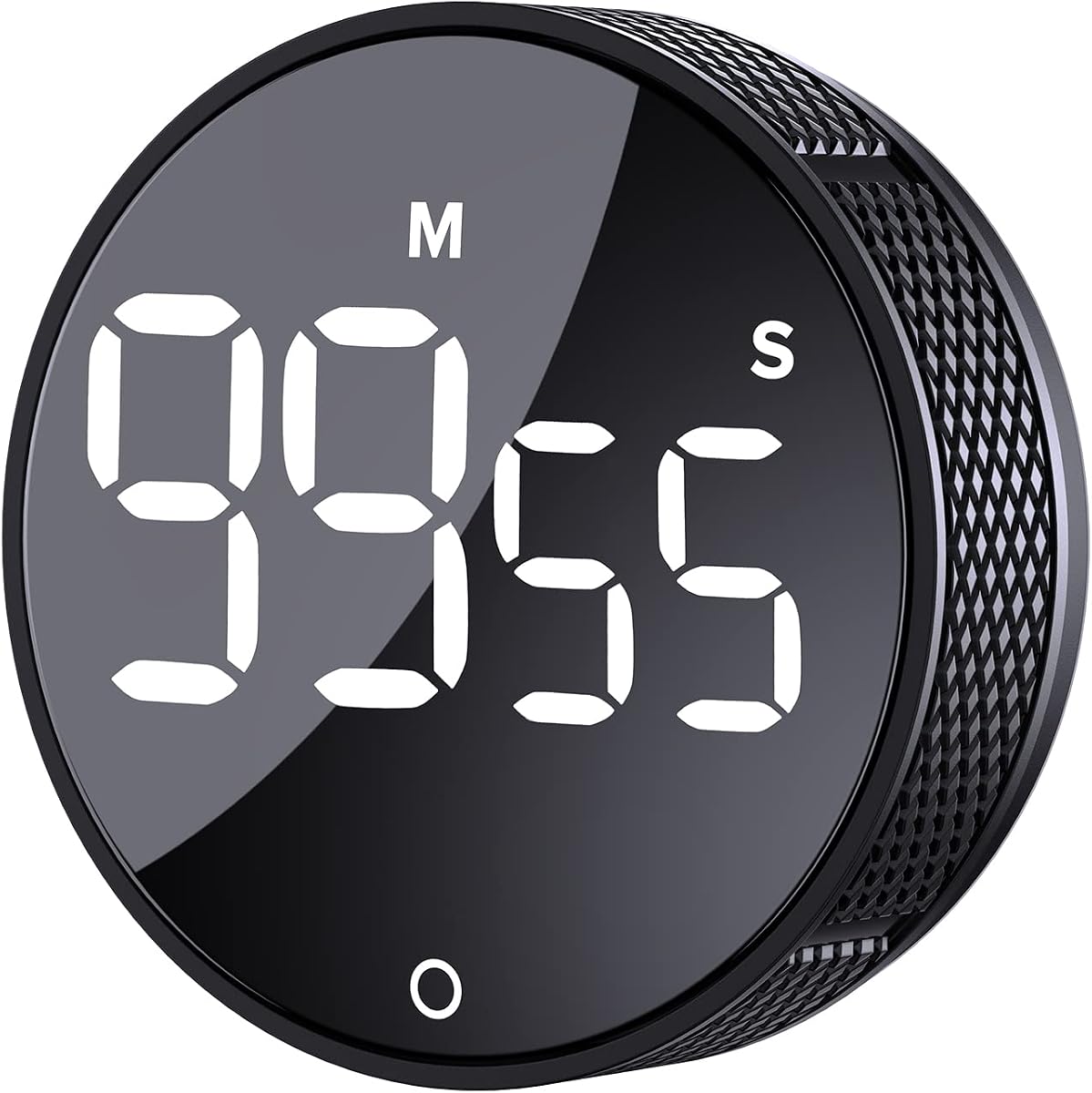


The PERSUPER Rechargeable Visual Timer is a compact 10-hour countdown and count-up timer designed around a simple white progress bar. Its 4.2 rating reflects a versatile feature set that combines child-friendly visual tracking with practical kitchen, classroom, and productivity controls. The bar gradually disappears during a countdown, giving users a continuous cue that does not depend on interpreting changing digits.
We may earn a commission when you buy through this link, at no additional cost to you.
Its two side-mounted knobs are easy to understand: one increases time, the other decreases it, and pressing a knob starts the sequence. A long press clears the current setting, while the timer can count up from zero when the selected duration is exhausted. The display can show hours and minutes or minutes and seconds, allowing the user to choose a format suited to the task. Three sound levels include mute, low, and loud, and the absence of ticking makes the timer appropriate for quiet rooms.
The principal limitation is the 10-hour ceiling, which is ample for most daily activities but shorter than the 12-hour range offered by the CreaViva model and the 99-hour range of the VOCOO. It also uses a monochrome progress bar rather than a full color display. On the other hand, the built-in 800mAh lithium-ion battery, Type-C charging, two brightness levels, power-saving behavior, low-battery indicator, magnetic back, and stand create a well-rounded package for the category.
This is a strong selection for families seeking a dependable visual timer without complicated child-facing controls. It works especially well for homework, chores, cooking, short exercise intervals, and routines that need a clear start and stop. Buy it when simplicity, rechargeable convenience, and a disappearing visual bar matter more than very long timing sessions or multiple color cues.
The white progress bar supplies a second way to understand elapsed time. Instead of repeatedly asking how many minutes remain, a user can watch the bar contract and gain a more intuitive sense of approaching completion.
Switching between hours-and-minutes and minutes-and-seconds display modes adds useful flexibility. The timer can cover short classroom activities, longer cooking processes, and mixed work-study routines without requiring a separate device for each scale.
We may earn a commission when you buy through this link, at no additional cost to you.
The AVINIA Digital Kitchen Timer is a straightforward rotary timer for people who want large digital numerals and a traditional dial-style setup. It holds a 4.2 rating and supports countdowns, count-ups, and timing from zero to 99 minutes. Rather than using several small buttons, it relies on an outer ring for adjustment and a single touch control for starting or stopping the timer.
We may earn a commission when you buy through this link, at no additional cost to you.
The adjustable outer ring makes the device approachable for children and seniors, while the large LED numbers help viewers follow the remaining time from a practical distance. Three brightness settings include constant, dim, and off, allowing the display to fit brighter kitchens or darker spaces. Alarm options range from silence to a level reaching 90dB, which is useful when a timer is cooking in another room or a classroom is busy.
Its main constraint is the 99-minute maximum, so it is less appropriate for long work blocks, extended projects, or all-day countdowns. It also depends on three AAA batteries, which avoids charging requirements but does mean users may eventually need replacements. Even so, the automatic dimming and light-off behavior are intended to limit energy use when the timer is inactive, and the strong rear magnets make it practical on refrigerators, ovens, blackboards, and other iron surfaces.
AVINIA is a good fit for cooks, teachers, fitness users, and households that prefer a simple timer with prominent digits. It is particularly effective when the activity lasts less than an hour and a loud or silent alert is more important than color graphics. Its restrained design also makes it easier to use than a more complex child-oriented interface.
The oversized LED readout is the defining advantage. It serves users who need to check a timer while cooking, exercising, or supervising a group without leaning close to the device.
Combining a rotating ring with one touch button keeps setup direct. That balance makes the timer approachable for older adults and children who may struggle with dense rows of small, purpose-specific keys.
We may earn a commission when you buy through this link, at no additional cost to you.
The VOCOO Large Digital Timer stands apart with a 7.8-inch display and numerals measuring 2.3 inches tall. Its 4.6 rating is among the highest in the group, reflecting a feature-rich device intended to be visible in classrooms, kitchens, and shared family spaces. The screen can count down as long as 99 hours and 59 minutes, or operate as a count-up stopwatch for meetings, workouts, projects, and elapsed-time tracking.
We may earn a commission when you buy through this link, at no additional cost to you.
Four alert methods cover a wide range of environments. Silent Mode uses a discreet screen flash, making the timer suitable for libraries, exams, and rest periods. Three distinct audible alarms, each with three adjustable volume levels, provide stronger notification choices for noisy kitchens and classrooms. Three brightness levels help the display remain legible in sunlight or under softer indoor lighting.
Power comes from a rechargeable battery with USB-C charging. The stated low-brightness continuous-use duration exceeds seven days, while high-brightness use exceeds seven hours. That makes the timer practical for a full classroom week or an established family routine. A low-power warning provides additional reassurance, and the included cable and 5V charger reduce setup friction. The silicone-covered magnets, built-in stand, and hanging hole support vertical, freestanding, and suspended placement.
The VOCOO is the most capable all-around option in this roundup for readers who need maximum readability, long-duration timing, and flexible alerts. Its larger body may occupy more counter or whiteboard space than compact products, but the display is easier to see from across a room. It is an especially strong fit for teachers, busy households, homeschool families, and anyone coordinating a group activity.
The extra-large face and tall numerals distinguish this model from conventional kitchen timers. A class or family can see the time without gathering around the device, which can reduce interruptions during transitions.
Silent Mode is valuable when a sound would be disruptive, while the adjustable audible options remain useful in louder spaces. This makes one timer more adaptable across study, meal-preparation, and classroom environments.
We may earn a commission when you buy through this link, at no additional cost to you.
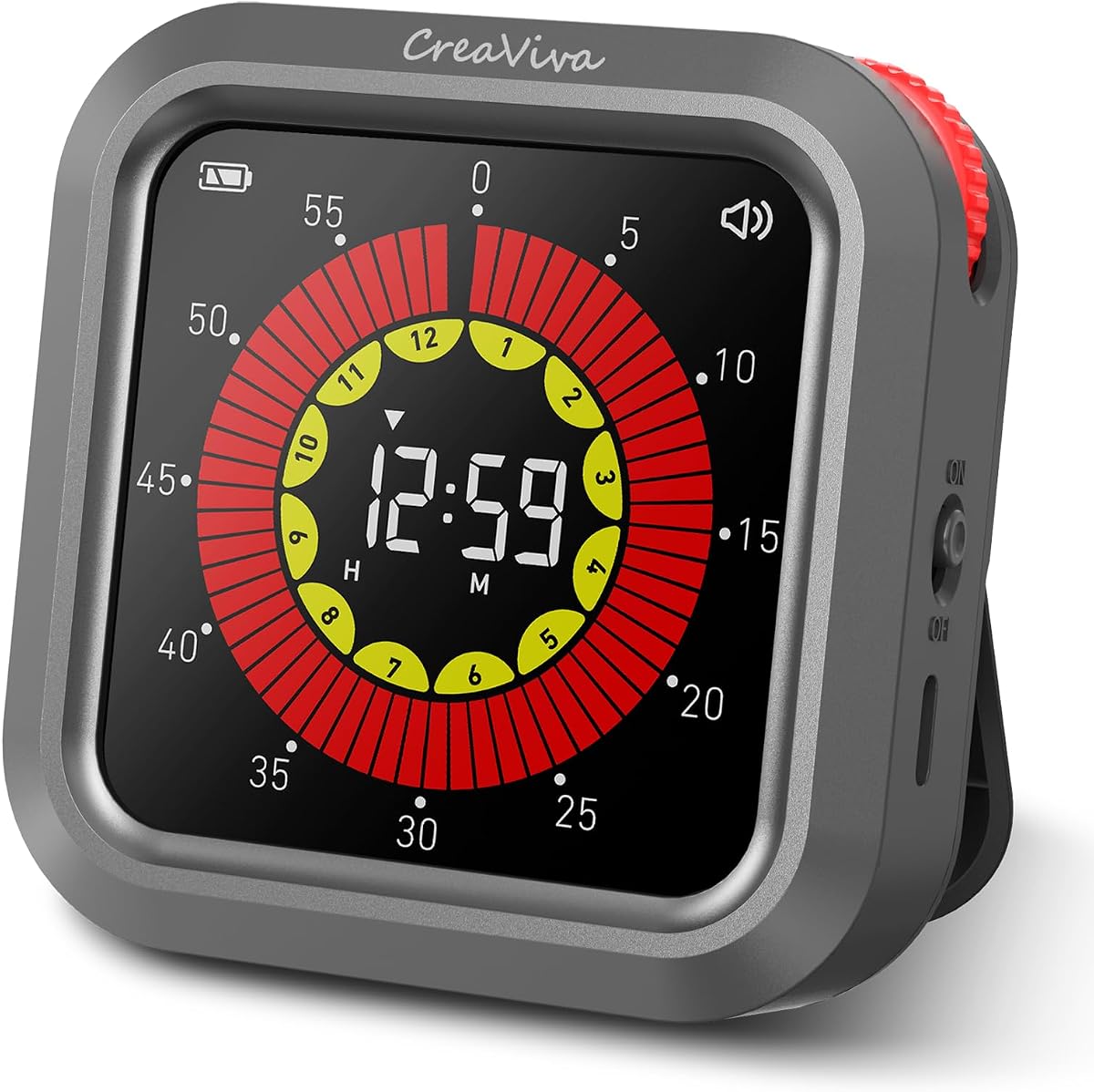
The CreaViva Visual Digital Timer combines a 3.15-inch high-contrast display with a color-coded progress bar. Its 4.3 rating reflects a balanced design for children, adults, classrooms, kitchens, and focused work. Yellow represents hours and red represents minutes, giving users a more differentiated visual signal than a single-color shrinking bar. The display also presents standard time information for people who prefer conventional digital reading.
We may earn a commission when you buy through this link, at no additional cost to you.
A simple wheel provides the main control. Turning clockwise increases time, turning counterclockwise decreases it, and a single press starts, pauses, or resumes. A long press resets the timer. Its three alert modes cover loud, low, and silent operation, while the mute mode uses a flashing LED rather than sound. Bright and ECO display modes accommodate daylight and nighttime use, and the screen dims after inactivity to conserve power.
The rechargeable battery and USB-C port remove routine battery purchases. Automatic memory recalls the previous countdown, which is useful for repeated habits such as meditation, morning routines, or homework blocks. Up to 12 hours and 59 minutes are supported for both countdowns and count-ups. The strong magnets and foldable stand make it suitable for refrigerators, ovens, whiteboards, counters, and desks.
This model is most attractive to buyers who want richer visual guidance than a plain number display but do not need the VOCOO's extra-large screen. Color differentiation, memory recall, and extended timing justify its premium positioning. It is an excellent recommendation for color-sensitive routines, longer work sessions, and homes that want a visually engaging timer without losing silent operation.
Separating hours in yellow from minutes in red gives the progress display a clearer structure. That visual distinction can make elapsed time easier to follow without requiring frequent verbal reminders.
Memory recall is especially helpful when the same duration is used repeatedly. Once a familiar activity has been established, the timer can resume the previous countdown without rebuilding the setting each time.
We may earn a commission when you buy through this link, at no additional cost to you.
The Red Visual Disc Timer provides a hybrid display with large digital numbers and a red disc that shrinks during a countdown or grows during count-up. Its 4.2 rating makes it a practical option for short activities involving children, seniors, or people who benefit from a pronounced visual cue. The 2.09-inch high-contrast screen is designed for visibility in low-light conditions and from across a room.
We may earn a commission when you buy through this link, at no additional cost to you.
The outer ring is the primary control. Clockwise and counterclockwise rotation changes the duration, with faster turns moving through minutes and slower turns through seconds. A single press handles starting, stopping, and resetting. The 60-minute ceiling keeps the scope focused on everyday intervals, while the luminous red disc gives users a second method of judging how much time remains.
Its 70dB-plus audible alarm should be noticeable in a busy household or kitchen, and a flashing backlight provides a silent alternative. Constant and ECO brightness modes suit different viewing conditions, while automatic screen-off after inactivity reduces energy use. A low-battery icon appears below 10 percent, and three AAA batteries are included. Strong magnets and anti-slip pads stabilize the timer while its ring is adjusted.
This is a good choice for daily homework, cooking, exercise intervals, and classroom activities that fit within an hour. The compact format and one-touch mechanics are more approachable than a large control panel, although the one-hour limit makes it less versatile for meetings or long projects. The vivid visual disc remains its most compelling feature.
The red disc changes continuously as time passes, giving the display a strong visual identity. A child can see the remaining portion without interpreting the digital value in detail.
Anti-slip pads help keep the timer from shifting while the outer ring is turned. That stability is useful in a kitchen or classroom where the device may be mounted on a vertical surface.
We may earn a commission when you buy through this link, at no additional cost to you.
The TimeBuddy Kids Timer is designed to make transitions understandable to young children through colorful countdown dots and a smiley face. It carries a 4.2 rating and targets everyday routines in homes, classrooms, and therapy settings. The manufacturer specifically identifies children with ADHD, autism, and sensory needs as potential beneficiaries of its structured, visual approach.
We may earn a commission when you buy through this link, at no additional cost to you.
Operation is intentionally simple: children twist to set the time and press to start. The device is described as suitable for ages three and older and remembers the last setting, reducing friction when a routine repeats. It includes clock, alarm, and count-up modes, with a range of five seconds to 99 minutes. That short starting point is useful for activities such as tooth brushing, while the full range accommodates longer screen-time, homework, or bedtime periods.
The built-in rechargeable battery lasts up to two weeks per charge according to the supplied information. Silent, medium, and loud volume options let caregivers adapt the alert to the environment, and adjustable brightness helps with different lighting conditions. There is no ticking, which avoids adding repetitive background sound. A calm visual presentation may be preferable to a traditional timer for children who become anxious when a task is nearly finished.
TimeBuddy is most appropriate for families and educators seeking an approachable routine-building tool rather than a general-purpose performance timer. The colorful dot display and remembered settings are especially valuable for repeated morning and evening routines. Its 99-minute maximum covers most child-focused activities, though it is shorter than the longest options in the roundup.
The dots and smiley face make the timer feel less like office equipment and more like a child-facing learning aid. That design can help make upcoming transitions easier to anticipate.
Remembering the previous duration supports consistency. For a child working through the same daily sequence, the timer can remain part of the routine without requiring an adult to reset it each time.
We may earn a commission when you buy through this link, at no additional cost to you.
The Smiley Face Visual Timer combines a cheerful character with digital count-up, countdown, and pause functions. Its 4.6 rating places it among the strongest-rated products here. Intended for children, including those with ADHD or autism, the timer uses visual progress bars and a smiley face to make elapsed time feel approachable rather than abstract.
We may earn a commission when you buy through this link, at no additional cost to you.
The intuitive knob makes setting and operating the device straightforward. It can run up to 99 minutes, which covers playtime, study sessions, classroom activities, and many household routines. A backlit display remains readable in dim rooms or outdoors at a distance. High, low, and mute volume settings allow the alert to match the surroundings, and the absence of mechanical ticking prevents a recurring sound from competing with attention.
Its most obvious limitation is the 99-minute maximum, which is shorter than the VOCOO and CreaViva alternatives. The supplied feature list also does not mention a last-setting memory, rechargeable battery, magnetic mount, or built-in stand, so buyers should verify those details if they are important. Its focus is instead on a friendly, compact format and intuitive visual progress.
Choose this model for a child who responds better to an inviting display than a conventional kitchen timer. It is well suited to play, study, and classroom routines where the goal is engagement and a clear sense of progress. The 4.6 rating, backlit readability, and simple knob interface make it a strong family-facing choice within the category.
The smiley interface gives the timer a more playful character. For children who may resist rigid or overly clinical tools, the friendly presentation can make a timed activity feel more approachable.
A backlit screen supports both low-light home use and brighter classroom conditions. Combined with mute and adjustable volume choices, it remains useful across different daily environments.
We may earn a commission when you buy through this link, at no additional cost to you.
The TIME TIMER Home MOD offers a calm 60-minute visual clock designed for desks, studies, meetings, and learning activities. Its 4.5 rating reflects a well-established visual-dial concept that communicates remaining time without relying on a conventional numeric countdown. The color-coded segment is intended to be intuitive across ages and abilities, including children with autism, ADHD, or other learning disabilities.
We may earn a commission when you buy through this link, at no additional cost to you.
Silent operation is central to the design, making it useful for reading, studying, projects, and tests where ticking or other background noise would be distracting. An optional audible alert gives users a way to receive notification when desired. The supporting description also describes four removable silicone covers that can be assigned to different activities, although those covers are not included with this particular listing.
The timer requires one AA battery, which is not included. That simple power requirement makes it suitable for a desk and avoids a charging routine, but it also means the battery may need occasional replacement. The 60-minute period is shorter than several digital models in the guide and is best suited to short work blocks, lessons, games, meetings, and routine activities rather than extended countdowns.
The Home MOD is a strong choice for buyers who value a clean visual format, quiet operation, and minimal cognitive load. Its dial offers a different experience from colorful dots, shrinking bars, or large digital numerals. For study spaces, therapy settings, and home desks where calm matters more than extended timing, the model remains focused and easy to adopt.
The silent design reduces auditory clutter during concentrated tasks. Users can still see time disappear across the colored dial, preserving awareness without the repetitive sound of a mechanical clock.
A 60-minute visual clock works well for reading, revision, meetings, and exercise intervals. It is particularly relevant for anyone who benefits from a clearly bounded period of concentrated activity.
We may earn a commission when you buy through this link, at no additional cost to you.
The Time Timer Twist presents remaining time as a filled digital visual disk and supports durations from one to 90 minutes. Its 4.5 rating reflects a simple, established design for classrooms, study sessions, exercise, cooking, and home routines. Turning the outer ring sets the duration, and pressing the play control begins the countdown.
We may earn a commission when you buy through this link, at no additional cost to you.
The full-disk format gives users an immediate overview of the session. As the selected duration approaches its end, the visible area changes in a way that communicates progress without requiring close reading of digits. The magnetic back allows placement on refrigerators, file cabinets, whiteboards, gym boards, and other metallic surfaces, while the kickstand supports tabletop viewing.
A distinguishing feature is the continuous alert at the end of the countdown. Unlike a timer that may beep only briefly, this model continues notifying the user until the play/pause button is pressed or the alert stops after one minute. It also supports pausing midway through a task and resuming from the same point, which is useful when reading, cooking, or exercising is temporarily interrupted.
The Twist is most appropriate for short to medium activities. Its 90-minute maximum gives it more range than a standard one-hour visual clock, but it does not handle long meetings or extended projects. One AAA battery is required and not included. Overall, it is a polished choice for users who prioritize a highly legible disk, flexible mounting, and a persistent end alert over rechargeable power or color-coded progress.
The visual disk provides a quick overview of the complete planned duration. That makes it useful for children who need an immediate impression of how much time they have rather than a number-by-number estimate.
Pause-and-resume support means a brief interruption does not require starting over. The remaining duration stays intact, which is convenient for cooking, reading, and workouts.
We may earn a commission when you buy through this link, at no additional cost to you.
The Doliwish Dinosaur Timer is a blue, dinosaur-shaped digital visual timer made to engage toddlers and young children. It carries a 4.4 rating and combines an LED display with colorful visual progress bars. The character theme and bright presentation give it more personality than a standard kitchen timer, helping time-based activities feel more like part of a child's play or learning space.
We may earn a commission when you buy through this link, at no additional cost to you.
The silent visual format can be set for up to 100 minutes, covering short play periods, classroom transitions, tooth brushing, and other routines. The LED display is designed to be readable from a distance and in low light, allowing a child to manage time without constant adult prompting. A visual progress bar supplements the numerical display, giving the user two ways to judge how much time remains.
Its listed construction includes a sturdy, durable body with smooth edges for safer everyday handling, and the product is intended for children over three. The feature set is intentionally simpler than that of the VOCOO, CreaViva, or PERSUPER models. There is no stated rechargeable system, long-duration mode, memory recall, or multi-level alert control in the supplied information, so the timer is better viewed as a cheerful focused tool than an all-purpose scheduling hub.
The Doliwish model is a good fit for families looking for a light, child-friendly visual timer and for teachers who want a playful addition to a preschool or early-elementary routine. Its 100-minute range is generous for most toddler activities, and silent operation avoids adding noise. Choose it when visual appeal, simple time awareness, and a friendly character are the main priorities.
The dinosaur shape turns a functional countdown into something more engaging for a young child. That playful presentation may make children more willing to participate in a timed routine.
Without ticking, the timer can provide structure without adding background noise. The LED numbers and colorful bars remain available as visual checkpoints throughout the selected duration.
We may earn a commission when you buy through this link, at no additional cost to you.
The most useful digital visual timer is not simply the one with the most features. Consider who will use it, how long activities usually last, whether sound is welcome, and where the device needs to be mounted before comparing control styles and displays.
Visual timers use several different ways to communicate elapsed time. Some shrink a colored disc, some show a progress bar that disappears, and others use dots, a full disk, or large digital numerals. A shrinking or filling graphic can provide an immediate sense of proportion, while digits are more precise for checking a remaining duration. Users with ADHD, autism, or sensory needs may respond especially well to a consistent graphic cue that is separate from the changing number.
Choose a display that communicates time without demanding repeated interpretation. Check whether the graphic remains visible in the room's normal lighting and whether it works alongside the numerical readout rather than leaving the digits as the only useful feature.
The maximum duration should match the routine, not merely sound impressive. A 60-minute timer is suitable for homework blocks, games, and many meetings, while 90 or 100 minutes gives more room for exercise and extended classroom activities. The VOCOO reaches 99 hours and 59 minutes, and the CreaViva supports up to 12 hours and 59 minutes, making them better suited to long cooking, projects, or all-day countdowns.
Count-up support is also useful when the start point is unknown or elapsed time matters more than a deadline. Prioritize a model that handles both directions and can pause without losing the current setting.
A useful timer needs to notify the user without becoming disruptive. Silent visual alerts are valuable in libraries, testing rooms, therapy settings, and homes with sound-sensitive people. Loud alarms help when a timer is on a distant refrigerator or busy classroom wall, and intermediate volume levels offer greater flexibility than a simple on-or-off choice.
Look for a mode that combines a screen flash with sound if possible. Also consider whether the device ticks while running, because silent operation can improve concentration even when the final alert is audible.
Simple controls can make a timer more usable for children, seniors, and anyone working with wet or busy hands. A twist ring or wheel provides fast adjustment, while a single start, pause, or reset button reduces the number of actions required. Important functions should be clearly separated, and the mechanism should be easy to activate without looking directly at it.
A timer intended for ages three and older should have intuitive feedback and a visual finish indicator. Memory recall is another useful child-friendly feature because repeated routines do not need to be configured repeatedly.
Rechargeable models reduce the need to keep spare batteries available, while removable-battery models may be simpler for a stationary desk. The PERSUPER has an 800mAh lithium-ion battery, the TimeBuddy claims up to two weeks per charge, and the VOCOO provides more than seven days on low brightness. The TIME TIMER Home MOD, AVINIA, and Red Visual Disc Timer use replaceable cells.
Consider charging location and frequency before choosing. A USB-C rechargeable timer is convenient for homes and classrooms that use it daily, but a user should check whether a cable and charger are included and how the low-battery warning works.
A timer that is difficult to see or reach will be used less often. Large digital models work well for groups because every participant can follow the display from a distance. Compact child-friendly designs may be better for a bedside table, activity tray, or single learner's desk. Display size and physical footprint are separate considerations, especially in crowded classrooms.
For vertical placement, look for strong magnets and a suitable surface. A kickstand is valuable for countertops and desks, while a hanging hole provides another option for a pantry, locker, or classroom hook. Check the dimensions against the intended space before purchasing.
A timer must remain readable without being unnecessarily harsh. Dim or ECO modes are useful for nighttime routines and close desk work, while brighter settings are better in sunlit classrooms and busy kitchens. Some models offer three brightness levels, including an off state, whereas others provide two practical levels.
Think about where the device will normally live. A classroom timer needs clear visibility under bright lighting, a bedroom timer should offer a subdued nighttime setting, and a kitchen model benefits from a strong constant display. Adjustable brightness makes one device more adaptable to changing conditions.
Memory can make a timer particularly useful for habits that repeat. Remembering the last countdown helps with morning routines, meditation, homework, cooking, and timed workouts. It also reduces the chance that a child must ask an adult to set the same duration every day. Durability remains important because classroom, kitchen, and child-care devices are handled frequently.
Check the listed materials, edge design, mounting hardware, and included accessories. A sturdy body, smooth edges, secure magnets, and anti-slip feet can influence whether a timer stays in place and remains comfortable to handle over time.
Before the first timed activity, choose a duration that matches the routine and explain whether the graphic, numbers, or both should be used as the reference. Set the timer while the child watches, start it together, and point out the remaining visual area. Consistency helps a visual timer become a familiar signal rather than another novelty.
Choose the alert according to the environment. Use silent mode for exams, reading, therapy sessions, or sleep-related routines, and select a louder level for a kitchen or classroom where sound is appropriate. If a device is mounted with magnets, confirm that the surface is clean and secure; otherwise, use the stand in a stable position.
Follow the power guidance supplied with the model. Charge rechargeable models regularly, and replace batteries before a planned routine if the low-battery indicator appears. Clean the surface gently with a soft, damp cloth, avoid exposing the timer to excessive moisture or heat, and keep magnetic surfaces free of grit that could scratch the housing.
A digital visual timer shows remaining time as both numbers and a changing graphic, making elapsed time easier to interpret at a glance. This is especially helpful for children and users who find a conventional countdown or ticking clock difficult to follow. It can also support calmer transitions by replacing repeated verbal reminders with a consistent visual signal.
They can be useful because the shrinking, filling, or disappearing graphic gives time a concrete visual form. The included models also offer features such as silent mode, count-up timing, memory recall, and simple controls. No timer works for every child, so adults should introduce it gradually and choose a pace and alert that suit the individual.
A countdown timer begins with a selected duration and moves toward zero. A count-up timer begins at zero and tracks elapsed time. Countdowns suit deadlines and activities with a planned finish, while count-up timing is useful when the start is unclear or when the goal is simply to measure how long something takes.
A silent timer is valuable when background noise would distract students or when an audible alarm is inappropriate. However, a quiet room may still benefit from a louder alert for activities such as cooking or fitness. The best classroom choice often provides both a screen flash and adjustable sound levels.
Choose a duration that matches the child's age, attention span, and the complexity of the task. A 15- to 30-minute session may be more realistic than a 60-minute block for a child who is just developing time-management skills. Longer sessions can work when the activity is familiar and the timer includes pause or count-up flexibility.
Rechargeable models are convenient for daily use because they can be replenished through USB-C and do not require regular battery replacement. Battery-operated models may be simpler for occasional use or a stationary desk. The best choice depends on charging habits, the required battery type, and whether a charger and cable are included.
Place it where the user can see the graphic and digits without interrupting the activity. A magnetic back works well on suitable metal surfaces, while a kickstand or built-in stand suits a counter or desk. In a classroom, choose a location with a clear line of sight and enough brightness to keep the display readable.
Yes, if its range and controls suit both tasks. A 60-minute timer can cover many study blocks and cooking processes, while a 90-minute, 99-minute, 100-minute, or longer model offers more flexibility. Kitchen users should also consider loud alerts, secure magnetic placement, easy cleaning, and a stable stand.
The VOCOO Large Digital Timer is the most versatile pick because its 7.8-inch display, 99-hour range, silent and audible alerts, rechargeable power, and multiple mounting options cover a wide range of environments. The PERSUPER is the best budget-oriented choice, offering a clear disappearing bar, useful sound controls, rechargeable construction, and a 10-hour range. The CreaViva stands out as the premium option through its color-coded display, extended timing, and automatic memory.
For a child-focused routine, the TimeBuddy and Doliwish models add friendly graphics and simpler presentation, while the Smiley Face Visual Timer combines a playful display with a 4.6 rating. The TIME TIMER Home MOD suits calm, silent work periods, and the Time Timer Twist offers a compact full-disk view with a persistent end alert. Prioritize the display type, maximum duration, sound behavior, and placement method that match your actual routine.
Ratings, features, availability, and prices can change over time, so check the current product listing before buying. Confirm battery requirements, included accessories, display dimensions, and mounting options as well. The right digital visual timer is the one a user will understand quickly, place where it can be seen, and use consistently enough to turn elapsed time into a helpful cue.