
2-Pack 150A Bus Bar 12V-48V
4.6Editor score
Two complete bus bars
150A rated capacity
Locking protective covers
A 12V bus bar provides a centralized, organized connection point for batteries, chargers, solar controllers, inverters, and other direct-current accessories. A well-designed unit makes electrical work cleaner while reducing loose connections, tangled wiring, and the chance that conductors will accidentally touch.
This guide compares ten bus bars by current capacity, voltage limits, terminal arrangement, conductor materials, cover design, mounting approach, and included installation hardware. It covers compact and high-capacity options for cars, trucks, RVs, boats, yachts, caravans, UTVs, and solar installations.
The selections show where each model is strongest, from a budget two-pack to heavily studded distribution blocks for large cables. Product ratings, configurations, and availability can change, so buyers should verify dimensions, electrical limits, and current conditions before purchasing.
4.6Editor score

4.8Editor score

4.7Editor score
As an Amazon Associate we earn from qualifying purchases.
The table below compares all ten models by capacity, voltage rating, terminal configuration, and construction, making it easier to identify the right bus bar for a particular wiring system.


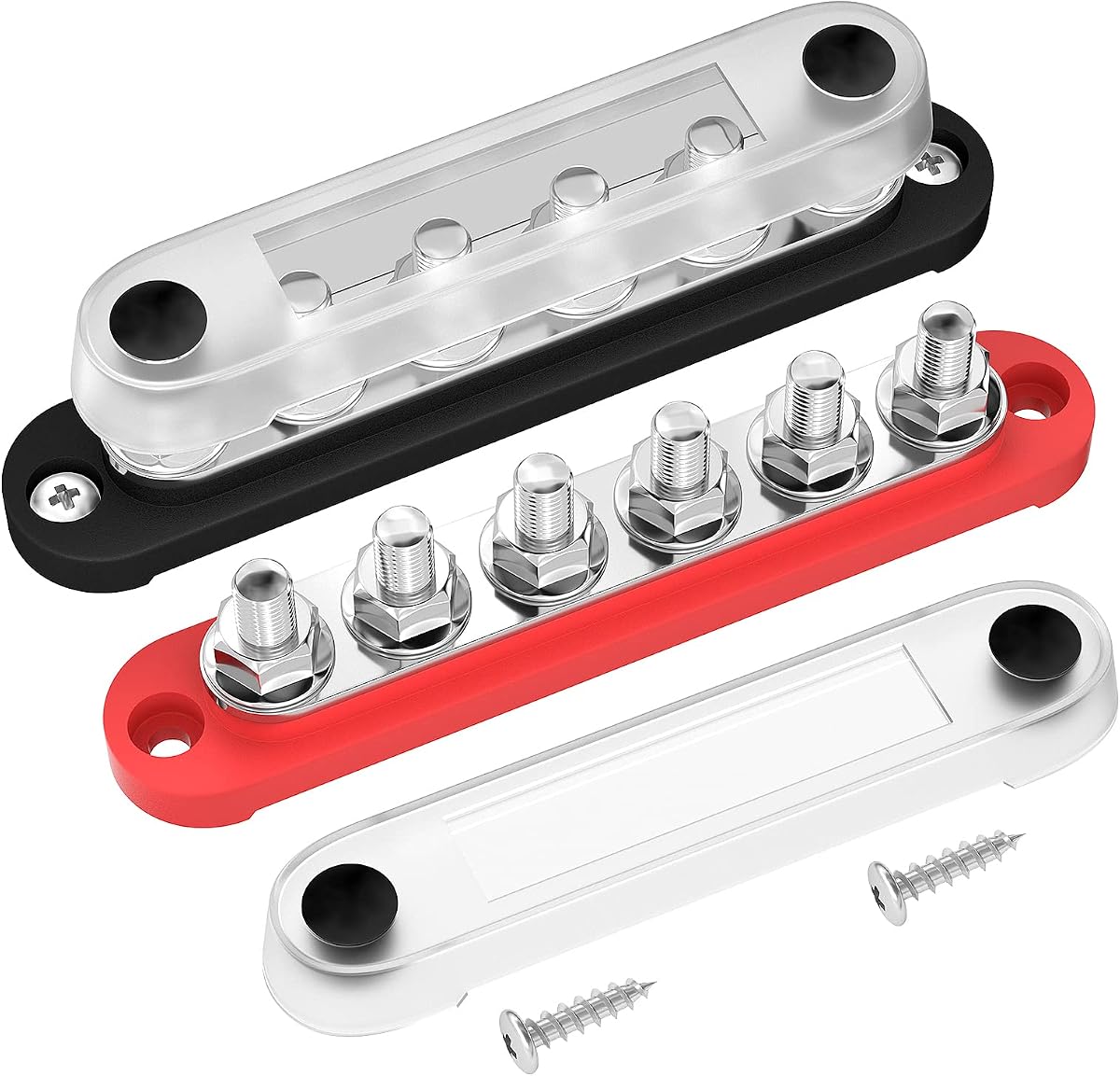


The RVBOATPAT 150A Marine Bus Bar combines a large 1/4-inch M6 stud with twelve smaller M4 terminal screws on each bar. Its 4.7 rating and maximum continuous current specification of 150A make it a practical option for organizing a 12V system that needs both a heavy feeder connection and several smaller accessory circuits.
We may earn a commission when you buy through this link, at no additional cost to you.
The mixed terminal layout is the defining feature. The main stud can accept a larger battery cable, while the M4 positions provide convenient attachment points for smaller leads. The package contains a positive bar, a ground bar, two covers, two 2 AWG copper lugs, and twenty-four terminals, giving installers a broad set of connection hardware.
Construction uses a thick tinned copper plate with an insulated ABS base described as mechanically strong, heat resistant, and flame resistant. A tradeoff is that only one major stud is provided on each bar, so a build with numerous high-current branches may need a more heavily studded model or a different distribution strategy.
This is a strong choice for a boat, car, caravan, yacht, or solar installation where one primary cable feeds the bus and smaller accessories branch from it. Buyers who need more stud positions may prefer the RVMARINEPAT model below, while those needing dual high-current studs can consider the RVBOATPAT 250A Dual-Stud option.
Combining one main stud with twelve M4 terminals lets a single bar accept both a substantial feed and multiple smaller loads. That flexibility is particularly useful in retrofit projects where the original conductors vary in diameter.
The inclusion of positive and ground bars, protective covers, copper lugs, and twenty-four terminals reduces the need for separate matching accessories. Buyers should still confirm that their cable sizes and quantities align with the supplied hardware.
We may earn a commission when you buy through this link, at no additional cost to you.
The RVMARINEPAT 250A Bus Bar is the strongest all-around selection in this guide, combining a 4.8 rating with six 5/16-inch M8 studs on each bar. Its 250A maximum current and 48V DC rating suit demanding automotive, marine, and solar power-distribution layouts.
We may earn a commission when you buy through this link, at no additional cost to you.
Six large terminals on every bar provide ample branching options without forcing smaller accessories onto undersized screw positions. The positive and negative pair uses copper conductor plates and stainless steel terminals, while the open-area cover allows lugs to be installed from up to 180 degrees, which helps when surrounding equipment limits hand access.
The package also contains twelve copper ring lugs and twelve heat-shrink tubes. This makes the set more complete than a bare distribution block and helps installers terminate connections consistently. The main compromise is physical clearance: six M8 studs on each bar require enough space for the lugs, nuts, cables, and protective cover.
This model is ideal for owners who need several high-current branches or a large number of dedicated circuits. It is also a particularly compelling choice for marine builds, where a dense, protected distribution point can simplify the wiring layout. Installers should still size upstream protection and cabling for the intended load.
The six M8 positions give each positive and negative bar substantial branching capacity. This makes the unit suitable for systems where lighting, pumps, inverters, chargers, or other substantial accessories need clearly separated connections.
The open-area cover supports 180-degree wire-lug installation, easing work in cramped engine compartments, battery compartments, and equipment cabinets. It also allows different lug styles to be oriented according to the available space.
We may earn a commission when you buy through this link, at no additional cost to you.
The Joinfworld 250A Bus Bar takes a premium approach with four 3/8-inch main studs and three small screw terminals on each positive or negative bar. Its 4.7 rating, 250A circuit rating, and four-millimeter copper plates make it well suited to systems using large battery cables.
We may earn a commission when you buy through this link, at no additional cost to you.
Its four large posts offer a useful middle ground between a basic one-stud design and a six-stud distribution bank. The additional small terminals accommodate accessories without occupying the larger cable positions, while the M10 mounting posts help secure the nylon base. Protective covers and nuts are supplied for each bar.
The four-millimeter copper construction is the standout feature for installers seeking a beefier conductor plate. The limitation is terminal density: projects with more than four major high-current branches per bar will find the RVMARINEPAT six-stud design more accommodating.
Choose the Joinfworld model for trucks, boats, cars, and solar installations that emphasize heavy cable accommodation, a substantial copper plate, and a balance of large and small connection points. It is a compelling premium option when cable diameter and mechanical robustness matter more than maximizing the number of branches.
The four 3/8-inch posts provide generous attachment points for large ring lugs. This makes the product attractive for battery feeds and high-load branches where smaller studs would be less appropriate.
The stated four-millimeter copper plates provide a more robust conductor structure than thinner alternatives. As with any distribution block, correct tightening, conductor sizing, and compatible cable lugs remain essential.
We may earn a commission when you buy through this link, at no additional cost to you.
The DAIERTEK Mini 150A Bus Bar offers four 5/16-inch M8 posts on each bar while remaining smaller than many conventional 150A distribution blocks. It carries a 4.7 rating and is specified for up to 150A at 48V DC, making it suitable for common 12V, 24V, and 48V direct-current applications.
We may earn a commission when you buy through this link, at no additional cost to you.
The positive and negative set uses tin-plated copper bars, stainless steel nuts and stud terminals, a nylon base, and polycarbonate covers. Posts extend to the sides, allowing wire lugs to approach from up to 180 degrees. This helps when the available installation area does not permit cables to enter vertically.
Its principal trade-off is capacity: the 150A rating is lower than several 250A alternatives. Buyers should also focus on the stated DC rating for 12V systems rather than interpreting the listed 300V AC maximum as relevant to ordinary battery distribution.
This is a sensible choice for compact automotive, marine, and solar installations that need several M8 cable connections but do not require a 250A-rated block. Its combination of four large posts, protective covers, and sideways installation access makes it a versatile middle-tier option.
Four M8 positions offer meaningful branching capability without requiring the footprint of a six-stud configuration. That makes the unit useful in battery compartments where every centimeter matters.
Tin-plated copper, stainless steel hardware, a nylon base, and polycarbonate covers provide a sensible material mix for automotive and marine environments. Equipment should still be protected from standing water and physical damage.
We may earn a commission when you buy through this link, at no additional cost to you.
The 2-Pack 150A Bus Bar provides a straightforward positive-and-ground distribution solution with a 4.6 rating. Each bar is rated for 150A and up to 48V, making the set suitable for 12V battery systems in RVs, boats, trucks, UTVs, and other direct-current installations.
We may earn a commission when you buy through this link, at no additional cost to you.
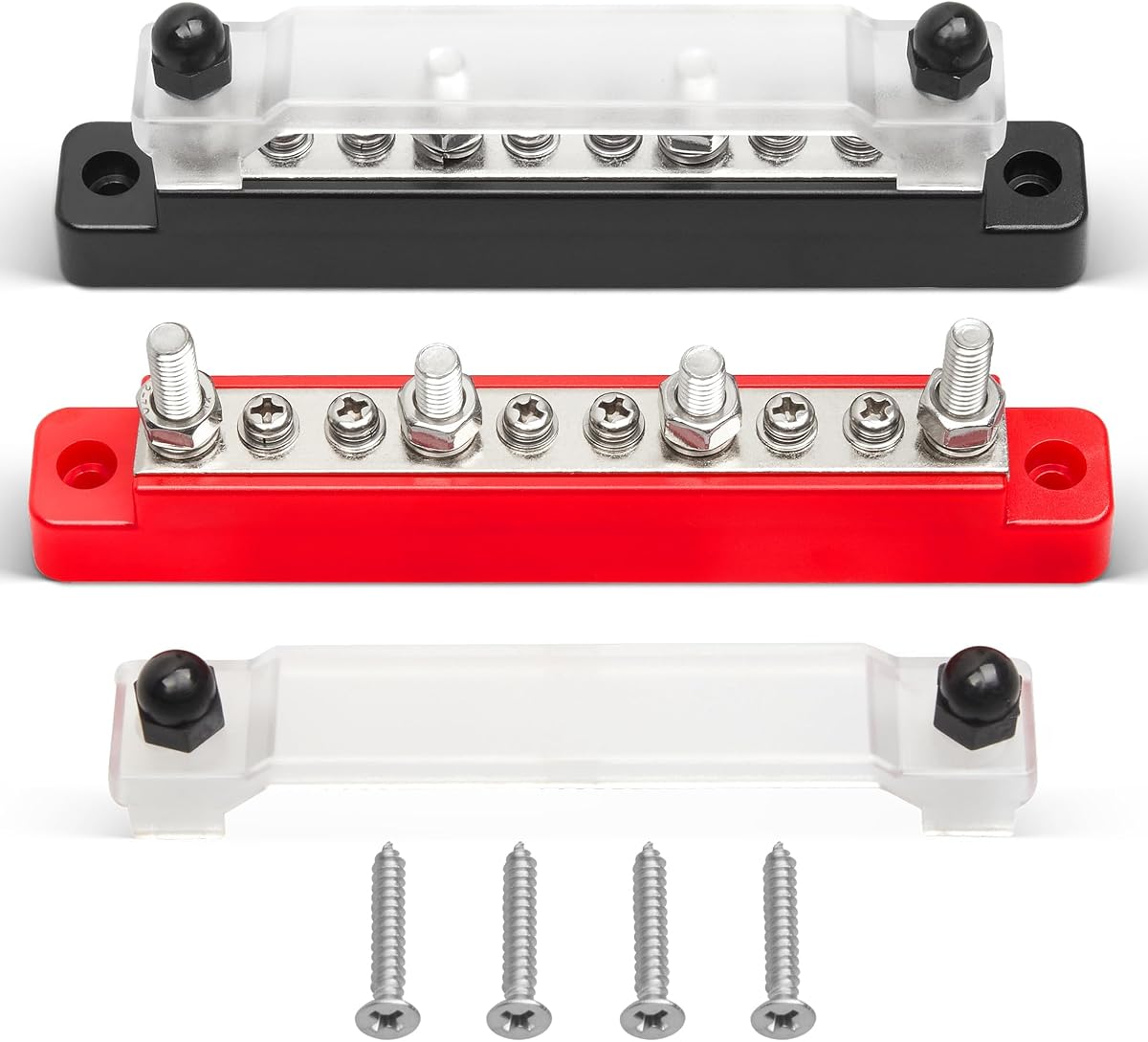
Each unit uses a solid tinned copper busbar, a rigid base, one-quarter-inch studs, and twelve terminals. The stated measurements are approximately 5.4 inches long with the cover, 4.7 inches for the base, 0.9 inches wide, and 0.5 inches high, giving installers useful guidance before mounting.
Snap-lock covers fit tightly to resist vibration and help reduce accidental contact with terminals. The main limitation is the single large stud on each bar, which may restrict projects that need multiple high-current outputs. The 150A rating also places it below the 250A alternatives.
This set is a good budget-oriented choice for consolidating several smaller accessory circuits around a main feed. It works especially well in RV, lighting, winch, audio, fuse-block, and general DC-accessory arrangements where the stated dimensions fit the available space.
Published dimensions help determine whether the bars will fit around a battery box or inside an enclosure. Checking cable clearance at the same time prevents a unit that looks suitable from becoming difficult to wire.
Snap-lock covers are designed to stay closed under vibration while reducing accidental contact with the terminals. This is particularly useful in vehicles, boats, and off-road equipment exposed to constant movement.
We may earn a commission when you buy through this link, at no additional cost to you.
The DAIERTEK Six-Stud Bus Bar gives each positive and negative bar six 5/16-inch M8 terminal studs. It has a 4.7 rating and is specified for continuous current up to 150A DC at voltages up to 48V DC, providing many branch positions in a conventional 12V installation.
We may earn a commission when you buy through this link, at no additional cost to you.
Its open-area cover permits 180-degree wire-lug installation, and the round-corner base is designed for stability and visual differentiation. Copper plates serve as conductors, while stainless steel terminals are intended to withstand demanding automotive and marine environments.
The distinction from the RVMARINEPAT 250A model is the current rating: this DAIERTEK set is listed at 150A DC, despite also specifying a 300V AC maximum. For a typical 12V battery project, the relevant limit is 150A continuous at 48V DC.
Buyers with numerous medium and heavy branches may appreciate six studs even at this capacity. It is a good fit for cars, boats, and other systems that need more connection positions than a four-post block, provided planned loads remain within the stated rating.
Six M8 studs make it easier to assign separate feeds to multiple accessories instead of combining several circuits on one terminal. The open cover also gives installers more freedom in lug orientation.
Copper plates and stainless steel terminals form the conducting structure, while the insulated base and cover help separate conductors. Proper environmental protection and sound workmanship remain important in exposed marine or automotive installations.
We may earn a commission when you buy through this link, at no additional cost to you.
The RED WOLF 150A Bus Bar combines four 1/4-inch M6 studs with six smaller M4 screw terminals on each bar. Its 4.6 rating and specified 12V-to-48V DC range make it a flexible distribution option for cars, RVs, yachts, caravans, ships, and solar systems.
We may earn a commission when you buy through this link, at no additional cost to you.
The open-frame cover supports 180-degree wire-lug installation while helping protect against dust and accidental contact. The conducting hardware uses pure copper studs with stainless steel screws and nuts, and the insulated PC base provides separation from the mounting surface.
An important specification note is that maximum continuous current decreases as temperature and humidity increase. That makes the stated 150A figure unsuitable as a blanket promise for every environment; installers should account for the actual operating conditions and planned load.
The RED WOLF is a balanced choice when a project needs several substantial connections plus extra small accessory terminals. It offers fewer large studs than the six-stud models but more small screw positions, making it flexible for mixed conductor sizes.
Four M6 studs handle larger conductors, while six M4 terminals suit smaller accessory leads. This combination helps installers organize branches without forcing every conductor onto the same type of connection.
The manufacturer notes that maximum continuous current falls as temperature and humidity increase. Buyers should therefore treat the stated 150A as a controlled-condition maximum rather than assuming identical performance in every installation.
We may earn a commission when you buy through this link, at no additional cost to you.
The RVBOATPAT 250A Dual-Stud is a streamlined distribution pair with two 3/8-inch M10 studs on each bar. Its 4.6 rating, 250A continuous-current specification, and 48V DC limit target marine, automotive, caravan, yacht, and solar applications.
We may earn a commission when you buy through this link, at no additional cost to you.
The studs are made from 304 stainless steel for corrosion resistance. The package includes one positive bar, one ground bar, two 1/0 AWG copper lugs, and four 6 AWG copper lugs, covering a useful range of heavy and lighter conductors. Polycarbonate covers add physical protection around the terminals.
Unlike models with many small screw terminals, this design concentrates on high-current cable connections. That makes it straightforward for a system with a main battery feed and a small number of substantial branches, but less adaptable when numerous low-current accessories need dedicated positions.
This is an attractive option for a clean, high-current layout where cable size and simple organization matter most. It is also a reasonable alternative to the Joinfworld model when two large 3/8-inch studs per bar are sufficient and a smaller terminal count is desirable.
Two M10 studs on each bar create a straightforward positive and ground distribution point. The design is easy to understand and suits systems dominated by a few large feeder and branch cables.
The supplied 1/0 AWG and 6 AWG copper lugs provide a convenient starting point for common heavy conductors. Installers should confirm that the actual cable diameter matches the lug opening and that every connection is properly torqued.
We may earn a commission when you buy through this link, at no additional cost to you.
The 250A Four-Post Bus Bar pairs four 3/8-inch M10 posts with six smaller screw terminals on both the red and black bars. Its 4.6 rating and stated maximum current of 250A make it versatile for cars, trucks, boats, yachts, and solar wiring.
We may earn a commission when you buy through this link, at no additional cost to you.
The product data describes a three-millimeter copper busbar supported by 304 stainless steel screw terminals, while also identifying a brass bottom plate. The bus bar's exposed sides support 180-degree installation, and the nylon sleeve and base are described as flame retardant for added separation.
The package includes four battery lugs and four heat-shrink tubes. This is a useful mixed-terminal design, although the ambiguous reference to both copper and brass means buyers should examine the physical construction closely if a specific conductor material is essential.
The model suits projects needing four large branch connections plus smaller accessory feeds. Its 250A rating exceeds the 150A alternatives, while the fewer M10 posts make it less dense than the six-stud RVMARINEPAT design.
Four M10 positions handle heavy cable, and six smaller screw connections add flexibility for lighter circuits. This mix supports cleaner circuits in builds that combine battery feeds with accessory wiring.
A flame-retardant nylon sleeve and base help insulate the conductive structure. They also reduce the chance that a nearby harness or tool will bridge adjacent terminals during routine service.
We may earn a commission when you buy through this link, at no additional cost to you.
The Aienxn 150A Copper Bus Bar uses an inverted buckle design to secure its base and hold the protective cover firmly over the terminals. It has a 4.6 rating, a stated maximum continuous current of 150A, and a maximum operating voltage of 48V DC.
We may earn a commission when you buy through this link, at no additional cost to you.
Each positive and ground bar includes one 1/4-inch M6 stud and twelve M4 screw terminals. The stud is secured from bottom to top for a firm structure, while three-millimeter copper plates and 304 stainless steel terminals form the conducting and fastening components.
The package contains two silicone terminal covers, two copper lugs, and twenty-four ring terminals. Its main limitation is connection density for high-current circuits, because there is only one large stud on each bar. The small-terminal arrangement is better suited to several lighter accessory branches.
This model is best for compact systems with one main feed and numerous smaller loads. Its base-locking approach and firmly fitted cover may appeal to builders who value a secure physical assembly, while projects requiring multiple 3/8-inch cable studs would be better served by the four-post options.
Driving the main bolt through the base and up through the conductor creates a more stable arrangement than relying only on a top nut. The buckle-style base is also designed to resist shifting during installation and service.
Twenty-four ring terminals, two copper lugs, and two silicone covers give installers many connection accessories in the box. The twelve M4 positions per bar make it a practical hub for smaller DC accessory circuits.
We may earn a commission when you buy through this link, at no additional cost to you.
The right bus bar depends on conductor size, branch count, mounting space, environmental exposure, and the electrical demands of the connected equipment. Reviewing these factors before ordering helps prevent a mismatch between the block, cables, and installation space.
Current capacity is the first consideration because every connected branch and the incoming battery feed contribute to the load carried by the distribution point. Four selections are specified for up to 250A, while the remaining products are listed at 150A. A 150A unit may suit a small vehicle or RV circuit, but a boat, truck, large solar installation, or inverter system with several substantial loads deserves careful comparison with the stated limit.
Choose capacity above the calculated load rather than matching it exactly, and use appropriately rated cable and circuit protection. Do not assume a bus bar's maximum rating is the appropriate continuous operating target for every environment.
Stud diameter determines which ring lugs and conductors can be attached without compromising the connection. The featured range includes 1/4-inch M6, 5/16-inch M8, and 3/8-inch M10 positions. Larger studs are generally more appropriate for heavy battery feeders and high-current branches, while 1/4-inch studs can be sufficient for smaller distribution points.
Measure the actual cable diameter, not merely the cable gauge, and confirm that the lug fits both the stud and the conductor. The copper lugs included with some products offer a starting point, but a proper fit remains essential for conductivity and mechanical security.
More terminals allow individual accessories to have dedicated connections rather than sharing a single post. Six-stud models maximize branching options, four-stud designs balance density and size, and one-stud products prioritize a single main feed with numerous small screw terminals. Mixed layouts are especially useful when large inverter cables and smaller lighting or accessory wires share a battery system.
Count both the incoming and outgoing connections, then add reasonable expansion room. Avoid overcrowding a bar if lug bodies and cables cannot be installed without touching one another or obstructing access to fasteners.
All ten products are intended for 12V bus bar use, and their listed DC voltage limits accommodate common 12V systems. Some also state 300V AC maximum limits, but the relevant specification for a battery installation is the DC rating. Systems that may be charged through certain inverter or converter arrangements can operate above a resting 12V, so the installer should evaluate the actual circuit.
Check the complete system voltage and the manufacturer's guidance for every connected component. A 48V DC maximum provides useful headroom for many 12V and 24V installations, but it should not be treated as permission to overlook device-specific limits.
The featured blocks use combinations of copper, tin-plated copper, brass, stainless steel, ABS, nylon, and polycarbonate. Copper conductor plates provide the electrical path, while stainless steel nuts, bolts, and studs are used for mechanical retention. Insulating bases and covers reduce the possibility of accidental contact with a live terminal.
One listing references both copper and brass construction, so buyers who have a firm material requirement should inspect the product and its diagrams. In exposed marine settings, corrosion resistance, secure covers, and sound sealing around the enclosure matter as much as the bare material list.
The physical footprint must accommodate the base, fasteners, stud height, lug bodies, cable bend radius, and cover. The 2-Pack 150A model publishes dimensions of approximately 5.4 inches long with its cover, 4.7 inches for the base, 0.9 inches wide, and 0.5 inches high, while other listings do not provide comparable measurements.
Do not compare only the visible plate length. Leave space above the studs for tools and tightening, and ensure the cover can be fitted or removed without disconnecting every cable. Measure the available battery-compartment area before finalizing the order.
Protective covers help prevent accidental contact with energized terminals and reduce the chance of short circuits. Several designs allow 180-degree lug installation, which is valuable where the bus bar is mounted close to a wall, battery, or other equipment. The 2-Pack uses snap-lock covers intended to resist vibration, while other models use an open-frame design for access.
Choose a cover that balances protection with serviceability. A tightly secured cover is useful in moving vehicles and boats, but it should still be removable when terminals need inspection. Confirm that the wire-entry style matches the direction of your cables.
A complete package can save time and reduce mismatched accessories. Among the selected products, kits include copper ring lugs, heat-shrink tubing, silicone terminal covers, nuts, and multiple sizes of terminals. The RVMARINEPAT 250A set includes twelve copper ring lugs and twelve heat-shrink tubes, while the Aienxn package provides twenty-four ring terminals and two copper lugs.
Inventory the required connections before purchasing and compare the supplied hardware with that list. Extra terminals are helpful, but they do not replace correctly sized lugs, suitable wire, proper fasteners, or a sound mounting surface.
Begin by planning the electrical layout rather than mounting the bus bar first. Identify the battery feed, each intended branch, the conductor size for every circuit, and the corresponding circuit protection. Confirm that the bar's stud pattern accepts the selected lugs and that the installation area has sufficient clearance for cable bending and cover removal.
Disconnect the battery and any sources capable of energizing the system before installing conductors. Mount the positive and ground bars in a dry, protected location, route the incoming cable to the appropriate main terminal, and attach each branch to its own connection. Use compatible ring lugs, clean the conductor surfaces, tighten fasteners to the manufacturer's guidance, and avoid placing exposed conductors against conductive edges.
After installation, inspect every connection and compare the wiring against the intended circuit map. Recheck terminals after initial operation and during routine service because vibration and thermal cycling can affect tightness. Keep the cover installed, protect the assembly from water and debris, and replace damaged insulation or loose hardware promptly rather than relying on the bus bar to compensate for a poor connection.
A 12V bus bar gathers multiple electrical connections into one organized distribution point. It can connect a battery to chargers, inverters, solar controllers, lighting, pumps, and other direct-current accessories. Using one helps replace several crowded battery terminals with a cleaner layout. It also makes circuit routing and troubleshooting easier when every branch has a clear termination point.
Most of the featured products are supplied as positive and ground pairs, which is the usual approach for a complete DC distribution system. Keeping the two functions physically distinct helps prevent accidental bridging and makes polarity easier to identify. Some listings allow either bar to serve different distribution roles, but the final arrangement should follow the system design and manufacturer instructions.
The correct stud size depends on cable diameter, lug construction, current demand, and the number of branches required. The featured options use 1/4-inch, 5/16-inch, and 3/8-inch studs. Match the lug hole to the stud, verify that the cable fits the lug barrel, and avoid relying on a lug that can be installed without proper metal contact.
It may be enough for a modest system, but suitability depends on the combined load and the wiring architecture. Larger inverters, pumps, refrigeration, charging systems, and multiple battery banks can require a higher-capacity distribution design. Calculate expected loads, apply appropriate safety margins, and compare the result with the bar's continuous current specification.
No. A bus bar provides a shared electrical connection point, while a fuse block protects individual branches from overcurrent. Some systems place a fuse or breaker close to each outgoing bus-bar connection, or use a fuse block alongside the bus bar. Protection requirements depend on the conductors, loads, and applicable electrical guidance.
Choose a bus bar with corrosion-resistant hardware and protect the assembly from standing water and salt-laden spray. The listed stainless steel terminals and insulated bases help, but the complete installation still needs suitable connectors, enclosure design, and maintenance. Inspect terminals periodically and address discoloration, moisture intrusion, or damaged insulation promptly.
Only if the enclosure permits safe current paths, prevents short circuits, and is compatible with the battery chemistry and environment. Lead-acid batteries require ventilation, and a bus bar placed too close to a battery can create a short-circuit hazard if a tool or loose conductor bridges a terminal. Confirm the battery manufacturer's installation requirements before mounting any distribution hardware.
Tighten each fastener firmly enough to maintain reliable metal contact without deforming the lug or stripping the thread. Follow the manufacturer's stated torque where available, and use the correct tool and washer arrangement. Connections should be checked after installation and periodically thereafter because vibration and temperature changes can reduce contact pressure.
The RVMARINEPAT 250A Bus Bar stands out for its 4.8 rating, six M8 studs per bar, 250A maximum current, and flexible 180-degree lug access. The 2-Pack 150A Bus Bar is the practical budget selection for compact systems, while the Joinfworld 250A model offers four large 3/8-inch studs, thick copper plates, and a strong high-current layout.
Prioritize the details that match the installation rather than selecting only by headline rating. Check the current requirement, cable diameter, stud size, number of branches, footprint, cover access, and included lugs. The smaller and mixed-terminal products can be excellent choices for accessory-heavy systems, while high-load marine, RV, and solar installations may justify more substantial studs and a 250A specification.
Finally, verify the latest specifications, dimensions, ratings, and included accessories before ordering, and compare current product listings because designs and prices can change. Confirm that the complete wiring plan, upstream protection, cable sizing, and mounting environment are appropriate for the bus bar you choose.