
TOPBULL 5000W Power Inverter
4.6Editor score
12V battery powered operation
10,000W peak surge output
Four AC outlets and USB ports
Color status display and remote
Comprehensive electrical protections
Our 5000 Watt Solar Inverter guide compares ten models for battery compatibility, charging features, output power, surge capacity, safety, and expandability.
A 5000 watt solar inverter is a substantial piece of equipment for off-grid homes, cabins, backup power systems, and large mobile installations. The right model must match your battery bank, solar array, load profile, and output voltage while providing dependable charging, monitoring, and protective controls.
We compared the ten inverters using the supplied specifications, customer ratings, charging options, battery support, surge capability, safety features, and expansion potential. The guide covers 48-volt hybrid systems, 12-volt vehicle inverters, and models designed for single-phase, split-phase, or parallel operation.
Each review explains the product's strongest benefits, practical limitations, and ideal installation environment. Ratings and specifications can change as manufacturers update products, while prices fluctuate frequently, so readers should verify current listings, manuals, and electrical requirements before purchasing.
4.6Editor score

5.0Editor score
3.9Editor score
The comparison highlights major differences in battery voltage, AC output, charging integration, surge capacity, phase support, and parallel expansion. These specifications reveal which units suit mobile power, whole-home backup, or larger renewable-energy systems.


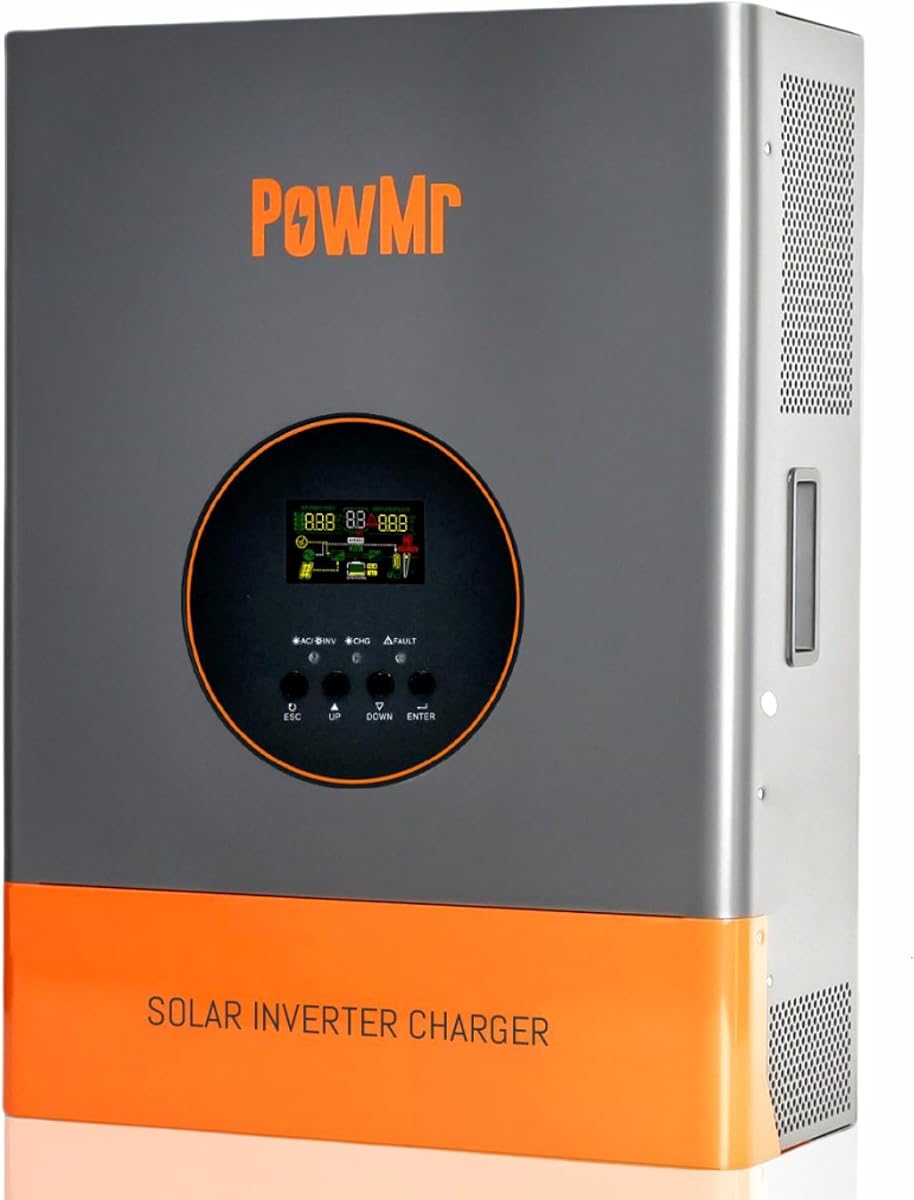


The PowMr 5000W Dual-Output Hybrid earns the Editor's Choice position because it combines a 5000W continuous rating with a substantial 15000W peak claim, pure sine wave output, and native 110V or 220V selection. Its supplied customer rating is 5.0, placing it among the strongest-rated models in this guide, although that rating should be considered alongside the complexity of installation.
We may earn a commission when you buy through this link, at no additional cost to you.
The integrated 120A MPPT controller is one of the most useful features for a permanent solar system. Maximum PV input is listed at 6400W, and the MPPT operating range is 60-105VDC. A larger toroidal transformer supports the high surge rating, while 50Hz or 60Hz output and a ±10% voltage tolerance make the unit relevant to a wider range of loads and operating environments.
Its charging and discharge priorities give owners meaningful control over how solar, utility power, and stored energy interact. The unit supports solar-only, utility-priority, and solar-priority charging, along with utility-priority, solar-priority, and inverter-priority discharge behavior. Compatibility with flooded, LiCoMnNiO2, LiFePO4, AGM, gel, and user-defined batteries also makes it flexible for a new installation or an existing bank.
This is best for owners of a 48V off-grid home, cabin, small commercial system, or backup installation who need more flexibility than a basic 120V inverter provides. Installation is not a casual DIY task, and the manufacturer explicitly warns against exceeding PV voltage, current, or array-power limits. With those constraints respected, it is the most versatile standalone choice in this comparison.
Native 110V and 220V output is a meaningful advantage for mixed-load systems, while three charging and three discharge modes let the owner define how utility and solar power are prioritized. These controls make day-to-day operation more adaptable than a fixed-priority inverter.
The 15000W peak rating adds headroom for motor starting and other short-duration surges. Because the continuous output remains 5000W, users should still calculate startup demand, running demand, and any simultaneous loads before connecting equipment.
We may earn a commission when you buy through this link, at no additional cost to you.
The ECO-WORTHY 5000W Solar Inverter Charger is a flexible 48V hybrid with a 4.1 customer rating. It combines a 5000W pure sine wave inverter, 100A MPPT solar controller, and AC battery charger in one enclosure, making it appealing to buyers who want fewer separate power-conversion components.
We may earn a commission when you buy through this link, at no additional cost to you.
Its defining feature is expansion capability. Up to six units can operate in parallel, with the supplied information describing single-phase and separate-phase arrangements and 120V, 208V, or 240V output when more than two inverters are combined. A single unit provides 5000W continuous output with a 10000W peak rating, so parallel operation can serve larger homes or small commercial loads.
Four charging modes cover solar-only, mains priority, solar priority, and combined mains-and-solar charging. The output side adds uninterrupted power supply behavior, while the LCD and protections address PV overvoltage, reverse night current, input limits, and overheating. The 120-500VDC PV input range is notably higher than the operating range of many 48V models in the list.
This model suits buyers who expect to grow a system or need broader PV input options. Its 120V single-unit output is less versatile than dual-output or phase-ready competitors, and the manufacturer recommends professional installation for 48V off-grid systems. Buyers without relevant electrical experience should not treat the compact all-in-one design as a reason to skip safe installation planning.
Six-unit parallel support offers a practical route from a 5000W starting point to a much larger installation. Users must follow the manual's phase and wiring requirements rather than assuming that any group of units can operate together.
The 120-500VDC PV input range allows suitable arrays to operate at a higher voltage than many 48V competitors. Correct array design remains essential to remain within the stated current and power limits.
We may earn a commission when you buy through this link, at no additional cost to you.
The SUNGOLDPOWER 5000W All-in-One Inverter has a 5.0 customer rating and combines solar charging, utility charging, and pure sine wave AC output in one unit. Its 48V architecture, 120V output, 5000W continuous rating, and support for 4HP motor loads make it relevant to homes and offices that need a compact renewable-power hub.
We may earn a commission when you buy through this link, at no additional cost to you.
Solar charging is handled by an 80A MPPT controller with a maximum array rating of 5500W, while a 40A AC charger supplements battery replenishment. The listed 5000W continuous output is joined by four charging priorities and four output modes, including PV priority, utility priority, inverter priority, hybrid output, and grid connection options.
Battery flexibility is another strength. The unit works with AGM, sealed, gel, flooded, and lithium batteries, includes a user mode for custom settings, supports a 40-60V charging range, and provides an RS485 port for battery-management-system communication. The manufacturer states that it includes a 24-month warranty and lifetime technical support.
The defining compromise is explicit: this inverter does not support parallel operation. It is best for a single 5000W installation rather than a system expected to grow through inverter stacking. Buyers who value straightforward integration, several operating priorities, and broad battery support will find that limitation easier to accept than those who anticipate immediate expansion.
Integrating the inverter, MPPT solar charger, and AC charger reduces the number of major components requiring coordination. It can simplify system design while preserving separate control over source priorities.
RS485 communication can help coordinate a compatible battery-management system. Owners should confirm connector, protocol, and battery compatibility with the manufacturer before installation.
We may earn a commission when you buy through this link, at no additional cost to you.
The TOPBULL 5000W Vehicle Inverter is the best budget-oriented selection for mobile and temporary power applications. It has a 4.6 customer rating, converts a 12V battery into 110V or 120V AC, and supplies 5000W continuously with a listed 10000W peak output.
We may earn a commission when you buy through this link, at no additional cost to you.
Its connection options are unusually convenient. Four 20A AC sockets, two 3.4A USB fast-charging ports, a 30W Type-C port, and three AC terminal blocks cover a range of consumer devices and hardwired loads. The included remote can operate the inverter from up to 200 feet away, while a color display reports voltage, power, and operating status.
The enclosure uses a metal shell with a temperature-controlled dual-fan system. The listed protection suite includes low-voltage, high-voltage, overload, short-circuit, overheating, reverse, grounding, overcurrent, leakage, and battery protections. Those features make the unit more appropriate for a vehicle, camper, work truck, or temporary off-grid setup than a conventional 48V stationary system.
This is a strong choice for anyone who needs substantial 120V output from a vehicle or deep-cycle battery without installing a full 48V system. It does not include an MPPT solar controller, so it cannot independently manage a PV array. The battery must also support the expected load, and high-output use requires careful cable sizing and ventilation.
Four AC outlets plus USB and Type-C ports reduce the need for separate adapters. Terminal blocks add a hardwired option for installations where plug-based connections are unsuitable.
The long-range remote and color status display are useful when the inverter is mounted in a cabinet, truck bed, or other inconvenient location. They also make shutdown and basic status checks more convenient.
We may earn a commission when you buy through this link, at no additional cost to you.
The LVYUAN 5000W Vehicle Inverter is a straightforward 12V-to-120V solution with a 4.5 customer rating. It supplies 5000W continuously and up to 10000W for peak demand, making it a practical option for RVs, trucks, tool vehicles, camps, and small off-grid power needs.
We may earn a commission when you buy through this link, at no additional cost to you.
The unit includes four AC outlets and a hardwire terminal, allowing both portable appliances and fixed connections. Its LCD displays voltage, battery level, load, and alerts, while the included wireless remote offers convenient control from inside a cabinet or elsewhere around a vehicle. These features are particularly valuable in installations where reaching the inverter is inconvenient.
Thermal management is handled by an intelligent fan that activates when internal temperature exceeds 104°F or load exceeds 45%. Protection features cover overvoltage, undervoltage, overload, short circuit, reverse polarity, and overheating. The combination of monitoring, remote operation, and broad electrical protection gives this model a well-rounded feature set for a mobile power unit.
It works with 12V systems rather than the 48V batteries used by most permanent solar hybrids, and it does not include a solar charge controller. It is therefore best viewed as a high-output DC-to-AC component. RV owners and mobile workers who need several standard outlets should find it easier to use than a model designed mainly for fixed residential wiring.
Showing voltage, battery level, load, and alerts provides the core information needed to notice an overloaded or poorly charged system. The display should still be checked regularly rather than assumed to replace proper system design.
The fan is designed to remain inactive until temperature or load reaches the stated thresholds. This approach supports quiet operation during lighter demands while preserving heat dissipation under heavier loads.
We may earn a commission when you buy through this link, at no additional cost to you.
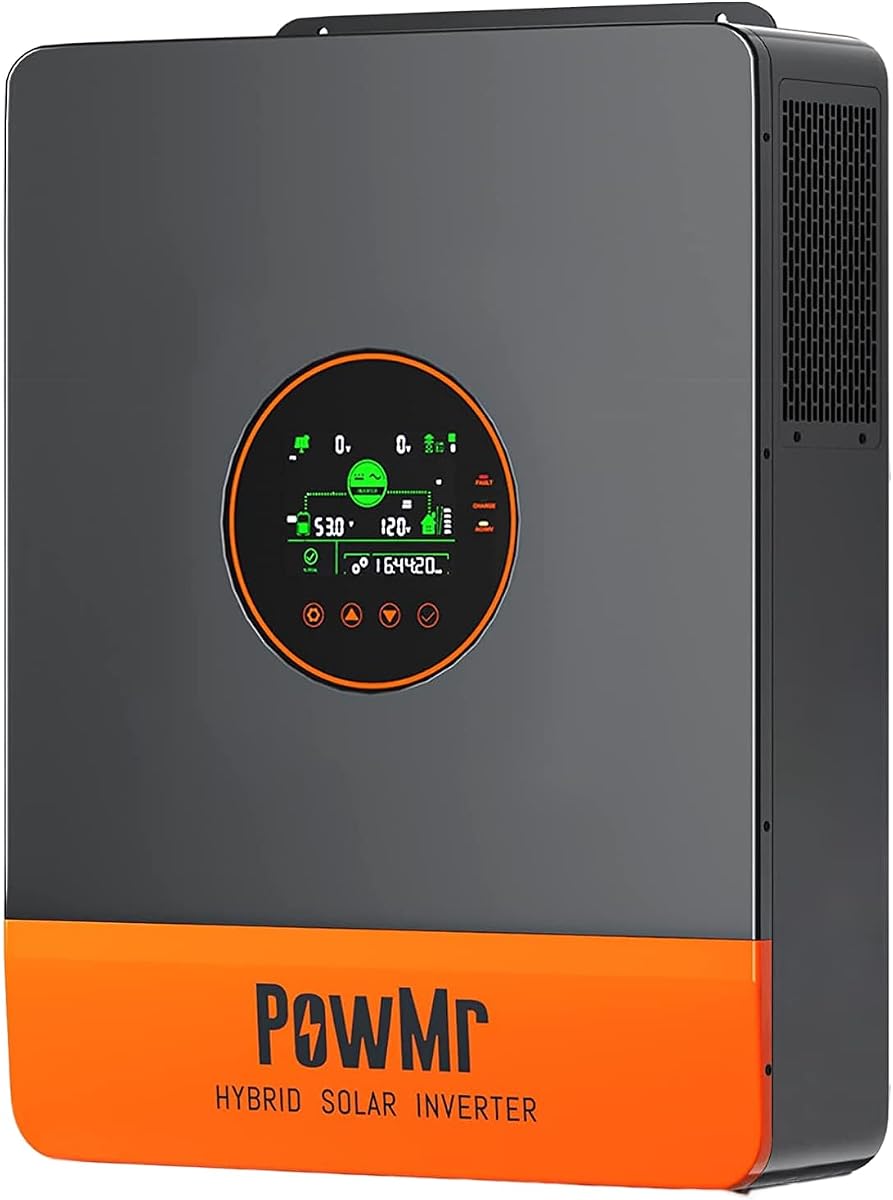
The PowMr 5000W Updated Hybrid closely matches the capabilities of the first-ranked model and carries a 4.8 customer rating. It offers 5000W continuous pure sine wave output, a listed 15000W peak rating, and selectable 110V or 220V operation from a 48V battery bank.
We may earn a commission when you buy through this link, at no additional cost to you.
Its 120A MPPT controller accepts up to 6400W of maximum PV input within a 60-105VDC operating range. The inverter also has a 50Hz or 60Hz output frequency and a 29A maximum AC input current. The enlarged transformer is intended to improve load handling for refrigerators, industrial machinery, and other demanding equipment.
Operating flexibility comes from three charging modes and three discharge modes. The product supports common 48V battery types, including flooded, LiCoMnNiO2, LiFePO4, AGM, gel, and user-defined settings. A color LCD, three LED indicators, dual cooling fans, and a dust- and corrosion-resistant finish improve monitoring and durability.
This is a compelling recommendation for an installer who values a high surge rating and dual-voltage output more than parallel stacking. It shares the same core strengths as the top-ranked PowMr, so the deciding factors may be listing availability, current manual details, enclosure features, and the exact protection and mode configuration. Professional electrical work is strongly appropriate.
The 15000W peak specification is particularly useful for loads with high startup current, such as motors and compressors. Continuous loads must still remain within the 5000W output rating and appropriate thermal conditions.
The LCD and LED indicators provide system status while the dual fans support heat removal. The durable enclosure is intended to reduce exposure to dust and corrosion in demanding installations.
We may earn a commission when you buy through this link, at no additional cost to you.
This 5000W Remote-Controlled Solar Inverter is a 12V mobile and off-grid option with a 4.4 customer rating. It converts battery power to 110V or 120V AC, provides 5000W continuously, and offers 10000W of peak surge capability for loads such as air conditioners and microwaves.
We may earn a commission when you buy through this link, at no additional cost to you.
Efficiency is a central selling point, with the supplied information claiming conversion efficiency above 90%. That can reduce unnecessary energy loss in a battery-limited system. The LCD reports input and output voltage, battery level, and load status, while a 16.5-foot wired remote permits control when the unit is mounted out of convenient reach.
Connectivity includes four AC sockets, one USB port, a hardwire port, and pure copper cables. The inverter is compatible with 12V and 12.8V batteries used in vehicles, RVs, and deep-cycle applications. Its eight protection layers cover undervoltage, overvoltage, overload, overheating, short circuit, reverse polarity, leakage, and overcurrent.
This product is best for RV owners, campers, mobile offices, and emergency kits needing several familiar AC connections. It lacks an integrated MPPT controller and operates from 12V rather than 48V, so it is not the natural choice for a new fixed solar installation. The included two-year warranty and technical support add reassurance for mobile use.
The stated efficiency above 90% is valuable when every unit of stored energy matters. Actual results depend on load level, wiring, battery condition, temperature, and the inverter's operating mode.
The 16.5-foot wired remote is useful for a cabinet-mounted inverter in an RV or camper. It also makes it easier to turn the unit off when the vehicle is stored without accessing the connection area.
We may earn a commission when you buy through this link, at no additional cost to you.
The PowMr 5000W Phase-Ready Inverter is the most technically expansive model in the list. It has a 3.9 customer rating, but that figure should be considered alongside the unusual breadth of features: single-phase, split-phase, 208V, 240V, parallel operation, batteryless operation, timed energy controls, and several communication protocols.
We may earn a commission when you buy through this link, at no additional cost to you.
The unit is rated at 5000VA with 10000VA peak output. Its PV operating range is 120-500VDC, MPPT range is 120-450VDC, and maximum PV input is 5500W. The listed MPPT efficiency reaches 99.9%. CAN, USB, and RS485 connections offer more monitoring options than most competing products, which is particularly relevant to a professionally integrated renewable-energy system.
Phase flexibility is the principal premium feature. The supplied description states that one unit can operate at 120V, while multiple units can form single-phase, split-phase, or three-phase arrangements. Six-unit parallel support offers a clear path to larger output, although the manual is essential because wiring errors in phase systems can be dangerous.
This premium recommendation is for buyers who need scale, phase control, and sophisticated system integration rather than a simple backup box. The 3.9 rating is the lowest among these ten products, so buyers should inspect current customer feedback and confirm manufacturer support in their region. Professional design and commissioning are strongly appropriate for this level of electrical complexity.
Supporting single-phase, split-phase, and three-phase arrangements makes the inverter relevant to installations that may evolve beyond a single 5000W unit. The requirement for two or more inverters for split-phase operation must be planned into the initial system design.
CAN, USB, and RS485 communication plus timer-controlled charging and discharging support more sophisticated energy management. These features can help owners prioritize solar, grid power, and battery use according to operating schedules.
We may earn a commission when you buy through this link, at no additional cost to you.
The LiTime 5000W Hybrid Inverter combines a 5000W inverter, 100A MPPT controller, and 40A battery charger in one unit. It carries a 4.2 customer rating and supports 48V lithium and lead-acid batteries as well as user-defined settings, making it a practical choice for home backup and renewable-energy systems.
We may earn a commission when you buy through this link, at no additional cost to you.
The inverter supplies 110V and 120V AC, with a listed surge rating of 10000W. Two charging modes and four output modes give users control over whether the system favors PV, stored energy, utility power, or a mixed load. When utility power is interrupted, the unit can use battery or PV power to maintain loads, providing its stated UPS-style function.
Expansion is a major strength. Up to six units can operate in parallel for a listed maximum of 30kW, and single-phase and split-phase arrangements can be used when more than two units are present. Timed charging and discharging allow the owner to schedule battery replenishment and use according to local utility rate periods.
The product is best for a 48V home or small commercial system that may expand and values a clear energy-management display. Its single-unit output is limited to 120V, so it does not match the 220V or 240V flexibility of several rivals. Buyers should also confirm battery communication and charge settings before pairing it with a particular battery bank.
Six-unit support and a 30kW maximum parallel output provide a practical expansion path. Single and split-phase configurations offer more flexibility than a simple single-output inverter, subject to the installation guide.
Timed charging and discharging can help coordinate grid use with solar generation and stored energy. The feature is most useful when operating schedules match actual demand and local tariff patterns.
We may earn a commission when you buy through this link, at no additional cost to you.
The 5000W Split-Phase Hybrid Inverter has a 5.0 customer rating and combines 5000W continuous output, 15000W peak capability, 110V or 240V output, and a 120A MPPT controller. It is a strong option for an owner who needs split-phase power from a 48V battery-based renewable system.
We may earn a commission when you buy through this link, at no additional cost to you.
Maximum PV input is listed at 6400W, with a 150V array limit and a 60-150VDC MPPT range. The 50A maximum AC input allows charging from utility power, a generator, or solar energy. BMS and RS485, RS232, and dry-contact interfaces give the unit more monitoring and control options than many basic models.
Three charging modes and three discharge priorities allow solar, utility, and battery power to be used in different sequences. The inverter supports flooded, AGM, gel, LiFePO4, and user-defined 48V batteries. Dual fans, a corrosion- and dust-resistant enclosure, a clear LCD, and LED indicators support long-term monitoring and thermal management.
This model is best suited to a home, office, RV, or truck project designed around 48V storage and 120V or 240V loads. Its extensive feature set and split-phase output justify professional design and installation. The 15000W peak rating should be treated as short-duration headroom, not a continuous 15kW operating capacity.
The 110V and 240V output capability makes the inverter more relevant to whole-home and small commercial systems than a 120V-only unit. Load balancing and output configuration must be verified against the installation manual.
BMS and RS485, RS232, and dry-contact interfaces allow integration with compatible monitoring or control equipment. These connections can improve system visibility when selected and configured correctly.
We may earn a commission when you buy through this link, at no additional cost to you.
The best 5000 watt solar inverter is the one whose electrical architecture, surge capacity, charging controls, and safety functions match the intended system. Begin with the load, battery voltage, solar array, output phase, and installation environment rather than focusing only on headline wattage.
The battery voltage is the most consequential compatibility decision. Most permanent hybrid inverters in this guide operate from a nominal 48V bank, while the TOPBULL, LVYUAN, and generic 12V model are designed around vehicle, RV, or deep-cycle 12V batteries. A 48V bank generally requires more series-connected cells than a 12V bank, and its charging, current, and cable requirements differ substantially. Buyers must also confirm whether the inverter accepts flooded, AGM, gel, lithium-ion, LiFePO4, or user-defined battery settings.
Choose a model that explicitly supports the battery type and voltage already in the system, or plan the entire battery bank around the inverter. Battery communication requirements should also be checked, especially for models offering RS485 or BMS connections.
A 5000W continuous rating describes the output available during sustained operation, while peak power is intended for temporary demand such as motor startup. Some models list 10000W peak, while several PowMr products and the split-phase model advertise 15000W. These surge figures are not interchangeable and should not be treated as evidence that every appliance can run continuously at that level.
List every intended load, estimate simultaneous running power, and identify equipment with high startup demand. Add reasonable headroom, then verify the inverter's continuous rating, surge duration, thermal limits, outlet or terminal capacity, and battery discharge capability.
Output options range from 110V or 120V to dual-output 110V and 220V, 120V and 240V, and more advanced 208V or three-phase arrangements. A 120V-only inverter is adequate for many household tools and appliances, but large heating equipment, welders, and certain commercial loads may require 240V. Split- and three-phase systems also involve balancing and interconnection requirements that exceed a basic single-phase setup.
Match the inverter to the voltage and phase of the intended loads rather than assuming a higher rating makes every configuration compatible. For parallel or phase operation, use the manufacturer's approved wiring diagram and have the final configuration professionally commissioned.
A built-in MPPT controller can reduce equipment count and simplify array design, but only when its voltage window and current rating suit the panels. The reviewed hybrid models vary substantially, with examples using 60-105VDC, 60-150VDC, 120-500VDC, and 120-450VDC MPPT ranges. Maximum PV power and current limits are equally important because exceeding them may damage the inverter.
Choose the unit around a properly designed array, not merely around the largest advertised input. Account for the coldest expected temperature, which raises a panel's open-circuit voltage, and verify the controller's operating range under expected temperatures. The 12V vehicle-style inverters do not include an MPPT controller, so they require separate solar-charging equipment.
Hybrid inverters decide when to use solar, stored energy, and utility power. The models reviewed offer combinations of solar-only, utility-priority, solar-priority, and hybrid charging, along with output priorities that favor PV, utility, the inverter, or a mixed load. More choices can be helpful, but they also create more opportunities for incorrect setup. Timed charging and discharging may suit buyers with predictable utility rates or variable daytime demand.
Prioritize understandable modes that match how the system will actually operate. Confirm uninterruptible-power behavior during outages, define battery reserve limits, and test transfers under representative loads. Avoid selecting on mode count alone when reliability, monitoring, and correct commissioning are the main objectives.
Six-unit parallel support appears in several 48V models, potentially scaling a 5000W design to a much larger system. SUNGOLDPOWER explicitly does not support parallel operation, while the phase-ready PowMr supports more elaborate configurations. Expansion is valuable only when the charger, battery bank, PV array, communications, and load distribution are designed to grow together.
Decide whether expansion is likely before purchasing, and use only the manufacturer's stated combination and phase rules. A unit that cannot parallel may be perfectly adequate for a stable single-inverter installation, but it offers less insurance against future power-demand growth.
Every reviewed inverter includes some combination of overload, overvoltage, undervoltage, short-circuit, reverse-polarity, overcurrent, and thermal protection. Additional features such as LCD displays, LED indicators, remote controls, temperature-controlled fans, and communication ports help with operation and diagnostics. Protection is essential, but it does not replace correct wire sizing, fusing, grounding, ventilation, and adherence to PV limits.
Look for protection features appropriate to the installation environment and verify the user manual's requirements. Mobile units benefit from remote control and rugged enclosures, while stationary systems benefit from clearer status displays and expandable monitoring. Every installation should be performed or inspected by someone with appropriate electrical expertise.
A 12V vehicle inverter may be convenient for camping or truck use, while a 48V hybrid unit is usually intended for a fixed installation with a substantial battery bank. Heat, dust, moisture, vibration, and enclosure placement all affect safe operation. Connectivity options such as hardwire terminals, remote controls, AC sockets, USB ports, and communication buses determine how conveniently the system can be monitored and connected.
Select connections that suit the installation rather than adding unnecessary features. A mobile application is unnecessary if a clear local display and remote controls meet the user's needs, while an integrated system may benefit from CAN or RS485 communication. Plan cable routes, ventilation, access for service, and protection from accidental disconnection before finalizing the purchase.
Before installation, identify every load, calculate maximum and startup power, verify the battery voltage and chemistry, and design the PV array within the inverter's voltage, current, and power limits. Read the manual, identify terminals, install appropriate disconnects and fusing, provide required ventilation, and confirm all switches and settings are correct before energizing the system.
During normal operation, use the display or remote to monitor battery voltage, input and output conditions, charging status, and fault messages. Keep the enclosure away from combustible material, moisture, and direct debris, and avoid exceeding the inverter's continuous output. Do not bypass protective functions or leave the inverter operating in an overheated or overloaded state.
Care and maintenance should follow the manufacturer's schedule. Keep terminals tight and free of corrosion, inspect cables for damage, clean vents and fans without opening the unit, and use only a dry, powered-off enclosure. Test outage transfer and battery reserve periodically, record unusual behavior, and contact qualified service personnel for persistent faults, damaged wiring, or unfamiliar error codes.
It may be enough for essential backup loads or a small home, but it cannot automatically support every household circuit. Calculate the combined running power of refrigerators, pumps, electronics, lighting, and appliances, then add startup requirements and sensible headroom. Larger homes may require multiple inverters, a larger battery bank, and careful load management.
A 12V inverter is commonly used for vehicles, campers, and portable systems connected to one or more 12V batteries. A 48V inverter serves permanent home or commercial systems with more series-connected storage, allowing lower current for the same power level. The battery bank, wiring, charge controller, and electrical design must all match the inverter architecture.
Not necessarily. The 5000W figure is the continuous output rating, while peak power is a temporary capability intended to cover startup and short bursts. The reviewed products list peak ratings ranging from 10000W to 15000W, but the inverter, battery, cables, and protection equipment must all support the load during that surge.
Several 48V models support parallel operation, with some supporting up to six units, while the SUNGOLDPOWER model explicitly does not. Expansion also requires compatible batteries, adequate PV capacity, correctly configured communications, and balanced loads. Check the exact model's manual and approved parallel configurations before purchasing additional units.
Most 48V hybrid models include an MPPT controller, often rated at 80A or 100A. The 12V vehicle-oriented inverters do not include one and need a separate compatible charge controller if they are intended to charge directly from solar panels. Confirm the array voltage and current against the controller specifications.
The products support several chemistries, including AGM, gel, flooded lead-acid, lithium-ion, and LiFePO4. The best choice depends on capacity, discharge rate, temperature, budget, and whether battery communication is required. User-defined modes exist on some models, but incorrect charge settings can damage either the battery or inverter.
Some models offer selectable 220V or 240V output, while others are 120V-only as a single unit. The phase-ready PowMr and ECO-WORTHY also describe multi-unit phase arrangements. Since voltage and phase selection can involve dangerous wiring, verify the manual and use professional installation for 240V or multi-phase systems.
Routine maintenance includes keeping ventilation openings clear, checking cable condition and terminal tightness, monitoring fault indicators, and confirming that battery and load readings remain normal. Internal service should be left to qualified personnel. Do not open a powered unit, bypass fans or protections, or ignore recurring overvoltage, overload, or overheating warnings.
The PowMr 5000W Dual-Output Hybrid is the strongest overall choice because it combines a 5.0 customer rating, pure sine wave output, native 110V and 220V operation, a 120A MPPT controller, and a 15000W peak rating. The TOPBULL unit is the best budget option for 12V mobile use, while the phase-ready PowMr stands out for sophisticated expansion and premium phase features.
The most important selection criteria are system architecture rather than headline wattage. Match the battery voltage, output voltage, surge behavior, PV limits, and parallel capability to the intended installation. Mobile users should focus on a 12V model with accessible outlets and remote monitoring, while permanent 48V systems benefit from integrated MPPT charging, clear operating priorities, and professionally designed wiring.
Ratings, manuals, product configurations, and prices can change, so verify the current listing and manufacturer documentation before ordering. Confirm the battery type, array specifications, load calculation, protections, and installation requirements, and obtain qualified electrical support whenever the installation involves high current, split phase, grid interaction, or permanent wiring.