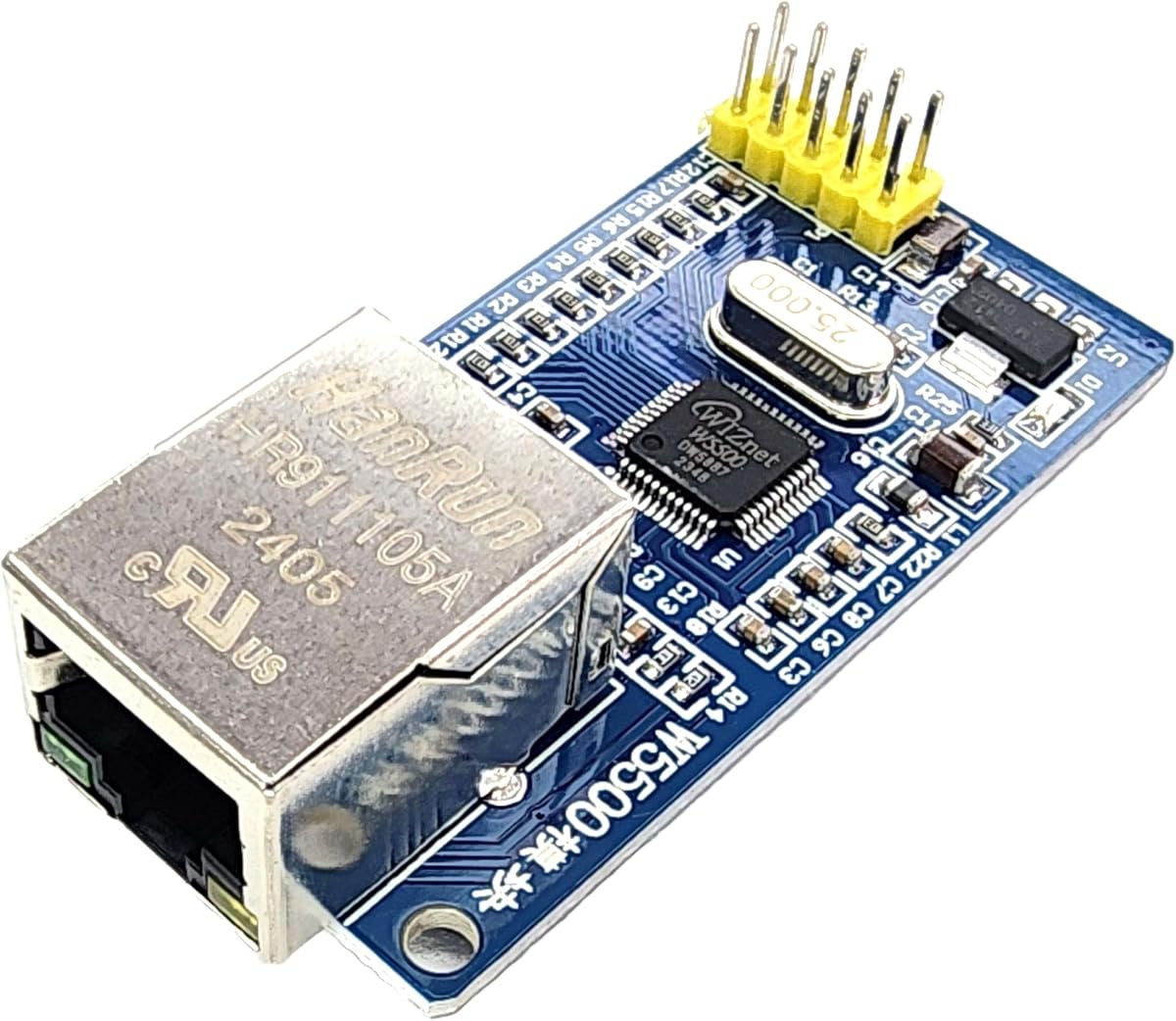
W5500 Ethernet Module with RJ45
5.0Editor score
Full-size RJ45 network port
SPI connectivity for microcontrollers
TCP/IP and UDP support
Our Arduino Lan Ethernet Module guide compares ten W5500, W5100, ENC28J60, and LAN8720 options for voltage, interface, features, and project fit.
An Arduino LAN Ethernet module adds wired network connectivity to projects that need more range, stability, or control than a typical wireless connection can provide. The right board combines a compatible network controller, an accessible SPI interface, appropriate voltage support, and an RJ45 connection suitable for home, office, or industrial networks.
This guide compares ten modules based on the supplied specifications, including their Ethernet chips, supported protocols, operating voltage, socket capacity, connector design, board format, and compatibility with common microcontroller families. It covers both standalone modules and Arduino-ready shields, helping distinguish general-purpose choices from specialized PHY, multi-socket, and multi-pack options.
The selections illustrate how useful differences emerge within the category: W5500 boards emphasize a hardware TCP/IP stack, ENC28J60 modules offer a compact alternative, LAN8720 boards focus on the physical layer, and a W5100 shield provides a familiar Arduino form factor. Ratings and product details reflect the provided information, while availability and current pricing can change over time.
5.0Editor score

4.2Editor score
3.8Editor score
This side-by-side comparison covers ten Arduino-compatible Ethernet options, highlighting the controller architecture, connection method, electrical requirements, protocol support, and physical features that distinguish each module.


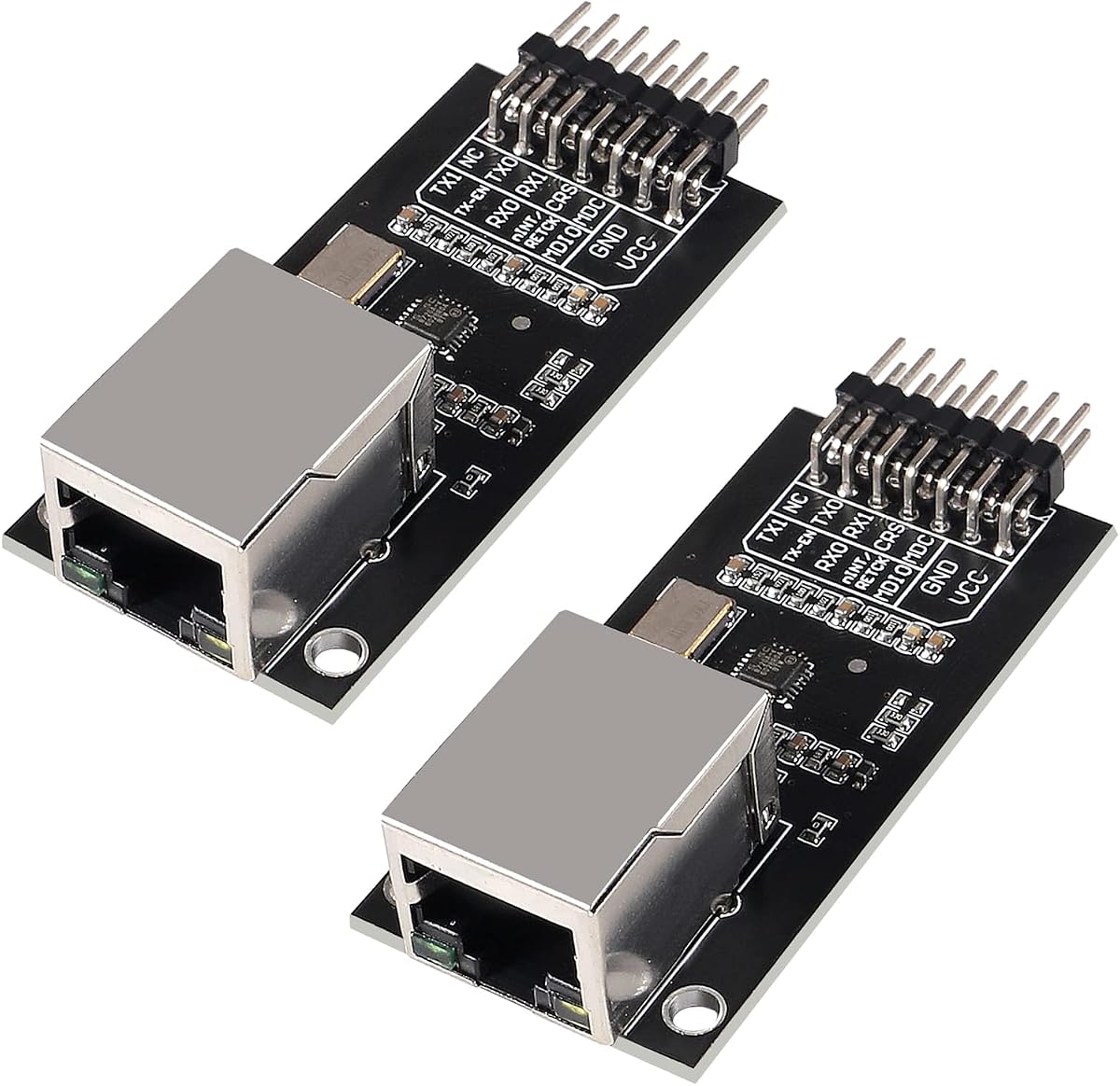

The HiLetgo 2pcs W5500 Ethernet LAN Network Module is a strong all-around option for Arduino projects that need dependable wired networking and more than one physical module. Its supplied rating is 4.2, and the defining technical advantages are the W5500 controller, support for eight independent sockets, 32KB of transmit and receive buffer memory, and a stated 3.3V/5V operating range.
We may earn a commission when you buy through this link, at no additional cost to you.
The biggest benefit comes from placing TCP/IP processing in the Ethernet controller rather than relying entirely on the microcontroller. That allows the Arduino to spend more time on sensors, actuators, controls, and user interaction. Eight simultaneous sockets make the module suitable for a local web server, several networked sensors, or a controller that needs to accept multiple client connections. The 32KB buffers also provide a practical foundation for responsive data exchange.
There are some trade-offs. The product title mixes terms such as TCP/IP51, STM32, and W5100 even though the primary controller is identified as W5500, so buyers should use the stated W5500 specification and library requirements as the deciding technical reference. Two boards are also more than one builder may initially need. Nevertheless, the combination of socket capacity, buffer memory, dual-voltage claims, and included quantity gives this package broad project value.
This is the recommendation for makers who want a capable general-purpose Ethernet module without committing to a full shield. It is especially appropriate for distributed monitoring, local control panels, and projects that may eventually require more than one network node. Choose it when the Arduino's SPI bus and electrical levels can be configured correctly and the software can use a compatible W5500 network library.
Moving protocol work into the W5500 gives the host microcontroller more time for application tasks. It also provides a clear path to TCP, UDP, and multi-client networking without designing a custom Ethernet interface.
Two modules make it easier to build matched nodes or keep a spare on hand. The same controller and electrical design can be used across both sides of a project, simplifying maintenance and firmware planning.
We may earn a commission when you buy through this link, at no additional cost to you.
The HiLetgo W5500 SPI to LAN Ethernet Network Module provides a focused, single-board option for Arduino projects that need the W5500's hardware-assisted TCP/IP capabilities. It carries a supplied rating of 4.3. Its 3.3V power requirement, 3.3V TTL-level SPI control interface, and compatibility with Arduino, STM32, and WIZ820io RC5-oriented hardware make it particularly relevant to embedded networking designs.
We may earn a commission when you buy through this link, at no additional cost to you.
The module's compact format is useful when the Ethernet function is one component of a larger controller rather than the main structure of the project. A 3.3V SPI interface is common on modern embedded systems, and the supplied recommendation for more than 200mA highlights an important practical point: the network section needs a dependable supply, especially when the RJ45 link is active. Software users can generally rely on the mature W5500 library ecosystem for Arduino-family development.
The electrical requirements deserve careful attention. Although the title mentions 3.3V and 5V, the supplied details specifically identify a 3.3V external supply, so the safest approach is to follow the detailed power guidance rather than assume broad 5V operation. The module also arrives as one board, so projects with several endpoints will need multiple units. These are manageable constraints for anyone already designing around 3.3V microcontrollers.
This module suits builders seeking a straightforward W5500 breakout for sensors, remotely operated equipment, or a local network service. It is a particularly natural match for boards with a 3.3V SPI bus and for users comfortable configuring a stable external power rail. For a beginner who wants a plug-in shield instead, the W5100 shield later in this list is simpler, but this module offers more freedom over placement and connections.
The stated need for more than 200mA from a continuous, stable 3.3V source is a key design consideration. A dedicated or well-regulated supply reduces the chance that Ethernet activity will interfere with sensors and other loads.
Using a 3.3V TTL-level SPI interface simplifies connections to compatible 3.3V microcontrollers. This reduces the need for level shifting when the host board and Ethernet module share compatible logic levels.
We may earn a commission when you buy through this link, at no additional cost to you.
The ACEIRMC W5500 SPI to LAN Ethernet Network Module set is built for projects that need several network endpoints rather than a single isolated Ethernet connection. It contains five modules and has a supplied rating of 4.3. Its stated 23 by 25 millimeter PCB size, TTL-level 3.3V SPI interface, and continuous 3.3V power requirement make it a practical option for coordinated Arduino, STM32, and WIZ820io-style installations.
We may earn a commission when you buy through this link, at no additional cost to you.
The five-piece format is the defining advantage. A room-monitoring system can assign identical modules to separate sensors, a robotics demonstration can distribute wired control across several nodes, and an educational lab can let multiple students assemble comparable systems. Standardized boards also simplify enclosure planning because each module has the same stated dimensions. The W5500 architecture provides hardware TCP/IP processing, avoiding the need for every node to implement the complete protocol stack.
The tradeoff is obvious but not necessarily negative: a multi-node project benefits from the package, while a beginner building one simple client may not use every board. The detailed electrical notes call for a stable, continuous 3.3V supply with at least 200mA available, and that requirement should be satisfied for every connected module. A weak common supply can become the weak point in an otherwise consistent design.
Choose this set for multi-device automation, classroom networking, sensor aggregation, or any build requiring uniform modules. It is less compelling for one experimental device, but for distributed projects it reduces repeated sourcing and creates a more consistent hardware platform. Make sure your enclosure, cable routing, and power distribution are planned before installing all five boards.
Using the same module design across several endpoints simplifies wiring, firmware configuration, and replacement. This consistency is valuable when nodes exchange data or act as peers on the same local network.
The stated 23 by 25 millimeter footprint leaves room for compact assemblies. It is still important to measure the available enclosure space and preserve clearance around the RJ45 connector and cable.
We may earn a commission when you buy through this link, at no additional cost to you.
The 2-Pack W5500 Ethernet LAN Module offers an ambitious specification sheet, including a hardware TCP/IP stack, eight simultaneous sockets, 32KB buffers, 80MHz SPI operation, and an integrated 10/100Mbps PHY. However, its supplied rating is only 1.0, and the product is identified with a generic title. That combination makes it a less secure recommendation despite several attractive technical claims.
We may earn a commission when you buy through this link, at no additional cost to you.
On paper, the module would suit real-time control applications that need fast SPI transfers and multiple concurrent connections. Dual voltage operation, 5V I/O tolerance, automatic negotiation, and full- or half-duplex support would make it flexible across a variety of Arduino and STM32 projects. Two boards would also be sufficient for a paired client-and-server arrangement or a spare assembly.
The central issue is not the stated capability but the lack of confidence implied by the very low supplied rating and generic presentation. Buyer feedback may reveal issues that the technical description cannot address, such as inconsistent soldering, questionable documentation, or problems that only appear under sustained network use. Strong specifications are valuable when supported by dependable hardware and clear documentation, but they cannot fully offset a poor user-review history.
This product is best considered only by buyers who have independently verified its build quality, documentation, and application support. It may work for experimentation, but the better-supported W5500 alternatives in this guide offer clearer brand identity and more reassuring customer histories. For a primary installation or a project with an important deadline, choose a better-rated module unless this particular set has demonstrated value in your own requirements.
The combination of 80MHz SPI modes, eight sockets, and substantial buffer memory is attractive for demanding applications. These features could help a technically capable builder create responsive networked devices.
A low rating is a warning that deserves investigation, not a reason to ignore every listed feature. Confirm the exact hardware revision, review available documentation, and test basic communication early if you choose this option.
We may earn a commission when you buy through this link, at no additional cost to you.
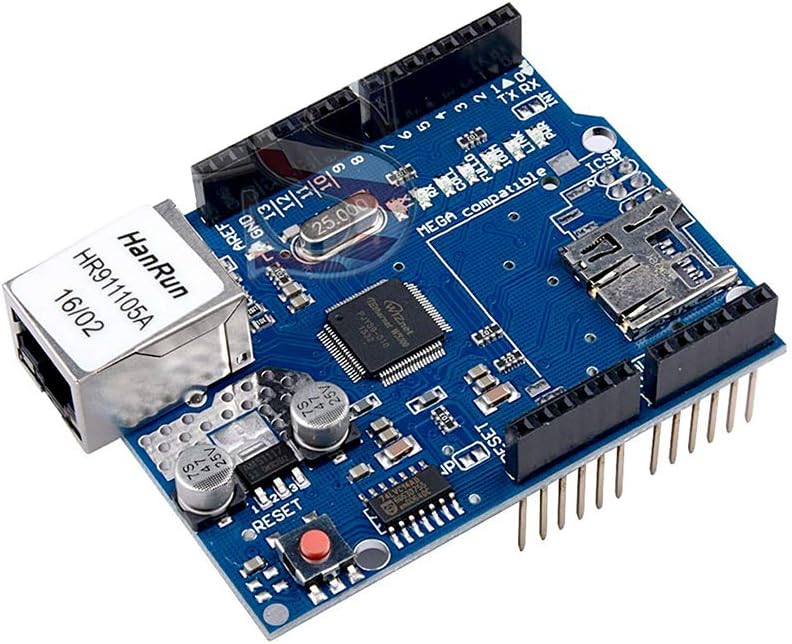
The DEVMO W5100 Ethernet Network Shield is the most convenient option in this guide for someone who wants to add networking directly to a compatible Arduino. It plugs into listed UNO, UNO R3, MEGA2560, ATMega 328, and MEGA 1280 families, uses a standard RJ45 jack, and supplies a W5100 network stack capable of TCP and UDP. Its supplied rating is 3.8.
We may earn a commission when you buy through this link, at no additional cost to you.
A shield form factor removes much of the pin-mapping and point-to-point wiring associated with small breakout modules. The Ethernet connection is straightforward: attach the board, insert a network cable, and begin configuring the software. The built-in SD card slot adds another dimension for projects that store web assets, logs, configuration data, or captured files locally. That makes the board particularly interesting for logging stations and local web interfaces.
Its main limitation is board compatibility. A shield only works when its dimensions, connector positions, and control pins align with the target Arduino. The rating is also lower than those of the leading standalone modules, so careful initial testing is sensible. Another potential consideration is that stacking a standard shield can reduce access to other connectors or create clearance issues with larger attachments.
Buy this shield when fast setup and the familiar Arduino expansion format matter more than maximum socket capacity or compact dimensions. It is a particularly logical choice for web servers, environmental data loggers, and projects that benefit from SD card access. Users who need a different controller, more flexible placement, or support for additional microcontrollers should favor one of the standalone Ethernet modules.
The shield's main convenience is physical alignment with compatible Arduino boards. That reduces wiring errors and makes it easier to move the project between a bench and a permanent enclosure.
The SD card slot gives networked projects a place to keep logs, assets, and configuration information. It can reduce the need to send every stored file over the network, especially in a local monitoring system.
We may earn a commission when you buy through this link, at no additional cost to you.
The HiLetgo ENC28J60 module is a practical alternative for makers who want a compact wired-network interface and do not need the W5500's more advanced hardware protocol support. It has a supplied rating of 4.3 and uses an ENC28J60-I/SO main chip, a 25MHz crystal, an HR911105A RJ45 connector with an isolation transformer, and a 3.3V power supply.
We may earn a commission when you buy through this link, at no additional cost to you.
The board is compatible with a broad range of Arduino, AVR, PIC, LPC, and STM32 systems. Because the ENC28J60 communicates through SPI, it fits well into embedded designs where wired networking is preferred over Wi-Fi. The isolation transformer is an important part of the Ethernet interface, and having the clock and RJ45 assembly integrated on the module simplifies construction compared with assembling those components separately.
The trade-off lies primarily in processing demands. W5500 modules offload TCP/IP tasks to dedicated hardware, while ENC28J60 designs generally require more microcontroller time and memory for protocol handling. On a small AVR board, this distinction can affect available application code, responsiveness, and maximum practical throughput. The 3.3V supply also means a 5V-only Arduino requires careful power and signal planning.
Choose this module for compact Ethernet projects, learning environments, or systems where the host controller has enough resources for the ENC28J60 software stack. It is a sensible choice for a simple client, local sensor node, or instructional build. For a busy server, frequent large transfers, or constrained memory, the W5500 alternatives may be easier to optimize.
The integrated 25MHz crystal and isolation-equipped RJ45 connector give the module most of the hardware needed for a wired connection. This makes it convenient for projects that cannot accommodate a larger shield.
ENC28J60 solutions can place more protocol workload on the microcontroller than W5500 solutions do. Check your controller's memory and processing headroom before selecting a library and designing the application.
We may earn a commission when you buy through this link, at no additional cost to you.
The ACEIRMC 5pcs ENC28J60 package stands out for customer feedback and for its suitability for multi-board projects. It has the highest supplied rating in this selection at 4.7. Five ENC28J60-I/SO Ethernet modules use a 25MHz crystal and an HR911105A RJ45 connector with an isolation transformer, and the supplied information states compatibility with Arduino, AVR, LPC, and STM32 platforms.
We may earn a commission when you buy through this link, at no additional cost to you.
A five-module set is especially useful for a classroom, distributed monitoring network, or an automation project with multiple endpoints. Every board includes the clock and Ethernet connector assembly, so builders can concentrate on firmware, addressing, and physical installation rather than searching for separately matched components. IEEE 802.3 compatibility supports its use as a conventional Ethernet interface for local or appropriately connected networks.
Because each module requires a 3.3V supply, powering five units calls for deliberate distribution. A regulated rail with adequate current, common-ground discipline, and decoupled connections will help maintain stable operation. ENC28J60 protocol handling can also consume more host resources than a hardware-assisted W5500 approach, so the number of nodes should be balanced against the processing capacity of each controller.
This package is a strong choice for educational labs, coordinated sensor nodes, and compact multi-device experiments. Its rating and included quantity make it especially attractive when several identical endpoints are required. For one high-performance network service, consider a W5500 instead; for several small distributed clients, however, this ENC28J60 set offers a coherent and well-supported package.
Five matching modules let several users work on equivalent wired-network projects at the same time. The shared hardware platform also makes comparisons, demonstrations, and troubleshooting exercises easier.
A multi-board installation needs a supply that can support every module continuously. Confirm the regulator's capacity, distribute 3.3V power carefully, and maintain a common ground across the network nodes.
We may earn a commission when you buy through this link, at no additional cost to you.
The W5500 Ethernet Module with RJ45 Port is an approachable, versatile choice for first-time and experienced Arduino network builders alike. It has the highest supplied rating in the guide at 5.0. The product supports Arduino, ESP32, ESP8266, and other 3.3V or 5V microcontrollers through SPI, with TCP/IP and UDP support for local-network and internet communication.
We may earn a commission when you buy through this link, at no additional cost to you.
Its standard full-size RJ45 port is one of the most useful physical features. The module can be connected with a normal Ethernet cable, which is convenient for desk-based development and straightforward to route in a finished project. The SPI interface keeps the electrical connection relatively small, while the W5500 handles core TCP/IP work in hardware. That combination makes the module effective for IoT controllers, robotics, remote monitoring, and classroom experiments.
The product description mentions that tutorials and sample code are available by searching for the named DIYables W5500 Ethernet Module. This is a helpful starting point, but users should verify that the examples match the exact library and board definitions they intend to use. Only one board is included, and microcontroller logic levels should still be checked before connecting a 3.3V module to a 5V host.
This is the top general-purpose budget recommendation for someone who wants a recognizable RJ45 interface, a well-regarded rating, and broad board compatibility. It is well suited to a first web server, a wired environmental station, or a local control project. Choose a higher-capacity W5500 pack when you need several nodes, and choose the shield when plug-and-play Arduino alignment is the priority.
A full-size RJ45 port accepts standard network cables, making setup feel more approachable than custom or less common connectors. It also allows the module to fit into projects already using Ethernet wall outlets or switches.
Available tutorials and sample code can shorten the path from wiring to a working network service. Treat them as a starting framework, then adapt the pin definitions, timing, and application behavior to your own hardware.
We may earn a commission when you buy through this link, at no additional cost to you.
The LAN8720 Ethernet Board 2-Pack is a specialized option for builders who understand the distinction between a physical-layer transceiver and a complete network module. It has a supplied rating of 3.9. The boards provide a high-performance 10/100 Ethernet PHY, HP Auto-MDIX support, single 3.3V power operation, an integrated 1.2V regulator, and a stated I/O voltage range of 1.6V to 3.6V.
We may earn a commission when you buy through this link, at no additional cost to you.
Because a LAN8720 is a PHY, it handles the physical Ethernet signal but does not independently provide a complete TCP/IP stack or SPI connection in the way the W5500 modules do. The host must include or use a compatible MAC implementation and software. This makes the boards more appropriate for advanced embedded systems, customized network hardware, or development boards designed around a specific MAC architecture.
The two-pack format supports paired development or a spare, while Auto-MDIX simplifies cabling by handling crossover requirements automatically. Low-power operation and a single 3.3V supply can suit embedded server and development-board applications. The trade-off is integration complexity: beginners who want to run a quick Arduino example may find a complete W5500 or ENC28J60 module much easier.
Select this pair when you specifically need LAN8720 hardware, already have suitable MAC support, or are designing a custom embedded Ethernet interface. For a typical Arduino project that simply needs to send data over a LAN, a W5500 module will usually provide a shorter path from wiring to working software. This makes the LAN8720 a specialized but potentially excellent choice for experienced designers.
A PHY converts logical data into the electrical signals carried by twisted-pair Ethernet. It does not replace the controller's MAC and TCP/IP software, so those layers must be supported elsewhere in the design.
HP Auto-MDIX can remove the need to manually distinguish straight-through and crossover cable arrangements. This is useful when modules may connect directly to different network equipment.
We may earn a commission when you buy through this link, at no additional cost to you.
The Hailege ENC28J60 module combines a strong supplied rating of 4.6 with a compact, widely supported design. It uses a DIP28 ENC28J60-I/SO controller, a 25MHz onboard crystal, and an HR911105A RJ45 connector with an isolation transformer. The product is identified as compatible with 51, AVR, LPC, STM32, and other common microcontroller families.
We may earn a commission when you buy through this link, at no additional cost to you.
Its standalone format gives makers flexibility over board placement and wiring. The SPI interface is familiar across embedded platforms, and the integrated clock and isolation-equipped Ethernet connector make the module a complete physical interface for many client or control applications. It can work well in remote sensors, simple networked appliances, and educational demonstrations where a full shield would be too large.
As with other ENC28J60 options, the main technical consideration is host-side processing. TCP/IP functions generally require more microcontroller resources than a W5500 design, so applications should be selected with adequate memory and processing capacity. The module also operates from 3.3V, which requires compatible logic levels and a suitable regulated supply. These points are manageable in a planned design but can frustrate an entirely plug-and-play approach.
This module is a strong pick for a single compact Ethernet node when the maker prefers the ENC28J60 ecosystem or needs broad microcontroller flexibility. It has one of the strongest supplied ratings in the selection, making it a more reassuring choice than the generic W5500 option. For heavier network workloads, consider W5500 hardware assistance; for multiple nodes, the ACEIRMC ENC28J60 set is the more relevant package.
The standalone ENC28J60 module is easy to incorporate where a full Arduino shield would be impractical. It is well suited to embedded nodes that only need modest network traffic and have sufficient controller resources.
Support for 51, AVR, LPC, STM32, and other families gives the module flexibility across many embedded ecosystems. Confirm pin mappings, library availability, and logic levels for the exact controller you plan to use.
We may earn a commission when you buy through this link, at no additional cost to you.
Choosing an Arduino LAN Ethernet module means balancing controller capabilities, voltage requirements, physical form, software support, and the number of network nodes in your project. These factors determine whether the board is convenient to use and capable of handling the expected workload.
A W5500 includes a hardware TCP/IP stack, allowing the Ethernet controller to handle core network processing while the Arduino focuses on the application. This is especially valuable when maintaining several connections, serving local clients, or running alongside sensors and actuators. ENC28J60 modules are more compact but can place a greater software burden on the microcontroller, so controller memory and processing headroom need careful consideration.
Check the module's actual supply requirement instead of relying on a broad title alone. The listed products include 3.3V designs, modules that claim 3.3V and 5V support, and one detailed 3.3V SPI specification. The host's logic levels, the module's I/O tolerance, and the RJ45 activity current must all be compatible with the available power source.
Most complete Ethernet modules use SPI because it provides a compact connection between the microcontroller and network controller. Verify the required chip-select, clock, MOSI, MISO, reset, and interrupt pins against the Arduino board you intend to use. A dedicated SPI connection and stable power can also improve reliability compared with sharing an overloaded bus.
A shield is the fastest option when it physically matches a compatible Arduino UNO or MEGA-style board. It reduces initial wiring and may include useful extras such as an SD card slot. A standalone module offers greater freedom in placement, works with more controller families, and is often better for compact embedded projects, but it requires manual wiring and configuration.
A standard RJ45 port accepts common Ethernet cables, but its physical size can influence enclosure design. Leave enough space for the plug, strain relief, and cable bend. The ENC28J60 and W5500 options described here use an HR911105A or full-size RJ45 arrangement, so cable routing should be planned before the board is fixed in place.
W5500 choices support TCP, UDP, and multiple sockets, while the ENC28J60 products are commonly used for standard Ethernet communication through compatible libraries. The LAN8720 board is different because it is a PHY and requires separate MAC and TCP/IP support. Determine whether the project needs multiple clients, UDP broadcasts, reliable TCP sessions, or only a simple local client before choosing the architecture.
Multi-module packs are useful when a project includes several sensors, classroom stations, paired nodes, or distributed controllers. A single module is more economical for one experiment or prototype. For multi-node installations, common power distribution, consistent addressing, and enclosure design matter just as much as the Ethernet controller itself.
Popular controller families such as W5500 and ENC28J60 have well-established Arduino libraries and many examples. Even so, verify that the available code supports your chosen board, SPI pins, and desired server or client behavior. A module with sample material and a clear pin definition can save substantial setup time, while a specialized PHY board may require more specialized driver knowledge.
Begin by identifying the module's controller, supply requirements, SPI pins, and required library. Inspect the board for loose components or damaged connector pins, then connect the appropriate power and ground leads. Wire SPI and control signals only after confirming that the Arduino's logic voltage is compatible with the module. Keep the Ethernet cable away from noisy motors, switching power supplies, and long parallel signal paths.
Install the relevant Ethernet library and configure the correct chip-select, reset, clock, MOSI, MISO, and interrupt pins for your board. Start with a simple example that opens a client connection or displays basic information over the network. Once communication is stable, add your sensors, outputs, web interface, or control logic gradually so that software faults are easier to isolate.
Protect the module from moisture, conductive dust, excessive heat, and accidental connector strain. Use a stable regulated supply, especially for ENC28J60 and W5500 designs with high stated current requirements. Check the RJ45 connection periodically, keep the enclosure vents unobstructed, and test the complete system after any change to wiring, firmware, or power distribution.
A W5500 is usually easier for demanding or multi-client networking because its controller handles core TCP/IP processing in hardware. An ENC28J60 is compact and can be excellent for small client projects, but it places more protocol workload on the microcontroller. Choose according to the required traffic, number of connections, available memory, and the complexity of your application.
Yes. These modules provide a wired network connection through RJ45 and communicate with the Arduino over SPI or a shield interface. The Ethernet module handles the physical network connection, while the Arduino runs the application and the appropriate network library. You still need suitable power, wiring, and a network configuration such as DHCP or a static address.
No. Many compact modules operate from 3.3V and may also require 3.3V signal levels. Some listings claim support for both 3.3V and 5V boards, but the detailed electrical specifications should control your decision. Check the supply voltage, SPI logic levels, and current demand before connecting a module to a 5V-only Arduino.
A LAN8720 is an Ethernet physical-layer transceiver, or PHY, while a W5500 is a complete network interface with a hardware-assisted TCP/IP stack. A LAN8720 design therefore needs suitable MAC and TCP/IP support elsewhere. A W5500 connects more directly to a microcontroller through SPI and is generally easier for typical Arduino projects.
No. A shield must match the dimensions, connector locations, and pin assignments of the Arduino board. The DEVMO W5100 shield specifically lists compatibility with UNO, UNO R3, MEGA2560, ATMega 328, and MEGA 1280 families. Confirm the exact board revision and check for pin conflicts before installation.
The listed modules use RJ45 connections and are intended for standard Ethernet networks. A typical setup connects the module through a router or switch with a standard network cable. Whether a particular direct cable arrangement works can depend on Auto-MDIX support and the hardware involved, so using a router or switch is generally the simplest approach.
Current requirements vary by design and network activity. One listed W5500 specification recommends more than 200mA from a stable 3.3V source, while some other boards advertise 3.3V and 5V support. Do not assume the Arduino's regulator can supply the network section; use an appropriately regulated source and check the selected module's requirements.
An SD card is not required for basic Ethernet communication. It can be useful for serving web files, storing logs, or caching configuration data, and the DEVMO W5100 shield includes an SD card slot. Standalone modules can also use external storage if the application and wiring support it, but network access itself does not depend on removable storage.
The HiLetgo two-pack W5500 is the strongest editorial choice for builders who need eight sockets, 32KB buffers, and two matching boards. The W5500 module with RJ45 stands out as the accessible general-purpose pick with broad controller compatibility and a strong supplied rating, while the DEVMO W5100 shield is the premium convenience option for compatible Arduino boards and projects that benefit from an SD card slot.
Prioritize electrical compatibility first, then choose the controller according to workload. Use W5500 hardware assistance for servers, multiple clients, or frequent transfers; use ENC28J60 for compact nodes with sufficient host resources; and use LAN8720 only when a dedicated PHY and separate MAC architecture fit the design. The number of endpoints, library maturity, enclosure space, and documentation should guide the final decision.
Review the current listing, availability, and pricing immediately before purchasing, since marketplace conditions and product details can change. Confirm the exact controller, voltage, current requirements, and pin definitions, and make sure your Arduino board has the necessary library support. Those final checks can prevent the most common integration problems and keep the finished network project dependable.