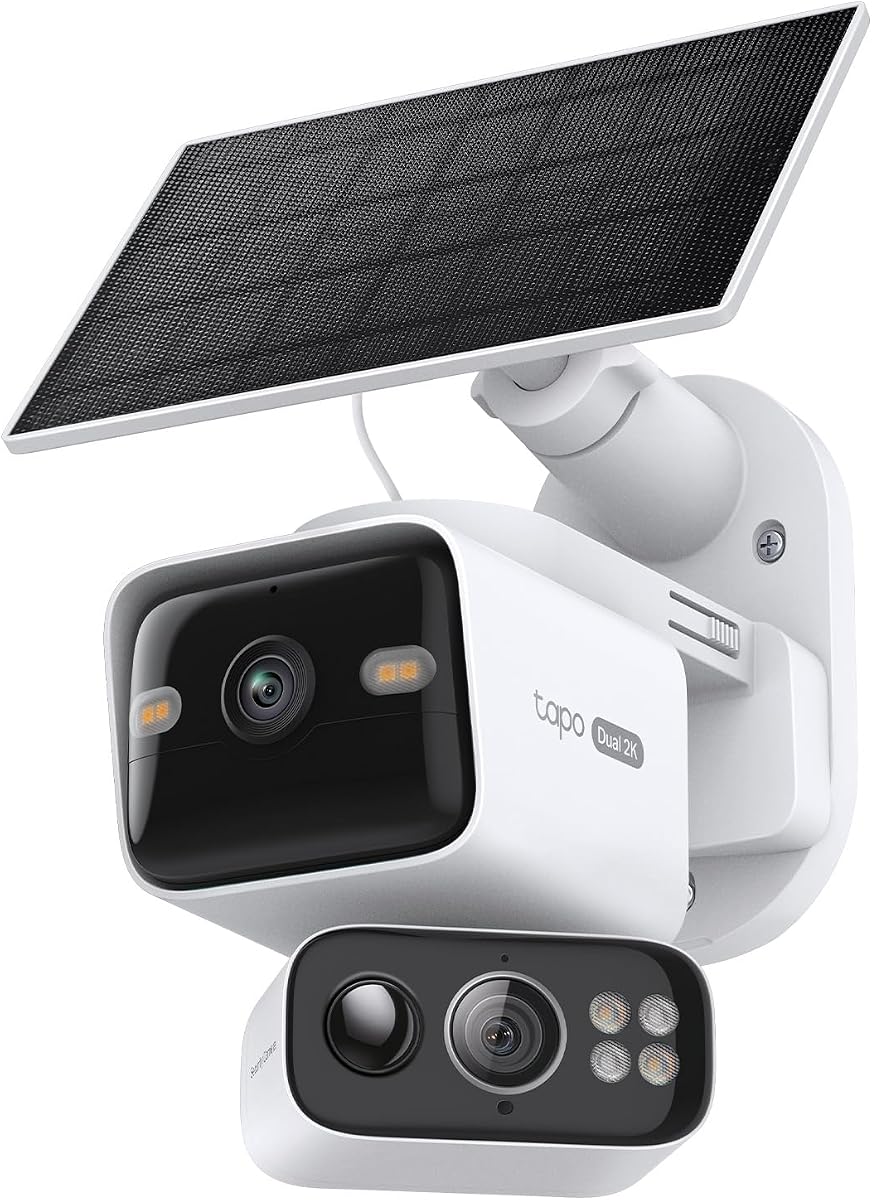
Tapo 2K Dual Lens Pan/Tilt Security Battery Camera w/Solar, C645D KIT
4.4Editor score
Dual 2K lens system
Solar panel and battery
Dual-band Wi-Fi support
AI object detection
Subscription-free local recording
Our Dual Lens Outdoor WiFi Security Cameras guide compares 10 models for coverage, night vision, solar power, tracking, connectivity, storage, and ease of use.
Dual lens outdoor WiFi security cameras combine a fixed wide view with a movable pan/tilt or telephoto perspective, helping reduce blind spots around driveways, yards, porches, and entry points. The best models pair dependable outdoor construction with detailed night footage, intelligent detection, useful alerts, and flexible recording options for different monitoring needs.
We compared all 10 cameras by examining lens configuration, field of view, night-vision features, motion tracking, weather resistance, Wi-Fi support, audio capabilities, storage choices, and smart-home compatibility. The list includes wired models, battery-powered solar kits, single-camera designs, and two-camera packs to reflect the range of available outdoor monitoring approaches.
Each review explains the most useful strengths and the practical compromises of its featured camera, along with the type of property or installer most likely to benefit. Product details and availability can change, so readers should verify current specifications, compatibility, and deal terms on the linked listing before making a final purchase decision.
4.4Editor score

4.5Editor score

4.4Editor score
The comparison below highlights the principal differences among all 10 dual lens outdoor WiFi security cameras, including lens resolution, motorized coverage, power method, connectivity, weather rating, tracking behavior, and storage flexibility. It is designed to help shoppers narrow the field before considering installation details and smart-home compatibility.


The Tapo C246D is a 2K dual lens outdoor WiFi security camera with a 4.5 rating, offering an unusually balanced combination of fixed wide-angle monitoring and motorized close-up coverage. Its fixed lens provides a 125-degree field of view, while the separate pan/tilt lens uses a 6mm telephoto perspective. That division of labor makes the camera well suited to properties where both context and detail matter, such as a front door beside a driveway or a porch overlooking a wider yard.
We may earn a commission when you buy through this link, at no additional cost to you.
The most impressive feature is synchronized smart tracking. Motion identified by the fixed camera can prompt the pan/tilt lens to follow it, reducing the need to manually redirect the camera. Users can also tap a location in the wide live view and have the movable lens zoom and center on that point. Detection options for people, pets, vehicles, and baby cries allow notifications to be tailored rather than treating every form of motion identically. This makes the system useful for both security monitoring and general household awareness.
Night performance is flexible, with black-and-white infrared, full color using built-in spotlights, and an automatic mode that changes to color when motion occurs. Privacy zones and detection zones add another layer of control, while local microSD storage supports up to 512GB and optional Tapo Care cloud storage provides an alternative. The principal compromises are operational: the camera requires 2.4 GHz Wi-Fi and a wired power connection, which may be inconvenient where outlets are distant or exterior wiring is undesirable.
Despite those installation constraints, the Tapo C246D is the strongest general recommendation in this group. It combines polished pan/tilt behavior, detailed 2K lenses, intelligent detection, practical low-light options, and flexible storage without adding solar complexity. Homeowners with reliable outdoor wiring and a 2.4 GHz network will find it especially effective for continuous surveillance and precise event inspection.
Its two-lens configuration is more than a marketing term. The fixed camera maintains a stable scene for detection, while the second camera supplies movement and magnification when an event occurs. That combination can reduce missed activity without forcing the user to choose between broad awareness and a narrow, zoomed view.
A fixed wide view preserves context while the motorized lens concentrates on details. Independent positioning makes this a better fit for active outdoor areas than a conventional single-lens pan/tilt camera that must constantly turn away from one direction to watch another.
Selectable AI categories let users focus notifications on relevant subjects. Custom detection and privacy zones further reduce unnecessary events, particularly in busy yards where leaves, pets, and passing vehicles may otherwise create similar alerts.
We may earn a commission when you buy through this link, at no additional cost to you.
The EVERSECU dual lens outdoor WiFi security camera carries a 4.4 rating and stands out with a 6MP image specification, dual-lens linkage, four-times telephoto zoom, and a broad 355-degree horizontal rotation range. Its fixed wide-angle lens can maintain a general view while the pan/tilt section responds to a target. This arrangement gives users both situational awareness and the ability to inspect a person or object at a distance.
We may earn a commission when you buy through this link, at no additional cost to you.
Night visibility is one of the camera's strongest attributes. Twelve integrated lights support full-color or infrared imaging at distances of up to 60 feet, and users can select among three night-vision modes. AI human detection helps distinguish people from leaves, insects, and other moving objects, after which the camera tracks the subject and sends a notification. A guard-position function returns the pan/tilt lens to its preset orientation when the subject leaves the monitored area.
The two-way audio system supports communication through the app, while compatibility with Alexa adds voice-control convenience. It is also unusually flexible for a camera in this category: the listed support for Blue Iris, iSPY, ZoneMinder, SecuritySpy, VLC, and other third-party applications can suit users who want to integrate feeds into a broader monitoring setup. RTSP access is available after setting a password in the O-KAM app.
Its main limitations are practical rather than fundamental. It lacks the solar charging found in several rivals, and its third-party integration depends on compatible software and network configuration. For buyers seeking strong resolution, precise motorized movement, flexible night views, and broad smart-home options without a complex multi-camera ecosystem, the EVERSECU remains an excellent value-oriented choice.
The fixed and movable lenses are shown concurrently, which helps prevent a zoomed-in view from hiding what is happening elsewhere. Even after the pan/tilt lens locks onto a person, the wide scene remains available for immediate context.
The 4x telephoto lens helps reveal small details, while the concurrent wide-angle feed preserves the larger scene. That makes it easier to determine whether an alert represents an approaching visitor, an animal, or activity beyond the immediate target.
Twelve integrated lights and selectable viewing modes make the camera adaptable after dark. Users can choose discreet infrared monitoring, full color, or a combination depending on the location and their tolerance for visible light.
We may earn a commission when you buy through this link, at no additional cost to you.
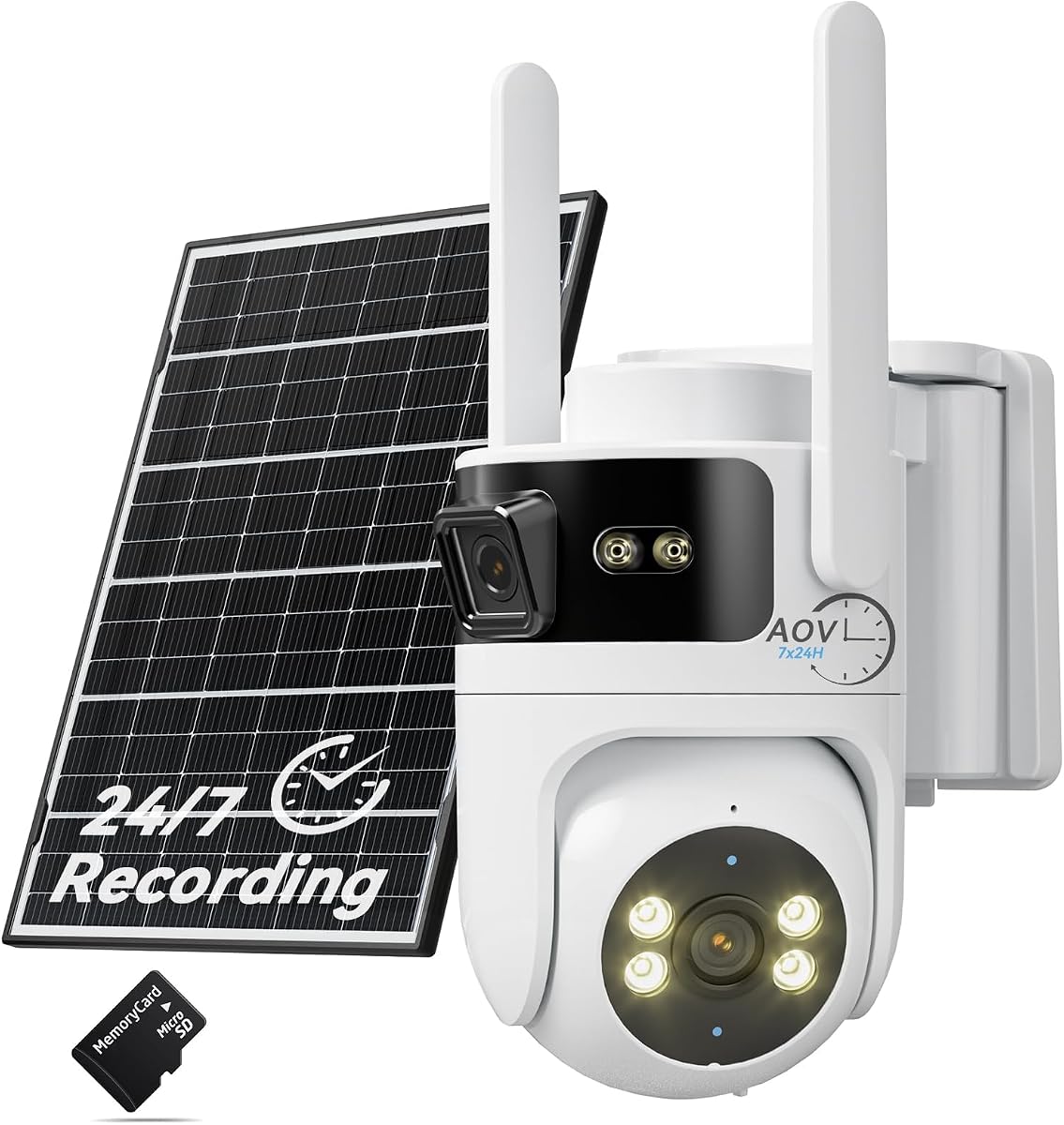
The 24/7 AOV Dual Lens Solar Security Camera has a 5.0 rating and differentiates itself with always-on-video recording, dual 2K lenses, Wi-Fi 6 support, and a completely solar-oriented installation. A fixed lens watches a chosen area while the pan/tilt lens scans 350 degrees horizontally and 91 degrees vertically, creating broad coverage without requiring a nearby outlet.
We may earn a commission when you buy through this link, at no additional cost to you.
Its AOV system records at 15 frames per second when a person or car triggers activity but drops to an adjustable 1 frame per second in static conditions. According to the supplied product information, this approach reduces power consumption by approximately 90 percent and can maintain roughly one month of continuous recording without sunlight under the stated conditions. An 8W solar panel replenishes the 8800mAh rechargeable battery, making the camera suitable for gates, farms, yards, or other locations where cabling would be inconvenient.
Connectivity is handled through both 2.4 GHz and 5 GHz Wi-Fi, allowing the camera to favor faster local performance or greater range. AI humanoid detection can activate an audio and strobe-light alarm, while a built-in microphone and speaker permit two-way conversation through the app. Four LED lights and four infrared lights support day and night color viewing, and the IP65 housing is designed to handle rain, snow, and other outdoor conditions.
Continuous recording and solar dependence are the key trade-offs. High-frame-rate activity consumes more energy than static AOV recording, and prolonged cloudy or shaded conditions can affect how long the battery lasts. Local storage is supported through an included 32GB SD card that accepts cards up to 512GB, while cloud storage is also available. For remote locations that require frequent monitoring without a wired connection, this is one of the most complete options in the roundup.
The camera's dual-band connectivity also gives installers more flexibility than models limited to 2.4 GHz. The listing recommends beginning configuration close to the router and ensuring the final location remains inside Wi-Fi coverage, a sensible precaution for any battery-powered outdoor device.
AOV keeps a record operating at all times while changing frame rate according to activity. This is useful for properties where a brief event might occur between standard motion-triggered clips and where continuous evidence is valuable.
The panel and rechargeable battery remove the need for an exterior outlet. This is particularly valuable at farm gates, storage sheds, isolated driveways, and other locations where running cable would be inconvenient or visually intrusive.
We may earn a commission when you buy through this link, at no additional cost to you.
The Hiseeu 2Pack is a wireless dual lens outdoor WiFi security camera set with a 4.2 rating, offering a practical way to monitor two exterior locations. Each unit combines a fixed lens with a PTZ lens, allowing one area to remain under constant observation while the other scans more widely. That makes the package more versatile than a conventional two-camera bundle containing two similar fixed cameras.
We may earn a commission when you buy through this link, at no additional cost to you.
Within each camera, the fixed upper lens remains stationary while the PTZ section tracks a detected person. A sensitive PIR sensor supports human-focused notifications, which helps limit irrelevant activity alerts. The listed upgraded Wi-Fi Pro technology extends the stated connection range to as much as 60 feet, while support for 2.4 GHz and 5 GHz Wi-Fi provides options for range and transfer speed. Users can link both cameras to one account and selectively share device access with another person.
The package is designed for outdoor use with an IP66 rating, built-in LEDs, and color night vision. Three recording views are available: infrared, full color, and an intelligent color adjustment mode. Setup is presented as straightforward through one-touch connectivity, and the app-based control is particularly approachable for households that do not want a complicated installation process.
The practical limitation is inherent in the two-pack format: both cameras need separate mounting locations, suitable Wi-Fi connections, and their own viewpoints. The stated 60-foot range is also a connection consideration, not a promise that every wall, floor, and outdoor obstruction will be transparent. For buyers who want broad coverage at both the front and rear of a home, however, the combination of two independently positioned dual-lens units is more useful than duplicating a single field of view.
Each camera's fixed section can guard a garage or entrance while its movable section watches a wider yard or driveway. Buyers should plan the two installations around their router's actual signal rather than relying solely on the maximum stated range.
A two-camera package is most valuable when each unit is assigned a different purpose. One can cover a front approach while the other monitors a side yard or garage, allowing both fixed and moving views to work together at each site.
Both cameras can sit under one account, and sharing controls allow another user to gain access without handing over complete administrative control. This is useful for family members, housemates, or occasional monitoring helpers.
We may earn a commission when you buy through this link, at no additional cost to you.
The TKENPRO Dual Lens Solar Security Camera earns a 4.2 rating and combines 2K recording, a solar-powered installation, and dual-lens coverage in a relatively approachable outdoor design. One fixed lens watches a critical zone such as a garage, while the rotating lens sweeps 355 degrees horizontally and 110 degrees vertically. The result is useful for properties where a single directional camera would leave significant gaps.
We may earn a commission when you buy through this link, at no additional cost to you.
Solar charging and a rechargeable battery eliminate the need for a nearby outlet, making the camera well suited to fences, gates, sheds, and wide exterior walls. Its IP65 rating is intended to withstand rain, snow, and harsh outdoor conditions. A white spotlight and infrared LED array provide both full-color and conventional night viewing, while PIR sensing and AI detection help refine the alerts sent to the user's phone.
Two-way talk allows users to speak with visitors from a remote location, and recorded footage can be kept on a memory card of up to 256GB or in cloud storage. The listing notes that basic cloud functionality is available without a charge, while the memory card is not included. Alexa compatibility lets compatible users request a live display through voice control.
Its 2.4 GHz-only connection is the most important limitation. It can be a sensible choice in a home where that band provides better outdoor reach, but it may not integrate with a network configured exclusively around newer 5 GHz or 6 GHz equipment. The vertical pan range is generous, yet the fixed lens still needs a carefully chosen location because it cannot follow moving subjects. Overall, the camera balances wireless convenience, flexible views, and night visibility without overwhelming users with specialized controls.
Installation planning should prioritize sunlight for the panel and a clear Wi-Fi path. Solar charging depends on exposure, so a shaded wall may require more attentive placement than the camera's wireless design suggests.
The solar panel and rechargeable battery make the camera suitable for locations where exterior wiring would be difficult. Its 110-degree vertical adjustment also helps frame high walls, gates, and ground-level approaches.
The spotlight and infrared LEDs let users choose color footage when visible illumination is acceptable or stealthier monochrome footage when discretion matters. This flexibility is useful throughout changing nighttime conditions.
We may earn a commission when you buy through this link, at no additional cost to you.
The Tapo C645D KIT is the premium pick in this roundup, combining a 4.4 rating with an advanced dual-lens camera, a 10,000mAh battery, and a solar charging system. Its fixed 2K ultra-wide lens has a listed 165-degree field of view, while a separate 2K pan/tilt telephoto lens provides detailed close-ups. The wide fixed view establishes context, and the motorized lens can follow important activity when synchronized tracking is enabled.
We may earn a commission when you buy through this link, at no additional cost to you.
The supplied information states that one hour of direct sunlight can support a full day of operation, while the battery can last up to four months on one charge during cloudy periods. Solar charging requires temperatures above 32°F, an important limitation for buyers in colder climates. The camera supports both 5 GHz and 2.4 GHz Wi-Fi, with the faster band best suited to closer placements and the lower band providing longer reach.
AI detection identifies people, vehicles, and pets without requiring a subscription, which helps keep alert categories meaningful. Privacy and detection zones support more focused monitoring, and full-color spotlight imaging can be switched to infrared for more discreet or power-efficient operation. The listing also identifies Tapo as a signatory of the U.S. Cybersecurity and Infrastructure Security Agency's Secure-by-Design pledge, adding useful context to the brand's stated security approach.
The main drawback is environmental dependence. Solar charging performs best where the panel receives direct sun, and cold temperatures reduce charging effectiveness. A larger installation may also require attention to the panel's orientation. Even so, the combination of wide and telephoto lenses, generous battery capacity, local recording without a subscription, and dual-band connectivity makes this a particularly complete solution for a larger property or a high-priority installation.
Compared with a basic dual-lens model, this kit gives users more freedom over power and connectivity without giving up the most important monitoring functions. It is best suited to buyers who want fewer network constraints and can place the panel where sunlight is reliable.
The 165-degree fixed lens covers a generous portion of the property and remains stable while the pan/tilt lens moves. That gives users a dependable overview for detection and a separate perspective for identifying details.
The large battery and solar panel support extended operation away from outlets. Installers should still account for shade, panel angle, and the stated requirement for temperatures above 32°F during solar charging.
We may earn a commission when you buy through this link, at no additional cost to you.
The ICSEE PTZ Dual Lens camera has a 3.8 rating, the lowest among these picks, but it offers a broad feature set for buyers interested in third-party monitoring systems. Its fixed upper lens and lower pan/tilt lens appear together in the ICsee app, and tapping the fixed screen directs the PTZ lens toward the chosen location. Human-oriented AI detection can then follow a target until it leaves view before returning to the default point.
We may earn a commission when you buy through this link, at no additional cost to you.
Both lenses provide 3MP resolution, with floodlights and full-color night vision for dark conditions. Digital zoom extends to 5x, while two-way audio supports communication with visitors or delivery personnel. Alerts are delivered through the app, and event recordings can be reviewed or downloaded after an SD card is inserted. Storage options include local SD recording up to 128GB and encrypted secure cloud storage.
Connectivity is a major strength. The camera supports both 2.4 GHz and 5 GHz Wi-Fi and is listed as compatible with ONVIF NVRs and software such as Blue Iris, iSpy, Tiny Cam, and ipcam viewer, as well as QNAP and Synology systems. The IP66 housing is designed for rain, snow, and hot summer conditions. A wired power connection makes the unit suitable for locations with reliable access to electricity.
The 3.8 rating indicates that some buyers may have found aspects of the setup or overall experience less satisfying than those of the higher-rated cameras. It is also worth distinguishing the listed 10-meter color night vision capability from digital zoom, because magnification can reduce clarity. Even so, this camera's extensive compatibility and dual-band support make it a credible option for users who want the camera integrated into an existing NVR or surveillance platform.
Its strongest audience is technical or enthusiast users who value interoperability. Buyers who only need a simple app and solar operation may find other models more straightforward, but those with an established recording system may value this camera's broader connection options.
ONVIF support and compatibility with major NVR and surveillance applications give this model unusual flexibility. It can fit into an existing monitoring setup instead of functioning only as a standalone phone-connected camera.
Touching the fixed-lens display prompts the PTZ lens to locate and lock onto that area. This is faster than manually scanning with pan and tilt controls and is useful when responding to an alert.
We may earn a commission when you buy through this link, at no additional cost to you.
The LongPlus Dual Lens Solar Security Camera earns a 5.0 rating and offers a 2MP plus 2MP dual-camera system with 24-hour AOV recording. A fixed lens covers a key area while the pan/tilt lens travels 350 degrees horizontally and 90 degrees vertically. Its broad monitoring pattern is particularly useful for a porch, garage, driveway, yard, or farm outbuilding where one directional view would be insufficient.
We may earn a commission when you buy through this link, at no additional cost to you.
The camera uses an 8W solar panel and an 8800mAh rechargeable battery, eliminating the need for an exterior power connection. AOV recording changes from 15 frames per second when a person or car is present to an adjustable 1 frame per second in static scenes. The stated power reduction of approximately 90 percent supports longer operation, with the listing indicating that continuous recording can continue for about one month even without sunlight.
AI humanoid detection can trigger an audible alarm and strobe light, offering both a practical warning and a visible deterrent. Built-in microphone and speaker components provide two-way communication through the app. Dual-band Wi-Fi lets the camera choose between faster 5 GHz performance and longer 2.4 GHz reach, while four LED and four infrared lights provide daytime and nighttime visibility.
The most notable compromise is the 90-degree vertical range, which is slightly less expansive than the movement offered by several competing cameras. Continuous operation also places a greater demand on the battery and solar panel than motion-only recording. Even so, the 5.0 rating, AOV approach, and fully wireless design form an attractive package for users who want continuous monitoring at a remote or difficult-to-wire location.
AOV is particularly helpful where incidents may be brief and unexplained. Even when no person or vehicle is present, low-frame-rate footage maintains awareness of the area, while activity prompts a faster and more detailed recording mode.
The camera records continuously while adapting its frame rate to the scene. This balances the assurance of round-the-clock coverage with a lower power demand than operating at the higher activity frame rate at all times.
Human detection can activate the siren and strobe light, while two-way audio allows a property owner to speak to someone detected near the camera. These active responses add more than passive recording.
We may earn a commission when you buy through this link, at no additional cost to you.
The ICSEE 6MP dual lens camera has a 4.3 rating and combines two 3MP perspectives with a 360-degree viewing concept. One lens is fixed while the other pans and tilts, and both screens can be monitored together. This gives users a stable overview of one direction and a movable perspective for activity elsewhere, reducing the need to switch between camera modes.
We may earn a commission when you buy through this link, at no additional cost to you.
White and infrared lamps provide three selectable night-vision approaches: full color, infrared, and smart vision. The listing states a best night-vision distance of up to 65 feet, with the lights activating automatically when ambient light is insufficient. Human detection displays a person's trajectory, initiates automatic tracking, triggers real-time alarms, and can capture an image or generate a video of the suspicious subject.
Built-in audio and speaker components support two-way conversation through the iCSee app. Multiple users can share access, making the system useful for families, friends, or security personnel. Recording can continue 24 hours a day under the PTZ section, with storage through a microSD card up to 128GB or a cloud server. Alexa support provides voice-controlled access to the live view.
One especially useful feature is the availability of both wireless Wi-Fi and wired Ethernet options. Buyers can choose a simpler wireless installation where appropriate or improve network stability with a wired connection. The 128GB local-storage ceiling is smaller than several dual-lens rivals, and the mixed descriptions of 3K, 6MP, and dual 3MP make careful attention to the product specifications important. Overall, it remains a well-rounded option with detailed dual screens and useful night performance.
The tracking behavior is particularly relevant for entrances where a person may approach and then move out of a fixed camera's most useful angle. Combining tracking with two simultaneous views lets users retain situational awareness while the PTZ lens follows the subject.
Displaying the fixed and movable feeds together preserves broad coverage while adding a closer tracked perspective. This can reduce the uncertainty that often comes from reviewing only a digitally cropped portion of a single feed.
Wireless setup offers installation convenience, while the listed Ethernet option can provide a more stable connection in locations with favorable cabling. Users can select the approach that best suits their property and router.
We may earn a commission when you buy through this link, at no additional cost to you.
The SEHMUA Dual-Lens Solar Security Cameras two-pack has a 4.2 rating and provides two complete solar camera systems for separate outdoor locations. Each camera displays two live views in the Ubox app: a fixed lens watches an assigned area such as a garage or front door, while the PTZ lens can turn toward a yard, path, or street. The two-camera format is valuable for monitoring more than one side of a home without relying on a single wide placement.
We may earn a commission when you buy through this link, at no additional cost to you.
Each unit's lens configuration combines 2K and 4MP detail, with infrared and spotlight options for full-color night vision when motion is detected. PIR detection with human filtering sends alerts and records event clips. Users can also redirect the PTZ lens to inspect the other scene and use two-way talk to greet a visitor, guide a delivery, or issue a warning.
A rechargeable battery and 6W solar panel reduce the need for frequent removal and recharging, while the IP65 housing is designed for rain, dust, heat, and cold. Settings can be tailored through custom detection zones, schedules, and sensitivity controls. The cameras connect over 2.4 GHz Wi-Fi and allow access for up to four users, which is convenient for family members or staff who need simultaneous viewing.
The main compromises are the limitation to 2.4 GHz and the need for suitable solar exposure at both installation points. The package also requires thoughtful placement because each camera has a fixed assignment as well as a movable view. For buyers seeking two independent solar-powered dual-lens installations, however, it offers an effective combination of coverage, night vision, alerts, and shared access.
The most productive arrangement assigns the fixed lens to a critical target and the PTZ lens to the surrounding approach. This division makes it easier to monitor a doorway and yard simultaneously instead of allowing the moving lens to dominate both tasks.
Owners can place one camera near the front entrance and another at a garage, side gate, or secondary entrance. Each location retains the same fixed-plus-PTZ structure, providing consistency across the property.
Human filtering makes PIR alerts more relevant, while schedules and custom zones help manage busy areas. Up to four users can view the feeds, allowing relatives or staff to monitor events without complex individual accounts.
We may earn a commission when you buy through this link, at no additional cost to you.
A useful dual lens camera should combine stable wide coverage with a more focused or movable view, while matching the installation's power, network, weather, and storage conditions. Comparing these factors before choosing a model prevents attractive features from being undermined by an unsuitable location.
The defining benefit of a dual lens system is the ability to preserve a stable view while another lens pans, tilts, or zooms. A fixed wide-angle lens is valuable for recognizing movement across a wide area, while a telephoto or PTZ lens can isolate details. Some products synchronize the moving lens with the fixed detection zone, allowing a person or vehicle to be followed automatically. Buyers should check both the stated mechanical pan range and the fixed lens's field of view because a large rotation figure does not guarantee that every important angle remains visible.
In short, prioritize a genuinely useful wide view plus accurate motorized positioning rather than focusing only on the largest advertised rotation angle.
Resolution determines how much fine detail remains available for later inspection, but pixel count alone does not determine usable nighttime footage. Look for both dual-lens resolution and a clear night-vision strategy. Infrared provides discreet monochrome coverage, while a spotlight enables color images but may be more noticeable. Automatic or smart modes can switch between the two as ambient light changes. The stated illumination range is also useful, provided it is treated as an ideal operating guide rather than a guarantee that every object will be identifiable at the maximum distance.
In short, choose enough resolution for detail and a night mode that matches the location's lighting, visibility preferences, and recording strategy.
Wired cameras offer consistent power and can be preferable near an outlet or existing exterior conduit. Battery models remove visible cables and simplify placement, while solar kits are best for locations with dependable sunlight. The two-pack options require adequate solar conditions at both sites. Review cold-temperature limitations, panel orientation, and the amount of shade around the intended mounting point. For a wired unit, check the distance to an outlet and the difficulty of routing a safe, weather-resistant cable.
In short, match the power system to the site first, then confirm that Wi-Fi coverage and physical mounting conditions are realistic.
A 2.4 GHz-only camera can provide excellent outdoor range and is often easier to connect across walls and long distances. Dual-band models add 5 GHz support, which can improve local throughput and reduce congestion when the camera is reasonably close to the router. Regardless of the advertised maximum distance, signal quality depends on walls, floors, interference, and the router's position. Solar cameras and other high-mounted devices may also perform differently from cameras installed near a window. Buyers should plan the installation and verify that the selected band remains available.
In short, choose dual-band support for network flexibility or 2.4 GHz for straightforward reach, based on the actual router and placement.
AI detection can distinguish people from pets, vehicles, leaves, insects, and changing light, but only when the camera supports the categories relevant to the property. PIR sensing may react quickly to heat-based movement, while video-based analysis can add more context. Automatic tracking is especially valuable when the subject leaves a fixed frame, though it should be viewed as a convenience rather than a guarantee that every event will be followed perfectly. Custom zones, sensitivity controls, and privacy zones help reduce irrelevant alerts and unwanted recording areas.
In short, choose detection categories that match common activity and use zones to keep alerts focused on the locations that matter.
Local microSD storage is useful when users want direct access to recordings without relying on a remote service. Capacity varies substantially across the list, so buyers should check both supported card size and whether a card is included. Cloud storage can provide convenient remote access and may include a trial or a basic tier, but retention and feature access depend on the provider's current terms. Continuous AOV recording also creates more footage than motion-only recording, making storage planning especially important for a solar model.
In short, compare card capacity, included media, cloud availability, and recording mode together instead of assuming every model stores footage in the same way.
IP65 and IP66 both indicate protection against dust and water ingress, though they are not identical claims. Both can suit ordinary outdoor installations, but the chosen camera still needs correct mounting, secure cabling, and protection around connectors. Consider whether the housing can be safely attached to siding, brick, metal, stucco, or a wall without creating leaks. Pay attention to the camera's viewing angle, the height of the lens, nearby vegetation, and the likelihood of reflected light or headlamps washing out night footage at night.
In short, verify the weather rating and use a suitable mounting surface, while positioning the lenses where vegetation and glare will not obstruct important areas.
The mobile app determines how users review footage, respond to alerts, share access, and adjust detection settings. Two-way audio is useful for visitors and deliveries, while visible alarms can deter activity. Alexa compatibility adds hands-free viewing for some users. More advanced NVR and third-party software support can be valuable for people who already maintain a surveillance ecosystem, but it usually requires more network and account configuration. Check whether the desired integrations are listed as native features rather than inferring support from generic Wi-Fi capability.
In short, verify app quality indicators, required accessories, voice-platform compatibility, and third-party integration before finalizing a model.
Begin by choosing the camera's location before mounting it permanently. Confirm power access, Wi-Fi reception, and a suitable view of the intended area. For solar models, prioritize a panel position with unobstructed sunlight and account for seasonal shade. Mount the unit securely, keep the lens out of direct glare, and make sure the fixed and movable lenses are aimed to complement rather than duplicate each other. If using a wired model, protect exterior connections from moisture and avoid routing cable where it could be damaged.
Complete the app setup near the primary router before relocating the camera, following the manufacturer's pairing guidance. Update the firmware, create the desired account, and configure the Wi-Fi band, recording mode, detection zones, privacy zones, and alert sensitivity. Test the fixed view, pan/tilt limits, zoom, night illumination, and motion tracking under real conditions. Anyone granted shared access should receive only the permissions needed for their role.
For ongoing care, clean the lens gently and remove dirt, cobwebs, and weather deposits that can reduce image quality. Check that the mount remains tight and that the solar panel is not shaded by new plant growth. Review storage capacity, recording schedules, and battery condition on a regular basis. Periodically test two-way audio and alerts, and update the camera's software when new versions are offered so that compatibility and security improvements can take effect.
The main advantage is simultaneous broad and focused coverage. A fixed lens can maintain a wide view of a driveway, yard, or entry, while a pan/tilt or telephoto lens follows activity or magnifies details. This arrangement reduces the blind spots associated with relying on one movable lens and gives users more context when reviewing an alert.
It depends on the property and installation priorities. A dual lens model can combine wide coverage and zoom in one compact unit, which may be easier to place and power. Two single-lens cameras can provide separate viewing angles, independent power, or stronger redundancy. Consider coverage, network reliability, recording capacity, and whether a second physical camera would better serve the monitored area.
These products are WiFi security cameras, so their core wireless functions depend on a connection to the router and app services. Some also offer wired Ethernet options or ONVIF integration for compatible local systems, but that does not mean every feature works without network access. Local SD recording can preserve footage during certain network interruptions, while remote viewing and alerts still require connectivity.
Solar charging depends on sunlight, panel angle, temperature, and seasonal conditions. The Tapo C645D KIT specifically requires temperatures above 32°F for solar charging, while other models may also experience reduced charging performance in cold weather. A rechargeable battery can help bridge poor conditions, but owners should check local sunlight and the manufacturer's operating limits before relying on solar-only operation.
Capacity and convenience determine the best choice. Local microSD storage offers direct access and can avoid recurring cloud fees, but a high-capacity card is needed for continuous footage. Cloud storage adds remote access and management features, subject to the provider's current terms. Models with AOV can create more recordings than motion-only cameras, making regular storage checks especially important.
The 2.4 GHz band usually provides better range and is more likely to travel through walls, making it useful for outdoor cameras placed farther from the router. The 5 GHz band can offer faster performance and less congestion over shorter distances. Dual-band cameras give users more flexibility, while 2.4 GHz-only models are often easier to deploy where the router is distant.
Yes, provided the camera has an appropriate night-vision mode for the environment. Infrared produces discreet monochrome imagery, while visible spotlights can provide full color. Smart modes can switch automatically as light changes. Buyers should compare the stated illumination range, lens resolution, and whether both views support low-light recording instead of relying on a single maximum-distance claim.
Support varies by model. The EVERSECU and ICSEE 6MP cameras are listed as Alexa compatible, while the ICSEE Dual-Lens PTZ model lists ONVIF and third-party NVR support. Before purchasing, verify the required app, account, firmware, network configuration, and any password or RTSP setup that may be needed for the intended integration.
The Tapo C246D is the most balanced overall choice, combining dual 2K lenses, synchronized tracking, one-tap zoom, flexible night modes, and local or cloud storage in a wired design. The Tapo C645D KIT is the premium option for shoppers who want solar charging, dual-band Wi-Fi, and a wide fixed field, while the EVERSECU 6MP PTZ stands out as a capable budget-oriented model with high resolution and broad third-party compatibility.
For off-grid properties, the LongPlus cameras are the strongest AOV options because their solar systems, rechargeable batteries, and continuous recording are designed to operate without an outlet. The Hiseeu and SEHMUA bundles are better suited to buyers who want two physical locations, while the ICSEE models serve users who prioritize network flexibility, NVR compatibility, detailed dual screens, or Alexa support.
Before ordering, confirm the lens coverage, power method, Wi-Fi band, weather rating, storage capacity, and app features against the intended installation. Also check current specifications and deal terms on the product listing, since hardware bundles, supported accessories, cloud plans, and manufacturer details can change over time.