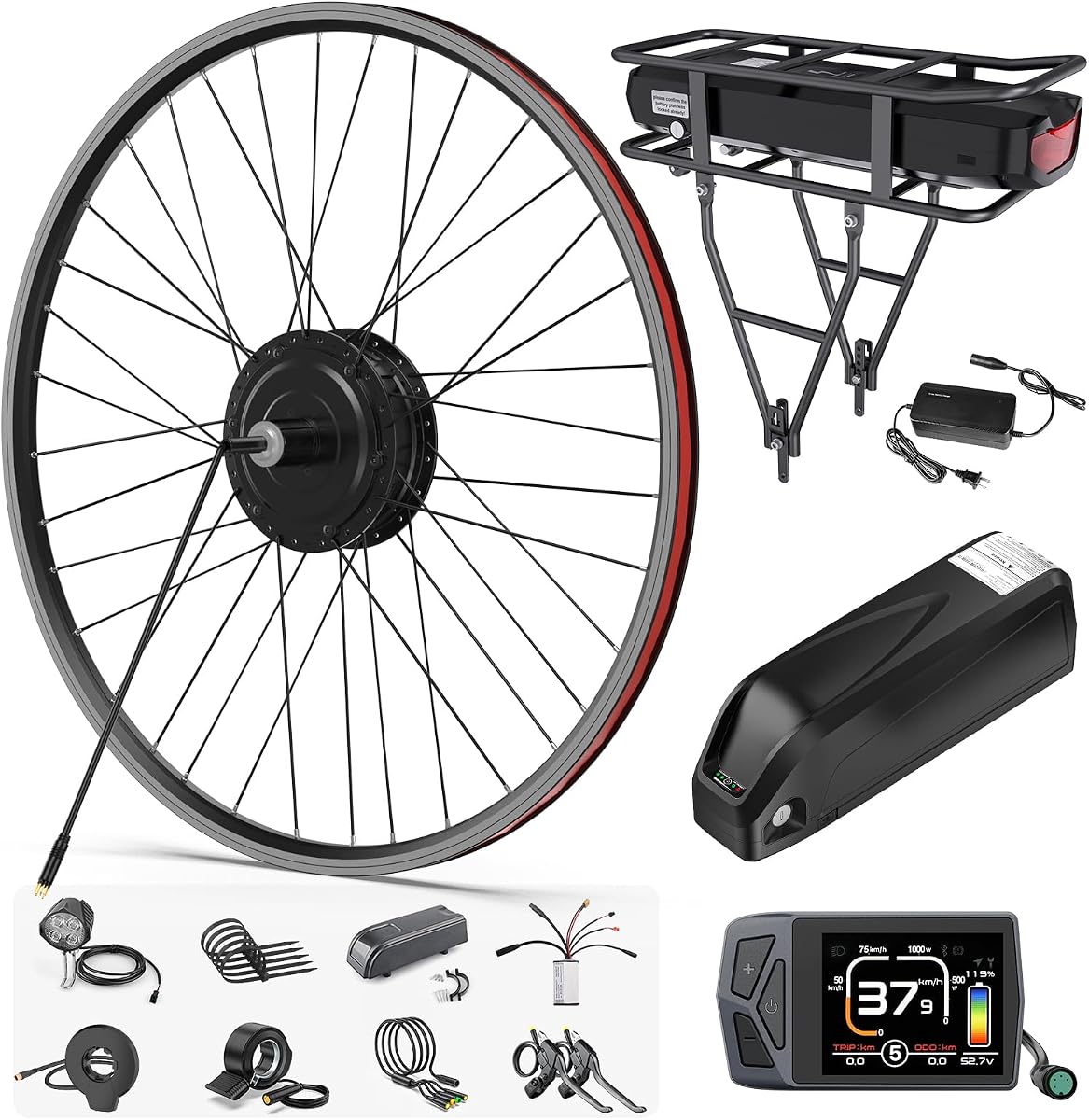
26-Inch 1000W Rear Hub Kit
4.8Editor score
48V 1000W gearless motor
Up to 45N.m torque
135mm rear dropout fit
PAS and thumb throttle
Electric conversion kits can transform a familiar bicycle into a practical pedal-assist machine without requiring riders to purchase an entirely new e-bike. The best kits balance motor performance, frame compatibility, control options, safety features, and installation complexity, making careful comparison essential before upgrading.
We compared the ten featured kits by examining their motor placement, rated power, torque, supported wheel sizes, control systems, brake cutoffs, displays, battery requirements, and installation guidance. The list covers rear-hub, front-hub, mid-drive, and chain-driven designs for commuters, mountain riders, touring cyclists, and DIY enthusiasts.
Each review explains who the kit is best suited to, along with the compromises that may affect fit or ownership experience. Ratings and product availability can change, and prices fluctuate frequently, so readers should verify the current listing and the compatibility of their specific bicycle before making a purchase.
4.8Editor score

5.0Editor score

4.1Editor score
As an Amazon Associate we earn from qualifying purchases.
The comparison below highlights the major differences among all ten kits, including motor location, rated output, supported wheel sizes, control functions, and important fit limitations. These details help riders narrow the field before confirming frame, brake, dropout, bottom-bracket, and battery compatibility.


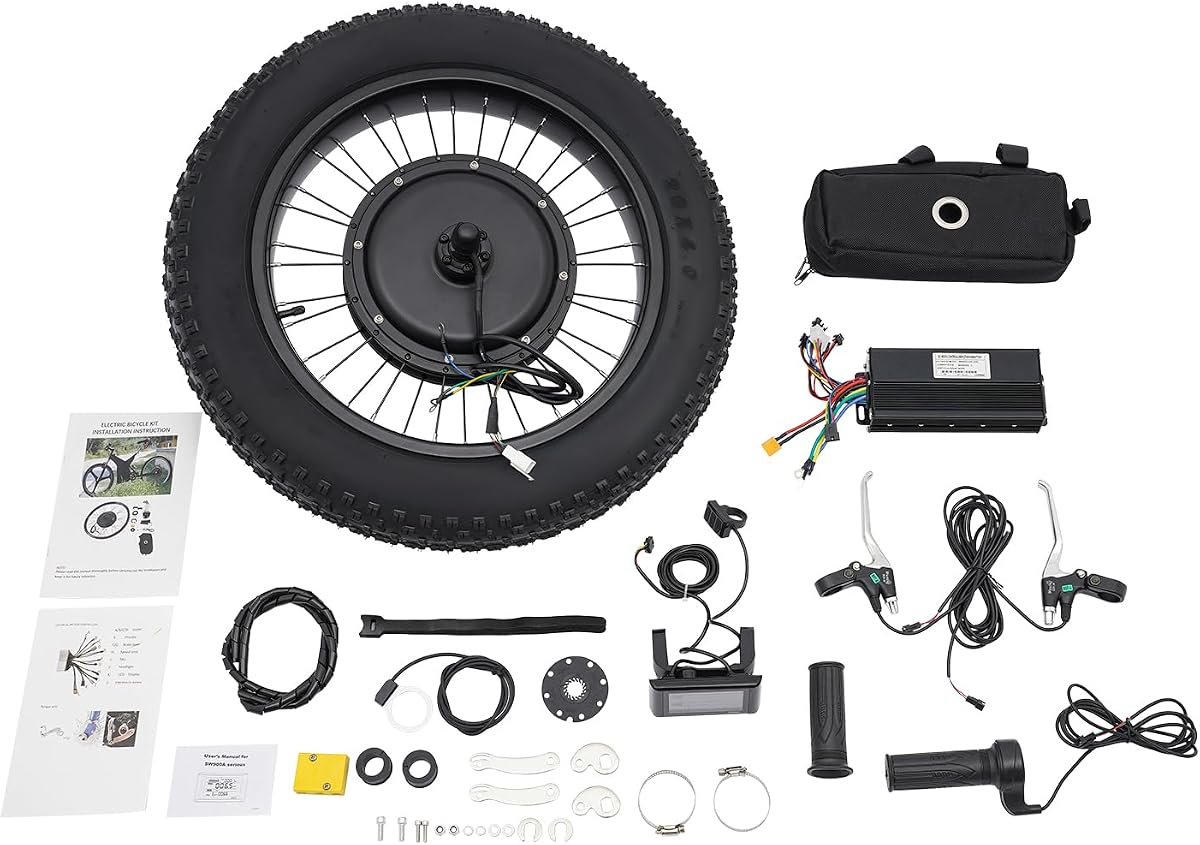
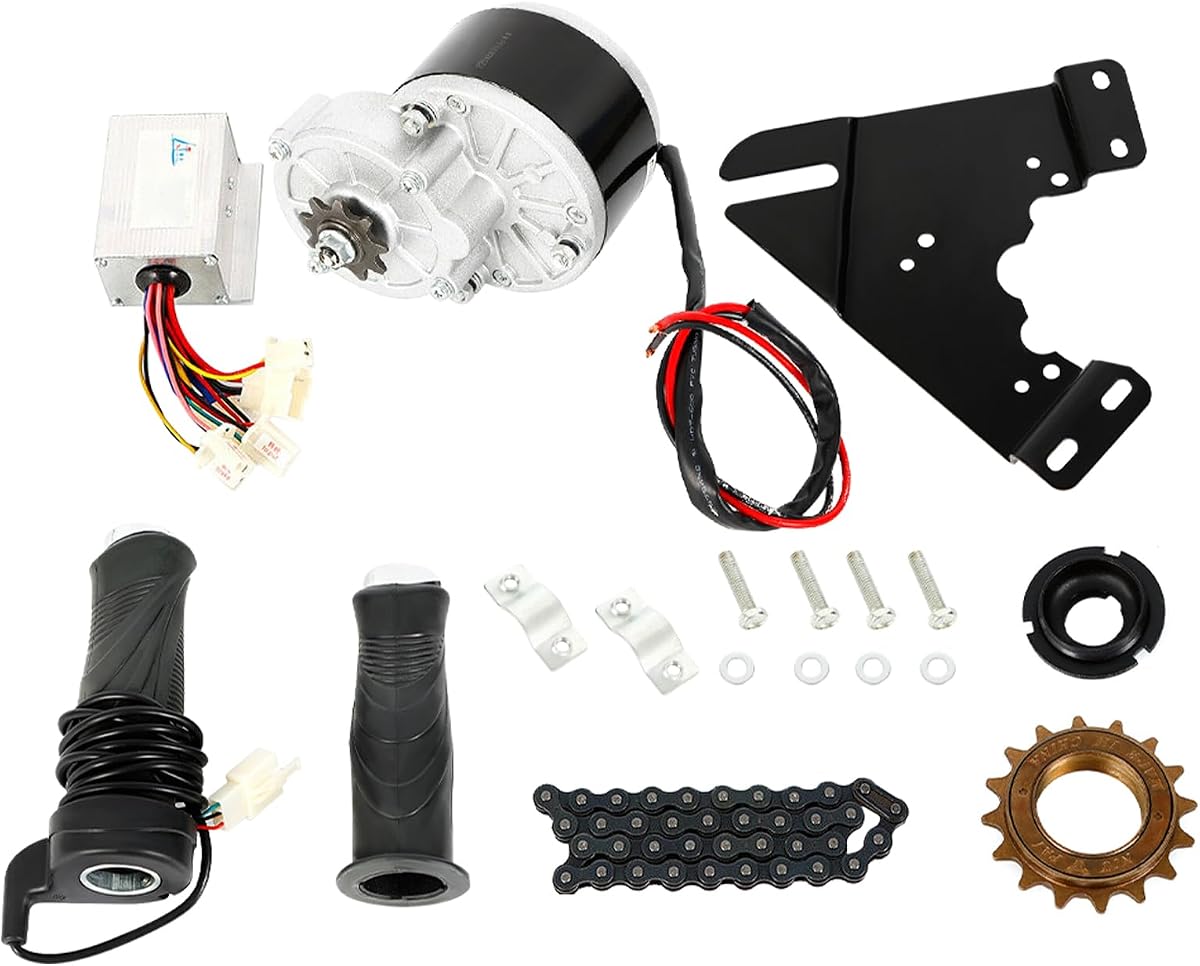


This 26-inch rear-hub conversion kit combines a 48V 1000W brushless gearless motor with pedal-assist sensing and a thumb throttle, giving conventional bicycles the core operating features of an e-bike. Its 4.8 rating reflects a strong balance of useful specifications, included accessories, and straightforward DIY positioning.
We may earn a commission when you buy through this link, at no additional cost to you.
The motor produces 45N.m of torque and is advertised for speeds of up to 33MPH, while its efficiency exceeds 80 percent. A reinforced wheel with 36 spokes distributes loads more evenly, and the stated maximum load of 265 pounds makes it a practical choice for many adult riders. The power-off brake levers interrupt motor assistance when braking, while the throttle's built-in LED improves nighttime visibility.
The principal compromise is that it is designed specifically for common 26-inch bicycles with 135mm rear dropout spacing, so it will not suit smaller folding-bike wheels, 700C bikes, or wider rear frames without modification. The battery is also excluded, and buyers must select one that matches the 48V electrical system. A high motor rating does not guarantee that every rider can reach the advertised maximum speed, since speed also depends on the battery, controller settings, terrain, and load.
This is the strongest general-value option for someone with a compatible 26-inch road, commuter, or mountain bicycle who wants meaningful power without moving to a mid-drive system. It includes the motor wheel, thumb throttle, pedal-assist sensor, brake levers, controller bag, and mounting hardware, making it a practical choice for a first conversion.
The 1000W brushless gearless motor provides ample power for commuting and climbing, while the combination of pedal assist and thumb throttle lets riders choose between active pedaling and powered cruising. The absence of brushes also reduces routine motor maintenance compared with brushed designs.
Power-off brake levers are valuable in an electric retrofit because they remove motor power during braking. The integrated LED in the thumb throttle adds another layer of visibility, although riders should still use proper bicycle lights and reflective equipment.
We may earn a commission when you buy through this link, at no additional cost to you.
The BAFANG 48V 500W front-hub kit combines a 65N.m motor with broad wheel compatibility, multiple display choices, and unusually accessible installation support. Its 5.0 rating makes it an especially compelling option for riders who want a well-rounded front-wheel retrofit without moving to a more complex mid-drive conversion.
We may earn a commission when you buy through this link, at no additional cost to you.
The motor is designed for 20-inch, 26-inch, and 700C bicycles with 100mm front dropouts and a 10mm fork aperture. That gives it meaningful flexibility across compact, standard, and larger bicycle formats. Riders can select from several display models, including the VD04, VD18MT, DZ40, EKD01, and SWM58, allowing the final setup to reflect their preferred data presentation and features.
Battery planning is the most important limitation. The kit is offered without a battery, and the motor uses a male XT60 connector, so a rider must prepare a compatible 48V battery or verify connector and electrical compatibility before ordering. The listed 52V battery options should also be checked against the complete system configuration. Fork clearance, dropout dimensions, and brake compatibility remain essential even when the nominal wheel size appears to match.
This kit is best for commuters, touring riders, and general DIY builders who want a recognized motor platform, clear instructions, video tutorials, and phone support. It is also a good fit for riders who prefer front-wheel traction and easier wheel swaps over the lower weight and centralized balance of a mid-drive system.
Several display choices allow the cockpit to be tailored after installation. Battery selection is not as flexible without verification, so riders should confirm voltage, capacity, connector type, physical dimensions, and the current configuration of the listing before ordering.
Detailed manuals, video tutorials, and phone-based technical support reduce the learning curve for first-time installers. Even so, the included materials cannot replace a careful inspection of the fork, brake, and dropout measurements.
We may earn a commission when you buy through this link, at no additional cost to you.
The Ktaxon 48V 1000W kit targets 24-inch bicycles and is built around a brushless, gearless front-hub motor. Its 4.4 rating reflects a capable power system combined with useful diagnostics and multiple control modes, though its wheel-size focus is much narrower than the broad-fit BAFANG alternatives.
We may earn a commission when you buy through this link, at no additional cost to you.
The motor wheel uses an aluminum-alloy rim and high-carbon-steel spokes, with a stated load capacity of up to 220 pounds. The LCD display reports battery power, speed, mileage, riding mode, and error codes, helping riders identify problems and manage the ride. Throttle, preset, pedal-assist, and manual modes provide flexibility for different traffic, terrain, and fitness preferences.
Its brake handles use a power cut-off function so motor power can be disconnected when the controller detects the brake signal. That is an important safety feature, but riders must still confirm that the kit's brake components work correctly with the bicycle. The 24-inch dropout specification of 3 15/16 inches also rules out bikes outside that format, and the battery is explicitly excluded.
This conversion makes the most sense for a rider with a compatible 24-inch bike who prioritizes strong acceleration and a diagnostic LCD over wide wheel compatibility. The included instructions, video assistance, and core components make the project approachable for a mechanically confident DIY enthusiast.
Showing battery level, speed, mileage, mode, and error codes gives the LCD genuine diagnostic value. It can help riders recognize a depleted battery, an inactive assist level, or a wiring issue before the problem becomes harder to diagnose.
Four modes let the rider move between throttle-led cruising, preset assistance, cadence sensing, and unassisted pedaling. These options are particularly useful when the same bicycle is used for commuting, exercise, and relaxed neighborhood rides.
We may earn a commission when you buy through this link, at no additional cost to you.
This BAFANG rear-hub kit is available in 500W and 750W configurations and supports a notably wide collection of wheel sizes, from 20 inches through 29 inches and 700C formats. Its 3.8 rating suggests that performance and feature breadth are compelling, though some buyers may place more weight on customer feedback than the specifications alone.
We may earn a commission when you buy through this link, at no additional cost to you.
The brushless geared motor provides up to 65N.m of torque and is advertised for speeds as high as 40 km/h. Its IPX5 rating offers protection against small rain and road spray, and the listed operating noise below 55dB supports a relatively quiet ride. Pedal assist, walk assist, throttle, and pedal-only modes cover commuting, touring, and exercise preferences.
The kit is intended for rear dropouts between 135mm and 142mm on bicycles with a ten-speed cassette or less. It supports V-brake and disc-brake configurations, but the wheel, freewheel, cassette, brake, and controller must be matched correctly. The average rating may reflect the learning curve or variability involved in installing a complete rear-wheel system.
The battery remains excluded, and the motor uses an XT60 connector. Riders should verify the electrical system, connector, and listed battery choices in the current order configuration. This kit is best for someone who wants a rear-hub conversion across several possible bicycle sizes and values a broad range of display and riding-mode options.
Support for 20-inch, 26-inch, 27.5-inch, 700C, 28-inch, and 29-inch wheels makes this one of the most versatile rear-hub choices in the guide. The rider must still confirm the exact dropout, cassette, brake, and rim requirements for the selected size.
The IPX5 rating is useful for commuting in variable weather because it is designed to withstand small rain and road spray. It is not a guarantee of waterproof operation during immersion or severe exposure, so normal electrical precautions remain important.
We may earn a commission when you buy through this link, at no additional cost to you.
This 20-inch rear-hub conversion kit stands out for its advertised 1500W motor, seven-speed wheel, high load rating, and large 3.94-inch tire. Its 4.6 rating is among the strongest in the group, indicating a favorable combination of features for riders targeting a compact, high-output electric bicycle.
We may earn a commission when you buy through this link, at no additional cost to you.
The brushless gearless motor is claimed to exceed 82 percent efficiency and deliver strong climbing performance. A pedal-assist sensor supports pedaling while reducing fatigue, and the LCD displays speed, battery level, riding mode, and faults. The stated load capacity of approximately 330.69 pounds is the highest listed among these kits and may appeal to larger riders, subject to the condition of the frame and other components.
The product is designed for snow-oriented use and includes a widened rubber tire intended to improve grip. The power-off brake lever can cut motor assistance when braking. However, the information provided does not identify the included battery or provide a complete battery compatibility list, so riders should determine the required voltage, capacity, connector, and physical battery arrangement before installation.
This kit is best for a mechanically capable rider with a compatible 20-inch bicycle who wants a seven-speed wheel, high rated output, and a substantial stated load capacity. It is less suitable for riders who need a broadly adjustable system or who want the listing to spell out every battery detail.
A 1500W rating gives the motor considerable nominal power, while the 20-inch wheel package keeps the overall bicycle compact. Actual performance depends on the battery, controller configuration, terrain, rider weight, and whether the speed capability is appropriate for local conditions.
The listed load capacity makes this one of the more accommodating kits in the guide. Because the total load includes the bicycle, motor, battery, cargo, and rider, the frame, wheels, brakes, and tires must all be appropriate for the intended use.
We may earn a commission when you buy through this link, at no additional cost to you.
This 26-inch rear-wheel conversion kit offers a straightforward way to add a 48V 1000W brushless motor to a compatible bicycle. Its 3.8 rating places it below several alternatives, but the stated performance, three LED lights, and 45N.m torque remain relevant to riders seeking a high-output rear-hub system.
We may earn a commission when you buy through this link, at no additional cost to you.
The gearless motor is rated at 440 RPM and is advertised to reach 53 km/h with more than 80 percent efficiency. Aluminum, iron, copper, magnetic steel, aluminum alloy, and butyl rubber are used in the construction. Three LED lights support visibility, while the toothless brushless design operates with lower noise and avoids the need to replace internal motor brushes.
The stated load capacity is 120kg, or approximately 264.55 pounds, and the wheel is intended for most 26-inch bicycles. The listing does not identify a battery among the included components, which means voltage, capacity, connector, and physical placement must be resolved separately. A 3.8 rating may indicate some dissatisfaction with assembly, completeness, or performance consistency among a portion of buyers.
This kit is best for a DIY rider who already owns a compatible 26-inch bicycle and wants a simple rear-motor conversion with integrated visibility lights. Compared with the leading 26-inch option, its overlapping specifications are accompanied by a lower rating and fewer clearly documented safety controls, so buyers should review the latest customer feedback carefully.
The absence of gears and brushes creates a simple, low-noise motor configuration with no brush replacement requirement. Riders should still perform normal checks of wiring, connectors, wheel alignment, and fasteners after installation.
Three LED lights add visibility to the conversion without requiring the rider to source every lighting component immediately. They supplement rather than replace a properly positioned front light, rear light, and reflective safety equipment.
We may earn a commission when you buy through this link, at no additional cost to you.
The 24V 250W chain-drive conversion kit is a compact, do-it-yourself option designed to work with handlebars of 0.87 inches and wheels from 16 through 28 inches. Its 3.2 rating is the lowest in this guide, so prospective buyers should examine recent reviews and understand the limitations of a smaller brushed system before committing.
We may earn a commission when you buy through this link, at no additional cost to you.
The package includes a 24V 250W DC motor, chain, freewheel, freewheel adapter, motor controller, mounting plate, accelerator handle, and a left handle sleeve. A 4.92-foot controller cable and 16-tooth flywheel are specified, while a 38-section chain is intended to reduce the chance of chain separation. Under-voltage protection is included in the brushed controller.
Compared with the 48V hub kits, this system has much lower rated power and requires more attention to chain alignment, tension, lubrication, and drivetrain compatibility. It may suit a project involving a compact bicycle, scooter, skateboard, or other compatible DIY vehicle, but it does not provide the same climbing power, speed potential, or refined control integration as the higher-output kits.
The kit is best for a budget-conscious experimenter who values the wide dimensional range and straightforward chain-drive system over high power or sophisticated displays. Because the rating is comparatively weak, riders should confirm that the included controller, throttle, chain, and mounting system satisfy their specific build before installation.
The stated 16-to-28-inch wheel range is exceptionally broad for a chain-drive system. Actual compatibility still depends on the frame, motor bracket, drivetrain, handlebar diameter, and the geometry of the selected wheel.
A chain and freewheel can be easier for some DIY builders to understand than a complete hub-wheel swap. The tradeoff is routine upkeep, including checking chain tension, lubrication, alignment, and the condition of the freewheel.
We may earn a commission when you buy through this link, at no additional cost to you.
The BAFANG BBS02B and BBS-HD mid-drive conversion is the most mechanically sophisticated option in the guide, offering 500W, 750W, or 1000W configurations and torque ratings of 100, 120, or 160N.m. Its 4.1 rating is moderate, but that does not fully reflect the appeal of a premium mid-drive platform for experienced builders.
We may earn a commission when you buy through this link, at no additional cost to you.
Unlike a hub motor, the mid-drive unit works through the bicycle's chain and chainring, allowing it to multiply the rider's pedaling input. This arrangement preserves a conventional drivetrain and can feel natural on hills because torque is delivered through the crank. Throttle, pedal-assist, and standard-cycling modes are supported, and speeds are advertised up to 45 km/h depending on configuration.
The kit fits bottom-bracket shells measuring 68–73mm, 100mm, or 120mm with inner diameters of 33.5–36mm under JIS standards. It is limited to chain-driven bicycles with disc or V-brakes. Installation is more involved than swapping a hub wheel because the crank, chainring, bottom bracket, brake, controller, and wiring must all be coordinated. Displays and the battery are optional.
This is the best premium pick for a rider who prioritizes natural pedal response, climbing ability, and centralized motor mass. It suits mountain bikes, city bicycles, and recumbent trikes with compatible chain-driven drivetrains. Buyers should confirm bottom-bracket dimensions and be comfortable with the more involved mechanical conversion process.
A mid-drive uses the bicycle's gearing to manage motor output, which can provide a more familiar pedaling sensation than a direct-drive hub. It also shifts motor mass toward the center of the bicycle, which can improve balance.
Available CAN-bus displays include advanced touchscreen and color-screen options, some of which can modify motor parameters. Because the display is optional and protocol-specific, riders should choose the display and motor together rather than assuming every display works with every configuration.
We may earn a commission when you buy through this link, at no additional cost to you.
The BAFANG G020 is a 48V 500W front-hub conversion designed for 20-inch, 26-inch, 700C, 28-inch, and 29-inch bicycles. Its 4.2 rating reflects a proven and highly configurable package, while the IPX5 motor protection and broad fit make it especially appealing for commuting and touring.
We may earn a commission when you buy through this link, at no additional cost to you.
Maximum torque is listed at 65N.m, with a top speed of 25MPH, or approximately 38–40 km/h. The brushless geared motor is claimed to operate at 80 percent efficiency or better and below 55dB. It uses 36-hole, 12-gauge spokes on an MH-19 rim, with a 100±1mm dropout and 158.5mm motor outer diameter designed to clear many fork braces and brake calipers.
Riders can select throttle, pedal assist, walk assist, or no-motor mode, while the brake levers cut motor power. The IPX5 rating is intended to handle small rain and road spray, and the listed operating range is -20°C to 45°C. A battery is required, and the numerous display and battery options create a flexible but complicated ordering process that must be checked against the current listing.
This kit is best for riders who value a simple front-wheel swap, broad wheel compatibility, all-weather awareness, and a large selection of displays. It is less suitable for anyone unwilling to verify fork geometry, brake compatibility, axle clearance, electrical connections, and battery placement.
The IPX5 rating offers useful resistance to small rain and road spray during year-round commuting. Normal care still matters: connectors should remain dry, and exposed electrical parts should be protected during heavy downpours or prolonged washing.
A front-wheel conversion can preserve the rear drivetrain and simplify the initial conversion compared with replacing a more complex rear assembly. The fork must have adequate strength, clearance, and correct dropout dimensions for the motor.
We may earn a commission when you buy through this link, at no additional cost to you.
The L-faster 450W left-drive kit uses a chain and spoke sprocket to propel a bicycle, with a focus on common city bikes equipped with rear V-brakes. Its 3.8 rating reflects a system that may appeal to straightforward DIY builders but demands more attention to bicycle-specific fit and frame preparation.
We may earn a commission when you buy through this link, at no additional cost to you.
The product information specifically notes that it is not compatible with disc-brake or coaster-brake bicycles. The motor bracket may also require modification if it does not match the frame, making a photograph of the bicycle and an assessment of the mounting area important before ordering. The listing offers both twist and thumb throttles, but the rider must select the appropriate option.
The controller includes a fuse wire and three spare fuses, and the product guidance explains that switching the motor's red and black wires can reverse its direction. Correct wiring is essential because an incorrect connection or poorly secured connection can damage components or create a safety issue. The stated difference between 24V and 36V systems concerns working current, with 36V suggested for longer riding.
This kit is best for a city bike with a rear V-brake and a frame with a workable left-side mounting area. It is not a good match for modern disc-brake bicycles unless the seller confirms compatibility in advance. Riders should also be comfortable with frame modification, chain alignment, fuse checks, and basic motor wiring.
Clearly stating the brake limitation can prevent an expensive mismatch. This kit is intended for bicycles whose rear wheel uses V-brakes and does not fit disc-brake or coaster-brake setups without other changes.
Riders can choose between twist and thumb throttles to suit their controls. Reversing the motor's rotation by exchanging two wires is useful during setup, but power should be disconnected and the change should be verified with care.
We may earn a commission when you buy through this link, at no additional cost to you.
The right conversion kit depends less on headline wattage than on the bicycle, motor location, electrical system, control preferences, and the installer's mechanical experience. Use the following factors to compare the featured options and identify a kit that can be integrated safely and reliably.
Motor placement changes acceleration, weight distribution, traction, maintenance, and compatibility. Front-hub motors pull the wheel and often feel direct, while rear-hub motors push the bicycle and can feel natural to pedaling. A mid-drive works through the crank and chainring, offering strong climbing performance and a more conventional pedaling response, but it requires more involved installation. Chain-driven left-side kits can suit simple city-bike projects but are the least broadly compatible with modern bicycle designs.
Choose the motor location based on your bicycle and intended terrain, not merely on the advertised output. Front-hub systems are worth examining for wide wheel-size options, rear-hub systems for direct wheel swaps, and mid-drive systems for riders who want low motor mass, effective gearing, and high climbing torque.
Voltage determines the electrical system, while rated power and torque indicate the motor's potential output. The featured systems range from a 24V 250W chain motor to a 48V 1500W rear-hub motor, with most modern hub kits operating at 48V. Torque is especially important for climbing because it reflects the force available at the wheel under load. A 1000W label alone does not tell the whole story; battery capacity, controller behavior, rider weight, gearing, and terrain all influence real-world performance.
Match the motor to a compatible battery and controller rather than treating wattage as a standalone figure. Reviewers should look for meaningful torque, stated load limits, several assist levels, and realistic performance expectations. Higher output also increases the importance of sound brakes, secure wiring, and a frame and wheels capable of handling the resulting loads.
Compatibility begins with wheel size but quickly extends to axle spacing, dropout width, fork aperture, bottom-bracket dimensions, brake type, cassette or freewheel, and available frame space. A 26-inch rear kit may require 135mm spacing, the G020 uses a 100±1mm front dropout, and the BAFANG mid-drive accepts several JIS bottom-bracket shells. These figures should be measured rather than estimated. Riders should also consider rim width, spoke count, chainline, brake compatibility, and whether the battery can be mounted securely.
Create a checklist from the seller's specifications and compare it with the actual bicycle. Include the exact wheel diameter, rear dropout spacing, front fork dimensions, bottom-bracket length and diameter, brake type, axle format, and drivetrain. If the manufacturer provides a support contact, send photographs and measurements before buying because a seemingly minor frame difference can prevent installation.
Pedal assist uses a cadence sensor to add power while the rider pedals, preserving a more active and natural cycling experience. A thumb throttle offers immediate powered control and can be useful for starts, hills, and relaxed cruising. Some kits add walk assist or allow a no-motor riding mode, while others provide multiple assist presets. The best control arrangement depends on whether the priority is exercise, predictable commuting, simple operation, or access to full-throttle assistance.
Look for a brake cut-off lever that immediately removes motor power, along with clearly labeled riding modes. A thumb throttle with a built-in light can improve visibility, but it should not be mistaken for a complete lighting system. Riders should test the controls after installation and make sure they can switch modes without taking attention away from traffic.
A useful display provides more than a speed number. The best options show battery level, assist level, error codes, distance, and sometimes walking or speed information. The Ktaxon kit stands out for its diagnostic LCD, while the BAFANG offerings offer several display families with different screen sizes, languages, protocol support, and parameter-adjustment functions. More advanced displays can make troubleshooting easier but also add wiring complexity and cost to the build.
Choose a display that matches the motor controller and connector rather than selecting the largest screen. Confirm the available display options in the current listing, especially when the battery or display is offered separately. Riders who value simple operation may prefer a compact readout, while enthusiasts may appreciate programmable assistance, speed limits, and battery information.
Most of the listed kits require a battery that is not included. The matching battery must have the correct nominal voltage, sufficient capacity, suitable discharge capability, a compatible connector, and a secure mounting location. Several BAFANG systems specify a male XT60 connector and list supported 48V and 52V battery capacities. Other listings provide little battery detail, making independent verification especially important. A battery that is physically too large for the frame can also spoil an otherwise compatible conversion.
Plan the entire electrical system before ordering the motor. Check the connector type rather than relying on a generic XT60 description, because cable and connector arrangements can vary. Riders should also consider range, charging location, weight, weather protection, and whether the frame has a suitable downtube, rack, or other mounting position. Never connect a battery to a motor system without confirming the full voltage and connector specification.
An electric conversion changes the forces acting on a bicycle, so the quality of the brakes, wheel, fasteners, wiring, and frame matters. Kits with power-off brake levers offer a meaningful safety advantage, and the G020's IPX5 rating is notable for resistance to small rain and road spray. Load ratings provide another useful limit, although they do not override the structural limits of the original frame or components. Wide tires, reliable spokes, and a properly secured controller bag can improve stability and protect electronics.
Inspect the bicycle before conversion and address worn brakes, loose bearings, cracks, and frame damage. After installation, check wheel alignment, spoke tension, chain engagement, cable routing, controller security, brake operation, and all electrical connections. Riders should follow local laws regarding power, speed, and class designation, and use appropriate protective equipment on every ride.
Before installation, photograph the original bicycle, record its wheel and frame measurements, and compare every dimension with the kit specifications. Disconnect the battery during the mechanical work, remove the wheel or bottom bracket as appropriate, and follow the included instructions without improvising electrical connections. If a dimension is uncertain, contact the seller or a qualified bicycle technician before proceeding.
Begin with low-power operation in a safe area. Check that the pedal-assist sensor responds consistently, the throttle moves the bicycle only when intended, and the brake cut-off removes assistance immediately. Test each riding mode, inspect the display for faults, and confirm wheel alignment, chain tension, spoke security, brake operation, and controller retention before taking the bicycle onto a public road.
For routine care, keep connectors dry, clean the chain and drivetrain, and check wheel fasteners and spokes regularly. Inspect brake pads, cable routing, tire condition, and battery mounting, and remove the battery for long-term storage. Do not wash a motor or controller with a high-pressure hose, and investigate unusual noise, heat, vibration, or error codes before continuing to ride.
Most of the kits in this guide do not include a battery, so buyers must plan for a separate purchase. The battery should match the system voltage, provide adequate capacity, use a compatible connector, and fit securely on the frame or rack. Always verify the current listing because included components can change, and never assume a battery with a similar-looking connector is electrically compatible.
Measure the wheel diameter, axle and dropout spacing, fork width, bottom-bracket dimensions, and brake type, then compare them with the kit specification. You should also check the cassette or freewheel, wheel clearance, chainline, and available battery-mounting space. Clear photographs of the bicycle can help the seller confirm fit before an order is placed.
A mid-drive generally feels more natural because it works through the chainring and bicycle gears, making it especially effective on hills. A hub motor is simpler to install and often less mechanically invasive, but it can feel less natural during pedaling and may require a freewheel or cassette setup. The best choice depends on frame compatibility, terrain, budget, and installation confidence rather than power alone.
Pedal assist adds motor power when it detects pedaling, allowing the rider to remain actively involved in the ride. Throttle control provides power through a twist or thumb control without requiring pedal input. Many kits offer both, along with walk assist and pedal-only modes, giving riders flexibility for commuting, climbing, exercise, and relaxed cruising.
A front- or rear-hub conversion can be manageable for a careful DIY rider because the main mechanical task is replacing a wheel and connecting the controller. Mid-drive and chain-driven kits demand more knowledge of drivetrains, brackets, chain alignment, and wiring. If you are unsure, have a bicycle mechanic inspect the completed conversion, especially the brakes, wheel security, and electrical connections.
It depends on the original bicycle and kit. Motor power and added weight increase stopping demands, so worn or weak brakes should be upgraded or serviced even if the kit is compatible with the existing type. A power-off brake lever is also important because it cuts motor assistance when the rider brakes. Do not assume a kit fitting the brake style means the original brakes are adequate.
Some kits offer meaningful weather protection, such as the BAFANG G020's IPX5 motor rating, but no motor should be treated as immune to water. Keep connectors dry, protect the controller, and avoid high-pressure washing. Very cold conditions can temporarily reduce battery performance, and riders should follow the battery manufacturer's storage and operating limits.
Advertised speeds in this guide range from roughly 25MPH to 33MPH for some hub systems, while the 1500W kit and mid-drive options list different maximum-speed claims. Actual speed depends on the battery, controller, motor, gearing, rider weight, terrain, and local regulations. Treat maximum-speed claims as configuration-dependent rather than guaranteed real-world performance.
The BAFANG 48V 500W front-hub kit is the most balanced choice for many riders because it combines a 5.0 rating, broad wheel compatibility, useful torque, multiple displays, and strong installation support. The 26-inch 1000W rear-hub kit stands out as the best budget-focused option, while the BAFANG BBS02B mid-drive is the premium pick for experienced builders who want centralized power and strong climbing performance.
Before choosing, prioritize exact fit over wattage. Measure the bicycle, verify the brake and drivetrain, confirm connector type, and plan where the battery will live. Riders new to e-bike conversions should favor a kit with clear instructions, accessible support, and straightforward wheel-swap construction, while experienced mechanics may prefer the more capable mid-drive system.
Prices, ratings, included components, and configuration options can change, so check the current listing before buying. Compare the latest customer feedback, seller support, battery requirements, and local riding regulations. With careful compatibility checks and correct installation, an electric conversion kit can give a well-chosen bicycle a new and genuinely useful second life.