
WD-40 Specialist Contact Cleaner Spray, 11 oz.
4.8Editor score
Quick-drying and residue-free
Safe on most plastics
Targets oil, dirt, and flux
Discover the best electronic contact cleaners by comparing residue, drying speed, precision, material compatibility, can size, and intended electrical
Electronic contact cleaners remove dust, flux residue, oil, grease, and condensation from electrical connectors and components. A useful formula dries quickly, leaves no residue, reaches confined areas, and remains compatible with the plastics, metals, and rubber used in sensitive equipment.
The products in this guide were compared using their stated ingredients or features, drying behavior, residue claims, application scope, container format, and suitability for common electronics tasks. The list includes single cans, multipack options, and one higher-capacity format without assuming that one type fits every repair.
Each review explains where the cleaner stands out, which surfaces and devices it suits, and where careful application may still be necessary. Product availability and prices can change, so compare the current listing, can size, and instructions before purchasing for a particular project.
4.8Editor score

4.8Editor score

4.7Editor score
This side-by-side comparison evaluates all ten options by cleaning purpose, residue behavior, drying speed, material compatibility, and container format, helping you identify the most practical formula for routine maintenance, electronics repair, or precision contact cleaning.




CRC 05103 QD Electronic Cleaner is the strongest all-around choice in this guide, combining a 4.8 rating with a formulation intended for sensitive electrical equipment. Its fast-evaporating, residue-free design targets the central requirements of contact cleaning: remove contaminants, leave the surface electrically usable, and avoid leaving a film that could interfere with future work.
We may earn a commission when you buy through this link, at no additional cost to you.
The product data specifically highlights petroleum distillate and alcohol, which contribute to quick drying. CRC describes the formula as plastic safe, making it a credible option for computer components, circuit breakers, sockets, relay switches, plugs, PVC, nylon, lighting, coin mechanisms, and other contacts. That unusually broad application list is useful for technicians who do not want to keep a separate cleaner for every material.
Aerosol format does require responsible use. Direct spraying can oversaturate small assemblies, while aiming too much liquid at a powered device can create avoidable risk. The residue-free and fast-drying claims make this a sensible general-purpose choice, but they do not remove the need to disconnect power, test hidden surfaces, and follow the can's complete instructions.
This cleaner is best for computer maintenance, connector cleaning, flux residue removal, relay work, and general electronics servicing. Choose it when you want one established formula that combines broad material compatibility with fast evaporation. It is the most balanced option for most readers who need a dependable general-purpose electronic contact cleaner.
A quick-drying formula is especially useful when reassembling equipment shortly after cleaning. The stated residue-free performance also reduces concern about a lingering film on contacts, switches, sockets, or plastic components.
The listed uses range from circuit boards and relay switches to lighting, plugs, and coin mechanisms. That versatility makes CRC 05103 practical for electronics benches, computer repair, and general household electrical maintenance.
We may earn a commission when you buy through this link, at no additional cost to you.
WD-40 Specialist Contact Cleaner combines a 4.8 rating with a straightforward 11-ounce aerosol format, making it an efficient choice for routine cleaning. Its formula is designed to remove oil, dirt, flux residue, and condensation from sensitive electrical equipment, covering the common contaminants most likely to interfere with a contact.
We may earn a commission when you buy through this link, at no additional cost to you.
The listed qualities align well with electronics work. It dries quickly, leaves no residue, and is stated to be safe on metal, most plastics, and rubbers. The manufacturer identifies printed circuit boards, controls, switches, precision instruments, and electric panels as suitable applications, giving it a useful combination of general and precision applications.
The manufacturer's own cautions deserve attention. Test on plastic before use, and avoid adhesives, device screens, and keyboards. A spray cleaner can also wet nearby components if the can is tilted or held too close, so controlled application remains important even when the formula itself is residue-free.
This product is a strong pick for owners who want an approachable contact cleaner for occasional maintenance. It suits cleaning switches, controls, instruments, and electronic panels, particularly when the goal is to remove common contamination without committing to a more specialized treatment. It is our best budget selection for general users.
Oil, dirt, flux residue, and condensation represent different cleaning challenges, but all are explicitly targeted by this formula. That makes it more versatile than a cleaner intended for only one residue or application.
Residue-free, quick-drying performance is helpful for contact work because the cleaner can evaporate without leaving a visible film. It also allows work to progress without waiting for a slower evaporating treatment to clear.
We may earn a commission when you buy through this link, at no additional cost to you.
CAIG DeoxIT Contact Cleaner earns a 4.7 rating and stands out as the most focused premium choice. Unlike listings that emphasize broad compatibility across many household materials, this product is identified specifically as a contact cleaner in a five-percent spray format, giving it a clear identity for maintenance tasks centered on electrical interfaces.
We may earn a commission when you buy through this link, at no additional cost to you.
The compact five-ounce aerosol is easy to place on a repair bench, in a technician's toolkit, or in a maintenance cabinet. That smaller size can be advantageous for users who want a specialized product without taking up the storage space of a larger general-purpose aerosol. The 5% designation also gives buyers a defined formulation characteristic to compare.
The supplied product information is concise, so it would be inappropriate to infer specific ingredients, drying times, or compatibility claims that are not stated. Prospective buyers should examine the current label for detailed directions and approved surfaces, particularly if they intend to use it on a specialized connector, a delicate display assembly, or an energized device.
This is the premium recommendation for someone who specifically wants a contact-focused treatment rather than a broad all-purpose cleaner. It is particularly relevant to technicians and serious hobbyists who value a dedicated product name and a compact can. It ranks third because the available information gives less detail about surface compatibility than the two leading formulas.
The product is presented as a dedicated contact cleaner, which makes it easy to distinguish from general lubricants and multipurpose maintenance sprays. That focus is useful for users who want a product selected specifically for contact maintenance.
At five ounces, the can is smaller than most aerosol options in the comparison. The more compact container can be easier to organize and may be convenient for a mobile toolkit or frequently used workbench.
We may earn a commission when you buy through this link, at no additional cost to you.
BW-100 Electronic Contact Cleaner has a 4.6 rating and distinguishes itself with a non-flammable, quick-evaporating formula that leaves no residue. Its listed applications include computers, printed circuit boards, and game controllers, making it particularly relevant to precision electronics maintenance where confined contacts can collect dust and dirt.
We may earn a commission when you buy through this link, at no additional cost to you.
The attached extension straw is one of its most useful practical features. It helps direct the spray toward hard-to-reach areas, potentially reducing overspray on nearby components. The product is stated to be safe on rubber, metal, and most plastics, although the manufacturer recommends a compatibility test on a small area first.
The 8-ounce capacity is smaller than the common 11-ounce and 12-ounce aerosol sizes, but the container remains large enough for routine bench work. Users should still avoid spraying on keyboards, screens, and adhesives, and they should disconnect equipment before applying cleaner to electrical contacts.
BW-100 is a compelling choice for computer builders, console repair technicians, and electronics hobbyists who value pinpoint delivery. It is particularly attractive when non-flammability is an important handling consideration. The rating and focused electronics positioning make it a strong fourth-place selection, although a larger can might be preferable for intensive workshop use.
The included extension straw supports more controlled application inside equipment. It can be especially useful for board contacts, recessed connectors, and other areas where a standard spray direction is difficult to maintain.
The stated zero-residue and quick-evaporation properties make the product appealing for routine maintenance. Fast clearance can support timely reassembly, provided the sprayed area is allowed to dry fully.
We may earn a commission when you buy through this link, at no additional cost to you.
WD-40 Specialist Contact Cleaner with Smart Straw in a twin pack has a 4.7 rating and offers a practical combination of cleaning performance, delivery control, and two-can convenience. Its formula removes oil, dirt, flux residue, and condensation while drying quickly and leaving no residue.
We may earn a commission when you buy through this link, at no additional cost to you.
The Smart Straw is important for precision work because it allows the user to direct cleaner into a more exact location. Suitable applications include printed circuit boards, controls, switches, precision instruments, and electric panels. The formula is also stated to be safe on most plastics, rubbers, and metals, widening the range of components it can address.
The pack contains two 11-ounce cans, which may be useful for separating maintenance and repair tasks, keeping one can in a different workspace, or having a spare available. The trade-off is increased storage demand, and the package is less convenient for a user who needs only one can or has limited bench space.
As with the single-can WD-40 option, test plastic surfaces first and avoid adhesives, screens, and keyboards. This twin pack is best for frequent users, mobile technicians, or maintenance setups that benefit from having two units. It ranks fifth because it offers the same core formula as the second-ranked product but does not provide as much versatility across different cleaner formats.
The Smart Straw helps users target contacts and recessed components with less incidental spray. This is valuable on crowded boards where a broad mist could reach parts that were not meant to be cleaned.
Two individually available cans make the package more convenient for regular users than a single-can arrangement. It can support separate work areas or provide a reserve for future cleaning tasks.
We may earn a commission when you buy through this link, at no additional cost to you.
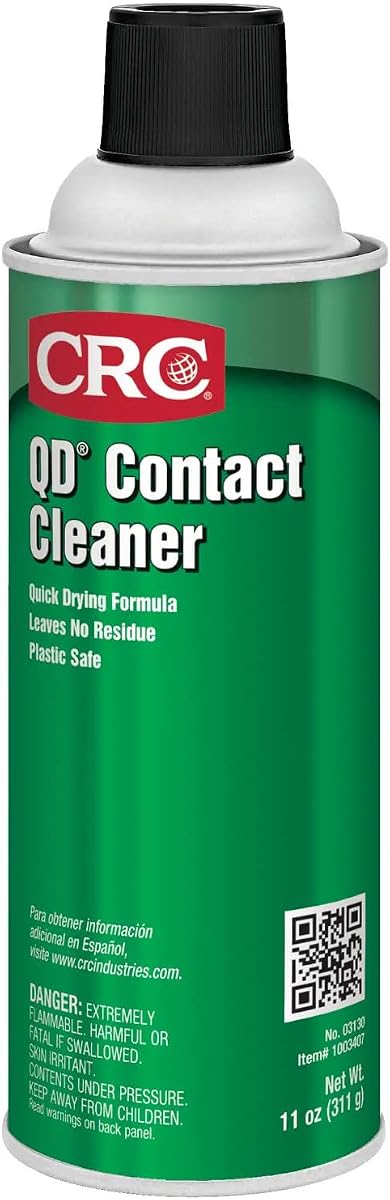
CRC QD Contact Cleaner has a 4.8 rating and distinguishes itself through a strong combination of quick drying, residue-free performance, and stated safety for all plastics. It is formulated to eliminate dust, light oil, grease, and dirt from sensitive electronic equipment, addressing several common causes of poor contact.
We may earn a commission when you buy through this link, at no additional cost to you.
The application list includes telephones, personal computers, relays, edge connectors, tape heads, busbars, circuits, contacts, printed circuit boards, switches, and breakers. This makes it a logical general-purpose option for repair benches and equipment maintenance. Its NSF K2 registration also gives purchasing departments and facility managers a documented status to consider when relevant.
One qualification appears in the product information: use it where lower-flashpoint cleaners are acceptable. That instruction should be considered in professional workplaces with specific safety or environmental requirements. Users should also prevent liquid from entering powered equipment and confirm compatibility before applying it to a critical or unusual assembly.
CRC QD is an excellent choice for technicians who need one product across many types of contacts and plastics. It is especially compelling for mixed electronics work where dust, grease, light oil, and residue may all be encountered. The rating and broad material claims place it near the top, while the flashpoint qualification prevents it from taking the leading position.
The explicit claim of safety for all plastics distinguishes this product from options whose listings call for testing on sensitive plastics. That broader claim is useful for mixed-component devices and household electronics.
From edge connectors and busbars to switches, relays, and tape heads, the listed uses show that the cleaner is not limited to conventional computer connectors. It is designed for varied electrical contact surfaces.
We may earn a commission when you buy through this link, at no additional cost to you.
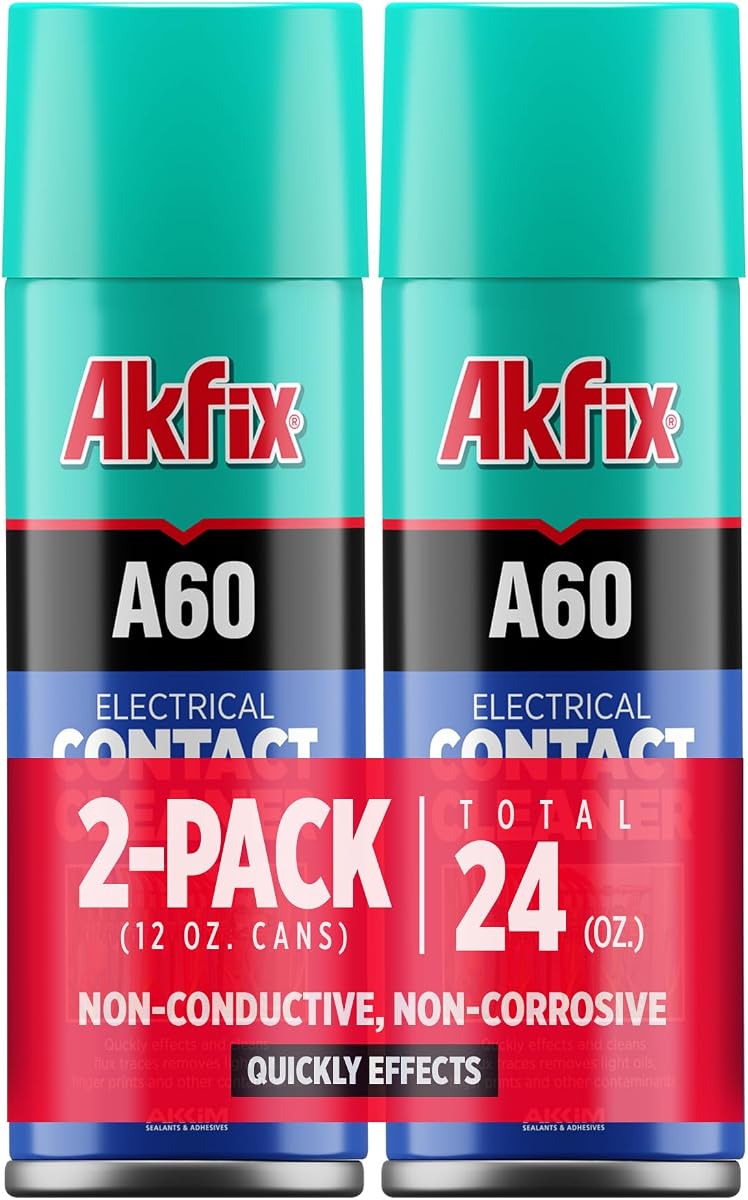
Akfix A60 Electrical Contact Cleaner has a 4.6 rating and offers a 4.6-rated result alongside a distinctive emphasis on fast, residue-free evaporation. Its stated purpose is cleaning delicate electrical components without relying on ordinary cleaners that may be inappropriate for sensitive electronic equipment.
We may earn a commission when you buy through this link, at no additional cost to you.
The formula targets dirt, light oil, grease, flux, and dust. It is also described as non-corrosive and is recommended for computers, batteries, keyboards, digital equipment, metal connectors, and contacts. These applications make the two-can pack attractive for repair technicians who regularly handle several kinds of equipment.
The manufacturer advises testing on sensitive plastics, adhesive-mounted parts, and stressed components. Those cautions are important because even a residue-free cleaner can create problems if liquid pools under an adhesive, penetrates a housing, or reaches a component under mechanical stress. The product should be used with equipment de-energized and only where the manufacturer permits it.
Akfix A60 is a good choice for users who want two 12-ounce cans and a broad contaminant-removal formula. It is particularly relevant for computer and digital-equipment maintenance, where dust, flux, and light oils may coexist. It places seventh because the available information gives fewer details about drying time and material compatibility than the leading CRC and WD-40 listings.
The formula is designed to evaporate swiftly without residue, which is useful when a cleaned connector must be reassembled soon. It also reduces the likelihood of visible liquid or cleaner film collecting around small components.
A stated non-corrosive formula is reassuring for electrical maintenance because connectors may contain several metals and finishes. The non-corrosive claim supports use for metal contact parts when the full label instructions are followed.
We may earn a commission when you buy through this link, at no additional cost to you.
CRC 05103 Case 5103 carries a 4.8 rating and is the clear bulk-supply option in this comparison. The package contains twelve 11-ounce cans of the quick-dry electronic cleaner, making it best suited to service departments, maintenance teams, training facilities, or technicians who consume contact cleaner regularly.
We may earn a commission when you buy through this link, at no additional cost to you.
Because every unit uses the same CRC 05103 format, a large shop can standardize its cleaning supplies and avoid repeatedly replenishing a single can. The quick-drying concept is useful for repeated maintenance because equipment can be cleaned and reassembled with less waiting for a slow-evaporating liquid to clear.
The primary drawback is practicality for occasional users. Twelve aerosol cans take up considerably more space than a single can, and a household project may never consume that quantity. The listing also supplies less detail about the formulation and applications than the individual CRC 05103 entry, so buyers should understand that this is a case of the 5103 cleaner.
This package is most appropriate for organizations with a steady requirement for electronic contact cleaning. It is less compelling for a home hobbyist or occasional computer repairer who simply wants one convenient aerosol. Its 4.8 rating and bulk consistency keep it competitive, while the format prevents it from being a universal recommendation.
A twelve-can case gives service teams a dependable reserve of the same cleaner. Standardizing on one product can simplify training, storage, and replenishment for frequent users.
The quantity makes most sense when contact cleaning is a recurring part of the job. Occasional users should weigh the convenience of the case against the storage and purchasing commitment of twelve separate aerosol cans.
We may earn a commission when you buy through this link, at no additional cost to you.
CRC QD Electronic Cleaner 05101 has a 4.7 rating and brings the same fast-evaporating, residue-free approach as the larger CRC format into a compact 4.5-ounce can. The product is specifically positioned as a plastic-safe cleaner for sensitive electronics, giving it a clear focus on components that could be affected by harsher chemicals.
We may earn a commission when you buy through this link, at no additional cost to you.
The formula is described as being made from petroleum distillate and alcohol. CRC lists computer components, circuit breakers, circuits, contacts, sockets, relay switches, plugs, plastics, nylon, PVC, coin mechanisms, lighting, and flux removal among its applications. The 4.5-ounce size is particularly convenient for a small work area or a frequently carried toolkit.
The smaller can is the central trade-off. Users performing continuous maintenance may need more refills than someone with an 11-ounce aerosol. As with any spray product, application should be controlled, and powered equipment should be disconnected before contact cleaning begins.
CRC 05101 is a strong recommendation for electronics hobbyists and repairers who want the core benefits of a residue-free, quick-drying contact cleaner in a portable size. It is less suitable for high-volume shops seeking a bulk reserve. It rounds out the list as a convenient compact option backed by a strong rating.
The 4.5-ounce format takes up less room than larger aerosol cans and is easy to keep near a repair kit. That convenience makes it practical for occasional maintenance and compact workbenches.
The stated plastic-safe and residue-free qualities suit cleaning delicate contacts. The formula is also listed for flux removal and a wide range of common connector and component types.
We may earn a commission when you buy through this link, at no additional cost to you.
The 250ML Electronic Contact Cleaner has a 4.0 rating and offers the largest stated container size in the comparison. Its rapid-evaporation formula is designed to dry within seconds, while its PCB and connector focus distinguishes it from conventional household sprays and makes it relevant to electronics repair.
We may earn a commission when you buy through this link, at no additional cost to you.
The listing identifies computer motherboards, mobile phone repairs, industrial control boards, metal connectors, and contacts as suitable applications. It describes direct application to oily areas followed by repeated wiping and drying. That workflow may be attractive to users who prefer visible control over application rather than relying entirely on aerosol spraying.
The rating is lower than those of the other nine products, and the product information is less specific about ingredients, nozzle design, and material compatibility. Claims such as being non-damaging should be understood in the context of the stated applications and instructions, not as permission to apply the cleaner indiscriminately to every electronic material.
This cleaner is worth considering for direct PCB maintenance, especially where the user wants a larger, non-aerosol-format option and a straightforward apply-and-wipe process. It ranks tenth because its 4.0 rating and less detailed compatibility information place it behind the more strongly documented aerosol options. Responsible application and compatibility checks remain essential.
The stated ability to dry within seconds is useful for cleaning a motherboard or control board and moving forward promptly. Rapid evaporation also helps limit the buildup of liquid residue around connectors.
The recommended process of applying the cleaner to an oily area, wiping repeatedly, and allowing it to dry gives users direct control. It may be especially useful where overspray management is important.
We may earn a commission when you buy through this link, at no additional cost to you.
The right electronic contact cleaner depends on the contaminants involved, the materials in the device, the importance of residue-free drying, and how much precision your work requires. Use the following factors to narrow the field before checking the current product listing and label.
A contact cleaner should remove contamination without leaving a film that could interfere with conductivity or attract new dust. Products using petroleum distillate and alcohol, or formulas explicitly described as quick-drying and residue-free, are designed to evaporate cleanly after application. Quick drying also improves workflow because cleaned assemblies can be reassembled sooner, although the full label directions and drying time should still guide the process.
Prioritize a stated residue-free formula, especially around printed circuit boards, edge connectors, relay contacts, and precision instruments. Avoid assuming that every cleaner marketed for electronics has identical residue behavior.
Different cleaners are designed for different problems. Some listings specifically target dust, dirt, and light oil; others emphasize flux residue, grease, and condensation. A formula that removes several contaminant types gives you more flexibility when the condition of a connector is uncertain, but you should still identify the main contaminant before spraying.
For post-soldering work, flux removal is an important listed use. For intermittent switches or control panels, look for a product that addresses oil and dirt. For exposed or moisture-affected equipment, choose one that explicitly covers condensation and deposits.
Electrical contacts frequently sit inside housings, connectors, seals, and cable jackets made from plastics or rubber. A cleaner labeled plastic safe gives greater confidence around these components, while products that recommend a small compatibility test should be used with particular care on stressed, tinted, coated, or adhesive-mounted parts.
Some listings claim safety for all plastics, while others specify most plastics and instruct users to test first. Also check for exclusions involving screens, keyboards, adhesives, and labels. The device manufacturer may provide even more restrictive instructions.
Recessed contacts, crowded circuit boards, and narrow connector housings benefit from controlled delivery. Aerosols with an extension straw or Smart Straw can direct cleaner more precisely, while a direct application and wipe method gives the user visual control over where the fluid goes. Whichever method you choose, avoid soaking components and prevent liquid from entering openings that are not part of the intended cleaning area.
Match the delivery format to the job. A straw is useful for targeted work, while a broad spray is convenient when cleaning several exposed contacts. A non-aerosol format may be easier to control during mobile repair work.
A cleaner intended for computers and printed circuit boards may not automatically be suitable for displays, keyboards, cameras, audio equipment, automotive controls, or industrial panels. Look for explicit application examples and the product's stated material compatibility. The strongest options describe a range of contacts, switches, relays, sockets, connectors, circuit boards, and control equipment.
If a product makes broad claims, confirm them against the manufacturer information and your equipment's service manual. Some formulas are explicitly limited to situations where lower-flashpoint cleaners are acceptable, which can matter in professional facilities with established safety procedures.
Contact cleaner comes in compact aerosol cans, standard aerosol cans, multipacks, and bulk cases. A smaller can is convenient for a small workbench or toolkit, while larger cans and cases are better for frequent service work. Multipacks can also let you keep supplies in different workspaces, but they require more storage and may be unnecessary for occasional use.
Think about how often you clean contacts, how much storage space you have, and whether a portable format matters more than minimizing refills. A bulk case is generally more relevant to a service department than to a homeowner performing an occasional repair.
The applicator can influence both precision and convenience. An extension straw helps reach contacts in recessed areas without flooding the surrounding assembly. A standard aerosol nozzle may be faster for broad maintenance, while a direct-wipe container allows the user to control the quantity and observe the surface as it is cleaned.
Consider the geometry of the device. Large, exposed busbars and switch assemblies may be straightforward to clean, while tightly packed boards and miniature connectors benefit from a narrow directed spray. Always verify that the applicator can reach the intended surface without contacting prohibited parts.
Detailed listings can make it easier to understand intended uses, material warnings, and application methods. Established brands may also provide clearer documentation and recognizable product lines, which is helpful for professional users who need repeatable results. Specialized products such as CAIG DeoxIT are clearly positioned for contact maintenance, while CRC and WD-40 Specialist lines provide broader application descriptions in the supplied information.
Look for a product that clearly states what it cleans, what surfaces it may contact, and what surfaces to avoid. Good documentation does not replace caution, but it reduces ambiguity and makes a product more suitable for a professional maintenance workflow.
Before cleaning, disconnect the equipment from power, remove batteries when appropriate, and allow hot components to cool. Identify the contaminated contacts and consult both the cleaner instructions and the device service guide. Move nearby items away, ensure ventilation, and avoid pointing the applicator at screens, keyboards, adhesives, or materials specifically excluded by the label.
Apply the cleaner sparingly and directly to the contact or connector being serviced. For aerosol products, use a controlled burst with the can upright and use the supplied straw where applicable. For direct-wipe formulas, apply only to the dirty area and wipe with an appropriate lint-free material. Do not flood switches, housings, or circuit boards, and do not clean a device while it is energized.
Allow the product to evaporate fully before reassembly or testing the equipment. Inspect the connector for remaining residue, reconnect it carefully, and verify that the contact is seated properly. Store the can upright in a cool, dry location away from heat, sparks, open flames, and direct sunlight, and keep the applicator clean so it does not become blocked.
Many products in this guide are specifically listed for printed circuit boards, but compatibility still depends on the formula and the individual board. Disconnect power, apply the cleaner sparingly, keep liquid away from displays, speakers, keyboards, adhesives, and components that are not rated for cleaning, and allow the area to dry completely before testing.
CRC 05103, WD-40 Specialist, Akfix A60, and other listed products specifically mention flux removal. Use a cleaner whose instructions cover the type of flux and board assembly involved, since ordinary household cleaners may leave unwanted residue or may not be compatible with sensitive plastics.
The WD-40 Specialist and BW-100 listings specifically warn against spraying keyboards, and users should follow those instructions. Keyboard cleaning is better approached with a product explicitly approved for that purpose, with power disconnected and the keyboard opened only if doing so will not compromise its warranty or construction.
Electronic contact cleaner is formulated to remove contamination from electrical interfaces while evaporating quickly and, in the products reviewed, leaving little or no residue. A general lubricant may be too slow-drying, oily, or incompatible with electronics, making it a poor choice for switches, connectors, and printed circuit boards.
Yes, electronic equipment should be disconnected from power and any batteries should be removed when appropriate. Even a residue-free cleaner can be conductive while liquid is present, and spraying a running device may allow fluid to reach unintended internal areas.
A product labeled non-flammable, such as BW-100 in this comparison, may offer a different handling profile from conventional aerosol cleaners. It does not eliminate the need for ventilation or safe storage, and users should still follow the label directions and keep the container away from heat or damaged applicators.
Cleaning may help when a switch fails because of dust, light oil, grease, or residue, but it cannot repair worn contacts, broken springs, damaged traces, or burned components. Power down the device, clean the switch only if its manufacturer permits it, and diagnose the underlying fault if the problem persists.
There is no universal interval because usage, dust, humidity, and equipment conditions vary. Inspect connectors during routine maintenance and clean them when visible contamination, corrosion, or contact-related symptoms appear, following the device manufacturer's service schedule and cleaning instructions.
CRC 05103 QD Electronic Cleaner is the best overall choice because it combines a fast-evaporating, residue-free formula with broad plastic-safe applications across computer components, switches, sockets, relays, and other contacts. WD-40 Specialist Contact Cleaner is the best budget option for routine removal of oil, dirt, flux residue, and condensation, while CAIG DeoxIT provides the focused premium alternative for contact maintenance.
Your priorities should determine the remaining choice. BW-100 stands out for its non-flammable formula, zero-residue claim, and extension straw; CRC QD offers especially strong plastic compatibility and a broader range of listed applications; Akfix A60 targets flux, grease, dust, and light oil in a two-can pack; and the remaining options suit compact toolkits or high-volume workshop use.
Before buying, verify the current listing, can size, ingredient details, material restrictions, and complete label directions. Contact cleaner is not a substitute for diagnosing damaged components, and application should always be performed on disconnected equipment. Prices and availability can change, so check the current product page and compare the format against the number and type of cleaning tasks you expect to perform.