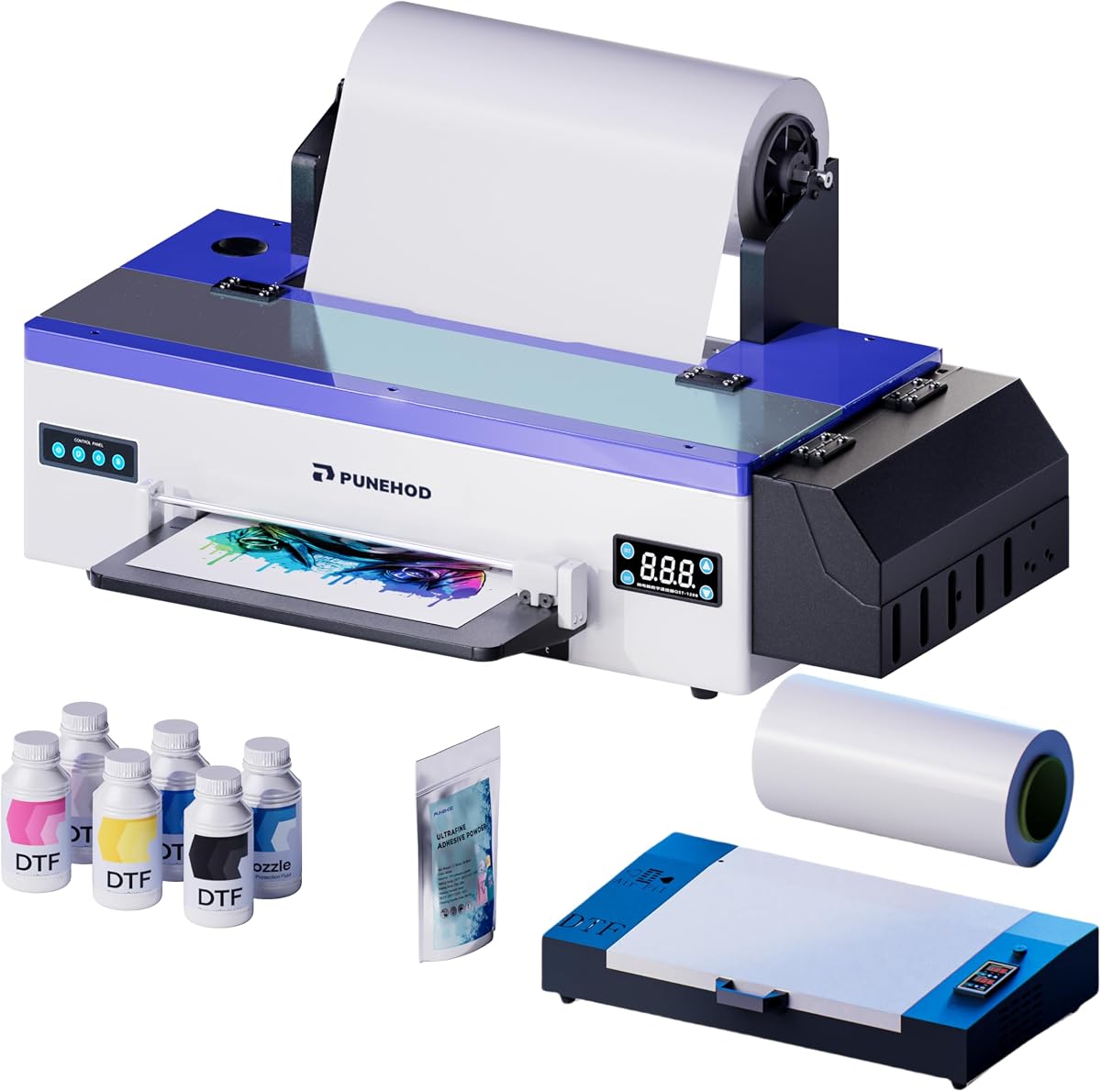
PUNEHOD A3 L1800 DTF
4.6Editor score
Automatic roll-film cutter
CMYK and dual-white system
A3 roll-feed workflow
Broad textile compatibility
A fabric printing printer gives creators a faster way to turn artwork into banners, garment transfers, home decor, labels, and personalized crafts. The right model depends on whether you want direct fabric printing, dye-sublimation projects, DTF apparel transfers, or a simpler inkjet-sheet workflow.
This guide compares ten relevant machines and supporting products using the supplied specifications, ratings, included features, media capabilities, and practical use cases. It covers dedicated fabric printers, sublimation systems, A3 and 14-inch DTF bundles, printable fabric sheets, and heat-transfer paper.
Each review explains who the option suits, which strengths matter most, and where trade-offs appear. Ratings are included when available, while unavailable ratings are represented as zero. Product availability, bundles, and prices can change, so confirm current details before buying.
4.6Editor score

4.9Editor score

4.5Editor score
As an Amazon Associate we earn from qualifying purchases.
The comparison spans direct fabric printers, compact sublimation models, business-oriented DTF bundles, roll-fed transfer systems, and two lower-cost media options for home printing.




The DXZ U14 DTF Bundle is the most capable all-in-one option in this guide for businesses that need broad garment coverage. It carries a 4.9 rating and stands out with a true 14-inch print width, an F1080 printhead, a stated resolution of 2880 by 1440 DPI, and printing speeds up to 500 millimeters per second. Those specifications position it as a production-oriented transfer system rather than a basic desktop craft machine.
We may earn a commission when you buy through this link, at no additional cost to you.
The headline advantage is coverage. At 35.56 centimeters wide, the printer can accommodate adult garments, hoodies, bags, and children’s clothing without the width limitation associated with many 13-inch A3 models. Its multi-fabric support extends to cotton, polyester, blends, and other textiles, while the automated print-to-bake workflow and included curing equipment reduce the number of separate components a new apparel business must assemble.
Maintenance receives unusually strong emphasis. Holiday Mode moisturizes the printhead, cleans nozzles, and circulates white ink during idle periods, while scheduled upkeep is designed to reduce downtime. The package also includes five 250-milliliter ink bottles and 500 grams of powder, with a stated two-year supply arrangement. These are meaningful advantages for operators who expect regular production rather than occasional craft projects.
The trade-offs are size, workflow complexity, and the need to maintain a larger system correctly. A 14-inch printer and its curing process require more space and sound setup discipline than a compact sublimation model or inkjet-sheet approach. Even so, the unmatched print width, high stated resolution, strong rating, multi-fabric support, and included supplies make the DXZ U14 the best overall choice for serious apparel production.
A genuine 14-inch printable area is the most consequential feature in this bundle. It enables broad transfers for larger garments and bags, helping reduce the need to split artwork across multiple prints.
Printhead moisturizing, scheduled cleaning, and white-ink circulation target the clogging and pigment-settling problems that can interrupt DTF production. The system is particularly relevant to operators who print in batches or allow equipment to sit between orders.
We may earn a commission when you buy through this link, at no additional cost to you.
The Brother SP1 is a compact dye-sublimation platform for makers who want to create shirts, mugs, tumblers, bags, hats, and other personalized items. Its 4.4 rating reflects a well-regarded option, and the Artspira integration makes it more approachable for users who do not want to begin with a professional RIP workflow. The product can store up to 20 printing images in the app.
We may earn a commission when you buy through this link, at no additional cost to you.
Sublimation produces particularly vivid results on polyester-coated items because heat and pressure turn the ink into a transfer that becomes part of the surface. Brother states that the resulting colors remain vibrant through repeated washing and wear. The SP1 therefore suits crafters who understand the material requirements and want more saturated results than they would typically expect from conventional heat-transfer paper.
The included software ecosystem is a major practical benefit. Artspira supplies more than 100 sublimation designs, stylistic image effects, and templates for popular personalized projects. Users can import images, save them, and move from digital composition to printing with less setup than a RIP-driven commercial printer often requires.
A heat press is an additional purchase, and sublimation is not interchangeable with every heat-transfer method. The image must be printed in reverse, and the receiving material must have a compatible coating. For crafters working primarily with polyester, the SP1 is a flexible and well-supported recommendation; those printing mainly on cotton should investigate DTF or heat-transfer paper instead.
Artspira removes much of the intimidation associated with preparing sublimation artwork. Its templates and editing features let users substitute text, images, and backgrounds before sending a design to the printer.
The heat-transfer process bonds dye to a polyester coating rather than forming a thick layer on top. With the correct substrate, press settings, and handling, this can create bright images designed for repeated use and laundering.
We may earn a commission when you buy through this link, at no additional cost to you.
Viewed specifically as a high-speed DTF machine, the DXZ F1080 stands apart from the 13-inch alternatives in the guide. Its F1080 single printhead is specified to deliver 2880 by 1440 DPI at speeds of up to 500 millimeters per second. Combined with the 4.9 rating, that makes it an attractive choice for custom apparel businesses prioritizing throughput.
We may earn a commission when you buy through this link, at no additional cost to you.
The printer handles cotton, polyester, blends, and other fabrics, giving operators a broad material palette for shirts, hoodies, bags, and promotional goods. DTF’s ability to work across light and dark substrates is a major advantage for small businesses that want one transfer method for many customer requests.
Automatic maintenance is central to the product’s practical proposition. Built-in moisturizing, scheduled cleaning, and circulation systems protect the printhead and support longer production runs. The manufacturer also states that technical engineers can assist with installation and printing issues within 24 hours, which is valuable for a specialized system with several operating stages.
This is not the simplest option for occasional personalization. It is designed for higher-volume work and carries the space, training, and upkeep requirements typical of commercial DTF equipment. For a serious apparel operation, however, its width, speed, resolution, multi-fabric capability, and support structure justify a strong position in the rankings.
The stated speed makes this bundle more compelling to high-volume operators than a basic hobby printer. Faster output can improve workflow efficiency when a business is consistently filling a queue of apparel orders.
DTF compatibility with cotton, polyester, and blends lets small businesses serve varied customer requests without switching to a different transfer method for every fabric.
We may earn a commission when you buy through this link, at no additional cost to you.
The InkSonic A3 R1390 is a 13-inch DTF bundle oriented toward beginners, home studios, and small apparel businesses. No customer rating is available in the supplied product data, so its evaluation must rest on its stated features. Those include resolution of up to 2880 DPI, a continuous ink supply system, adjustable air suction, white-ink circulation, filtering, and printhead moisturizing.
We may earn a commission when you buy through this link, at no additional cost to you.
A major strength is its support structure. InkSonic provides one-on-one technical guidance, phone assistance, installation videos, and detailed manuals, with a California-based service center supporting ongoing use. That guidance can be particularly valuable for buyers unfamiliar with film handling, ink management, powder curing, and transfer application.
The bundle also includes 3500 milliliters of DTF ink, transfer film, hot melt powder, and maintenance supplies. The matched consumables are intended to improve color consistency and simplify the early stages of ownership. Compatible materials include cotton, polyester, denim, canvas, leather, athletic mesh, and blends.
Its 13-inch width is narrower than the DXZ U14 and it lacks a stated automatic cutter, although that is not a deficiency for every workflow. Compared with a bare printer, the oven, consumables, RIP software, and support substantially simplify initial setup. It is a sensible bundle for a new operator, provided the available space and ongoing maintenance fit the business plan.
Installation videos, manuals, and ongoing technical assistance help bridge the learning curve between unpacking a DTF system and producing reliable transfers. This support may be more valuable than a headline specification for a first-time apparel printer.
The included ink, film, powder, oven, and maintenance supplies reduce the number of add-ons required before the first order. Matching the supplied consumables also simplifies initial troubleshooting.
We may earn a commission when you buy through this link, at no additional cost to you.
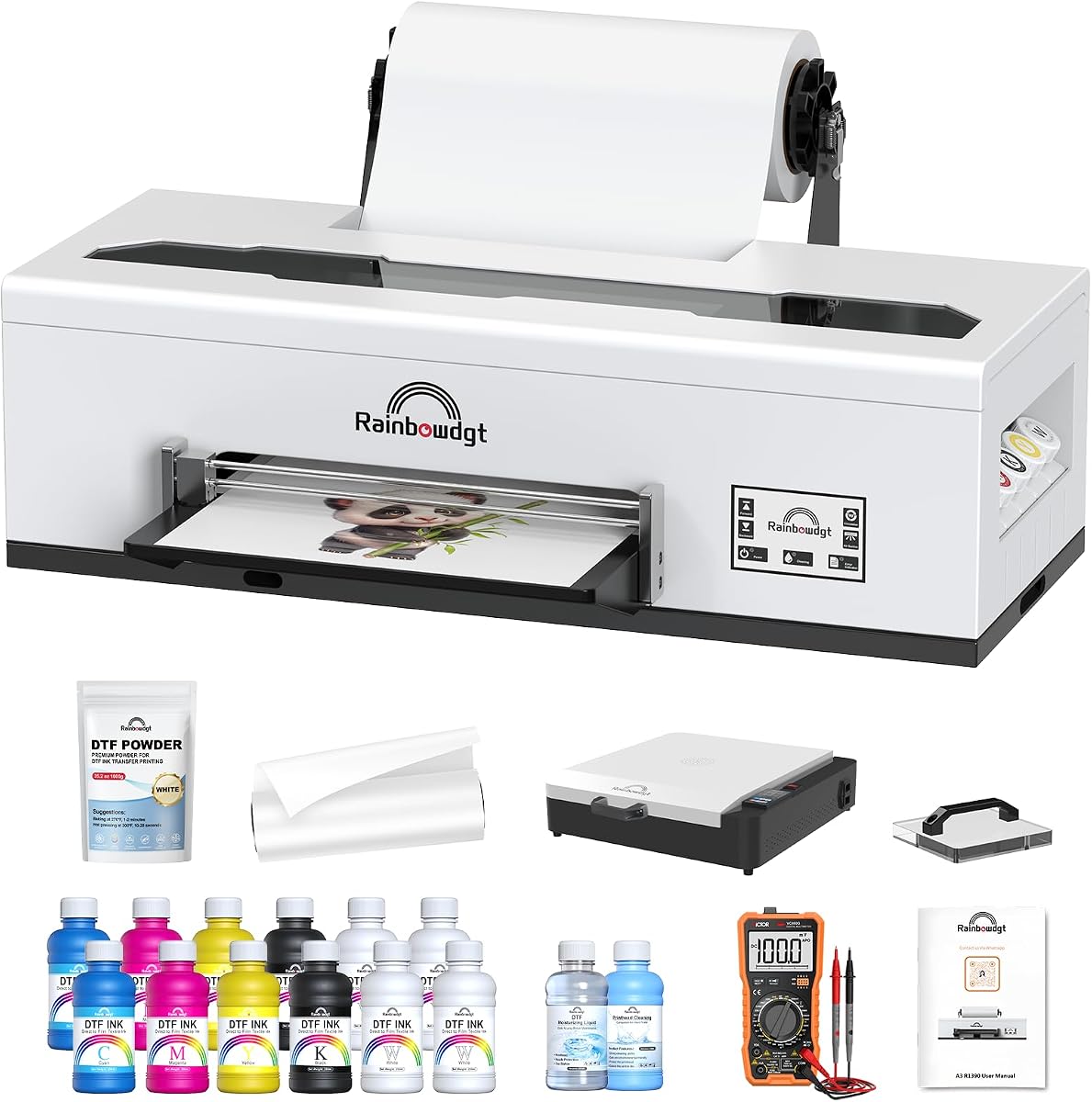
The RAINBOWDGT A3 R1390 is one of the most balanced bundles in the guide. Its 5.0 rating is the highest listed score, while a stated resolution of 2880 by 1440 DPI supports fine detail, gradients, and photographic artwork. The package combines the R1390 printer, curing oven, ink, film, powder, and other essential supplies.
We may earn a commission when you buy through this link, at no additional cost to you.
Its media handling is versatile. Support for A3 and A4 sheets gives creators familiar options, while roll-to-roll printing allows long runs of transfer film. An integrated vacuum adsorption system holds media flat, and the heating system cures ink before powder application to reduce smudging and protect image detail.
White-ink management receives detailed attention through agitation, circulation, filtration, a one-touch cleaning function, and a nozzle moisturizer. These features matter because white pigment is especially prone to settling, and maintaining it is a recurring responsibility of any DTF system that prints onto dark garments.
The package includes six 250-milliliter ink bottles under a stated two-year supply arrangement. Warranty terms include a six-month printhead replacement warranty, one year of parts coverage, and lifetime remote technical assistance. The main drawback is practical: the heavy bundle may arrive in multiple packages, and the complete setup requires room. For users who value a high-rated, fully supplied package, it is an excellent fit.
Vacuum adsorption helps keep the transfer film flat and reduces the chance of wrinkles or printhead contact. The integrated heater then prepares the ink layer for powder, supporting more consistent transfers.
Six included bottles and recurring replacement service support high-volume apparel work. Operators should still monitor white pigment carefully, but the system includes several mechanisms designed to preserve consistent flow.
We may earn a commission when you buy through this link, at no additional cost to you.
The Epson SureColor F170 is the most approachable dedicated sublimation printer in this roundup. It carries a 4.5 rating, includes a full set of Epson sublimation ink, and uses a PrecisionCore printhead with Precision Droplet Control. The result is a compact entry point for personalized mugs, shirts, coasters, and other coated items.
We may earn a commission when you buy through this link, at no additional cost to you.
Its 150-sheet auto-feed tray is unusually useful for a compact printer, reducing the need for frequent paper refills. The closed, dust-resistant paper tray also helps protect media between jobs. Connectivity is flexible: users can print from Windows or macOS systems through Epson software or send jobs from compatible Android and iOS devices using Epson iPrint.
The ink bottles use an auto-stop filling system intended to reduce spills and help users get more from each container. Epson’s dye-sublimation inks are designed for saturated color and strong contrast, while the printer’s stated image clarity supports detailed graphics and text.
A heat press and compatible sublimation blanks are still necessary, and the system is not suitable for direct printing onto ordinary fabric. However, among dedicated machines here, the F170 offers a relatively simple package with useful capacity and wireless flexibility. It is the best budget choice for a craftsperson who wants dedicated sublimation without moving into a larger DTF system.
The 150-sheet tray gives a small craft printer enough capacity for a sequence of transfer jobs. That can reduce interruptions when completing a batch of personalized products.
Windows and macOS support covers typical design workstations, while iPrint expands access to compatible mobile devices. USB remains available for a direct computer connection when preferred.
We may earn a commission when you buy through this link, at no additional cost to you.
The InkSonic Spark F13 is designed specifically for home studios, side businesses, and small apparel shops. Its 4.0 rating is solid, and the 13-inch L1800 printhead is specified for fine detail, smooth gradients, and accurate color reproduction. G7-certified color performance helps keep output close to the original artwork.
We may earn a commission when you buy through this link, at no additional cost to you.
A dense white underbase allows vivid colors to remain distinct on dark garments, an essential capability for personalized apparel. The system can produce full-color transfers for T-shirts, hoodies, tote bags, uniforms, gifts, and other orders without garment pretreatment, making the workflow more approachable than some application methods.
Ownership-cost features include 12-hour automatic cleaning, white-ink circulation and stirring, filtration, and a platen vacuum. The vacuum helps hold film flat and reduce printhead strikes, while eligible replacement parts are provided at no additional cost during the stated coverage period. Lifetime technical assistance and InkSonic RIP software support initial setup and ongoing work.
DTF still requires daily care, and the Spark F13 does not include the same extensive starter bundle highlighted by some competing systems. It is most compelling for a home operator who values understandable controls, strong white coverage, and lower-maintenance idle periods. It is a focused choice rather than the broadest package in the category.
The white underbase is designed to provide an opaque foundation for saturated color. This helps graphics remain legible on shirts and bags whose base color would otherwise obscure the design.
Automatic cleaning and white-ink movement help reduce clogs and settling when the machine is not printing continuously. These routines are particularly useful for intermittent home-studio schedules.
We may earn a commission when you buy through this link, at no additional cost to you.
The PUNEHOD A3 L1800 is a premium DTF package distinguished by its roll-fed film system, automatic cutter, and extensive bundle. Its 4.6 rating places it among the strongest reviewed options. The printer uses an L1800 printhead with a standard CMYK plus double-white configuration to support clear, full-color transfer artwork.
We may earn a commission when you buy through this link, at no additional cost to you.
The built-in automatic cutter is particularly valuable for continuous production. It cuts film to custom pattern dimensions after printing, and the manufacturer states that the roll-to-roll design reduces DTF film waste by 30 percent compared with flat-sheet-only printers. That efficiency can matter significantly for operators producing repeated labels, garment panels, and decorative elements.
The package is unusually complete. It includes the printer, roll-feeding stand, curing oven, six bottles of 250-milliliter CMYKWW ink, 500 grams of hot melt powder, 100 meters of transfer film, printing software, tutorials, and matching accessories. White-ink agitation, continuous circulation, and automatic printhead cleaning support stable pigment flow and reduce nozzle clogging.
This setup can print on cotton, polyester, canvas, and genuine leather, as well as both light and dark materials. Its trade-offs are a larger footprint, separate shipping for the printer and ink, and the learning curve associated with automated roll handling. For serious customizers, though, the material flexibility and efficient film workflow justify the premium position.
Continuous roll printing combined with an automatic cutter reduces manual sheet preparation and is said to cut film waste. This is attractive for batch-oriented decoration businesses and repeat production runs.
Agitation, circulation, and automatic cleaning target the consistency problems associated with dense white pigment. Together, they support solid underbases and help protect the printhead during extended use.
We may earn a commission when you buy through this link, at no additional cost to you.
EQ Printables Inkjet Fabric Sheets offer one of the simplest ways to create printed fabric without purchasing a dedicated textile printer. The product has a 4.7 rating and includes six letter-size sheets measuring 8.5 by 11 inches. They are designed for use with a compatible inkjet printer and can carry photos, flowers, letters, and other computer-based designs.
We may earn a commission when you buy through this link, at no additional cost to you.
The soft, non-rubbery texture is a meaningful differentiator from ordinary paper. Once printed, the sheets can be incorporated into craft projects, appliqués, decorations, and personalized fabric pieces. This makes them especially useful for creators who already own an inkjet printer and want a modest way to test fabric-printing ideas.
Compared with DTF and sublimation systems, the workflow is much less complex. There is no transfer film, curing powder, large roll feeder, or dedicated heat press in the core process. The primary requirements are a suitable printer, the fabric sheets, and an application method appropriate to the finished craft.
The limitation is scale and permanence relative to specialized transfer systems. The package is a set of consumable sheets rather than a printer, so it is not intended for commercial apparel runs. It also depends on the user’s existing inkjet hardware. For experimentation, educational crafts, and small decorative projects, though, the 4.7-rated sheets offer a compelling low-complexity entry point.
A compatible desktop inkjet handles the printing, making fabric output accessible to users who do not want a specialized machine. The media itself becomes the central product rather than the printer.
The stated soft, non-rubbery result is more fabric-like than conventional coated paper. That texture can make the printed pieces more suitable for appliqué, gift-making, and decorative projects.
We may earn a commission when you buy through this link, at no additional cost to you.
TransOurDream heat-transfer paper is a compact crafting solution for users who want to personalize light-colored fabric with an existing inkjet printer. The product carries a 4.4 rating and includes 15 letter-size sheets along with three reusable Teflon sheets. It supports text, images, photos, and pictures on cotton garments and other light textiles.
We may earn a commission when you buy through this link, at no additional cost to you.
The stated workflow is straightforward: print and cut the image, peel and place it face-up on the material, cover it with the supplied protective sheet, and apply an iron or heat press. Step-by-step instructions appear on the package, and the listing also points users to a tutorial video. No specialized printer is required beyond a compatible inkjet model.
The second-generation paper is described as having a lower melting point, making it easier to iron on than some alternatives. It does not require mirror printing and is compatible with pigment or dye ink from common printer brands. It is also stated to be suitable for cutting machines, giving users more control over the shape of each transfer.
Its boundaries are important. This is light-transfer paper rather than a universal fabric printing solution, and the instructions say not to use sublimation ink. Application still requires an iron or heat press, and results on light fabrics do not offer the same substrate range as the DTF systems above. For gifts, apparel, and seasonal crafts on pale cotton, it remains a useful and accessible option.
The paper works with common HP, Brother, and other inkjet printers using either pigment or dye ink. That flexibility makes it easier to begin without replacing existing equipment.
Cutting-machine compatibility allows creators to trim designs into labels, graphics, and decorative shapes. The combination of print and cut adds flexibility to a basic iron-on workflow.
We may earn a commission when you buy through this link, at no additional cost to you.
The right choice depends on the output you want, the fabrics you use, the volume of your orders, and how much equipment you already own. Evaluate the printing method and total workflow before focusing on a single specification.
Choose based on what you plan to make, not only on the word fabric. A direct printer may be less useful for shirts, while a DTF bundle may be unnecessary for fabric wall art.
Match the printable area to the largest item you expect to decorate. Wider is generally more flexible, but it also demands more space and a larger workflow.
Prioritize legible text, smooth gradients, accurate colors, and consistent white coverage. Raw resolution alone does not reveal every factor affecting the finished transfer.
List the materials you already own or expect to sell. A versatile machine is less useful if its required substrates do not match your intended projects.
Look for automated maintenance when downtime is frequent, but budget time for manual care as well. A well-maintained system is more valuable than a feature-rich machine that is neglected.
Compare the entire package rather than treating included accessories as free bonuses. Supplies that match the printer and clear technical guidance can reduce early troubleshooting.
Test the software with a representative design before buying. Simple guided templates help beginners, while established apparel businesses may require more precise production controls.
Choose the smallest workflow that comfortably supports your order volume. A faster machine is not automatically economical if it remains idle for long periods.
Begin by reading the included manual and confirming that your computer, operating system, media, inks, and software are compatible. For DTF systems, set up the curing oven in a suitable ventilated area, connect the printer, install the RIP software, and complete a test transfer before preparing customer orders. Sublimation users should confirm that every receiving item has the correct coating and use reversed artwork where the transfer method requires it.
For each job, prepare the artwork at the correct dimensions, select the matching profile, and allow media and ink to reach a suitable condition. Load film or paper cleanly, align the design, and perform a small test whenever changing garment types, inks, settings, or transfer materials. Apply the required heat, pressure, and dwell time, then allow the item to cool before peeling or handling. Direct fabric printing requires its own drying or curing process, which should follow the manufacturer’s instructions.
Care for the machine by keeping the printhead, film path, and platen clean, running automatic cleaning routines as directed, and checking white-ink circulation and filtration. Use compatible inks, powders, films, and coated substrates, and store consumables properly. Keep vents unobstructed, clean the curing area, address nozzle checks promptly, and perform periodic test prints. Always consult the current manual when a warning, error code, or maintenance interval appears.
The Brother PrintModa Studio is the clearest direct-to-fabric option in this guide because it uses a dedicated fabric roll and offers templates for banners, decor, quilt blocks, labels, patterns, and bags. DTF and sublimation machines decorate finished objects through a transfer process rather than printing directly onto the final textile. The best choice still depends on whether the fabric itself is the finished product or you are decorating garments and accessories.
Yes. The featured DTF systems are described as compatible with cotton, polyester, denim, canvas, leather, mesh, and blended fabrics. Unlike sublimation, DTF does not generally require a polyester coating and can produce transfers for both light and dark garments. Proper film, powder, curing, pressing, and garment preparation remain essential to the final result.
A compatible inkjet printer can print onto specially prepared fabric sheets, as demonstrated by the EQ Printables product in this guide. It cannot safely print on arbitrary fabric without suitable media. A dedicated textile, sublimation, or DTF system is more appropriate for repeatable rolls, garment transfers, and higher-volume production.
Sublimation uses heat and pressure to move dye into a polyester-coated surface, producing vivid results without a separate film-and-powder transfer. DTF prints colored and white layers onto a transfer film, applies adhesive powder, cures the image, and then presses the transfer onto fabric. DTF supports a wider range of textiles, while sublimation often produces excellent color on compatible coated items.
Yes, a heat press is generally needed to apply the cured DTF transfer evenly to the garment. Some bundles include a curing oven but not every possible pressing tool, so buyers should verify the package contents before planning a full workflow. An iron may be used for some simple craft applications, but a heat press provides more consistent pressure and temperature across the transfer.
Automatic cleaning routines help clear residue and keep nozzles from becoming blocked, while printhead moisturizing can help prevent drying during idle periods. They reduce routine maintenance but do not eliminate it. Operators should still use suitable ink, monitor white pigment, clean the film path and platen, and respond quickly to streaking, gaps, or inconsistent output.
A 14-inch machine offers greater garment and media flexibility, particularly for hoodies, wide bags, and adult apparel. A 13-inch A3 system may be sufficient for common shirts and smaller accessories while occupying less space. The wider format is not automatically better if your products fall within the smaller area, so compare your largest regular print size, workspace, and order volume.
The featured TransOurDream paper is specified for light and white fabrics and is not the right choice for dark garments. For dark clothing, a DTF system with a reliable white underbase is more suitable. Sublimation can also work on dark items when the receiving material is appropriately coated and compatible.
The DXZ U14 DTF Bundle is the strongest overall recommendation because it combines a 14-inch width, high stated resolution, fast output, automated maintenance, multi-fabric support, and substantial included supplies. The PUNEHOD A3 L1800 is the premium choice for creators who value roll feeding, automatic cutting, a full starter package, and broad textile compatibility.
Prioritize the printing method that matches your products, then consider width, software, white-ink maintenance, included equipment, and the time required to learn the workflow. The Epson SureColor F170 is a practical budget option for coated personalized goods, while the Brother PrintModa serves direct fabric printing. For occasional crafts, printable fabric sheets and heat-transfer paper may offer the simplest starting point.
Before ordering, verify the current package contents, software requirements, media restrictions, warranty coverage, and included accessories. Product bundles and prices can change, and a heat press, curing oven, or compatible substrate may still be needed. Checking those details will help ensure that the chosen machine fits both your creative goals and your production space.