
LOCTITE 406 Super Glue
4.7Editor score
Low-viscosity professional formula
Fast plastic and rubber bonding
Compatible with LOCTITE primers
Hard plastic glue options vary in strength, cure time, applicator design, and material compatibility, so this guide compares the best choices for every repair.
Hard plastic glue is not interchangeable with general-purpose adhesive for every job. Some formulas bond instantly, while two-part systems offer greater strength, gap filling, and controlled curing for more demanding repairs.
This guide compares ten options by examining adhesive chemistry, plastic compatibility, set and cure times, application control, finish, and resistance to water, chemicals, impact, and temperature. The list includes versatile cyanoacrylates, brush-applied formulas, and epoxies.
Each pick highlights a different use case, from precision model work to larger household repairs. Ratings and specifications reflect the available product information, while current prices and availability can change, so shoppers should verify those details before purchasing.
4.7Editor score
4.6Editor score

4.6Editor score
The comparison below highlights the different adhesive formats, curing profiles, applicator styles, material support, and practical strengths of each hard plastic glue option.


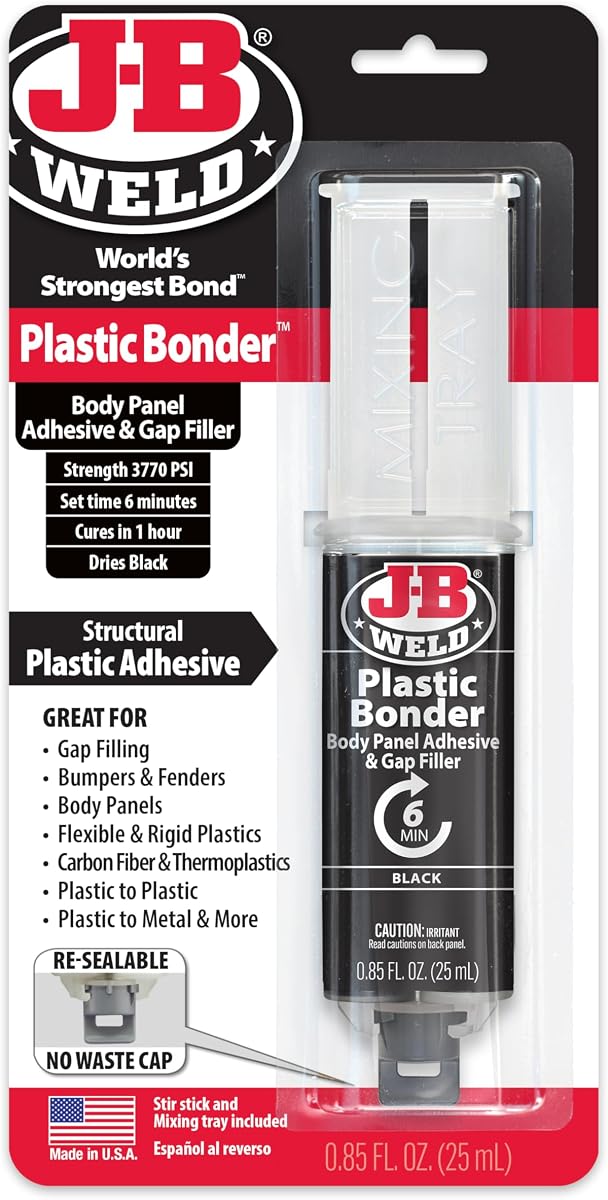
J-B Weld Plastic Bonder Black is a two-part urethane adhesive and gap filler rated 4.6 stars. It is the most versatile option in this guide because it combines strong bonding performance with a fast 15-minute set time and a broad list of compatible materials.
We may earn a commission when you buy through this link, at no additional cost to you.
Its advertised 3770 PSI tensile strength makes it a compelling choice when an instant cyanoacrylate feels too limited for a substantial repair. The 1:1 mixing ratio is straightforward, and the finished adhesive cures into a hard, permanent black bond that can be sanded after 30 minutes.
The main trade-off is the preparation involved. Unlike single-component super glue, this system must be measured and mixed, and the black appearance is less discreet than a clear adhesive. It is also a gap filler rather than a purely invisible solution, so careful application matters when appearance is important.
This pick suits DIY users repairing plastic body panels, household objects, composite pieces, or multiple materials. Choose it when strength, versatility, and controlled curing matter more than instant placement or a completely transparent repair.
The two-part urethane system is intended for strong, lasting repairs rather than temporary positioning. Once cured, it creates a rigid bond that is better suited to impact-prone and structurally demanding assemblies.
Compatibility with thermoset and carbon fiber composites, thermoplastics, coated metals, concrete, plastic, and PVC makes this useful for mixed-material household and workshop projects.
We may earn a commission when you buy through this link, at no additional cost to you.
Super Glue All-Purpose Liquid is a 1.75-ounce instant adhesive with a 4.6-star rating. It is designed for quick household fixes and heavier projects, offering a larger supply than many conventional small tubes.
We may earn a commission when you buy through this link, at no additional cost to you.
Its rapid-drying formula reaches maximum handling durability in seconds, which helps reduce the time parts must remain aligned. The crystal-clear finish remains unobtrusive on intricate crafts, while the anti-clogging cap supports consistent dispensing during repeated use.
A liquid cyanoacrylate can spread beyond the intended joint if too much is applied, so careful control is essential. The product information is broad rather than deeply specific about plastic grades, and it does not describe a two-part gap-filling system.
This adhesive is a practical pick for visible plastic repairs, decorative objects, and general household assembly. It is particularly attractive when fast bonding and a larger bottle matter more than a sculpted gel or a long structural curing window.
The seconds-level handling strength is useful for small household items that need to be reassembled quickly. A minimal bead and firm alignment help keep the repair neat.
The invisible finish is helpful for crafts and decorative surfaces where an obvious glue line would distract from the repaired object.
We may earn a commission when you buy through this link, at no additional cost to you.
J-B Weld Plastic Bonder Tan shares the strong two-part urethane design of the top-ranked product but uses a tan finish. It holds a 4.6-star rating and is a balanced option for structural plastic repairs, dent filling, and general DIY use.
We may earn a commission when you buy through this link, at no additional cost to you.
The adhesive sets after 15 minutes and reaches full cure in 30 hours. Its 3770 PSI tensile strength provides a more substantial cure than typical instant glue, while the 1:1 syringe format simplifies proportional mixing.
The tan appearance is conspicuous on black, white, or transparent parts. The longer cure time also means the joint should not be treated as fully finished immediately, and the two components must be mixed thoroughly for consistent performance.
This is a good choice for shoppers who want a capable structural adhesive without moving to an industrial product. It is particularly appropriate for plastic household items, bumpers, and mixed-material repairs where gap filling is useful.
The syringe and included mixing tray reduce guesswork when combining equal amounts of resin and hardener. Consistent measurement supports the advertised strength and curing performance.
The listed applications include thermoplastics, carbon fiber composites, coated metals, PVC, concrete, ceramic, tile, fiberglass, and aluminum.
We may earn a commission when you buy through this link, at no additional cost to you.
The Loctite Super Glue Plastics Bonding System is a 4.2-star kit built specifically for plastics that are often difficult to bond. Unlike conventional super glue, it combines an adhesive with an activator that primes the surfaces.
We may earn a commission when you buy through this link, at no additional cost to you.
Its major advantage is compatibility with polyethylene, polypropylene, and PTFE, materials that can cause ordinary cyanoacrylates to struggle. The system dries transparently, sets in seconds, and does not require mixing or clamping.
Activating each surface before bonding adds a step that must be planned into the repair. The small kit size is also better for occasional use than for a stream of household projects, although it delivers a focused solution for challenging plastics.
Choose this product for broken PE or PP household objects when a standard solvent adhesive would be unsuitable. It is also relevant for PTFE components and outdoor repairs where water and chemical resistance are valuable.
Priming with the included activator helps the adhesive achieve a more dependable bond on low-surface-energy plastics that are often excluded from standard super glue guidance.
Resistance to water, many chemicals, and freezing temperatures broadens its usefulness for objects used in changing environments.
We may earn a commission when you buy through this link, at no additional cost to you.
GH1200 Plastic Glue 2-in-1 is a 4.5-star adhesive distinguished by its built-in brush and precision nozzle. It combines fast setting with more deliberate placement than a standard liquid super glue bottle.
We may earn a commission when you buy through this link, at no additional cost to you.
Fine brush bristles are intended for controlled applications, while the nozzle can dispense more adhesive or cover broader surface areas. The formula sets in approximately 10 to 45 seconds and is described as waterproof, clear, and suitable for toys, models, ABS, PVC, and 3D figures.
The manufacturer specifically states that it will not work on all hard plastics, including certain bags and containers. That limitation makes material testing important. A full 24-hour cure is also recommended for the strongest result despite the rapid initial set.
This pick is ideal for hobbyists who need neat lines around intricate parts, as well as general users making small plastic repairs. Its dual applicator design is especially helpful when one project requires both a tiny dab and a slightly wider bead.
The brush can place adhesive along a model seam or into a narrow joint without flooding the area. The nozzle offers a faster alternative when more material is required.
A stain-free crystal-clear finish is valuable for finished miniatures and toys where an opaque glue line would affect the appearance of the project.
We may earn a commission when you buy through this link, at no additional cost to you.
Gorilla Super Glue Gel XL is a 4.6-star, thick cyanoacrylate designed for precision and vertical applications. Its no-run gel consistency addresses one of the most common problems with liquid super glue: drifting or running before the joint is secured.
We may earn a commission when you buy through this link, at no additional cost to you.
The formula is reinforced with Impact Tough technology, sets in 10 to 45 seconds, and reaches full cure in 24 hours. It bonds a broad range of materials including plastic, metal, glass, wood, ceramic, rubber, leather, and paper.
Its gel consistency may not penetrate some tight-fitting mechanical joints as readily as a thin liquid, and its all-purpose design means it is not exclusively optimized for every plastic grade. Users should still verify compatibility and perform a small test when the plastic type is uncertain.
This adhesive is a strong choice for vertical surfaces, irregular parts, and repairs where keeping glue in place is essential. It also works well for mixed-material household projects and any job needing a discreet, clear bond.
The thicker gel reduces the need to hold loose parts together while liquid adhesive finds its level. That makes it useful for vertical or uneven assemblies.
The product dries completely clear without foaming, which helps preserve the appearance of small components and decorative repairs.
We may earn a commission when you buy through this link, at no additional cost to you.
Plastic Super Glue Liquid is a 4.5-star cyanoacrylate developed for plastic repair, models, ABS, acrylic, 3D-printed pieces, toys, and even eyeglass frames. Its fast-drying formula makes it well suited to assembly work where waiting is inconvenient.
We may earn a commission when you buy through this link, at no additional cost to you.
Precision tips help place a small amount in tight spaces and detailed components, reducing the amount of excess adhesive that must be cleaned from intricate models. The anti-clog cap is intended to support smooth flow and repeated use.
A fast set leaves little time to reposition parts after contact. Although the product information lists wood, metal, ceramic, glass, and plastics, shoppers should not infer identical performance on every substrate or surface condition.
This pick is especially useful for model kits, miniature assemblies, 3D-print corrections, and small household plastic items. It is less appropriate when a joint must remain open for extended alignment or when structural gap filling is needed.
The narrow tips support careful placement in small geometries where a broad bead of liquid adhesive could obscure details or create an uneven finish.
The rapid-setting formula is useful when joining printed components or correcting fit issues quickly during a build process.
We may earn a commission when you buy through this link, at no additional cost to you.
GH1200 Brush and Nozzle Glue is a 4.6-star cyanoacrylate featuring a fine brush and dispensing nozzle. It is designed for clean application across plastics, rubber, metal, ceramics, and other household materials.
We may earn a commission when you buy through this link, at no additional cost to you.
The smooth-flowing formula is advertised as resistant to drying out, which is valuable for a brush-equipped bottle because residue at the applicator can make reuse difficult. It sets in 10 to 40 seconds and develops a permanent, weather-resistant bond over 24 hours.
The product name emphasizes a never-dries claim, but users should still store the container as directed and keep the cap clean. Its broad material focus also means it is not as narrowly formulated for hard plastics as products explicitly designed around that substrate.
This is a convenient general repair adhesive for anyone who wants brush control without giving up fast setting. It suits jewelry, toys, pottery, household objects, and mixed-material assemblies where a clear finish is desired.
A fine brush allows glue to be painted onto a joint rather than dropped into it, which is useful for small components and decorative items.
The ability to bond plastic, rubber, ceramic, and metal makes this a practical addition to a general repair kit rather than a single-project purchase.
We may earn a commission when you buy through this link, at no additional cost to you.
J-B Weld PlasticWeld is a 4.5-star two-part epoxy with the highest listed tensile strength in this guide at 3900 PSI. It is a fast-curing structural option for plastic, PVC, fiberglass, glass, ABS, composites, and vinyl.
We may earn a commission when you buy through this link, at no additional cost to you.
After mixing the components in equal portions, the adhesive sets in five minutes and cures in one hour. That schedule is notably quicker than the 30-hour full cure stated for J-B Weld Plastic Bonder Tan, making it attractive for urgent repairs.
The color is translucent yellow rather than clear or black, so it may be visible on finished surfaces. Epoxy mixing must also be accurate and thorough; poor proportioning or incomplete stirring can undermine an otherwise strong cure.
Choose PlasticWeld when a load-bearing or gap-filling plastic repair needs more strength than instant glue and cannot wait for a full-day cure. It is a solid middle ground between rapid cyanoacrylates and slower structural urethanes.
The five-minute set and one-hour cure provide a faster path back to use than many traditional epoxies while still offering a rigid structural bond.
Compatibility with fiberglass, glass, composites, vinyl, and PVC lets users repair assemblies that combine several common construction materials.
We may earn a commission when you buy through this link, at no additional cost to you.
LOCTITE 406 Super Glue earns the highest rating in the list at 4.7 stars. It is an exceptionally low-viscosity cyanoacrylate designed for rapid fixturing of plastics and elastomeric materials in professional and industrial assembly work.
We may earn a commission when you buy through this link, at no additional cost to you.
Its low viscosity supports quick bonding along narrow contact lines, while the 20-gram container provides enough adhesive for repeated applications. The formula can also be combined with LOCTITE primers for cyanoacrylates when bonding difficult plastics.
Low viscosity means the adhesive can spread quickly, so precise application is important. Difficult plastics may require primer, and the professional formulation may offer more consistency than general hobby glues but does not remove the need to verify substrate compatibility.
This is the top premium pick for workshops, production processes, and experienced users who need dependable fast fixturing. It is particularly valuable when a component must be held or positioned only briefly during assembly.
Rapid fixturing reduces the time needed to keep plastic or rubber components aligned, which can streamline repetitive assembly tasks.
Compatibility with LOCTITE primers expands the practical range of difficult plastics and provides a path when the adhesive alone is not sufficient.
We may earn a commission when you buy through this link, at no additional cost to you.
The right hard plastic glue depends on the plastic type, joint design, required strength, application visibility, and acceptable curing time. These factors help narrow the field before comparing formulas.
Begin by identifying the exact plastic whenever possible. Cyanoacrylates are common choices for many recognizable plastics, but polyethylene, polypropylene, PTFE, and other low-surface-energy materials may require an activator, primer, or a product specifically formulated for them. A product that bonds ABS or PVC should not automatically be assumed to bond every hard plastic.
A small model seam and a cracked structural housing do not have the same performance requirements. Instant adhesives can be ideal for light assembly and precise repairs, while two-part epoxies and urethanes are better candidates for rigid, load-bearing, or impact-prone joints. Compare advertised tensile strength and intended applications rather than assuming all glues are interchangeable.
Set time is when the adhesive reaches an initial handling state, while full cure is when it reaches its final performance. Products may feel secure quickly yet still benefit from additional curing. Fast-setting cyanoacrylates suit assembly work that cannot wait, whereas epoxies and urethanes may need longer before the joint should be heavily loaded.
Liquid adhesives are convenient for simple joints, but they can run, spread, or create excess residue. Gel formulas stay in place better on vertical surfaces, precision tips help with narrow assemblies, and brush applicators allow controlled coverage along seams. The best applicator depends on whether the repair requires a small dab, a long bead, or careful placement into a detailed model.
If the damaged pieces do not meet cleanly, a rigid adhesive that can also fill the space may be necessary. Two-part plastic bonders and epoxies are better suited to that function than thin instant glues. Color also matters: clear finishes are discreet, black is useful for dark components, tan or yellow may show on lighter surfaces, and a gap-filling repair may remain visible.
Consider whether the repaired item will encounter water, freezing temperatures, chemicals, heat, or repeated outdoor use. Some products are described as waterproof or weather resistant, while others focus primarily on immediate bond strength. Resistance claims should be matched to the actual repair environment rather than assumed to be universal.
Cyanoacrylate products are moisture sensitive, and even a cap that appears closed can allow gradual thickening or clogging. Anti-clog caps, resealable syringe caps, smooth-flow packaging, and precision nozzles can improve storage. Store adhesives as directed, keep applicators clean, and avoid leaving a bottle open unnecessarily.
A larger bottle or syringe may be more efficient for repeated repairs, while a small kit can be preferable for occasional or highly specialized work. General-purpose formulas can handle mixed assemblies, but products focused on plastic often provide more relevant substrate guidance. Consider the volume of adhesive needed, the range of materials involved, and whether the container will remain open between projects.
Begin with clean, dry repair surfaces. Remove dirt, oil, loose particles, and any old adhesive, because contaminants can prevent proper contact. Work in a ventilated area, protect the surrounding surface, and consult the product instructions for safety, compatibility, and any recommended surface preparation.
Use the applicator suited to the joint. Apply a thin bead to one surface for most cyanoacrylates, measure equal amounts of two-part products, and mix thoroughly when required. Position the pieces immediately, then hold or clamp them until the adhesive reaches its stated set time without disturbing the alignment.
Allow the repair to cure fully before exposing it to load, water, heat, or chemicals. Store the container tightly closed and clean the applicator after use. If a product is designed for hard plastics, confirm the material type and perform a small trial whenever compatibility is uncertain.
J-B Weld PlasticWeld lists the highest tensile strength at 3900 PSI, followed by the two J-B Weld Plastic Bonder products at 3770 PSI. Actual joint strength also depends on plastic compatibility, surface preparation, mixing quality, joint design, and full curing.
It can bond many common plastics, but not every plastic reacts equally to cyanoacrylate adhesives. Polyethylene, polypropylene, and PTFE may require a primer, activator, or a specifically formulated bonding system. Always check compatibility before committing to a visible repair.
A clear cyanoacrylate is suitable for a small, clean, low-stress crack, while a two-part epoxy or urethane is better for a rigid, stressed, or poorly aligned joint. The repair's appearance, required strength, and curing time should determine which option fits.
Gap-filling adhesive is better when the broken sections do not meet closely or when a rigid filler is needed to restore the shape. It generally requires mixing, has a longer cure, and may be more visible than a clear liquid super glue.
Wait at least until the product reaches its stated handling time, but allow the full cure period before placing heavy stress on the joint. Some products set in seconds yet recommend 24 hours for maturation, while the tan J-B Weld Plastic Bonder lists a 30-hour cure.
Yes, a fine brush can offer better control than a liquid nozzle on small seams and intricate parts. Apply a thin, even coat and allow the model to cure in a well-ventilated area. A gel may be preferable if the joint is vertical or the adhesive tends to run.
Cyanoacrylate cures in the presence of moisture, and residue around the opening can create a blockage. Clean the applicator, close the cap securely, and store the bottle upright as directed. Products with anti-clog pins or resealable packaging can reduce the risk.
A product described as waterproof or weather resistant may be suitable for outdoor exposure, but temperature range, chemical exposure, and UV conditions still matter. For demanding exterior assemblies, choose a structural adhesive with explicit outdoor and environmental resistance.
J-B Weld Plastic Bonder Black stands out as the most versatile overall choice, combining strong urethane performance, rapid setting, gap filling, and broad material compatibility. LOCTITE 406 is the premium pick for professional fast-fixturing work, while the tan Plastic Bonder provides a balanced structural option at a budget-friendly level.
For ordinary household repairs, prioritize verified plastic compatibility, applicator control, and a finish that suits the object. For loaded joints, choose a rigid two-part system and allow the advertised full cure. Models and detailed parts benefit from precision tips or brush application, while low-surface-energy plastics may need an activator or primer.
Before purchasing, check the current listing for updated specifications, availability, and price. Product formulations and seller details can change, and the best adhesive is the one that matches the exact material, joint, strength requirement, and working conditions of the repair.


