
Douk Audio L1-MiINI
4.3Editor score
Adjustable 20dB signal gain
RCA and 3.5mm connections
Compact metal enclosure
Discover the best Inline Amplifier for Speakers, comparing power, connectivity, gain, controls, and ideal uses to help you choose with confidence today.
An inline amplifier for speakers adds useful signal gain and, depending on the model, enough power to drive passive speakers directly. The right unit can turn a phone, turntable, TV, computer, or other low-level source into a more flexible home-audio system. Good choices balance clean amplification, flexible inputs, practical controls, speaker compatibility, and a compact enclosure.
This guide compares ten inline and compact stereo amplifiers according to the functions and specifications supplied for each model. It examines amplification type, channel configuration, input and output options, gain or power capabilities, tone controls, wireless connectivity, crossover functions, and intended applications. It also distinguishes line-level boosters and preamps from amplifiers capable of directly powering passive speakers.
The recommendations reveal different paths for different listeners: small line-level boosters for source correction, versatile Class D receivers for conventional home systems, and more advanced integrated designs for demanding installations. Each section explains the most useful strengths, practical limitations, and likely buyer profile. Product availability, configurations, and prices can change, so confirm current details before purchasing.
4.3Editor score

4.4Editor score

4.4Editor score
The table below compares the ten products by core function, channel layout, connection options, and control features. It includes both low-level boosters and direct-drive Class D amplifiers so readers can match the correct type to their speakers and source equipment.




The Douk Audio L1 is a mini stereo line-level booster and preamp with a stated maximum gain of 20dB. Its 4.1 rating reflects a practical product aimed primarily at correcting weak source signals rather than replacing a full power amplifier. Its standout quality is connectivity: the supplied information lists 3.5mm AUX, stereo RCA, and 5-DIN inputs, with stereo RCA and 5-DIN outputs.
We may earn a commission when you buy through this link, at no additional cost to you.
The L1 uses an adjustable amplification and voltage-boost circuit designed to match signals from sources such as phones, tablets, televisions, computers, CD players, and game consoles. Its double-sided PCB, pluggable NE5532P op amp, sealed potentiometer, and all-metal enclosure reflect a design aimed at both compactness and reduced interference. The broad 5 to 24V input range also allows it to share an amplifier's power supply in compatible systems.
The most important limitation is functional. Although its product title calls it an amplifier, the L1 is a line-level booster and preamp, so it should not be treated as a direct-drive power amplifier for passive speakers. It is most valuable when feeding another amplifier, receiver, or powered setup. Users who require speaker terminals and substantially more output power should look to one of the Class D models in this list instead.
Buy the L1 if you need a compact signal-conditioning box with unusually varied input options and want the flexibility of an upgradeable op amp. It suits source-control projects, karaoke, recording, home stereo, and small speaker setups where additional line-level drive is needed. For a basic home speaker amplifier with Bluetooth, the BT20A is the more direct solution; for pure signal gain in a smaller enclosure, the L1-MiINI is more streamlined.
The mix of 3.5mm AUX, RCA, and 5-DIN connections is the L1's most distinctive advantage. That makes it easier to integrate older equipment, portable players, and modern source components without relying on a single cable standard.
The adjustable 20dB boost can make quiet line-level sources more compatible with downstream equipment. It is best understood as signal conditioning, not a substitute for a power amplifier capable of driving passive speakers.
We may earn a commission when you buy through this link, at no additional cost to you.
The Douk Audio L1-MiINI is a compact stereo line-level booster with adjustable gain up to 20dB and a 4.3 rating. It is designed for low-volume sources that need stronger line-level output before reaching an amplifier, receiver, or other downstream component. Compared with the larger L1, it offers a more focused set of connections and a smaller footprint.
We may earn a commission when you buy through this link, at no additional cost to you.
Its input selection includes 3.5mm AUX and stereo RCA, while stereo RCA handles the output side. The internal voltage-boost and amplification circuit operates from a high internal voltage to provide the stated output amplitude and maximum gain. A pluggable NE5532P op amp gives experienced users an upgrade path, and the sealed volume potentiometer supports precise level adjustment.
The L1-MiINI is not a speaker power amplifier. It cannot directly drive passive bookshelf speakers, floorstanding speakers, or other speaker cabinets that require substantial power. Its listed use cases therefore center on boosting portable devices, adding external volume control, supporting karaoke or CD/DVD sources, and improving compatibility with mixers, speakers, and other downstream audio equipment.
This is the most sensible budget recommendation for someone who needs extra line-level drive in a very small package. Choose it when space is important, your source has a quiet output, and you already have amplification downstream. If your goal is to connect speakers directly, move up to the Fosi Audio BT20A or V1.0G, which include speaker-level amplification.
The mini metal enclosure makes the L1-MiINI practical beside source components, inside a media cabinet, or in a portable audio arrangement. Its smaller footprint is balanced by fewer connector types than the standard L1.
A front volume control can be more convenient than relying on a source device with no level adjustment. It also makes it easier to fine-match output into downstream equipment without changing the source's own settings.
We may earn a commission when you buy through this link, at no additional cost to you.
The Fosi Audio V1.0G is a two-channel mini Class D amplifier built around the Texas Instruments TPA3116D2. Its 4.6 rating is the highest among the conventional Fosi models in this guide. It is aimed at straightforward home-audio applications where a small, efficient power amplifier is more useful than streaming features or extensive tone shaping.
We may earn a commission when you buy through this link, at no additional cost to you.
The amplifier supports a 12 to 24V supply range, allowing flexibility across home and professional applications. The chip incorporates multiple switching-frequency options intended to avoid AM interference, while the V1.0G adds a speaker-protection circuit and a solid aluminum chassis. Its Class D design emphasizes low power loss, cool operation, and suitability for compact home systems.
Compared with the BT20A, the V1.0G does not offer Bluetooth, RCA convenience features, or visible bass and treble controls. That simplicity is not necessarily a disadvantage: listeners who want a dedicated analog amplifier can connect a source through its input and avoid setup complexity. It is also a more focused choice for passive speakers than the Douk boosters, which operate only at line level.
The V1.0G is a strong recommendation for building a compact stereo system with existing powered or analog sources. It suits desktop listening, bookshelves, small home stereo setups, and installations where efficient amplification and speaker protection matter. Buyers wanting wireless playback or tone controls should consider the BT20A instead, while those seeking more advanced signal features may prefer the V3.
The Class D architecture is well suited to a small aluminum enclosure because it emphasizes efficiency and low power loss. It provides a direct way to power two passive speakers without occupying a full-sized component shelf.
A built-in speaker-protection circuit adds a useful layer of safeguards for compact home systems. It helps make the V1.0G feel purpose-built for direct speaker connection rather than simple line-level signal routing.
We may earn a commission when you buy through this link, at no additional cost to you.
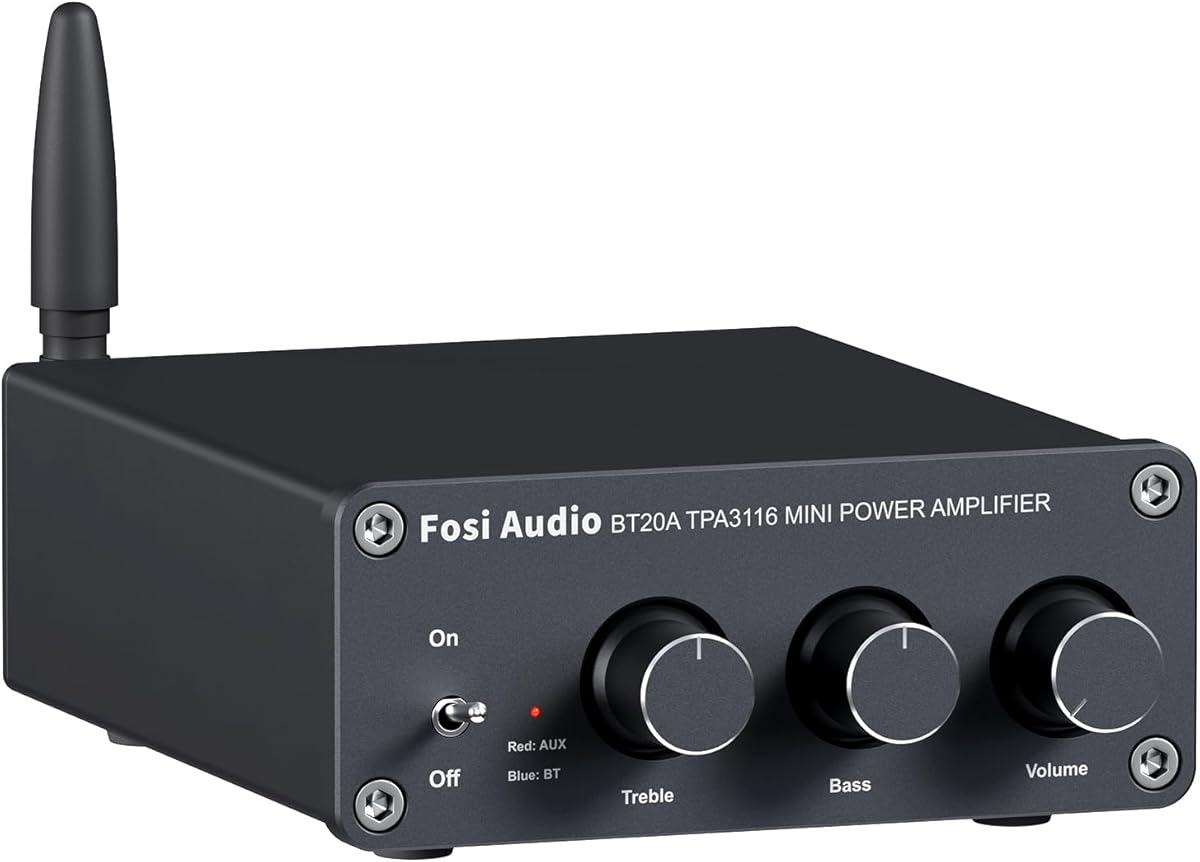
The Fosi Audio BT20A is a compact two-channel Class D amplifier that combines wired and wireless source support. Its 4.5 rating reflects its position as one of the most approachable options for driving passive speakers. Bluetooth streaming is handled directly, while RCA inputs support traditional analog components, and the integrated form keeps the installation visually simple.
We may earn a commission when you buy through this link, at no additional cost to you.
The supplied specifications describe a maximum output of 100W per channel, allowing the unit to power multiple speaker cabinets in home or small-venue environments. Bass and treble controls let listeners adapt the output to different rooms and speakers, while a one-touch power switch simplifies operation. Its all-black, one-piece enclosure is designed to fit shelves and blend into many home-audio arrangements.
The BT20A is less specialized than the BT20A Pro, which adds Bluetooth 5.0 and replaceable op amps, and it has fewer refinement-oriented features than the V3. It also lacks the richer digital input and DAC capabilities of the WiiM Vibelink Amp. Even so, it covers the core needs of most compact speaker systems without requiring a separate streamer.
Choose the BT20A when you want a simple, attractive amplifier that can receive music from a phone over Bluetooth or from an analog source through RCA. It is a strong fit for bookshelves, bedrooms, offices, patios, garages, and small venues. It is the most balanced recommendation here for listeners who prioritize simplicity, wireless convenience, and direct speaker control over enthusiast-level customization.
Bluetooth removes the need for a separate streamer when listening from a phone, while RCA inputs preserve compatibility with traditional components. That combination makes the BT20A practical for mixed-source households.
Separate bass and treble controls are simple but valuable. They let a listener compensate for room acoustics, speaker placement, and source characteristics without reaching for a more complex separate preamplifier.
We may earn a commission when you buy through this link, at no additional cost to you.
The Mini Stereo Audio Preamp is a small signal booster with 20dB gain, a 4.5 rating, and a useful secondary role as a headphone amplifier. It is designed to transform weak source signals into line-level signals and can directly drive headphones up to a stated maximum impedance of 16 ohms. That makes it more versatile than a basic booster but less suitable than a power amplifier for passive speakers.
We may earn a commission when you buy through this link, at no additional cost to you.
The unit uses a dual NE5532 op amp and includes a noise-reduction circuit design. Inputs cover RCA left and right, 3.5mm, and sources such as a turntable, TV, mobile phone, computer, microphone, game console, or electronic instrument. Outputs include RCA, 3.5mm, and a headphone connection, all supported by an external DC supply in the 9 to 19V range.
A crucial limitation is stated directly in the supplied information: this is a preamp, not a power amplifier for passive speakers. In addition, the headphone output cannot operate simultaneously with the other output ports. Users should also verify whether a turntable includes a built-in phono stage, since the product title references phono use but the core function is general signal amplification.
Buy this model for a compact desktop headphone setup, a source with weak output, or a convenient way to add gain and volume control between components. It is particularly appealing when a single box needs to serve both line-level and headphone listening. For direct passive-speaker driving, choose one of the Class D power amplifiers instead.
The combination of 20dB line-level gain and compatible headphone output is unusually practical. It can serve as a compact desktop hub rather than requiring a separate headphone stage for basic listening.
RCA and 3.5mm connections make the preamp approachable for phones, computers, instruments, media players, and turntables. Confirm source type and output requirements before building the final signal chain.
We may earn a commission when you buy through this link, at no additional cost to you.
The Fosi Audio BT20A Pro is a two-channel mini Class D amplifier with Bluetooth 5.0, tone controls, and an enthusiast-oriented replaceable-op-amp design. Its 4.4 rating and stated 300W x2 headline output place it between the basic BT20A and the more component-focused V3. It is aimed at listeners who want wireless convenience without giving up opportunities to refine the analog signal path.
We may earn a commission when you buy through this link, at no additional cost to you.
The TPA3255-based design is listed with a signal-to-noise ratio of at least 108dB and total harmonic distortion no higher than 0.005%. Its plug-in NE5532 op amps can be exchanged for options including LME49720HA, MUSES02, OPA2604AP, OPA2134PA, LM4562, and NJM4556AD. Bass and treble controls are also provided, with a neutral setting available by placing both at the midpoint.
Bluetooth pairing can be cleared by holding the volume control for five seconds, and a memory function assists with reconnection. The package includes the amplifier, antenna, power adapter, AC cord, and manual. As with all headline power figures, buyers should determine which speaker impedance and operating conditions apply, because the numerical wattage claim should not be treated as identical output into every load.
The BT20A Pro is a compelling choice for outdoor speakers, bookshelves, offices, or a modern home system where Bluetooth 5.0 and analog customization are both appealing. It is less beginner-friendly than the standard BT20A because of the op-amp options, but it offers more control for listeners who understand component-level design. It is also a strong alternative to the V3 when wireless playback is a priority.
Bluetooth 5.0, pairing reset, and a connection-memory function make repeated use less cumbersome. This is important in a home setup where the amplifier remains powered while the listener switches between everyday source devices.
Replaceable dual op amps provide a clear path for experimentation. Users can retain the supplied NE5532 configuration or try compatible alternatives to explore differences in sound character.
We may earn a commission when you buy through this link, at no additional cost to you.
The Fosi Audio TB10D is a two-channel Class D power amplifier whose defining use case is broader than a conventional bookshelf-speaker setup. Its 4.5 rating and supplied feature list emphasize passive speakers, a bass shaker, home audio, desktop listening, and compact installation. The TPA3255 platform allows it to serve as a flexible mini power component.
We may earn a commission when you buy through this link, at no additional cost to you.
The stated headline output is 600W across two channels, with the supplied information indicating suitability for 2-to-8-ohm bookshelf speakers. Bass and treble controls, a power switch, RCA input, and passive-speaker outputs make basic operation straightforward. The amplifier can work with phones, computers, DVDs, CD players, TVs, and other line-level sources.
The unusual opportunity is bass-shaker support. A tactile transducer can add low-frequency physical effects to compatible games, media, or installations, but the correct connection and signal arrangement must be followed. The 600W figure is an aggregate headline claim, so buyers should assess the actual output applicable to their chosen load and system configuration rather than assume constant output under every condition.
Choose the TB10D when you want a compact two-channel amplifier with tone controls and a clear plan for passive speakers or a bass shaker. It is a better fit for this specialized use than a simple line booster. If wireless streaming is essential, choose the BT20A Pro; if the goal is a more refined component design and adjustable pre-out, the V3 may be preferable.
Bass-shaker compatibility opens the amplifier beyond conventional audible speaker output. It can support immersive game, home-theater, or installation effects when paired with compatible equipment and proper settings.
RCA input and passive speaker outputs cover common home-audio sources. The small enclosure also makes the TB10D suitable for desktop, game-room, and media-console installations.
We may earn a commission when you buy through this link, at no additional cost to you.
The Fosi Audio V3 is a compact two-channel TPA3255 Class D amplifier positioned as a more refined audio component than the entry-level mini models. Its 4.4 rating reflects a combination of strong specifications, upgraded internal components, cooling, and customization. It is suitable for passive bookshelf or tower speakers, desktop systems, and home-theater installations that benefit from more than basic amplification.
We may earn a commission when you buy through this link, at no additional cost to you.
The supplied information highlights Japanese NCC, ELNA, and German WIMA capacitors alongside Japanese Sumida inductors. It lists a SINAD rating up to 88dB, signal-to-noise ratio up to 110dB, and a noise floor of 140uV. Top and bottom vents work with a whole-body heatsink to dissipate heat, while the 48V power supply supports the stated amplifier platform.
The V3 also improves system flexibility through a pre-out whose level follows the volume control. This is useful when connecting the unit to additional equipment or integrating it into a more advanced signal chain. Its stock NE5532 op amps are replaceable, and the supplied list includes Sparkos SS3602, MUSES02, OPA2604, OPA2134PA, OP249, AD827, RM4559, LM4562, and LME49720HA.
The principal tradeoff is that the V3 does not include Bluetooth. It is therefore a stronger recommendation for an analog-oriented enthusiast who values construction, cooling, pre-out behavior, and op-amp flexibility. The BT20A is easier for a phone-first household, while the WiiM Vibelink Amp serves buyers who want a premium DAC and digital playback features.
Top and bottom ventilation combined with a whole-body heatsink helps the compact Class D design manage heat. That cooling strategy supports placement in enclosed or less ventilated locations where sustained operation requires attention to temperature.
The volume-controlled pre-out output makes the V3 easier to combine with other equipment. It also creates a route to adjust levels at the amplifier rather than relying only on the source component.
We may earn a commission when you buy through this link, at no additional cost to you.
The WiiM Vibelink Amp is a premium stereo power amplifier that combines a TPA3255 amplification stage with an ESS 9039Q2M DAC. Its 4.4 rating reflects an advanced feature set for listeners who want direct passive-speaker power, high-resolution digital sources, and careful construction. Unlike a conventional network streamer, it is positioned as a pure amplifier with integrated conversion and input options.
We may earn a commission when you buy through this link, at no additional cost to you.
The supplied specifications list 100W per channel at 8 ohms and 200W per channel at 4 ohms. PFFB technology, variable sample rates, and support for bit-perfect 192kHz/24-bit playback through optical and coaxial inputs make the V3 class model less relevant by comparison. Its RCA analog input bypasses ADC conversion, offering a direct route for analog purists.
The unibody aluminum chassis uses a copper heat pipe and graphene heatsink as part of its thermal-management system. Anti-pop circuitry is included for smooth transitions, while 12V trigger input and auto-standby support convenient system control. A crucial note is that output differs by input: the supplied data lists 60W for RCA and 100W for digital input, so comparisons should account for the source path.
Buy the Vibelink Amp for a high-end passive-speaker system using a WiiM streamer, a digital source, or high-resolution files. Its compatibility with WiiM Mini, Pro, Pro Plus, and Ultra makes it particularly appealing to listeners already invested in that ecosystem. It is not the right choice for someone expecting built-in streaming, because streaming functions require a separate compatible WiiM device.
The ESS 9039Q2M DAC and variable-rate optical and coaxial inputs provide a strong path for digital playback. The pure analog RCA route avoids ADC conversion for listeners who prefer an entirely analog connection.
The aluminum unibody chassis, copper heat pipe, graphene heatsink, anti-pop design, and trigger input all support a polished installation. Auto-standby also helps reduce unnecessary power consumption in a multi-component system.
We may earn a commission when you buy through this link, at no additional cost to you.
The Stetsom HL 400.1 is a single-channel Class D full-range amplifier with a 5.0 rating, the highest listed score in this comparison. It is designed for installation-style applications rather than the typical two-speaker desktop setup. Its 400W RMS specification at 2 ohms makes it especially relevant to a subwoofer, specialized full-range speaker, or custom multi-amplifier configuration.
We may earn a commission when you buy through this link, at no additional cost to you.
The amplifier accepts both RCA and high-level speaker-wire inputs, allowing integration with line-level sources as well as an existing head-unit or speaker-level output. Adjustable input-level controls and a variable crossover add installation flexibility. Users can select low-pass or high-pass modes to focus the amplifier's output on the frequency range appropriate to the connected speaker.
Its mono architecture is the central constraint. This is not a conventional stereo amplifier for a pair of bookshelf speakers, and attempting to use it as a general two-channel solution would be inappropriate. The 2-ohm load figure also requires careful wiring, stable power provisioning, and attention to manufacturer guidance. Its full-range positioning means the crossover is a flexible tool rather than a signal-chain necessity in every setup.
Choose the HL 400.1 for a dedicated subwoofer, custom passive speaker system, or car-audio-inspired installation that benefits from high-level input and crossover control. The included mounting brackets support secure placement outside a conventional living-room component stack. For ordinary stereo listening, the Fosi models offer a more straightforward path with two-channel outputs and consumer-friendly controls.
Both RCA and high-level inputs simplify integration with different source arrangements. High-level input is especially useful when the amplifier must work with an existing speaker-level head unit.
Selectable low-pass and high-pass modes help match the amplifier to a subwoofer or other driver with a defined frequency range. Adjustment gives installers greater control over how the channel participates in the system.
We may earn a commission when you buy through this link, at no additional cost to you.
The most important decision is whether you need a line-level signal booster or a true power amplifier. Beyond that distinction, source compatibility, speaker impedance, output power, tone controls, connectivity, and installation requirements should shape your selection.
A line-level booster, preamp, or signal conditioner raises the voltage of a weak source so that downstream equipment receives a more useful signal. It does not provide the substantial current required to drive conventional passive speakers. The Douk Audio L1, L1-MiINI, and Mini Stereo Audio Preamp fall into this category. If your goal is to connect passive bookshelf or floorstanding speakers directly, choose a true power amplifier such as the Fosi Audio models, WiiM Vibelink Amp, or the mono Stetsom unit.
Most home systems use two channels for a left and right speaker pair. The V1.0G, BT20A, BT20A Pro, TB10D, V3, and WiiM Vibelink Amp are two-channel choices, while the Stetsom HL 400.1 is optimized for one channel. A mono amplifier can still be used in a multi-amp system, but it requires a separate channel for stereo playback. Match the amplifier count to the speaker layout rather than judging only by headline wattage.
An amplifier should be compatible with the impedance of every speaker it drives. The TB10D and V3 descriptions specifically reference 2-to-8-ohm bookshelf speakers, while the Stetsom is optimized for a 2-ohm load. The Vibelink Amp provides different stated output depending on impedance and input type. High headline wattage is not a complete compatibility specification. Consider speaker sensitivity, room size, listening distance, amplifier efficiency, and the manufacturer's load limits before selecting a model.
Start with the equipment you intend to connect. The L1 supports 3.5mm AUX, stereo RCA, and 5-DIN inputs, while the L1-MiINI uses 3.5mm and RCA. Bluetooth-focused users may favor the BT20A or BT20A Pro. The Mini Stereo Audio Preamp includes both RCA and 3.5mm inputs plus headphone output, and the Vibelink adds optical and coaxial digital inputs. A pre-out may matter if the amplifier will feed another component, as on the Fosi Audio V3.
Bluetooth provides a quick path from a phone or tablet without a separate streamer. The BT20A offers the most straightforward version, while the BT20A Pro adds Bluetooth 5.0, pairing memory, and reset controls. The WiiM Vibelink Amp is designed to pair with separate WiiM streamers but does not itself include streaming functions. If the amplifier is part of a fixed system, analog or digital inputs may be more appropriate than wireless convenience.
Bass and treble controls are useful for matching speakers to a room, and the BT20A, BT20A Pro, and TB10D include them. The V3 emphasizes component quality, cooling, and pre-out level control rather than highlighting tone knobs. The BT20A Pro and V3 also support replaceable dual op amps, allowing experimentation with compatible chips. Replacement parts should be installed with care, and beginners may prefer a fixed, straightforward design.
Compact enclosures make an amplifier easier to place beside source equipment, but thermal design matters for sustained power. The V3 uses top and bottom vents with a whole-body heatsink, while the WiiM Vibelink Amp employs a copper heat pipe and graphene heatsink. Smaller metal booster units prioritize shielding and portability. Leave appropriate ventilation around a power amplifier, particularly inside a closed cabinet, and use the supplied mounting hardware when a product is designed for installation.
Headline features can conceal important differences. A product labeled an amplifier may be a preamp, Bluetooth may be limited to a particular version, and digital or analog input paths may provide different output levels. The Mini Stereo Audio Preamp cannot run its headphone and other outputs simultaneously, and the WiiM Vibelink Amp is a pure power amplifier without built-in streaming. Reading the detailed specifications prevents a technically incompatible purchase.
Begin by identifying the amplifier's role. Connect the source to the appropriate line-level input, connect passive speakers to the speaker outputs only on a model designed to power them, and make sure the amplifier is switched off while wiring is completed. If using a preamp, connect its output to another amplifier or receiver rather than directly to passive speakers. Check polarity on speaker-wire connections and confirm impedance compatibility before powering the system.
Power the amplifier with the specified supplied or appropriate adapter, then set its volume low before selecting a source. For Bluetooth models, complete pairing using the documented control sequence. Raise the source level to a moderate position, then use the amplifier's gain, pre-out, or volume control to fine-tune the balance. When using bass or treble controls, make small changes and listen at several levels to avoid overcompensating for room acoustics.
For good long-term operation, keep the unit ventilated, use clean dry power, and avoid placing it beneath stacked equipment unless the manufacturer permits it. Inspect cables and connections periodically, and do not leave a power amplifier connected to a mismatched speaker load. If replacing an op amp or changing internal components, disconnect power completely and follow the relevant component-handling guidance. Wipe the enclosure with a dry or lightly damp soft cloth rather than abrasive cleaners.
Only a model designed as a power amplifier can directly drive passive speakers. The Douk Audio L1, L1-MiINI, and Mini Stereo Audio Preamp provide line-level gain and should feed an amplifier, receiver, or powered speakers. The Fosi Audio models, WiiM Vibelink Amp, and Stetsom HL 400.1 include power-amplification functionality for compatible speaker loads.
A preamp raises and controls a line-level signal, preparing it for another component. A power amplifier converts that signal into enough current to drive passive speakers. Some products combine both functions, while others, such as the Mini Stereo Audio Preamp, explicitly cannot act as a passive-speaker power amplifier.
The correct amount depends on speaker sensitivity, impedance, room size, placement, and preferred listening level. Higher-impedance or more sensitive speakers need less power, while low-sensitivity speakers and large rooms may benefit from a more capable amplifier. Always verify the amplifier's supported impedance and do not treat a headline wattage figure as a guarantee for every load.
Bluetooth is convenient when you frequently stream from a phone or tablet. The BT20A and BT20A Pro include wireless playback, while the V1.0G and V3 focus on wired sources. If you already own a streamer, the Vibelink Amp can integrate with WiiM devices, but it does not include streaming functions itself.
They can be useful, but they require care because incorrect handling, incompatible pinouts, or poor soldering can damage the board. The BT20A Pro and V3 list compatible alternatives, but a newcomer may prefer the standard BT20A or V1.0G. Anyone undertaking internal work should disconnect power and follow the manufacturer's instructions.
A variable crossover filters low or high frequencies so one amplifier channel can serve a specialized driver. The Stetsom HL 400.1 offers selectable low-pass and high-pass modes with adjustable crossover control. This is especially useful for a subwoofer or a custom full-range system where frequency range must be coordinated with other channels.
A gain preamp can raise a low-level phono signal, but a turntable without a built-in phono stage produces a signal that also requires correct RIAA equalization. The Mini Stereo Audio Preamp lists phono-turntable use, but buyers should verify the cartridge, stage, and connection requirements. A turntable with an integrated phono stage can feed a line-level gain unit more directly.
Start with the amplifier volume at its minimum, connect all cables, and power the system before raising the level. Use compatible input and output connections rather than leaving unused ports active where the design does not support simultaneous use. The WiiM Vibelink Amp includes anti-pop circuitry, and proper grounding and source connections remain important across all models.
The strongest general-purpose recommendation is the Fosi Audio BT20A because it combines direct passive-speaker amplification, Bluetooth, RCA inputs, and simple tone controls in an approachable package. The Fosi Audio V3 is the more component-oriented choice, adding refined internal parts, advanced cooling, replaceable op amps, and adjustable pre-out functionality. For a compact line-level need, the Douk Audio L1-MiINI delivers focused 20dB gain in a smaller enclosure.
Prioritize the function you actually need. Choose a booster when the problem is a weak source or insufficient line-level signal, a two-channel power amplifier for conventional passive speakers, and the WiiM Vibelink Amp for a premium high-resolution analog-and-digital system. The Stetsom HL 400.1 is the specialist option for mono, high-level, crossover-controlled installations rather than ordinary stereo listening.
Before buying, verify the current source inputs, speaker impedance, required power, included accessories, ventilation needs, and any output limitations. Ratings, configurations, and market availability can change over time, and prices also fluctuate. Comparing the final current listing against the intended speaker system is the safest way to select the right inline amplifier for speakers.