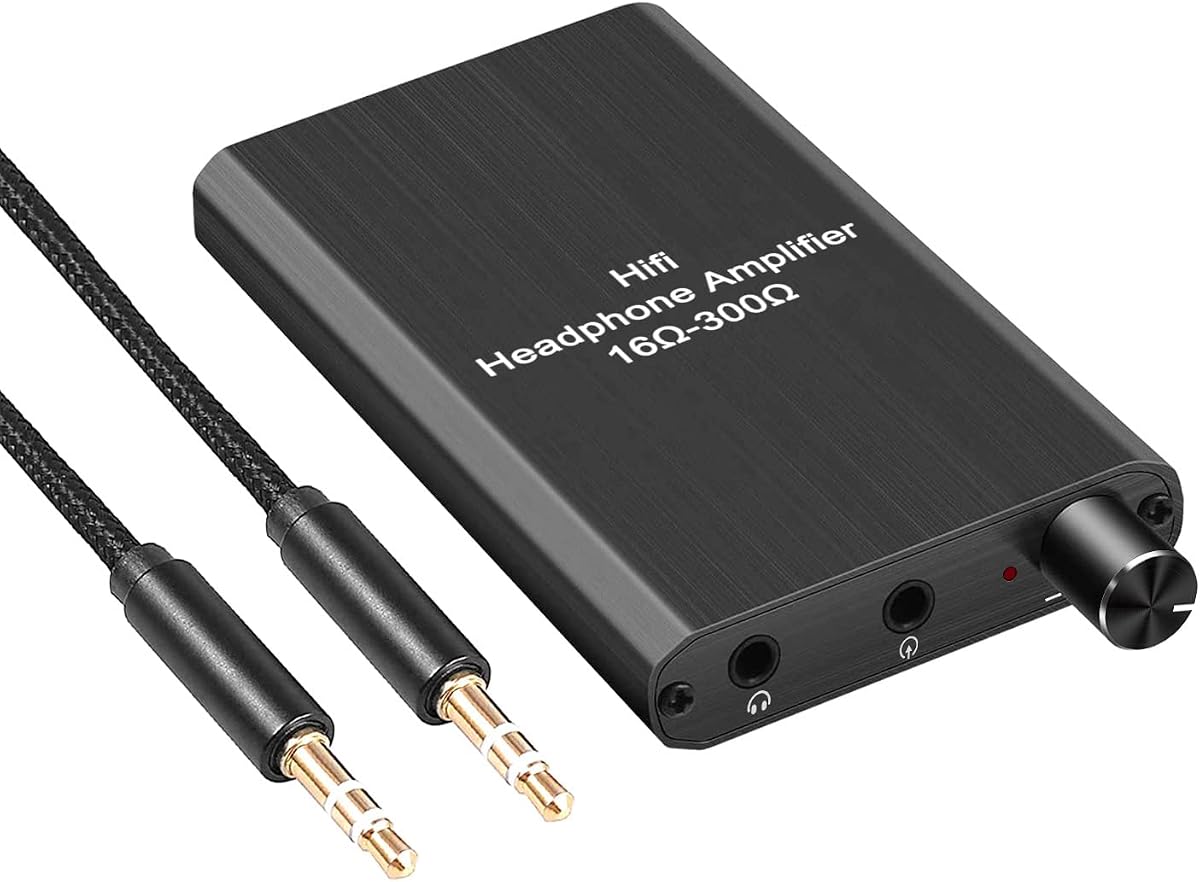
Portable Headphone Amplifier with GAIN Switch
4.5Editor score
15-hour rechargeable battery
Separate high and low gain
Inline volume adjustment
3.5mm input and output
This expert guide compares 10 inline headphone amplifiers across gain control, impedance support, portability, connectivity, sound specifications, and desktop
An inline headphone amplifier adds gain, control, and cleaner signal delivery between an audio source and your headphones. A good model can improve volume, reduce distortion, support demanding headphone impedances, and provide convenient switches for different listening situations.
We compared all ten products by examining their stated impedance ranges, gain controls, signal-to-noise ratios, distortion figures, input and output options, power requirements, and portability. The guide covers compact battery-powered units for travel as well as desktop Class A amplifiers for home listening.
Each review identifies the product's strongest applications, practical limitations, and ideal user, from listeners seeking a simple bass boost to audiophiles who need high power and flexible input connections. Product ratings and availability can change, and current prices should always be checked before purchasing.
4.5Editor score

4.3Editor score

4.5Editor score
The comparison below highlights the major differences among portable, travel-ready, and desktop inline headphone amplifiers, including supported impedances, gain selection, power, and connection options.


The Neoteck 16-300 Ohm Portable Headphone Amplifier is a balanced all-purpose choice for listeners who want more control over a broad range of headphones without moving to a desktop setup. It carries a 4.3 rating and supports impedances from 16 to 300 ohms, covering many earbuds, conventional over-ear headphones, and more demanding studio-style models.
We may earn a commission when you buy through this link, at no additional cost to you.
Its principal strengths are the two-stage gain switch, stated signal-to-noise ratio above 120 dB, and low THD+N figure of 0.0003 percent. The included 1500mAh rechargeable battery provides more than 12 hours of continuous use, while the aluminum housing, 102-gram weight, and smartphone-like proportions make it straightforward to carry.
The trade-offs are mostly about connectivity and tone shaping. It uses 3.5mm input and output rather than offering modern digital inputs or balanced connections, and it does not include a dedicated bass switch. Those limitations make it less versatile than some alternatives for a permanent desktop system, but they also keep the design simple and portable.
This is a strong recommendation for mobile listeners, commuters, students, and home users who want a dependable inline amplifier with battery power. Start with the gain setting appropriate for the connected headphone, set the source volume reasonably, and then adjust the amplifier to avoid unnecessary gain.
The two-stage gain switch makes the amplifier useful with both efficient and higher-impedance headphones. It also reduces the need to rely entirely on an unsuitable software volume control when connecting a phone, laptop, or portable player.
A battery life of more than 12 hours supports long flights, commutes, and extended listening away from an outlet. The compact aluminum body also offers a more premium feel than a disposable-battery inline booster.
We may earn a commission when you buy through this link, at no additional cost to you.
The Neoteck 3.5mm Headphone Amp with Bass Boost stands out with a 4.6 rating, the highest rating among the ten listed products. It combines a stated 16-600 ohm range with a dedicated bass switch, making it appealing to listeners who want extra low-end shaping in addition to more power.
We may earn a commission when you buy through this link, at no additional cost to you.
Signal purity is supported by a stated SNR above 100 dB and THD+N of 0.0005 percent. The rechargeable battery lasts more than eight hours, and the aluminum, lightweight enclosure is designed for portable use with phones, laptops, MP3 players, portable CD players, and other 3.5mm sources.
Its bass control is a feature rather than a universally neutral option, so listeners who prefer an unaltered presentation may leave it disabled. The manufacturer also advises against using the amplifier while charging because of safety and current interference. Compared with the first Neoteck model, its battery runtime is shorter despite the wider impedance range.
Choose this model if you listen to bass-heavy music, want one portable device to cover unusually wide impedance demands, or value a simple bass switch. It is less compelling for long journeys where maximum battery life matters more than tonal flexibility.
The bass control gives users a quick way to emphasize low frequencies without permanently changing system settings. It is especially useful for selected genres and can be left off for more neutral listening.
The stated 16-600 ohm compatibility is unusually broad for a portable unit. That makes it a practical single-device option for a collection that includes both sensitive in-ear monitors and high-impedance headphones.
We may earn a commission when you buy through this link, at no additional cost to you.
The eSynic Rechargeable 16-300 Ohms Portable Headphone Amplifier is particularly well suited to travel, older car audio systems, and listeners using high-impedance headphones. It has a 4.3 rating and explicitly identifies output levels of 30mW into 16 ohms and 15mW into 300 ohms.
We may earn a commission when you buy through this link, at no additional cost to you.
Its two-stage gain switch separates lower-impedance headphones from demanding loads up to 300 ohms. The stated SNR exceeds 100 dB and THD+N is as low as 0.0003 percent, while the rechargeable design provides more than 12 hours of playback. Two included cables, measuring 12cm and 100cm, add practical flexibility.
The amplifier remains limited to a maximum stated impedance of 300 ohms, so it does not cover the 600-ohm range claimed by some alternatives. It also uses only 3.5mm connections and offers no dedicated bass adjustment or balanced output. The slim 95 by 52 by 13mm enclosure helps offset those functional limits for travel use.
This is a convincing choice for commuters, drivers, flyers, and anyone who wants to drive 250-300 ohm headphones from a laptop or phone. It is also a straightforward way to add gain to an older car's AUX connection without replacing the head unit.
The published output figures and separated gain ranges provide a clearer idea of what to expect from demanding headphones. It is better suited to this use case than a basic inline volume booster with no impedance selection.
The included 12cm and 100cm cables cover close-range desktop connections and more extended setups. The rechargeable 12-hour runtime also makes the device practical for flights and long drives.
We may earn a commission when you buy through this link, at no additional cost to you.
The eSynic Rechargeable 16-600Ω Headphone Amplifier Portable with Gain Switch delivers one of the most ambitious portable specifications in this roundup. It has a 4.3 rating, supports 16-600 ohm headphones, and states 80mW output into a 600-ohm load.
We may earn a commission when you buy through this link, at no additional cost to you.
Its dual-voltage plus or minus 4V circuit is designed to maintain signal consistency, while the stated SNR exceeds 100 dB and THD+N is 0.0003 percent. Low gain covers 16-32 ohm earbuds and IEMs, whereas high gain covers 50-600 ohm monitoring headphones. A 12-hour battery life and 95 by 52 by 13mm aluminum enclosure preserve portability.
The two-stage control is less granular than having continuously variable gain, so users may need to work with the source's volume control for fine adjustment. There is also no bass switch, output-level meter, or digital input. The 6061 aluminum enclosure is described as providing RF and EMI shielding and effective heat dissipation, but it does not make the device as compact as the simplest inline boosters.
This model is a strong fit for a listener who wants one portable amplifier capable of handling a very broad headphone collection. It is especially attractive for users who regularly switch between sensitive IEMs and 300-600 ohm models and want a defined high-gain range.
A stated 80mW into 600 ohms provides meaningful output for a battery-powered device. This specification makes the amplifier more relevant for audiophile models than units designed mainly to add modest gain to easy-to-drive headphones.
The low range is appropriate for sensitive earbuds, while the high range addresses power-hungry studio models. Starting on low and increasing only when needed helps avoid excessive gain.
We may earn a commission when you buy through this link, at no additional cost to you.
The LVY Portable Headphone Amplifier is a straightforward option for users who want an inexpensive, rechargeable gain booster with more capability than a passive volume adapter. It has a 4.3 rating, a 16-300 ohm load range, and a two-stage gain switch.
We may earn a commission when you buy through this link, at no additional cost to you.
Its stated signal-to-noise ratio is above 120 dB, and distortion is listed at 0.004 percent. The 3.5mm AUX input and output make it compatible with MP3 and MP4 players, phones, laptops, computers, and other 3.5mm digital devices. The rechargeable format removes the need for disposable batteries.
The primary limitation is runtime: more than five hours is less convenient than the 8- to 15-hour claims of several competing portable models. Its 0.004 percent distortion figure is also higher than the 0.0003-0.0005 percent figures stated for the leading portable choices, though those numbers alone do not determine the final listening experience.
Buy this model for everyday portable use with moderate-impedance headphones, especially if simplicity and rechargeability matter more than long battery life. It is less suitable as the sole amplifier for a demanding collection spanning well beyond 300 ohms.
The universal 3.5mm connection removes much of the setup complexity. It can sit between a phone, music player, or computer and a compatible pair of headphones without requiring a special desktop system.
The rechargeable construction is convenient for repeated portable use. Users should account for the shorter operating time when planning long journeys or sessions away from a power source.
We may earn a commission when you buy through this link, at no additional cost to you.
The Douk Audio U3 Headphone Amp is designed for a permanent home or office system rather than portable use. It has a 4.3 rating, uses a Class A circuit, and is described as providing warm, delicate, full, and mellow sound for a range of vocal, string, classical, pop, and rock material.
We may earn a commission when you buy through this link, at no additional cost to you.
The amplifier accepts RCA and 3.5mm inputs and offers both 6.35mm and 3.5mm headphone outputs. Its stated drive capability extends to widely recognized high-impedance models such as the HD580, HD600, HD650, K701, K702, Q701, DT880, T70, T90, SR225, SR325, and RS1e. A pluggable op-amp socket adds customization for interested users.
The architecture uses a TI-NE5532 op amp with an expanding current circuit and a 1300mA transistor operating in Class A. A wide stated DC input range of 5-20V gives installation flexibility, although the unit still needs a suitable power supply and a permanent location. It is not a direct substitute for a rechargeable travel booster.
This is a sensible choice for desktop listeners who want more output, larger headphone plugs, and analog stereo inputs. It is particularly attractive for those who want to experiment with replaceable op-amps without moving to a large, complicated component.
RCA input allows connection to a more conventional stereo source, while 3.5mm input serves computers, phones, and compact systems. Matching 3.5mm and 6.35mm outputs reduce the need for adapters.
The replaceable op-amp socket introduces a practical upgrade path. The stated ability to drive demanding high-impedance headphones is the main reason to consider this model over a portable inline unit.
We may earn a commission when you buy through this link, at no additional cost to you.
The eSynic Rechargeable 16-150Ω Headphone AMP is aimed at listeners using portable headphones, earbuds, and moderately demanding over-ear models. It carries a 4.3 rating and supports 16-150 ohm loads, with 30mW output into 150 ohms and a stated eight-hour runtime.
We may earn a commission when you buy through this link, at no additional cost to you.
A two-stage gain switch assigns 16-32 ohms to low gain and 50-150 ohms to high gain. The dual-voltage circuit is stated to provide an SNR above 100 dB and THD+N of 0.0003 percent. Its 6061 aluminum enclosure also contributes shielding and heat dissipation, while the 95 by 52 by 13mm dimensions preserve portability.
Its most important limitation is the 150-ohm ceiling. Headphones with 250- or 300-ohm ratings fall outside the stated range, as do 600-ohm models. The product also lacks a bass boost, digital input, balanced output, and the longer battery runtime found in some competitors. The included 1m cable is useful, though a shorter cable may be convenient for pocket use.
This is a good match for travel, mobile gaming, or a collection centered on IEMs and popular portable headphones. Buyers should verify the impedance of any high-end headphone they intend to connect and choose a broader model if it lies outside the supported range.
The 16-32 ohm low-gain range is designed for sensitive earbuds and in-ear monitors. It provides a controlled way to add power without forcing excessive gain onto efficient transducers.
The aluminum body helps manage heat and limit radio-frequency interference. Its compact dimensions make the amplifier easy to carry, although the 150-ohm limit should guide expectations.
We may earn a commission when you buy through this link, at no additional cost to you.
The eSynic Portable Bass Boost Style Headphone Amplifier is the most explicitly bass-focused model in the group. It has a 4.4 rating, supports 16-300 ohm headphones, and offers a stated 13.3dB boost around the 50Hz range while retaining midrange clarity.
We may earn a commission when you buy through this link, at no additional cost to you.
Output is listed at 160mW into 16 ohms and 25mW into 300 ohms, with THD+N below 0.005 percent. The 1000mAh battery supports more than eight hours at 75mW into a 64-ohm load, and 5V/1A charging is stated to reach a full charge in approximately 2.5 hours.
The bass control is a substantial tonal adjustment rather than a subtle effect, so it may not suit listeners who want strict neutrality. The product otherwise focuses on amplification rather than broad source control, and its eight-hour runtime is shorter than the strongest alternatives. The stated 85-gram weight and included cables help offset that limitation for mobile use.
This amplifier makes sense for EDM, hip-hop, cinematic content, and casual listeners who want more impact from small headphones. Audiophiles monitoring mixes should leave the boost disabled, while bass-focused mobile users may find it more useful than a purely neutral inline booster.
The stated 50Hz focus targets bass fundamentals without claiming to alter the entire frequency spectrum. It gives users an obvious tonal option that can be switched off when a more neutral presentation is wanted.
The 160mW rating into 16 ohms provides substantial power for portable headphones and earbuds. This makes the model useful when a phone or laptop does not offer enough clean output.
We may earn a commission when you buy through this link, at no additional cost to you.
The Douk Audio U3 PRO HiFi Mini Class A Headphone Amplifier is the premium desktop selection in this guide. It has a 4.5 rating and combines a stated maximum output of 1500mW at 32 ohms with support for headphone impedances from 18 to 600 ohms.
We may earn a commission when you buy through this link, at no additional cost to you.
Its built-in voltage boost circuit operates at plus or minus 14V from a 5V input, supporting the stated low distortion and warm, delicate presentation. Stereo L/R RCA and 3.5mm AUX inputs provide source flexibility, while 3.5mm and 6.35mm headphone outputs accommodate earbuds, portable headphones, and larger studio plugs.
The OP42 and BUF634 architecture includes a replaceable op-amp socket, allowing compatible alternatives such as OP17, AD797, AD843, AD847, and OPA627 to be used. This is an attractive feature for hobbyists, although not every user will need the complexity. Unlike the portable options, it requires power and is intended for a home or office setup.
The U3 PRO is the strongest recommendation for audiophiles who need substantial desktop power, multiple analog inputs, and upgrade potential. It offers more capability than a travel-oriented inline amplifier while remaining smaller and simpler to operate than a large component system.
The stated 1500mW output at 32 ohms provides comfortable headroom for high-impedance and power-hungry headphones. It is a meaningful advantage when the goal is dynamics and volume rather than merely a modest boost.
Replaceable op-amps allow users to explore circuit changes without replacing the entire amplifier. Multiple inputs and both common headphone jack sizes make it easy to integrate with an existing desktop system.
We may earn a commission when you buy through this link, at no additional cost to you.
The Portable Headphone Amplifier with GAIN Switch is an attractive budget pick because it combines a 4.5 rating with a particularly long stated battery life of 15 hours. It supports 16-150 ohm headphones and adds both high and low gain plus a dedicated volume control.
We may earn a commission when you buy through this link, at no additional cost to you.
Its 3.5mm input and output make it suitable for Switch, PS4, PS5, mobile phones, PCs, MP3 and MP4 players, and compatible headphones such as the HD 650, subject to the stated 150-ohm support limit. A 1000mAh battery recharges through Micro USB, while separate power and volume controls provide straightforward operation.
The 150-ohm ceiling is the most important qualification. Some well-known high-impedance headphones exceed that range, so buyers should verify the exact model and its impedance before expecting full output. Micro USB is also less convenient than the USB-C charging used by several competing portable amplifiers.
Despite those limitations, this is a strong budget recommendation for gaming, mobile listening, and travel. The long runtime, simple controls, and flexible gain make it particularly useful for users who want more control than a passive inline adapter without moving to a full desktop system.
The stated 15-hour operating time is the strongest battery figure in this group. It suits long gaming sessions, extended travel, and all-day listening without frequent charging.
Separate volume and power controls make the amplifier easy to operate. The high and low gain switch also allows listeners to tailor output to more efficient headphones.
We may earn a commission when you buy through this link, at no additional cost to you.
The right inline headphone amplifier depends on headphone impedance, source flexibility, listening location, and whether sound shaping matters more than portability. The following factors help narrow the field without overlooking practical compatibility.
Impedance describes the electrical load presented by the headphones, while sensitivity indicates how efficiently they convert signal into sound. A portable amplifier with a stated range up to 150 ohms is suitable for many earbuds and mainstream wireless-style over-ear headphones, but it may not provide adequate voltage for 250-, 300-, or 600-ohm models. Always check the manufacturer's impedance figure before buying, especially if the amplifier advertises a maximum exactly at the headphone's rating.
Output power is one of the clearest indicators of whether a device can drive demanding headphones. The listed products range from a 30mW output into 150 ohms to as much as 1500mW at 32 ohms in the desktop Douk model. Portable users should also look for separate gain stages, since switching between low and high gain is safer and more practical than forcing maximum gain onto sensitive earbuds.
A higher signal-to-noise ratio generally means the added circuitry introduces less unwanted noise relative to the music signal. Values above 100 dB are common among the stronger portable choices, while the first Neoteck and LVY models state figures above 120 dB. Total harmonic distortion plus noise, written as THD+N, should also remain low; the portable models in this guide state figures from 0.0003 to 0.005 percent.
Most portable inline amplifiers use 3.5mm input and output connections, making them straightforward with phones, laptops, portable players, and gaming systems. Desktop models can be more flexible: the Douk Audio U3 accepts RCA and 3.5mm inputs, while the U3 PRO also provides 3.5mm and 6.35mm headphone outputs. Check both ends of the signal chain, because an amplifier cannot improve a connection that is inconvenient, unbalanced, or incompatible.
Battery-powered amplifiers are valuable for commuting, flying, gaming away from a desk, and connecting to a car AUX system. Stated runtimes range from more than five hours for the LVY model to 15 hours for the budget pick with a GAIN switch. Charging standards also matter: some products use USB-C, while others use Micro USB. For long trips, prioritize a realistic battery estimate and carry the appropriate cable when needed.
A bass switch can be useful for selected genres, but it changes the tonal balance rather than simply adding clean gain. The Neoteck 3.5mm model and the eSynic Portable Bass Boost Style model provide dedicated bass adjustments, while the other products focus on amplification. Listeners who monitor recordings or prefer neutral sound may place more value on straightforward gain selection and minimal coloration.
A permanent desktop system can justify more elaborate construction, multiple input formats, larger headphone plugs, and user-replaceable components. Both Douk Audio models use a Class A design, and the U3 PRO adds a replaceable op-amp socket. Portable models instead emphasize rechargeable batteries, 3.5mm connectivity, and compact dimensions. The right choice depends on whether mobility or long-term system flexibility is your main priority.
Several products use aluminum housings that assist with heat dissipation and electromagnetic shielding. That is particularly relevant for a portable device placed close to a phone, laptop, or game console. The eSynic models use 6061 aluminum enclosures, while the Neoteck and LVY options also emphasize aluminum construction. Weight, jack durability, and the presence of clear controls can be just as important as the enclosure material in daily use.
Begin by confirming that the source has the correct output connection and that the amplifier's input matches it. Connect the source to the amplifier first, select the appropriate gain stage, and then attach the headphones. On a desktop model, connect the power supply before switching the unit on and use the source's own volume control to establish a moderate starting level.
For portable models, charge the battery fully before a long session and carry the specified charging cable. Set the source volume low, connect the headphones, choose low gain for sensitive models, and increase the amplifier's volume gradually. Move to high gain only when a headphone requires it, and avoid unnecessary extreme settings that can amplify noise or create excessive headroom.
Keep the charging and audio ports clean, route cables without sharp bends, and avoid moisture or extreme heat. Do not operate a rechargeable model while charging unless its manufacturer explicitly permits it; the Neoteck 3.5mm model specifically advises against that practice. Store the unit in a dry place, inspect the cables for damage, and consult the included guidance whenever a connector, power supply, or firmware-related behavior is uncertain.
No. An amplifier is most useful when your source cannot provide enough volume, your headphone has a high impedance, or you want cleaner gain than a phone or laptop can deliver. Efficient earbuds and easy-to-drive headphones may work perfectly well without one. Trying the headphones directly first is a sensible way to identify a real need.
Choose an amplifier whose stated range includes the impedance of your headphone. Portable models here cover 16-150, 16-300, or 16-600 ohms, while desktop options extend as high as 600 ohms. If your headphone sits at the very top of a model's range, a model rated for a higher load may provide more practical headroom.
A passive volume adapter only reduces an analog signal and provides no additional power. An active inline amplifier uses electronics to add gain, which can make high-impedance headphones louder while potentially reducing distortion. Active models may also add gain switching, bass controls, rechargeable power, or other features.
Start with low gain, particularly for sensitive in-ear monitors or efficient headphones. Move to high gain only if the headphone needs more voltage or you cannot reach a comfortable level. Excessive gain can make noise more obvious and offers no benefit when the headphone is already driven comfortably.
The listed portable amplifier with a GAIN Switch explicitly supports Switch, PS4, and PS5 systems through its 3.5mm connections. Compatibility with any other console depends on having a usable analog headset output and the correct cable. Check the console's output design and whether it carries microphone or chat signals as well as headphone audio.
A bass boost increases selected low-frequency energy; it does not inherently correct a poor headphone. It can be enjoyable with certain music or make thin low end feel more substantial, but it may cause muddiness, mask vocals, or reduce headroom. Audiophiles and critical listeners usually prefer to leave such controls off unless they are intentionally seeking a different presentation.
It depends on the use case. A desktop Class A amplifier generally offers greater power, steadier operation, and more input options, making it better suited to demanding headphones and permanent systems. A portable rechargeable model is more convenient for travel, gaming, and use with phones. The correct choice follows the headphones, source, and listening location rather than the circuit label alone.
Keep the battery partially charged during long storage periods, use the intended charging cable and power source, and avoid leaving the unit in extreme heat or moisture. Inspect the 3.5mm plugs and cables for wear, clean the ports gently, and do not charge while listening if the manufacturer advises against it. Updating your choice of gain and volume settings as your headphone collection changes also helps maintain safe, consistent output.
The top selections cover different priorities. The Neoteck 16-300 Ohm Portable Headphone Amplifier is the balanced overall choice with strong specifications, gain switching, and 12-hour battery life. The Portable Headphone Amplifier with GAIN Switch is the budget leader thanks to its 15-hour runtime and 4.5 rating, while the Douk Audio U3 PRO is the premium desktop option for high power and extensive connectivity.
Prioritize supported impedance before any secondary feature. Once the amplifier can drive the intended headphone, consider gain control, noise and distortion specifications, battery life, jack sizes, and source connections. Bass controls make sense for listeners seeking a specific tonal effect, whereas neutral playback and upgradeable desktop construction appeal to different audiences.
Ratings, product details, and prices can change, so check the current listing and compatibility information before ordering. Also verify the exact headphone impedance and the supplied cable arrangement. With those checks completed, the right inline amplifier can provide cleaner output, more practical volume control, and a better match for the way you listen.