
Cable Matters Infrared Remote Extender Cable
4.3Editor score
15-foot IR signal range
USB-powered wired design
Works with infrared equipment
Adhesive-backed mounting
Blue signal confirmation LED
IR Remote Extender guide comparing ten kits for range, device compatibility, multi-device control, installation ease, and infrared signal extension at home.
An IR Remote Extender makes infrared-controlled entertainment equipment easier to use when the device is hidden in a cabinet, equipment closet, or another room. A good system preserves commands from an existing remote, places a receiver where it can be aimed, and sends those commands to the equipment through attached emitters.
The products in this guide were compared using their stated control methods, supported device types, coverage, emitter and receiver arrangement, installation requirements, and compatibility limitations. The list covers compact wired kits as well as wireless systems designed to carry commands across rooms, cabinets, walls, and other obstacles.
Each pick highlights a distinct use case, from a straightforward single-device solution to expandable systems for complex home theaters. Ratings and technical details reflect the supplied product information, while current prices and availability can change, so shoppers should verify those details before purchasing.
4.3Editor score

4.8Editor score

4.7Editor score
The table below compares the ten extender kits by control range, system style, device capacity, and installation considerations, making it easier to identify the option that matches your equipment and room layout.




The Cable Matters Infrared Remote Extender Cable is a straightforward solution for people who want to operate one infrared-controlled source without leaving it exposed. It carries commands from a receiver near the remote toward a transmitter positioned beside the equipment. Its supplied rating is 4.3, which reflects a generally practical design with clear installation guidance and useful power-management notes.
We may earn a commission when you buy through this link, at no additional cost to you.
The system supports an IR signal range of up to 15 feet, while the included cable is 6 feet long. A 30-degree receiver angle provides some placement flexibility, and the blue LED confirms when a command is being received. Adhesive backing on the transmitter and receiver simplifies attachment to a cabinet, wall, or entertainment unit. USB power keeps the setup uncomplicated, although a separate wall charger is recommended because a television's USB port may not operate while the television is off.
Its limitations are important but easy to understand. This is a wired extender rather than a wireless whole-room system, and it only works with equipment that uses an infrared sensor. It cannot operate RF-controlled devices, Bluetooth-only remotes, or equipment designed solely for app and network control. Placement can also affect performance, so the receiver should face the handheld remote and remain away from Wi-Fi routers and CFL lighting.
This is a strong choice for a cable box, DVD player, Blu-ray player, receiver, or similar component hidden behind a cabinet door. It is especially appealing to shoppers who value a compact installation, recognizable confirmation LED, and uncomplicated USB power over advanced channel controls or room-to-room transmission. For a single concealed source, it provides the essentials without requiring a larger distribution network.
The transmitter can be placed near the source's IR sensor while the receiver remains visible to your remote. This arrangement lets you keep the equipment in an equipment closet and operate it from the main viewing area without exposing the device itself.
The blue receiver LED provides immediate confirmation that a command is reaching the extender. For troubleshooting, it helps distinguish an aiming or placement issue from a remote or equipment compatibility problem.
We may earn a commission when you buy through this link, at no additional cost to you.
The Fourair Infrared Wireless IR Repeater is designed for situations where the controlled equipment must be separated from the remote by a substantial distance. Its wireless emitter and receiver can bridge up to 700 feet, according to the supplied information, while the receiver can pick up a remote within 30 feet across a 90-degree area. The product carries a 4.3 rating.
We may earn a commission when you buy through this link, at no additional cost to you.
This arrangement is useful for entertainment cabinets, wardrobes, and equipment rooms where cables from the source to a receiver would be inconvenient. The system operates across a 20–60KHz frequency range, making it suitable for many DVD players, cable or satellite boxes, and audio equipment. A built-in LED illuminates when the repeater receives a signal, providing basic confirmation during setup.
The most important installation detail is that extension cables should remain in line of sight with the source IR sensor and be no more than two inches away for best signal transfer. Despite the long wireless link, reliable control still depends on the emitter being positioned correctly. Bluetooth remote systems, certain smart televisions, app-driven streaming products, and other non-IR devices remain outside the product's stated compatibility.
Choose this kit when cabinet concealment or long physical separation is the main objective. It offers more flexibility than a short wired cable and comes with a stated one-year warranty. It is best suited to IR-operated home entertainment components rather than newer smart-home or app-controlled devices, and the receiver should be positioned where your existing remote can aim at it clearly.
The wireless design makes it practical to keep bulky components in a remote location while retaining remote control from the viewing area. The stated 700-foot extension distance provides ample flexibility for larger homes and unusual room layouts.
A 20–60KHz operating range covers many common infrared entertainment devices. Checking your source's remote type and sensor location before installation helps avoid purchasing a system that is not suitable for Bluetooth or network-based controls.
We may earn a commission when you buy through this link, at no additional cost to you.
The Infrared Repeater System is built for home theaters with several hidden components rather than a single concealed source. It can control up to 10 devices and expand to 12, covering amplifiers, cable boxes, stereo receivers, satellite receivers, CD players, DVD players, and Blu-ray players. Its supplied rating is 4.4, and the package includes a distribution block, power plug, receiver, five dual emitters, and an instruction manual.
We may earn a commission when you buy through this link, at no additional cost to you.
The receiver is 5 feet long, while each of the five dual IR emitters is 10 feet long. That generous wiring makes it possible to place emitters near devices stored in different parts of a cabinet. High-sensitivity transmission is designed for real-time response, and indicator lights show power and command activity. The stated broadband compatibility is intended to work with a wide selection of infrared-controlled electronics.
Setup does require planning. The receiver should be kept away from plasma displays because their emitted infrared frequencies may interfere with operation. When two or more receivers are connected to the transceiver's 3.5mm ports, the guidelines advise at least six meters of separation between receivers. Compact fluorescent lighting is also addressed by the system as an environmental consideration.
This is a practical pick for a densely equipped entertainment center where many source components need to remain behind closed doors. The included five emitters offer more attachment options than a single-head cable, and the distribution block supports organized multi-device control. Buyers should carefully map the cabinet and follow the receiver-spacing guidance, but the result is a more capable system than a basic one-device extender.
The ability to handle up to 10 devices and expand to 12 makes this system useful for entertainment setups containing several receiver components. Five dual emitters provide multiple placement points throughout a larger cabinet or equipment area.
Green and red receiver indicators distinguish power status from active command transmission. This makes the system easier to diagnose when several devices are involved, especially if one unit responds intermittently.
We may earn a commission when you buy through this link, at no additional cost to you.
The 2CH IRBlast Wireless IR Repeater combines a 500-foot wireless link with two independent channels, making it one of the most versatile options in this guide. It has a supplied rating of 4.8, the highest among the listed products, and is especially useful where neighboring cable boxes or stereo components could otherwise respond to the same commands.
We may earn a commission when you buy through this link, at no additional cost to you.
The receiver captures IR commands within a 45-degree area, while the emitter sends the commands onward to attached devices. Matching channel switches on the receiver and emitter allows two separate control paths, which reduces accidental cross-control between adjacent components. The package includes an IR receiver, emitter, two extension cables, dual AC and USB power adapters, adhesive stickers, and a manual.
Power flexibility makes installation easier in entertainment furniture where one outlet or USB connection may be more convenient than the other. The adhesive emitter probes can be attached directly over an equipment IR window, while the signal LED flashes as soon as a command is received. As with all infrared systems, the remote itself must use IR; RF remotes, Bluetooth-only televisions, Wi-Fi devices, and app-controlled streaming boxes are not supported.
This is an excellent choice for a cabinet containing multiple similar components or for a setup where accidental commands would be disruptive. Its combination of long-distance wireless control, channel separation, and straightforward mounting makes it a strong all-around recommendation. The stated open-air maximum of 984 feet and typical 500-foot range should be understood as theoretical transmission figures, with obstacles and room layout affecting actual results.
The two selectable channels let you separate equipment that would otherwise react to identical IR commands. Matching the switches on both units reduces unwanted control of neighboring cable boxes, receivers, and audio components.
The flashing indicator responds as soon as the receiver detects a command. That immediate feedback helps identify whether the problem lies in remote aiming, receiver placement, or the final emitter position.
We may earn a commission when you buy through this link, at no additional cost to you.
The Herfair IR Extender Cable is a practical wired solution for hiding a set-top box or other infrared source while retaining access to its remote commands. The kit includes a smaller IR transmitter, a larger IR receiver, and a USB power connection. Its supplied rating is 4.3, and the design emphasizes straightforward placement and visible status feedback.
We may earn a commission when you buy through this link, at no additional cost to you.
The system claims a control range of up to 49 feet at a 45-degree angle, which gives the handheld remote more freedom than a typical direct line of sight arrangement would allow. The receiver-to-USB section is 4.5 feet, while the receiver-to-transmitter section is 6.6 feet, creating an 11-foot total installation length. Both IR heads have adhesive backing for convenient attachment under a television or inside a cabinet.
It is compatible with common IR-controlled DVD players, set-top boxes, amplifiers, receivers, and similar A/V equipment. The red LED in the receiver indicates operating status, which is useful when determining whether the path from remote to receiver is working. The system must receive 5V power, and it should be kept away from routers to reduce potential interference. It does not add wireless coverage between separate rooms.
This kit suits a straightforward home setup in which the controlled equipment is close enough for an 11-foot wired run. It offers more generous remote positioning than the shortest cable options and greater simplicity than a multi-channel or distribution-based system. It is best for one or a small number of nearby IR devices rather than a large, multi-room installation.
The 49-foot stated control range allows you to move around more freely while the source remains concealed. The two-part cable path also gives the receiver and transmitter separate mounting locations.
The red receiver LED provides a quick way to confirm that the extender is powered and processing commands. This is useful during initial setup and when repositioning the receiver.
We may earn a commission when you buy through this link, at no additional cost to you.
The Sewell SW-32988 Direct BlastIR Wireless Pro is a wireless extender aimed at installations where a directional receiver can be positioned for reliable command pickup. It has a supplied rating of 4.1 and provides a stated 650-foot wireless distance between the emitter and receiver, plus approximately 30 feet of remote reception from the IR receiver.
We may earn a commission when you buy through this link, at no additional cost to you.
The receiver is directional and should face the location where the remote will be used. Sewell recommends connecting the included IR receiver cable to widen the usable angle and improve reception. The emitter should sit within a few inches of the device being controlled; attaching the optional emitter cables directly over a device's IR receiver provides more consistent results than merely pointing the emitter toward it.
The package includes USB and AC power cables, extra IR cables, mounting adhesive, and rubber feet. Despite its wireless architecture, the system remains limited to IR-controlled devices. The product information also identifies incompatibility with the Yamaha HTR 6140, Arris DCX 3520E-M, and OSD ATM-7 Speaker Selector, making model verification important before purchase.
This kit makes sense for users who want a substantial wireless distance and can carefully position a directional receiver. It is less suitable when commands must be accepted from many directions or when any of the specifically listed components are part of the planned system. Confirming the remote type and equipment model before ordering can prevent an otherwise avoidable compatibility problem.
The included receiver cable allows the main unit to be linked to a more favorably positioned sensor. That gives users a way to improve directional reception when the primary receiver location cannot face the remote directly.
The optional emitter cables are designed to stick directly over a device's IR sensor. This close placement is more dependable than pointing a freestanding emitter at an equipment window from a distance.
We may earn a commission when you buy through this link, at no additional cost to you.
The IR Repeater Kit is designed to control a large number of infrared A/V components concealed behind doors or walls. According to its supplied information, it can operate up to 32 components and does not require line of sight between the receiver and those components. Its stated rating is 4.1, and its primary strengths are capacity and support for hidden equipment.
We may earn a commission when you buy through this link, at no additional cost to you.
The system provides one IR receiver input and four IR emitter outputs, and it works with practically all brands of A/V infrared remotes. Equipment such as cable or satellite receivers, stereo receivers, amplifiers, CD players, DVD players, and Blu-ray players can be operated from the existing remote. A built-in confirmation LED on the receiver acknowledges receipt of commands, offering a basic way to verify signal pickup.
Its four initial emitter outputs make it more versatile than a single-device cable, although the stated maximum of 32 components suggests the system may be intended to scale through additional compatible expansion. Buyers should confirm how their chosen configuration is assembled and whether additional emitters or other components are required. Placement still matters: the receiver should capture the remote's command before the system can distribute it.
This is a good fit for a large entertainment cabinet, equipment room, or collection of legacy A/V hardware controlled by infrared. It is especially useful when closed doors or walls make direct remote access impossible. Shoppers should plan the number and location of emitter connections carefully, but the system offers a high capacity and broad compatibility for a multi-device installation.
The system can carry commands through solid cabinet doors or walls, removing the need for direct line of sight to every controlled component. This is the core advantage for installations built around hidden equipment.
Support for up to 32 IR components is useful for homes with extensive amplifier, disc-player, receiver, and set-top-box collections. The included emitter outputs provide a starting point for distributing commands around those devices.
We may earn a commission when you buy through this link, at no additional cost to you.
The Hidden Infrared Remote Extender System is designed to let an existing infrared remote operate A/V components from another room. That capability can support tasks such as adjusting volume or changing a TV channel when the source equipment is not in the same space. The product has a supplied rating of 4.4 and includes one receiver with an LED plus four IR emitters.
We may earn a commission when you buy through this link, at no additional cost to you.
The receiver cable measures two meters, while each emitter cable is one meter. This arrangement offers some placement flexibility for entertainment furniture and nearby equipment. A 34–60KHz operating range supports most IR devices, including amplifiers, cable boxes, stereo and satellite receivers, CD players, DVD players, and Blu-ray players.
The receiver uses a 5V USB AC power supply, making it straightforward to install where a suitable outlet is available. The remote should be aimed toward the receiver for best results, so the system depends on a practical line of sight between the person holding the remote and the receiver. As with other IR-based products, it does not add support for Bluetooth, RF, Wi-Fi, or app-only controls.
This kit is a sensible choice for a two-room arrangement where one room contains the entertainment equipment and another needs remote access. Four emitters allow commands to reach several components, while the compact receiver is easy to position near a doorway or media area. It offers a useful balance of multi-device support and uncomplicated setup, provided the remote can be aimed at the receiver.
The system can carry commands from a receiver in one location to emitters connected to equipment in another. This makes basic volume and channel control available beyond a single entertainment area.
A two-meter receiver lead and one-meter emitter leads provide enough reach for many cabinet and room arrangements. The included four emitters support control of several connected A/V sources.
We may earn a commission when you buy through this link, at no additional cost to you.
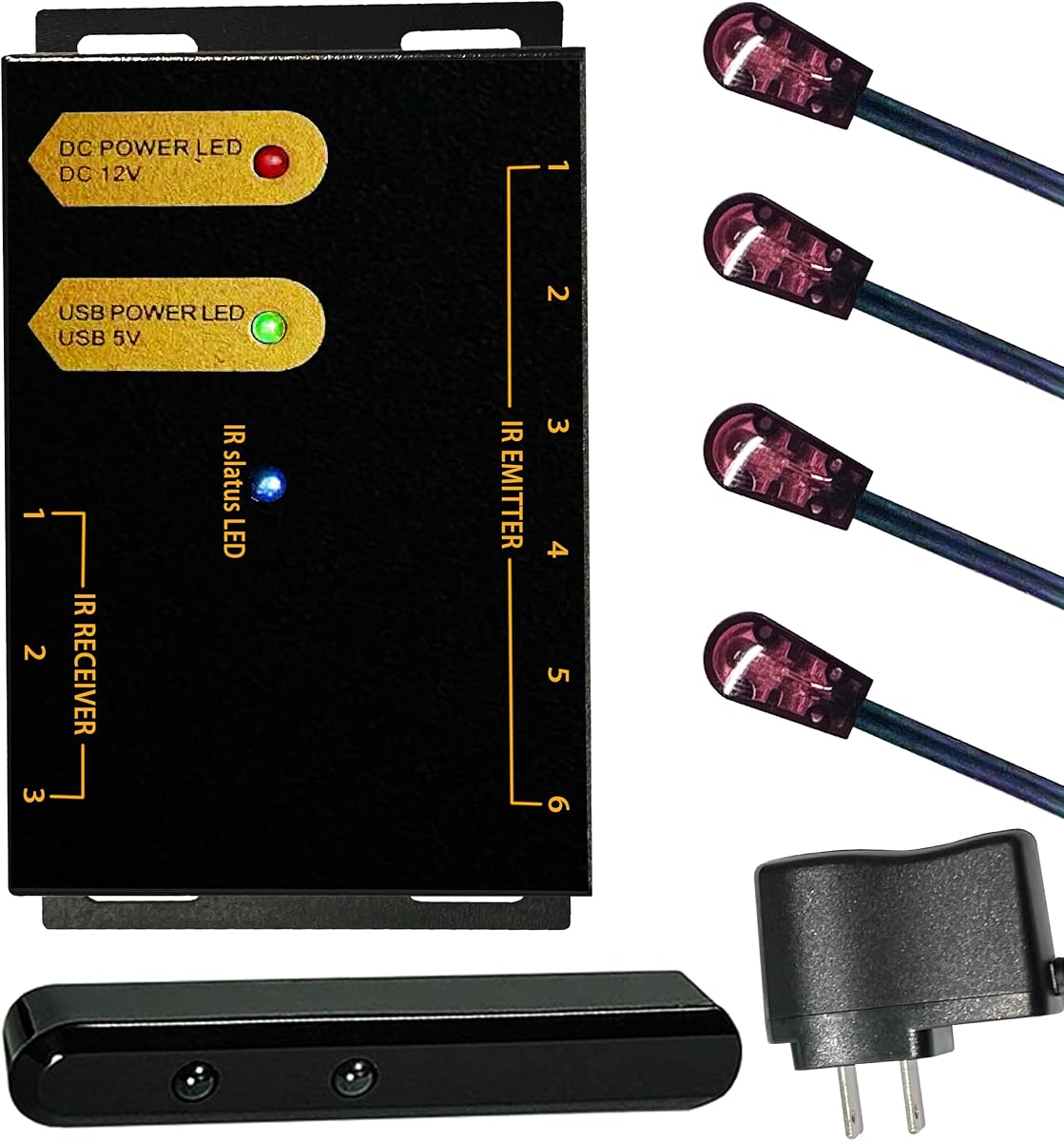
The IR Repeater System Kit is the most expandable option in this guide and offers an optional route for placing a receiver much farther from the equipment. It has a supplied rating of 4.7 and includes a connecting block, four IR emitters, a dual-band mini receiver, a power supply, mounting screws, and a manual. The system is intended for multiple IR devices stored in a closed cabinet or remote location.
We may earn a commission when you buy through this link, at no additional cost to you.
Its 20–60KHz frequency range supports a broad selection of A/V equipment, including amplifiers, cable boxes, stereo receivers, game consoles, satellite receivers, CD and DVD players, Blu-ray players, and other IR-operated devices. The information specifically notes compatibility with SKY set-top boxes and Cisco DVD players using RCMM code. Connection does not require software, allowing the existing remote to remain the primary control method.
The included four emitters can be expanded with double or triple emitters to as many as 12 or 18 outputs. For installations where the receiver must be positioned much farther away, the connecting block accepts CAT5 or higher Ethernet on a terminal block connector. A separate terminal block is required for that configuration, and the receiver then plugs into that additional hardware.
This is a strong premium pick for a complex home theater with many sources, a large cabinet, or a receiver located far from the equipment. Its expansion potential and optional Ethernet extension make it more adaptable than a basic cable kit. The added complexity is worthwhile only if you need multiple emitters or a long receiver run; for a single hidden source, one of the simpler wired options may be more efficient.
The connecting block can grow from the included four emitters to as many as 12 or 18 using compatible double or triple emitters. This is valuable for cabinets containing several amplifiers, receivers, players, and set-top boxes.
The optional Ethernet connection can carry the receiver signal as far as 100 meters. This solves a placement problem when the convenient remote location is far from the main entertainment equipment.
We may earn a commission when you buy through this link, at no additional cost to you.
The Hidden IR Repeater System is a high-capacity option for operating infrared A/V components that are located behind closed doors or walls. It can support up to 32 components according to the supplied information, with one IR receiver input and four IR emitter outputs. Its stated rating is 4.3 reflects a broadly applicable system for concealed entertainment hardware.
We may earn a commission when you buy through this link, at no additional cost to you.
The main advantage is the elimination of direct line-of-sight requirements between the controlled components and the remote. Commands can be received by the receiver and then distributed through the system to devices in an entertainment cabinet or equipment closet. A confirmation LED on the receiver acknowledges when commands are received, giving users immediate feedback during setup.
The system is described as compatible with practically all brands of infrared A/V remotes, making it relevant for a mixed collection of older and current IR-controlled equipment. It can serve cable and satellite receivers, stereo receivers, amplifiers, CD players, DVD players, Blu-ray players, and similar components. It does not make Bluetooth, RF, Wi-Fi, or app-controlled hardware compatible; those devices require their native remote or network control.
Choose this system when concealment and the number of controlled devices are the main priorities. Four included emitter outputs provide a practical starting point for distribution, while the stated capacity leaves room for larger installations. Because every device must be connected to the appropriate emitter, careful planning of cabinet space and cable routes is important before installation.
The receiver can capture a command and distribute it to equipment that is fully hidden by a door or wall. This makes the system well suited to tidy cabinets where exposed equipment would be inconvenient.
The receiver's confirmation LED shows when it has accepted a command. That feedback simplifies initial alignment and makes it easier to identify a disconnected or poorly positioned emitter.
We may earn a commission when you buy through this link, at no additional cost to you.
Choosing an IR Remote Extender requires matching the system's signal type, range, capacity, and wiring method to your equipment and room layout. The most important first step is confirming that the devices you want to control actually use infrared.
An IR extender can only relay commands sent through infrared. Many older cable boxes, disc players, amplifiers, stereo receivers, and satellite receivers use IR remotes, while newer smart televisions and streaming devices may use Bluetooth, radio frequency, Wi-Fi, or app-based control. Examine the original remote carefully: an IR remote generally requires the user to aim it at the device and may use an infrared emitter visible through a phone camera. If a device accepts commands through an application without pointing a remote at it, an IR repeater is not the right solution. Checking every source before ordering prevents a system from being installed only to discover that one important device cannot be controlled.
Range requirements differ according to the physical distance between the remote, the receiver, and the controlled source. A compact wired kit may be sufficient when the equipment sits behind the same television or within a nearby cabinet. A wireless system becomes valuable when the receiver and source are separated by a wall, hallway, or larger room. Published wireless distances can describe an unobstructed maximum, so buyers should allow for walls, furniture, people, and other construction materials. Similarly, a wired product's usable remote range depends on the angle and distance of the receiver from the person holding the remote.
A single transmitter and receiver are usually enough for one concealed set-top box or disc player. Larger entertainment systems may require a distribution block, multiple emitter heads, or an expandable system. Compare the base number of outputs, the stated maximum capacity, and whether additional emitters are available. A system with four or more emitters can place commands directly over several device sensors, which is more reliable than trying to cover many devices with one emitter. Also consider whether the equipment includes different source types, such as a receiver, DVD or Blu-ray player, game console, and cable box, because each generally needs its own emitter connection.
Wired systems are usually simpler for one cabinet or nearby room because the receiver connects directly to the transmitter. Their main limitation is cable length and the need to route wires along furniture, walls, or baseboards. Wireless systems eliminate the physical link between the receiving and transmitting sections, making them better for separated rooms or installations where cables would be inconvenient. They still require IR to travel from the handheld remote to the receiver and from the emitter to the equipment, so neither type provides unrestricted control.
The receiver must be positioned where it can capture the command from the existing remote. Some receivers are directional and perform best when aimed toward the person using the remote. The emitter is a separate consideration: it should sit within a few inches of the target device's IR sensor or be attached directly over that sensor. A wall or closed door can block the emitter-to-device signal even when the wireless link is working perfectly. Adhesive-backed probes make close attachment easier, while built-in LEDs help confirm that commands are reaching the receiver or being processed.
IR systems operate within different frequency bands. Products in this guide list ranges such as 20–60KHz, 34–60KHz, and 20–60KHz, which cover many mainstream A/V devices. Special remote codes can still create exceptions, as shown by the support for RCMM in one expandable kit and the explicit incompatibilities listed for the Sewell model. Before buying a higher-capacity system, note the exact model numbers of important receivers, set-top boxes, and selectors. Compatibility is a product-specific issue, and a broad IR rating does not guarantee support for every command set.
Power options affect where the receiver can be installed. USB-powered systems are convenient near a television or powered accessory, but some television USB ports stop supplying power when the screen is off. Wall-powered systems avoid that uncertainty, while kits offering both AC and USB adapters provide greater placement freedom. Multi-component systems also require room for a distribution block, enough emitter cable length, and a safe way to route wiring. Before purchasing, identify the available outlet or USB port and sketch how the receiver, distribution block, emitters, and target sensors will connect.
Features such as dual channels, expandable emitters, status LEDs, and long receiver extensions can make a system much easier to manage. Dual-channel controls are valuable when two nearby devices use similar commands, while extra emitter capacity lets a growing entertainment center expand without replacing the core system. A confirmation LED provides immediate evidence that the receiver has detected a command, although it does not prove that the target device accepted it. Long-distance receiver options are useful when the remote is used in a room far from the distribution equipment.
Begin by identifying the IR sensor on each target device. Remote control windows are commonly located near the front panel, but the exact position varies. Test the original remote at short range, then install the receiver where the person using the remote can aim toward it clearly. Connect the required power supply and allow the receiver to warm before testing. For wired kits, route the receiver cable and emitter leads along furniture edges or other protected surfaces to reduce snagging and accidental pulling.
Attach each emitter as close as practical to the corresponding device sensor, usually within a few inches. Adhesive-backed probes can be placed directly over the sensor without covering essential controls. For wireless systems, pair the receiver and emitter channel switches as instructed, and keep the units away from wireless routers or other equipment that may introduce interference. Test each source individually before attaching every emitter, because this makes it easier to identify a poorly placed probe or an incompatible device.
Use the system's LED indicators to confirm reception, then verify that the target equipment responds. Clean adhesive surfaces before mounting, and avoid placing cables where furniture movement, foot traffic, or cleaning can create tension. Periodically check that each emitter remains attached and that the receiver still has a clear path to the remote. If a command fails, first adjust the remote's aim, then reposition the receiver or emitter, verify power, and finally check whether the source uses a non-IR control method.
Only when that device still accepts infrared commands through an IR sensor or an appropriate IR input. Bluetooth, Wi-Fi, and app-controlled products generally require their original remote or network-based control. Check the remote and the manufacturer's specifications before purchasing, especially if the equipment is a newer smart television or streaming stick.
It can, because the receiver captures the remote's IR command and a wired or wireless system relays it to an emitter beside the equipment. The emitter still needs to be in line of sight with the device's sensor, or attached directly over it. A solid door may also block the receiver from seeing the original remote.
A wired kit connects the receiver to the emitter with a physical cable, making it simple and reliable for equipment located nearby. A wireless kit sends the captured IR command between separate units, allowing the receiver and equipment to be farther apart. Wireless transmission does not make the system compatible with non-IR devices.
Most systems need one emitter for each target device because every source has a different IR sensor. A basic kit with one emitter is suitable for one concealed box, while a cabinet with several devices may require four or more. Multi-device systems are more reliable because each emitter can be placed directly beside its corresponding sensor.
The receiver may be detecting the command while the emitter is too far from the device's sensor or aimed incorrectly. Confirm that the target uses IR, check the emitter attachment, and move it within a few inches of the sensor. Also verify that the correct source is connected and that the equipment itself is powered and responsive to its original remote.
A wired system can control equipment in another room if the emitter cable can be routed that far, while a wireless system is generally more convenient for separated spaces. In either case, the handheld remote must reach the IR receiver, and the final emitter must still be positioned near the target's IR sensor. Room-to-room control does not apply to Bluetooth or app-only equipment.
No. RF remotes transmit radio signals rather than infrared commands, so an IR receiver and emitter cannot relay them. The same restriction applies to Bluetooth and network-controlled devices. Identifying the remote's signal type before installation prevents most compatibility problems.
Place the receiver where the person holding the remote can aim toward it with minimal obstruction. Position the emitter directly over or within a few inches of the target's IR sensor. If the device responds intermittently, adjust the emitter angle first, then reposition the receiver or improve the remote's line of sight.
The Cable Matters Infrared Extender is the most straightforward choice for one nearby concealed source, while the 2CH IRBlast Wireless Repeater stands out for flexible wireless placement and separate control channels. The IR Repeater System Kit is the most expandable option, offering six included emitters, support for up to 18, and an optional extended receiver connection for complicated installations.
Prioritize confirmed IR compatibility before considering range or capacity. A basic wired kit will meet many single-device needs, but wireless models are better when the receiver must be separated from the equipment. Multi-device homes should count their sources, allow room for individual emitter placement, and favor a distribution system with visible signal feedback and room for expansion.
Finally, compare the stated specifications with your exact room and equipment setup before ordering, and verify current prices and availability when you are ready to purchase. Features such as dual channels, Ethernet receiver extension, and multiple emitter outputs are worthwhile only when they solve a real installation problem. The right IR Remote Extender is the one that reaches the intended source, provides dependable emitter placement, and supports the signals your existing remote actually sends.