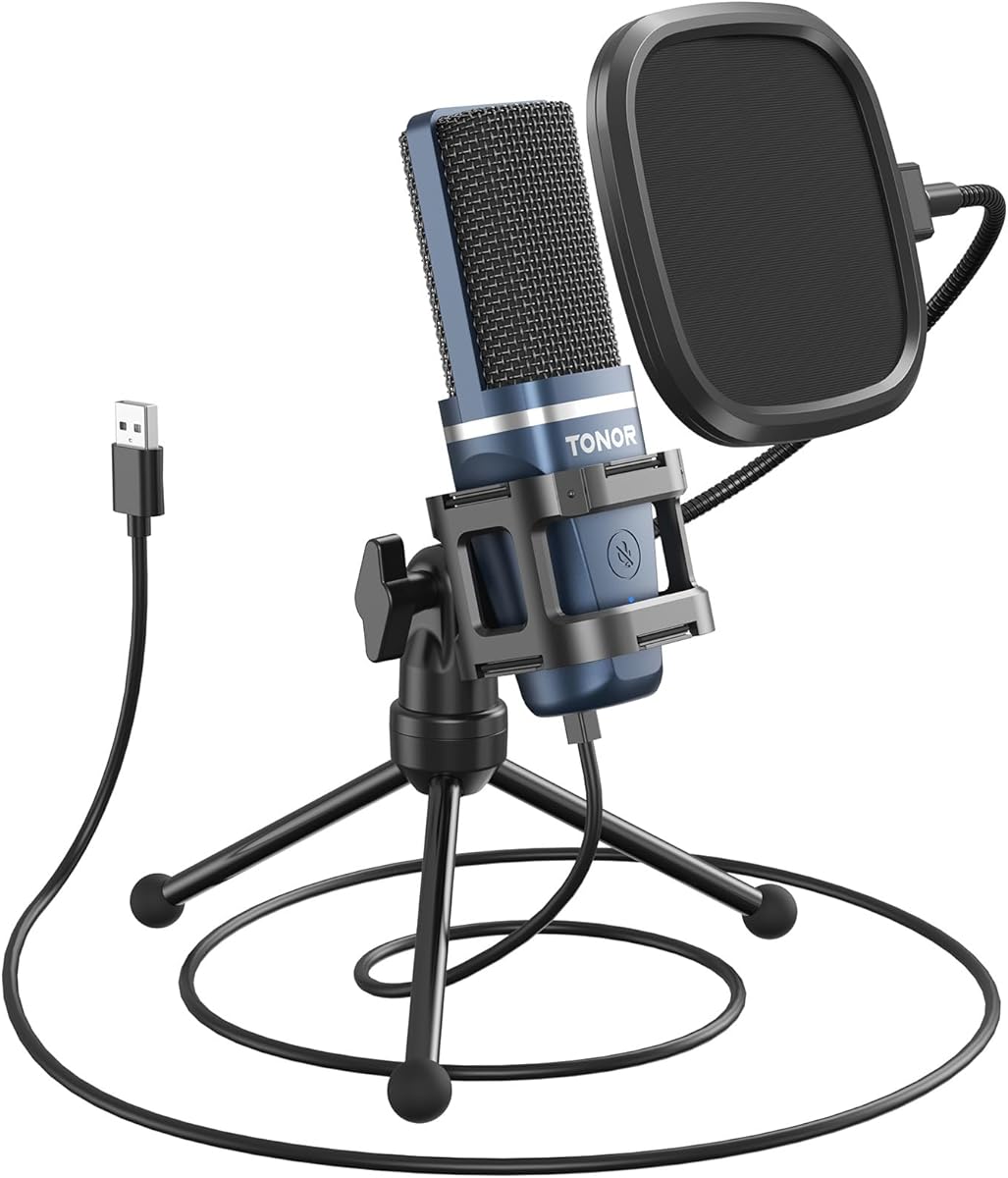
TONOR TC-777
4.3Editor score
Cardioid voice isolation
One-click mute control
Shock mount and pop filter
A podcast microphone can determine how clear, intimate, and professional your recordings sound. Even an affordable model can perform well when it offers a focused cardioid pattern, convenient controls, and reliable USB connectivity. The right choice depends on your room, software, recording style, and whether you also need features for streaming or gaming.
We compared all ten products by examining their stated pickup patterns, frequency response, connection methods, monitoring support, mute functions, included accessories, and device compatibility. The guide covers condenser and dynamic microphones, desktop and boom-arm designs, fixed and adjustable stands, and options for PC, Mac, PlayStation, and mobile recording.
Each pick highlights the features that matter most for a new podcaster, from straightforward plug-and-play operation to noise reduction, live headphone monitoring, and flexible USB or XLR connectivity. Product ratings and specifications reflect the supplied information, while prices change frequently, so confirm the current listing before buying.
4.3Editor score

4.4Editor score

4.6Editor score
As an Amazon Associate we earn from qualifying purchases.
The table below compares all ten microphones by design, capture method, connection, and monitoring features, making it easier to identify the right model for a home podcast, livestream, gaming setup, or mobile recording workflow.




The ZealSound K66 has a 4.4 rating and stands out as the most adaptable microphone in this guide for new podcasters. Its cardioid condenser design, 40Hz–18kHz frequency response, and 46kHz sampling rate are intended to deliver clear, balanced vocals, while the physical controls make common adjustments possible without opening editing software.
We may earn a commission when you buy through this link, at no additional cost to you.
Its most appealing feature is the intelligent Noise Reduction Mode, activated by holding the mute button. The stated purpose is to reduce keyboard clicks, computer fan noise, air-conditioning hum, and background conversation. Creators can also use separate knobs for microphone gain, monitoring volume, and echo, giving them more immediate control than most entry-level USB microphones provide.
Real-time, zero-latency monitoring through the 3.5mm headphone jack is another meaningful advantage for podcasting. The 360-degree rotatable body, weighted metal base, LED mute status, and included foam windscreen also make the K66 feel thoughtfully equipped. The trade-off is that it depends entirely on USB and included adapters rather than offering XLR, so users seeking studio-scale interface connectivity may prefer another option.
This is a strong choice for a first home podcast, livestream, online class, or mobile voice recording setup. It combines a familiar condenser format with unusually broad control options and compatibility. Anyone wanting simple PC recording can use it directly, while mobile creators benefit from the included USB-C and Lightning adapters. For those priorities, the K66 is the most complete overall recommendation.
The press-and-hold noise reduction mode can be useful in rooms with steady household or computer noise. It is not a substitute for acoustic treatment, but it gives creators another way to improve perceived vocal clarity without adding software effects.
Independent microphone, headphone, and echo controls make level changes fast during live recording. Zero-latency monitoring also lets speakers hear their own voice and identify clipping, unwanted noise, or inconsistent delivery before the take is finished.
We may earn a commission when you buy through this link, at no additional cost to you.
The Amazon Basics Condenser Microphone carries a 4.4 rating and offers a straightforward starting point for podcasting, online meetings, streaming, and solo recording. Its 14mm diaphragm is described as providing high sensitivity, low noise, and low distortion, while the cardioid pattern focuses capture toward the speaker in front of the microphone.
We may earn a commission when you buy through this link, at no additional cost to you.
The strongest feature is its simplicity. It connects through USB without additional drivers, includes a 360-degree rotating stand, and offers a one-tap mute function that syncs with the connected laptop or PC. It can also be detached and fitted to a tripod, boom arm, or other stand using the standard 5/8-inch thread, which makes it easier to integrate into a more permanent recording setup.
Compared with the ZealSound K66, this model offers less control hardware and no stated headphone monitoring. It also has a smaller diaphragm and a less elaborate accessory package. Those limitations matter for creators who want to monitor levels or shape their sound in real time, but they do not undermine the microphone's basic role as an easy USB condenser for a clean home setup.
Choose this model if your priority is uncomplicated setup, a compact footprint, and a recognizable cardioid recording approach. It is particularly suitable for a first podcast, online class, conference call, or streaming session on Windows or Mac. Buyers who only need solid desktop capture and do not require extensive monitoring controls will find the design refreshingly direct.
The mic's small desktop footprint and rotating body make it easy to position beside a laptop or monitor. The detachable 5/8-inch thread also gives creators an easy path to a boom arm or tripod when they outgrow the included stand.
The cardioid pattern is designed to emphasize sound directly in front of the mic while reducing unwanted off-axis sound. It is a sensible pattern for solo narration, podcast dialogue, meetings, and commentary recorded in a reasonably controlled space.
We may earn a commission when you buy through this link, at no additional cost to you.
The TONOR TC-777 has a 4.3 rating and delivers a useful podcast-microphone package without requiring complicated setup. Its cardioid pattern, one-click mute, volume control, shock mount, and pop filter cover the essentials, while USB 2.0 plug-and-play operation lets a new creator begin recording quickly.
We may earn a commission when you buy through this link, at no additional cost to you.
Its compatibility with Windows, Mac, PS4, and PS5 is useful for creators who move between content formats. The microphone is also stated to work with Zoom, Skype, and Discord, so it can serve podcasting, teleconferencing, gaming chat, and streaming without requiring a separate driver. Adjustable microphone and pop-filter angles make it easier to place the capsule near the mouth.
The main limitation is that it does not claim the same breadth of monitoring or adjustment as the K669B, and live headphone output is not listed. It is also explicitly not compatible with Xbox. Users who require a headset connection, an XLR workflow, or extensive physical controls may need to spend up for a different model.
The TC-777 is an appealing budget recommendation for a home podcaster who wants a recognizable condenser microphone and useful bundled accessories. It is particularly suitable for beginner interviews, remote calls, and uncomplicated voice recording. The included stand, shock mount, and pop filter help reduce the need for separate purchases, making it a practical first microphone.
The included shock mount helps limit vibration, while the pop filter is designed to reduce disruptive bursts from speech. Together with the foldable tripod, they cover the basic positioning and desk stability needs of a new recording setup.
Recognized operation in common communication and recording applications makes this a practical choice for creators who do not want to manage complicated setup routines. It can move between a podcast, a call, and game chat with a straightforward USB connection.
We may earn a commission when you buy through this link, at no additional cost to you.
The FIFINE K669B has a 4.5 rating and combines a sturdy metal design with uncomplicated USB operation. It is designed for vocals, meetings, voice-over, livestreaming, and podcasting, and its cardioid condenser pattern is intended to emphasize the primary voice source while reducing background noise.
We may earn a commission when you buy through this link, at no additional cost to you.
The included 5.9-foot cable connects directly to a USB-A port, and the microphone does not require 48-volt phantom power. A dedicated knob handles volume, allowing users to lower the output to zero for privacy or adjust it for gaming, calls, and recording. Its metal body and stable tripod should appeal to anyone who wants a desktop microphone that feels more substantial than a lightweight plastic alternative.
Its limitations are clear. Phone use is expressly excluded, and live headphone monitoring is not stated. Some applications also need automatic gain behavior disabled to prevent the recording level from moving unexpectedly. It is therefore less attractive for creators who need mobile capture or immediate headphone feedback, and it does not offer the multiple connection formats of the FIFINE AM8.
The K669B is a good fit for a home office, gaming desk, or podcast station centered around a PC or Mac. It supports a wide range of platforms, including Discord, OBS, Teamspeak, Twitch, Zoom, Webex, Audacity, and voice-recognition tools. Buyers who value durability, straightforward controls, and clear cardioid capture will find it especially practical.
The solid metal construction and stable tripod are useful for a microphone that will remain on a desk through calls, games, and recordings. The design is uncomplicated, but it appears better suited to regular use than to occasional travel.
A dedicated microphone volume knob gives creators immediate control over output and privacy. Because it works at the hardware level, it can be useful when application-level automatic volume controls are inconvenient or inconsistent.
We may earn a commission when you buy through this link, at no additional cost to you.
The FIFINE AmpliGame AM8 has a 4.5 rating and is the only product here offering both USB and XLR operation. Its dynamic cardioid design, 50Hz–16kHz response, and end-addressing format make it especially relevant to streamers and podcasters who want to move between direct computer recording and a traditional audio interface or mixer.
We may earn a commission when you buy through this link, at no additional cost to you.
USB mode offers the easier path for beginners, including tap-to-mute, gain adjustment, monitoring volume, and RGB lighting. The dynamic capsule is positioned to reject off-axis noise, and the included windscreen is intended to reduce hum from nearby electrical appliances. When using XLR, the microphone can connect to an interface or mixer, although the required XLR cable is not included.
There are important trade-offs. The RGB ring and function key are inactive in XLR mode, and the device is not a complete studio signal chain on its own. Users choosing XLR will need suitable external hardware. Its dynamic construction also differs from the finer high-frequency detail associated with many condenser microphones, although that can be advantageous in an untreated room.
This model is best for a creator who wants one microphone to serve streaming, gaming, podcasting, and future studio work. Beginners can start in USB mode without immediate configuration, while more experienced users can later integrate the XLR connection. It is a particularly strong option for someone who values flexible connectivity and a dynamic capsule for home environments.
USB mode offers immediate computer access, while XLR mode opens the door to mixers and audio interfaces. That versatility makes the AM8 a practical bridge between entry-level streaming and a more conventional recording workflow.
The cardioid dynamic design focuses on the sound directly in front of the microphone and is intended to reject unwanted off-axis noise. The suggested close recording range also encourages a practical speaking distance that can help produce a strong vocal signal.
We may earn a commission when you buy through this link, at no additional cost to you.
The Logitech Creators Blue Yeti has a 4.6 rating, the highest stated rating among these ten products. Its three-capsule array, four selectable pickup patterns, onboard controls, and no-latency monitoring make it the most versatile premium option for podcasting, streaming, music capture, meetings, and video production.
We may earn a commission when you buy through this link, at no additional cost to you.
The pattern selection is the defining feature. Cardioid works well for a solo creator, omnidirectional can capture a group conversation, bidirectional is suited to face-to-face interviews, and stereo accommodates broader instrument or environmental recording. Onboard controls for headphone volume, pattern selection, mute, and gain let the user manage the microphone without repeatedly opening software.
Blue VO!CE software provides broadcast vocal processing, advanced modulation, and HD audio samples, adding functionality beyond the hardware. The trade-off is that this is a larger, more substantial desktop unit, and users who only need a compact microphone for occasional calls may find it excessive. Some creators may also prefer direct analog controls without relying on effects software for their final sound.
The Yeti is a strong recommendation for a creator whose recording ambitions extend beyond a single-person podcast. Its multiple patterns make it easy to accommodate solo episodes, roundtable discussions, interviews, livestreams, and instrument sessions. It earns the premium recommendation because the versatility is built into the microphone itself rather than dependent on a changing collection of accessories.
Switching among cardioid, omnidirectional, bidirectional, and stereo modes allows the same microphone to handle narration, group discussions, interviews, and broader capture. This flexibility is especially valuable for creators who do not know whether future projects will remain strictly solo.
Headphone volume, gain, pattern selection, and mute are all available directly on the body. No-latency monitoring makes it easier to judge the signal while speaking, and the adjustable stand helps place the microphone correctly for the selected pattern.
We may earn a commission when you buy through this link, at no additional cost to you.
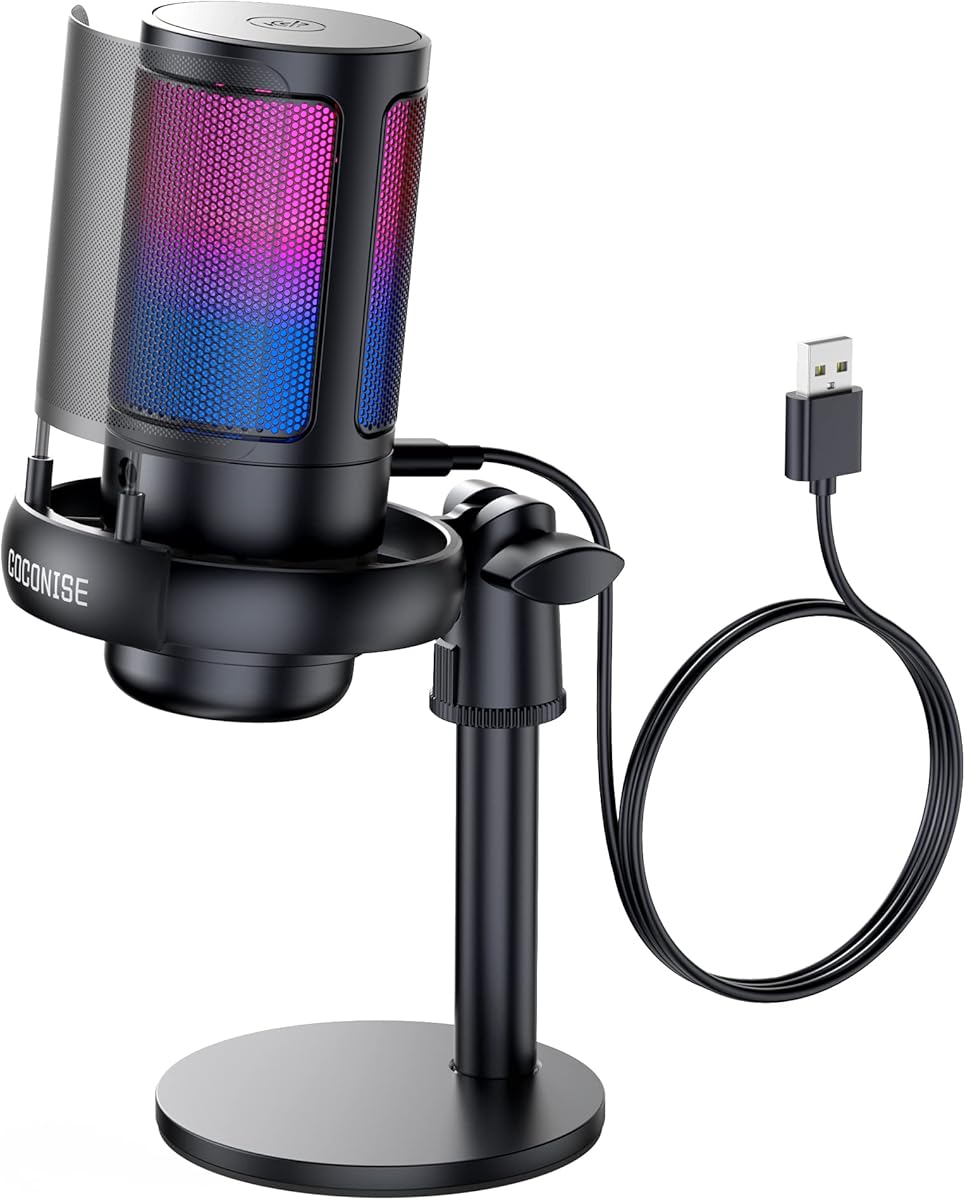
The COCONISE Gaming Microphone has a 4.3 rating and is designed for creators who want a podcast microphone to blend into a gaming setup. Its RGB lighting, weighted carbon steel base, and detachable metal anti-splash screen distinguish it from conventional office-style condenser microphones.
We may earn a commission when you buy through this link, at no additional cost to you.
A cardioid polar pattern and 25mm condenser capsule focus capture on the speaker in front of the mic. The stated sampling rate reaches 192kHz, and the included shock-mount arrangement uses a rubber elastic band intended to reduce vibration from keyboard typing and mouse movement. Tap-to-mute, a rotary volume control, and a 3.5mm headphone jack add practical controls.
As with many gaming-oriented condenser microphones, the visual design may be more prominent than a podcaster wants, and the supplied information does not list a separate gain control. The bright RGB lighting also changes or turns off when muted, which is useful in a stream but less important for a private recording. Users seeking a restrained broadcast appearance may prefer the Blue Yeti or TONOR models.
This microphone works well for video commentary, livestreaming, gaming chat, and podcasts that share one visual production environment. Its detachable 180cm USB cable, compatibility with PS4, PS5, desktop, and laptop systems, and straightforward plug-and-play operation make it a solid choice for a creator building a gaming-centered channel.
Cyclic and gradient RGB effects add visual appeal to a livestream, while the lights going off when muted provides an immediate on-screen status cue. That visible feedback can help prevent accidental audio transmission during a busy session.
The weighted base, anti-vibration support, and detachable metal screen are intended to withstand active desktop use. These details are particularly relevant when the microphone shares a desk with mechanical keyboards, controllers, and other equipment that can transmit vibration.
We may earn a commission when you buy through this link, at no additional cost to you.
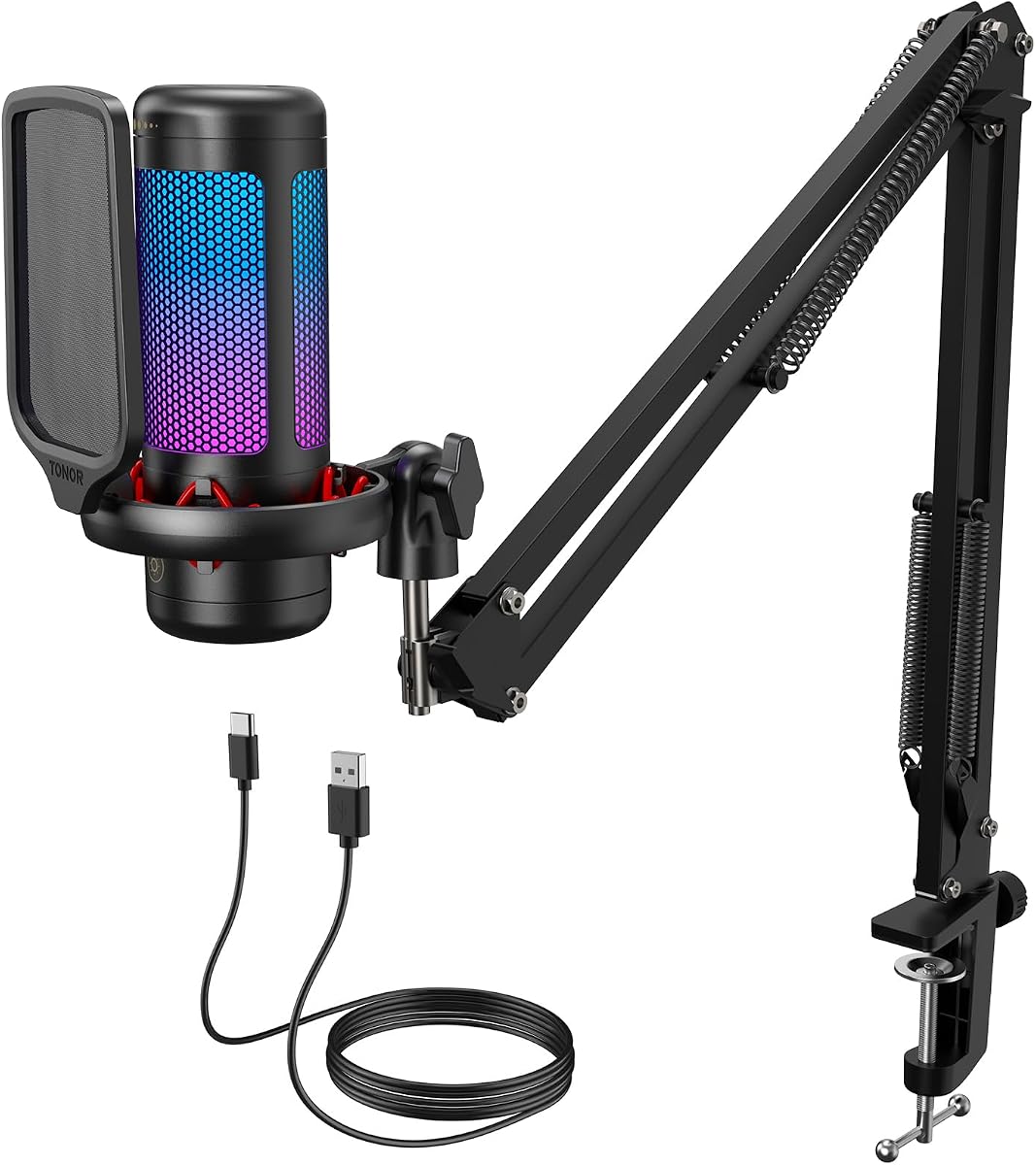
The TONOR TC310+ has a 4.5 rating and comes as a coordinated microphone-and-boom-arm set. That packaging is its main advantage for a creator who wants a stable, elevated microphone position without assembling a separate stand or support system.
We may earn a commission when you buy through this link, at no additional cost to you.
The set includes a metal boom arm and sturdy clamp for desks up to 2.36 inches thick. Multiple adjustable joints help position the microphone beside a monitor and away from the center of the desk. Tap-to-mute operation is built into the top, while rotating the top adjusts gain. Four RGB modes, including static, gradient, breathing, and mixed-color options, add a gaming-oriented appearance.
The supplied information does not mention headphone monitoring, so live vocal feedback is uncertain. The clamp also has a defined desk-thickness requirement, which should be checked before purchase. For users who need a compact standing mic or plan to use a different arm, this complete set may be less adaptable than the ZealSound K66 or FIFINE K669B.
The TC310+ is a strong match for a streaming desk, gaming channel, or podcast station where a boom arm is already desired. Its physical gain and mute controls are useful during live sessions, and the arm keeps the microphone consistent in position. It is particularly convenient for buyers who want the support hardware included in one coordinated package.
The adjustable joints make it easier to bring the microphone close to the speaker and keep it away from a monitor or other reflective equipment. The sturdy clamp and metal arm provide a more permanent arrangement than a lightweight desktop tripod.
Tap-to-mute and rotating gain adjustment provide fast hardware control during a live session. These controls are useful when software menus would interrupt the recording flow or when the creator needs to respond immediately to changing audio conditions.
We may earn a commission when you buy through this link, at no additional cost to you.
The MAONO A04 has a 4.5 rating and is built around a complete USB podcast kit. The package includes the microphone, scissor arm, metal shock mount, pop filter, foam windscreen, boom base, cable, and manual, reducing the need to assemble a basic recording rig from separate parts.
We may earn a commission when you buy through this link, at no additional cost to you.
Its 192kHz/24-bit chipset and 16mm electret condenser transducer are intended for high-resolution speech and voice-over capture. A magnet ring on the USB cable is described as providing anti-interference benefits, and the stated best range is two to six inches. The shock mount, pop filter, and foam windscreen address several common recording problems at once.
The microphone connects through USB without extra drivers or an external sound card and works with most PCs, laptops, PS4 systems, PS5 systems, and mobile phones. It is not compatible with Xbox, and the AU-A04 specifically is not used with Maono Link; the manufacturer recommends the A04 Gen2 for that function. The included desk clamp is intended for surfaces less than 2.1 inches thick.
The A04 is a compelling option for a new podcaster who values a complete, coordinated setup. The arm and accessories support a close, stable microphone position, while the USB connection keeps daily operation simple. It is less suitable for someone who already owns a good boom arm and shock mount or specifically needs Maono Link support.
The scissor arm, clamp, shock mount, pop filter, windscreen, and appropriate cable create a functional starting point. This is especially helpful for a creator who does not yet know which stand hardware will fit the recording space.
The advertised 192kHz/24-bit specification and 16mm condenser transducer target detailed speech reproduction. Actual results still depend on the room, microphone placement, computer settings, and recording software, but the hardware is designed for creators who want a high-resolution podcast signal.
We may earn a commission when you buy through this link, at no additional cost to you.
The FIFINE AmpliGame A6V has a 4.5 rating and combines a 192kHz sampling rate with a stated 70dB signal-to-noise ratio. Its cardioid pattern and front-focused sensitivity make it appropriate for voice commentary, streaming, online meetings, and video chat, while the RGB design suits a visible gaming setup.
We may earn a commission when you buy through this link, at no additional cost to you.
A tap-to-mute button silences the microphone, and the RGB lighting turns off in the muted state to provide a clear visual warning. A nearby gain control makes it possible to maintain a comfortable speaking level without shouting or whispering. The microphone includes a shock mount with four rubber bands and a detachable pop filter to help manage desk vibration and plosives.
It supports Windows and Mac, as well as PS4 and PS5, and works with Discord, Team, Zoom, OBS, Streamlabs, and Twitch according to the supplied information. The included 6.6-foot detachable cable makes it easier to position the microphone when the computer is under the desk. Unlike the AM8, this model offers only USB connectivity, so it does not provide an XLR upgrade path.
The A6V is well suited to a creator building a colorful streaming station or gaming channel. Its high-resolution specification, clear mute state, and anti-vibration accessories make it a strong all-in-one desktop option. It is less compelling for a minimalist recording room, but those who like visible RGB design will appreciate the visual integration.
Tap-to-mute is quick enough for a live interruption, while the RGB-off state gives viewers an immediate visual cue. Gain adjustment helps normalize the voice at a practical speaking distance, reducing the need to rely entirely on software automation.
The four-band shock mount is designed to absorb tremors from keyboard use and mouse movement. The detachable pop filter targets plosive sounds, making the included accessories useful for a compact streaming and podcasting setup.
We may earn a commission when you buy through this link, at no additional cost to you.
The best inexpensive podcast microphone is the one that captures your voice cleanly, connects to your equipment without friction, and provides the controls and accessories needed for your recording format. Use the following factors to narrow the field before making a final decision.
A condenser microphone generally uses a sensitive capsule to capture vocal detail and is common in podcast, streaming, and voice-over work. The models in this guide are especially appropriate for speech when placed properly and used with reasonable gain. A dynamic microphone, such as the FIFINE AM8, uses a different capsule design and is often less sensitive to off-axis sound, which can be helpful in an active or untreated room. Neither type is automatically better, because placement, room treatment, and speaking distance remain important.
For a quiet home office and solo narration, a cardioid condenser is usually the most straightforward choice. For a noisy room, close-miked gaming commentary, or a creator interested in XLR, a cardioid dynamic deserves careful consideration.
Cardioid capture focuses on sound directly in front of the microphone while reducing sound arriving from the sides and rear. That makes it the most common pattern for podcasting, meetings, gaming chat, and voice-over. It is especially useful for solo creators who want the microphone to ignore much of the surrounding room. The pattern does not block every unwanted sound, so close placement and basic room control remain beneficial.
If a project requires two speakers, group discussion, or room ambience, consider the Blue Yeti's omnidirectional and bidirectional modes. Most other choices are optimized for one speaker directly in front of the microphone.
USB is the simplest route for a new creator because it usually carries both power and audio through one connection to a computer. It works well with podcast software, conferencing applications, OBS, Streamlabs, Discord, and other common tools without a separate interface. The ZealSound K66, for example, also includes USB-C and Lightning adapters for a broader device range. XLR requires an external audio interface or mixer, so it adds cost and complexity but creates a more conventional path toward professional studio hardware.
Choose USB for simplicity and immediate use. Choose the AM8's USB and XLR design if you want the option to transition into a hardware-based recording setup later.
Headphone monitoring lets you hear the microphone input while speaking, helping you notice clipping, low output, unwanted room noise, and inconsistent distance from the capsule. Models such as the K66, AM8, COCONISE, and Blue Yeti provide a 3.5mm headphone connection. A monitoring volume control is useful because it lets you adjust your headphones independently of the signal sent to the computer. For interviews, live streams, and long recording sessions, this feedback can be invaluable.
If you plan to record without headphones, monitoring may matter less. If you want to perform while listening to yourself, prioritize a model with headphone output and a clear volume control.
Physical controls make live production more responsive. A mute button prevents accidental transmission during a conversation, while a gain or microphone-level knob gives you a direct way to set the input signal. The K669B, K66, and A6V provide level controls, while the K66 also separates microphone gain, headphone volume, and echo adjustment. The Blue Yeti provides onboard gain, mute, pattern selection, and headphone volume. These features are helpful when software menus or automatic gain behavior make quick changes difficult.
At minimum, a reliable mute control is valuable for live content. For consistent recordings, a physical gain control can also reduce the need for repeated corrective work in editing software.
A cardioid pattern, a close speaking position, and a suitable shock mount can all improve the recorded signal, but no microphone can completely remove a problematic room. The ZealSound K66 includes a dedicated noise reduction mode intended to reduce keyboard clicks, fan noise, air-conditioner hum, and background chatter. It also includes a foam windscreen. Other bundled kits use pop filters and foam windscreens to address plosives and breathy bursts rather than continuous room noise.
Choose a noise reduction feature when you cannot control the environment, but do not treat it as a substitute for acoustic treatment. For a very active desk, a dynamic microphone, a close working distance, and vibration control may be the more dependable combination.
The accessories supplied with a microphone can determine how quickly you can start recording. A stable tripod is sufficient for many desktop sessions, while a boom arm and clamp provide a consistent position and free up desk space. The TONOR TC310+ includes a metal boom arm, while the MAONO A04 includes a scissor stand, shock mount, pop filter, windscreen, and cable. The TONOR TC-777 includes a shock mount and pop filter, while the Blue Yeti supports a desktop stand or a separate mic stand or boom arm.
Check the dimensions of your desk before choosing a clamp-based set. Confirm that a standard 5/8-inch thread or another included mounting option matches the stand you already own.
A microphone can capture a clean signal but still be inconvenient if it is not recognized by your preferred application or operating system. The products here generally support common Windows and Mac workflows, with many specifically naming Zoom, Discord, OBS, Twitch, Audacity, Streamlabs, Skype, and Teamspeak. The AM8 also supports XLR, while the Blue Yeti adds Blue VO!CE effects and advanced vocal processing. Some gaming models explicitly support PS4 and PS5, and the K66 includes adapters for modern mobile devices.
Verify the operating system, application, connector type, and any special requirements before buying. Exclusions such as Xbox incompatibility or the lack of Maono Link support on the A04 are important details to note.
Begin by choosing a stable location away from obvious noise sources, speakers, air vents, and hard reflective surfaces. Connect the microphone with the supplied cable, install any required application, and confirm that the computer recognizes it as the recording input. If the model includes a shock mount or pop filter, position the microphone and screen correctly before opening the software. Speak at a natural volume and adjust the gain gradually rather than turning every control to its maximum.
Place the microphone close enough to capture a clear, consistent signal, usually slightly to one side of the mouth for a natural spoken texture. Keep a consistent distance during the recording and use headphones when the microphone supports monitoring. Test the mute function, confirm the headphone level if present, and record a short sample before the full session. In editing software, avoid aggressive noise reduction that can make the voice sound artificial or hollow.
For care, unplug the microphone before moving it and avoid pulling on the cable. Clean the grille and pop filter gently according to the manufacturer's instructions, and keep liquid away from the USB connector and controls. Check the mount, desk clamp, and shock-mount bands periodically for looseness. Store the microphone in a dry, dust-free area, and treat the included adapters, cables, adapters, and detachable supports as parts of the complete recording system.
No. A well-positioned budget microphone can produce a useful podcast when the room is reasonably controlled and the recording software is set correctly. The biggest improvements often come from keeping the microphone close, using a pop filter, reducing background noise, and speaking consistently. A higher-priced model may add convenience, multiple patterns, better physical controls, or more advanced hardware, but it cannot repair a very noisy recording space by itself.
USB is usually better for beginners because it connects directly to a computer and generally requires no separate interface. It is portable, simple, and supported by common recording and streaming applications. XLR provides a conventional studio connection and allows more control over external preamps, mixers, and interfaces. The FIFINE AM8 is notable in this group because it supports both USB and XLR, allowing a creator to begin simply and retain a path to studio hardware.
A cardioid pattern is designed to capture sound most strongly from directly in front of the microphone while reducing sound from the sides and rear. That makes it useful for solo speech, interviews, gaming commentary, and meetings because it focuses on the intended speaker. It does not remove all background noise, so microphone placement, room treatment, and a close speaking distance still influence the final result.
A dynamic microphone is often a sensible choice in a noisy or untreated room because it is generally less sensitive to off-axis sound. The FIFINE AM8 is the dynamic model in this guide and also offers USB and XLR connections. A condenser can still work well if you speak close to it, control the room, and use a pop filter, but a dynamic capture style may demand less effort when background activity is difficult to control.
Most USB models in this guide are designed for plug-and-play use without additional drivers, and they are recognized by common operating systems and recording applications. Some products offer optional or bundled creative software, such as Blue VO!CE on the Logitech Blue Yeti, while the ZealSound K66 emphasizes hardware controls instead. Check the product details for any specific compatibility notes before recording.
Headphones are highly useful when the microphone supports live monitoring. They let you hear your voice, identify clipping, judge the input level, and monitor without adding the microphone's signal to the room through speakers. The K66, AM8, COCONISE, and Blue Yeti include 3.5mm headphone connections. Other models can still be used for podcasts, but you will not receive the same direct hardware feedback.
Yes, when the model and platform are compatible. Several options explicitly support common streaming applications such as OBS, Streamlabs, Twitch, Discord, and Team, and many include tap-to-mute or RGB lighting suited to a gaming desk. The K66 also includes adapters for phones and tablets. Always verify the operating system, console, connection type, and application requirements before purchasing.
At minimum, you need a stable stand, the correct connection cable, and a suitable recording application. A pop filter helps reduce plosive sounds, while a shock mount or vibration support can limit noise from a desk and keyboard. Some models include these accessories already, including the TONOR TC-777, MAONO A04, FIFINE A6V, and COCONISE microphone. If your chosen model does not include them, buying them as a coordinated set is usually simpler.
The ZealSound K66 is the best overall option because it combines a cardioid condenser design with active noise reduction, independent level controls, zero-latency monitoring, and broad USB device compatibility. The TONOR TC-777 stands out as the best budget pick with its straightforward USB operation, included shock mount and pop filter, and useful compatibility. The Logitech Blue Yeti earns the premium recommendation for its four pickup patterns, onboard controls, monitoring, and Blue VO!CE features.
Your priorities should guide the remaining choice. Select the FIFINE AM8 for both USB and XLR, the Blue Yeti for maximum format flexibility, the TONOR TC310+ for a bundled boom arm, or the MAONO A04 for a complete accessory kit. The FIFINE K669B suits a sturdy PC-first desk, while the A6V and COCONISE microphone fit gaming-centered visual setups. Most importantly, match the microphone to your room, connection needs, and recording workflow rather than choosing only by appearance.
Ratings, feature bundles, device support, and prices can change, and the current listing is the best source for final compatibility details. Before ordering, confirm the connector, operating system, included stand, desk-clamp requirements, and whether you need headphone monitoring or XLR. With that final check completed, one of these ten models can provide a practical foundation for your next podcast, stream, call, or voice recording.