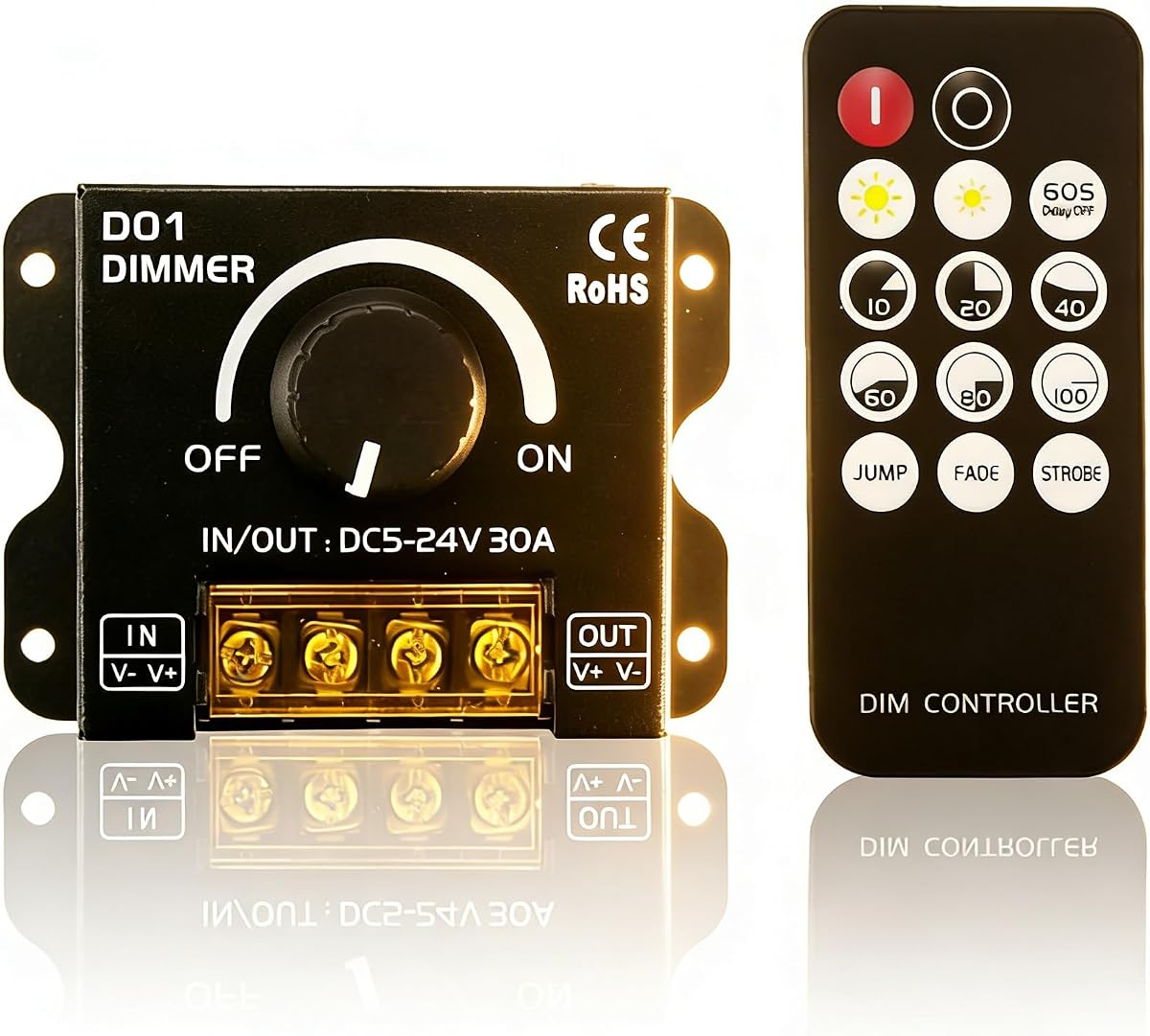
5V 12V 24V LED Dimmer Switch
4.5Editor score
Dual knob and remote control
Stepless 0-100% dimming
DC 5V, 12V, 24V support
Memory and dynamic lighting modes
Our LED Light Strip Dimmer compares ten dimmers for brightness control, remote range, voltage support, installation ease, memory functions, and versatility.
An LED light strip dimmer gives you more control over brightness, atmosphere, and everyday convenience than a basic on/off switch. The right model should match your strip voltage, fit your installation space, and offer the controls you actually use—from a simple rotary knob to wireless remote, smart-home, timer, and multiple dynamic modes.
This guide compares ten dimmers using the specifications and features listed for each product, including supported voltages, current limits, control styles, pairing options, memory behavior, housing materials, and installation methods. It covers rotary controllers, inline dimmers, RF remote dimmers, a smart WiFi model, and a complete warm-white strip kit.
Each review explains where the product stands out, which installation it suits, and what compatibility limitations deserve attention before ordering. The featured models show the range of available approaches, from compact plug-in controls to high-current PWM systems, while a complete LED strip offers a different all-in-one option. Market conditions can change, so verify the current listing and strip requirements before purchasing.
4.5Editor score

5.0Editor score

4.4Editor score
The comparison below highlights the major differences among rotary, inline, RF remote, smart, and complete-kit options, with particular attention to voltage, control method, current capacity, and installation needs.


The PAUTIX RF WiFi Smart Remote Dimmer is built for single-color LED strips operating on DC 12-24V, with a stated maximum current of 5A. It combines a 14-button RF remote with smart-home control through Tuya or Smart Life, Alexa, and Google Assistant. Its 4.5 rating reflects a versatile feature set, particularly useful for installations where physical switches and voice commands are both desired.
We may earn a commission when you buy through this link, at no additional cost to you.
The remote provides 11 brightness levels and works up to 32.8 feet in open areas. Unlike infrared controls, the RF signal is multi-directional, so the receiver does not need to be in the remote's direct line of sight. The dimmer can use one-to-one or one-to-multi pairing, making it suitable for controlling several compatible receivers together. Memory restores the last setting, while 15-, 30-, and 60-minute delay options add convenience for temporary lighting.
The main limitation is voltage compatibility. This model does not work with 5V LED strips and cannot convert AC to low-voltage DC. It is also a single-color controller rather than a solution for RGB, RGBW, tunable-white, or addressable lighting. Voice functions depend on connecting the appropriate app and smart-home ecosystem, so buyers should not expect out-of-the-box voice control without completing that setup.
This is a strong choice for a new smart-home installation, a kitchen with under-cabinet lighting, or a bedroom where the ability to dim from a remote or by voice improves daily convenience. Choose it when your strip is 12V or 24V, your load stays within 5A, and integrated smart control matters more than the broadest possible voltage support.
The RF remote works from many angles and does not depend on a visible receiver. Smart-app and voice-control options add another layer of convenience, particularly in rooms where reaching a knob is inconvenient.
The receiver restores the last operating state after power returns. Three delay-shutdown intervals are useful for temporary accent lighting, though permanent schedules still require an external timer or supported automation.
We may earn a commission when you buy through this link, at no additional cost to you.
This 5V, 12V, and 24V LED dimmer switch combines a rotary control with a 14-key RF remote, giving buyers two ways to operate the same single-color lighting system. It has a 4.5 rating and a stated 30A output capacity. PWM technology provides stepless brightness control from zero to full output, while the aluminum enclosure is designed to help dissipate heat.
We may earn a commission when you buy through this link, at no additional cost to you.
One of its strongest features is the dual-control design. The knob remains available if the remote is lost, while wireless control is convenient when the receiver is mounted out of reach. A memory function restores the prior brightness and mode after power is restored. Jump, fade, and strobe effects, along with a timed-off function, add more control than a basic rotary controller offers.
Compatibility is limited to single-color LED strips. It is not suitable for RGB multicolor strips, fans, energy-saving lamps, or ordinary bulbs. Although the housing is described as suitable for outdoor string-light use, it should not be assumed to be waterproof. The stated 30A figure also represents a maximum under the appropriate supply conditions, so actual load, wiring, and power-supply limits still matter.
This dimmer is a good general-purpose choice when you want broad voltage support, both remote and manual operation, and several effects without moving to a smart-home model. It is particularly useful for single-color cabinet lighting, display shelves, counters, and decorative strips where a physical knob and wireless remote are both valuable.
The rotary knob offers a dependable local control option, while the 14-key remote makes brightness and mode changes more convenient from across a room. This redundancy can simplify setup and everyday use.
The memory function avoids repeated setup after power returns. Jump, fade, and strobe modes expand the dimmer's role beyond simple task lighting, although users wanting only smooth illumination can stay with the knob.
We may earn a commission when you buy through this link, at no additional cost to you.
The LED Strip Dimmer Switch, DC 5-24V Frequency Adjustable Controller stands out with four selectable PWM frequencies, a feature not offered by most conventional rotary dimmers in this roundup. It carries a 5.0 rating and supports DC 5-24V constant-voltage single-color strips. Its principal appeal is the ability to balance operating frequency against available current according to the installation.
We may earn a commission when you buy through this link, at no additional cost to you.
The frequency choices are 8 kHz at 10A, 4 kHz at 15A, 2 kHz at 20A, and 800 Hz at 30A. Selecting a higher frequency can reduce visible flicker in compatible devices and may help reduce striping in camera footage. The result depends on the strip, power supply, and camera settings, but the control gives users a way to experiment when a fixed-frequency controller produces unwanted visual artifacts.
Brightness adjustment is smooth and stepless from zero to 100%. The controller works with two-pin COB and SMD single-color strips in 5050, 2835, and 5630 formats, provided the input voltage exactly matches the strip. It does not raise or lower voltage, support AC power, or accommodate RGB, RGBW, CCT, addressable, 0-10V, fan, or motor systems.
This is the most technically flexible model for a user who understands PWM behavior or works with camera-visible lighting. It is also a strong general controller for cabinets, displays, workbenches, and protected vehicle interiors. Buyers should select the frequency according to both their load and application, and keep the metal controller in a dry, protected location.
The 8 kHz, 4 kHz, 2 kHz, and 800 Hz settings offer different current ceilings. Higher frequency is useful for cameras, while the lower setting supports the greatest stated load.
The controller does not convert voltage. A 12V strip must use a suitable 12V DC source, and the positive and negative connections must be correct for the dimmer to operate as intended.
We may earn a commission when you buy through this link, at no additional cost to you.
The 30A PWM Stepless LED Dimmer is a single-channel controller designed for DC 5V, 12V, and 24V single-color lighting. It has a 4.0 rating, a stated maximum current of 30A, and smooth rotary dimming from zero to 100%. The product is aimed at applications such as boats, camper vans, trucks, off-grid systems, under-cabinet lights, decks, and gardens.
We may earn a commission when you buy through this link, at no additional cost to you.
Its high current capability makes it more relevant for larger lighting runs than low-current inline controllers. The metal housing provides heat dissipation and corrosion resistance, while screw terminals and pre-drilled holes simplify permanent installation. An automatic memory function restores the previous setting after power is restored, avoiding the need to reset brightness every time the system starts.
The dimmer does not step voltage up or down, so the power supply must match the LED strip. Positive and negative terminals must also be connected correctly, or dimming may malfunction and the strip may not illuminate. It is for dimming, not motor-speed control, and the minimum supported load is greater than 1W. The metal housing is durable, but outdoor suitability still depends on weather exposure and enclosure placement.
Choose this model for a powered installation that needs more capacity than a small remote controller can handle. It is best suited to users who prefer a direct rotary control, permanent screw-terminal wiring, and straightforward operation over wireless convenience. Marine, automotive, cabinet, and off-grid applications are especially good fits when the unit is protected appropriately.
A 30A maximum makes this controller more suitable for high-power single-color installations. The power supply, wire gauge, connectors, and strip must all be appropriate for the intended load.
Screw terminals, mounting holes, and automatic memory support a fixed installation where the dimmer will be used repeatedly. It offers fewer control options than remote models but remains straightforward to operate.
We may earn a commission when you buy through this link, at no additional cost to you.
The JOYLIT RF LED Dimmer combines a 14-key remote with a sensitive touch slider and supports single-color strips from DC 5V to 36V. It has a 4.4 rating and an 8A maximum current per channel. Its most distinctive feature is the stated RF range of up to 98 feet in an open area, with the ability to operate through walls and doors.
We may earn a commission when you buy through this link, at no additional cost to you.
The touch slider provides fine brightness adjustment, while the remote offers traditional button-based commands. A three-second fade-in and fade-out function can be selected through a remote programming sequence. The receiver remembers its last setting and supports both one-to-one and one-to-multi pairing after reconfiguration. A magnetic wall-mount bracket provides a dedicated home for the remote and helps prevent it from being misplaced.
The widest listed voltage range does not make the unit universal for every lighting type. It remains a single-color controller, so multicolor and addressable strips are outside its stated scope. The remote's long range depends on the environment, and the touch panel enters sleep mode after 20 seconds without operation. Waking it while the strip is on requires a long press, which may take a little adjustment for new users.
This is a premium-feeling choice for a finished installation where the remote is expected to be used regularly. It works especially well for bedroom, lounge, display, and decorative lighting where remote range, smooth fading, and fine control are priorities. Choose it when the wider 5-36V range and touch interface justify the added programming complexity.
The RF remote can operate across rooms and through a wall or door, depending on the building materials and environment. This removes the line-of-sight limitation common to infrared controls.
The sensitive touch slider makes subtle brightness changes easier, and the programmable three-second fade avoids abrupt on and off transitions. These details are useful in relaxed or eye-sensitive lighting environments.
We may earn a commission when you buy through this link, at no additional cost to you.
The weideer 2Pcs DC12V-24V LED Strip Lights Dimmer Switch is a straightforward inline rotary controller for 12V and 24V LED lighting. It has a 4.2 rating and supports PWM stepless dimming from zero to 100%. Two matching dimmers are included, allowing two independent runs or providing a spare for another installation.
We may earn a commission when you buy through this link, at no additional cost to you.
Its main advantage is the familiar 5.5mm by 2.1mm DC barrel connector. Installation generally involves connecting the strip and power source through the inline controller, then turning the knob to select brightness. There are no complex pairing steps, apps, or mounting requirements. The product is compact at approximately 61 by 33 by 32 millimeters and has a stated working-temperature range of minus 20 to 60 degrees Celsius.
The maximum load is 2A per color, which is much lower than the capacity of several high-current controllers in this guide. That makes the dimmer more appropriate for shorter runs or lighter-duty decorative strips. It is strictly for DC 12-24V and must never be connected to AC power. There is also no listed remote, timer, or memory function, so it focuses on uncomplicated manual brightness control.
This is a practical choice for someone adding dimming to a compatible strip without opening a wall or rewiring a circuit. It suits Christmas lights, rope lights, ambient lighting, aquariums, and smaller decorative runs where the connector size and two-ampere limit are appropriate. Buyers should confirm both the strip voltage and barrel-connector dimensions before ordering.
The male-and-female barrel connectors make the controller convenient for temporary or accessible installations. It can be placed directly in the strip's power path without terminal wiring.
With a two-ampere maximum per unit, the dimmer works best for shorter or lower-power strips. Higher-current installations need a controller with a more substantial load rating.
We may earn a commission when you buy through this link, at no additional cost to you.
The SUPERNIGHT LED Light Strip Dimmer is a high-current, single-channel PWM controller for DC 12V and 24V strips. Its 4.2 rating reflects a design focused on straightforward rotary control and durable construction. The stated maximum current of 30A makes it suitable for larger single-color installations, while the aluminum enclosure helps with heat dissipation and corrosion resistance.
We may earn a commission when you buy through this link, at no additional cost to you.
The knob provides continuous brightness adjustment from zero to 100%. Screw-in input and output terminals, along with pre-drilled mounting holes, support a clean permanent installation. The controller is compatible with common 5050, 3528, and 5630 single-color strips. PWM digital dimming is intended to avoid sudden rush current and help protect the lighting load.
There are no listed remote controls, timers, dynamic effects, or memory functions. The mechanical knob also has a practical operating detail: if the unit does not respond, the adjustment screw beneath the knob may have loosened, and the knob must be pressed down to engage it properly. The dimmer does not convert voltage, so the supply must match the connected strip.
Choose this model for a wired installation that needs simple, dependable manual dimming without wireless complexity. It is well suited to high-output cabinet, display, workshop, vehicle-interior, or decorative lighting where the controller can remain accessible. It is less suitable for users who want remote operation, app control, or multicolor support.
The aluminum body and 30A rating suit larger installations where heat management matters. Proper wire sizing and a compatible DC supply remain essential to safe operation.
A single knob keeps operation intuitive, and the installation uses familiar screw terminals. It is a dependable option for anyone who does not need app, timer, or remote functions.
We may earn a commission when you buy through this link, at no additional cost to you.
The PAUTIX RF Remote Dimmer provides an 18-button remote and an inline receiver for DC 12-24V single-color LED strips. It has a 4.4 rating and supports 5050, 3528, 2835, 5630, 3014, and COB strips. Its maximum current is 3A, making it better suited to medium-sized runs than the highest-current controllers in the roundup.
We may earn a commission when you buy through this link, at no additional cost to you.
Ten brightness levels cover routine lighting adjustments, while eight dynamic modes and eight speed levels expand the range of decorative effects. The multi-directional RF remote works up to 49 feet in open areas without needing to point directly at the receiver. It can be paired one-to-one or one-to-many, which allows compatible receivers to operate in coordination.
The controller remembers its previous setting and offers delayed shutdowns of 30 minutes, one hour, or three hours. These features make it convenient for bedroom, cabinet, counter, and shelf lighting where a physical knob would be inconvenient. Its brightness control is divided into fixed levels rather than offering continuous rotary adjustment, and the three-ampere limit means that an undersized power source or long run could exceed the intended operating range.
This dimmer is a good fit for users who want more dynamic modes and a larger remote than a basic brightness controller. Choose it for moderate-load 12V or 24V accent lighting, especially where dynamic effects, timer shutdowns, and multi-receiver control are valuable. It is not the best choice for a five-volt strip or a high-current installation.
Eight dynamic modes and adjustable speed provide more visual variety than a standard dimmer. This makes the controller useful for shelves, counters, and accent areas where changing the atmosphere is desirable.
One-to-one and one-to-many pairing support both individual and coordinated receivers. Timer options reduce the need to manually switch off temporary lighting.
We may earn a commission when you buy through this link, at no additional cost to you.
The BTF-LIGHTING Mini RF Dimmer Controller is a compact 14-key wireless controller for DC 5V, 12V, and 24V single-color strips. It has a 4.4 rating and a maximum current of 6A. Compatibility spans common strip types, including FCOB, 3014, 5630, 5730, and 3528 formats, making it versatile for several residential lighting projects.
We may earn a commission when you buy through this link, at no additional cost to you.
Two brightness-selection methods are provided: a quick choice and a more gradual general adjustment. The product description states brightness from 10% to 100%, so it is not a true zero-output design. The RF controller can operate within 20 meters in an open area and does not require the remote to point directly at it, which adds placement flexibility.
Jump, fade, and strobe modes expand the controller beyond basic on/off and brightness functions. The listed use cases include TV tables, counters, nightstands, and bathrooms, as well as strip, cabinet, and puck lights. The power supply must be sufficient for the connected strip, and an inadequate supply can cause flickering. The controller also does not raise or lower voltage, so the input must match the strip.
This is a good compact option when a remote is preferred but a large rotary enclosure would be unnecessary. It suits moderate-load decorative and task lighting, especially around counters, media areas, and compact installations. The most important compatibility check is ensuring that the power supply has enough capacity and that the strip operates at the same DC voltage.
The small controller is useful where cabinet space is limited or the receiver must be concealed. Remote operation reduces the need to place a full-size rotary dimmer in an accessible location.
The remote supports both direct brightness selection and a general adjustment method. This makes it easy to move between task lighting and a softer decorative level.
We may earn a commission when you buy through this link, at no additional cost to you.
The Govee Warm White LED Strip Lights 16.4ft with Control Box is a complete dimmable strip rather than a standalone dimmer controller. It has a 4.6 rating, includes 300 LEDs, and produces warm 3000K illumination. The 16.4-foot flexible strip comes with a 12V control box and power adapter, making it a convenient option for a new installation.
We may earn a commission when you buy through this link, at no additional cost to you.
Six brightness levels allow the strip to serve brighter task lighting and softer ambient lighting. Installation is straightforward: the strip attaches to a clean, dry surface with adhesive and is further secured with clips. It can also be trimmed to a shorter length for DIY projects. The low-voltage design and included short-circuit prevention feature make the kit approachable for household cabinet, closet, classroom, and room-accent applications.
This product is less flexible for retrofitting because the dimming control is designed for the included strip. It does not provide an RF remote, timer, app control, or unlimited brightness adjustment, and the listed control method is the attached control box. A buyer who already owns a strip should choose a separate dimmer instead of this complete kit.
The Govee kit is ideal for someone who wants a ready-to-install warm-white strip and does not need to select a separate power supply or controller. It is particularly suitable for under-cabinet lighting, shelves, closets, and living-room accents. Choose it for a simple new project; choose one of the dedicated controllers when upgrading an existing strip or requiring remote operation.
The strip, control box, and 12V power adapter are included, reducing the need to assemble a compatible lighting system from separate parts. Verify the surface and final cut length before adhering it.
The 3000K output creates a warm atmosphere, while the flexible strip can follow cabinets, shelves, counters, and room edges. Adhesive and clips help keep the installation secure.
We may earn a commission when you buy through this link, at no additional cost to you.
The right dimmer depends on your strip's voltage, load, control preferences, and installation environment. Review the electrical limits first, then decide whether a local knob, remote, smart control, or complete strip system best fits the space.
Voltage is the first compatibility check. Most LED strips in this guide are designed for low-voltage DC power, but supported ranges differ. The 5V, 12V, and 24V model covers all three, the frequency-adjustable controller also supports 5-24V, and the JOYLIT unit extends to DC 5-36V. Other rotary models are limited to 12V and 24V. None of the listed controllers converts AC household power into the DC supply required by an LED strip, and they should not be connected directly to AC mains.
Choose a dimmer whose stated voltage range exactly matches the strip and power supply. Using a higher-voltage source on a lower-voltage strip can damage the LEDs, while an under-voltage source may cause dim output, unstable color, or failure to start.
Current capacity determines whether a dimmer can safely handle the connected load. The listed maximum values range from 2A for each weideer inline unit to 6A for the BTF-LIGHTING controller, 8A for JOYLIT, 30A for several rotary models, and 5A for the PAUTIX smart dimmer. The frequency-adjustable controller varies its rating by setting, ranging from 10A at 8 kHz to 30A at 800 Hz.
Calculate the expected current from the strip's power draw and wiring method, then stay comfortably below the controller's limit. A high maximum rating is useful for long runs, but the power supply, extension cables, connectors, and strip must also be appropriate for the load.
A rotary dimmer gives direct, tactile control and works without pairing, batteries, or an app. It is a strong choice for permanent installations where the controller remains accessible. An RF remote is more convenient when the receiver is concealed or the dimmer is mounted out of reach. The PAUTIX WiFi model adds app and voice control for smart-home users, while the Govee product uses its integrated control box and is intended for its included strip.
Match the interface to your routine rather than choosing the most feature-dense controller. A simple knob is often easier to live with than a remote with dozens of buttons, while remote and smart features are most valuable when reaching the dimmer would be inconvenient.
PWM dimming controls the LED output by rapidly switching the supplied power and adjusting the effective on-time. It is widely used because it can support smooth, low-brightness control. Most dedicated controllers in this guide advertise stepless adjustment from zero to 100%, although the Govee kit offers six discrete levels and the PAUTIX 18-key model offers ten brightness levels.
The visible result can depend on the strip, power supply, and surrounding electronics. The frequency-adjustable model offers multiple PWM frequencies, which can help reduce flicker in compatible devices and may improve camera results. If your setup contains cameras or sensitive equipment, assess flicker and compatibility before finalizing the installation.
Most of the dimmers are designed for single-color strips, not RGB, RGBW, tunable-white, or addressable systems. A single-color controller can adjust brightness but cannot independently select colors. The BTF-LIGHTING model supports several single-color strip formats, while the frequency-adjustable controller is specifically listed for 2-pin COB and SMD 5050, 2835, and 5630 strips.
Check connector type, strip voltage, color capability, and whether the receiver is designed for a two-wire or other wiring arrangement. RGB lighting needs a controller with the correct red, green, and blue channels, so using one of these single-channel units would not provide the intended color control.
RF remotes are multi-directional and do not require the remote to point at the receiver, but their effective range varies. The JOYLIT model lists up to 98 feet in an open area, the PAUTIX 18-key model up to 49 feet, the PAUTIX smart model up to 32.8 feet, and the BTF-LIGHTING model up to 20 meters. Walls, doors, room layout, and interference can reduce practical performance.
One-to-one pairing prevents one remote from controlling unrelated rooms, while one-to-many pairing synchronizes compatible receivers. Choose the pairing arrangement that matches the installation. In large homes, one-to-many grouping can simplify control, but separate pairing may be safer in adjacent rooms.
Housing material affects heat dissipation, durability, and placement options. Aluminum is used on the higher-current rotary controllers and the dual-control model, while some compact RF controllers are designed for concealed or dry locations. The frequency-adjustable controller's metal housing is explicitly intended for dry, protected spaces and is not waterproof.
Choose based on the actual installation environment. Marine, automotive, RV, garden, and outdoor applications demand more caution than indoor cabinetry. If the controller could encounter moisture, debris, or direct weather, use an appropriate protective enclosure and follow local electrical guidance.
Memory can restore the last brightness, mode, or operating state after a power interruption, reducing setup time. It appears on the PAUTIX smart model, the dual-control dimmer, the 30A stepless unit, and the JOYLIT controller. Timers are especially useful for temporary or staged lighting and are offered in the form of delayed shutdown periods by the two PAUTIX models.
Memory is more about convenience than scheduling. If you need a strip to switch on and off at specific clock times, use a dedicated timer or compatible smart-home system. Delayed shutdown functions are better suited to lighting that should remain on for a set period after activation.
Before installation, disconnect the DC power supply and confirm that the strip voltage, power-supply voltage, connector type, and dimmer's current rating are compatible. Review the positive and negative connections carefully, especially when using screw terminals. The dimmer is designed for DC lighting and should not be connected directly to AC mains. Plan where the receiver will sit before cutting wires or drilling mounting holes.
For a rotary controller, connect the power source and strip to the marked input and output terminals, then restore power and turn the knob slowly through its range. If a remote controller is included, follow its pairing or matching sequence, select the desired brightness, and confirm that the remote works through the expected walls and doors. Controllers with memory may automatically restore the last setting after the next power cycle.
Keep the controller away from water, excessive heat, and loads beyond its stated current rating. Periodically check terminals for looseness, discoloration, or heat, and avoid resting heavy objects on the housing or cables. If the output flickers, dims incorrectly, or fails to turn on, verify polarity, the power supply, total load, and any adjustable knob screw before assuming the controller is defective. Turn off power before changing wiring.
No. Check the dimmer's supported voltage, maximum current, color type, and connector or wiring requirements against the strip. A single-color dimmer will not control RGB or addressable lighting, and a controller that does not step voltage up or down requires an exact voltage match. The strip, power supply, and dimmer should all be part of the same compatible system.
PWM dimming changes the effective light output rapidly and can create a smooth, continuous brightness adjustment. Stepped dimming moves through a fixed number of levels, such as the Govee kit's six levels or the PAUTIX 18-key model's ten levels. Both are useful, but PWM offers finer control and is often preferred for task and ambient lighting.
Flickering can result from an underpowered supply, reversed polarity, a loose connection, an incompatible strip, or a load beyond the dimmer's current rating. It can also occur when PWM frequency interacts with a camera or nearby device. Disconnect power, check all connections, and confirm that the power supply matches both the strip voltage and load before testing again.
RF signals can work through walls and doors, making them different from infrared remotes that require a direct line of sight. Actual range depends on the controller, building materials, room layout, and interference. The JOYLIT model has the longest stated open-area range in this roundup, but no controller guarantees the same distance in every environment.
Yes, when the controller supports one-to-many pairing and the receivers are compatible. The PAUTIX and JOYLIT models specifically support reconfigurable one-to-one or one-to-multi pairing. Follow the manufacturer's remote programming sequence and pair only the receivers you want grouped, especially in adjacent rooms.
No. The Govee 16.4-foot strip comes with its own control box, and that box provides six dimming levels. The complete kit is intended for a new installation rather than a retrofit. To dim an existing strip, select a separate controller that matches the strip's voltage, current, wiring, and color configuration.
Only use an outdoor-rated controller where exposed to moisture unless it is installed inside a suitable waterproof enclosure. Several dimmers in this guide use metal housings for heat dissipation but are not stated to be waterproof. For marine, automotive, RV, deck, or garden installations, weather protection, correct wiring, and appropriate power supplies are essential.
The frequency-adjustable controller is the most versatile technical choice because it combines smooth rotary dimming with four PWM frequencies, including a high-frequency option for camera use. The dual-control model stands out for broad DC voltage support, manual and remote operation, memory, and dynamic effects. For remote-focused premium convenience, the JOYLIT dimmer offers a sensitive touch slider, long stated RF range, fade control, and magnetic remote bracket.
Prioritize compatibility before features. Match the strip voltage, confirm the current draw, verify connector or terminal type, and determine whether the installation needs a local knob, remote, smart-home integration, or only basic stepped control. A feature-rich dimmer cannot compensate for an incompatible power supply or a strip that requires multicolor channels, so electrical specifications should always come first.
The complete Govee strip is a separate buying path for shoppers starting from scratch, while the other nine products are controllers for existing or planned single-color installations. Market conditions and listed availability can change, so check the current product page, included components, and manufacturer instructions before ordering. In every case, use a correctly rated DC supply and protect any controller from moisture or excessive heat.