
1/2-Inch Hall Effect Flow Meter
4.7Editor score
One to thirty liters per minute
NPT threaded installation
Pulse output for Arduino
Sealed magnetic Hall sensor
A magnetic water flow meter can provide dependable flow measurements for irrigation, industrial water, wastewater, and other liquid-monitoring applications. The best model depends on pipe size, flow range, installation method, electrical output, environmental protection, and whether you need local, analog, pulse, or smart monitoring.
This guide compares ten water flow meters using the supplied product specifications, ratings, construction details, supported liquids, output options, and intended applications. It covers true electromagnetic meters as well as ultrasonic, Hall-effect, and smart hose meters that are often considered alongside magnetic models.
Each review highlights the meter that best suits a particular use, from compact DIY systems to professional process equipment. Product configurations and availability can change, and prices vary between sellers, so confirm the current listing, specifications, and compatibility before buying.
4.7Editor score

4.5Editor score

4.8Editor score
As an Amazon Associate we earn from qualifying purchases.
The comparison below sorts the ten products by their supplied listing rank and summarizes the most important differences in measurement method, connection style, output, pipe coverage, and practical use.



The DN25 Digital Electromagnetic Flowmeter is the most complete industrial measurement option in this group, combining a true electromagnetic sensing principle with a stated 0.5% accuracy and a 1.0-16 cubic meter per hour flow range. Its standout feature is the combination of a PTFE liner, SS316L electrodes, a carbon steel body, a DIN flange, and both pulse and 4-20mA outputs.
We may earn a commission when you buy through this link, at no additional cost to you.
This construction is well suited to wastewater and other conductive-liquid applications where corrosion resistance and stable process integration matter. The 4-20mA output supports real-time process monitoring, while the pulse output can support totalization. A 24V power supply, four-megapascal pressure capability, and IP65 integrated enclosure make the meter more appropriate for fixed industrial equipment than for temporary hose monitoring.
The main limitation is that electromagnetic flow meters require a conductive liquid; they are not the correct solution for deionized water or other poorly conductive fluids. The model is also tied to a DN25 size and a specific flange arrangement, so buyers should confirm dimensions and straight-pipe requirements before ordering. Custom liquid measurements are offered according to the listing, but those services do not replace careful application matching.
This is the strongest choice for a wastewater, industrial-water, or controlled process installation that needs professional outputs and durable wetted components. It is the premium pick for buyers who value accuracy, integration flexibility, and electromagnetic measurement over a simple hose-compatible design.
The PTFE liner and SS316L electrodes are central to the meter's suitability for conductive liquids described as aggressive or abrasive. Together with the carbon steel body, they form a meter designed around durability rather than lightweight residential plumbing.
The dual output design makes this meter useful in both continuously monitored and totalizing installations. A control system can read the 4-20mA signal for live flow rate while using the pulse output for cumulative volume calculations.
We may earn a commission when you buy through this link, at no additional cost to you.
The DN100 Digital Electromagnetic Meter targets larger water and drainage installations where a four-inch, DN100 configuration is required. The supplied listing does not include a customer rating or a numerical accuracy claim, but it identifies a 4-20mA output, a daylight-readable LCD, infrared touch controls, and an electromagnetic measurement design.
We may earn a commission when you buy through this link, at no additional cost to you.
One of its most useful operational advantages is the unobstructed conduit. Because the meter has no internal obstruction, it avoids the pressure drop associated with obstruction-based devices, and the listed requirement for relatively short straight pipe can simplify installation planning. The advanced processing is also described as providing strong immunity to negative pressure.
Prospective buyers should not treat the title's broad high-accuracy language as a substitute for a verified tolerance specification. The listing does not provide a complete flow-range chart, lining material, wetted-material description, ingress rating, or power details. These omissions matter for a large drainage application, where fluid chemistry, pressure, pipe layout, and electrical integration should be verified with the seller before installation.
This meter is a logical candidate for a larger drainage or water line that benefits from electromagnetic principles and a standard industrial analog signal. It ranks highly on scale and integration, but the lack of detailed published specifications makes pre-purchase verification especially important.
With no obstructive element in the conduit, the meter can reduce the pressure loss associated with restrictive internal parts. That characteristic is valuable where preserving the natural flow behavior of a large line matters.
Infrared touch nubs allow parameters to be set without opening the converter cover. The LCD remains readable in both daylight and darkness, improving operation during routine inspections and nighttime service.
We may earn a commission when you buy through this link, at no additional cost to you.
The 1/2-Inch Hall Effect Flow Meter is an approachable option for water heaters, purifiers, fountains, beverage machines, and electronics projects. It carries a 4.7 rating and covers a 1-30 liter per minute range, making it useful for relatively compact water lines where an industrial meter would be excessive.
We may earn a commission when you buy through this link, at no additional cost to you.
Its integrated magnetic Hall effect sensor produces an electrical pulse with every rotor revolution. That output can be counted by an Arduino, Raspberry Pi, or other compatible controller. The sensor is sealed away from the water pipe, helping protect the electronics, while the rotating assembly uses bearings to support smooth operation.
The meter must be installed according to the indicated flow direction; otherwise, it will not produce the expected signal. It also has a narrower operating envelope than the industrial electromagnetic options and depends on moving parts. Very low flow, unusual liquids, or a need for a certified industrial accuracy specification may call for a different technology.
This is the best budget pick for makers, appliance builders, and water-treatment hobbyists who need a simple pulse source. It provides the most accessible route into flow monitoring without requiring a full industrial transmitter or smart home hub.
Every rotor revolution produces a Hall-effect pulse, allowing a controller to estimate flow from signal frequency. This makes the sensor practical for custom displays, alarms, water-use records, and automated shutoff projects.
The light, compact body and half-inch NPT thread simplify integration into small water lines. Its modest size is particularly useful where a full-bore industrial flow meter cannot be accommodated.
We may earn a commission when you buy through this link, at no additional cost to you.
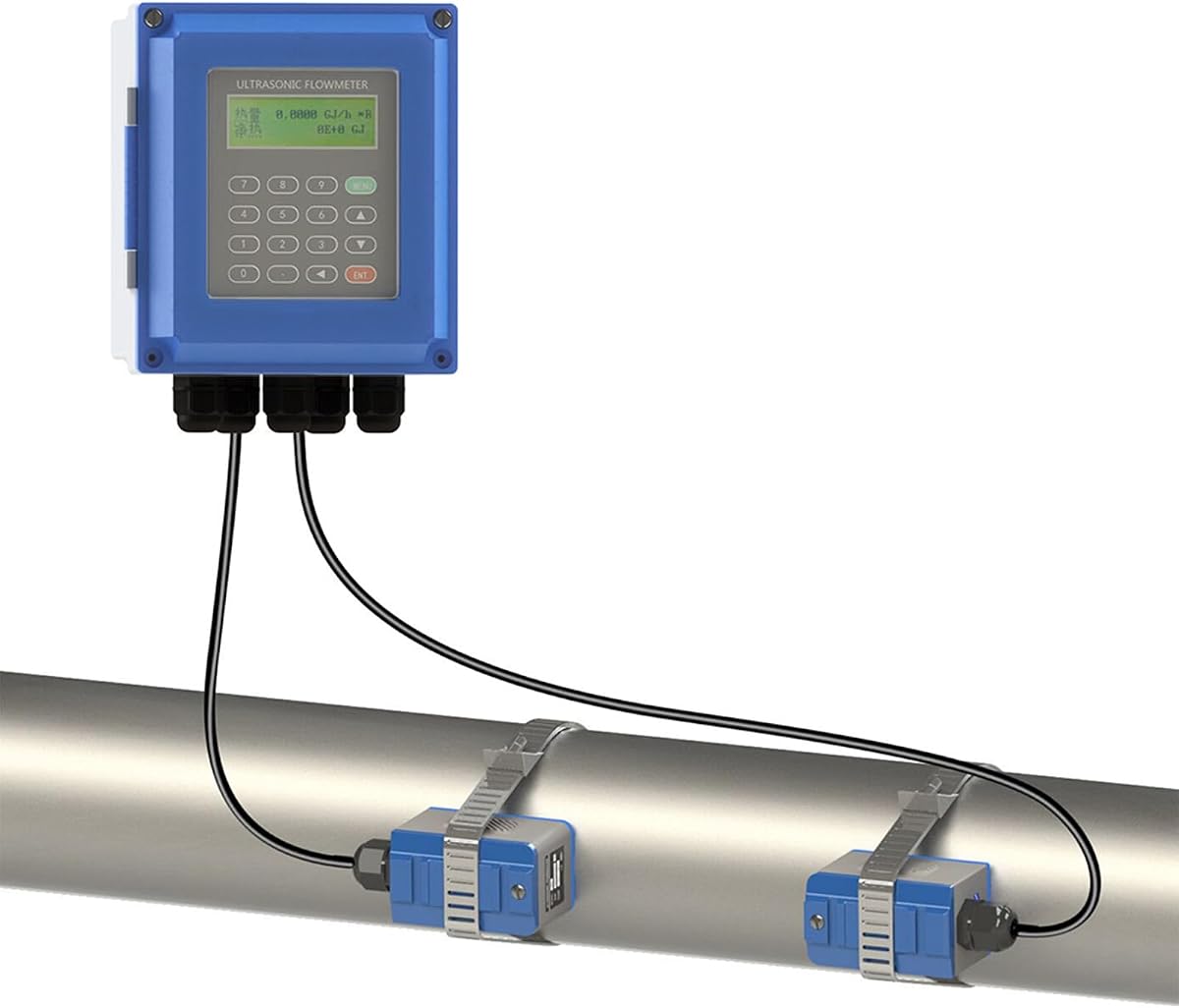
The Digital Ultrasonic Water Flow Meter offers nonintrusive flow measurement for water supply, heating, water-conservancy, energy, and related applications. Its supplied specifications state an accuracy of plus or minus one percent, an ABS-and-steel construction, and compatibility with copper and PVC pipes as well as liquids including seawater, alcohol, and river water.
We may earn a commission when you buy through this link, at no additional cost to you.
The complete package includes a flow meter, TS-2 and TM-1 ultrasonic transducers, a signal cable, two steel belts, and silicone sealant. This is useful because it provides the principal installation components together. Broad voltage support also makes the meter easier to deploy in environments with either alternating or appropriate direct-current supplies.
As a clamp-on ultrasonic instrument, its performance still depends on correct transducer placement, pipe material, and a suitable measured liquid. The listing does not provide a customer rating, a stated pipe-size range, or a detailed flow-speed range. Users needing a guaranteed industrial output protocol, documented ingress protection, or a signed accuracy specification should request those details before purchase.
This meter is a strong candidate for fixed water-supply monitoring where a non-contact installation is preferred. It is especially convenient for copper or PVC lines and for users who want a complete transducer kit without assembling each component separately.
The ultrasonic transducers are mounted externally with the supplied belts and sealant. This approach reduces contact with the liquid and can be attractive where inserting an obstruction into the line is undesirable.
An AC 85-264V input range and DC 8-36V range broaden the possible installation environments. The correct power arrangement should still be confirmed against the meter, transducers, and local electrical requirements.
We may earn a commission when you buy through this link, at no additional cost to you.
The Bonvoisin Handheld Ultrasonic Flow Meter is designed for mobile measurements across pipes from DN15 to DN700 millimeters, or approximately one-half to 28 inches. It has a 3.7 rating, a stated plus-or-minus one percent accuracy, 0.50% linearity, 0.20% repeatability, and a velocity range of 0.1-6 meters per second.
We may earn a commission when you buy through this link, at no additional cost to you.
The S1 and M2 sensors are attached externally to the pipe, and the operator enters pipe and fluid information into the control unit. This approach avoids cutting into the pipeline or stopping production during measurement. The meter also supports readings in liters or gallons and can record up to 2,000 groups of data for later analysis.
Its internal Ni-MH rechargeable battery supports up to 12 hours of continuous operation, making the unit practical for maintenance rounds and temporary surveys. The data download software is not described as immediately included; the listing instructs buyers to contact the seller for it. The supplied rating is also lower than those of several compact residential meters, so expectations should reflect the product's industrial-portable positioning.
Choose this model for field testing copper, PVC, or compatible lines carrying seawater, alcohol, river water, sewage, lubricating oil, diesel, or fuel oil. It is especially valuable when the measurement must be made without interrupting the pipeline.
The clamp-on sensors and handheld controller are designed for temporary surveys where opening or modifying a line would be inconvenient. Installation still requires correct sensor placement and accurate pipe setup information.
The internal logger can retain up to 2,000 measurement groups. Real-time information is visible on the machine, while historical data review depends on obtaining the referenced software from the seller.
We may earn a commission when you buy through this link, at no additional cost to you.
The RAINPOINT Bluetooth Smart Water Flow Meter is designed around hose-level monitoring for gardens, recreational vehicles, sprinklers, and nozzles. It has a 4.2 rating, supports gallons and liters, connects to the Smart Life app, and stores up to one year of historical consumption data for analysis.
We may earn a commission when you buy through this link, at no additional cost to you.
Its defining feature is the 180-degree flip backlit LCD, which can be read from more than one orientation. That design is useful during RV filling or outdoor watering, when a fixed display might be awkward to see. The meter also offers separate total counters and five measurement modes, allowing consumption to be divided into useful segments.
The rotating brass inlet and outlet, anti-clog filter, and IPX5 waterproof rating support outdoor use. However, the product uses Bluetooth only, not Wi-Fi, and its useful remote functions depend on the compatible app and connection range. It is better suited to near-site monitoring than to a remote plant-wide dashboard, and the listing does not provide a formal measurement-tolerance figure.
This is a practical pick for homeowners, RV users, and gardeners who want consumption information in an app plus a readable local display. It combines smart features with a hose-friendly form factor and prioritizes convenience over industrial analog outputs.
The 180-degree flip display makes the meter easier to read during hose use, sprinkler monitoring, and tank filling. Its backlight supports visibility in poor lighting as well as daylight operation.
Dual total counters and five measurement modes support both overall totals and segmented usage. This helps users compare watering routines, RV fills, or individual hose-use periods without relying on a single undifferentiated total.
We may earn a commission when you buy through this link, at no additional cost to you.
The YoLink FlowSmart Kit is a home-focused monitoring package containing a 0.75-inch water meter, monitor, and hub. It has a 4.5 rating and focuses on leak awareness, usage reports, and automated control rather than pipe-size versatility or industrial process signals.
We may earn a commission when you buy through this link, at no additional cost to you.
The YoLink app can send real-time leak alerts to iOS and Android devices. Reports cover hourly, daily, weekly, and monthly consumption, and saved or exported information can support household water analysis. Users can create as many as six time slots, add personalized leakage parameters, and define maximum volumes for automated valve shutoff.
Constant and conditional leak-detection modes offer different ways to interpret consumption, and schedules can be bypassed when necessary. The hub is required for full operation and supports third-party integration with Amazon Alexa and Google Assistant. Battery life is listed as up to ten years, which is a manufacturer claim that depends on use and operating conditions.
Installation remains critical. The listing specifically warns against excessive moisture, flooding, standing water, condensation, extreme temperatures, and other unsuitable conditions unless the device is rated for them. This kit is best for homeowners who want remote leak awareness and smart-home control around a suitable water line.
Custom schedules, personalized parameters, and maximum-volume thresholds make it possible to define what counts as abnormal use. Those rules can support automated shutoff rather than merely sending a generic warning.
The app breaks consumption into hourly, daily, weekly, and monthly views. Saving and exporting reports helps users compare usage patterns and investigate changes in household or rental water consumption.
We may earn a commission when you buy through this link, at no additional cost to you.
The RESTMO Brass Water Flow Meter offers an effective balance of durability, readable local information, and straightforward outdoor use. It has a 4.5 rating, a brass inlet and outlet, a one-touch control button, and four display modes covering flow, last-use consumption, a weekly daily average, and total usage.
We may earn a commission when you buy through this link, at no additional cost to you.
Its internal Hall-type sensor and IC chipset provide the measurement and calculations, with a stated measurement tolerance of less than 5%. Users can switch between gallons and liters by holding the button in flow mode. The screen enters sleep mode after one minute without operation or flow, which helps reduce unnecessary display activity.
The weather-resistant ABS construction is designed to withstand outdoor UV exposure, sunshine, and rain, while the IPX6 grade adds stability for garden-hose use. The brass metal threads are more suitable for repeated hose or faucet installation than lightweight plastic fittings, although the listed tolerance is not suitable when tight regulatory or process accuracy is required.
This is the editor's choice because it covers the most common residential water-metering needs without requiring an app, hub, or complex transmitter. It is a strong option for irrigation, garden hoses, and consumption tracking, offering better information and construction than a basic pulse-only sensor.
Flow mode shows the current rate, consumption mode recalls the most recent use, average mode presents a daily average over a weekly cycle, and total mode maintains cumulative usage. This makes the same display useful across several common monitoring tasks.
Heavy-duty brass threads are designed to withstand regular installation and removal. Combined with the IPX6 housing, the meter is better suited to exterior hose connections than an unsealed indoor-only device.
We may earn a commission when you buy through this link, at no additional cost to you.
The TUF-2000B Ultrasonic Flow Meter is a clamp-on instrument for DN15-700 millimeter pipes, with a stated flow-meter accuracy of plus or minus one percent. It supports forward and reverse measurement, displaying real-time flow rate, cumulative flow, and velocity on a backlit LCD.
We may earn a commission when you buy through this link, at no additional cost to you.
The included TS-2 and TM-1 transducers provide external measurement without inserting a sensor into the pipe. The meter supports conductive liquids including water, wastewater, seawater, and oils, and it is compatible with carbon steel, stainless steel, cast iron, cement, copper, PVC, and aluminum pipes.
Environmental protection is split between two IP68 transducers and an IP65 host. A fault self-diagnosis function is also included. The specifications state plus-or-minus one percent flow accuracy, plus-or-minus two percent water-meter accuracy, plus-or-minus zero percent flow repeatability, and plus-or-minus 0.5% heat-meter repeatability, so buyers should confirm which performance category matches their application.
This model is well suited to pipe surveys and fixed monitoring where bidirectional behavior and broad material compatibility are important. It is less appropriate for someone seeking a simple hose display or a compact DIY pulse sensor, but it offers more measurement information and diagnostic functionality than those alternatives.
Bidirectional measurement records forward, reverse, and net cumulative behavior. This is useful in systems where return flow, recirculation, or reversal events must be distinguished from normal one-direction supply.
IP68 transducers and an IP65 host provide different levels of environmental protection. The fault self-diagnosis function adds an operational check that can help identify configuration or measurement issues.
We may earn a commission when you buy through this link, at no additional cost to you.
The IP68 Metal Hose Flow Meter combines an aluminum alloy body with a stated accuracy of up to plus or minus one percent. It tracks batch volume, total water usage, and real-time flow rate, making it relevant to garden hoses, recreational vehicles, pools, and lawn sprinklers.
We may earn a commission when you buy through this link, at no additional cost to you.
Its 4.4 rating reflects a generally well-received outdoor-focused design. The metal housing offers better impact resistance than plastic, while the IP68 sealing is intended to withstand rain, splashes, and wet outdoor conditions. That combination makes the meter more physically robust for hose environments where knocks and exposure are common.
The LCD automatically turns off after ten minutes, and the listing states a standby target of more than one year. Battery replacement can be performed without removing the flowmeter, while a low-battery alert helps indicate when service is needed. The rotating display can be fixed at an angle for easier viewing from different positions.
This is a good fit for users who want a straightforward local meter and prioritize a metal body over app-based control. It is less suitable for industrial analog signals or remote leak automation, but it combines useful readings with rugged outdoor construction.
The aluminum alloy body is intended to resist impact and cracking during use or installation. It offers a more substantial feel and construction profile than meters built entirely with plastic housings.
The 360-degree rotating LCD can be oriented to suit the hose and viewing position. This improves usability when the meter sits below eye level, against a wall, or in another awkward installation location.
We may earn a commission when you buy through this link, at no additional cost to you.
Choosing a water flow meter starts with the liquid, required accuracy, pipe dimensions, installation environment, and data output. The most important distinction is whether you need a true electromagnetic industrial meter, an ultrasonic inline or clamp-on instrument, or a compact Hall-effect and smart hose meter.
A true electromagnetic flow meter uses a magnetic field and requires a conductive liquid to generate a measurable signal. It is well suited to wastewater and many industrial water applications, but it is not the universal answer for every fluid. Ultrasonic meters can measure certain nonmagnetic liquids through transit-time or clamp-on methods, while Hall-effect meters use a rotating turbine and pulse output. Consider whether the term magnetic requirement reflects a genuine electrical measurement need or simply a preference among available household meters.
A meter must cover the expected operating range without being oversized or operating at its extreme lower limit. The DN25 electromagnetic model states a 1.0-16 cubic meter per hour range and 0.5% accuracy, while the half-inch Hall sensor supports 1-30 liters per minute. The TUF-2000B lists plus-or-minus one percent flow accuracy, and the garden-oriented IP68 model also claims up to plus-or-minus one percent. Compare like-for-like accuracy categories because a flow meter, water meter, and repeatability figure are not interchangeable.
Pipe size determines the required meter geometry. Options in this guide include DN25, DN100, a half-inch NPT sensor, a 0.75-inch smart meter, and ultrasonic units covering DN15-700 millimeters. Inline models need compatible flanges or threads, while clamp-on ultrasonic meters must fit the outside diameter correctly. Always verify nominal dimensions, thread standards, wall thickness, sensor spacing, and whether straight pipe is required before cutting or modifying a plumbing line.
The correct output depends on what happens after the meter. A pulse output can drive an Arduino, Raspberry Pi, or simple counter, while a 4-20mA signal supports industrial process control and longer-distance monitoring. The DN25 electromagnetic model includes both pulse and 4-20mA outputs. Smart residential systems may instead require an app, leak alerts, usage reports, and a hub. Before choosing an output, identify the controller, power supply, data logging requirements, and any need for automated shutoff.
Indoor and outdoor ratings should not be treated as interchangeable. The RAINPOINT smart meter has an IPX5 rating, the RESTMO brass meter is IPX6, and the TUF-2000B combines IP68 transducers with an IP65 host. The IP68 metal hose meter is designed for rain, splashes, and wet outdoor use. Industrial buyers should also consider pressure, temperature, fluid chemistry, condensation, flooding, and whether the meter is continuously submerged or only exposed to splashes.
Some meters are designed for permanent inline installation, others attach externally, and compact sensors fit into appliances or hobby projects. Hall-effect models require the correct flow direction, while clamp-on units need accurate pipe information and well-positioned transducers. Consider battery access, seals, cable routing, straight-pipe requirements, and service access before installation. Smart meters also require a suitable hub or phone connection, and full-featured kits may need a specific app and account.
Wetted materials determine how a meter handles corrosion, wear, and aggressive liquids. The DN25 electromagnetic meter combines a PTFE liner with SS316L electrodes and a carbon steel body. The garden meters use brass or aluminum alloy for robust outdoor connections. Ultrasonic models may accept several liquids and pipe materials, but not every combination has the same level of verification. Confirm the medium, concentration, temperature, viscosity, and cleanliness before selecting a model.
A local LCD is useful for immediate readings, while app-based data is better for remote awareness and long-term analysis. The RESTMO meter provides flow, consumption, average, and total modes, while the TUF-2000B displays flow rate, cumulative flow, and velocity. Smart products can add leak alerts, historical reports, and automated shutoff. Choose based on who will use the information and whether the installation permits reliable screen access or wireless connectivity.
Begin by identifying the pipe size, liquid, expected minimum and maximum flow, required output, and installation environment. Confirm that the meter's measurement method suits the fluid and that its range includes normal operating conditions. For inline units, verify flange or thread dimensions; for clamp-on ultrasonic models, confirm pipe diameter and material; and for Hall-effect sensors, observe the marked flow direction before tightening the connection.
Install the meter according to its instructions while keeping sensors, seals, cable joints, and display surfaces protected. Respect any straight-pipe requirements and do not assume that a specific flow direction may be reversed. After installation, check for leaks and compare the reading with a known quantity of water or another trusted measurement. Calibrate or configure units, thresholds, totalizers, and alerts only after confirming that the plumbing and electrical connections are stable.
For ongoing care, keep the meter body and sensing area clean, inspect seals and threaded connections, and protect electrical openings from moisture. Follow the manufacturer's battery or power guidance, replace batteries in the correct direction, and lock any battery compartment. Update smart-device software when needed, retain measurement records for trend analysis, and arrange professional verification if readings drift, pressure behavior changes, or the fluid chemistry falls outside the specified conditions.
No. True electromagnetic meters require a sufficiently conductive liquid, which makes them well suited to water, wastewater, and many industrial process fluids. They are generally unsuitable for nonconductive liquids such as oils or deionized water. Ultrasonic and Hall-effect alternatives may fit those applications better, depending on the model and fluid properties.
A hose-compatible model with brass or metal connections and a clear local display is usually the most practical. The RAINPOINT meter adds app monitoring, while the RESTMO meter provides four display modes and an IPX6 housing. The IP68 metal hose meter is attractive when impact resistance and maximum outdoor sealing are priorities.
A pulse output produces a series of electrical signals that a controller can count to estimate flow and accumulated volume. A 4-20mA output provides a continuously varying analog current for process monitoring and control. Pulse output suits counters and DIY controllers, while 4-20mA is generally more appropriate for fixed industrial systems.
The ultrasonic products in this guide are clamp-on designs, so their transducers attach to the outside of compatible pipes without opening the line. Correct placement, pipe dimensions, fluid properties, and sensor spacing remain essential. A poorly installed clamp-on meter can produce inaccurate results even when the instrument itself is working correctly.
Only smart meters with suitable monitoring logic can automatically identify abnormal usage and trigger alerts or shutoff. The YoLink FlowSmart Kit supports scheduled and conditional leak detection, customizable volume thresholds, and automated valve shutoff through its app system. Ordinary local-display meters record usage but generally do not perform the same level of automated protection.
The acceptable accuracy depends on the job. Garden watering and rough consumption tracking may work with a broader tolerance, while billing, process control, or regulated measurement may require tighter documented accuracy. Compare the meter against the stated operating range and verify whether the published figure refers to flow accuracy, water-meter accuracy, linearity, or repeatability.
IP65 indicates protection against dust ingress and water jets, while IP68 indicates a higher level of protection against prolonged immersion, subject to the manufacturer's specified conditions. Neither rating automatically protects against every chemical, temperature, pressure, or installation situation. The enclosure, cable entries, seals, and actual exposure conditions all affect real-world performance.
A smart meter is better when remote readings, leak alerts, reports, or automated shutoff are important. A basic Hall-effect flow meter is usually more appropriate for a DIY controller, appliance, or simple totalizing project. The smart option adds hub, app, connectivity, and configuration requirements that may be unnecessary for straightforward flow counting.
The best overall selection is the DN25 Digital Electromagnetic Flowmeter because it combines true electromagnetic measurement, a 0.5% stated accuracy, corrosion-resistant wetted components, and both pulse and 4-20mA outputs. The RESTMO meter is the strongest general-purpose residential option, while the half-inch Hall Effect Flow Meter is the best budget choice for compact DIY and appliance-scale projects.
Prioritize the measurement method and flow range first, then verify pipe compatibility, accuracy, output signals, environmental ratings, and installation constraints. A large drainage project may need an industrial electromagnetic meter, whereas an RV or garden system may be better served by a smart hose meter, and a temporary pipe survey may benefit from portable ultrasonic equipment.
Before ordering, confirm the current product configuration, dimensions, fluid compatibility, and included accessories with the seller. Prices and availability can change, and a listing that looks suitable on paper still needs to match the actual pipe, liquid, and monitoring system. Taking these final checks seriously helps prevent an inaccurate or difficult installation.