
5-Pack 20 Amp Microwave Fuse
4.5Editor score
Five replacement fuses included
20-amp 250-volt rating
6 by 30 millimeter size
Broad multi-brand compatibility
Compare the best microwave fuses for GE, Frigidaire, Whirlpool, Kenmore, and other ovens by rating, voltage, amperage, size, compatibility, pack details, and
Microwave fuses are small but essential safety components that interrupt power when a circuit draws excessive current. Choosing the correct replacement involves matching amperage, voltage, physical size, fuse type, and part numbers rather than relying on appearance alone. A mismatched fuse can fail prematurely or fail to provide intended protection.
The products in this guide include slow-blow ceramic fuses, sand-filled replacement fuses, and a door-switch replacement kit. We compared the supplied ratings, dimensions, electrical specifications, compatibility claims, pack quantities, and practical guidance for owners and repair technicians. The list covers 20-amp models using both 125-volt and 250-volt configurations.
Each review explains where a particular fuse fits best and where its compatibility requires careful verification. The top selections include a well-reviewed 20-piece set, a broad 125-volt multipack, and a useful repair bundle. Product details and marketplace availability can change, so confirm the original fuse markings and your microwave model before ordering.
4.5Editor score
4.7Editor score

4.4Editor score
The table below compares all ten options by rating, construction, electrical specification, and stated compatibility. It also highlights the practical difference between a single-replacement format, a maintenance multipack, and a combined door-switch repair kit.


This BOJACK replacement fuse carries a 4.6 rating and offers a focused option for microwaves that use a 20-amp, 250-volt, 6-by-30-millimeter slow-blow ceramic fuse. Its primary appeal is direct compatibility with the GE WB27X10388 part number. That makes it easier for a repairer to identify than a broadly described universal option, provided the original component has matching electrical and physical specifications.
We may earn a commission when you buy through this link, at no additional cost to you.
The stated construction follows a familiar pattern for microwave fuses: a ceramic body designed to interrupt overcurrent without producing the scattered glass fragments associated with conventional glass cartridge fuses. Its 20-amp current rating and 250-volt voltage rating match the 6x30mm form factor. Those details give an owner a clear checklist against the marking found inside the microwave.
The principal trade-off is quantity. This option is presented as one replacement rather than a maintenance assortment, so another purchase may be necessary if the fuse fails again or if you service several appliances. The word universal in the listing should also be interpreted carefully; a matching physical size and current rating alone do not establish compatibility with every microwave or every fuse application.
This is a sensible selection for someone who has already identified WB27X10388 as the required part and wants a straightforward ceramic replacement. Before buying, disconnect the appliance, locate the fuse markings, and compare the amperage, voltage, and length. If all specifications align, it is a practical alternative to searching among several vaguely similar listings.
The direct WB27X10388 reference is the most useful feature for a targeted repair. It gives you a concrete part number to compare with the original fuse instead of relying only on a general compatibility statement.
A ceramic cartridge is suited to the demanding environment inside a microwave because it is designed to open the circuit during excess current. It also avoids the loose glass fragments that can result from a broken glass fuse.
We may earn a commission when you buy through this link, at no additional cost to you.
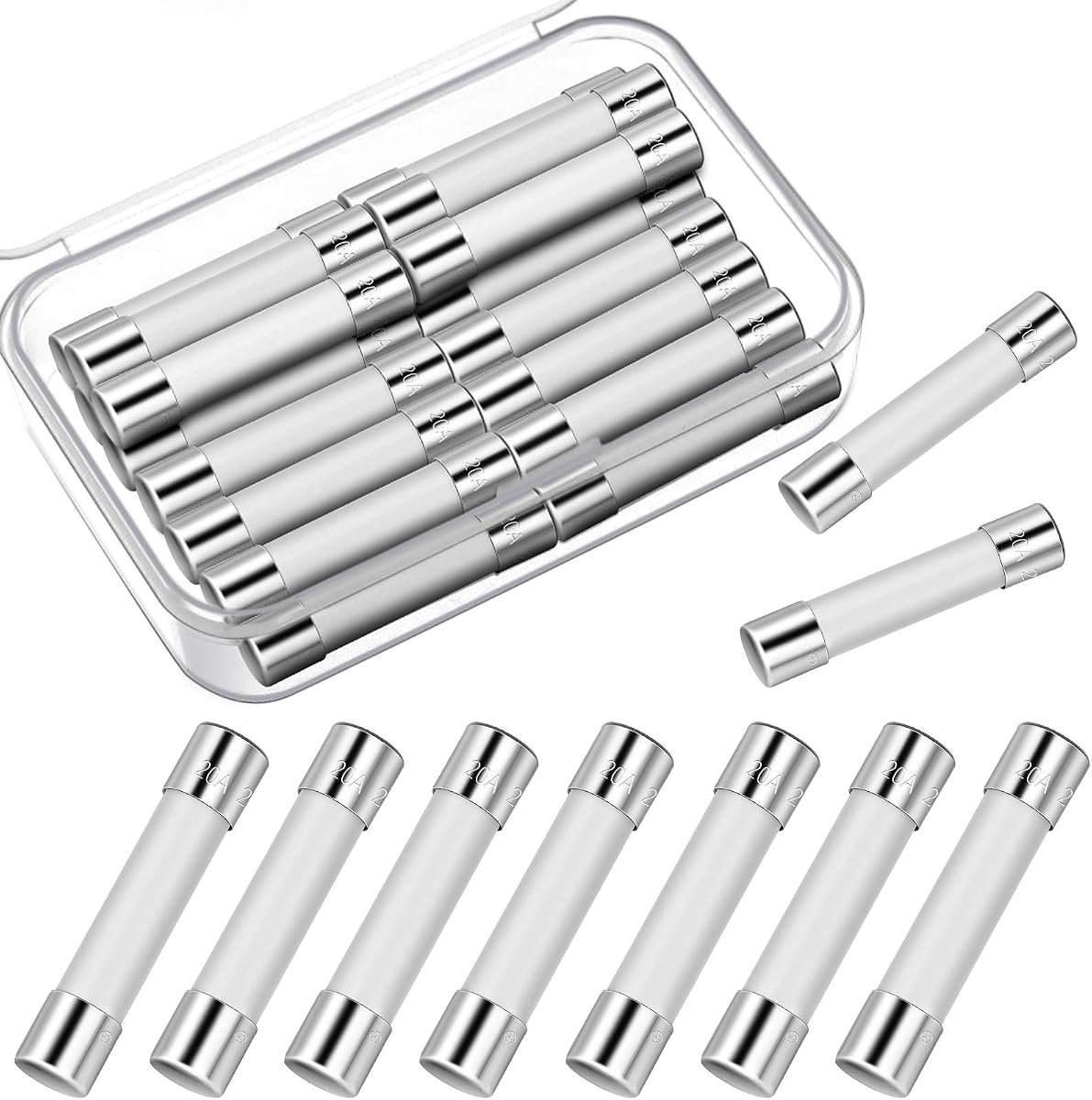
The Frienda 20-piece set earns one of the strongest overall positions because it combines a 4.7 rating with a generous quantity and clearly stated 20-amp, 250-volt slow-blow specifications. It is especially useful for appliance owners, maintenance workers, or anyone who prefers keeping several correctly matched fuses on hand rather than ordering a single component for each repair.
We may earn a commission when you buy through this link, at no additional cost to you.
Its ceramic fuses are described as sand-filled, which helps contain the fuse element when it opens and reduces the possibility of scattered glass fragments. The listing also identifies compatibility with the GE WB27X10388 and Kenmore microwaves. Importantly, it explicitly states that this is an aftermarket product and that referenced brands and models are used to demonstrate compatibility rather than to imply original-brand status.
A larger pack does not make the 250-volt rating universally suitable. Microwaves using 20-amp, 125-volt fuses should not assume that a larger housing or a similar appearance makes this option interchangeable. The dimensions, current, voltage, time-delay behavior, and the original markings all need to match. Those caveats are reasonable for a replacement safety component where exact specification matters.
This is our top overall choice for buyers who need a 20-amp, 250-volt, 6.35x30mm slow-blow fuse and want multiple replacements in one order. It is a particularly good maintenance choice for a household with more than one compatible microwave. For a single repair, the smaller multipacks may be more proportionate, but the Frienda set offers strong overall value and the highest rating in the group.
Twenty fuses are useful for repeated maintenance, multiple compatible appliances, or technicians who service equipment regularly. Having matched spares on hand reduces the inconvenience of ordering again for a routine component replacement.
The sand-filled construction is a meaningful distinction from an ordinary glass cartridge. It is intended to contain the fuse element when the device opens, helping avoid loose fragments inside the appliance.
We may earn a commission when you buy through this link, at no additional cost to you.
This five-pack provides a balanced choice for a straightforward replacement at 20 amps and 250 volts. Its 4.5 rating reflects a generally favorable reception, while the physical specification of 6x30mm and 0.24 by 1.2 inches gives buyers familiar dimensions to compare with the original component.
We may earn a commission when you buy through this link, at no additional cost to you.
The stated compatibility is extensive. It names GE, Whirlpool, Kenmore, KitchenAid, Jenn-Air, Amana, and Magic Chef, as well as several replacement numbers including WB27X10388, 875392, AP3994062, PS1481237, EAP1481237, and WB27X10928. The ceramic tube, strong end caps, and quartz-sand fill are also described in a way that emphasizes insulation and stability.
The breadth of the compatibility claim deserves caution. Users should not treat every listed brand as a blanket approval for every model, and they should verify whether the microwave uses a 250-volt fuse rather than a 125-volt one. The product data also notes that a new fuse should be installed only after power is turned off. If a replacement blows immediately, the underlying fault may still be present.
This option is a good budget pick for a compatible 20-amp, 250-volt system, particularly when a small maintenance reserve is useful. The five-piece quantity is more practical than ordering a single fuse repeatedly but avoids the storage burden of a much larger set. Confirm the original part number and printed electrical rating before purchase for the best result.
The brand and part-number coverage makes this set useful across many common microwave families. That breadth is most valuable when your existing fuse matches the stated dimensions, amperage, voltage, and replacement number.
Five units provide a balance between immediate replacement and modest inventory. It is a sensible quantity for owners of several compatible appliances or a technician who wants a few matching spares without maintaining a large stock.
We may earn a commission when you buy through this link, at no additional cost to you.
This two-pack targets 20-amp, 125-volt microwave fuses and includes an extensive list of compatible models and replacement numbers. Its 4.2 rating is lower than the leading options, but the useful diagnostic guidance helps distinguish a simple fuse replacement from a deeper electrical problem. The listed part numbers include 5304509451, 1810711, EA3486694, PS3486694, AH3486694, and AP4980426.
We may earn a commission when you buy through this link, at no additional cost to you.
The most valuable feature is the warning that a fuse which blows immediately after replacement may indicate a door-switch problem. The listing advises checking the switch for continuity and states that continually blowing fuses suggest an unresolved short or overcurrent condition. This is sensible guidance because replacing a fuse without identifying the cause can damage another component or create a safety risk.
The compact two-piece quantity suits a single household repair, while the long model list offers a practical way to check compatibility. However, the 125-volt rating is decisive: it should not be substituted for a 250-volt fuse even if the body dimensions look similar. Users also need to disconnect the appliance from its power supply before servicing it.
Choose this product if your microwave is listed among the compatible models and the original fuse is marked 20 amps and 125 volts. It is especially valuable for repairers who want the door-switch troubleshooting reminder close at hand. If you cannot confidently identify the required electrical rating, do not rely on a visual guess; locate the markings on the existing fuse or consult the appliance documentation.
The guidance about door switches and unresolved shorts can prevent repeated replacement attempts. A fuse is designed to open under excessive current, so immediate or continuous failure is a signal to inspect the circuit rather than keep installing new fuses.
The long list of compatible models makes this a useful option when you have a specific GE, Kenmore, or Frigidaire model number. Searching within the listing can help narrow down whether the intended replacement matches the microwave in question.
We may earn a commission when you buy through this link, at no additional cost to you.
This BOJACK set shares the electrical and dimensional specifications of the rank-one single fuse but increases the quantity to ten. With a 4.6 rating, it sits comfortably within the stronger-reviewed portion of the list. It is aimed at owners who have identified a 20-amp, 250-volt, 6x30mm slow-blow fuse and want a modest stock of matching replacements.
We may earn a commission when you buy through this link, at no additional cost to you.
The core specification is easy to understand: 20 amps, 250 volts, slow-blow construction, and a body measuring 6×30 millimeters. The listing also identifies compatibility with GE microwaves and direct replacement of WB27X10388. These specifics allow a buyer to cross-check the old fuse, rather than relying on broad appliance branding alone.
Ten units are a practical middle ground between a single replacement and a very large service pack. The trade-off is that buyers who need only one fuse may end up with more components than required, while those maintaining several compatible ovens may appreciate having spares immediately available. As with any ceramic fuse, the housing size is not enough; the voltage and time-delay behavior must also match.
This is a good maintenance option for a household with several compatible 250-volt microwaves or a repair professional handling a small volume of matching units. It is less compelling for a single simple repair, but the extra spares can prevent repeated ordering. Verify the original rating and WB27X10388 reference before installation, and investigate the cause whenever a new fuse blows unexpectedly.
Ten fuses cover a moderate maintenance need without reaching the size of a large bulk purchase. The set is particularly convenient for compatible appliances that share the same fuse specification.
Every unit in the set is presented with the same dimensions and electrical rating. Keeping matched spares makes it easier to maintain an inventory without mixing incompatible 125-volt and 250-volt parts.
We may earn a commission when you buy through this link, at no additional cost to you.
This ten-pack is designed around 20-amp, 250-volt slow-blow time-delay fuses measuring 6×30 millimeters. Its 4.6 rating makes it one of the better-rated multipacks, while the detailed construction notes give repairers useful information about what they are installing. The stated materials are a ceramic tube, alloy, nickel-plated brass, and quartz sand.
We may earn a commission when you buy through this link, at no additional cost to you.
The time-delay characteristic is central to its use in microwave circuitry. A slow-blow fuse is designed to tolerate a brief surge while still opening when a sustained overcurrent condition threatens the appliance. The quartz-sand fill supports containment of the fuse element, and the nickel-plated brass end caps are part of the stated construction. These details distinguish it from a generic glass cartridge.
Compatibility is described broadly for GE, Whirlpool, Kenmore, and other microwaves, with WB27X10388 specifically mentioned. Nevertheless, buyers should verify the original part number and printed rating. The 250-volt requirement also makes it unsuitable for a microwave that uses a 20-amp, 125-volt fuse, even if both products occupy the same general 6x30mm format.
This is a strong choice for someone maintaining compatible 250-volt appliances or seeking a few matching spares with clearly stated time-delay behavior. Its materials make it particularly appealing for repairers who want to understand the construction they are installing. Confirm the electrical specifications before ordering, and never treat the broad compatibility phrase as permission to substitute across different fuse ratings.
The slow-blow characteristic allows the fuse to tolerate short-lived current variations while still protecting the circuit from sustained excess current. That behavior is central to a microwave replacement fuse rather than a minor packaging detail.
Listing the ceramic body, alloy, nickel-plated brass, and quartz sand gives useful context for repair decisions. It also makes this option more transparent than listings that describe a fuse only by size and wattage.
We may earn a commission when you buy through this link, at no additional cost to you.
This 5-Pack is built for 20-amp, 125-volt, 6x30mm microwave fuses and includes a long list of compatible models. Its 4.1 rating is the lowest in this group, so it is not the strongest choice on customer feedback alone. However, its detailed model coverage and common replacement numbers can be highly useful when identifying a specific appliance.
We may earn a commission when you buy through this link, at no additional cost to you.
The listing names GE, Frigidaire, and Kenmore microwaves and includes numerous compatible model designations, including several FGMV, FFMV, CFMV, CGMV, and FPBM series units. It also lists replacement numbers 1810711, EA3486694, PS3486694, AH3486694, and AP4980426. This makes it easier to check an exact model than a listing that only says it fits many ovens.
The troubleshooting guidance is again important: if the fuse keeps blowing, the door switch should be checked for continuity, and the underlying short should be found before another fuse is installed. The appliance must be disconnected from its power supply during service. The 125-volt rating is the key limitation, since it makes the fuse unsuitable for a 250-volt circuit.
This product makes the most sense when a specific model appears in its compatibility list and the original component is clearly marked 20 amps and 125 volts. The five-piece quantity is sensible for a small maintenance stock. Its lower rating should prompt careful review of current customer feedback and seller information, but the detailed identification data can outweigh a generic rating for a knowledgeable repairer.
The extensive model list is valuable when the appliance label identifies a specific series. Searching the listing for the exact model helps distinguish a supported replacement from a visually similar but electrically different fuse.
The instructions correctly direct owners toward the door switch and underlying short when a new fuse fails quickly. This prevents an endless cycle of replacement without addressing the circuit condition that caused the fuse to open.
We may earn a commission when you buy through this link, at no additional cost to you.
This repair bundle stands apart because it includes a KW3A microwave door switch alongside four 20-amp, 250-volt, 6x30mm slow-blow ceramic fuses. Its 4.4 rating reflects a solid but not leading score. For a repairer dealing with both a blown fuse and a potentially faulty door switch, the combined format can streamline diagnosis and parts collection.
We may earn a commission when you buy through this link, at no additional cost to you.
The door switch is described as normally closed or open, with a plastic gray body, 16-amp current capacity, and voltage compatibility listed for 125 and 250 volts. Its stated temperature resistance is 105 degrees. The included fuses use a ceramic tube, alloy, nickel-plated brass, and quartz sand, with a time-delay design for circuit protection.
The main limitation is that a door switch is model-specific. A microwave door interlock switch may have the same general appearance as a replacement while differing in mounting position, terminal arrangement, physical dimensions, or switching behavior. Installing the wrong switch can prevent the oven from starting or compromise the safety interlock. The fuse rating must likewise match the original exactly.
This is our premium pick for a qualified owner or repair technician who has confirmed that a 20-amp, 250-volt fuse and the listed KW3A switch match the appliance. It is not an automatic fix for every microwave and should not be bought merely because the oven is dead. Confirm the part numbers, switch style, electrical ratings, and fuse dimensions before ordering.
A blown fuse and a failed door switch are related issues in many microwave repairs. Including both can be useful when the original fuse has already opened and the door interlock also needs testing or replacement.
The switch is identified as KW3A and includes current, voltage, material, and temperature information. Those details help a repairer compare it with the original component rather than selecting a switch solely by appearance.
We may earn a commission when you buy through this link, at no additional cost to you.
This 10-pack stands out as the strongest 125-volt option, combining a 4.7 rating with ten matching replacement fuses. It is designed for 20-amp, 125-volt, 6x30mm microwave applications and references GE and Frigidaire compatibility. Owners of several compatible appliances or technicians who want a small inventory of correctly rated spares will find the quantity useful.
We may earn a commission when you buy through this link, at no additional cost to you.
The listing provides numerous references, including WB27X11138, 5304509451, 1810711, AH3486694, AP6230606, EA3486694, PS12071294, PS3486694, AP4980426, and 261201200040. This gives buyers several ways to cross-check the replacement. The stated purpose is to cut power during overloads or short circuits, protecting the microwave and reducing the chance of continued damage.
The primary limitation is the 125-volt rating. These fuses must not be installed in a microwave requiring a 250-volt component, even if the physical size is the same. The product data also refers to the unit as a thermal fuse, so buyers should compare all markings and specifications rather than relying on one generic description. A quantity of ten does not resolve an underlying short or door-switch fault.
This is our top pick for 125-volt users because of its strong rating, broad part-number references, and useful ten-unit supply. It is especially well suited to a household with multiple compatible GE or Frigidaire ovens. Verify the original 20-amp and 125-volt markings, disconnect the power, and investigate any immediate repeat failure before installing another fuse.
Ten replacements offer more flexibility than a two- or five-piece set. The supply is useful for multiple appliances, repeated preventive maintenance, or repair professionals who service the same common fuse specification.
The extensive list of original and aftermarket part numbers makes cross-checking easier. A buyer can search for the marking on the failed fuse or the model information recorded inside the microwave cabinet.
We may earn a commission when you buy through this link, at no additional cost to you.
This eight-pack is a clearly identified 20-amp, 125-volt Type 611 replacement in a 6x30mm format. Its 4.6 rating places it firmly among the better-reviewed choices, while the explicit type marking makes it easier for owners to distinguish from standard 5x20mm glass fuses. It is positioned for GE, Frigidaire, and Hotpoint microwaves.
We may earn a commission when you buy through this link, at no additional cost to you.
Compatible part numbers include WB27X11138, 5304509451, 5304464087, 5304488359, AP5648907, and PS5136235. The fuses are marked with their amperage, voltage, and 611 type, which helps reduce the risk of selecting the wrong cartridge. The listing explains that a blown fuse interrupts power during a surge or component failure, helping protect the magnetron, control board, and high-voltage components.
The safety section is notably specific. It advises unplugging the oven and discharging the high-voltage capacitor before replacement, and clearly states that the fuse is not universal. That warning is important because a microwave contains hazardous stored energy even after it is unplugged. An ordinary appliance fuse swap is not an appropriate model for servicing the high-voltage section of a microwave.
This set is a strong option for owners with a compatible 125-volt system who want a moderate reserve of clearly marked fuses. The eight-unit quantity is useful without being as large as the ten-piece options. It is not suitable for 250-volt appliances, and the door switch or another failed component may still need diagnosis if the original fuse opened.
The 611 designation and 6x30mm measurement help distinguish the fuse from common 5x20mm glass cartridges. Those visible details make it easier to confirm that the replacement matches the component removed from the oven.
The instruction to unplug the oven and discharge the high-voltage capacitor recognizes the risk posed by stored energy. It is an important reason to consider qualified service help when the repair extends beyond an accessible fuse holder.
We may earn a commission when you buy through this link, at no additional cost to you.
Selecting a microwave fuse requires exact electrical and physical matching, not a general estimate. Use the following factors to compare part numbers, voltage, amperage, dimensions, fuse behavior, construction, compatibility, and package quantity before making a selection.
Every product in this guide is rated at 20 amps, but amperage is still one of the most important checks. The replacement should carry the same current rating as the fuse removed from the appliance. A lower-rated fuse may open too readily, while an incorrectly higher-rated fuse could permit more current than the circuit was designed to interrupt. Treat the printed amperage as an exact specification rather than a rough minimum.
Choose a replacement only when its 20-amp marking matches the original. Do not infer the rating from body length, diameter, or the brand of the appliance. A fuse may look identical while carrying a different rating, and installing an incorrect one can undermine the protection expected from the circuit.
This guide contains both 125-volt and 250-volt products, and the two groups are not interchangeable. A microwave designed around a 125-volt fuse should use a 20-amp, 125-volt replacement, while a model calling for a 250-volt component needs a 20-amp, 250-volt fuse. Read the marking on the old fuse, the part label, or the appliance documentation before choosing.
The voltage difference is one of the easiest mistakes to make because many replacements share similar dimensions. If the original marking is missing or illegible, locate the correct part number instead of relying on a visual match. A supply of extra 125-volt fuses does not make them suitable for a 250-volt installation.
The products reviewed are 6x30mm, 6.35x30mm, or 0.24 by 1.2 inches, which are effectively the same general format within normal measurement tolerance. The replacement must fit the holder correctly and should not be forced, twisted, or modified. A physically correct body is still not enough, but an incorrect body may not make secure contact or may not fit at all.
Measure the old fuse rather than estimating from the listing photograph. Compare both diameter and overall length, then verify the electrical rating and fuse type. If the dimensions do not agree, do not attempt to adapt the part. Continue looking for the exact replacement specified for your model.
The ceramic options in this guide are slow-blow, time-delay, or sand-filled fuses. Their behavior is designed to tolerate a brief surge while still opening during a sustained overcurrent. This differs from a standard fast-acting glass fuse. A replacement should preserve the time-delay characteristics specified for the circuit, along with the required current and voltage ratings.
Look for markings such as slow-blow, time-delay, or the relevant type number on the original component. Do not use a common household glass fuse merely because its amperage appears similar. The ceramic body and internal filling are part of the component's operating design, not cosmetic differences.
Part numbers provide the most reliable starting point for compatibility. Relevant references in this guide include WB27X10388, WB27X11138, 5304509451, 1810711, EA3486694, PS3486694, AH3486694, AP4980426, AP6230606, and several other manufacturer and aftermarket numbers. Cross-check the number on the old fuse or appliance documentation against the listing.
Brand names and model lists are helpful filters, but they are not substitutes for the electrical specification. Some products describe themselves as universal replacements, yet the data expressly limits certain products to particular voltages or applications. Search the full model number when the listing provides one, and confirm every marking before ordering.
Ceramic bodies, quartz-sand fills, alloy components, and nickel-plated brass end caps are common construction details in the reviewed products. A sand-filled fuse is designed to contain the fuse element when it opens, avoiding the loose glass fragments that may come from a conventional glass cartridge. Durable materials can also help the fuse maintain stable operation before it needs to open.
Construction is a secondary selection criterion after voltage, amperage, size, and type. Choose a clearly described ceramic or sand-filled design for a suitable microwave circuit, but do not assume that two visually similar ceramic fuses are interchangeable. The electrical markings remain the deciding factors.
A fuse normally opens because a circuit draws too much current. If a new fuse blows immediately, the component may not be the underlying problem. Several listings correctly recommend checking the microwave door switch for continuity and looking for a short or failed component. The door-switch-and-fuse bundle is useful for repairers who have already confirmed that both parts match the appliance.
Plan to replace the fuse only after identifying the fault when practical. Repeatedly installing new fuses without diagnosis can lead to further damage. If the fault involves the magnetron, control board, wiring, or high-voltage section, a qualified appliance technician is better equipped to diagnose the system safely.
Pack sizes range from two to twenty units. A two- or five-piece set is convenient for an occasional household repair, while eight- or ten-piece sets provide a modest maintenance reserve. The twenty-piece Frienda set is best suited to technicians or owners with several compatible appliances. More units are useful only when every included fuse has the correct rating and type.
Choose a quantity that matches likely future needs without creating a confusing stock of mismatched parts. Store spare fuses in a dry, protected place and keep their specifications visible. If you own microwaves with different voltage or amperage requirements, label each set separately rather than mixing them together.
Begin by unplugging the microwave and allowing enough time for stored electrical energy to dissipate before opening the appliance. Locate the existing fuse, note its amperage, voltage, dimensions, type, and part number, and compare every marking with the replacement. Do not install a fuse based only on the shape of its body. If the old fuse is visibly damaged, discolored, or cracked, handle it carefully and keep fragments away from the appliance interior.
After confirming the correct replacement, disconnect power before removing the old fuse. A qualified technician should follow the appliance service procedure for releasing or removing the fuse holder, since holders differ in design and may require tools. Install the new fuse in the specified orientation, making sure it is seated securely without bending the end caps. Replace the access cover and other removed panels according to the appliance instructions.
Restore power only after confirming that all covers are back in place. If the microwave operates normally, no further action is required. If the new fuse blows immediately, the door switch or another part may be faulty, and the underlying overcurrent condition may remain. Disconnect the appliance again, avoid repeated fuse replacement, and have a qualified technician inspect the door switch, wiring, and related components before using the oven again.
Not always. A compatible replacement should match the original amperage, voltage, physical dimensions, fuse type, and relevant part number. Many of the reviewed fuses share a 6x30mm size, but a matching body does not make a 125-volt and 250-volt fuse interchangeable. Always compare the printed markings before installation.
The correct size depends on the model and the part it uses. Several options reviewed are 6x30mm or 6.35x30mm and reference GE part numbers such as WB27X10388 or WB27X11138. Locate the old fuse or look up the model-specific part number to confirm both size and electrical rating.
No. They have different voltage ratings and should only be used in the circuit for which they are specified. The products in this guide divide into 20-amp, 125-volt and 20-amp, 250-volt groups. Replacing a 125-volt fuse with a 250-volt unit, or the reverse, can fail to provide the required protection.
A new fuse can blow if the original fault remains. Common possibilities include a defective door switch, a short circuit, or another component drawing excessive current. Several listings recommend checking door-switch continuity and finding the short before replacing the fuse again. Repeated fuse changes do not correct an underlying electrical fault.
Replacing an accessible fuse can be relatively simple, but microwaves contain a high-voltage capacitor that can retain dangerous charge after disconnection. Unplug the appliance, allow time for the charge to dissipate, and follow the service instructions. Qualified service help is appropriate if you are unsure about high-voltage discharge, access covers, or internal components.
In the context of these products, slow-blow and time-delay describe a fuse that tolerates a brief surge without opening immediately. It opens when a sustained overcurrent condition occurs. That behavior is different from a fast-acting fuse, which is designed to respond quickly to a more immediate fault.
Several reviewed ceramic fuses are filled with quartz sand specifically to help contain the fuse element when it opens. This differs from a standard glass cartridge, which can break into fragments. The ceramic body should still be handled carefully, and the original fuse should be replaced with the same specified rating and type.
A multipack is useful for multiple compatible appliances, repeated maintenance, or technicians who service common models. For one occasional repair, a two- or five-piece set may be more proportionate. The included fuses must all have the correct voltage, amperage, dimensions, and type, and different specifications should be stored separately.
The Frienda 20-pack stands out as the best overall choice for compatible 20-amp, 250-volt installations, combining a 4.7 rating with a generous supply and clearly stated sand-filled construction. The five-pack WB27X10388 option delivers the most budget-friendly balance for a smaller replacement stock, while the door-switch-and-fuse kit offers a feature-rich premium repair bundle.
Exact compatibility matters more than broad claims. Begin with the part number and printed specifications on the existing fuse, confirm whether the circuit calls for 125 or 250 volts, and verify the amperage, dimensions, and slow-blow behavior. If a new fuse opens immediately, investigate the door switch and underlying circuit rather than treating another fuse as a permanent solution.
Marketplace listings, customer feedback, and product details can change, so review the current product page and seller information before purchasing. Compare the replacement against the markings inside your microwave, follow all safety procedures, and seek qualified service assistance when the repair involves high-voltage components or an unresolved electrical fault.