
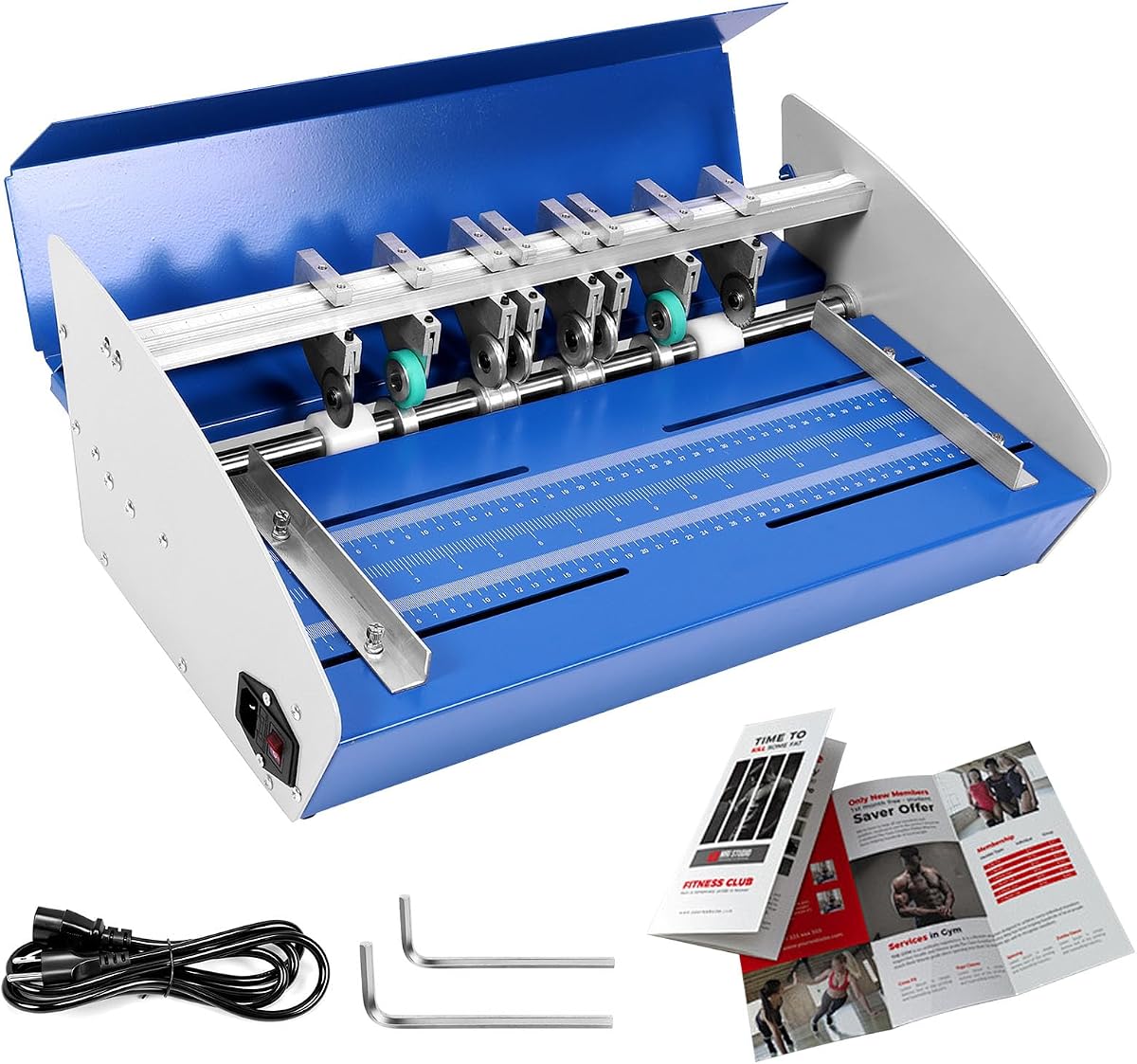
13.78-Inch Foldable Manual Paper Creaser
4.1Editor score
13.8-inch creasing capacity
0.1mm alignment deviation
Alloy creasing blade
Foldable desktop storage
A paper folding machine can turn time-consuming document preparation into a consistent, efficient process. The right model should match your paper volume, supported sheet sizes, required folds, available workspace, and whether you prioritize automatic feeding, precise scoring, or compact manual operation.
We compared all ten products by examining their stated capacities, throughput, fold styles, paper handling, controls, construction, and intended work environments. The list includes high-speed automatic folders, desktop machines, and manual or electric creasers for professional, office, and craft applications.
Each pick highlights a different practical reason to consider it, from accessible scoring tools to high-volume automatic folders. Product availability, features, and prices can change, so confirm current listing details before purchasing and choose based on your actual workflow.
4.1Editor score

4.1Editor score

4.1Editor score
As an Amazon Associate we earn from qualifying purchases.
The comparison below highlights each machine's operating method, stated capacity, supported formats, and most notable feature, making it easier to distinguish automatic folders from manual and electric scoring tools.


The Martin Yale P7500 is an automatic tabletop paper folder aimed at offices, mailrooms, churches, and other settings that regularly prepare letters and standard documents. Its 3.9 rating reflects a practical balance of automatic operation, multiple folding choices, and a relatively compact format, while its stated throughput reaches up to 4,000 sheets per hour.
We may earn a commission when you buy through this link, at no additional cost to you.
Automatic feeding is the machine's main convenience. You load up to 50 sheets into the feed tray and let the machine handle the folding process, while the stacking tray collects completed documents. The stated fold choices include letter, half, Z-fold, and double parallel configurations, and the machine is listed for 8.5-by-11-inch and 8.5-by-14-inch 20-pound bond paper.
Its trade-offs are most noticeable in capacity and speed. A 50-sheet tray requires more frequent loading than 200- or 250-sheet automatic folders, and the stated output is lower than the Formax FD 300 and Martin Yale 1217A. The 3.9 rating is also lower than the 4.1 ratings attached to several alternatives, so buyers should consider whether simple operation outweighs those differences.
This is a sensible choice for a small office or mailroom that wants automatic folding without a large floor-standing system. It works particularly well for recurring letter preparation where operators want straightforward controls and a modest footprint. For heavier or uninterrupted runs, a larger-capacity model may be more efficient.
The automatic feed removes much of the repetitive hand work associated with preparing large batches of letters. Its stated 4,000-sheet hourly output makes it more productive than a hand-fed folder, although actual results depend on the material, operator setup, and workflow.
Letter, half, Z-fold, and double parallel options cover common business formats. This variety is useful for envelopes, notices, invoices, and internal mail where recipients may need different opening or filing arrangements.
We may earn a commission when you buy through this link, at no additional cost to you.
The Formax FD 300 combines high-volume automatic folding with a desktop format, making it one of the strongest all-around choices in this guide. It carries a 4.1 rating and is specified to process up to 7,400 sheets per hour, placing it well ahead of entry-level automatic folders in stated throughput.
We may earn a commission when you buy through this link, at no additional cost to you.
Its drop-in top-feed system accepts up to 200 sheets of 20-pound paper without requiring the operator to fan the stack. The LCD control panel includes a resettable three-digit counter and an AutoBatch function for processing a defined number of sheets with pauses, which helps organize recurring jobs and makes output easier to track.
Four pre-marked fold guides—C, Z, V, and double parallel—cover the most common document-folding patterns. The machine accepts paper from 4-by-5 inches through 8.5-by-14 inches and weights up to 30 pounds, while the output conveyor and adjustable stacker wheels help maintain orderly, sequential output.
The primary drawback is that users still need to choose and configure the fold correctly, and complex multi-format jobs require more attention than basic hand folding. Even so, the combination of capacity, speed, paper range, and batch controls makes the FD 300 an excellent choice for established offices, schools, churches, mailrooms, and professional print environments.
A stated output of 7,400 sheets per hour makes the FD 300 suitable for recurring jobs that would make manual folding labor-intensive. Its 200-sheet feed capacity also reduces interruptions compared with smaller automatic folders.
The three-digit counter and AutoBatch mode help operators process repeatable quantities. These features are particularly valuable when preparing standardized mailings, statements, or classroom materials that must be counted and completed in stages.
We may earn a commission when you buy through this link, at no additional cost to you.
The Martin Yale P6500 is a compact, hand-fed folder designed for organizations that need more consistency than manual folding but do not require a fully automatic high-volume machine. Its 2.9 rating is the lowest among the rated products, so buyers should assess the straightforward design and limited fold selection against that relatively modest customer feedback.
We may earn a commission when you buy through this link, at no additional cost to you.
The machine folds 8.5-by-11-inch paper into half-fold or tri-fold formats and can process stapled or unstapled documents when sheets are hand-fed. Its stated maximum of 1,800 sheets per hour provides a meaningful improvement over folding each page by hand, although the operator remains responsible for feeding every sheet.
Limitations include the absence of several fold styles offered by automatic models, the lack of a large loading tray, and lower throughput. Its 3.9-inch? No, the listed format is 8.5 by 11 inches, and the design is clearly oriented toward letter-size work. It also does not offer the electronic counters, batch settings, or output conveyor found on more advanced desktop folders.
The P6500 is best for a small office, school, church, or home workspace that produces modest batches of letters and needs a compact, uncomplicated machine. It may also suit users who prefer a hybrid workflow in which they manually feed documents but still rely on consistent fold geometry. For continuous runs, an automatic model is a better fit.
Manual feeding keeps the machine straightforward, while the automatic fold action saves effort once a sheet has been inserted. This makes it approachable for users who are uncomfortable with complex electronic document folders.
Half-fold and tri-fold formats cover common envelope and filing needs. The stated ability to handle stapled and unstapled documents also broadens its usefulness for routine office paperwork.
We may earn a commission when you buy through this link, at no additional cost to you.
This manual paper creaser is a different kind of solution from the automatic folders: it scores one sheet at a time with precise positioning rather than feeding a stack through powered rollers. It carries a 4.1 rating and is designed for cardstock, invitations, brochures, book covers, greeting cards, and menus.
We may earn a commission when you buy through this link, at no additional cost to you.
The extended positioning block, grooved platform, and clear scale help keep paper aligned as it enters the crease. An upgraded alloy blade is stated to create sharp fold lines with a minimal deviation of 0.1 millimeter, while the widened handle uses an automatic rebound mechanism to return after each press and reduce hand fatigue.
The main limitation is throughput. Every sheet must be positioned and creased manually, so the tool is not intended to compete with an automatic folder processing thousands of pages per hour. It also serves a narrower function: scoring a deliberate fold line in a relatively stiff or specialty sheet, rather than continuously folding ordinary business documents.
This is an excellent choice for invitations, card making, small print-shop finishing, and professional craft work, especially where portability, repeatability, and compact storage matter more than speed. The foldable working panel also makes it practical for shared desks or home studios. Users preparing routine mail at scale should look to an automatic folder instead.
The extended positioning block and grooved platform reduce shifting when cardstock or heavier stock is scored. These details are especially useful when a collection of matching cards, menus, or covers needs a uniform fold position.
Because the working panel folds down, the creaser can be stored in a cabinet or placed on a shared workspace without occupying a large permanent footprint. It also needs no power, making setup and relocation uncomplicated.
We may earn a commission when you buy through this link, at no additional cost to you.
The black Formax FD 300 listing offers the same core platform as the standard FD 300: a 4.1 rating, a 200-sheet top-feed capacity, a stated output of up to 7,400 sheets per hour, and four standard fold types. It is a strong high-volume option for offices that want a distinctive finish or encounter the black version as the currently listed configuration.
We may earn a commission when you buy through this link, at no additional cost to you.
Paper does not need to be fanned before loading; the stack can be squared and placed directly into the drop-in top-feed system. The LCD panel provides a resettable three-digit counter and AutoBatch function, allowing operators to define a processing quantity and introduce pauses when more complex batching is required.
C, Z, V, and double parallel folds are selected using pre-marked guides. The output conveyor includes adjustable stacker wheels to help maintain sequential placement, and the stated media range extends from 4-by-5-inch sheets to 8.5-by-14-inch paper up to 30 pounds.
Because the operating specifications closely mirror the standard FD 300, selection should be based on current availability and the specific listing rather than a major functional difference. It is well suited to schools, churches, mailrooms, and corporate offices with recurring document volume. Smaller users may find its capabilities more than they need.
C, Z, V, and double parallel folds cover widely used business and mailing formats. Pre-marked guides simplify changeovers and reduce the need for extensive operator training.
The adjustable stacker wheels support orderly collection of finished documents. Together with the counter and AutoBatch mode, this helps keep a repetitive production run organized from start to finish.
We may earn a commission when you buy through this link, at no additional cost to you.
The Portable Style Manual Paper Creaser is a compact, heavy-duty scoring tool for technical, craft, laboratory-model, and small workshop tasks. Its 5.0 rating is the highest numerical rating among the ten products, though ratings alone do not establish suitability for a particular workflow.
We may earn a commission when you buy through this link, at no additional cost to you.
The machine accepts sheets up to 350 millimeters wide and is stated to handle solid cardstock under 300 grams per cubic meter and corrugated board under 5 millimeters. Its mechanical guide and grooved platform are designed to stabilize thin or specialty sheets, while the extended positioning block helps maintain a consistent indentation location.
A wider handle incorporates an automatic rebound homing function, providing mechanical feedback after each press. The blade is stated to maintain 0.1-millimeter indentation alignment, and the single-sheet indentation depth can reach 0.8 millimeters. These characteristics make the tool more relevant to model making, board preparation, and controlled scoring than to conventional office mail.
The 5.0 rating and broad material claims make it an appealing choice for a small print shop, studio, classroom, or workshop. However, each sheet still has to be aligned and pressed individually, so it is not a substitute for a high-volume automatic folder. Buyers should match it to the thickness and material types they actually crease.
The built-in guide, grooved platform, and extended positioning block are intended to keep paper from shifting. This is important when working with thin sheets, cardstock, or corrugated board that may behave differently under a hand lever.
The handle's rebound action returns it toward its starting position after each press. That consistency can help operators repeat the same scoring motion while reducing the chance that a drifting paper position produces uneven lines.
We may earn a commission when you buy through this link, at no additional cost to you.
The United Office Products F100A is an automatic paper folder for offices, schools, churches, and mailrooms that regularly prepare letters, invoices, statements, flyers, and notices. Its listing does not provide a numerical customer rating, so the stated specifications and intended uses are the best basis for evaluating it.
We may earn a commission when you buy through this link, at no additional cost to you.
Its most notable figure is a stated processing rate of up to 156 sheets per minute. The 200-sheet hopper supports longer uninterrupted runs, while the integrated outfeed conveyor collects folded documents in sequence. Clearly marked fold settings, an LCD control panel, and a resettable three-digit counter make operation approachable and measurable.
The machine supports 8.5-by-11-inch letter and 8.5-by-14-inch legal paper. Its available folds include C, also called letter, Z or accordion, half, and double parallel. These cover common external and internal mailing formats without requiring separate equipment for every document type.
Its lack of a published numerical rating is worth noting, particularly when compared with several 4.1-rated alternatives. Nevertheless, the stated output, 200-sheet capacity, broad fold selection, and integrated stacking form a compelling package for high-volume users. Confirm current product details, electrical requirements, and included accessories before making a final decision.
A stated rate of up to 156 sheets per minute is well suited to large mailing batches. The 200-sheet hopper complements that speed by reducing the number of pauses required for frequent reloading.
Clearly marked settings make it easier to move among C, Z, half, and double parallel folds. This is useful for offices that alternate between several mailing formats during the same week.
We may earn a commission when you buy through this link, at no additional cost to you.
The Nei Foldable Manual Creasing Machine is designed for home crafters, DIY studios, and small print shops that need clean folds in invitations, art paper, menus, brochures, and book covers. It has no published numerical rating, but its stated construction and alignment features make it a relevant option for precision-oriented scoring.
We may earn a commission when you buy through this link, at no additional cost to you.
Interlocking adjustable guide rails and an extended precision ruler support repeatable placement. The tool is stated to handle cardstock up to 300 grams per square meter and produce clean fold lines with deviation no greater than 0.1 millimeter. An upgraded alloy blade is intended to avoid tearing or cracking heavier stock during the crease.
The widened auto-return handle reduces hand fatigue over longer sessions, while the reinforced metal base helps resist wobble. Its foldable panel and lightweight portable format suit apartments, small desktops, and shared workstations. A two-year warranty and factory inspection are also stated in the product information.
This creaser is best for a maker, invitation designer, or small studio that values repeatable positioning and compact storage more than production speed. It cannot match the output of an automatic folder, but that limitation is less important when the objective is a professional-looking score in a limited number of specialty sheets.
Adjustable rails and a precision ruler make it easier to repeat the same fold position across multiple pieces. The stated deviation and upgraded blade are especially relevant for cardstock that might crack under an imprecise crease.
The foldable panel reduces the space required when the tool is not in use. Because it operates without power, it can also move between a home studio, shared desk, or small workshop without setup complications.
We may earn a commission when you buy through this link, at no additional cost to you.
This 3-in-1 electric machine combines creasing, scoring, and perforating in one powered format. Its 5.0 rating makes it one of the most highly rated products here, while its 460-millimeter feeding width distinguishes it from narrower manual creasers and many desktop document folders.
We may earn a commission when you buy through this link, at no additional cost to you.
Multifunctional rollers are designed to create clean folds and tear-off lines without cracking the paper. A scale and ruler along the working area help position materials, while the solid metal frame provides stability during repeated use. These features make it relevant to offices, print shops, professional craft rooms, and businesses that need more than one finishing operation.
The machine can handle standard documents, extended menus, large book covers, photos, business cards, invitations, tear-off tickets, envelopes, and bound documents. It operates on a standard 110V system. That electrical requirement is an important consideration for portable users, while the wide format offers flexibility for materials that exceed common letter dimensions.
This is a compelling pick for a small print shop or craft facility that regularly alternates between folding and perforation. It is less direct than a dedicated automatic folder for large batches of routine mail, and operators must still select the appropriate function and align each piece. For multi-format finishing with frequent medium-sized runs, the combined functionality offers clear value.
Creasing, scoring, and perforating cover common finishing needs for invitations, menus, tickets, and documents. Consolidating these functions can simplify workspace setup and reduce the need for separate tools.
The 460-millimeter feeding width accommodates extended menus and large covers. Powered rollers and a metal frame make the tool well suited to repeated professional use when its electrical requirements fit the available workspace.
We may earn a commission when you buy through this link, at no additional cost to you.
The Martin Yale 1217A is the premium high-volume choice in this guide, combining a 4.1 rating with a stated throughput of up to 10,300 sheets per hour. Its 250-sheet feed capacity and seven fold types position it for organizations that prepare large quantities of documents across several formats.
We may earn a commission when you buy through this link, at no additional cost to you.
The machine automatically feeds, folds, and collects paper ranging from 4-by-4 inches to 12-by-18 inches. Two adjustable fold tables allow operators to configure customized folds, while large rubber folding rollers are intended to create consistent results across long production runs.
A conveyor-belt exit supports smooth output, and a manual bypass can process stapled or unstapled sets of up to five sheets. That bypass is a valuable distinction for jobs that would be awkward to feed conventionally. A simplified folding chart is also included to help operators select settings quickly.
The trade-off is complexity and scale. Seven fold types and adjustable tables demand more deliberate setup than a basic desktop folder, and the machine may require more room than compact models. It is best for high-volume offices, schools, mailrooms, churches, and print operations that value flexibility and throughput. Those environments can justify the investment for consistently large document runs.
The 250-sheet hopper and stated 10,300-sheet hourly output minimize downtime during demanding jobs. The result is especially relevant to mailrooms and schools that repeatedly prepare large batches of folded material.
Seven fold types and two adjustable tables provide more configuration options than the simpler folders in the guide. The manual bypass adds a practical route for stapled or unstapled document sets that may not feed comfortably through the automatic path.
We may earn a commission when you buy through this link, at no additional cost to you.
The most useful paper folding machine is not necessarily the fastest or most feature-rich model. Start with your document volume, material, fold requirements, workspace, and need for precision, then compare those priorities with each machine's stated specifications.
Automatic folders feed paper from a hopper, apply a preset fold, and collect finished pieces with little intervention. They are generally better for recurring batches, shared mailrooms, and organizations where operator time is limited. Manual creasers are simpler, quieter, and easier to store, but each piece must be aligned and creased by hand. A hybrid hand-fed folder can be a useful middle ground for smaller workloads that still benefit from consistent fold geometry.
Stated hourly output is a useful starting point, but consider the entire job rather than a single headline figure. The Martin Yale 1217A leads the automatic models here at up to 10,300 sheets per hour, while the Formax FD 300 reaches 7,400 sheets per hour and the United Office F100A states up to 156 sheets per minute. Smaller or manual tools may be perfectly adequate when daily demand is limited. Allow time for loading, fold changes, alignment, jams, and collecting the finished stack.
A folder is only useful if it can handle the media in your workflow. The Formax FD 300 accepts sizes from 4 by 5 inches through 8.5 by 14 inches and weights up to 30 pounds, while the Martin Yale 1217A extends up to 12 by 18 inches. Manual and electric scorers focus more on cardstock, boards, menus, and specialty stock. Check both sheet dimensions and material thickness, especially when using envelopes, folded inserts, or heavier paper.
Different documents need different fold geometries. C, Z, V, half, and double parallel are common automatic-folder styles, while the Martin Yale 1217A offers seven types and two adjustable fold tables. Manual scorers usually create one consistent fold position in a sheet rather than performing automatic document folds. List every format you currently use, including any future mailing or filing needs, and select a machine that can produce them without excessive reconfiguration.
Feed capacity controls how often an operator must reload the machine. The P7500 accepts up to 50 sheets, the FD 300 and F100A accept 200, and the 1217A accepts 250. Larger hoppers reduce interruptions but may require more table or floor space. Look for a square-stack loading system, clear paper guides, and an output tray or conveyor that keeps completed documents in order.
Uniform fold placement matters when documents need to open cleanly, align consistently, or fit into a designed package. Manual creasers emphasize positioning blocks, rulers, guide rails, and blade alignment, with some models stating deviations as low as 0.1 millimeter. Automatic folders emphasize repeatable powered rollers and multiple fold tables. Decide whether visual precision on cardstock or fast, consistent handling of standard paper matters more in your work.
LCD panels, resettable counters, and batch modes can make production easier to monitor and repeat. The Formax FD 300 and United Office F100A both include a three-digit counter, with AutoBatch on the FD 300 supporting set quantities and pauses. These features are helpful when a job must be divided into manageable sections. A simpler machine may be more appropriate when the operator folds only a few standard documents at a time.
Automatic and electric machines need enough clearance for the feed table, mechanism, and output stack, while manual creasers often fold down for storage. Check the stated power requirement, especially for an 18-inch electric model. Plan for routine access to rollers or blades, removal of stray debris, and periodic checks of guides and paper paths. The best machine is one that fits comfortably in the intended location and can be maintained by the people who will use it.
Begin by placing the machine on a stable, level surface with adequate clearance around the feed and output areas. Read the included instructions, install paper guides for the selected size, and confirm that the fold plate or table corresponds to the document format. For manual and electric scorers, measure the intended crease position before using the positioning guide.
Load only the material types and quantities permitted by the machine's specifications. Square the stack neatly, place it in the hopper, and select the appropriate fold on automatic models. Feed one sheet at a time into manual machines, aligning the edge against the positioning block or guide rails. Run a small test batch first to verify the fold direction, depth, and final fit before processing the entire job.
For care, switch off and unplug powered machines before opening or cleaning them, and remove paper jams according to the manufacturer's instructions. Keep rollers, blades, guides, and scoring surfaces free of dust, adhesive, and paper debris. Store manual models in their folded or protected configuration, and schedule periodic checks of moving parts, fold settings, and output stacking to maintain consistent results.
A paper folder automatically feeds and folds stacks of ordinary documents into shapes such as C, Z, half, or double parallel folds. A paper creaser presses a controlled line into a single sheet, usually for cardstock, invitations, menus, covers, or craft material. Folders prioritize volume, while creasers prioritize deliberate positioning and finished appearance.
The Martin Yale 1217A stands out for its stated throughput of up to 10,300 sheets per hour, 250-sheet capacity, and seven fold types. The Formax FD 300 and United Office F100A are also strong high-volume options, with 7,400 sheets per hour and 156 sheets per minute respectively. The right choice also depends on fold complexity, available space, and batch-control requirements.
If you regularly print on 8.5-by-14-inch legal paper, yes, you should choose a folder that explicitly supports that format. The Martin Yale P7500, Formax FD 300, and United Office F100A list legal-size support. If your documents remain letter size, a smaller machine may offer a more compact footprint and simpler operation.
A manual creaser can be well suited to professional or small-batch craft work when it has reliable positioning guides and a quality blade. The 13.78-inch manual creaser and Nei model are intended for repeatable scoring in cardstock, invitations, brochures, and covers. Their main limitation is that every sheet must be aligned and pressed individually.
An output conveyor, adjustable stacker wheels, and a resettable counter can support neat, sequential output and repeatable job sizes. The Formax FD 300 includes all three, while the United Office F100A has an integrated outfeed conveyor and three-digit counter. Proper stack alignment and a clean paper path remain important regardless of the included accessories.
Many automatic folders can, provided the model includes the required fold plates or adjustable tables. The FD 300 supports C, Z, V, and double parallel folds, the F100A supports C, Z, half, and double parallel, and the 1217A offers seven types with two adjustable tables. Manual creasers usually create a repeatable scoring position rather than automatic document folds.
The required space varies by model. Compact manual creasers may fold for storage, while automatic folders need room for the feed tray, folding mechanism, and output stack. Larger automatic machines with 200- or 250-sheet hoppers generally require more clearance. Measure the intended location and leave access to guides, rollers, and the output area before ordering.
Keep the feed path, rollers, blades, guides, and output area free of dust, paper fragments, and adhesive. Use the approved paper range and avoid overloading the hopper. Powered models should be switched off and disconnected before cleaning, while manual models need only careful removal of debris and occasional checks for alignment or mechanical wear.
The Formax FD 300 is the most balanced overall recommendation because it combines a 200-sheet feed capacity, up to 7,400 sheets per hour, four standard fold types, an LCD counter, AutoBatch, and orderly output handling. The 13.78-inch manual creaser is the best budget-oriented choice for precision craft work, while the Martin Yale 1217A is the premium option for maximum stated throughput, flexible folding, and large production runs.
Prioritize the factors that affect your daily work: automatic capacity for high-volume mailing, manual positioning for specialty scoring, wide-format capability for oversized materials, and reliable controls for repeatable batches. A simpler machine may deliver better value if your needs are narrow, while a more advanced folder can justify its complexity when it removes substantial repetitive labor.
Before purchasing, verify the current listing, included accessories, supported paper types, dimensions, and warranty terms. Features, configurations, availability, and prices can change, so the final decision should reflect your current document volume and the exact formats you need to produce.