
ALD-200 Refrigerant Leak Detector
4.4Editor score
Broad modern refrigerant support
Color TFT concentration display
Peak and reset functions
This Refrigerant Leak Detector guide compares 10 models across refrigerant compatibility, sensitivity, displays, probes, alarms, and power options for HVAC
A refrigerant leak detector helps technicians locate escaping refrigerant before an air-conditioning or refrigeration system loses efficiency or fails. A useful detector should recognize relevant refrigerant gases, signal clearly in noisy and dark workspaces, reach awkward fittings, and provide readings that help distinguish a stronger leak source from background contamination.
We compared the 10 products in this guide using the information supplied for each model, focusing on supported refrigerants, detection method, sensitivity settings, probe design, display features, alert options, power source, and field practicality. The list includes entry-level, rechargeable, professional, infrared, heated-diode, semiconductor, and color-display options for different jobs.
Each review identifies the product's strongest capabilities, practical trade-offs, and most suitable user. Specifications and product availability can change, and prices also fluctuate over time, so readers should confirm the current listing and refrigerant requirements before making a purchase.
4.4Editor score

4.8Editor score
4.2Editor score
The comparison below highlights the major differences among all 10 refrigerant leak detectors, including sensor technology, sensitivity, refrigerant coverage, display style, probe design, alerting, and power options.


The Tadeto Rechargeable Refrigerant Leak Detector combines a halogen-focused sensing system, an 11-inch gooseneck probe, dual audio-visual warnings, and a digital display with a bar graph. Its 4.8 rating is the highest among the products in this guide, and its feature set is especially well balanced for technicians who want a flexible, rechargeable tool for residential, commercial, and automotive air-conditioning work.
We may earn a commission when you buy through this link, at no additional cost to you.
The detector supports common CFC, HCFC, and HFO refrigerants, including R22, R134a, R410a, R404a, and R1234yf. The display provides real-time detection information and a visual bar reference, while the audible alarm and light alert help make the result noticeable in a noisy workshop or a dark basement. A universal Type-C port eliminates the need for disposable batteries during normal operation.
The bendable 11-inch probe is one of the model's most useful physical features. It can curve around coils, hoses, service valves, and other obstructions, while the non-slip handle is designed to reduce fatigue during extended searches. The principal trade-off is operational discipline: the device typically needs about 30 seconds to warm up and automatically calibrate, and users should move steadily without sweeping too quickly or pausing halfway.
This is a strong all-around recommendation for HVAC technicians, maintenance personnel, and advanced do-it-yourself users who want one detector to cover several refrigerant families. It offers more flexibility than a simple handheld sniffer without relying on the larger color displays found in higher-end professional models. Confirm that your target refrigerant is supported, allow the unit to stabilize, and use slow, consistent probe movements for the most reliable result.
The built-in rechargeable design and Type-C charging make the detector easier to deploy across multiple calls. A supplied charging cable and carry bag round out a package that is practical for technicians who regularly move between job sites.
The gooseneck probe bends around coils and fittings while holding its chosen shape. That flexibility makes it more useful than a rigid probe when the suspected leak sits behind pipes or inside a crowded equipment cabinet.
We may earn a commission when you buy through this link, at no additional cost to you.
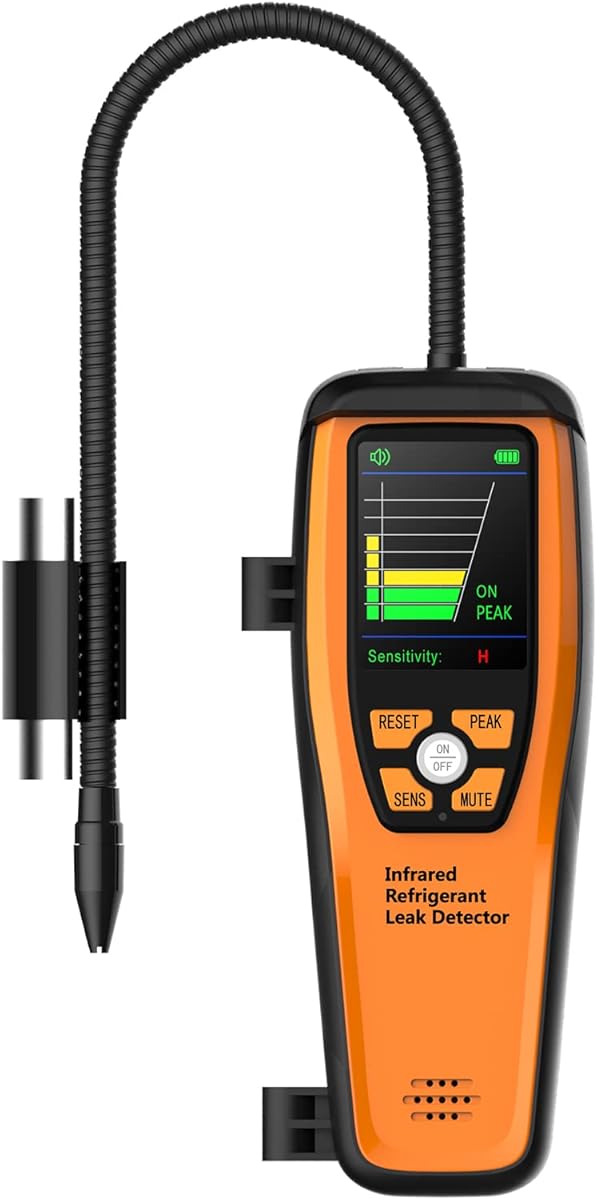
The Elitech ILD-200 is an infrared refrigerant leak detector with a 2.8-inch screen, three adjustable sensitivity levels, and a listed maximum sensitivity of 0.14 ounces per year. Its 4.4 rating reflects a well-regarded professional instrument, while the infrared sensing approach distinguishes it from semiconductor and traditional heated-diode models.
We may earn a commission when you buy through this link, at no additional cost to you.
The detector covers CFCs, HFCs, HCFCs, HCs, HFOs, and mixed refrigerants. The supplied information specifically includes R11, R22, R404a, R410a, R600a, R1234yf, AZ-50, HP62, and MP39. This broad compatibility is valuable for service professionals who encounter different refrigerant types across residential, commercial, and automotive equipment.
Its peak display is designed to show the direction and orientation of a detected leak while allowing the operator to continue working without relying on a constant buzzer. High, medium, and low sensitivity settings let users adapt the instrument to different leak sizes and environments. The stated infrared sensor life of 10 years also makes this a longer-term tool compared with basic semiconductor sniffer designs.
The ILD-200 is best suited to technicians who value sensor technology, broad refrigerant coverage, and clear professional-grade feedback. It may be more than a homeowner needs for occasional checks, but for a working HVAC service tool, the ILD-200 offers a compelling combination of detection breadth, adjustable sensitivity, and quiet peak-mode operation.
Support for multiple refrigerant families, including common blends and newer HFOs, reduces the need to own separate detectors for different equipment. Users should still verify the exact refrigerant in the system before relying on a reading.
The infrared sensor is presented as offering faster response, strong resistance to interference, and a 10-year service life. Those characteristics suit technicians who depend on one instrument across varied service environments.
We may earn a commission when you buy through this link, at no additional cost to you.
The Rechargeable Refrigerant Leak Detector with Japanese Sensor has a 4.7 rating and combines a 14.5-inch flexible probe with a full-color TFT display, real-time PPM readings, and three independently selectable alarm modes. It is one of the most visually informative instruments in this roundup and is designed for technicians who want more than a simple alarm.
We may earn a commission when you buy through this link, at no additional cost to you.
The Japanese semiconductor sensor offers high, medium, and low sensitivity, with sensitivity stated as high as 3 grams per year, or 0.1 ounce per year. A funnel view gives a quick visual indication of leak intensity, while a trend graph helps show how the level changes as the operator moves closer to or farther from a suspected source.
Sound, indicator light, and vibration alerts can each be enabled or disabled independently. A quick mute function can silence the buzzer while visual or vibration warnings remain active, which is useful in occupied buildings, basements, garages, and other environments where noise is unwelcome. A 2,000mAh battery supports up to eight hours of continuous use, and USB-C charging simplifies recharging.
This detector is a good fit for professionals and serious enthusiasts who want numerical concentration information, flexible alerts, and a long probe. Its more complex display may feel excessive for a quick check, but for methodical troubleshooting it provides useful feedback. As with any electronic sniffer, clean-air calibration and controlled probe movement are important for dependable readings.
The funnel display provides a fast visual overview of leak intensity, while the trend graph helps track changing levels. Together, they make it easier to judge whether the probe is approaching a leak source.
Independent sound, light, and vibration modes can be tailored to the environment. Technicians can use vibration in a noisy room or rely on the display and light in a quiet indoor space.
We may earn a commission when you buy through this link, at no additional cost to you.
The Elitech CLD-100 is an upgraded version of the WJL-6000 and uses a corona sensor with an updated analogue circuit. It offers six adjustable sensitivity levels, a 6.26-ounce-per-year maximum sensitivity claim as supplied, a flexible 8.26-inch probe, and audible and visual alarms in a relatively simple package.
We may earn a commission when you buy through this link, at no additional cost to you.
It is designed to trigger on R11, R22, R134a, R404a, R410a, and halogenated refrigerants including HFCs, CFCs, HCFCs, and blends. The brief six-second preheating period and instantaneous response make the unit convenient for quick service checks, especially for automotive and residential applications where frequent starts and stops are common.
The main limitation is its power arrangement: it runs on four AAA batteries, which are not included. That keeps the detector light and straightforward, but it also creates a small ongoing task because the cells must be available and replaced as needed. The dual-color battery indicators help users monitor power, while the flexible probe improves access around difficult components.
Choose the CLD-100 when you need a no-frills halogen sniffer with multiple sensitivity settings and quick startup. It is well suited to automotive air-conditioning checks, basic residential service, and users who want straightforward audible and visual feedback rather than detailed concentration graphs. Verify battery requirements and confirm the target refrigerant with the manufacturer before use.
A six-second preheat is shorter than the warmup period of many rechargeable models. This makes the CLD-100 convenient for technicians who perform repeated, short inspections.
The 8.26-inch probe can reach around vehicle components and other confined areas. It offers enough flexibility for automotive HVAC work without the length and complexity of a full-color-screen instrument.
We may earn a commission when you buy through this link, at no additional cost to you.
The Elitech ILD-100H uses a heated diode sensor and combines a full-color TFT display with high, medium, and low sensitivity settings. Its listed maximum sensitivity is 0.1 ounce per year, and the product information states a response within one second. These specifications place it firmly in the professional diagnostic category.
We may earn a commission when you buy through this link, at no additional cost to you.
It detects CFC, HFC, HCFC, HC, and HFO refrigerants, including R11, R22, R404a, R410a, R600a, R1234yf, AZ-50, HP62, and MP39. The TFT screen provides information about sensitivity, leakage alerts, and battery level, while two front buttons allow quick sensitivity changes and buzzer muting.
Compared with a basic semiconductor sniffer, the heated diode platform is presented as offering more accurate results across halogenated refrigerants. The quick response and broad blend compatibility are meaningful advantages for working technicians who move between different systems. A one-year warranty and listed support coverage also add reassurance, although no rechargeable power option is specified in the supplied information.
The ILD-100H is a strong recommendation for service professionals who want a clear TFT display, quick response, and a proven sensor family without moving to a model with every advanced diagnostic function. It suits HVAC repair, automotive air conditioning, and general refrigeration work. Users should consult the manual for battery requirements and follow the prescribed warmup and calibration sequence.
The TFT display consolidates sensitivity, alarm, and battery information in one readable view. This reduces the need to interpret separate LEDs or a minimal analogue-style interface.
Support for CFCs, HCFCs, HFCs, HCs, HFOs, and common blends allows one instrument to cover a wide service load. Exact refrigerant confirmation remains an important part of any diagnosis.
We may earn a commission when you buy through this link, at no additional cost to you.
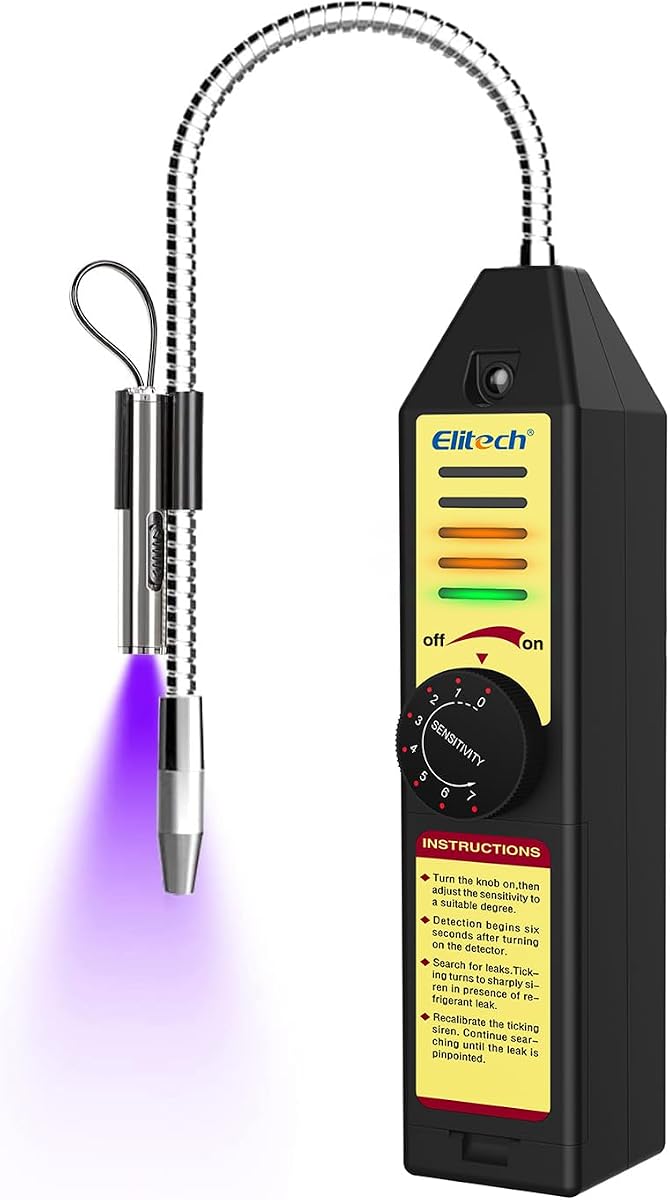
The Elitech WJL-6000S is a practical halogen refrigerant gas detector with seven sensitivity settings, a flexible 7.9-inch probe, and audible and visual leak indicators. Its 4.2 rating reflects a dependable entry-level tool, while the maximum sensitivity is stated as 0.21 ounce per year.
We may earn a commission when you buy through this link, at no additional cost to you.
The detector responds to R22, R134a, R404a, R410a, R1234yf, and other halogenated refrigerants including HFCs, CFCs, HCFCs, and blends. A six-second warmup and three-second response make it easy to deploy for quick checks, and the seven-level sensitivity control allows the operator to adapt the instrument to different leak sizes and ambient conditions.
The flexible probe improves access to difficult locations, while the dual battery indicators provide at-a-glance power information. There is no elaborate numerical screen or rechargeable system listed. Instead, the WJL-6000S focuses on a simple indicator-and-alarm design, which can be easier to learn and less distracting during a quick inspection.
This is the strongest budget-oriented recommendation in the roundup for homeowners, automotive technicians, and HVAC learners who need a capable sniffer without advanced data displays. It is particularly useful for self-checking automobile air-conditioning systems or performing routine residential inspections. Users should read the manual for power requirements, allow the device to stabilize, and use slow probe movement to avoid missing a small signal.
Fine sensitivity adjustment gives the operator more control than a simple two-position device. This can help separate meaningful leaks from low-level background readings in different environments.
The short warmup and three-second response support fast deployment. Those characteristics are useful when checking several components or moving between a vehicle and a residential system.
We may earn a commission when you buy through this link, at no additional cost to you.
The ALD-200 is a professional-grade detector with an upgraded heated diode sensor, a 2.8-inch color TFT display, Peak Mode, a reset function, and a rechargeable battery intended to last through a full service day. Its 4.4 rating and extensive refrigerant list make it a compelling premium choice.
We may earn a commission when you buy through this link, at no additional cost to you.
The product data emphasizes support for A1, A2L, and A3 refrigerants, including R410A, R32, R454B, R290, and R600, plus hydrogen-nitrogen tracer gas. The compatibility list extends across CFCs, HCFCs, HFCs, HFOs, blends, PFCs, and hydrocarbons, making the device unusually broad for both modern and older equipment.
Sensitivity is stated as high as 0.14 ounce per year. The color display shows concentration levels, while the beep frequency increases as the detected leak intensifies. Peak Mode captures the maximum reading, and the reset function recalibrates the sensor to help reduce false alarms. The housing is described as oil-resistant and impact-resistant, while the rechargeable battery supports a full day of service.
This detector is best for professional HVAC and refrigeration technicians who encounter R32, R454B, R290, R600, tracer gas, and conventional halogen refrigerants. It is also suitable for serious DIY users who value a color display, modern refrigerant coverage, and field-oriented features. Before use, the manufacturer instructs users to charge the unit fully, warm the sensor, and perform auto-zero calibration in clean air.
The unusually broad compatibility list includes A2L refrigerants, hydrocarbons, and a 5% hydrogen and 95% nitrogen tracer-gas mixture. That range supports both refrigerant searches and tracer-assisted diagnostics.
Peak Mode preserves the strongest reading encountered during a sweep, while Reset recalibrates the sensor. These functions help manage changing ambient conditions and make repeat searches more consistent.
We may earn a commission when you buy through this link, at no additional cost to you.
The POROMETISTO HLD01 is a rechargeable halogen gas detector that combines numerical concentration readings, two sensitivity modes, two calibration methods, and several lighting and alert options. Its 4.5 rating and rich feature set position it as a versatile alternative to conventional probe-style sniffer.
We may earn a commission when you buy through this link, at no additional cost to you.
Its LCD uses a three-color scale: red for warning above 85 ppm, yellow for caution from 16 to 85 ppm, and green for the safe range from 0 to 16 ppm. The stated measurement range is 16 to 200 ppm, and sensitivity can be switched between high and low modes. This gives the user more context than a basic audible-only alarm.
The extended hose improves reach, while one-button auxiliary lighting supports inspection in dark spaces. A purple LED is included specifically to help locate leak points, and the package also includes a cloth bag and USB Type-C charging cable. Both automatic and manual calibration modes allow the operator to adapt the instrument to different surroundings.
The HLD01 suits technicians who want visual leak-location assistance and a numerical display in a rechargeable package. It supports CFC, HCFC, HFC, and HFO refrigerants, including R22, R32, R134a, R410a, R404a, R407c, R1234yf, R454a, and many others. Users should account for the stated ppm range and confirm that the target gas falls within the instrument's intended use.
Red, yellow, and green display zones make the reading easier to interpret at a glance. Numerical feedback can also help distinguish a persistent source from a brief background spike.
Standard LED illumination and a purple auxiliary mode support inspection in dark cabinets and cramped spaces. These features work well with the extended hose when the source is not immediately visible.
We may earn a commission when you buy through this link, at no additional cost to you.
The GL77A Refrigerant Leak Detector is a compact, battery-powered tool built around a semiconductor sensor, a backlit LCD, audible and visual alerts, and a UV light. Its 3.8 rating is the lowest in this list, so it warrants careful consideration against the more established professional options, but its included batteries and UV assistance may suit occasional users.
We may earn a commission when you buy through this link, at no additional cost to you.
The supplied information lists a maximum sensitivity of 0.49 ounce per year, or 14 grams per year, and names R134a, R1234yf, R410a, R22, R404a, R407c, R454b, and R32 among the supported refrigerants. A 30-second automatic warmup prepares the unit, while the screen displays gas concentration, battery status, and alarm information.
Its distinguishing feature is the UV light, which provides real-time visual assistance when locating a suspected leak. The product guidance also calls for a probe distance of no more than 0.25 inches and a movement speed no greater than 3 inches per second, illustrating how close and slowly the probe must pass over a leak source.
The GL77A is most appealing to homeowners, maintenance learners, and occasional users who value a simple LCD, included AAA batteries, and a dedicated UV mode. It is less compelling for professional users who need the highest sensitivity, multiple sensitivity levels, or a more sophisticated display. The lower listed rating and modest sensitivity should be weighed against those benefits.
The UV function can help make a leak-related indication easier to see around fittings and coils. It complements the audible alarm, visual warning, and concentration display rather than replacing them.
Two included AAA batteries remove the need to purchase cells before the first use. Automatic power-off also helps conserve energy when the detector is left idle.
We may earn a commission when you buy through this link, at no additional cost to you.
The Inficon Model 705-202-G1 is a rugged professional refrigerant leak detector with a heated diode sensor, A2L certification, and a listed sensitivity of 0.25 ounce per year. Its 4.4 rating places it among the stronger-reviewed instruments in this comparison, and the included carrying case reflects its professional positioning.
We may earn a commission when you buy through this link, at no additional cost to you.
It detects CFCs, HCFCs, HFCs, and HFOs. Automatic background adjustment, commonly called zeroing, helps the detector establish a clean baseline before use. The product information also states that soap solutions do not cause false alarms, an important benefit in environments where technicians may encounter residues or fluids near service areas.
The sensor has a stated service life of 100 hours, and the unit runs on two D-cell alkaline batteries. That power arrangement offers straightforward operation without a charging cycle, although technicians will need to keep replacement cells available. The sensor life figure also makes scheduled replacement planning relevant for frequent users.
This detector is best suited to established HVAC and refrigerant-service professionals who value a rugged instrument, heated diode sensing, broad halogen coverage, and automatic background adjustment. It is less compelling for occasional users who prefer rechargeable convenience or color concentration displays. The A2L certification and included support information make it especially relevant for technicians working with modern flammable-refrigerant systems.
Automatic zeroing establishes the ambient reference before a search begins. This reduces the chance that ordinary background conditions will be mistaken for a significant leak.
The included carrying case helps protect and transport the instrument, while listed US technician support provides an additional service resource. Its D-cell design favors dependable operation over rechargeable convenience.
We may earn a commission when you buy through this link, at no additional cost to you.
The right refrigerant leak detector depends on the gases you service, the sensitivity you need, the locations you inspect, and the way you prefer to interpret readings. Sensor technology, probe access, display quality, alerting, calibration, and power are the most important factors to compare.
The sensor is the core of any refrigerant leak detector. Semiconductor sensors are common in compact and general-purpose units and can provide a practical way to identify halogen refrigerants. Heated diode sensors are used in more professional instruments and are presented as offering strong halogenated-refrigerant performance. The Elitech ILD-200 uses infrared technology and emphasizes interference resistance, fast response, and a 10-year sensor life. The ALD-200 and Inficon 705-202-G1 use heated diode platforms, while the Tadeto and Japanese Sensor models use halogen-focused semiconductor sensing. Choose according to the refrigerants, workload, and level of repeat service you expect.
A detector is only useful when it responds to the refrigerant installed in the system. Common models in this guide cover R22, R134a, R410a, R404a, and R1234yf, but newer refrigerants can change the requirements. R32 and R454B are especially relevant to A2L systems, while R290 and R600 belong to the hydrocarbon category highlighted by the ALD-200. Some products also support CFC, HCFC, HFC, HFO, PFC, and mixed refrigerant families. Review the exact refrigerant name and classification before purchasing, and never assume a detector will identify an unsupported gas.
Sensitivity determines how small a leak the instrument can indicate. Listed maximum sensitivities vary widely, from 0.1 ounce per year on the Japanese Sensor and ILD-100H models to 0.14 ounce per year on the ILD-200 and ALD-200, while simpler units claim higher thresholds. Adjustable settings also matter: the WJL-6000S provides seven levels, the CLD-100 provides six, and several professional detectors offer high, medium, and low choices. A wider adjustment range can help an operator tune the instrument to ambient conditions and the size of the expected leak.
Probe design controls how easily you can reach service valves, coils, bends, and equipment cabinets. The Tadeto has an 11-inch gooseneck probe, the Japanese Sensor detector uses a 14.5-inch flexible probe, the ALD-200's long probe supports access around condensers and evaporators, and the POROMETISTO HLD01 uses an extended hose. Shorter flexible probes, such as the 7.9-inch WJL-6000S and 8.26-inch CLD-100, may be more convenient in vehicles. Consider both reach and rigidity: a probe that bends and holds position can be more useful around obstructions than a longer but inflexible attachment.
Displays range from a simple bar graph to numerical PPM readings, color-coded concentration zones, and trend graphs. The Japanese Sensor detector provides real-time PPM data with funnel and trend views, the ALD-200 uses a 2.8-inch color TFT display, and the POROMETISTO uses color-coded numerical ranges. The Elitech ILD-200 and ILD-100H also use larger screens, while the Tadeto relies on a digital display and bar graph. A numerical display can support more methodical comparisons, but a simple alarm may be sufficient for quick checks and easier for new users to interpret.
A leak signal that cannot be noticed is not useful. Most detectors provide an audible alarm and visual indicator, while the Japanese Sensor model adds vibration and allows each of its three alert modes to be selected independently. The Tadeto combines sound, light, and LCD feedback, and the GL77A adds UV visualization. Quiet operation can matter in homes, offices, and occupied commercial areas, so mute controls or a peak-display approach may be preferable to constant beeping. In noisy mechanical rooms or garages, vibration and strong visual cues can be more noticeable than sound alone.
Power design affects how a detector behaves across a full workday. Rechargeable models include the Tadeto, Japanese Sensor detector, ALD-200, and POROMETISTO HLD01. The Japanese Sensor model is stated to run for up to eight hours, while the ALD-200 battery supports a full day of service. The WJL-6000S, CLD-100, GL77A, and Inficon use removable batteries. Removable cells are simple to replace but require spares, whereas rechargeables reduce interruptions and are more convenient for frequent service. The GL77A is unusual among the battery-powered options because two AAA batteries are included.
Every electronic detector needs a stable baseline before it can provide meaningful readings. The Tadeto typically warms up and calibrates for about 30 seconds, the ALD-200 instructs users to charge it fully, warm the sensor, and auto-zero in clean air, and the POROMETISTO provides both automatic and manual calibration. The Inficon includes automatic background adjustment, while the Elitech CLD-100 and WJL-6000S offer short warmup periods. Whichever model you choose, allow the full warmup, calibrate in clean air away from a suspected leak, and move the probe slowly and consistently.
Begin by identifying the refrigerant in the system, then read the detector's instructions before applying power. Charge a rechargeable unit fully, install the correct batteries, select a sensitivity appropriate for the environment, and place the unit in clean air away from the suspected leak. Allow the specified warmup and automatic calibration to complete before moving the probe toward equipment. Do not begin a sweep while the sensor is still stabilizing.
Approach the suspected area slowly and maintain a consistent distance from coils, service valves, fittings, and pipe joints. Move through the area in overlapping passes rather than jumping from one location to another. Watch both the audible signal and any numerical or graph display, and note where the response increases. A flexible or extended probe can make close positioning easier, but sudden movements and pauses may make small signals harder to distinguish.
After the search, switch the unit off, remove batteries if applicable, and store it in a protective bag or carrying case. Clean the exterior according to the manual, keep moisture and oils away from vents, and avoid dropping the device. Recharge before the next job or replace cells promptly, and schedule sensor or calibration service as directed. Because refrigerant can displace air, ventilate the area and follow all safety requirements applicable to the specific refrigerant and system.
The best choice depends on the refrigerants and systems you regularly service. The Tadeto offers a balanced package with a flexible probe, rechargeable power, and clear alerts, while the ALD-200 offers broader modern-refrigerant support and advanced display functions. The Elitech ILD-200 and ILD-100H suit technicians who prefer infrared or heated-diode instruments. Confirm compatibility before selecting a model.
No detector should be assumed to cover every gas without checking its specifications. Many models detect common CFCs, HCFCs, HFCs, and HFOs, while only some support hydrocarbons, tracer gas, or every modern blend. The ALD-200 has one of the broadest listed compatibility ranges. Always confirm the exact refrigerant and its classification before relying on a result.
A semiconductor detector uses a sensing element that reacts to target gases, while a heated-diode detector heats a sensing element as part of the measurement process. Heated-diode models are common in professional tools and are often chosen for halogenated refrigerant work. Semiconductor units can be simpler and more compact. The best choice depends on sensitivity, refrigerant range, portability, and expected service frequency.
Keep the probe close to the surface being inspected, but follow the specific product instructions. The GL77A guidance specifies a distance of no more than 0.25 inches and a movement speed of no more than 3 inches per second. For other models, move slowly and consistently. A deliberate search is more reliable than sweeping quickly across the entire equipment cabinet.
The sensor needs time to stabilize so its readings and alarm threshold are based on a stable background. Some models warm in six to 30 seconds, while others require a full charge and auto-zero procedure as well. Starting before the sensor stabilizes can create false alarms or make a small leak harder to recognize. Complete the stated warmup and calibration sequence before every search.
Rechargeable models are usually more convenient for technicians who work throughout the day because they can be recharged between jobs and do not require spare cells. Removable-battery detectors are simple, dependable, and easy to deploy when batteries are available. The GL77A includes two AAA batteries, whereas the CLD-100 requires four AAA batteries that are not supplied.
A refrigerant leak detector helps locate a suspected leak, but it does not establish the cause of a system failure or confirm system-wide operating conditions. A complete diagnosis may also require pressure checks, temperature measurements, electrical testing, inspection procedures, and recovery work by a qualified professional. Use the detector as one tool in a broader diagnostic process.
Calibrate the detector in clean air, allow the sensor to warm fully, and keep it away from refrigerants, oils, cleaning chemicals, and other contaminants before the search. Use the correct sensitivity setting and move the probe consistently. If a reading seems inconsistent, move to fresh air and use the reset or recalibration controls if the manufacturer provides them.
The Tadeto Rechargeable Refrigerant Leak Detector is the strongest all-around recommendation, combining a high 4.8 rating, an 11-inch gooseneck probe, rechargeable Type-C power, and multiple forms of feedback. The ALD-200 stands out for its extensive refrigerant coverage, color display, Peak Mode, and rechargeable full-day battery, while the Elitech WJL-6000S is a sensible budget choice with seven sensitivity levels and quick startup.
Prioritize the factors that directly affect your work: confirm refrigerant compatibility, choose a probe that can reach the fittings you inspect, and select the sensitivity and display complexity that match your diagnostic method. Professionals handling R32, R454B, hydrocarbons, or tracer gas should pay special attention to the exact detection list. Occasional users may prefer a simple alarm model with included batteries and a short learning curve.
Before purchasing, verify the current product listing, included accessories, power requirements, calibration steps, and certification for the refrigerant system in question. Specifications and availability can change, and prices fluctuate, so compare the current offer against the features that matter most rather than relying on an old listing or sale.