
X-Sense Smart Wi-Fi Thermometer Hygrometer
4.5Editor score
High-precision Swiss-made sensor
Dew point and VPD insights
Expandable whole-home monitoring
Our expert guide compares 10 remote temperature monitoring system for home options across connectivity, alerts, accuracy, battery life, and data history.
A remote temperature monitoring system for home gives you continuous visibility into conditions in rooms, basements, nurseries, wine cellars, and other spaces that may be difficult to check regularly. The right device combines dependable readings, accessible alerts, useful history, and a connection method suited to your property and lifestyle.
We compared the ten systems in this guide using the supplied specifications, focusing on temperature and humidity accuracy, connectivity, alert options, battery behavior, display usability, remote access, and data-retention features. The list covers cellular, Wi-Fi, and Bluetooth models as well as systems designed for indoor, outdoor, and mixed-environment monitoring.
Each review identifies the strongest reason to consider a particular model and any meaningful compromises. The top three receive specialized awards, while every remaining product is evaluated on its own merits. Product features, ratings, availability, and pricing can change, so verify the latest listing details before making a purchase.
4.5Editor score

4.7Editor score

4.0Editor score
The comparison below highlights connectivity, measurement capabilities, alert functionality, and practical extras across all ten systems, making it easier to identify the right model for different rooms and monitoring needs.


The Necto Cellular Temperature Monitor holds a 4.7 rating and stands out as the most complete remote monitoring option in this guide. It combines temperature, humidity, and power-loss detection with cellular connectivity, allowing users to monitor a home, RV, vehicle, or pet-related space without depending on a Wi-Fi network. Its ability to remain operational during an outage is especially valuable.
We may earn a commission when you buy through this link, at no additional cost to you.
Remote access is handled through a mobile app or online portal where readings can be reviewed and alert thresholds customized. The sensor refreshes its local measurements every 10 seconds and uploads the latest reading every 10 minutes. Users can store readings for one year and download them as a CSV file, creating a useful record for identifying trends. Up to five contacts can receive unlimited text and email alerts when temperatures, humidity, power, connectivity, or battery status require attention.
The rechargeable internal battery provides up to three days of monitoring when external power is unavailable. That makes the device more resilient than a basic plug-in sensor and particularly appropriate for locations where an outage could threaten pipes, pets, stored goods, or other temperature-sensitive possessions. Low-battery and disconnection notifications further reduce the risk of silent monitoring gaps. The tradeoff is that cellular monitoring depends on network coverage and an included service period that eventually requires renewal.
This is the strongest recommendation for someone who wants dependable remote access across unreliable internet service or without any Wi-Fi requirement. The app is designed for quick setup, and the plug-in form makes placement straightforward. Choose it when uninterrupted cellular monitoring, outage awareness, and historical data are more important than having multiple physical sensors in the box.
The internal rechargeable battery supports continued temperature, humidity, and connectivity monitoring for up to three days. That makes the Necto a practical choice for cabins, basements, RVs, and other places where a power failure can create a time-sensitive environmental risk.
Custom high and low thresholds can trigger unlimited text and email messages for up to five contacts. One year of server-stored readings also makes it possible to review patterns or export a CSV record when longer-term analysis is useful.
We may earn a commission when you buy through this link, at no additional cost to you.
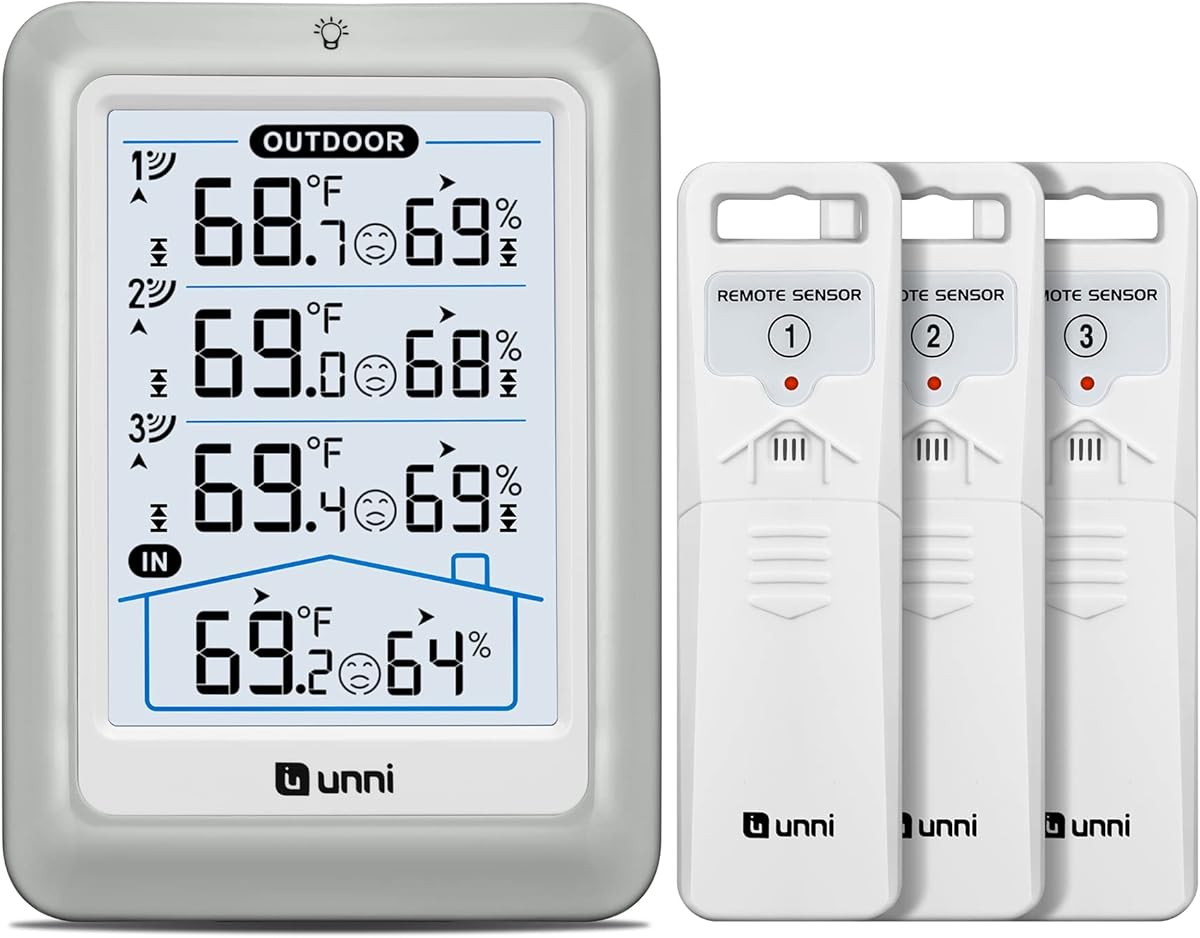
The Unni Indoor Outdoor Thermometer Wireless 4.5 Inch Display Digital Hygrometer earns a 4.4 rating and offers a different kind of monitoring from app-connected sensors. It includes three outdoor sensors and a sizable console display, making it a practical option for comparing conditions across several parts of a property from one central location.
We may earn a commission when you buy through this link, at no additional cost to you.
The system reports indoor and outdoor temperature and humidity with a stated temperature accuracy of plus or minus 2 degrees Fahrenheit and humidity accuracy of plus or minus 5 percent. Its indoor measurement range extends from 14.2 to 122 degrees Fahrenheit, while the outdoor range covers minus 40 to 158 degrees Fahrenheit. Data transmits over a claimed radius of up to 328 feet and refreshes every 30 seconds, which is useful for tracking patios, garages, sheds, or other exposed areas.
A 4.5-inch screen presents bold information along with trend data, comfort indicators, maximum and minimum values, and a switch between Fahrenheit and Celsius. The backlight has three brightness settings, including an off position. Maximum and minimum records reset every 24 hours. The unit can run from USB or batteries and can sit on a table or mount on a wall. Unlike several competitors, the supplied description does not identify a companion app for off-site remote access.
Buy this model if a central indoor display and several wireless outdoor probes are your priorities. It is especially convenient for checking conditions around a home without opening an app, although it does not provide the same phone-based remote visibility or programmable server alerts as the cellular and Wi-Fi products in this list.
Three outdoor sensors can be positioned around a property and read from the main console. This arrangement is useful for comparing shaded and exposed areas, indoor and outdoor conditions, or the stability of several remote spaces without deploying separate displays.
Large black numbers, a trend display, daily maximum and minimum records, comfort indicators, and a selectable temperature scale make the console easy to consult. Its adjustable backlight and wall-mountable design also support permanent placement.
We may earn a commission when you buy through this link, at no additional cost to you.
The Govee Indoor Hygrometer Thermometer 3Pack H5075 with Bluetooth App Control has a 4.5 rating and is well suited to checking several rooms from a nearby phone. Its three physical monitors are an important advantage over single-sensor options, making it easy to place one unit in a bedroom, nursery, basement, or another area of interest.
We may earn a commission when you buy through this link, at no additional cost to you.
Each unit uses a Swiss-made sensor rated for temperature accuracy of up to plus or minus 0.54 degrees Fahrenheit and humidity accuracy of plus or minus 3 percent relative humidity. Readings refresh as quickly as every two seconds, while the bright three-inch LCD displays large numbers, maximum and minimum records, and dry, comfort, or wet indicators. The 196-foot Bluetooth range provides enough mobility for most homes without requiring a hub or Wi-Fi network.
The Govee Home app supports remote monitoring within Bluetooth range, threshold alerts, and a 20-day online data view. Users can examine curve graphs and export up to two years of data in CSV format. This combination of three monitors, clear local displays, and app-based history is especially useful for short-term environmental checks. The limitation is that a phone must remain within Bluetooth range to retrieve live data, so this is not the best solution for checking a remote cabin or property while away.
This three-pack is an excellent fit for homeowners who want multiple inexpensive-looking room monitors without building a hub-based system. Choose it for nursery, bedroom, basement, wine cellar, or greenhouse monitoring where phones are normally nearby. For access from anywhere, consider a Wi-Fi or cellular model instead.
Separate sensors can cover multiple rooms without creating separate app ecosystems. The three-pack is particularly useful when you want a consistent view of a nursery, bedroom, basement, wine cellar, or other indoor environment.
A two-second refresh rate keeps the app responsive, while the bright LCD remains useful without a phone. Threshold notifications add remote awareness whenever the phone remains within the stated Bluetooth range.
We may earn a commission when you buy through this link, at no additional cost to you.
The Frigga 4G Cellular Temperature & Humidity Monitor with Email App Alerts has a 4.2 rating and stands out for flexible connectivity. It supports 4G cellular service, making it suitable for properties without reliable internet, while optional support for both 2.4GHz and 5GHz Wi-Fi gives home users another way to connect.
We may earn a commission when you buy through this link, at no additional cost to you.
The display refreshes every five seconds in constant-on mode and automatically sleeps to conserve battery before waking with a button press. Latest readings can be uploaded to the app every 10 or 30 minutes. Alert delivery is unusually broad: users can receive app push notifications, emails, and on-device voice alarms for temperature or humidity changes, power failures, freeze risks, disconnections, and device drops. Threshold settings and shared access can be managed through the app.
The built-in rechargeable battery supports up to seven days of portable operation, and the unit can remain plugged in for longer-term monitoring without harming battery performance. Records can be retained for up to two years and downloaded as CSV files. The cellular option includes a pre-installed global SIM and two years of service, after which renewal is required. Buyers should account for both the cellular coverage at their location and the continuing service arrangement.
This model is a strong recommendation for vacation homes, cabins, crawlspaces, basements, warehouses, and RVs where cellular service may be more dependable than Wi-Fi. It is also flexible enough for normal homes. Choose it over a pure cellular unit when having both connection options and extensive alert channels would make the monitoring setup more reliable.
The ability to switch between 4G and Wi-Fi reduces the chance that a lack of home internet will prevent remote monitoring. Dual-band Wi-Fi support also makes it easier to fit into an existing home network.
Beyond basic temperature and humidity thresholds, the monitor can flag power failures, freeze risks, disconnections, and drops. Push, email, and voice channels provide several ways to receive a warning.
We may earn a commission when you buy through this link, at no additional cost to you.
The X-Sense Wi-Fi Thermometer Hygrometer with LCD, 3 Sensors & Base Station carries a 4.5 rating and is designed for households that want shared remote monitoring. Three sensors cover separate areas, while the included base station connects the system to the X-Sense Home Security app and provides an audible alarm in addition to phone notifications.
We may earn a commission when you buy through this link, at no additional cost to you.
The Swiss-made sensors offer a stated temperature accuracy of plus or minus 0.36 degrees Fahrenheit, or plus or minus 0.2 degrees Celsius, within a minus 4 to 140 degrees Fahrenheit range. Relative humidity accuracy is plus or minus 2 percent between 0 and 99 percent. Users can set preferred ranges, receive low-battery warnings, adjust alarm sound and volume, and view maximum, minimum, and average temperature and humidity graphs.
Up to 12 users can monitor the indoor environment simultaneously, making shared access convenient for families or households where more than one person should receive alerts. Comfort icons provide an immediate visual indication of whether conditions fall within the selected comfort range. A critical network limitation is that the base station works only with 2.4GHz Wi-Fi and does not support 5GHz networks, so the router may need a compatible network band.
This three-pack is a good option for families monitoring multiple rooms who want both local and phone-based warnings. Choose it when shared household access and an in-home audible alarm matter. If you need advanced plant metrics, a much larger linked-device capacity, or a connection method that works without Wi-Fi, one of the specialized alternatives may be a better fit.
Supporting as many as 12 simultaneous app users helps families coordinate without installing separate accounts on separate systems. Each person can view the relevant rooms and receive alerts when conditions leave the chosen range.
The base station sounds a configurable alarm while the app sends a phone notification. This combination is useful when someone is home but not looking at the LCD or when a condition changes while everyone is away.
We may earn a commission when you buy through this link, at no additional cost to you.
The X-Sense Smart Wi-Fi Thermometer Hygrometer, 3 Sensors & Base Station earns a 4.5 rating and is the most feature-rich premium system in the group. It combines high-precision readings with dew point and vapor pressure deficit calculations, giving users a more nuanced view of environmental conditions than basic temperature and humidity readings alone.
We may earn a commission when you buy through this link, at no additional cost to you.
Temperature accuracy is stated at plus or minus 0.36 degrees Fahrenheit, or plus or minus 0.2 degrees Celsius, with humidity accuracy of plus or minus 2 percent relative humidity. Historical graphs can be viewed by day, month, or year, and data can be exported for trend analysis. Instant phone notifications appear when temperature or humidity falls outside the selected range. Dew point and VPD are particularly relevant for plant collections, wine storage, and other moisture-sensitive environments.
The system supports linking up to 50 devices through one base station, including a maximum of 10 thermo-hygrometers, with a stated coverage of up to 1,700 feet. That makes it appropriate for a large home with bedrooms, basements, and other monitoring zones. Each device uses replaceable 1,200mAh AAA batteries that can last up to one year, while low-battery warnings help prevent unnoticed interruptions. The product is also described as designed around a five-year lifespan.
This is the premium pick for users who want more than simple threshold monitoring and expect to expand their system. It is a good match for plant rooms, wine collections, home offices, and larger properties with multiple environmental zones. The main caveat is that even though 50 devices can be linked, no more than 10 can be thermo-hygrometers, and the base station remains a necessary part of the setup.
Dew point and VPD help translate temperature and humidity into information that is especially useful for plant care and collection storage. The historical views make it easier to recognize recurring patterns instead of reacting to one isolated reading.
A single base station can link as many as 50 compatible devices, including up to 10 thermo-hygrometers. This gives an expanding household a practical path for monitoring additional rooms without changing to a different platform.
We may earn a commission when you buy through this link, at no additional cost to you.
The Govee WiFi Thermometer Hygrometer H5179 with App Notification Alert has a 4.3 rating and combines a small form factor with flexible app connectivity. It supports both Wi-Fi and Bluetooth through the Govee Home app, allowing local setup and remote online access when a compatible network is available.
We may earn a commission when you buy through this link, at no additional cost to you.
A Swiss-made sensor provides stated accuracy of plus or minus 0.54 degrees Fahrenheit, or plus or minus 0.3 degrees Celsius, for temperature and plus or minus 3 percent relative humidity for moisture. Readings refresh every two seconds, and the widget function offers a convenient way to keep current conditions visible on a phone screen. The device also works with Bluetooth for settings, while its temperature and humidity range alerts depend on the app connection.
The app stores 20 days of online data and allows users to export up to two years of information through historical graphs. A lanyard loop makes placement in a basement, baby room, or other indoor area straightforward. One important configuration detail is that the product supports only 2.4GHz Wi-Fi rather than 5GHz. Users with a dual-band router may need to ensure the 2.4GHz network is enabled and connected.
The H5179 is a good choice for a single room where compact size, app access, and quick updates are important but a multi-sensor kit is unnecessary. It is especially useful for a nursery, bedroom, or office. Buy a multi-pack if you need to compare several rooms, and look to a cellular option if the monitored location cannot maintain a reliable Wi-Fi connection.
The small enclosure and included lanyard loop make it easy to position the sensor where it will not be in the way. Widget support then provides a quick temperature and humidity check without opening the app.
Custom temperature and humidity thresholds let the app notify you when conditions move outside the desired band. This makes the monitor suitable for quickly identifying unusual changes in occupied rooms or storage spaces.
We may earn a commission when you buy through this link, at no additional cost to you.
The Govee WiFi Thermometer Hygrometer H5103 with Electronic Ink Display receives a 4.2 rating and focuses on an always-readable screen with long battery life. Its electronic ink display shows temperature and humidity without the glare associated with some illuminated screens, making it useful for a wall, shelf, or countertop in a frequently consulted room.
We may earn a commission when you buy through this link, at no additional cost to you.
The unit supports Wi-Fi and Bluetooth through the Govee Home app, with Wi-Fi limited to 2.4GHz networks. Its Swiss-made sensor is stated to measure temperature within plus or minus 0.54 degrees Fahrenheit, or plus or minus 0.3 degrees Celsius, and humidity within plus or minus 3 percent relative humidity. The readings refresh every two seconds, while users can define temperature and humidity ranges that generate app notifications.
One replaceable 1.5-volt AA alkaline battery can power the device for about six months according to the supplied information. Online graph viewing covers 13 days, and users can export data over a two-year period for longer-term tracking. The local screen means current conditions remain visible even when attention to the phone is limited, while Bluetooth can assist with local setup and access.
This is the most practical option for someone who values a persistent display and infrequent battery changes. It works well in a wine cellar, basement, bedroom, or office where an e-ink panel is easy to read from a distance. Its online viewing window is shorter than several competing systems, so consider the advanced X-Sense models if detailed daily, monthly, or annual graphs are your top priority.
The electronic ink panel provides an always-visible local reading without requiring the display to remain illuminated. A replaceable AA battery can deliver approximately six months of operation between changes.
Wi-Fi access enables remote visibility and threshold alerts, while the screen keeps essential information in front of household members. Bluetooth support provides an additional local connection option.
We may earn a commission when you buy through this link, at no additional cost to you.
The eMylo WiFi Thermometer Hygrometer, Smart Indoor Temperature Humidity Sensor has a 4.0 rating and offers an approachable entry into remote monitoring. It connects directly to a 2.4GHz Wi-Fi network through the Smart Life or Tuya app, with no separate hub required, making setup straightforward for users already invested in that ecosystem.
We may earn a commission when you buy through this link, at no additional cost to you.
The stated measurement range is 14.2 to 140 degrees Fahrenheit for temperature and 0 to 99 percent relative humidity. Accuracy is specified at plus or minus 1.8 degrees Fahrenheit, or plus or minus 1 degree Celsius, with humidity accuracy of plus or minus 5 percent. Readings need about 30 minutes to stabilize after installation or relocation. The app provides push notifications, low-battery reminders, one year of historical data, and export functions without a subscription.
Smart-home automation is the standout feature. The sensor can act as a trigger for compatible fans, humidifiers, or dehumidifiers when conditions become too hot, cold, dry, or humid. Alexa and Google Assistant users can request current readings by voice, although settings, alerts, and automations remain in the Smart Life or Tuya app. Optional SMS and telephone notifications require a separate paid subscription, while the basic environmental alerts do not.
This is the best budget choice for basic remote indoor monitoring and connected-home control. It is a strong fit for a bedroom, nursery, greenhouse, or storage area when approximate readings are sufficient and automated responses are valuable. Buyers seeking higher precision, a local display, cellular fallback, or extensive historical graphs should consider one of the more specialized alternatives.
The sensor can trigger compatible fans, humidifiers, and dehumidifiers based on environmental thresholds. This turns monitoring into an active control system without requiring manual intervention every time conditions change.
Push notifications, low-battery reminders, one year of history, and data export are included at no additional subscription cost. Only enhanced SMS and phone-call delivery require a separate paid service.
We may earn a commission when you buy through this link, at no additional cost to you.
The Govee Indoor Hygrometer Thermometer H5075 with Bluetooth App Control earns a 4.5 rating and is a focused solution for one room. It combines a bright three-inch LCD with Bluetooth app access, so users can check current conditions at the display or review recent trends through a nearby phone.
We may earn a commission when you buy through this link, at no additional cost to you.
The Swiss-made sensor provides stated accuracy of up to plus or minus 0.54 degrees Fahrenheit and plus or minus 3 percent relative humidity. It refreshes as quickly as every two seconds. On the display, large numbers make temperature and humidity easy to read, while maximum and minimum records and dry, comfort, or wet indicators provide quick context. The screen is particularly useful in a bedroom, nursery, wine cellar, basement, or plant nursery.
Bluetooth has a stated connection range of 164 feet, which is enough for many homes but does not provide the unlimited distance associated with internet-connected devices. The Govee app can display 20-day curve graphs and export up to two years of data in CSV format. Range alerts notify users when readings leave preset levels, making this more than a passive display.
The single H5075 is a good option when only one area requires monitoring and you want an uncomplicated device without a hub. Choose it for a bedroom, child’s room, or indoor plant area where the phone will usually be nearby. For multiple rooms, choose the three-pack; for off-site access, choose a Wi-Fi or cellular system.
Large LCD numbers, comfort indicators, and maximum and minimum records make the sensor useful without opening an app. It is designed to remain visible in frequently checked indoor spaces.
Bluetooth access supports remote viewing within range, preset threshold alerts, 20-day curve graphs, and CSV export. No separate hub is required for these functions.
We may earn a commission when you buy through this link, at no additional cost to you.
The right remote monitoring system depends on where it will be installed, how you expect to access readings, and which conditions matter most. Compare connection methods, sensor precision, alert design, power resilience, display needs, and historical-data features before choosing.
Wi-Fi is the most conventional choice for a home with a dependable router and internet connection. Look for 2.4GHz support, since several listed sensors do not operate on 5GHz networks. Wi-Fi models generally provide the most convenient anywhere access, but they can lose remote visibility during an internet or power outage unless they include backup power. Bluetooth is simpler and can work without a router, although the phone must remain within the stated range. Cellular is the strongest option for cabins, RVs, basements, and other locations where Wi-Fi is absent or unreliable.
Stated accuracy varies considerably across the products in this guide. Premium sensors offer temperature precision of approximately plus or minus 0.36 degrees Fahrenheit and humidity precision of plus or minus 2 percent relative humidity. Less expensive models generally remain suitable for general comfort monitoring but may not provide the same confidence for delicate collections or tightly controlled environments. Also consider refresh speed, measurement range, and whether readings need time to stabilize after the sensor is moved.
Remote access is only valuable when a meaningful change produces a prompt notification. Compare the number of adjustable thresholds, available delivery methods, recipient sharing, and the types of events that can trigger an alert. The strongest systems notify users about temperature or humidity excursions, low batteries, disconnections, and power failures. Cellular models may also identify freeze risks. Some products support push notifications and email, while optional SMS or telephone delivery can require an extra paid service.
A monitor that turns off during the event it was meant to detect has limited value. Rechargeable internal batteries can preserve cellular or Wi-Fi operation through a power outage, while plug-in devices are convenient for permanent installations. Battery-powered sensors are easier to reposition and often offer long service between replacements. Compare stated backup duration, replacement battery type, low-battery warnings, and whether the device can operate continuously while plugged in without shortening battery life.
A single sensor is often enough for one bedroom or office, while a three-pack is better for comparing a nursery, bedroom, and basement. Cellular systems can cover isolated buildings, vehicles, or other remote assets. The Unni display takes a different approach with three outdoor sensors and a central console. Consider whether you need indoor-only readings, outdoor exposure, mixed indoor and outdoor data, or specialty metrics such as dew point and vapor pressure deficit for plants and collection storage.
Immediate readings are useful, but history reveals recurring humidity problems, seasonal changes, and equipment issues. The systems here offer different retention periods and graph views, ranging from short online views to one- or two-year server storage. CSV export is useful for creating independent records, while day, month, and year graphs make long-term patterns easier to inspect. Check whether history is visible in the app, available only during a limited online period, or subject to any service plan.
An app is useful, but a local display can make conditions easier to check without a phone. LCD screens offer bright, readable numbers and sometimes maximum, minimum, and comfort indicators. Electronic ink displays remain visible without frequent attention and work well with long battery life. Some systems also add a base-station alarm, dew point, or vapor pressure deficit calculations. Decide whether the display is the primary interface or whether app-based access and automation are more important.
Remote monitoring still depends on the infrastructure supporting it. Confirm that the router supports the required Wi-Fi band, that cellular coverage is adequate at the installation site, and that the phone or base station can reach the sensor. Cellular products may include several years of service and then require a renewal. Also review whether the app supports the number of users you need, how sharing works, and whether optional communication channels carry separate charges.
Begin by choosing the location carefully. Indoor sensors should be placed away from direct sunlight, heaters, vents, windows, exterior doors, and appliances that create localized temperature swings. Allow a newly installed sensor to stabilize according to its instructions, and avoid comparing readings from adjacent rooms as if they were perfectly uniform. For outdoor probes, select a shaded, protected position that still represents the area you want to monitor.
Next, pair the sensor with the required app, connect it to the appropriate 2.4GHz Wi-Fi network or cellular service, and establish realistic thresholds. Set alerts around conditions that require a response, then test the notification route if the app permits it. Configure temperature units, contacts, graph views, and data exports. Connect several sensors under one account when comparing rooms, and assign names that make their locations obvious to everyone receiving alerts.
For care, replace batteries on schedule and respond to low-battery warnings promptly. Keep cellular devices charged or plugged in as appropriate, and keep Wi-Fi sensors within range of a stable router. Clean the housing with a dry or lightly damp cloth without pushing moisture into vents. Review readings and alert thresholds seasonally, download important history, and confirm the device remains connected after a router, app, or network change.
It depends on the model. Wi-Fi monitors require a compatible home network and internet connection, while Bluetooth monitors rely on a nearby phone or hub. Cellular models use mobile service and are particularly useful for cabins, RVs, basements, and other locations without dependable Wi-Fi. Check whether the network is available during the outages or periods when you most need alerts.
Only models with explicit outage detection or backup power can report a loss of external power. The Necto monitor includes a power outage alarm and a three-day rechargeable battery, while the Frigga also offers power-failure alerts and a seven-day rechargeable battery. Standard plug-in sensors without backup capabilities may simply go offline during an outage.
Bluetooth is usually simpler and does not require a hub or router, but the connected phone must remain within the stated range. Wi-Fi provides access through the internet from beyond the home, although it depends on a 2.4GHz network and continued power and internet service. Many users choose Bluetooth for nearby rooms and Wi-Fi or cellular for checking a property while away.
Count the spaces that may need separate monitoring, such as a bedroom, nursery, basement, wine cellar, or detached garage. A single-sensor model is sufficient for one area, while a three-pack offers broader coverage and easier comparisons. The Unni model takes a different approach by supplying three outdoor sensors and one central display for users focused on outdoor conditions.
Humidity monitoring is useful because moisture can affect comfort, mold risk, wood, electronics, plants, and stored collections. All ten products track both temperature and humidity. Premium X-Sense options add dew point and vapor pressure deficit, which can provide more relevant information for plant rooms and wine storage than raw relative humidity alone.
The two cellular-focused products in the guide include stated service periods, but service must be renewed afterward. Coverage and renewal terms should be checked before installation. Meanwhile, the Govee, X-Sense, and eMylo Wi-Fi or Bluetooth products do not require a cellular subscription for their standard connectivity.
History varies by model. Several Govee products offer 20 days of online graph viewing with export of up to two years of data, while the Necto stores readings for one year and the Frigga supports up to two years. The eMylo provides one year of history without an added subscription, and the X-Sense systems add detailed graphs by day, month, or year.
The eMylo model explicitly supports Tuya scene automation and can trigger compatible fans, humidifiers, or dehumidifiers based on environmental conditions. It also permits voice reading checks through Alexa or Google Assistant, while settings remain in the Smart Life or Tuya app. Other products focus primarily on remote monitoring, alerts, and data review rather than direct automation.
The Necto Cellular Temperature Monitor is the strongest all-around choice because it combines cellular independence, temperature and humidity tracking, power-loss detection, backup power, flexible alerts, and one year of history. The X-Sense Smart Wi-Fi Thermometer Hygrometer is the premium option for advanced metrics and expandable whole-home monitoring, while the eMylo WiFi Thermometer Hygrometer is the budget-friendly pick for basic alerts and smart-home automation.
Prioritize the connection method that matches the location rather than choosing only on display or app appearance. Use Bluetooth for close-range multi-room checks, Wi-Fi for normal connected homes, and cellular where internet access is unreliable. Accuracy, threshold alerts, backup power, history, and the number of rooms requiring coverage should determine the final shortlist.
Before purchasing, confirm the latest specifications, network requirements, app compatibility, service terms, and availability for your location. Product features and customer ratings can evolve, and current pricing may change. Comparing those details against the needs outlined in this guide will help you select a remote temperature monitoring system for home that remains useful and dependable.