
TopTes PT177
4.6Editor score
Pocket-sized combustible gas sniffer
Audible and visual leak alarms
Thirty-second calibration period
Includes two AAA batteries
Discover the best RV propane leak detectors and compare portable gas sniffers, installed alarms, probe reach, %LEL readings, and power options.
RV propane leak detectors range from compact portable sniffers to permanently installed alarms and combination units that monitor carbon monoxide alongside combustible gas. The right choice depends on whether you want to inspect a suspected leak, check a specific appliance connection, or provide continuous protection while the RV is occupied.
This guide compares ten propane and combustible-gas detectors based on supported gases, alarm type, probe design, detection range, display information, power source, installation needs, and RV-specific features. It includes handheld tools for troubleshooting as well as hardwired and plug-in alarms designed for broader monitoring.
Each review explains the product’s strongest benefits, practical limitations, and ideal use case so you can distinguish a portable inspection tool from a fixed safety alarm. Product details and availability can change, so confirm the current specifications and listing information before purchasing.
4.6Editor score

4.6Editor score

4.7Editor score
This side-by-side comparison covers portable gas sniffers, remote-probe detectors, flush-mounted RV alarms, and combination gas alarms. The key differences are detection method, access to hidden leak points, %LEL information, installation requirements, and whether the unit is intended for troubleshooting or continuous monitoring.



The TOPTES PT520A combines a portable combustible-gas detector with a 17-inch gooseneck probe, making it one of the most versatile inspection tools in this roundup. It carries a 4.6 rating and stands out because the flexible probe can reach pipelines, storage-tank areas, gas fireplaces, basement spaces, and confined RV utility locations without forcing the entire detector into narrow gaps.
We may earn a commission when you buy through this link, at no additional cost to you.
The detector supports methane, propane, natural gas, LPG, butane, and other combustible gases. Its stated methane detection range extends from 50 to 10,000 ppm, giving it more headroom than several smaller handheld models. A 75 dB audible alarm and seven colored concentration bars provide both immediate warning and a visual indication that readings are increasing. The specification calls for the probe to be held approximately 1–5 cm from a suspected source.
There are some compromises to consider. A flexible 17-inch probe makes the PT520A larger and less pocket-friendly than the PT177 or PT205, while batteries require periodic replacement. The sound can also be silenced with the Mute button, and automatic power-off may be enabled after ten minutes of inactivity. The user must allow a 30-second warm-up in clean air before beginning an inspection, and careful probe placement remains essential for meaningful results.
This is the strongest all-around choice for RV owners who want more reach and a broader detection range than a basic pocket sniffer. It is particularly useful for tracing suspected leaks around regulators, hoses, valves, cabinets, and enclosed compartments. Choose it when flexibility, visibility, and manual leak-source location matter more than permanent monitoring or a numerical %LEL display.
The 17-inch gooseneck is the PT520A’s defining advantage. It lets the user place the sensing tip close to a suspected connection while keeping hands, face, and the detector body farther away, and the flexible form can follow curved or restricted paths.
Seven colored bars rise with the detected concentration while the 75 dB alarm supplies an immediate warning. This feedback is more informative than a simple beep-only tool and can help the user identify where gas is strongest.
We may earn a commission when you buy through this link, at no additional cost to you.
The TopTes PT199 is a pocket-sized gas sniffer built for locating combustible sources around home and RV gas appliances. Its 4.6 rating reflects a well-balanced feature set, and the most notable strengths are quick response, a straightforward LCD interface, audible and visual alarms, and the included storage bag that makes it easy to keep in a toolbox or maintenance compartment.
We may earn a commission when you buy through this link, at no additional cost to you.
This model detects methane, propane, butane, natural gas, LPG, and other combustible gases. It responds to detected gas within 0.5 seconds, and its alarm grows more intense as concentration rises. The LCD turns red when gas levels are high, providing a second way to recognize a concern without relying entirely on sound. Based on methane, the listed range is 50–1,000 ppm, with a detection distance of 1–5 cm.
The main limitation is its relatively low upper range compared with the PT520A and PT760. It also lacks an extended probe, so inspecting deeply hidden connections can be awkward. The unit requires two AAA batteries, includes a low-battery indicator below 2.4 V, and can automatically power off after five minutes without operation or detected gas. A 30-second warm-up must occur in clean air before use.
The PT199 suits RV owners who want an uncomplicated inspection tool for accessible regulators, valves, stovetop areas, and cabinet connections. It is easy to carry and less cumbersome than a long-probe detector. For tracing gas to a source or checking spaces where a probe cannot safely fit, it remains a practical option, although users needing deeper access or a wider range should look higher in the list.
The compact body fits easily into a pocket, drawer, or included storage bag. That makes it convenient to keep accessible for seasonal checks of an RV’s gas system without dedicating substantial storage space.
The audible alarm changes with gas concentration, while the LCD provides a separate visual cue and turns red at higher levels. The combination is useful in a noisy garage, workshop, or enclosed service area.
We may earn a commission when you buy through this link, at no additional cost to you.
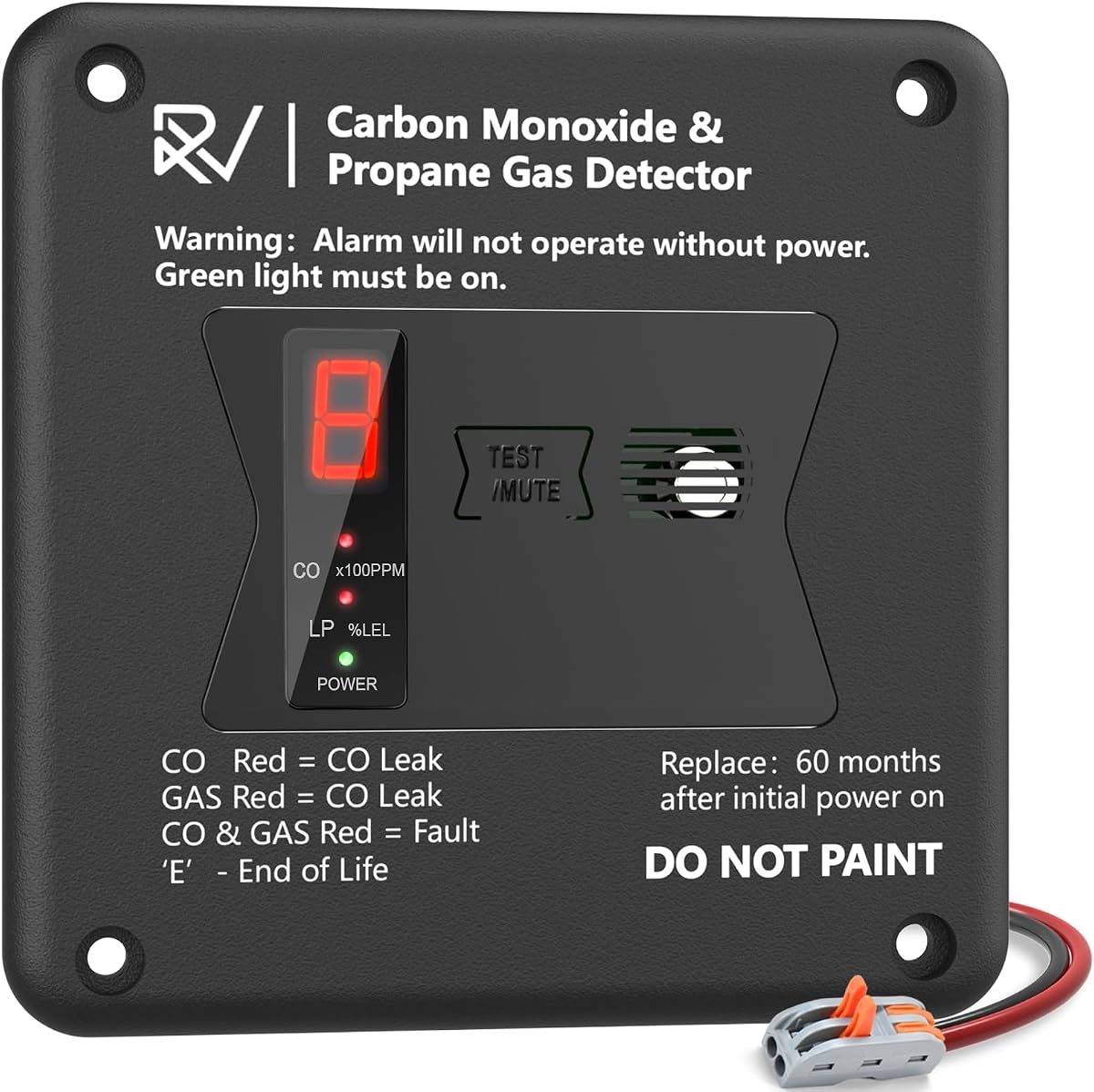
The R503 Flush Mount is a permanently installed RV detector rather than a handheld gas sniffer. It has a 4.6 rating and uses two independent sensors for carbon monoxide and combustible gas, giving owners one fixed unit that can monitor both hazards. Its twelve-volt DC design is specifically suited to motorhomes, travel trailers, motor coaches, and truck campers.
We may earn a commission when you buy through this link, at no additional cost to you.
A digital LED display communicates the detected carbon monoxide level and indicates when the gas sensor is active. The product title identifies a 100 dB alarm, providing a conspicuous warning for occupants. Installation uses lever-nut connectors intended to reduce wiring work, while the face plate measures 4-5/8 inches square and the specified wall cutout ranges from 2 by 3-3/8 inches to 3-15/16 inches square.
The trade-off is that this is not a flexible diagnostic tool. It needs a suitable opening, electrical connection, and permanent mounting location. Screw spacing is described as compatible with the 31011 style, which may simplify a replacement, but installers should still verify dimensions and wiring before ordering. It also lacks the probe and numerical concentration readouts found on several portable alternatives.
This detector is best for an RV owner who wants integrated, continuous monitoring in place. It is especially relevant when replacing a similar flush-mounted unit or addressing both carbon monoxide and combustible-gas concerns with a single installed faceplate. It should complement, rather than replace, a portable sniffer used to inspect hoses, valves, and suspected leak points.
The R503 uses separate CO and gas sensors rather than treating them as a single generic function. That distinction is useful for owners who want one installed display while still monitoring two distinct hazards.
Lever-nut connectors are intended to replace wrapped butt connections and electrical tape during installation. The approach may reduce assembly effort, although the existing RV wiring and cutout still need proper inspection.
We may earn a commission when you buy through this link, at no additional cost to you.
The TopTes PT205 is a portable gas detector that adds numerical %LEL information to the familiar handheld format. It has a 4.6 rating and is especially useful for RV owners who want more than a basic beep during appliance and connection checks. The LCD can show concentration as a percentage of the lower explosive limit, and the bar graph rises as the detected level increases.
We may earn a commission when you buy through this link, at no additional cost to you.
The stated range is 1% to 10% LEL, equivalent to 100–5,000 ppm based on methane. It supports LPG, methane, ethane, propane, butane, natural gas, coal gas, gas fuel, and liquefied natural gas. Detection can trigger audible and visual alarms in 0.5 seconds, with a red display at higher concentrations. Two AAA alkaline batteries are included, and a countdown on the screen shows the 30-second warm-up.
Its main limitation is accessibility. Unlike the PT520A, PT760, and PT299, the PT205 does not provide a probe, so it works best for checking exposed valves, appliance areas, and accessible compartments. A low-battery indicator and automatic power-off improve convenience, but the display remains primarily a handheld diagnostic feature rather than a permanent RV monitoring solution.
The PT205 is a strong choice for owners who prioritize concentration visibility in a compact tool. The numerical %LEL display can make comparisons between locations more meaningful, while the dual alarm system helps during active troubleshooting. It is most useful alongside a permanently installed alarm and for checks where the sensing area can be approached safely.
Showing concentration as %LEL gives the user a more defined picture than an alarm alone. The bar graph and numerical display together make it easier to compare readings from different fittings or compartments during a systematic inspection.
The screen displays a countdown during the required 30-second warm-up in clean air. This helps prevent a hurried user from beginning before the sensor is ready.
We may earn a commission when you buy through this link, at no additional cost to you.
The TopTes PT177 is a straightforward portable gas sniffer that delivers the core functions many RV owners need without a remote probe or numerical display. It holds a 4.6 rating and includes a pocket clip, a drawstring storage bag, two AAA batteries, and a user manual, making it a practical entry for routine maintenance and checking accessible gas-appliance areas.
We may earn a commission when you buy through this link, at no additional cost to you.
The PT177 detects LPG, methane, ethane, propane, butane, natural gas, coal gas, and other combustible gases. After a required 30-second auto-calibration in a clean, gas-free environment, it can trigger an alarm in approximately 0.5 to 3 seconds. Five red LEDs and a 75 dB buzzer intensify as concentration increases, providing both visual and audible confirmation.
The simple design also defines its limitations. There is no %LEL numerical reading, no flexible probe, and no way to inspect deeply concealed connections without moving the detector body itself. A low-battery light appears below 2.4 V, and the unit automatically turns off after five minutes without activity or detection. Users still need to follow warm-up instructions for dependable operation.
The PT177 is a good budget-oriented choice for accessible leak-source checks around a stove, water-heating area, regulator, or valve. It is easiest to recommend to owners who want a small, understandable tool rather than advanced concentration analytics. For hard-to-reach spaces or more exact readings, one of the probe-equipped or digital alternatives may be a better fit.
The pocket clip and compact body are valuable in an RV where every storage location matters. The included drawstring bag also makes it easy to separate the detector from tools, dust, and other maintenance equipment.
The alarm and five red LEDs become more intense as the detected concentration rises. Although less detailed than a %LEL display, the escalating pattern gives useful feedback while moving the sensor around a suspected leak area.
We may earn a commission when you buy through this link, at no additional cost to you.
The TopTes PT210S offers a balanced combination of portability, probe access, and numerical concentration information. With a 4.6 rating, it is a compelling middle-ground detector for RV maintenance because its pen-shaped body remains easy to carry while the four-inch probe reaches beyond the detector housing.
We may earn a commission when you buy through this link, at no additional cost to you.
The device detects propane, natural gas, methane, butane, and other combustible gases. Its screen presents a two-digit %LEL reading, and the specified range is 100–5,000 ppm, equivalent to 1–10% LEL. Visual bar graphs rise and the display turns red when gas is detected, while a 75 dB buzzer provides an audible warning. The stated response time is 0.5 seconds.
The 4-inch probe is shorter than the PT520A’s 17-inch gooseneck and the PT760’s 12-inch telescopic probe, so it is less capable in deep or highly confined spaces. One useful feature is dual-mode detection, which provides high-sensitivity and low-sensitivity settings. The low-battery light activates below 2.5 V, and the unit shuts down after five minutes of inactivity. Two AAA batteries and a storage bag are included.
The PT210S is well suited to routine checks where moderate probe access and a numeric reading are both valuable. It can be used around exposed appliance areas, storage compartments, and service points that are difficult to reach with a flat detector body. Choose it when you want more information than the PT177 without carrying the longer design of a telescopic or gooseneck model.
The four-inch probe lets the sensor tip enter narrow gaps around connections and cabinets. It also allows the user to keep the electronic display oriented toward them while the sensing end is positioned near a suspected source.
High- and low-sensitivity modes give users flexibility when moving from close inspection to broader area checks. The mode selection can make the tool more adaptable to different RV layouts and leak patterns.
We may earn a commission when you buy through this link, at no additional cost to you.
The TopTes PT760 stands out as the most feature-rich portable inspection detector in the group. It has a 4.5 rating and combines a rechargeable power system, a 12-inch stainless-steel telescopic probe, %LEL readings, and a built-in flashlight. That combination makes it particularly appealing for RV owners who need to inspect dark cabinets, pipes, or other difficult access areas.
We may earn a commission when you buy through this link, at no additional cost to you.
The PT760 detects LPG, methane, ethane, propane, butane, natural gas, coal gas, and gas fuel. It provides visual and audible alarms within 0.5 seconds, and the screen reports the lower explosion limit value across a stated range of 1–20% LEL, or 100–10,000 ppm. The alarm tone frequency and screen color change with concentration, providing several ways to judge severity. The probe should be held 1–5 cm from the point being checked.
The retractable stainless-steel probe reaches inside pipes and behind cabinets, then folds down for storage in the included protective case. The Type-C charging port eliminates routine disposable battery changes, although the unit must be charged and available when needed. Its 30-second preheat includes a countdown display, and low-battery and automatic power-off functions are included. The built-in flashlight is valuable in poorly illuminated service compartments.
This detector is a strong choice for maintenance work requiring both reach and concentration information. The broad %LEL range exceeds the typical range of the other portable units, while the flashlight improves usability in confined RV spaces. It is less convenient for spontaneous pocket checks than the PT177, but better equipped for deliberate troubleshooting.
The 12-inch stainless-steel probe can enter narrow pipe runs, cabinet gaps, and other spaces where a flat sensor cannot sit close to the suspected point. Retraction restores a compact form for storage.
The Type-C charging system and included cable remove the need for routinely replacing AAA cells. Keeping the detector charged before an inspection is an important habit for owners who rely on it only during seasonal maintenance.
We may earn a commission when you buy through this link, at no additional cost to you.
The TopTes PT299 is a portable propane and combustible-gas sniffer built around an adjustable rod. Its 4.6 rating and mix of retractable access, a 1–10% LEL range, and combined audible and visual alerts make it useful for inspecting pipes, storage-tank areas, fireplaces, basements, and RV compartments where direct contact with the sensor would be awkward.
We may earn a commission when you buy through this link, at no additional cost to you.
The rod extends from 2.20 to 6.30 inches, allowing the sensing point to move away from the main body. The detector supports propane, methane, natural gas, LPG, gasoline, and other combustible gases. Its stated range is 1–10% LEL, equivalent to 100–5,000 ppm based on methane. A 75 dB buzzer sounds within 0.5 seconds of detection, nine analog bars rise, and the screen turns red.
Compared with the PT520A and PT760, the PT299’s extension is shorter and does not provide a flexible gooseneck or 12-inch telescopic reach. It also lacks a numerical concentration display, using the bar system instead. A 30-second preheat countdown and low-battery alert improve readiness, while the optional five-minute automatic shutdown conserves power. Two AAA batteries and a storage bag are included.
The PT299 is a good fit for an owner who wants more reach than a compact sensor but does not need the PT760’s rechargeable power, flashlight, or wider 20% LEL range. It works especially well when checking moderately concealed fittings and pipes during an RV service routine. Its straightforward escalating display also makes it approachable for newer users.
The adjustable rod provides extra positioning distance without leaving a permanently extended tool in the RV. After inspection, it retracts to create a more compact shape that is easier to store with maintenance gear.
Nine analog bars rise as concentration increases, giving a clear indication of changing readings. The pattern is easy to interpret while moving the tip along a hose, pipe, or other possible leak path.
We may earn a commission when you buy through this link, at no additional cost to you.
The Safe T Alert 20 Series Mini is purpose-built as a fixed LP gas alarm for RVs, and its 4.7 rating is the highest among the products in this guide. Unlike portable sniffers, it is intended to remain installed and provide continuous propane monitoring in travel trailers, fifth wheels, truck campers, folding campers, and other recreational vehicles.
We may earn a commission when you buy through this link, at no additional cost to you.
The alarm activates below 25% LEL for propane or methane. Its mute control is designed to permit safe ventilation, while the rapid-recovery sensor reactivates if propane levels remain dangerous. It operates on 12V DC at 75 mA, so it does not depend on disposable batteries for routine protection and can be integrated into the RV’s electrical system.
Installation requires planning. The compact case measures 3.5 inches wide by 2.5 inches high by 1.25 inches deep, and the mounting bracket supports installation in tight areas. Because it is a fixed alarm, it cannot identify a particular leaking fitting or replace a handheld sniffer during troubleshooting. Correct placement and sound activation should be confirmed after installation.
The stated temperature range of -40°F to +158°F underscores its suitability for harsh RV conditions. This is an excellent choice for owners who prioritize continuous, dedicated propane detection over portability. It is especially relevant when an existing surface-mounted RV alarm needs replacement or when a compact fixed unit is needed in a confined living area.
A fixed 12V alarm remains active while the RV is occupied, providing a different safety role from a portable detector used only during maintenance. It is designed to warn occupants of dangerous propane or methane levels without requiring a handheld inspection.
The alarm-mute control allows the user to ventilate the area without leaving the device fully disabled. Rapid recovery reactivates the warning if the gas level remains dangerous.
We may earn a commission when you buy through this link, at no additional cost to you.
The Kidde Carbon Monoxide and Explosive Gas Alarm offers simple installation and combined hazard monitoring. It has a 4.5 rating and plugs into a standard 120V outlet, making it a straightforward option for an RV or nearby residence where wiring work is undesirable. A 9V battery backup adds protection when normal power is interrupted.
We may earn a commission when you buy through this link, at no additional cost to you.
The digital display shows the carbon monoxide level currently sensed or displays “GAS” when explosive gas is detected. An 85 dB alarm announces either condition, and LED status indicators provide additional visual information. Peak Level Memory records the last time carbon monoxide was detected or the last time the unit was tested, which can help users review events after returning to the vehicle.
This model differs from the R503 and Safe T Alert in that it is not described as a dedicated flush-mounted or surface-mounted RV unit. Its performance therefore depends on sensible placement, and the power cord limits how far it can be positioned from an outlet. It also monitors carbon monoxide and explosive gas rather than serving as a handheld propane leak locator.
The Kidde alarm is a good choice for owners who want a low-friction combination alarm and already have a suitable outlet location. It can complement a portable detector and a hardwired RV-specific alarm, particularly when adding a second layer of monitoring is desirable. Verify placement requirements, the appliance’s compatibility with the intended space, and the battery backup before installation.
The plug-in format removes the need for hardwiring during setup. This can be useful in an RV interior, rental property, or temporary monitoring location where outlet access is more convenient than cutting into the electrical system.
The 9V backup battery helps the unit remain available during a power interruption, while Peak Level Memory helps preserve useful CO event information. Together, they add practical context beyond a basic warning tone.
We may earn a commission when you buy through this link, at no additional cost to you.
The right RV propane leak detector depends on whether you need a portable tool for pinpointing leaks, a permanently installed alarm, or both. Consider access, sensor coverage, display detail, power, and the particular gas system in your RV before choosing.
Portable gas sniffers are designed for maintenance: the owner moves the sensor near hoses, valves, regulators, appliance connections, and suspected leak areas. They are not a substitute for a fixed alarm because they cannot continuously monitor the living space when no one is actively inspecting it. Installed alarms, such as the Safe T Alert 20 Series Mini, are engineered to remain connected to the RV’s 12V system and warn occupants of dangerous propane levels. The R503 Flush Mount adds a permanent, combined CO and gas option, while the Kidde unit uses a more convenient plug-in format. A complete safety setup may reasonably include one portable detector for locating faults and one installed alarm for ongoing protection.
Probe design determines where a detector can be used effectively. A pocket sniffer with a flat sensor is convenient for exposed fittings, but it may be difficult to position around cabinet walls, pipes, or recessed connections. The PT210S offers a four-inch probe, the PT299 extends to 6.30 inches, the PT760 reaches 12 inches, and the PT520A uses a flexible 17-inch gooseneck. Greater reach allows the sensing tip to approach a suspected source while keeping the user’s face and hands farther back. It also makes inspection easier when the detector body cannot physically enter the target space. Select probe length according to the tightest areas in your RV and the types of appliances and storage compartments you need to inspect.
A broader detection range can make a detector more useful across different leak concentrations. The portable models listed here range from 50 to 10,000 ppm, with several covering 100–5,000 ppm. The PT760 stands apart with a stated 1–20% LEL range, while most digital portable units show readings between 1 and 10% LEL. A numerical display is helpful for comparing locations, but range figures should always be considered in relation to the gases supported and the device’s calibration requirements. Do not assume that a detector’s display replaces a fixed safety alarm; portable readings are best used to investigate and locate a suspected problem.
Propane is central to the RV use case, but many detectors also support methane, natural gas, butane, LPG, ethane, and other combustible gases. Methane-based equivalence figures are common in product specifications, so actual response can depend on the gas and environmental conditions. Several TopTes models require a 30-second warm-up or auto-calibration in clean air before use. Skipping that step can undermine the usefulness of a reading. Follow the instructions for the exact model, allow the sensor to stabilize away from suspected gas, and confirm the listed gas compatibility before using the tool on an appliance or fuel line.
A useful alarm should be noticeable through both sound and visual feedback. Audible alerts in the listed products reach 75 to 100 dB, while screens change color, bars rise, or LEDs activate as concentration increases. The PT205 and PT760 provide numerical %LEL information, and the Kidde unit displays a CO level or “GAS.” In an enclosed, noisy, or poorly lit compartment, visual feedback can be as important as the buzzer. For continuous alarms, consider how loud the notification should be and whether a mute function supports a safe ventilation process. For handheld units, look for a warning pattern that becomes more intense as the sensor approaches the source.
Power affects convenience, maintenance, and placement. Most portable TopTes units use included AAA batteries and automatically power down after inactivity; the PT760 instead uses a rechargeable Type-C system. Fixed alarms are better for continuous use because they draw from the RV’s electrical system, but installation, wiring, and cutout compatibility must be verified. The R503 uses lever-nut connectors and offers a wide 12V operating tolerance, while the Safe T Alert uses a compact surface-mount bracket. The Kidde alarm plugs into a standard 120V outlet and uses a 9V battery for backup. Compare the RV’s available power, desired mounting location, and willingness to perform installation before selecting a permanent unit.
RV storage space makes portability valuable. The PT177, PT199, and PT205 are pocket-sized and include storage bags, while the PT299 and PT210S remain compact. Probe-equipped models require more room to operate, even if the probe retracts or folds. Fixed alarms save storage space once installed but occupy a wall location and may be more difficult to relocate. Consider how often you expect to perform inspections, whether the detector will live in a maintenance compartment or an occupied living area, and whether a protective case is included. A tool you can conveniently reach at each seasonal check is often more useful than a more advanced detector that remains buried in storage.
Response speed matters during a close inspection because the user often moves the sensor incrementally around a fitting. Several TopTes models indicate alarm activation in 0.5 seconds, while the PT177 is described as detecting within approximately 0.5 to 3 seconds. These figures are most useful when the sensor is near the source and used according to the stated 1–5 cm working distance. Warm-up periods of 30 seconds are common across the lineup. Plan the inspection sequence so the detector is already calibrated in clean air, then begin with the suspected area and move systematically through nearby connections.
Begin by reading the manual for the specific detector and identifying every supported gas. For a portable model, move it to a clean area with fresh air, install the specified batteries or fully charge the unit, and allow the full warm-up or auto-calibration period to finish. Confirm that the battery indicator is normal and that the display, buzzer, and visual alerts are functioning before approaching the RV’s gas equipment. Never calibrate or warm the unit in an area where propane or another supported combustible gas may be present.
Inspect from a safe distance and begin with the least enclosed likely source, such as an exposed valve, regulator, appliance connection, or hose section. Hold or position the sensor approximately 1–5 cm from the area being tested, as specified for the model, and move it slowly and methodically. Listen for the alarm and watch the LEDs, bars, display, or red-screen warning. If a strong reading or repeated alarm occurs, stop testing, avoid flames and electrical switches, ventilate if safe, and consult a qualified RV or propane technician.
Care for the unit according to its design. Replace disposable batteries before they weaken, charge the PT760 before planned use, and keep the sensing opening clear of dust, moisture, grease, and debris. Do not immerse a detector or spray cleaning fluid into its vents or probe. Store portable devices in a dry location and use the included case or bag where provided. For installed alarms, follow the manufacturer’s placement instructions, test the unit as directed, check wiring and mounting stability, and replace a fixed alarm when it reaches the end of its service life or behaves abnormally.
No. Portable detectors are primarily inspection tools and only provide information while someone is actively using them. A fixed alarm can monitor propane continuously and warn occupants when the RV is occupied. For the strongest approach, use a portable detector to locate suspected leaks and a properly installed alarm for ongoing protection.
%LEL means the percentage of the lower explosive limit, a measure used to express combustible-gas concentration relative to the level at which the atmosphere may become dangerous. A higher percentage indicates a greater concentration. The meaning can vary with the gas and calibration, so use the readings for guidance and have suspected leaks professionally evaluated.
The sensor needs time to stabilize and complete auto-calibration before it can provide dependable readings. Several listed models require approximately 30 seconds in clean, gas-free air. Starting too soon may produce inaccurate readings or delay the expected alarm response, so follow the exact instructions for the product.
The supplied specifications generally call for a working distance of approximately 1–5 cm from the suspected leak point. Move slowly around the connection rather than holding the sensor at one fixed spot. If the alarm is strong or the reading rises quickly, back away and arrange qualified service rather than continuing to search around a significant leak.
Some models can, but not all. The R503 Flush Mount uses independent CO and gas sensors, and the Kidde combination alarm monitors carbon monoxide alongside explosive natural gas and propane. The portable TopTes models are described as combustible-gas detectors and should not be assumed to provide full carbon monoxide protection.
Placement should follow the alarm manufacturer’s guidance and account for propane’s characteristics, the RV’s layout, fuel-appliance locations, airflow, and the location of occupants. Avoid placing a detector in a dead-air pocket or where it will be damaged. Verify spacing, mounting, power, test operation, and any compatibility requirements before considering the installation complete.
Stop the inspection, move away from the suspected source, and avoid flames, sparks, smoking, and unnecessary electrical switching. Ventilate the area only if you can do so safely, keep people and pets away, and contact a qualified RV or propane technician. Do not attempt to repair a suspected fuel connection with the detector still running in the area.
Follow the instructions supplied with the detector, and test portable units before each seasonal inspection or whenever you suspect a problem. Installed alarms should be checked and tested on the schedule specified by the manufacturer, along with any RV service schedule. A test only confirms the alarm is responding; it does not prove that every hose, valve, and appliance connection is leak-free.
The TOPTES PT520A is the most versatile all-around inspection tool because its 17-inch flexible gooseneck reaches confined areas while seven concentration bars and a 75 dB alarm provide clear feedback. The TopTes PT177 is the simplest budget pick for accessible checks, while the Safe T Alert 20 Series Mini is the strongest dedicated fixed alarm for continuous RV protection. Each serves a distinct role, so choosing according to the type of protection needed matters more than comparing isolated specifications.
Prioritize the environments you actually need to inspect, the distance you must maintain from a suspected leak, and whether you need a numerical %LEL display. Owners with difficult-to-reach connections should favor a long or flexible probe, while those needing continuous coverage should install a dedicated alarm. A portable sniffer and installed alarm can work together to provide both source location and ongoing occupant warning.
Before purchasing, verify the detector’s supported gases, warm-up procedure, power requirements, and compatibility with your RV. Product specifications and availability can change over time, so review the current listing carefully. Regardless of the model selected, use the device only as intended, respond cautiously to alarms, and arrange professional service for any suspected propane leak.