
DROK 2 Pack Waterproof DS18B20
4.9Editor score
Waterproof stainless steel probes
Wide operating temperature range
Integrated adapter pull-up resistor
Works with Arduino and ESP32
Our Arduino Temperature Sensor guide compares 10 modules by accuracy, range, interface, voltage, durability, and compatibility to help select with confidence.
An Arduino temperature sensor turns a basic microcontroller project into something capable of measuring its surroundings, monitoring equipment, or responding to changing conditions. The right module depends on whether you need temperature alone, humidity as well, indoor readings, or dependable measurements in wet and demanding environments.
This guide compares ten Arduino-compatible sensors based on the supplied specifications, including measurement range, stated accuracy, operating voltage, communication method, environmental suitability, and included components. It covers DHT11 modules, high-precision AHT30 and SHT31 sensors, and waterproof DS18B20 probes for projects of different scales.
Each entry explains the sensor’s strongest use case, practical limitations, wiring considerations, and ideal applications. Ratings reflect the supplied customer feedback rather than hands-on testing, while availability and prices can change. The top recommendations include options for budget builds, precision-focused projects, and rugged installations.
4.9Editor score

4.7Editor score

5.0Editor score
The comparison below organizes all ten modules by their core sensing technology, measurement capability, electrical requirements, and most appropriate project environment, making it easier to compare similar products without overlooking installation constraints.


The HiLetgo 5-Pack DHT11 combines a familiar Arduino-compatible temperature and humidity module with a generous five-piece bundle. It holds a 4.5 customer rating and is aimed at learners, classroom demonstrations, and straightforward monitoring projects. Its appeal comes from the simple digital interface, the included cables, and the availability of five modules for multi-location or replacement needs.
We may earn a commission when you buy through this link, at no additional cost to you.
The supplied specifications call for a 3.3 to 5.5-volt operating range, a 0 to 50-degree Celsius temperature range, and a 20 to 90 percent relative humidity range. Stated accuracy is approximately plus or minus 2 degrees Celsius and plus or minus 5 percent relative humidity, with 1-degree and 1-percent resolution. The module includes a bypass capacitor and pull-up resistor, reducing the number of extra components needed for a basic setup.
Its main limitation is that the DHT11 is not the strongest choice when fine accuracy, extreme temperatures, or fast-changing conditions matter. The relatively narrow temperature range also makes it less useful outdoors in many climates. Because the single-bus protocol and sampling behavior require appropriate library support and sensible read intervals, beginners should avoid treating every requested reading as an instantaneous laboratory-grade measurement.
This pack is a good fit for a first Arduino temperature sensor project, an indoor environment monitor, or a classroom activity where several nodes will be built. Choose it when ease of integration, humidity measurement, and a useful spare supply matter more than laboratory-grade precision. For a single inexpensive demonstration, it remains approachable, while the five-module format is especially attractive for group work.
The three-wire arrangement and onboard support components make this easier to introduce than a bare probe requiring careful external circuitry. It suits tutorials that need both temperature and humidity without introducing a more involved bus first.
Five boards and five cables support multi-room comparisons, distributed environmental logging, or classroom builds. Spare modules also reduce the impact if a connection later fails.
We may earn a commission when you buy through this link, at no additional cost to you.
The AHT30 High Precision Module pairs a 5.0 customer rating with specifications that make it a strong candidate for environmental monitoring. It uses I2C communication, measures both temperature and humidity, and operates from 2.0 to 5.5 volts. The two-module package gives builders a spare board or the option to monitor two separate points.
We may earn a commission when you buy through this link, at no additional cost to you.
Its most impressive supplied specification is the stated temperature accuracy of plus or minus 0.3 degrees Celsius. The temperature range extends from minus 40 to 85 degrees Celsius, while humidity covers 0 to 100 percent relative humidity with stated accuracy of plus or minus 2 percent at 25 degrees Celsius. Resolution is listed as 0.01 degrees Celsius and 0.024 percent relative humidity, providing finer numerical increments than the DHT11 options in this list.
The tradeoff is that I2C is less forgiving of wiring errors than a simple one-wire connection. The module needs compatible software, a correctly addressed bus, and suitable pull-up arrangement for reliable communication. It also offers no stated ingress protection, so it should remain in a dry enclosure when used around moisture. Its low minimum operating voltage is useful for embedded designs, although the sensor still needs appropriate supporting electronics and stable connections.
Choose this module when accurate indoor conditions, detailed environmental logging, or compact temperature-and-humidity data are central to the project. It is particularly compelling for a room monitor, greenhouse control prototype, or fan automation system where finer readings can improve decision-making. Among the listed modules, it combines the most detailed resolution with one of the strongest temperature accuracy figures.
The stated plus or minus 0.3-degree Celsius accuracy and fine resolution make this suitable for projects that react to small environmental changes. It can support more nuanced control than a coarse indoor DHT11 reading.
I2C supports multiple compatible devices on a shared bus, provided addressing and pull-up requirements are handled correctly. Four-wire test leads make initial connection work convenient.
We may earn a commission when you buy through this link, at no additional cost to you.
The Teyleten Robot SHT31-D stands out for combining a 4.7 customer rating with a broad operating range and three-module package. It measures temperature and humidity over unusually generous limits for an Arduino breakout, making it useful for indoor monitoring, controlled enclosures, and applications that may extend beyond normal room temperatures.
We may earn a commission when you buy through this link, at no additional cost to you.
The supplied data lists a temperature range of minus 40 to 125 degrees Celsius, humidity from 0 to 100 percent relative humidity, and operating voltage from 2.4 to 5.5 volts DC. Stated temperature accuracy is plus or minus 0.3 degrees Celsius, while humidity accuracy is plus or minus 2 percent relative humidity. Communication is through I2C, which can share a bus with other compatible peripherals when addresses and pull-up components are configured correctly.
As with the AHT30, successful deployment depends more on software and wiring discipline than on simply attaching three loose wires. The module is not described as waterproof, and the provided information does not indicate a protective enclosure. Its wide range should also not be confused with guaranteed accuracy across every environmental condition. Calibration, placement, electrical noise, and sensor response can all influence actual readings.
This is a strong all-around recommendation for builders who want more range and precision than a DHT11 without moving to a remote waterproof probe. It is well suited to a desktop climate display, storage monitor, temperature logger, or multi-node environmental network. The three included modules make it particularly appealing when one board can serve as a backup or when a project needs several sensing locations.
A minus 40 to 125-degree Celsius range allows the module to serve projects beyond typical indoor conditions. That flexibility is valuable for controlled testing and temperature-alert systems.
The pack supports distributed sensing, comparisons between locations, or straightforward replacement of a failed module. It also gives learners additional hardware to experiment with bus addressing.
We may earn a commission when you buy through this link, at no additional cost to you.
The Gikfun 3-Set DS18B20 is built for projects where the sensing point must be separated from the Arduino board. It includes three waterproof probes with adapter modules, each using a one-meter lead. The 4.4 customer rating reflects a practical package aimed at temperature monitoring, thermostatic controls, fish tanks, greenhouses, and other thermally sensitive systems.
We may earn a commission when you buy through this link, at no additional cost to you.
The working voltage is 3.3 to 5 volts, and the stated measuring range extends from minus 55 to 125 degrees Celsius. The adapter board carries a pull-up resistor, allowing connection to many microcontrollers without adding that component separately. The probe wiring is identified by color: yellow for data, red for supply, and black for ground. This makes the physical connection approachable even though software support for the one-wire protocol is still necessary.
An important limitation is that the supplied information says the lead itself can withstand a maximum temperature of 85 degrees. The probe therefore should not be assumed to survive conditions above that lead rating, regardless of the sensor’s broader advertised measurement range. The adapter modules and exposed connections also require protection from condensation and water. A wet probe is not the same as a fully sealed electronics assembly.
This three-set package is a good choice for remote sensing, aquarium monitoring, greenhouse readings, or checking several equipment locations. It is especially useful when the Arduino must remain in a dry enclosure while the probe tip reaches a damp, warm, or distant environment. The included adapters remove much of the setup friction, making the pack approachable for intermediate builders who need distance and environmental reach.
The probe can enter a wet location while the Arduino and adapter remain protected. This separation is valuable in tanks, plant beds, and outdoor installations.
The onboard pull-up resistor reduces extra component requirements. Builders should still verify the board’s logic level and avoid long, poorly terminated data runs.
We may earn a commission when you buy through this link, at no additional cost to you.
The WWZMDiB 5-Pack DS18B20 is a comprehensive remote temperature-sensor kit. It includes five waterproof probes and five 4.7-kilohm resistors, giving builders the basic pull-up components needed for one-wire data lines. Its 4.4 customer rating and broad platform support make it relevant to Arduino, Raspberry Pi, ESP32, and STM experiments.
We may earn a commission when you buy through this link, at no additional cost to you.
The probes operate from 3 to 5.25 volts and cover a stated range of minus 55 to 125 degrees Celsius, with listed accuracy of plus or minus 0.5 degrees Celsius. Red, yellow, and black leads identify power, data, and ground. Because the probes are intended for underwater or moist environments, they can serve as the remote sensing element while the main controller remains safely installed elsewhere.
Unlike some alternatives in the list, this package does not include dedicated adapter boards. That means the included resistors must be incorporated correctly, and the electrical layout deserves attention. Several DS18B20 devices on one bus need unique addresses and careful wiring. Long or parallel data routes can introduce communication problems, so the system should be tested one probe at a time before being expanded.
The kit is well suited to multi-location monitoring, such as a greenhouse, storage cabinet, aquarium, or thermal comparison rig. It is also attractive for educational projects that require several independent measurements. Buyers who value a complete set of probes and resistors will find it straightforward to assemble, while those seeking the simplest possible single-sensor module may prefer a product with an integrated adapter.
Five probes and five matching resistors provide a useful foundation for a distributed measurement array. The included parts reduce the chance that a project stalls over a missing pull-up component.
The waterproof probe tips are suited to submerged or damp placements. Keep connectors, controller boards, and any exposed resistor junctions away from moisture.
We may earn a commission when you buy through this link, at no additional cost to you.
The Two-Pack DHT11 Module is a straightforward option for learning how an Arduino reads a combined environmental sensor. It holds a 4.3 customer rating and includes two modules with wires, making it a practical choice for paired measurements, backups, or introductory electronics work.
We may earn a commission when you buy through this link, at no additional cost to you.
Its listed operating voltage is 3.3 to 5 volts, with a digital output over a single-wire connection. The stated temperature range is 0 to 50 degrees Celsius, and humidity spans 20 to 95 percent relative humidity. Stated errors are approximately plus or minus 2 degrees for temperature and plus or minus 5 percent for humidity. An internal microcontroller combines the sensing elements and presents the values digitally, reducing the need for analog signal processing.
The simplicity comes with limitations. The temperature range does not cover freezing conditions, the humidity accuracy is relatively coarse, and readings may not change quickly enough for some immediate-control applications. Users also need a compatible DHT library and should observe sensible read intervals rather than querying the sensor continuously. A common connection mistake is failing to distinguish the signal, power, and ground wires.
This pair is best for a beginner who wants to add environmental data to a fan controller, classroom display, or simple logger. It is also useful when comparing conditions in two nearby locations, such as opposite sides of a cabinet. For projects requiring finer precision, a wider temperature range, or I2C flexibility, one of the SHT31, AHT30, or DS18B20 alternatives will be more capable.
The module provides a digital output and includes connection wires, so new users can focus on wiring identification and library setup. This keeps the first project approachable.
Two modules can compare temperature and humidity at nearby positions, helping demonstrate airflow or placement effects. Each sensor should be exposed to representative air rather than enclosed in the controller case.
We may earn a commission when you buy through this link, at no additional cost to you.
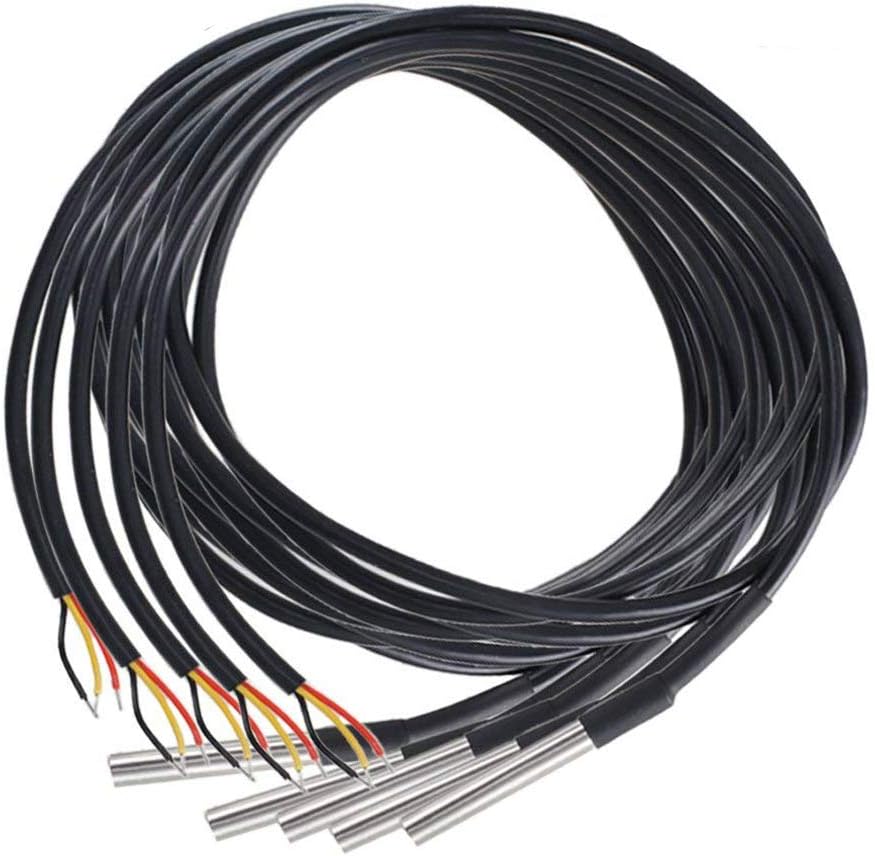
The DROK 2-Pack Waterproof DS18B20 combines a 4.9 customer rating with a well-equipped accessory bundle. It includes two stainless steel probes, two adapter boards, female-to-female jumper wires, and 4.7-kilohm resistors. That combination makes it a convenient choice for Arduino and Raspberry Pi builders who want remote sensing without assembling every interface part separately.
We may earn a commission when you buy through this link, at no additional cost to you.
The probes operate from 3.0 to 5.5 volts and provide a stated range of minus 55 to 125 degrees Celsius with plus or minus 0.5-degree accuracy. Their stainless steel construction is described as waterproof, corrosion resistant, and suitable for continuous submersion. Color-separated red, yellow, and black wires simplify the probe connection, while the adapter boards provide a convenient path to the controller and include an integrated pull-up resistor.
There is an important wiring nuance. Although the adapter includes a pull-up resistor, the product guidance also recommends using a 4.7-kilohm resistor between data and supply for optimal stability. Builders should follow the included connection guidance rather than assume every board arrangement is interchangeable. The one-wire bus must also avoid long unshielded runs and poor connections, especially when more than one probe is connected.
This kit is a compelling budget recommendation for aquariums, hydroponics, plant monitoring, appliance temperature checks, and other damp environments where remote probes are valuable. It performs well as a general-purpose temperature sensor for any project that cannot place the controller next to the measured environment. The accessories reduce setup friction, while the two-probe pack provides a spare or enables a useful comparison.
The stainless steel probe housing and thermal sealant are designed for submersion and moist environments. Keep the exposed wires and adapter boards dry, however.
Adapters, jumper wires, and resistors are included, reducing the number of separate purchases required. The extra resistor gives builders a reliable way to tune the data-line pull-up arrangement.
We may earn a commission when you buy through this link, at no additional cost to you.
The Gikfun 5-Pack DS18B20 provides a generous group of waterproof, remote temperature probes. It holds a 4.5 customer rating and is aimed at Arduino projects that need several sensing points, from thermostatic controls to industrial-style monitoring and sensitive equipment systems.
We may earn a commission when you buy through this link, at no additional cost to you.
The five probes each have an approximately one-meter cable and operate from 3.0 to 5.5 volts. Red, yellow, and black conductors identify power, data, and ground. A unique single-bus interface allows compatible temperature sensors to share a data connection, but the supplied guidance recommends a 4.7-kilohm resistor between data and supply to make probe testing easier.
The absence of adapter boards means users will need to plan their own connection arrangement. When using multiple probes, each device must be identified and addressed, and the wiring should be kept as orderly and short as practical. The probes are suitable for wet environments, but exposed terminations still need protection. A five-probe system can also place more demand on wiring quality and power distribution than a single-sensor setup.
This pack is a good match for distributed temperature logging, greenhouse monitoring, multiple equipment checks, and classroom groups that need several probes. It offers flexibility without requiring temperature-humidity measurement. Buyers should choose it when remote placement and a five-unit supply are priorities, then add the appropriate resistors or interface hardware needed for their particular wiring arrangement.
The one-meter cable lets the probe reach a tank, pipe, cabinet interior, or plant bed while the controller remains in a protected location. Secure the lead to reduce strain and accidental disconnection.
Additional probes can provide a useful map of temperature variation across a room or enclosure. Introduce one sensor at a time to simplify addressing and diagnose communication faults.
We may earn a commission when you buy through this link, at no additional cost to you.
The HiLetgo DHT22/AM2302 is a more capable relative of the entry-level DHT11 and a useful middle ground for Arduino environmental monitors. The two-pack holds a 4.4 customer rating, and its supplied specifications show a wide measurement range with stronger temperature accuracy than the DHT11 modules included in this guide.
We may earn a commission when you buy through this link, at no additional cost to you.
The AM2302-based sensor uses a single-bus digital signal with bidirectional serial data. Its temperature range is minus 40 to 80 degrees Celsius, humidity spans 0 to 100 percent relative humidity, and stated temperature accuracy is plus or minus 0.5 degree Celsius. Humidity accuracy is listed at plus or minus 2 percent relative humidity. A fixing screw hole adds installation convenience, although the sensor still requires suitable pull-up circuitry and software support.
It does not have the remote reach of a DS18B20 probe, and it is not described as waterproof. That means the board is better suited to indoor enclosures, protected cabinets, and ventilated monitoring stations than direct rain exposure. The digital interface is convenient, but users must follow the module’s connection requirements. A pull-up resistor between the data and supply lines is commonly needed, and long wires can make communication less reliable.
Choose this option for a room climate display, storage-condition logger, or indoor automation system that benefits from a wider range and finer accuracy than the DHT11. The two included modules also make comparison testing or a spare build straightforward. It is especially attractive to users who understand the familiar DHT-style ecosystem but want more capable specifications.
The broader temperature range and plus or minus 0.5-degree stated accuracy make the AM2302 useful for more demanding indoor monitoring. It offers improved specifications without moving to an I2C sensor.
The fixing hole helps position the sensor in a stable enclosure or on a panel. Leave airflow around the sensing area and keep the board away from heat-generating components.
We may earn a commission when you buy through this link, at no additional cost to you.
The HiLetgo 5-Pack DS18B20 rounds out the list as a flexible set of five waterproof, stainless steel temperature probes. It carries a 4.5 customer rating and suits projects requiring remote readings from several points, including thermostatic controls, equipment monitoring, consumer products, and other thermally sensitive systems.
We may earn a commission when you buy through this link, at no additional cost to you.
The stated measurement range spans minus 55 to 125 degrees Celsius, with operation from 3.0 to 5.5 volts. Each probe uses a one-meter cable with red for power, yellow for data, and black for ground. The product guidance recommends placing a 4.7-kilohm resistor between data and supply to make testing easier, so a first-time builder should not expect to connect the probes without any additional passive component.
The main practical consideration is one-wire bus management. Multiple sensors can share a data line, but each needs identification, and long parallel branches or poor solder joints can cause intermittent readings. It is wise to test one probe before attaching the others. The probe housing is described as waterproof, while the cable termination and any exposed controller components still require moisture protection.
This five-pack is a practical choice when one probe is insufficient but the project does not require humidity data. It can monitor several tanks, compare machine temperatures, log cabinet conditions, or provide spares for an installation. Its simple color-coded wiring and broad voltage compatibility make it accessible, while the remote probe format gives it more placement freedom than a fixed environmental breakout.
The one-meter leads let the sensor reach environments separated from the Arduino enclosure. They are particularly useful for liquid containers, equipment cavities, and protected outdoor installations.
The recommended 4.7-kilohm resistor supports a more dependable data line. Include it in the wiring plan and test each probe individually before combining the full set.
We may earn a commission when you buy through this link, at no additional cost to you.
The most useful Arduino temperature sensor depends on the environment, required measurements, wiring distance, and acceptable accuracy. Compare sensing technology and environmental protection before considering package size or convenience.
Start by deciding whether the project needs to measure only temperature or a combined environmental picture. The DS18B20 families are dedicated temperature sensors, while the DHT11, DHT22/AM2302, AHT30, and SHT31 measure both temperature and relative humidity. Temperature-only modules are often appropriate for equipment monitoring, liquid sensing, and thermostatic control, whereas paired readings are valuable for room comfort, plant care, and mold-risk awareness.
Choose a dedicated probe when humidity is irrelevant and the sensor must reach into a wet or remote location. Choose a combined module when relative humidity affects the decision your Arduino must make.
Compare the stated accuracy figures carefully. The DHT11 options list temperature accuracy of about plus or minus 2 degrees Celsius, while the AM2302, AHT30, and SHT31 list plus or minus 0.5 degrees or plus or minus 0.3 degrees. The DS18B20 kits list plus or minus 0.5-degree accuracy. Resolution determines how finely a reading can be represented, but it does not by itself guarantee equivalent real-world accuracy.
For alarms, calibrated comparisons, or tighter control loops, favor the modules with stronger stated accuracy. For a basic classroom display, DHT11 precision may be sufficient.
The measurement range must cover every condition the sensor may encounter, including margins around the project’s expected values. The DHT11 modules are listed from 0 to 50 degrees Celsius, which suits ordinary indoor rooms but excludes freezing environments. The AHT30 covers minus 40 to 85 degrees Celsius, the SHT31 minus 40 to 125 degrees Celsius, the AM2302 minus 40 to 80 degrees Celsius, and the DS18B20 products minus 55 to 125 degrees Celsius.
Do not select solely by the widest number. Consider cable ratings, enclosure heat, and sensor placement as well as the nominal sensing range.
Most options use a digital interface, but the protocols differ. DHT modules and DS18B20 probes use a one-wire or single-bus arrangement, while the AHT30 and SHT31 use I2C. One-wire sensors can be economical for long, simple links, although multiple devices require unique addressing and clean wiring. I2C supports multiple compatible devices on a shared bus, but it also requires correct pull-ups, address handling, and compatible software.
Match the interface to your experience and library support. Verify the required pull-up resistor or adapter and check that the voltage is appropriate for the Arduino board.
A waterproof sensing tip does not make the entire module waterproof. The DS18B20 packs are the clearest choices for submerged, damp, or exposed probe locations, while the DHT, AHT30, and SHT31 boards need dry enclosures or protected placement. For an outdoor project, use a suitable enclosure with ventilation that does not trap humidity against the sensing element. Protect exposed connections, resistor joints, and adapter boards even when the probe itself is rated for moisture.
Match the protection level to the exposure. For direct submersion, select a remote DS18B20 probe and keep every connection outside the wet area.
The listed operating ranges vary from 2.0 volts to 5.5 volts for the AHT30, 2.4 to 5.5 volts for the SHT31, 3.0 to 5.5 volts for the DS18B20 products, and 3.3 to 5.5 volts for the DHT11 modules. These figures describe sensor power requirements, not the output levels expected by every Arduino-compatible board. Five-volt and 3.3-volt logic environments both appear in common Arduino projects, so the data interface deserves separate consideration.
Use a stable regulated supply and confirm both sensor and controller logic levels. Avoid powering multiple probes through weak board outputs when their combined demand could be excessive.
A fixed breakout board is appropriate when the air or surface to be measured is close to the Arduino. A remote probe becomes valuable when the sensing point is several centimeters away, inside a tank, beneath a floor, or in a cabinet while the controller remains elsewhere. The listed DS18B20 options use approximately one-meter leads, providing much greater placement freedom. Longer runs increase sensitivity to wiring quality and interference, so secure cables and use suitable pull-up arrangements.
Choose a remote probe when distance improves the measurement. Keep a fixed module for compact builds where short wiring and simple placement are priorities.
The package format can influence the total cost and workflow of a multi-node project. Two-module packs suit paired measurements or provide one spare, while five-packs support distributed monitoring and classroom builds. Bundled resistors or adapters are especially helpful when a beginner does not yet know which supporting components are required. A single high-quality module may be more appropriate when the project needs only one point and the builder already has interface hardware.
Count the intended sensing locations and add room for expansion. Avoid buying extra modules solely for quantity if their measurement range or protocol does not fit.
Begin by identifying the sensor’s protocol, voltage range, and pin labels. For a DHT11, DHT22, or DS18B20, follow the appropriate one-wire or single-bus library and connect power and ground carefully. For an AHT30 or SHT31, use an I2C library, identify the correct device address, and confirm that the bus has suitable pull-up resistors. Power off the Arduino while wiring, then double-check every connection before applying power.
For a fixed environmental module, place the sensor in representative airflow rather than directly above a warm processor, display, regulator, or enclosed battery. Do not trap air inside a sealed enclosure. For a remote DS18B20, immerse only the waterproof probe section, keep connectors dry, and strain-relieve the cable so movement does not damage the termination. If several probes share one bus, test and identify each one individually before connecting the full group.
Care for the system by keeping the sensor clean, dry at the electronics, and physically stable. Check readings against a trusted reference when accuracy is important, and consider the sensor’s warm-up and placement conditions. Avoid using the stated maximum range as a target, since long cables, nearby heat, and environmental exposure can influence results. Record calibration details, sensor position, and sampling intervals so later readings remain meaningful.
A waterproof DS18B20 probe is generally the most suitable of the listed options when the sensing point will be damp or exposed. Keep the Arduino, adapter, and connections in a weather-resistant enclosure. Its stated range is wide, but the probe, cable, and installation method must all tolerate the actual environment.
The DHT11 can be adequate for simple demonstrations and broad heating, cooling, or ventilation decisions. Its stated temperature accuracy of about plus or minus 2 degrees is modest, however. A DHT22/AM2302, SHT31, or AHT30 offers a more appropriate specification when thresholds need tighter control.
Most DS18B20 data lines require a pull-up resistor, commonly 4.7 kilohms, between data and supply. Some listed adapter boards already include one, while kits with loose probes include or recommend separate resistors. Verify the exact hardware and follow its wiring guidance to avoid unstable readings.
One-wire devices such as the DS18B20 use a single data connection for communication and power, which can simplify wiring to one probe. I2C sensors such as the AHT30 and SHT31 use two communication lines and can share a bus with other I2C peripherals. I2C requires correct addressing and pull-up arrangements but offers a more structured multi-device layout.
Several listed products explicitly support Raspberry Pi, ESP32, or STM platforms, including the DS18B20 kits and the AHT30 module. Compatibility still depends on voltage, logic levels, pull-up components, and the correct software library. Confirm the board’s GPIO voltage and the sensor’s wiring requirements before connecting it.
Common causes include poor sensor placement, nearby heat from the Arduino, a probe that is not fully exposed, poor electrical connections, and long one-wire data runs. Check the wiring and pull-up arrangement, let the sensor settle in its intended environment, and compare it with a trusted reference thermometer before changing the code.
Choose a combined sensor when humidity influences your project, such as room comfort monitoring, plant care, or condensation control. Use a temperature-only DS18B20 when humidity is irrelevant and a remote waterproof probe would be more useful. Combined modules tend to be larger and should be placed where representative air can reach them.
The limit depends on the protocol, power budget, addressing, and wiring. Two or three modules are straightforward, while multiple DS18B20 devices can share a one-wire bus if each is uniquely addressed and the data line is properly supported. Start with one sensor, confirm reliable communication, and add devices gradually.
The Teyleten Robot SHT31-D stands out as the most versatile overall option because it combines a wide temperature range, strong stated temperature accuracy, full humidity coverage, and a three-module package. The AHT30 is the premium choice for projects that prioritize fine resolution and very tight stated temperature accuracy, while the DROK DS18B20 pack is the strongest budget recommendation for wet or remote sensing.
Choose based on the physical project first. Use the AHT30, SHT31, DHT11, or DHT22/AM2302 for nearby temperature and humidity measurements. Choose a DS18B20 probe when the sensing point must be separated from the electronics, placed in water, or protected inside equipment. Also account for voltage, bus requirements, enclosure design, and the level of precision your control decisions actually require.
Finally, check current prices, availability, package contents, and manufacturer documentation before ordering, since all three can change. Compare the included adapters and resistors, verify the protocol against your Arduino library, and confirm that your planned environment fits the specified range. With those checks completed, you can select a sensor that matches the measurement rather than simply choosing the largest specification.