
NFESOLAR 4W Solar Pond Aerator
4.2Editor score
Compact four-watt solar design
Two-thousand-mAh battery backup
Complete tubing and stone kit
This Solar Pond Aerator guide compares 10 solar-powered air pumps and fountain aerators, focusing on oxygenation, runtime, pond size, installation, and
A solar pond aerator adds oxygen without requiring a nearby electrical outlet, making it useful for small ponds, fish tanks, aquariums, hydroponic systems, and remote water features. A worthwhile unit combines dependable daytime charging, battery backup, useful aeration modes, weather resistance, and an easy way to position air stones or fountain nozzles.
This guide compares ten products using the information published for each model. It evaluates solar-panel and battery arrangements, airflow claims, operating modes, included components, installation requirements, pond-size guidance, warranty coverage, and the different roles played by compact air pumps and floating fountain aerators.
Each review explains who benefits from a particular model and where its trade-offs may matter. The first three selections stand out for overall versatility, useful outdoor controls, and premium pond-fountain performance. Product configurations and seller offers can change, so readers should confirm current specifications, availability, and pricing before purchasing.
4.2Editor score

3.9Editor score

4.3Editor score
The comparison includes compact solar air pumps, battery-powered pond aerators, a flexible solar power-management system, and two large floating fountain aerators. These products serve different pond sizes and power requirements, so the most useful choice depends on whether the priority is simple placement, nighttime oxygenation, remote operation, or high-volume circulation.


The POPOSOAP 8W Solar Pond Aerator combines an eight-watt solar panel, a built-in 4400mAh battery, and three aeration modes in a package intended for small ponds, fish ponds, and tanks. Its published rating is 3.9, but its specification balance is unusually informative: strong mode is listed at 22 GPH and 24 hours, soft mode at 11 GPH and 48 hours, and intermittent mode at 72 hours.
We may earn a commission when you buy through this link, at no additional cost to you.
Its standout quality is the separation between the solar panel and pump body. That arrangement gives owners more freedom when positioning the panel where it can receive sunlight while placing the air pump near the water. The dual-power system also addresses a common weakness of small solar pumps: when clouds or nighttime interrupt direct charging, the battery can keep the pump operating.
The operating modes offer practical control rather than merely adding buttons. Strong mode is useful for demanding daytime oxygenation, soft mode balances output with longer battery operation, and the ten-second on/off mode stretches the stated runtime when energy conservation matters. Indicator lights for mode and battery status also make it easier to understand what the pump is doing without opening or adjusting it.
This is a sensible all-around recommendation for a small outdoor pond that needs flexible scheduling and reliable battery support. The relatively modest published rating and small-pond orientation mean it is not the automatic choice for a large lake or a pond with unusually heavy fish stocking. Within that intended category, however, its three modes, runtime information, and outdoor-oriented design offer a well-rounded feature set.
The three modes make it possible to match consumption to weather, pond size, and fish activity. Strong mode prioritizes airflow, soft mode lowers the stated output, and intermittent operation is intended to conserve stored energy during prolonged cloudy periods.
Separating the panel from the pump body can simplify placement in gardens where the best sun exposure is far from the shoreline. This freedom is especially helpful when a fixed cable route or shaded dock would otherwise limit installation options.
We may earn a commission when you buy through this link, at no additional cost to you.
The POPOSOAP 15W Solar Pond Aerator is a higher-panel-capacity model with a 4400mAh battery, two airflow outlets, a power display, and three operating modes. It carries a published rating of 3.8. The product is aimed at fish ponds, aquariums, hydroponic plants, fish transportation, and outdoor fishing, making it broader than a conventional garden ornament.
We may earn a commission when you buy through this link, at no additional cost to you.
Its most useful distinguishing feature is the dual-outlet arrangement. Two air lines can serve separate stones or distribute air across a wider section of a pond, which may be preferable when one concentrated bubble column is not enough to create visible circulation. The listed airflow is 0.8 liters per minute, giving buyers a more concrete performance figure than many competitors provide.
The upgraded glass-covered panel and Grade A+ cells are presented as improving conversion efficiency and outdoor durability. A built-in battery continues oxygenation at night and during rainy or heavily cloudy conditions when it has been charged. Strong, soft, and cycle modes add operating flexibility, while the power display gives users a quick indication of battery status.
The main limitation is that the published information does not provide specific runtime estimates for each mode, making direct comparisons with the 8W POPOSOAP model less precise. Buyers prioritizing the largest panel, two outlet distribution, and a one-year warranty will find this the stronger fit; those who need exact runtime guidance may prefer a model with more detailed mode specifications.
Two outlets make it easier to position air stones in different areas of a pond or aquarium. This can improve the visible spread of bubbles and give aquatic life more varied access to oxygenated water without requiring a second pump.
A visible power indicator helps owners determine whether the battery is adequately charged before a cloudy stretch. It also makes it easier to identify a prolonged loss of output that may require repositioning the panel or adjusting the operating mode.
We may earn a commission when you buy through this link, at no additional cost to you.
The Biling 8W Solar Pond Aerator has a published rating of 3.9 and uses two built-in air pumps beneath an eight-watt solar charging arrangement. Like many compact models in this category, it depends on a 4400mAh battery for nighttime operation, but it pairs that battery with clearly listed runtimes of 24, 48, and 72 hours across its three modes.
We may earn a commission when you buy through this link, at no additional cost to you.
The two-pump configuration is the primary attraction. Rather than using a single outlet, the unit can move air through more than one line, potentially supporting multiple stones or distributing bubbles across a broader pond area. The manufacturer recommends the aerator for koi ponds and small outdoor ponds needing supplemental oxygen.
During daylight, the panel powers the pump and replenishes the battery. At night, stored energy takes over. Strong bubble mode is listed at 22 GPH, soft bubble mode at 11 GPH, and ten-second on/off mode extends the operating window. This makes the controls especially relevant for seasonal use, as lower-demand settings can be selected when sunlight is weaker.
Installation does not require professional electrical skills, and the product includes a one-year warranty. Its limitations are the absence of a more specific maximum pond volume and the relatively modest airflow implied by an eight-watt portable design. It is best suited to small or medium garden ponds that need supplemental aeration and would benefit from two air-distribution points.
The three stated operating windows make it easier to adjust consumption as weather changes. Intermittent mode offers the longest battery use, while strong mode is intended for periods when maximum aeration is the priority.
Two integrated pumps can divide airflow between separate air stones or create more than one bubble area. That distribution may be helpful in long, irregularly shaped ponds where a single outlet leaves much of the water less visibly aerated.
We may earn a commission when you buy through this link, at no additional cost to you.
The Solar Powered Pond Aerator Box is not a conventional self-contained solar air pump. It is a preassembled solar power-management system for connected pond aerators or fountain equipment. Compatible solar panels and a battery bank can be added according to the required power load, giving this option substantially more expansion potential than the compact products elsewhere in the guide.
We may earn a commission when you buy through this link, at no additional cost to you.
Its upgraded 30A charge controller supports up to 780 watts of solar input in a 24-volt system. Built-in protections address low voltage, overload, and other abnormal conditions. A programmable timer can establish several operating periods during the day, allowing connected equipment to switch automatically in response to energy availability and changing pond conditions.
The enclosure uses a rugged ABS shell and water-resistant construction, while outdoor-rated cables and included mounting hardware support installation. The package contains a 16-foot solar-to-power-box cable, a 16-foot solar extension, 10AWG battery cables, two pairs of Y-type solar connectors, and four aluminum Z-brackets. Panels and batteries are not included.
This is the strongest option for a technically confident owner who wants a scalable off-grid installation rather than a ready-made pump. The trade-offs are cost, setup complexity, and the need to source compatible panels and batteries separately. It is not the easiest choice for a first-time small-pond owner, but it can provide the foundation for a larger aeration or fountain system.
Because the box accepts compatible panels and a battery bank, the installation can be scaled rather than locked to one small panel. This is useful for owners who expect aeration demands to grow or who want redundancy across multiple pieces of pond equipment.
Multiple daily operating periods can be programmed to match daylight availability and the times when aeration is most valuable. Automatic scheduling also reduces the likelihood that equipment will remain on unnecessarily or fail to operate during a preferred window.
We may earn a commission when you buy through this link, at no additional cost to you.
The NFESOLAR 8W Solar Pond Aerator is an all-in-one portable air pump for small ponds, aquariums, water features, and hydroponic systems. Its published rating is 3.7. The package includes an eight-watt panel, a solar pump with a built-in 4400mAh battery, 8.8 feet of PVC tubing, three air stones, and two T-connectors.
We may earn a commission when you buy through this link, at no additional cost to you.
That accessory bundle is one of the model's main practical strengths. Buyers do not need to calculate a separate tubing length or determine which air stones fit the outlets. The included tubing can be adjusted to place bubbles precisely, and the T-connectors provide options for branching the air supply.
Three modes cover strong operation, soft continuous operation, and a ten-second on/off cycle. The last setting is intended to conserve battery during prolonged cloudy or rainy weather. The description also emphasizes quiet performance, which makes the unit more suitable for ponds near a patio, wildlife area, or frequently occupied outdoor space.
The rating is the lowest among the rated products in the list, and no precise airflow or maximum pond volume is stated. Nevertheless, the generous battery capacity, complete installation kit, and flexible placement make this a practical choice for small water features. It is particularly attractive to buyers who value having all essential components included in the box.
Three air stones and two T-connectors provide multiple ways to organize the air lines. This reduces the need for extra parts and allows users to place bubbles in more than one location.
The stated quiet-operation focus is valuable in gardens designed for relaxation or wildlife. Lower perceived noise can make continuous aeration easier to live with near seating areas, although it does not mean the pump is completely silent.
We may earn a commission when you buy through this link, at no additional cost to you.
The NFESOLAR 4W Solar Pond Aerator is a compact, battery-backed solar pump designed for small ponds, aquariums, garden features, and hydroponics. It has a published rating of 4.2, tying for the highest rated figure among the products in this guide. Its four-watt panel and 2200mAh battery make it a more modest system than the eight-watt and 15-watt models.
We may earn a commission when you buy through this link, at no additional cost to you.
Despite its compact size, it includes 8.8 feet of PVC tubing, three air stones, and two T-connectors. Strong, soft, and ten-second intermittent modes provide basic scheduling control. The intermittent mode is especially relevant for conserving battery during extended cloudy periods, while soft mode offers a compromise between continuous aeration and energy consumption.
The package is designed for straightforward placement and installation, and its quiet-operation emphasis makes it suitable for decorative water spaces. Solar power removes the need for an electrical outlet, while the battery permits operation at night. This combination is useful where daytime sunlight is reliable but continuous daytime and nighttime aeration are required.
The 2200mAh battery provides less stored capacity than the 4400mAh batteries used by several competitors, and the four-watt panel is best suited to modest demand. It is not the strongest choice for a heavily stocked or large pond. For a small garden pond, aquarium, or hydroponic container, however, it offers an appealing combination of rating, compactness, and included accessories.
The four-watt panel and lightweight all-in-one arrangement suit small ponds, tanks, and hydroponic systems where high-volume circulation is unnecessary. It is easier to position discreetly than a larger setup and can be moved when the feature is relocated.
Owners receive tubing, three stones, and two T-connectors with the unit. Those components support immediate placement and branching without requiring a separate trip for common accessories.
We may earn a commission when you buy through this link, at no additional cost to you.
The NFESOLAR 4W Outdoor Aerator is designed for outdoor stock tanks and small ponds up to 80 gallons. It carries a published rating of 4.2 and uses solar power during the day with a 2200mAh battery at night. Two air stones and three operating modes are included in its core feature set.
We may earn a commission when you buy through this link, at no additional cost to you.
Its clearest advantage is the explicit pond-volume guidance. Many compact solar aerators avoid stating a maximum pond size, leaving buyers to estimate requirements from wattage alone. This model gives a clearer framework: it is intended for smaller water bodies, including outdoor stock tanks and modest garden ponds.
The battery can operate the aerator for more than 16 hours in strong bubble mode when the battery is charged. Soft mode reduces demand, while the ten-second on/off setting is recommended when weak winter sunlight makes energy conservation important. The product description also describes the unit as waterproof and suitable for outdoor use.
This recommendation is best for owners who can keep their pond within the stated 80-gallon range and want straightforward seasonal controls. Its battery capacity and four-watt panel are modest, so it should not be stretched to a larger lake or heavily stocked feature. Within its stated use, the combination of clear sizing, nighttime support, and two stones makes it easy to recommend.
The 80-gallon recommendation helps buyers avoid overloading a compact aerator. It also makes the product easier to compare with similarly sized garden ponds and stock tanks.
The intermittent setting can be especially useful when sunlight is weak and fish metabolism may change with cooler weather. Strong mode remains available when maximum aeration is needed.
We may earn a commission when you buy through this link, at no additional cost to you.
The RELIY 1HP Pond Fountain Aerator is an electric floating fountain rather than a solar air pump. It has a published rating of 4.3 and uses a 110-volt, 0.75-kilowatt, one-horsepower pump with a stated flow rate of 15000 GPH. It is built for large ponds and lakes where substantial circulation is more important than solar independence.
We may earn a commission when you buy through this link, at no additional cost to you.
Combining aeration with a fountain provides visible results in addition to oxygen transfer and water movement. Two nozzle heads create v-shaped and parabolic spray patterns, allowing the display to be adapted to the pond's appearance. A specialized filter screen is included to help protect the pump and reduce cleaning needs.
Installation is supported by a 100-foot, 12-gauge submersible power cord and two 100-foot braided traction ropes. Ground stakes help position the floating unit. The stated low-energy-consumption design focuses on making the one-horsepower pump more efficient, while the float is described as using solid materials for balance and upright stability.
This is the right choice for a large pond with reliable electrical access and a desire for a decorative fountain. It is not suitable for remote sites without power, and the listed one-horsepower output would be excessive for a tiny fish tank. Owners should also consider the need for a suitably rated outdoor electrical circuit and safe cord routing.
A floating fountain combines visible water movement with aeration, making it attractive for residential ponds that serve as landscape features. Two nozzle patterns provide some control over how the display looks.
The stated 15000 GPH flow separates this model from compact bubble pumps. That output is better matched to larger water bodies where a single small air stone would produce limited circulation.
We may earn a commission when you buy through this link, at no additional cost to you.
The Biling 2200mAh Solar Aerator is a portable solar pump for fish ponds, aquariums, fish transportation, wild fishing, hydroponics, and other locations needing supplemental oxygen. Its published rating is 3.8. The panel charges a built-in 2200mAh battery during the day, allowing the pump to run at night without a wired power supply.
We may earn a commission when you buy through this link, at no additional cost to you.
Its most concrete weather-related advantage is the stated IPX5 water-resistance rating for the air pump. It is also designed for outdoor use and is promoted as safe for fish and plants because it does not require a connection to household wiring. The glass-covered solar panel is intended to improve conversion efficiency and service life.
Runtime figures are supplied for all three modes: 18 hours for strong bubbling, 30 hours for soft bubbling, and 48 hours for the ten-second on/off cycle. This makes it easier to estimate how the battery will behave under different settings. The manufacturer also states that air output, waterproofing, and noise were optimized.
The product is a good fit for mobile or outdoor applications where avoiding extension cords is important. Its lack of a stated airflow figure and maximum pond volume means buyers cannot easily assess its capacity from the listing alone. It is most convincing for small-to-medium applications that can be monitored and adjusted according to visible bubble output and fish behavior.
The IPX5 rating provides useful reassurance for a pump installed beside a pond or other exposed feature. It does not imply that the entire product can be submerged without limitation, so placement instructions remain important.
Published runtimes of 18, 30, and 48 hours make it easier to select a mode before extended cloudy weather. Intermittent operation offers the greatest endurance, while strong mode delivers the highest output.
We may earn a commission when you buy through this link, at no additional cost to you.
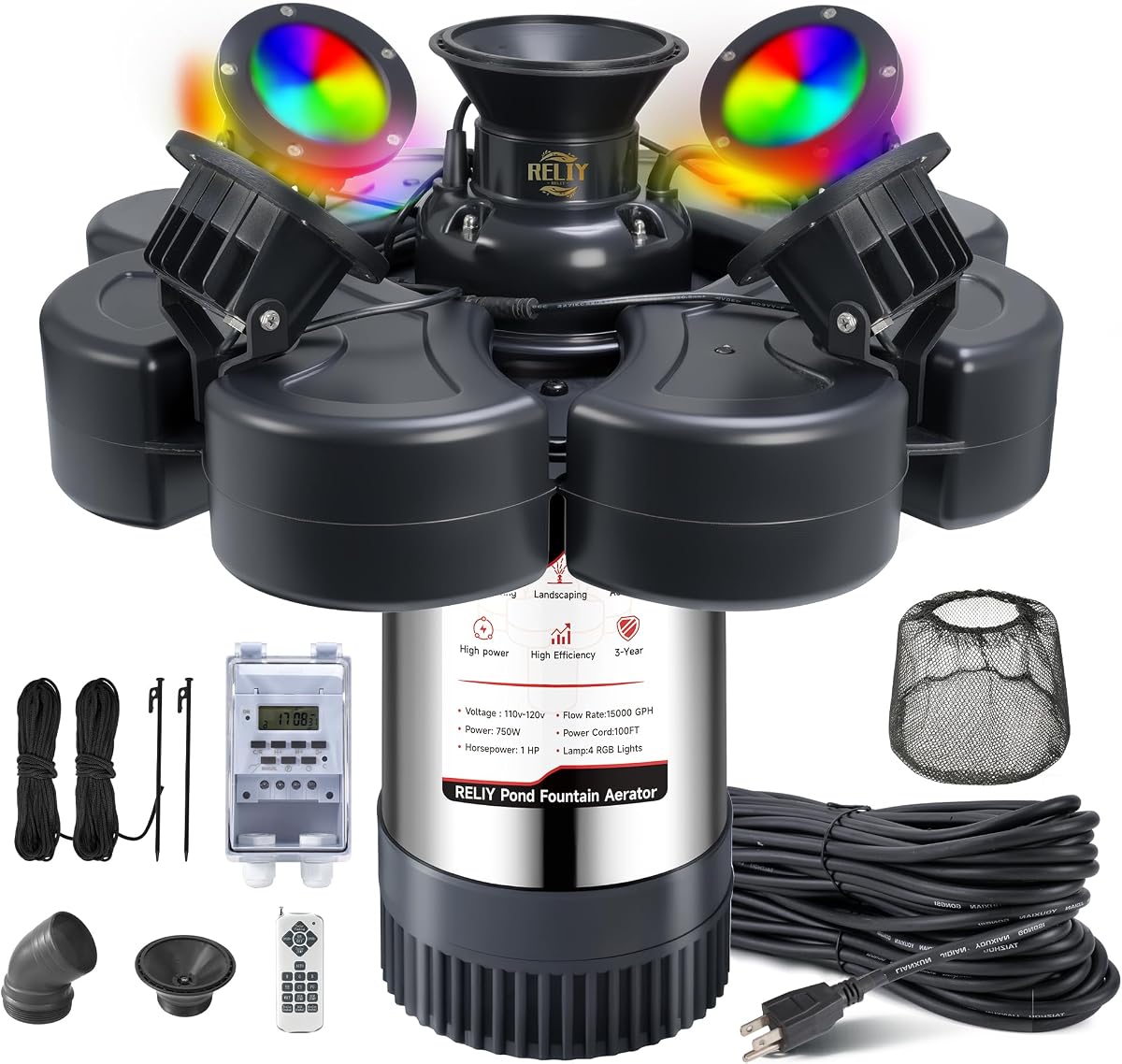
The RELIY 1HP RGB Pond Fountain is the most feature-rich display product in the guide, although it is electric rather than solar. It has a published rating of 4.3 and combines a 110-volt, 0.75-kilowatt, one-horsepower pump with a stated 15000 GPH flow rate. It is intended for large ponds and lakes.
We may earn a commission when you buy through this link, at no additional cost to you.
Four RGB light units provide ten color modes and a listed 1200-lumen brightness. Their P65 waterproof construction and remote control with an approximately 150-foot range make nighttime operation customizable. This lighting system distinguishes the product from conventional fountain aerators, especially for owners creating an evening garden display.
A programmable timer handles automatic operation, reducing the need to switch the fountain on and off manually. The package includes a 100-foot submersible power cord, two 100-foot nylon braided traction ropes, ground stakes, two nozzles, the RGB lighting system, a remote, a timer, and a specialized filter screen.
Its limitations are significant for anyone specifically seeking a solar product: it needs a reliable 110-volt outlet and does not include a solar charging system. The one-horsepower pump is also excessive for small ponds. It earns its place as a premium alternative for large ponds where decorative lighting, automated timing, and strong circulation justify a dedicated mains-powered installation.
Ten RGB lighting modes and remote control allow the fountain to change appearance without returning to the shoreline. The listed P65 waterproof construction supports outdoor nighttime use.
The programmable timer makes recurring fountain operation easier to manage. Owners can establish daily active periods rather than relying on a manual switch or separate external timer.
We may earn a commission when you buy through this link, at no additional cost to you.
Choosing a solar pond aerator requires balancing pond demand, available sunlight, battery endurance, placement, and the type of circulation desired. The most important distinction is whether a small bubble pump or a high-capacity floating fountain is appropriate for the water feature and whether dependable operation must continue at night.
Begin with the pond's actual water volume, depth, fish population, and climate. A compact four-watt pump may suit a small garden pond, aquarium, stock tank, or hydroponic container, while a larger body with valuable fish may require higher output. Only one product in this guide provides a specific upper limit of 80 gallons, so owners of larger ponds should consider output, number of outlets, and the possibility of multiple aeration points rather than relying on wattage alone.
In general, match aeration capacity to the feature rather than choosing the largest available pump. Overpowering a tiny tank can create excessive bubbles and unnecessary energy use, while underpowering a large pond may leave circulation uneven.
Solar panel wattage determines how quickly available sunlight can replenish stored energy, while battery capacity influences how long the pump can operate after sunset or during cloudy weather. The listed compact systems use four-, eight-, or 15-watt panels with 2200mAh or 4400mAh batteries. Runtime depends on the selected mode, weather, panel placement, and battery condition, so published figures should be treated as operating guidance rather than unconditional guarantees.
For areas with frequent cloud cover, a larger panel, higher-capacity battery, and energy-saving mode are especially valuable. Position the panel where it receives unobstructed sunlight and keep it clean. Battery runtime becomes less relevant when direct solar power remains strong throughout the day.
Look for a published airflow figure when possible, but also consider how the air is distributed. The POPOSOAP 8W and Biling 8W models list 22 GPH in strong mode, while the POPOSOAP 15W model lists 0.8 liters per minute and two outlets. Multiple outlets or dual pumps can spread aeration across a wider area, which may be more valuable than placing every bubble in one concentrated zone.
The included tubing and air-stone arrangement matters as well. Eight-point-eight-foot PVC tubing and multiple stones allow flexible positioning, while the RELIY fountains use high-volume jets to circulate a much larger body of water.
Multiple modes let users balance oxygenation against battery consumption. Continuous strong mode supports maximum output, soft mode reduces demand, and intermittent mode is useful when weather weakens solar charging or when the pond needs less aeration. Models with stated runtimes by mode make it easier to plan for nighttime and cloudy periods.
Choose a product with a mode that matches your conditions rather than operating strong mode continuously by default. Intermittent cycling may also be more appropriate during cooler months, while strong aeration can be helpful during hot weather or periods of heavy biological demand.
The best solar pond aerator should be easy to position in direct sunlight while keeping the air lines, pump, and air stones where they can circulate water effectively. Compact all-in-one models support quick, tool-light installation and relocation. The larger power-box option requires compatible panels, a battery bank, and more involved wiring, while floating fountains need secure traction ropes and a safe route for a long electrical cord.
Avoid extension leads for submerged electrical equipment unless the manufacturer specifically permits and properly rates them. For solar pumps, follow the supplied instructions and keep charging panels unobstructed. For electric fountains, use a suitable protected outdoor outlet and plan cable routing before placing the unit in the water.
Outdoor aerators should be evaluated for rain, splashing, seasonal temperature changes, and prolonged sun exposure. The Biling 2200mAh model identifies an IPX5 water-resistance rating for its pump, while several competitors describe waterproof or water-resistant construction without providing a complete standardized rating. That distinction should be considered carefully.
A glass-covered solar panel may offer better surface durability and conversion efficiency than an exposed alternative, but it still needs regular cleaning. Keep electrical connections above splash-prone areas and follow all manufacturer guidance. No outdoor rating eliminates the need for sensible placement and routine inspection.
True solar products operate from sunlight and stored battery energy, making them suitable for ponds without a nearby outlet. Electric fountain aerators deliver higher flow and can add dramatic water displays, but they need reliable 110-volt electricity. The Solar Powered Pond Aerator Box provides another path: it manages compatible panels and a separate battery bank to power standard pond equipment off-grid.
Consider whether uninterrupted electrical access matters more than cord-free placement. If the pond is remote, solar charging or a dedicated battery system is likely preferable. If it is near a safely powered outlet and needs large-scale circulation, an electric fountain may offer greater performance.
Compact pumps are commonly marketed for quiet operation, which matters in gardens, near seating areas, or around wildlife. Floating fountains produce both water and pump noise, but their visual display may make them more satisfying for decorative ponds. Warranty terms also vary: several solar air pumps include one-year coverage, while RELIY's fountain aerators carry a three-year warranty.
Compare included accessories, remote controls, timers, filters, tubing, and stones as part of the complete package. A complete kit can simplify setup, while programmable controls and lighting add convenience at larger pond scale.
Begin by identifying the pump's location, sunlight exposure, and intended air distribution. Place the solar panel in the strongest available sunlight without allowing foliage, walls, or other objects to cast a persistent shadow. Secure the pump above or at the appropriate waterline, connect the tubing and air stones as directed, and avoid kinking or sharply bending the lines.
Choose the operating mode according to pond conditions, weather, and fish activity. Use strong mode when maximum aeration is needed, soft mode for a lower continuous output, and intermittent mode when conserving stored energy is more important. Keep the panel clean and check the battery or power indicator periodically, particularly before a period of cloudy weather.
Inspect the pump, tubing, air stones, and connections regularly for blockage, algae, damage, or reduced bubble output. Remove accumulated debris carefully and use only cleaning methods compatible with the manufacturer’s instructions. For electric fountain systems, check the cord, ground stakes, traction ropes, timer, nozzles, and filter screen before each operating season.
Yes, when the built-in battery has been charged by the solar panel. The listed models operate their pumps from stored battery power at night and during unfavorable solar conditions. Runtime varies by model and mode, so check the current specifications before relying on a particular duration.
Continuous operation is useful when fish density, warm water, or organic waste creates high oxygen demand. Lower-demand ponds may benefit from an intermittent mode, especially during cooler months or cloudy weather. Observe the fish, water condition, and available sunlight rather than relying on a universal runtime.
No. Most compact solar air pumps in this guide are aimed at small ponds, tanks, stock tanks, and hydroponic systems. Large ponds may require a higher-output fountain, several compact aerators, or a custom solar power system, depending on water volume and fish population.
They can, but performance depends on prior sunlight, battery capacity, panel placement, and operating mode. The battery provides a reserve after charging, while intermittent operation can extend endurance. Extended poor weather may still reduce output or stop the pump once stored energy is depleted.
Place it where it receives the most direct sunlight for the longest practical period. Keep it clear of shade, leaves, dirt, and debris, and orient it according to the manufacturer's instructions. In the Northern Hemisphere, a south-facing position generally receives stronger exposure, while local climate and surrounding structures remain important.
It depends on the pump's outlet count and included accessories. Some models include T-connectors and multiple stones, while others feature two outlets or two built-in pumps. Follow the supplied instructions because adding too many restrictive lines can reduce airflow.
No. Both RELIY models are 110-volt electric floating fountain aerators rather than solar air pumps. They are included as premium alternatives for buyers who want high-volume circulation, a fountain display, and automatic operation where reliable household electricity is available.
Inspection frequency depends on algae, debris, insects, mineral buildup, and nearby vegetation. Check air stones and tubing whenever bubble output declines, and clean the panel whenever dirt or leaves reduce its exposure. Follow manufacturer-specific cleaning instructions and disconnect power before servicing any electrical component.
The POPOSOAP 8W model is the most balanced overall recommendation because it combines an eight-watt panel, a 4400mAh battery, three clearly differentiated modes, and flexible outdoor positioning. The NFESOLAR 4W model is the strongest budget-oriented choice for small ponds and tanks, while the RELIY RGB fountain represents the premium path for large ponds that value powerful circulation, lighting, and programmable operation.
Prioritize pond capacity first, then compare battery-backed runtime, number of airflow outlets, solar-panel size, and placement requirements. Compact units with included tubing and stones are convenient for small features, while larger or more heavily stocked ponds may need multiple aeration points or a high-capacity fountain. Remote installations should account carefully for cloudy weather and battery reserve.
Before ordering, verify the current product specifications, included accessories, pond guidance, warranty terms, and seller availability. Product configurations and offers can change, and current prices should be checked directly at the time of purchase so the selected aerator still fits both the water feature and the budget.