WiFi Water Timer 3 Outlet
4.8Editor score
Three independent outlets
Extended wireless gateway range
App and voice control
Our app controlled watering systems guide compares ten smart sprinkler, hose, and drip options by zone count, app features, water management, setup, and
App controlled watering systems make it easier to maintain lawns, gardens, flower beds, and indoor plant collections without relying entirely on manual timers. The best options combine smartphone scheduling, remote monitoring, weather awareness, reliable watering patterns, and dependable outdoor construction, while the right choice depends heavily on the property and plants involved.
This guide compares ten smart watering products across several important categories, including multi-zone sprinkler controllers, hose timers, and automatic drip systems. We considered app control, scheduling flexibility, water-saving features, installation needs, watering capacity, connectivity, and practical details that affect everyday reliability and maintenance.
Each pick below shows what its design is best suited to, from controlling an established sprinkler system to watering a group of potted plants while away. Product features and availability can change, so readers should verify current specifications, compatibility, and app requirements before making a final purchase.
4.8Editor score
4.5Editor score
4.3Editor score
The comparison below organizes each system by its intended watering environment, app capabilities, scheduling features, and practical capacity, making it easier to match a controller to a lawn, garden, or collection of potted plants.



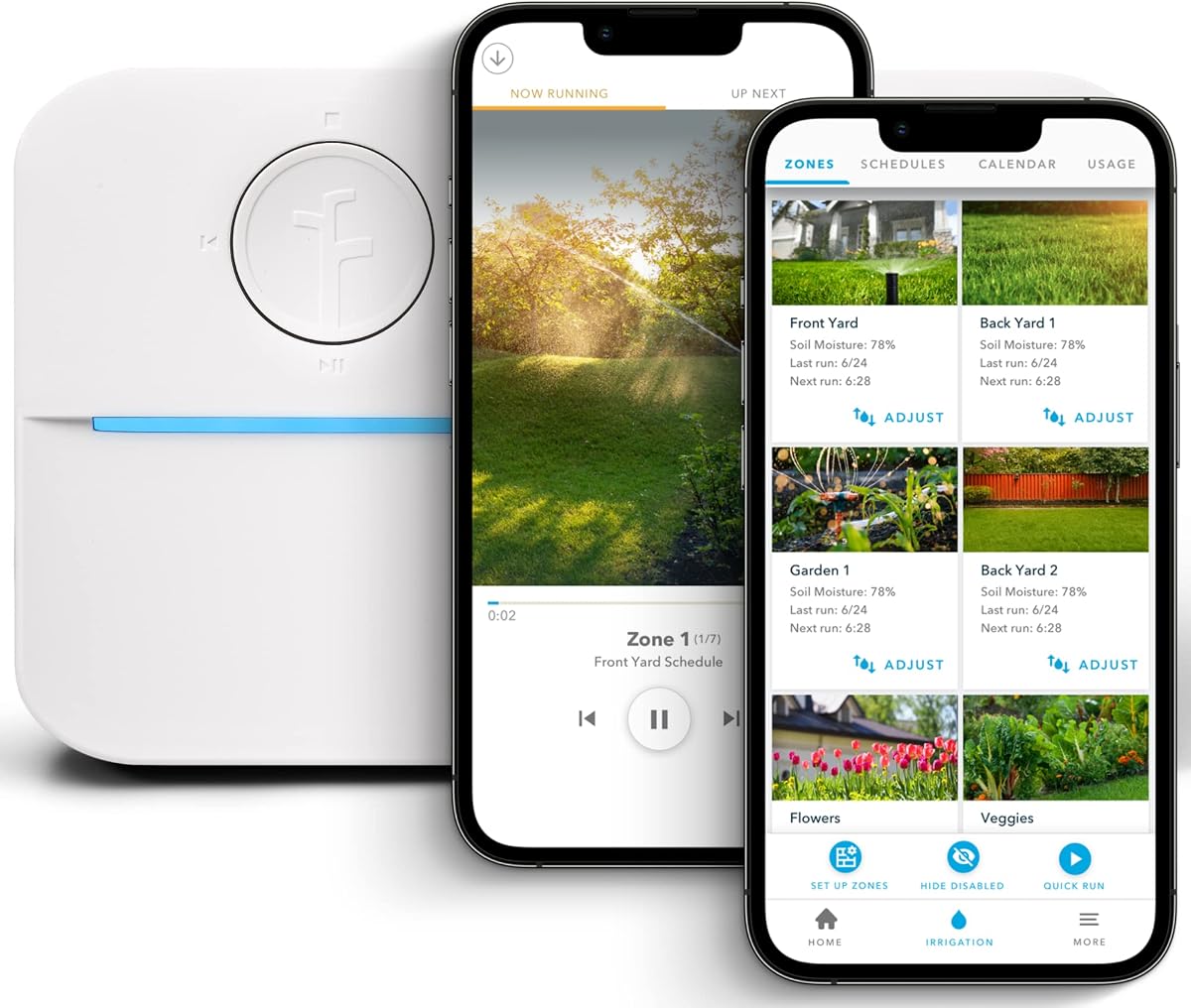
The Rachio 3 is a sophisticated app controlled watering system for homes with a conventional, independently zoned sprinkler setup. It carries a 4.5 rating and stands apart through its combination of eight-zone control, local weather intelligence, and straightforward remote management. Users can create their own schedules or allow the system to adjust watering based on conditions, giving the controller a strong balance of automation and flexibility.
We may earn a commission when you buy through this link, at no additional cost to you.
Its standout feature is Weather Intelligence, which can skip watering for rain, wind, freeze, and other relevant conditions. The Rachio app also lets users manage schedules, run individual zones, and review estimated water usage from anywhere. Grow-in options help new lawns establish more gradually, while the compatibility claim of 99% with existing sprinkler systems makes the unit practical for many homes that already have professional irrigation installed.
Installation is described as a fast DIY process that can take 30 minutes or less when replacing a compatible existing controller. The trade-off is that Rachio is primarily an upgrade for a wired sprinkler system rather than a faucet-mounted timer or an indoor plant reservoir system. Buyers without a properly wired controller may need an electrician or irrigation professional, and people with only one or two zones may find the full capacity unnecessary.
This is the strongest all-around recommendation for a larger lawn or landscaped property with multiple irrigation zones. It particularly suits homeowners who want weather-responsive automation, clear app controls, and remote adjustments without replacing their existing sprinkler layout. For smaller hose-based setups or indoor plant collections, the more specialized options later in the list may be simpler and more appropriate.
Weather Intelligence adds value by allowing the controller to skip unnecessary cycles during rain, wind, freeze, and other unsuitable conditions. That automation can make a fixed irrigation plan more responsive to actual growing conditions without requiring constant manual changes.
Independent control across eight zones makes the Rachio 3 useful for properties with separate lawn, shrub, flower, and drip-irrigation areas. The app also provides remote zone operation and estimated usage information for better oversight.
We may earn a commission when you buy through this link, at no additional cost to you.
The Orbit B-hyve Smart Sprinkler Controller is a six-zone option for homeowners who need app-based scheduling without moving to a full eight-zone controller. It has a 4.5 rating and is designed to coordinate multiple parts of a landscape, including lawn sprinklers and drip systems. The app-controlled interface supports custom irrigation programs, zone monitoring, and remote management.
We may earn a commission when you buy through this link, at no additional cost to you.
A key practical benefit is the weatherproof protective case, which allows installation in garages, sheds, or on outdoor walls. That flexibility can make the controller more approachable than a unit restricted to a protected indoor location. Its multi-zone architecture is well suited to properties where different plants require separate schedules, such as a front lawn, rear garden, and drip-fed planting area.
The main limitation is that the B-hyve controller assumes an existing multi-zone sprinkler arrangement and compatible wiring. It is not a simple faucet attachment, and it does not offer the same detailed weather-skip description presented by the Rachio. The two-year limited warranty provides some reassurance, but buyers should also understand that statutory consumer rights remain unaffected.
This controller is a sensible choice for an established six-zone irrigation system that needs remote access and flexible programming. It is especially attractive when the current controller must live outdoors. People with fewer than six zones, no conventional sprinkler wiring, or a need for detailed local weather skips may find another option more aligned with their setup.
The protective weatherproof case supports indoor or outdoor installation in locations such as garages, sheds, and exterior walls. This makes the controller useful where an indoor-rated model would not be practical.
Custom programs and multi-zone operation allow different landscape areas to receive distinct schedules. That separation is valuable when lawns, shrubs, flower beds, and drip lines have different watering requirements.
We may earn a commission when you buy through this link, at no additional cost to you.
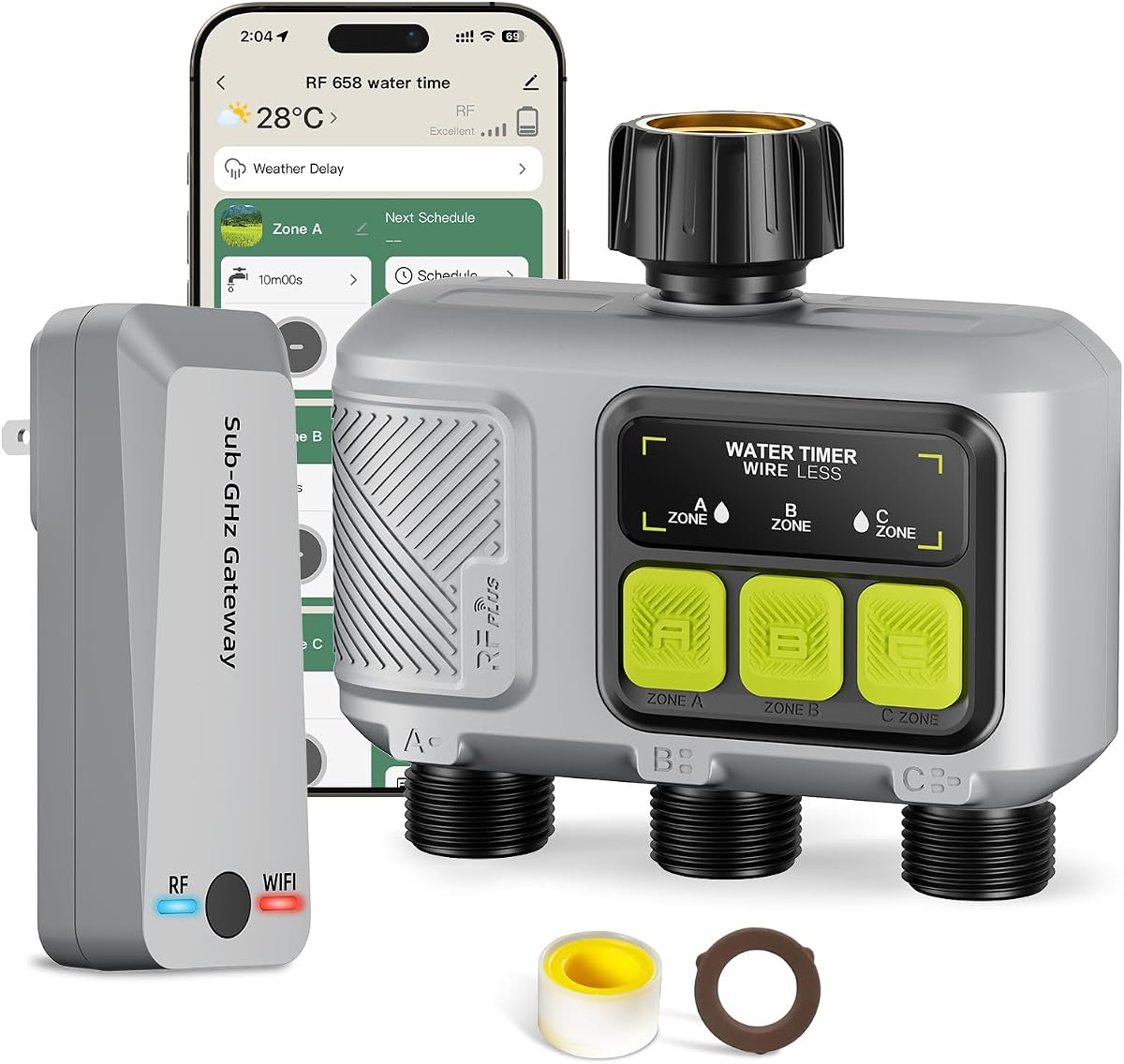
The WiFi Water Timer 3 Outlet is a flexible hose-level watering system with a 4.8 rating, the highest numerical rating among the products reviewed. It combines three independently controlled outlets with app scheduling, voice control, rain delay, and a dedicated gateway. It is a practical option for homeowners who want to automate multiple sprinklers or drip lines without installing a wired sprinkler controller.
We may earn a commission when you buy through this link, at no additional cost to you.
The included gateway is the defining feature. Its stated range reaches as far as 984 feet, and the product description says the connection can remain stable through two or three walls. Each outlet can have its own start time, duration, frequency, and weekly schedule, with duration adjustable from one minute to 24 hours. Timed, weekly-cycle, mist, rain-delayed, and manual modes add flexibility for lawns, plants, and drip irrigation.
The principal constraint is the requirement for 2.4GHz WiFi. The brass inlet, filter, and IP55 housing are designed for outdoor use, but the unit remains a hose timer governed by available flow and pressure rather than a high-capacity irrigation controller. Buyers should also account for the need to position the gateway and maintain a stable 2.4GHz network.
This product is an excellent match for renters, newer homeowners, and users seeking inexpensive remote control across several connected water sources. It also works well for mixed irrigation, since one outlet might run a sprinkler while another operates a drip line. It is less appropriate for a large property with many independently zoned sprinklers or professional-grade water demand.
Independent scheduling lets connected sprinklers, soaker hoses, or drip lines run on different plans. This makes the timer useful for mixed watering needs without purchasing three separate units.
The dedicated gateway is stated to maintain a stable connection within 300 meters, or 984 feet, even through several walls. It can be more practical than relying on a phone's Bluetooth range alone.
We may earn a commission when you buy through this link, at no additional cost to you.
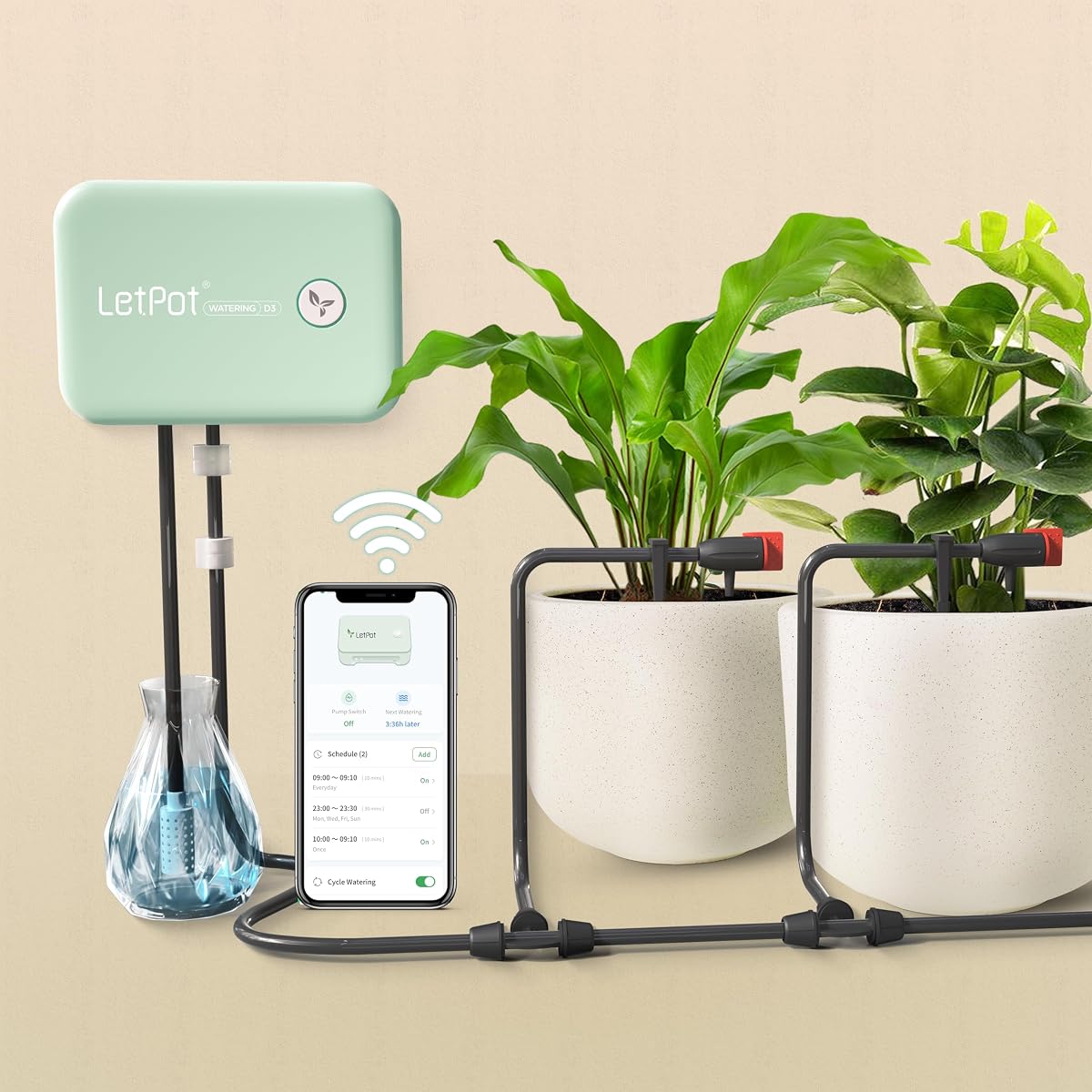
The LetPot Automatic Watering System is designed for indoor or outdoor potted plants and delivers water through a network of adjustable drip lines. Its 4.2 rating reflects a feature-rich approach centered on app scheduling, low-water alerts, and flexible drip modes. The system can support 10 to 20 pots and runs up to five watering tasks simultaneously.
We may earn a commission when you buy through this link, at no additional cost to you.
The upgraded 2.0 chip is intended to improve connection stability, while an anti-backflow valve helps prevent siphon-related water loss. Users can customize frequency, duration, and intermittent or continuous drip patterns. The dedicated app also includes a plant diary and plant information features, which add value for users who want to record care routines rather than simply automate them.
Its IP66 waterproof housing and silent German-imported pump make it suitable for balconies, patios, indoor plant areas, and other shared spaces. The included components cover 10 meters of pipe, 10 adjustable drippers, connectors, brackets, a filter, and an adapter plug. The main practical consideration is that it is a plant-specific drip kit, not an outdoor faucet timer or multi-zone sprinkler controller, and the listed box contents do not include a water reservoir.
This is a strong recommendation for plant owners who want precise, app-based watering for multiple pots. It works particularly well for frequent travelers, busy households, and collections with mixed moisture needs. Buyers should confirm their available water source and ensure the tubing can be routed to all intended pots before installation.
The app can run as many as five watering tasks at once, each with its own frequency and duration. That flexibility helps plants with different moisture requirements receive more suitable schedules.
Built-in shortage notifications make it easier to refill the water supply before plants become stressed. The alert system adds useful visibility for users who are not physically present throughout the day.
We may earn a commission when you buy through this link, at no additional cost to you.
The VIVOSUN Automatic Drip Irrigation Kit is a smart pump-and-drip arrangement designed to water as many as 16 plants at once. It has a 4.1 rating and distinguishes itself with a high stated flow rate, a 15-watt pump, and compatibility with soil, coco coir, perlite, and rockwook growing media. It is particularly relevant to indoor growers and users already invested in the Vivosun app ecosystem.
We may earn a commission when you buy through this link, at no additional cost to you.
App control works through the Vivosun A10 GrowHub. Users can create custom schedules, use Cycle Mode for automatic intervals, or select Recipe Mode for a defined daily amount. The four-millimeter drippers are stated to increase flow by 30%, and the pump can deliver up to 1,000 liters per hour while operating at 30 to 40 decibels. Flexible tubing allows the layout to be adapted to the location of each plant.
The anti-siphon connector is designed to prevent backflow and flooding, while a filter cotton helps block dirt and debris that could clog the emitters. The trade-off is ecosystem dependence: the listed app functionality specifically requires the A10 GrowHub rather than operating as a universally standalone WiFi timer. Users should also consider reservoir capacity and whether the tubing arrangement can reach every plant without kinks.
This kit is a good fit for indoor growers, propagation setups, and plant collections using Vivosun equipment. Its strong pump specification and 16-emitter capacity may also suit larger arrangements. It is less suitable for conventional outdoor users who want direct faucet control or for those unwilling to add a GrowHub to the setup.
Recipe Mode schedules a precise daily watering time and amount through the Vivosun app. This can reduce the need for repeated manual adjustments when a plant collection has a predictable routine.
A stated maximum delivery of 1,000 liters per hour gives the pump useful capacity for a multi-plant setup. Users still need to select compatible tubing and ensure their source can provide consistent flow.
We may earn a commission when you buy through this link, at no additional cost to you.
3.9Editor scoreThe Orbit B-hyve XD 4-Port Smart Hose Watering Timer is a hose-mounted alternative for users who need several connected watering points. It has a 3.9 rating and includes a WiFi hub for remote programming and monitoring. With four ports, it can coordinate multiple sprinklers, drip systems, or other hose-connected irrigation devices.
We may earn a commission when you buy through this link, at no additional cost to you.
Its smart WeatherSense technology is designed to use local weather data and adapt to drought conditions, helping conserve water without requiring every schedule to remain fixed. Bluetooth programming provides another way to configure and monitor the timer, while the hub extends the smart remote-access role. The weatherproof multi-valve unit and battery-powered design support dependable outdoor use.
Its rating is lower than those of the other products in the guide, so buyers should pay close attention to compatibility and expected feature operation. As with any hose timer, total flow is constrained by the faucet and supply pressure. It also does not offer the same multi-zone irrigation capabilities as a dedicated controller for a buried sprinkler network.
This model is most suitable for a yard with up to four hose watering points and a need for weather-responsive remote management. It may be particularly useful where installing a wired controller would be excessive. People needing broad app features, stronger rating consistency, or control over an extensive underground sprinkler system should compare it with the other Orbit and Rachio models.
Multiple outlets reduce the need for separate smart timers on sprinklers and drip lines. Each connected watering point can be managed through the broader B-hyve setup.
Local weather data and drought-responsive adjustments can reduce unnecessary irrigation. The feature is most valuable when a lawn or garden has clearly changing seasonal moisture needs.
The Orbit B-hyve XR 8-Zone Smart Sprinkler Timer provides app-managed control for a substantial conventional irrigation system. It carries a 4.3 rating and supports eight independently programmed zones, making it relevant to medium and large properties with separate lawn, shrub, flower, and drip areas.
We may earn a commission when you buy through this link, at no additional cost to you.
WiFi connectivity allows users to make quick schedule changes, monitor irrigation, and organize watering from the B-hyve app. Forecast-driven intelligence automatically adjusts watering cycles to help conserve water as conditions change. The controller is designed for both indoor and outdoor installation, offering more placement flexibility than models restricted to a dry indoor enclosure.
The trade-off is the same one that comes with any eight-zone wired controller: it assumes the property has compatible sprinkler wiring and valves, and it may offer more capacity than a small yard needs. Installation should therefore be planned around existing zones rather than treated like a simple hose attachment. The two-year limited warranty covers stated material and workmanship defects for private use without limiting statutory consumer rights.
This is a strong choice for homeowners who want Orbit's app and forecast-aware scheduling across as many as eight zones. It may appeal particularly to users who need an outdoor-rated unit or want more multi-zone capacity than the six-zone Orbit model. Buyers with only a few zones should assess whether a smaller controller would be easier to use and maintain.
The controller uses forecast-driven irrigation intelligence to adjust cycles as weather changes. This reduces the need to edit fixed schedules whenever rainfall or dry conditions alter plant requirements.
Indoor and outdoor suitability helps the controller fit garages, sheds, or protected exterior locations. Placement flexibility can make it easier to serve the property without relocating nearby irrigation wiring.
We may earn a commission when you buy through this link, at no additional cost to you.
The GoveeLife H5901 is a single-outlet smart hose timer designed to operate as part of a larger connected irrigation network. It has a 4.1 rating and is compatible with a gateway that can support as many as 64 devices. That makes the timer suitable for properties that want several hose-connected watering points under one management system.
We may earn a commission when you buy through this link, at no additional cost to you.
Weather adaptation uses internet data for rain, light, temperature, and humidity. The timer can skip rainy periods and increase watering in hot, dry conditions. Users can choose continuous, intermittent, or custom modes, create up to 10 schedules, and view charts showing watering time and volume. Alexa and Google Assistant support allow common routines to be triggered by voice or connected smart-home routines.
Dual brass inlets, an IP67 waterproof housing, a UV-stabilized shell, and a stated 7.25 to 116.03 PSI operating range emphasize outdoor durability. The main compromises are the single outlet and the requirement for 2.4GHz WiFi. The timer also uses a threaded connection that users should verify before installation, and very low-pressure supplies may cause dripping rather than proper valve operation.
This model is best for users who want to build a connected smart watering network over time or need several independent hose timers managed through one gateway. Its weather response, usage charts, and voice-control options make it more data-focused than a basic mechanical timer. It is less convenient for a single location where a multi-outlet model would reduce hardware needs.
One gateway can connect as many as 64 devices, allowing a household to unify watering across front, back, and side yards. Individual timers can then serve separate hose connections while sharing one app ecosystem.
Real-time environmental data informs schedule adjustments, while charts report watering time and volume. Together they help users understand irrigation patterns and identify unnecessarily wet or dry zones.
We may earn a commission when you buy through this link, at no additional cost to you.
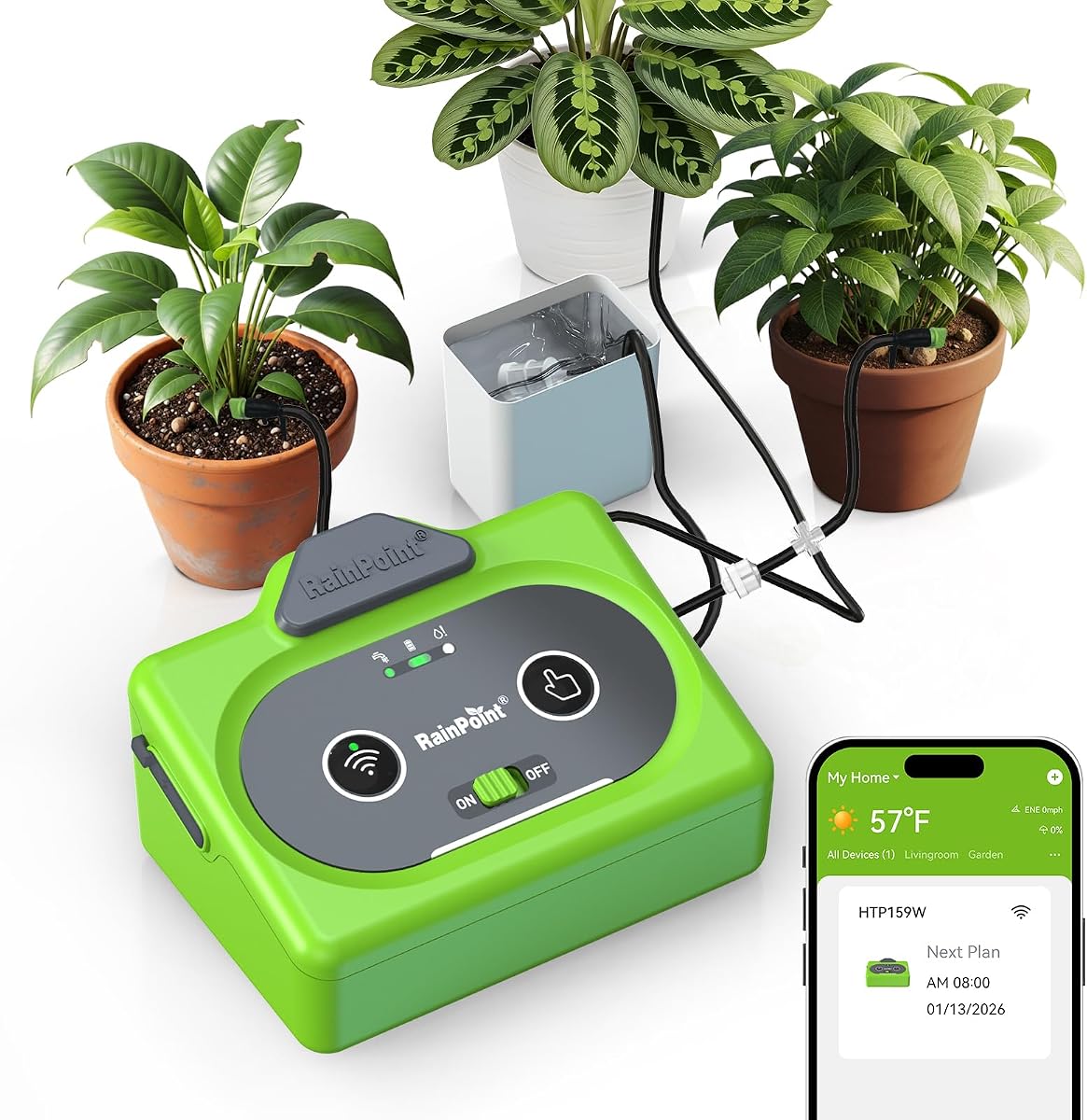
The RAINPOINT Direct WiFi Connection Smart Auto Plant Waterer is a comprehensive indoor drip system with a 4.3 rating. It can water 10 to 15 plants and distinguishes itself through local schedule storage, power-outage support, and thoughtful plant-care notifications. It is a strong choice for households that want dependable automation without depending on a continuous internet connection.
We may earn a commission when you buy through this link, at no additional cost to you.
The RainPoint Home app is described as offering a simple one-step WiFi setup, with schedules, cycle and seasonal adjustments, and remote status monitoring. Local storage keeps preset schedules running during an internet outage. A USB-C power option and built-in rechargeable battery help maintain watering during power interruptions, making the product particularly relevant for frequent travelers.
Low-water protection automatically shuts off the pump if it runs dry, while visual indicators and push or email notifications warn users when the reservoir needs attention. Adjustable emitters support different pot sizes and plant types, while the anti-siphon component helps prevent unwanted backflow. A shade cloth blocks light inside the black reservoir to limit buildup, and family permissions allow shared monitoring and alerts.
This system is a premium indoor-plant recommendation for people who value resilience, detailed care information, and remote collaboration. It is less appropriate for lawns, underground sprinklers, or numerous outdoor drip zones. Users should ensure their router provides 2.4GHz WiFi, select a suitable reservoir, and verify that the available tubing length can reach the intended pots.
Preset watering plans remain active even if the internet connection fails. This is a meaningful reliability advantage for plant owners whose home network experiences frequent interruptions.
USB-C power and a built-in rechargeable battery help the system continue watering during an outage. The combination gives travelers greater confidence that their indoor plants will not be left without water.
We may earn a commission when you buy through this link, at no additional cost to you.
The RAINPOINT WiFi Automatic Plant Waterer is built for indoor houseplants and small collections, with a stated capacity of 10 to 15 pots. It has a 4.1 rating and emphasizes cordless operation, a 2400mAh rechargeable battery, and app-based scheduling. Its vacation focus makes it most relevant to people who travel regularly or want to avoid carrying heavy watering cans.
We may earn a commission when you buy through this link, at no additional cost to you.
The app allows users to schedule and monitor routines from a smartphone and provides real-time notifications. The battery is stated to operate the system for up to 60 days on one charge, allowing the inlet to sit in a bucket without requiring a permanent connection to a wall outlet. This arrangement provides flexibility in choosing a water source and keeping the setup away from power cords.
The upgraded anti-siphon valve is designed to stop water flow when the pump turns off, reducing the risk of leaks and overwatering. The kit includes a pump, tubing, and drip stakes for distributing water to multiple pots. Installation is described as taking about 15 minutes and requiring no plumbing or professional tools. The important limitation is that 2.4GHz WiFi is required.
This is a good choice for indoor plant owners seeking simple vacation watering without a wired smart system. It is especially convenient where nearby outlets are scarce and a bucket is an acceptable water source. It is less versatile than the Direct WiFi model with offline schedule memory, and it is not designed to replace an outdoor sprinkler controller.
The rechargeable battery allows the pump to run without a nearby outlet. Placing the inlet in a bucket creates a flexible setup that can serve an indoor collection during an extended absence.
The valve cuts off flow when the pump stops, helping prevent the continuous dripping associated with some passive watering setups. It is a useful safeguard around floors, furniture, and delicate containers.
We may earn a commission when you buy through this link, at no additional cost to you.
The right app controlled watering system depends on the type of irrigation, number of watering points, available water pressure, connectivity, and desired automation. Reviewing these factors before buying helps prevent an expensive mismatch between the product and the property.
Start by identifying what the device will actually water. A wired multi-zone controller is designed for an underground sprinkler system with solenoid valves, while a hose timer is better for connected sprinklers, soaker hoses, and simple drip lines. Indoor plant systems use a reservoir, pump, tubing, and drip stakes rather than a household faucet. Choosing a purpose-built design reduces the need for improvised adapters and makes installation, flow, and maintenance expectations more predictable.
Count independently scheduled areas rather than simply counting sprinklers. A lawn and a flower bed may use several heads but only one zone, while a drip circuit and a lawn sprinkler may each need their own program. Eight-zone controllers suit large or complex landscapes, six-zone units cover a moderately complex property, and multi-outlet hose timers can support several hose connections without extensive sprinkler wiring. For plant kits, check how many pots the tubing and emitters can serve at one time.
A smart controller cannot overcome inadequate plumbing. Hose timers and faucet attachments depend on sufficient pressure to open and close their valves properly, and multi-outlet models may divide flow among connected devices. Pump-based plant systems should have a source and reservoir appropriate for the stated delivery rate. Before purchasing, check the relevant pressure range, connection size, maximum flow, and whether several outlets will operate at the same time.
Remote control is only useful when the app makes routine decisions easy. Look for clear controls for start time, duration, frequency, manual runs, and separate schedules. A useful app should also show watering status, send shortage or fault alerts, and make it easy to change a plan after rain or seasonal conditions. Some systems also offer seasonal adjustments, water-use charts, cycle modes, recipes, voice assistants, and family sharing.
Most app controlled systems rely on 2.4GHz WiFi, a dedicated hub, or Bluetooth for local setup, so home-network compatibility should be confirmed before purchase. Pay attention to gateway range and whether walls or outdoor placement interfere with the signal. If the device must continue watering during an internet outage, look for local schedule storage. Voice control and smart-home routines are convenient additions, but they should not replace reliable standalone scheduling.
Weather-aware features can prevent unnecessary watering and reduce waste. Rain skips are especially useful where storms are unpredictable, while temperature, humidity, light, wind, and drought data can help adjust dry periods. Forecast-driven controls are most valuable for lawns and outdoor beds, while reservoir-based plant systems should provide low-water alerts and automatic dry-run protection. Review which environmental inputs each product actually uses rather than assuming every smart timer provides equivalent intelligence.
Watering equipment is exposed to rain, sunlight, splashing, pressure, and temperature changes. Look for a weatherproof housing, suitable water-resistance rating, rust-resistant or brass components, and a UV-stabilized exterior where applicable. For pump-based plant systems, also consider noise, tubing durability, filter protection, anti-siphon components, and whether a backflow or siphon could affect the water source. Outdoor ratings do not eliminate the need to protect connections from freezing conditions.
More zones and outlets provide flexibility but can also increase cost, setup time, and maintenance. Wired controllers require compatible valves, wiring, and adequate water flow, while hose timers need suitable faucet connections and pressure. Plant kits need a reservoir or bucket, tubing routes, and enough pump capacity. A larger system is worthwhile only when the property genuinely has multiple watering areas; otherwise, a simpler model may provide more dependable results with less complexity.
Begin by mapping every zone, outlet, or plant that the system will manage. For a sprinkler controller, confirm valve wiring and identify which plants each zone serves. For a hose timer, inspect the faucet, connection size, and available flow. For a plant kit, arrange the reservoir, pump, tubing, and emitters before creating the first schedule. Connecting and testing each watering point before enabling automation helps reveal leaks, poor flow, or incorrectly assigned zones early.
After the physical setup is complete, connect the controller to its app, update any required firmware, and establish the correct WiFi network. Create conservative schedules based on plant type, season, soil, and recent weather rather than starting with maximum durations. Run each zone, outlet, or group of drip emitters manually, observe the results, and then adjust frequency and duration. It is also wise to test the app's notifications and confirm that rain delays, shortage warnings, and backup power features work as intended.
Ongoing care involves cleaning filters, checking connections, inspecting tubing, and monitoring plants for signs of overwatering or drought. Hose fittings and threaded connections should be checked for leaks, while buried or outdoor controllers should be protected from debris and extreme weather. Plant systems need a clean reservoir, an unobstructed pump inlet, and regularly adjusted emitters. Review weather-adjusted settings each season and update the app when prompted, especially if notifications, firmware, or scheduling behavior changes.
Many systems still perform their saved schedules without the phone being present, while the app is used for setup, monitoring, and changes. Devices with local storage or stand-alone timer logic are especially resilient during internet outages. Buyers should confirm the product's exact offline behavior, because remote control, notifications, and some smart-home functions still require connectivity.
Yes, multi-zone controllers can give separate schedules to different irrigation areas, such as lawns, flower beds, shrubs, and drip circuits. Each zone usually controls a group of sprinklers connected to one valve. The number of independently managed areas is a key specification, and it does not necessarily equal the number of sprinkler heads on the property.
The LetPot, VIVOSUN, and RAINPOINT systems are designed around pump-fed drip irrigation for pots. LetPot supports numerous individual tasks, VIVOSUN is suited to GrowHub users, and RAINPOINT emphasizes vacation use and backup power. The best choice depends on the number of pots, source of water, required tubing length, and app ecosystem.
They can by enabling precise schedules, rain skips, drought adjustments, and remote corrections. Savings depend on proper configuration, weather intelligence, and avoiding excessively long runs. A smart timer cannot compensate for a broken head, poor drainage, or an incorrectly placed emitter, so physical maintenance remains important.
Several products in this guide support 2.4GHz WiFi only, including the WiFi Water Timer 3 Outlet, GoveeLife H5901, and both RAINPOINT plant systems. Users should check the product requirements and router settings before purchasing. A dedicated gateway may also need careful placement to provide a stable connection to the outdoor timer.
Many compatible replacements can be installed by homeowners, and the Rachio 3 is described as a fast DIY installation for compatible systems. The process involves matching wire terminals, connecting valve wires, mounting the controller, and configuring the app. A qualified electrician or irrigation professional is advisable if the wiring is unclear, the power supply is unsuitable, or the system lacks compatible valves.
It depends on the product. The RAINPOINT Direct WiFi plant waterer has local storage and can continue running preset schedules during an internet outage. Other systems may continue a programmed cycle but temporarily lose remote access or weather updates. Buyers who need guaranteed stand-alone operation should look specifically for local schedule memory.
Check it more frequently during dry, hot, or rainy periods and at least periodically during stable weather. Inspect the app's history, plant or soil moisture, visible leaks, tubing, filters, and connections. The first few weeks are especially important because plant needs, weather patterns, and flow rates may require schedule adjustments.
The Rachio 3 is the leading overall choice because it combines eight-zone control, app-based scheduling, and detailed weather skips for a conventional irrigation system. The WiFi Water Timer 3 Outlet stands out as a capable budget-oriented hose solution with three independent outlets, while the RAINPOINT Direct WiFi plant waterer is the premium indoor pick because it adds local schedule memory, backup power, and detailed shortage alerts.
The right priority depends on the property. Existing sprinkler owners should focus on zone compatibility, wiring, and weather-aware automation. Users with several hose connections should compare outlet count, gateway range, pressure tolerance, and independent schedules. Indoor plant owners should instead evaluate reservoir arrangement, pump output, tubing reach, battery life, low-water protection, and whether they already use a particular smart-home ecosystem.
Before buying, verify the current specifications, app requirements, connection size, WiFi frequency, and included components. Product availability and current pricing can change, so checking the latest listing details can prevent compatibility problems and help ensure that the selected app controlled watering system fits both the property and the gardener's routine.