
Zewdov High Lumen Light Set
4.6Editor score
1000-lumen wide coverage
Rechargeable front and rear
IP65 weather resistance
Our mountain bike lights for night riding guide compares brightness, beam coverage, battery life, mounting, waterproofing, and mode controls for trails.
Mountain bike lights for night riding must illuminate trails without overwhelming the rider, while also making the bicycle visible from the front and rear. A useful light balances beam shape, brightness, runtime, weather resistance, and a mount that stays secure over roots, rocks, and rough descents. The right setup can improve confidence on unfamiliar terrain.
We compared ten rechargeable bike-light systems using the specifications supplied by their manufacturers. The assessment covers claimed output, beam design, lighting modes, battery capacity and runtime, charging options, water resistance, mounting hardware, and useful features such as battery displays and phone-charging capability. Headlight-only options are included alongside complete front-and-rear sets.
Each review explains who the product is best suited for and where compromises may exist. Our top three represent a budget-oriented all-rounder, a feature-rich editor's choice, and a premium high-output system. Product listings and technical details can change, ratings reflect the supplied data, and prices fluctuate, so readers should confirm current specifications and offers before purchasing.
4.6Editor score
4.4Editor score

4.5Editor score
The table below compares all ten lighting systems by output, coverage, runtime, weather resistance, charging, and mounting. It highlights the major differences among budget sets, high-output systems, compact lights, and headlight-only designs for riders with different trail and commuting needs.


The Zewdov High Lumen set combines a 1000-lumen headlight, an auxiliary floodlight arrangement, and a rechargeable rear light in one package. Its supplied rating is 4.6 out of 5, placing it among the strongest-rated products in this guide. The main appeal is versatility: the front light is intended to illuminate the trail, while the rear unit helps make the cyclist visible in lower-light conditions.
We may earn a commission when you buy through this link, at no additional cost to you.
Its wide beam is the most important feature for trail riders. The manufacturer claims visibility up to 650 feet and says eight auxiliary floodlights expand coverage, particularly in fog, rain, and other challenging conditions. Eight front modes and seven rear modes allow riders to trade illumination for battery life. The 2000mAh headlight battery can run for as long as four hours at maximum brightness or 19 hours at the lowest setting, while the 350mAh tail light can reach 50 hours.
The controls take a little learning. Headlight modes are changed through single clicks, double clicks, and long presses, and the manual is needed to understand the sequence. There is no display showing the exact remaining battery, so route planning must account for the stated runtimes. Nevertheless, USB-C charging, a two-port cable, an IP65 rating, and an aluminum housing make this a well-equipped budget package.
This is a strong recommendation for mountain bikers who want both trail coverage and rear visibility without moving to a much larger system. It is also suitable for commuting, hiking, camping, electric scooters, strollers, and backpacks. Choose it if you prioritize multiple modes, broad illumination, and a complete front-and-rear package without focusing on a battery-status screen.
The focused beam and eight auxiliary floodlights are designed to cover both the rider's forward path and a wider area around it. Fourteen combined operating modes across the two lights provide useful choices for steady trail travel, brighter descents, and flash-based visibility.
The supplied two-port USB-C cable can charge the headlight in about two hours and the taillight in about one hour. A full charge before every ride is still advisable, particularly when a long mountain route is planned.
We may earn a commission when you buy through this link, at no additional cost to you.
The 2026 Upgrade 6800Lumen set is built for riders who prioritize maximum illumination. It uses six high-performance LEDs and claims a beam reaching 3600 feet, with a horizontal design intended to expand coverage to 270 degrees. The supplied customer rating is 4.3 out of 5. The package includes a headlight, taillight, mounting hardware, charging cables, and a manual.
We may earn a commission when you buy through this link, at no additional cost to you.
Five front modes cover high, medium, low, fast flash, and SOS, while the taillight offers red, blue, fast red flash, slow red flash, and alternating red-and-blue flashing. A rotating bracket allows the beam to be aimed through up to 360 degrees, which is useful when changing the light angle for descents, technical climbs, or trail-side inspection.
The most notable specification is the claimed runtime of up to 72 hours. Real-world use will vary considerably by mode, and the product uses a simple power indicator: green from 100 to 30 percent and red from 30 to 10 percent. Its aviation-grade anodized aluminum housing is rated IPX6, and the headlight can charge a phone or other device. A reflective rear feature offers passive visibility when the light has no power.
The set is a compelling choice for fast night riding, wide trails, and riders who value flexible beam direction. It may be excessive for short urban commutes, and the 4.3 rating is slightly below the leaders in this comparison. Still, no other entry combines such a high stated output with a wide-angle design, rotating mount, emergency charging, and long potential runtime.
The horizontal lamp arrangement and stated 270-degree spread are designed to illuminate the trail edge as well as the center line. This can help riders identify roots, branches, ruts, and approaching turns without constantly repositioning the headlight.
The ability to charge a phone makes the main light useful beyond cycling. The reflective taillight also provides a passive warning when the electrical system is depleted, although active flash modes remain more conspicuous in normal use.
We may earn a commission when you buy through this link, at no additional cost to you.
The Victoper set is one of the lightest complete front-and-rear systems listed, weighing four ounces in total. Its supplied rating is 4.4 out of 5, and its simple construction makes it attractive to mountain bikers who prefer to carry less equipment. The aluminum housing adds durability without turning the lights into bulky handlebar accessories.
We may earn a commission when you buy through this link, at no additional cost to you.
The front light provides six selectable modes: left strong, left weak, right strong, all on, breathing, and strobe. Splitting the beam into directional choices can reduce glare or concentrate illumination where it is needed. This is particularly helpful on winding trails where the useful view shifts between turns, descents, and climbs.
Weather protection is rated IPX4, which is lower than the IP65, IPX6, and IPX7 ratings offered by several other picks. The set should therefore be treated as suitable for rain and splashes but not as a guarantee against severe, prolonged downpours. It also lacks a detailed battery indicator, and the supplied information does not provide a precise runtime figure.
For riders seeking a lightweight, uncomplicated setup, the Victoper is a practical recommendation. Its directional modes are more interesting than the basic low-high-flash arrangement found on many budget lights. It suits shorter rides, bike commutes, and riders who already carry backup illumination. More demanding night trails may favor a model with greater weather protection, longer stated runtime, and a battery-status display.
Six front modes let the rider emphasize the left or right side independently, use both sides, or switch to breathing and strobe patterns. This gives the small light more flexibility than its basic appearance might suggest.
At four ounces for the listed bicycle lights, the set is easy to carry on longer rides and straightforward to remove between outings. The trade-off is a less rugged IPX4 weather rating than that of the higher-ranked systems.
We may earn a commission when you buy through this link, at no additional cost to you.
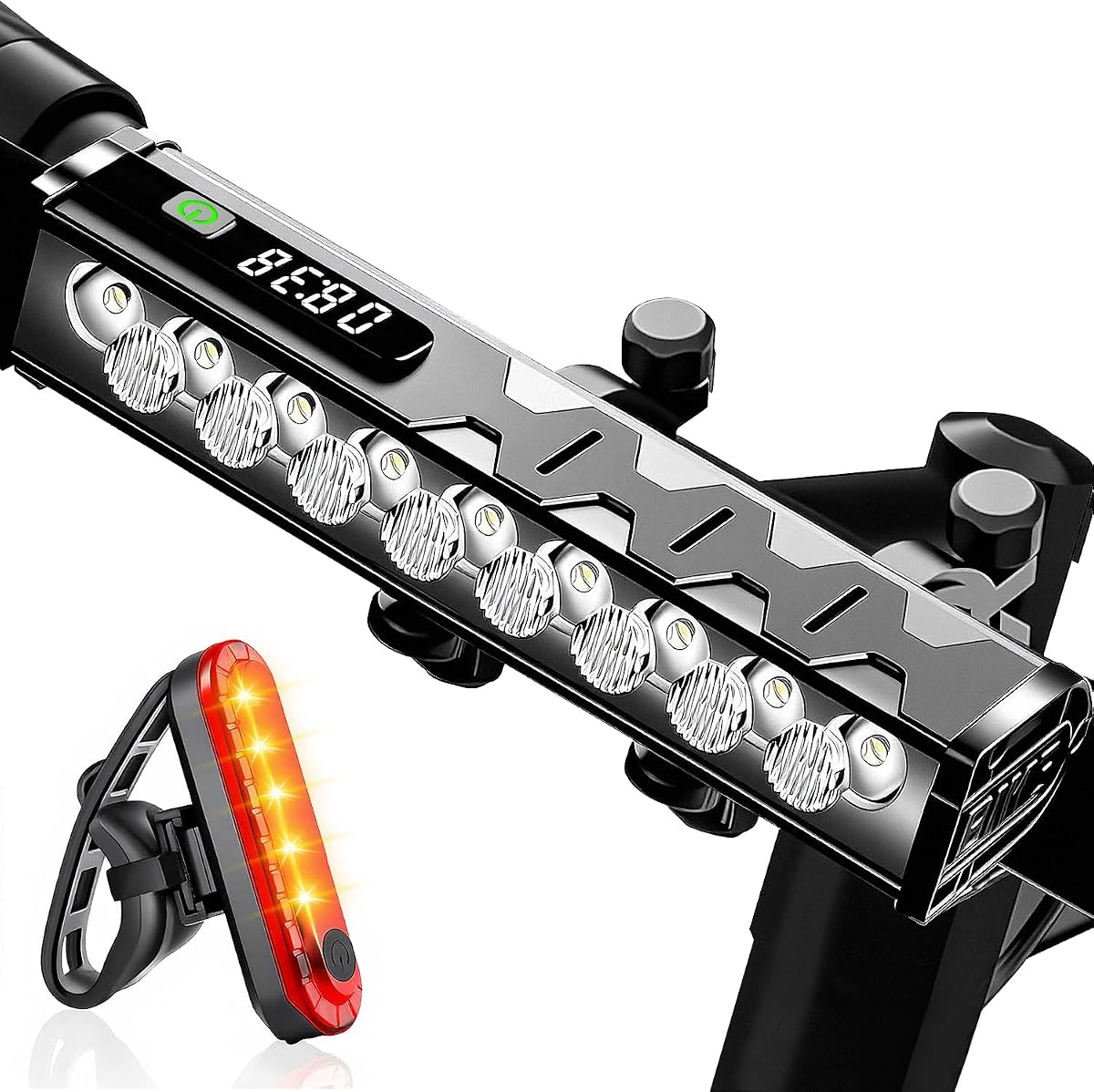
The Vastfire 17 LED system is our editor's choice for riders seeking a capable mix of output, control, and trail-friendly construction. It combines a claimed 5000-lumen headlight with a high-visibility rear light and has a supplied rating of 4.4 out of 5. Its defining features include a digital power display, USB-C input and output, four lighting modes, and an IPX7 protection rating.
We may earn a commission when you buy through this link, at no additional cost to you.
The 17-LED headlight is designed to cast a wide beam over forest trails and city roads. Floodlight, spotlight, high beam, and strobe modes cover different needs, allowing riders to choose broad awareness or a more directed throw. A built-in fast-charging chip is claimed to accelerate charging, while USB-C output allows a phone or another device to be charged during an emergency.
Mounting is a major strength. A dual-nut aluminum bracket uses silicone buffer pads to reduce movement and vibration over rough ground. The system also includes thick plastic gaskets, non-slip silicone gaskets, brackets, screws, a wrench, and a charging cable. IPX7 protection offers the highest listed water-resistance rating in this guide, making the set a sensible option in wet mountain conditions.
The package is more involved than a compact two-light set, and the stated 16-hour maximum runtime is a general figure rather than a promise for every mode. Nevertheless, the Vastfire balances several features that are rarely combined in one package: strong output, a battery percentage display, emergency charging, a damped mount, and serious weather sealing. It is our most complete choice for demanding trail riders.
The digital display provides a clear view of the remaining battery and charging progress. This makes it easier to decide when to switch to a lower mode or shorten a route before the light reaches a critical level.
Metal locking and silicone cushioning work together to limit movement on bumpy trails. The mounting hardware also includes gaskets, screws, and multiple brackets, allowing a more involved installation than a quick strap but a potentially more controlled setup.
We may earn a commission when you buy through this link, at no additional cost to you.
The AINXCDOTE 4800-Lumen set offers a balanced combination of illumination, battery information, and easy mounting. Its supplied rating is 4.4 out of 5. Unlike products that rely on a simple colored indicator, this system includes an LCD that shows remaining battery percentage, helping riders plan around a trail, commute, or overnight camping trip.
We may earn a commission when you buy through this link, at no additional cost to you.
The headlight combines low and high beams to extend range and widen coverage, with illumination extending across hundreds of meters according to the manufacturer. Low, medium, high, and rapid-flash modes cover the main riding situations. An anti-dazzle transition is designed to make switching between brightness levels smoother, which may be more comfortable during frequent mode changes.
The front light has a stated runtime of six to 10-plus hours, while the rear light can run for up to 50 hours. A sturdy nut design and upgraded aluminum mount are intended to prevent rotation and loosening over rough paths, and the quick-release knob allows fast removal. IP65 protection covers heavy rain, splashes, and impacts, though it is one step below the Vastfire's IPX7 rating.
This system is well suited to mountain biking, off-road riding, and everyday city use. It can also serve as a camping, fishing, running, or night-work light. Riders who want numerous specialized modes may prefer one of the more elaborate sets, but those who want useful battery information and a straightforward four-mode interface will find this list easier to understand.
The anti-dazzle design smooths the transition between low and high output. It is a subtle feature, but it can make repeated adjustments less distracting when a trail alternates between open sections and dense vegetation.
The front light is stated to run from six hours to more than ten, depending on the mode, and the rear light can last for 50 hours. The LCD makes those differences easier to manage because riders can check remaining power during a stop.
We may earn a commission when you buy through this link, at no additional cost to you.
The JW617 17 LED headlight is our premium pick for riders who want extended range and a large battery without the multi-LED naming conventions of the 6800-lumen option. It has a supplied rating of 4.5 out of 5. The headlight claims 4800 lumens, a 2624-foot reach in high-beam mode, and a seven-to-sixteen-hour operating range.
We may earn a commission when you buy through this link, at no additional cost to you.
Four modes—flood, spot, bright, and flashing—provide useful flexibility. Floodlighting supports general trail awareness, while a spot or bright mode can concentrate the beam farther ahead. A digital display reports battery level and usage time, and a fast-charging chip is claimed to charge the unit up to three times faster. USB-C input also allows the headlight to charge a phone or another device.
The 10000mAh battery is the most prominent specification in this guide and should appeal to riders who regularly travel beyond the reach of charging points. The dual-nut aluminum bracket includes a silicone cushion to keep the light from shifting, and it can be installed or removed without tools. IP65 protection is appropriate for wet-weather trail riding, including heavy rain and splashes.
This product does not include a rear bicycle light, so riders need a separate tail light for complete visibility. That is an important distinction from the other top picks. Even so, it is a premium headlight for mountain bikers who prioritize long range, battery capacity, exact power information, and flexible mounting over a bundled front-and-rear package.
A 10000mAh internal battery and stated seven-to-sixteen-hour runtime provide more capacity than most competing systems. This is particularly useful on extended rides where carrying a backup power source may be inconvenient.
Flood, spot, bright, and flashing modes address different trail demands. Riders can use broad light for close obstacles and a more concentrated beam for distant terrain, then switch to flashing for added visibility.
We may earn a commission when you buy through this link, at no additional cost to you.
The Suruid 1800-lumen headlight is a compact, headlight-only option intended for mountain biking, off-road cycling, commuting, and other nighttime activities. Its supplied rating is 4.4 out of 5. A multi-lamp arrangement combines low and high beams, extending the illumination range to hundreds of meters in the high-beam setting.
We may earn a commission when you buy through this link, at no additional cost to you.
Five lighting modes let the rider adapt the output to different surroundings. The low beam can be used for less demanding sections or longer outings, while the high beam provides stronger forward visibility. A USB Type-C interface simplifies recharging, and the aviation-grade anodized aluminum shell is designed to resist impacts, dissipate heat, and handle outdoor use.
The quick-release knob allows the light to be removed from the bracket in a few seconds, which is helpful for trail repairs and for carrying the light in a pack. The knob-secured aluminum bracket is intended to stay firm over rough terrain. IPX4 protection offers resistance to rain and wind, but it is the second-lowest weather rating included in this list.
The main limitation is visibility from behind because no taillight is included. Riders should pair it with a separate rear light, especially on public roads. Within that limitation, the Suruid is a good middleweight option for off-road riders who want more output than a basic commuter light without carrying a large high-capacity headlight and a complete bundled system.
The bottom quick-release knob separates the light from the bracket in seconds. That makes it easy to remove the unit at a trailhead, carry it during non-riding activities, and reposition it without loosening multiple fasteners.
The 1800-lumen claimed output and paired beam design sit below the very high-output models but remain aimed squarely at outdoor use. The low-beam option also offers a practical way to conserve energy when less illumination is needed.
We may earn a commission when you buy through this link, at no additional cost to you.
The Banral BHL-001 set delivers a practical balance of brightness, charging speed, and straightforward controls for road, mountain, and commuter bikes. Its supplied rating is 4.4 out of 5. The two-LED headlight claims up to 3000 lumens and a 500-foot beam distance, while the package includes a rear light with several red and flashing patterns.
We may earn a commission when you buy through this link, at no additional cost to you.
Both lights offer five modes. Front options include high, medium, low, fast flash, and slow flash; rear choices include steady red, red fast flash, red slow flash, white, and a combined red-and-white fast flash. A three-second long press switches the headlight off from any mode, reducing the need to cycle through every option when the light is no longer needed.
USB Type-C fast charging replenishes the front unit in three hours and the tail light in half an hour. The headlight can also serve as a power bank. Its LCD shows the battery percentage, but the stated runtime is three and a half hours at maximum brightness and 12 hours at the lowest setting. The tail light is rated for up to six hours with a 150mAh battery.
The quick-release handlebar bracket fits bars from 0.98 to 1.26 inches, while the adjustable silicone strap accommodates seatposts from 0.79 to 1.38 inches. Tool-free installation is convenient for commuters. The main trade-off is the IPX4 weather rating and relatively short high-mode runtime, making the set best suited to riders who alternate between low, medium, and flash settings.
Independent five-mode selections give the rider direct control over steady illumination, different flash rates, and rear visibility. The long-press off function is particularly useful after a ride because it avoids unnecessary mode cycling.
The front bracket covers a stated 0.98-to-1.26-inch handlebar range, and the four-slot rear strap fits 0.79-to-1.38-inch seatposts. These ranges make the set broadly usable across common mountain and commuter bicycle shapes.
We may earn a commission when you buy through this link, at no additional cost to you.
The Cuvccn set stands out for its extensive independent controls and exceptionally long stated flash-mode runtime. Its supplied rating is 4.6 out of 5. Each light combines two main LEDs with 19 surrounding auxiliary LEDs, while the front offers two sets of four modes and the tail offers two sets of six modes.
We may earn a commission when you buy through this link, at no additional cost to you.
The front contains a 1100mAh battery and the rear a 350mAh battery. In slow-flash mode, the headlight is stated to last for up to 58 hours and the tail light for 25 hours. A switch indicator flashes green when power falls below 20 percent, providing a useful low-battery warning without adding a screen. Actual runtime will be lower in the brightest steady modes.
IPX6 water resistance is among the strongest ratings in the comparison, and a silicone cover protects the USB port from moisture. Installation requires four basic steps and no tools: wrapping the buckle, positioning the bracket on the handlebar, snapping it into the appropriate hole, and orienting it horizontally or vertically. The flexible mount can accommodate different bicycle arrangements.
This set is a good recommendation for riders who spend long periods between charges, use flash modes for much of their riding, or want separate control of the front and rear. It is also useful for camping, hiking, and emergencies. The lack of an exact percentage display is the main inconvenience, but the low-power warning still helps prevent an unexpected cutoff.
Separate switches and multiple mode groups let riders configure both lights without repeatedly cycling one control. That flexibility is useful when a trail calls for a steady front beam and a flashing rear pattern at the same time.
The stated 58-hour front-light runtime in slow-flash mode substantially reduces charging frequency. Riders using high output continuously should treat that figure as a mode-specific maximum and plan more conservatively.
We may earn a commission when you buy through this link, at no additional cost to you.
The Zewdov Slim set is the most compact and portable option among these ten products. It has a supplied rating of 4.6 out of 5. The front and rear lights together weigh only 27 grams, and each housing is described as being just 1.7 centimeters thick. Riders can therefore carry them in a chest or jeans pocket without using much space.
We may earn a commission when you buy through this link, at no additional cost to you.
The included two-in-one USB cable charges both lights simultaneously in approximately one to one and a half hours. A Type-C protection port is designed to resist rainwater infiltration, while the overall light set carries an IP65 water-resistant rating. The front offers four modes, and the rear provides six, including a memory function and a non-dazzling breathing flash.
Two pairs of elastic rubber straps make installation straightforward on the front and rear of a bicycle. The system is compatible with electric scooters, strollers, and backpacks, as well as bicycles. Its appeal is portability rather than maximum illumination, and no exact battery percentage is shown. Riders must therefore balance brightness and runtime without a precise status display.
The slim set is a strong recommendation for travelers, commuters who value low weight, and anyone who wants a light that can move easily between bikes and other activities. It is less appropriate for riders seeking the long throw and broad trail coverage of the 4800- to 6800-lumen systems. Within its compact category, however, the combination of IP65 protection, quick charging, and multiple modes is persuasive.
The 1.7-centimeter thickness and 27-gram total weight are especially useful for ultralight riders, travelers, and emergency kits. The lights take up little pocket space and remain easy to carry when a bicycle is not the only intended use.
The two-in-one cable charges the front and rear lights together in roughly one to one and a half hours. This reduces preparation time and makes it easier to top up both components before a ride.
We may earn a commission when you buy through this link, at no additional cost to you.
Choosing a mountain bike light involves balancing beam usefulness, trail-bright output, usable runtime, secure placement, and protection from rain and impacts. The most important choice depends on whether the rider needs a complete visibility system, a powerful headlight, or a compact light for occasional use.
A wide flood beam helps reveal roots, rocks, branches, and the edges of a trail, while a narrower spot beam projects farther down the route. Many mountain trails require both: wide peripheral awareness and a focused view of distant turns or descents. The products in this guide offer different approaches, including combined low and high beams, flood and spot modes, 270-degree coverage, and auxiliary LED arrangements. Advertised lumen totals alone do not describe the shape, reach, or evenness of the beam, so riders should examine the mode structure and intended trail coverage as carefully as the output figure.
In short, choose broad coverage for technical trails and a focused beam for open, fast routes.
Claimed brightness ranges from 1800 lumens on the compact Suruid model to 6800 lumens on the 2026 Upgrade set, with many products clustered around 4800 to 5000 lumens. High output can reveal more of the environment, but it also consumes more energy and may create glare when directed into open terrain. A practical light offers several brightness levels so the rider can match the beam to the trail rather than using maximum output continuously.
In short, more lumens can improve reach, but controllable lower modes are more valuable than one oversized output claim.
Mountain rides can last longer than expected, especially on cold nights or routes far from a vehicle. Battery capacity and stated runtime are therefore critical, particularly for backcountry riders. The listed runtime figures differ substantially because they may describe low or flash modes rather than maximum brightness. The Cuvccn claims up to 58 hours in slow flash, the Zewdov high-lumen headlight reaches 19 hours at its lowest setting, and the JW617 pairs a 10000mAh battery with a stated seven-to-sixteen-hour range. A digital battery display provides better planning than a simple colored indicator.
In short, compare mode-specific runtimes, choose realistic usage levels, and favor a visible battery readout for long rides.
A light that shifts on the handlebar can point into the ground, illuminate the rider's shadow, or fail to show the intended path. Mountain-bike riders should favor a secure bracket with a clamp, locking fastener, or anti-rotation design. The Vastfire and JW617 use dual-nut aluminum brackets with silicone cushioning, while the Banral set uses a quick-release bracket and adjustable rear strap. Elastic straps are simpler and lighter, but fit and retention vary with handlebar diameter and vibration.
In short, test the mount on your actual bicycle and prioritize vibration control over a complicated installation when riding rough trails.
Night rides are more likely to end in rain, fog, mud, or cold water than sunny daytime rides. The water-resistance ratings in this guide range from IPX4 to IPX7. The Vastfire leads with IPX7, while the 2026 Upgrade and Cuvccn sets offer IPX6. IPX5 and IPX65 systems from Zewdov, AINXCDOTE, and JW617 also provide meaningful rain protection. IPX4-rated products may handle splashes but warrant more caution in sustained downpours. Aluminum housings add impact resistance and improve heat dissipation, but seals around the ports and buttons remain important.
In short, choose at least IPX5 for regular wet-weather trails, and inspect seals and covered charging ports before every ride.
USB-C charging has become the most convenient choice across this category. Several products also support USB output, allowing the headlight to charge a phone or another device when an emergency arises. Charge times vary from about half an hour for a small taillight to three hours for some high-output headlamps. The Zewdov slim set can charge both lights simultaneously, while the Vastfire and JW617 include fast-charging chips. Riders who travel remote routes should still carry a backup light because no charging system can prevent every depleted battery.
In short, favor USB-C, check realistic charging time, and consider phone-charging output if your rides leave you far from power.
A powerful headlight does not show drivers that a cyclist is approaching from behind. A red taillight remains important on mixed-use paths, urban roads, and trail entrances where visibility matters. Complete sets offer coordinated controls and convenient charging, while headlight-only products such as the Suruid and JW617 require a separate rear light. Look for steady red, slow flash, and fast flash options, especially if the bicycle travels near traffic. The 2026 Upgrade set also adds a reflective rear feature that can provide passive warning when its battery is depleted.
In short, a complete set is the simplest choice for full visibility, but a dedicated rear light remains necessary with any headlight-only purchase.
Controls should remain understandable while wearing gloves and operating in the dark. Some systems use straightforward one-button mode changes, while others require short presses, double presses, and long presses. A display showing battery percentage or estimated usage is especially helpful on long or unfamiliar routes. Cuvccn uses a flashing green warning below 20 percent, while the Vastfire, AINXCDOTE, JW617, and Banral products include LCD battery information. More indicators are not always better, however, and a simple interface can be safer when the rider cannot look away from the trail for long.
In short, prioritize an interface you can operate by touch and enough battery information to prevent an unplanned ride in darkness.
Begin by fully charging both lights and checking the mount on the bicycle before entering a trail. Most manufacturers recommend a complete initial charge, and several specify their own charging times. Install the headlight on a level section of handlebar with the beam aimed slightly below the rider's eyeline to reduce glare. Mount the rear light on the seatpost where it remains visible, then tighten every clamp and confirm that neither light shifts when the handlebars are moved.
On the ride, begin with a lower or medium mode and increase output when a climb, narrow descent, or obstacle-filled section requires it. Use a flash mode in areas where other trail users or vehicles are likely to be present, but remember that a flashing front beam can impair the rider's own depth perception. Carry a backup light when entering remote terrain, and treat the displayed battery level as an estimate because cold temperatures, vibration, and high output can reduce usable runtime.
After the ride, wipe mud and moisture from the housing, lens, buttons, and USB port, then dry the lights before storing them. Check that the seals are seated correctly and that the charging cover closes fully. Do not charge a wet light unless its instructions explicitly permit it. Store the battery at a moderate temperature and recharge it periodically during long periods of inactivity; some manufacturers recommend doing so if a light has remained unused for three months.
There is no single ideal lumen figure because trail conditions, speed, speed, and available modes matter as much as maximum output. Many useful systems in this guide offer approximately 3000 to 5000 lumens with lower settings for ordinary sections. Riders should look for a controllable beam and suitable runtime rather than choosing solely by the largest advertised number.
No. Maximum brightness can improve long-distance visibility, but it also drains the battery faster and may create glare in open areas. A good trail light includes low, medium, and high modes so the rider can select an appropriate output as the terrain changes. A focused long-range beam and a wide flood beam are both valuable.
Yes, a separate rear light is strongly recommended. A headlight illuminates the path ahead but does not make the cyclist visible to approaching riders or vehicles from behind. The Suruid and JW617 are headlight-only options, so buyers should add a suitable red rear light for roads, shared paths, and trail junctions.
IPX5 or higher is a sensible target for regular use in rain, mud, and trail spray. The products here range from IPX4 to IPX7, with IPX6 and IPX7 models providing the strongest listed protection. No water-resistance rating makes immersion safe, so exposed connectors should still be dried and inspected after severe weather.
Charge it fully before every ride, especially when planning a long or remote route. After use, top it up according to the manufacturer's storage instructions. If the light will remain unused for an extended period, periodic charging can help maintain battery health; two products in this guide specifically recommend recharging after three months of inactivity.
Several models support USB output and can charge a phone or another small device. The 2026 Upgrade, Vastfire, JW617, and Banral products all list emergency charging capability. This should be treated as a backup function rather than a substitute for carrying a charged phone, and the light's own runtime will be reduced while it powers another device.
Flash modes can improve how quickly other people notice you, particularly near junctions, homes, or roads. However, a rapidly changing beam may make it harder to judge depth and obstacles for the rider. Use steady low or medium output on technical sections and reserve flashing for more open or mixed-use areas when appropriate.
Choose a mount designed to resist rotation and vibration, then tighten it according to the instructions. The Vastfire and JW617 use dual-nut aluminum brackets with silicone cushioning, while the AINXCDOTE uses a locking knob and aluminum mount. Check the mount before riding and periodically inspect it after especially rough descents.
The Zewdov High Lumen set is the strongest budget-oriented all-rounder, combining 1000 lumens, a broad set of modes, IP65 protection, and front-and-rear lighting. The Vastfire 17 LED system is the editor's choice for riders who value a digital battery display, a stable damped mount, USB-C phone charging, and IPX7 protection. The JW617 stands as the premium long-range headlight, with 4800 lumens, a 10000mAh battery, and a stated seven-to-sixteen-hour runtime.
Prioritize the beam pattern and mount before maximum output. A controllable light with secure placement and realistic runtime will generally serve a trail rider better than an oversized lumens claim. Complete front-and-rear sets simplify visibility, while headlight-only products can suit riders who already own a tail light. Weather resistance, battery information, and access to a backup light remain important for backcountry routes.
Ratings, technical specifications, availability, and prices can change after this guide was prepared. Before ordering, confirm the current product listing, included accessories, charging requirements, and compatibility with the bicycle's handlebar or seatpost. That final check helps ensure the selected mountain bike light matches both the route and the rider's expectations.