
Construction Fast-Curing Anchoring Adhesive
4.2Editor score
Fast-curing polyester resin
Extra mixing nozzle included
Sleeve-compatible hollow materials
Our chemical anchors for concrete guide compares ten options for rebar, threaded rod, masonry, wet holes, fast curing, and professional use.
Chemical anchors for concrete provide a strong mechanical bond by curing around rebar, threaded rod, bolts, or other inserts inside a drilled hole. A reliable choice depends on load demands, base-material condition, cure time, applicator compatibility, and whether the hole is dry, damp, flooded, cracked, or smooth-sided.
This guide compares ten products using their stated construction, application methods, cartridge formats, curing behavior, material compatibility, and code-related features. It covers single-component and dual-cartridge epoxies, polyester resin, packaged anchor rods, a threaded chemical anchor, and a reusable reaction-filter accessory.
Each review explains the strongest use case, practical advantages, and important limitations so readers can distinguish general-purpose products from specialized systems. Ratings and product details reflect the supplied listings, while availability and prices can change over time, so confirm the current listing before purchasing.
4.2Editor score
4.5Editor score

5.0Editor score
The comparison highlights each product's anchor type, packaging, cure profile, substrate support, and most useful installation advantage, helping contractors match a chemical anchoring system to the job, equipment, and base material.





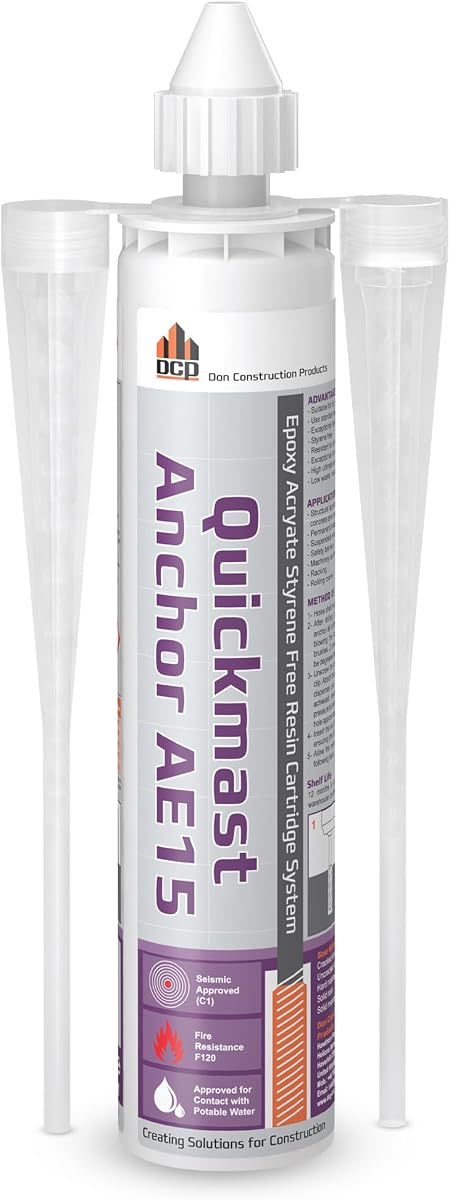
The DCP Quickmast AE15 is a two-part acrylic epoxy designed to anchor rebar, threaded rods, and other fasteners in concrete and several other solid base materials. It carries a 4.5 rating, making it one of the strongest general-purpose choices in this guide. Its defining advantage is the combination of a short working window, rapid cure potential, and suitability for dry, wet, or flooded holes.
We may earn a commission when you buy through this link, at no additional cost to you.
Installation follows a familiar cartridge workflow: drill and prepare the hole, dispense the two-part epoxy with a standard caulking gun, mix the material through the supplied nozzle, and insert the anchor. The listing gives a working time of 4 to 10 minutes, depending on conditions, so installers still need to move efficiently. Full load-bearing capacity may be reached in approximately 40 to 145 minutes depending on the base-material temperature.
The product's versatility is unusually broad. It is described for concrete, masonry, stone, and rock, with indoor and outdoor applications. That makes it useful for handrails, machinery, safety fixtures, and other embedded connections. The trade-off is that a fast-setting two-part system leaves less margin for correcting an insertion error than a slower-curing adhesive, and full loading should never be attempted before the stated temperature-dependent cure period.
Choose the AE15 when you need a responsive, high-strength adhesive without a proprietary dual-cartridge gun. It is especially attractive for repairs involving damp or water-filled holes, provided the drilled hole has been prepared correctly. Contractors seeking a simple cartridge format and strong material versatility will find this one of the most balanced options in the roundup.
The ability to work in dry, wet, and flooded concrete holes separates the AE15 from products restricted to dry substrates. This makes it relevant for repairs, renovation work, and installations where moisture cannot reliably be eliminated.
Its advertised 40-to-145-minute load window is attractive for active job sites, but temperature materially changes the result. Plan curing around the actual concrete temperature rather than assuming the fastest advertised timeline.
We may earn a commission when you buy through this link, at no additional cost to you.
This fast-curing construction adhesive is a practical chemical anchor option for concrete, brick, stone, granite, and other solid substrates. Its 4.2 rating reflects a general-purpose resin option that focuses on straightforward application, dependable bonding, and minimal equipment requirements. The included extra nozzle is especially useful when work is interrupted or multiple injection cycles are required.
We may earn a commission when you buy through this link, at no additional cost to you.
Its installation sequence is direct: drill the hole, clean it, inject the resin, and insert the fastener before curing. Unlike expansion anchors, the resin does not create expansion pressure against the hole wall, which can be helpful in sensitive base materials. For hollow block, brick, or cavity walls, however, the product needs a mesh sleeve to distribute the adhesive and support reliable anchoring.
The main limitation is that the supplied information does not provide a detailed temperature-dependent cure schedule or the same level of formal performance documentation as some professional epoxy systems. Buyers should therefore treat the product as a versatile resin choice rather than assume it carries every certification required for a specialized structural installation. Confirm the published technical data for the exact formulation before specifying it for safety-critical work.
This adhesive is well suited to general repair work, light-to-medium anchoring tasks, and installers who value speed and simple tools. Its extra nozzle and sleeve compatibility add flexibility, while the 4.2 rating keeps expectations measured. Choose it when ease of use and broad substrate support matter more than the most extensive published code information.
The additional mixing nozzle helps maintain workflow when a cartridge must be paused or a job includes repeated installations. Small operational details like this can reduce interruptions without changing the basic chemical-anchor process.
A mesh sleeve creates a defined path for the resin and fastener through hollow construction. It is a necessary accessory for the listed hollow-block, brick, and cavity-wall applications.
We may earn a commission when you buy through this link, at no additional cost to you.
Akona Fast-Setting Anchoring Epoxy is designed for anchor bolts, dowels, rebar, and fixtures in concrete and masonry. The product has a 4.4 rating and uses a convenient caulking-tube format that avoids the complexity of a large dual-cartridge system. Its listed uses include floors, walls, driveways, and stairs, providing enough scope for common residential, renovation, and light-commercial anchoring tasks.
We may earn a commission when you buy through this link, at no additional cost to you.
Chemical and solvent resistance, combined with moisture tolerance, makes the adhesive appropriate for demanding service environments. It begins setting in approximately 12 minutes and fully dries in 16 hours, giving installers a reasonable balance between manageable handling strength and a longer final cure. The gray color also helps it blend with many concrete and masonry surfaces without leaving a visually prominent repair area.
Compared with a two-part epoxy, this product may be easier to deploy for a single installation because it uses a standard-style caulking tube. The trade-off is a much longer wait for full dryness than the advertised initial set, and users should not confuse the two figures. For structural or safety-critical work, it is prudent to review the manufacturer's current technical literature and verify that the application is within its stated scope.
Akona is a sensible pick for installers who want a fast-setting epoxy without a separate dual-cartridge mixing gun. It is especially useful for repeatable smaller jobs, maintenance, and anchoring work in commonly encountered concrete surfaces. Choose it for convenience and moisture tolerance, and schedule the final load only after the complete curing period.
The caulking-tube format is approachable for maintenance crews and homeowners completing occasional anchoring tasks. It also simplifies storage and dispensing compared with a bulk two-part epoxy package.
The listing specifically highlights resistance to chemicals and solvents, making the epoxy relevant where an ordinary cementitious adhesive could be vulnerable to exposure from cleaning agents, oils, or workshop chemicals.
We may earn a commission when you buy through this link, at no additional cost to you.
The Fischer FIS A Anchor Rod M8 x 130 is a ten-pack of ready-made threaded rods designed for use with the Fischer FIS A chemical anchoring system. It has the highest listed rating in the roundup at 5.0. The product is not an adhesive cartridge by itself, but a compatible anchoring component that can simplify projects requiring several identical M8 anchors.
We may earn a commission when you buy through this link, at no additional cost to you.
The primary benefit is standardization. Each rod measures 130 millimeters and uses an M8 thread, allowing installers to plan hole and embedment details around a consistent component. The ten-rod format is useful for equipment bases, framing connections, brackets, and other layouts that call for multiple matching anchors rather than a single isolated insertion.
Because the listing provides no resin details, buyers must select or confirm a compatible Fischer FIS A adhesive and follow the complete system's installation requirements. A packaged rod cannot substitute for design data concerning embedment depth, edge distance, cracked concrete, temperature, or load capacity. It is also less flexible than loose threaded rod when an unusual length or diameter is required.
This M8 rod pack is an attractive choice for contractors already using the Fischer FIS A platform or planning a repeatable installation with ten matching anchors. Its 5.0 rating is encouraging, but the complete assembly matters more than the rod rating alone. Verify resin compatibility, dimensions, and engineering requirements before using it on a critical connection.
A ten-pack is efficient when a project uses the same M8 size across several connection points. It also reduces the need to cut and thread individual pieces of rod on site.
These rods are identified as part of the FIS A system, so the adhesive and installation instructions should be treated as a matched package. Confirm the current Fischer technical data before pairing components.
We may earn a commission when you buy through this link, at no additional cost to you.
SIKA AnchorFix-2 is a professional-strength epoxy for threaded bars in uncracked concrete, solid masonry, steel, and other hard materials. Its supplied rating is 4.1, but the product includes several features relevant to professional installations: a narrow dispensing tip, a static mixer, solvent- and styrene-free formulation, and certification for use in drinking-water systems.
We may earn a commission when you buy through this link, at no additional cost to you.
The cartridge is designed to fit most applicator guns. Installation begins by cutting the cartridge tip, attaching the static mixer, and placing the cartridge in the gun. Its narrow outlet supports accurate placement of epoxy in the drilled hole, which can reduce waste and help the resin surround the intended anchor.
Preparation is the decisive issue. The listing specifically instructs installers to use a blow pump and bristle brush to remove dust and debris after drilling. Failure to clean the hole can undermine bond strength regardless of the cartridge's quality. The stated material scope also centers on uncracked concrete and solid substrates, so it should not be substituted for a product explicitly approved for cracked concrete without supporting documentation.
AnchorFix-2 is well matched to professional installers who value controlled dispensing, recognized performance characteristics, and a low-solvent epoxy. It is particularly relevant where a threaded bar must be set in steel or masonry and where drinking-water-system certification may influence material selection. Verify project-specific design requirements before installation.
The narrow cartridge tip and static mixer make it easier to place resin consistently without manually blending it. Proper nozzle attachment and dispensing discipline are essential to achieving a uniform installation.
The product listing emphasizes using a blow pump and bristle brush. A clean, correctly sized hole gives the epoxy the surface contact and space needed to form a dependable bond around the bar.
We may earn a commission when you buy through this link, at no additional cost to you.
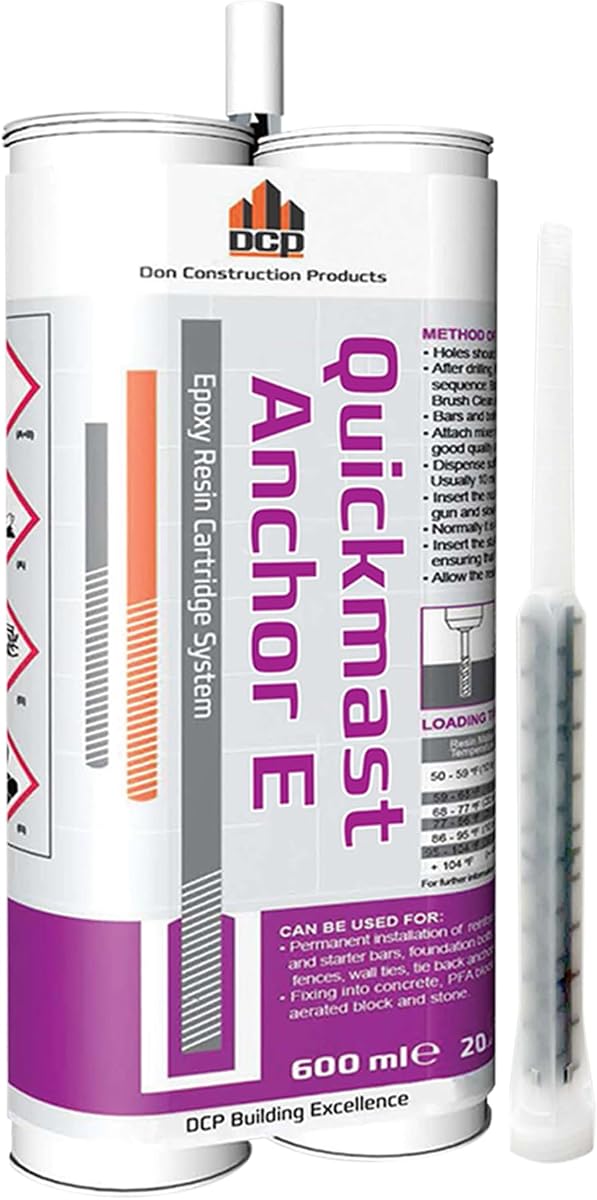
DCP Quickmast Anchor E is a 20.2-fl-oz dual-cartridge epoxy intended for demanding anchor installations ranging from handrails and safety fences to railway-track and ground-anchor applications. It has a 4.7 rating, making it one of the most highly rated products in the guide. Its list of uses is broad, but the dependable working time and temperature-sensitive cure profile are the central features.
We may earn a commission when you buy through this link, at no additional cost to you.
After dispensing, the resin provides 3 to 20 minutes to position rebar or threaded rod. Full loading may take 3 to 24 hours depending on the base-material temperature. This combination offers useful installation flexibility while still allowing a relatively quick transition to the next task under favorable conditions. The adhesive can be applied in dry and damp concrete holes and bonds to both concrete and steel.
Its format requires a standard dual-cartridge application gun, which is more equipment than a caulking-tube adhesive demands. That setup is an investment but can be worthwhile for a contractor doing repeated professional installations. The broad load claims should be understood as application potential rather than a guarantee: anchor diameter, embedment, hole condition, concrete condition, and spacing all influence actual performance.
Quickmast Anchor E is a strong general pick for installers who want a high-rated two-part epoxy, manageable working time, and suitability for damp conditions. It is well suited to rebar and threaded-rod work where a standard dual-cartridge gun is already available. Review the current technical data for cracked-concrete applications and design-critical loads before specifying it.
The stated 3-to-20-minute range gives installers a defined period to insert the anchor. Although it can be brief at the lower end, it is long enough to complete a standard sequence when hole preparation and equipment are ready.
The listing positions the epoxy for both everyday connections and heavier applications. Actual suitability still depends on the governing engineering data, concrete quality, installation geometry, and the anchor being used.
We may earn a commission when you buy through this link, at no additional cost to you.
The Quickmast E two-part system is the most complete package in the guide, pairing 20.2-fl-oz anchoring epoxy cartridges with a dedicated applicator gun. It holds a 5.0 rating and is designed for rebar and threaded rods in concrete, with a listed 3-to-20-minute working window. The included tool is a major convenience for buyers who do not already own suitable dispensing equipment.
We may earn a commission when you buy through this link, at no additional cost to you.
Its 25:1 thrust-ratio gun is intended to deliver a smooth, controlled flow with less mess and better accuracy than a basic manual applicator. The gun accommodates 20.2-fl-oz and 22-fl-oz cartridges at a 1:1 mix ratio, adding some equipment flexibility. The epoxy can be used in dry and damp concrete holes and forms a strong bond to concrete and steel.
As a substantial two-part package, it is less attractive for a single small installation. The paired cartridges also mean users should consider storage, shelf life, and the likelihood of using the second container. None of this undermines the system's advantages, but it clarifies that the package is aimed at frequent installers and serious project work rather than occasional household repairs.
Choose this system when you want the resin and a purpose-built gun together and expect multiple anchors. It combines a top rating, a reasonable working window, damp-hole capability, and a premium dispensing tool. For smaller jobs, a standard caulking-gun adhesive may be the more efficient choice, while for repeated professional anchoring this package offers strong convenience.
The 25:1 thrust ratio supports smoother material flow and more consistent placement. Including the gun removes the need to source and verify a separate applicator before the first installation.
The paired-cartridge format and included gun are most useful for a contractor or installer performing several anchor placements. The equipment becomes part of the workflow rather than a disposable accessory.
We may earn a commission when you buy through this link, at no additional cost to you.
The internal-threaded epoxy anchor is a compact, zinc-plated steel insert designed for concrete anchoring in vibration-prone and space-constrained applications. Its listing identifies theater and stadium seating, machinery, conveyor belts, material handling, and ductwork as potential uses. The internal thread allows a bolt to be removed while the chemical anchor remains embedded in the base.
We may earn a commission when you buy through this link, at no additional cost to you.
The anchor measures 2-3/4 inches long with a 5/16-18 thread, 5/16-inch rod diameter, and 2-5/8-inch minimum embedment. The stated minimum hole depth is 2-3/4 inches, and the listed ultimate tension in 4,000-psi concrete is 7,272 pounds. These dimensions make advance planning possible when a project has tight geometric constraints.
The listing also identifies the anchor as better suited than some mechanical alternatives for close-edge or close-installation conditions and as vibration resistant. Those attributes make it relevant to equipment and dynamic applications. However, the supplied data does not provide a customer rating, installation resin compatibility, or complete code documentation, so engineers and installers should obtain current technical documentation before relying on it in a critical design.
This is the most specialized choice in the roundup. Choose it when an internal-threaded, removable connection is specifically required and the listed dimensions match the available base material. Its compact zinc-plated steel construction and vibration-focused features distinguish it from bulk epoxy cartridges, while the lack of a listing rating warrants extra due diligence.
The internal 5/16-18 thread allows an external bolt or component to be removed from the installed insert. This is useful where equipment may need to move while the anchor remains in concrete.
The listing highlights close-edge and close-installation use. These applications still depend on correct embedment, hole preparation, resin selection, and compliance with the manufacturer's installation instructions.
We may earn a commission when you buy through this link, at no additional cost to you.
The Fischer Reaction Filters RSB 12 Mini is a specialized accessory for the Fischer reaction mortar system. With a 4.4 rating, it stands out for a different reason than the other picks: rather than being a cartridge or packaged anchor, it uses two mortar cartridges to increase load capacity and can reduce the number of required attachment points.
We may earn a commission when you buy through this link, at no additional cost to you.
The product is identified as ideal for filled drilled holes and overhead installation. Its economical placement can be valuable in large projects where reducing the number of individual anchors improves efficiency, provided the system's technical data supports that layout. The listed processing capability down to -30°C is another notable feature for cold-weather work.
This filter should not be confused with a complete chemical anchor by itself. It needs compatible mortar cartridges, the correct drilled-hole dimensions, and installation methods defined for the Reaction system. Overhead use also places extra importance on correct dispensing, insertion, and temporary support. The compact RSB 12 designation and the product's specialized purpose mean installers should consult system documentation rather than improvise a connection.
The RSB 12 Mini is a good fit for trained installers working with Fischer reaction mortar, particularly on overhead or high-load layouts where the filter design can improve efficiency. It is not a first-time-user purchase unless the entire system and its documentation are already available. Confirm compatibility and current low-temperature limitations before incorporating it into a project plan.
Using two mortar cartridges can increase the load level of an installation and potentially reduce how many separate points are needed. Any change to the attachment layout must follow the system's published design information.
The product is specifically identified for overhead mounting and processing at temperatures down to -30°C. Both scenarios require strict adherence to the manufacturer's handling and placement procedure.
We may earn a commission when you buy through this link, at no additional cost to you.
PC-Concrete PRO is a professional-grade, two-component anchoring epoxy designed for cracked and uncracked concrete. Its 4.3 rating reflects a technically oriented product with an extensive compliance listing. It can anchor threaded rod and reinforcing bar into cracked concrete, and threaded rod into uncracked concrete drilled with a core drill.
We may earn a commission when you buy through this link, at no additional cost to you.
One of its most useful distinctions is the ability to be used in smooth-bore holes without roughing the interior walls, as noted in the product information. It can also be applied in dry, water-saturated, and water-filled conditions when used with threaded rod or rebar. Those features make it relevant to infrastructure, repair, and professional construction environments where hole conditions vary.
The listing cites IAPMO UES ER-632, several editions of IBC and IRC, Florida Building Code editions, AASHTO M235, and ASTM C881-15 classifications. These references broaden its documented use potential, but installers should confirm the current edition, exact product variant, installation parameters, and jurisdictional acceptance for their particular project. The listed compliance is meaningful, but it is not a substitute for current technical review.
Concrete PRO is a strong choice for contractors working with cracked concrete, water-filled holes, or smooth-bore installations. It requires a standard high-thrust caulking gun or a 600 ml dual-cartridge gun. Choose it when code documentation and broad site-condition support are priorities, and verify the full published data before installation.
Many general-purpose anchoring adhesives are limited to uncracked concrete. Concrete PRO is specifically described for cracked and uncracked base material, making its supporting documentation especially relevant to structural and infrastructure work.
The epoxy can be used in smooth-bore holes without roughing the walls and in dry, saturated, or water-filled concrete. These capabilities reduce some installation constraints, although anchor type and project requirements still govern suitability.
We may earn a commission when you buy through this link, at no additional cost to you.
The right chemical anchor depends less on the product name than on the insert, base material, hole condition, load requirements, curing environment, and applicator equipment available on the job.
Start with the expected tensile, shear, and combined loads, including any dynamic or vibration effects. The listing's references to handrails, safety fences, machinery, railway tracks, and ground anchors describe potential applications, but they do not replace engineering calculations. Anchor diameter, embedment depth, concrete strength, hole diameter, edge distance, and spacing can all change the usable load. Consult the product's current technical data and any governing design requirements before using a general-purpose adhesive for a critical connection.
Some adhesives are designed only for sound, uncracked concrete, while others explicitly support cracked concrete. Dry, damp, saturated, flooded, smooth-bore, and roughened holes can also be treated differently. Select a product that expressly covers the actual condition and use the prescribed hole diameter, cleaning method, and preparation sequence. When the base material is unknown or visibly deteriorated, corrective work and engineering review may be more appropriate than simply changing cartridge brands.
Initial set, working time, and full-load time are different measurements. A resin may feel firm quickly while still lacking full design strength, and many epoxies cure more slowly as concrete temperature falls. Review the temperature-dependent cure chart for the expected site conditions. If a handrail, equipment guard, or other safety-critical element must be loaded soon after installation, allow the full stated cure period or select a product with a documented schedule suited to the job.
Single-component caulking-tube products are convenient for small jobs and installers with basic dispensing tools. Dual-cartridge epoxies require a suitable mixing gun, but they can provide more consistent resin mixing and are common in professional workflows. Some packages include the applicator, while others require separate equipment. Check cartridge volume, gun compatibility, mix ratio, nozzle design, storage requirements, and whether the entire package quantity will be used before making a selection.
A strong cartridge cannot compensate for an unsuitable anchor. Determine whether the installation calls for rebar, threaded rod, an internally threaded insert, a smooth anchor rod, or another engineered component. The Fischer M8 pack is limited by its fixed diameter and length, while the 5/16-18 internal-threaded anchor serves a different connection need. Match the insert's material, diameter, length, thread, and embedment requirements to the product's published installation parameters.
For residential permits, public work, transportation projects, or other regulated installations, documentation may be as important as the physical bond. Some products in this guide cite specific evaluation reports, building-code editions, ASTM classifications, drinking-water certification, or suitability for cracked concrete. Standards can be revised or withdrawn, and a listing may cover only certain embedment depths or installation methods. Verify the exact certificate, current revision, and local acceptance for the intended application.
Temperature, moisture, hole orientation, access, and cure conditions shape the product that works best. Overhead installations benefit from a system designed for that orientation and may need temporary support until the adhesive develops handling strength. Cold environments can extend cure times substantially, while high temperatures may shorten working time. The RSB 12 Mini filter, for example, is highlighted for overhead use and processing down to -30°C, while several cartridges emphasize rapid or temperature-dependent curing.
Small details can determine whether an installation is efficient. A caulking gun, static mixer, extra nozzle, mesh sleeve, blow pump, and bristle brush may all be necessary depending on the product and hole. A package that includes an extra nozzle or gun can reduce interruptions, while a sleeve is specifically required for the listed hollow-material applications with the polyester adhesive. Think through waste, nozzle changes, cleanup, and storage, especially with dual-component epoxy that cannot easily be reused once mixed.
Begin by identifying the anchor insert, required embedment, hole diameter, base-material condition, and governing product instructions. Drill the correct number and geometry of holes, then clean each hole using the prescribed method. Blowing out dust and brushing the walls are explicitly emphasized for some epoxy systems, while other products may permit a different procedure. A clean, correctly prepared hole is essential because dust and loose material can prevent the resin from contacting the concrete surface.
Position the anchor for the required embedment and make sure it can be inserted without damaging the resin bond. Fit the correct mixing nozzle, dispense the required amount into the hole, and insert the anchor promptly within the stated working time. Avoid excessive rotation or movement that could create voids or keep resin from fully surrounding the insert. For overhead work, support the assembly until the adhesive reaches the handling strength required by its instructions.
Let the anchor cure without disturbing it for the full period appropriate to the base-material temperature. Do not treat an initial set as permission to apply the full design load. Remove temporary supports only when the manufacturer permits, inspect the finished installation for visible gaps or incomplete resin coverage, and record the product, lot information, hole details, and cure conditions when documentation is required for future maintenance.
There is no single strongest type for every application. Performance depends on the epoxy or resin formulation, anchor diameter, embedment, concrete strength, cracking, hole preparation, and applied load. A high-strength professional epoxy may be appropriate for critical work, but it must still be installed according to its documentation and used within its stated base-material and load limits.
Yes, but only with an adhesive that explicitly permits the condition. The DCP Quickmast AE15 is listed for dry, wet, and flooded holes, while PC-Concrete PRO supports dry, water-saturated, and water-filled conditions with the specified inserts. Follow the exact preparation and installation instructions because standing water, debris, and inadequate cleaning can interfere with the bond.
A mechanical expansion anchor is not required when a properly designed chemical anchor is used. The resin cures around the rebar or rod and forms the connection to the concrete. An optional mesh sleeve is needed for certain hollow-material applications with the listed polyester adhesive, but that sleeve is a support accessory rather than a substitute for chemical bonding.
Use the full-load time published for the exact product and base-material temperature. The AE15 is advertised as reaching full load-bearing capacity in approximately 40 to 145 minutes, while the 20.2-fl-oz DCP system lists 3 to 24 hours. These ranges are product-specific, and an initial set should never be treated as full design strength.
Many epoxy cartridges are designed for both rebar and threaded rod, including the DCP Quickmast AE15, DCP Quickmast Anchor E, Quickmast E, and PC-Concrete PRO. Confirm the exact insert type, diameter, embedment, and material before installation. Some packaged products are narrowly sized or formatted, such as the Fischer M8 rod pack.
A two-part epoxy generally requires a dual-cartridge gun that mixes the resin and hardener as they are dispensed. The PC-Concrete PRO listing accepts a high-thrust standard-size caulking gun or a 600 ml dual-cartridge gun, while the Quickmast E package includes a 25:1 gun. Confirm cartridge volume and mix ratio before purchasing an applicator.
Only products specifically approved for cracked concrete should be used in that condition. PC-Concrete PRO is explicitly described for cracked and uncracked concrete and carries several listed code references. Products limited to uncracked concrete may still be used in sound structures, but their approval does not automatically extend to a cracked base material.
Prepare the hole exactly as the adhesive manufacturer specifies. This commonly includes drilling to the correct diameter and depth, removing loose dust with a blow pump, and brushing the hole walls with a bristle brush. The SIKA listing explicitly calls for both tools. Hole cleanliness, diameter, and depth directly affect resin coverage and anchor performance.
The DCP Quickmast AE15 stands out as the most versatile editorial pick, combining a convenient caulking-gun format with a rapid cure, strong material compatibility, and support for flooded holes. The Construction Fast-Curing Anchoring Adhesive is a practical budget-oriented option for general materials and sleeve-supported hollow applications, while the Quickmast E two-part package is the premium choice for crews seeking a complete, high-rated setup with a dedicated gun.
Prioritize the conditions that control installation success: base-material cracking, moisture, hole preparation, insert compatibility, working time, and temperature-dependent cure. Also consider the scope of the required load and whether the product's documentation supports cracked concrete, regulated work, or specialized equipment applications. The right cartridge is the one whose documented conditions match the actual job rather than merely the one with the broadest advertised application list.
Finally, confirm the current listing, technical data, certifications, applicator accessories, and project requirements before ordering. Chemical anchor formulations, availability, and compliance information can change, and prices also fluctuate over time. Comparing the current product details against the intended installation is the safest way to select a chemical anchor for concrete.