
Mcbazel 3-in-1
4.5Editor score
Three simultaneous measurements
Five wind-speed units
Backlit double-line display
Explore the best anemometer for measuring wind speed, comparing accuracy, units, displays, extra sensors, portability, and outdoor usefulness.
An anemometer for measuring wind speed can reveal the conditions that affect sailing, drone flights, shooting, HVAC work, fishing, kite flying, and outdoor planning. A useful model should be accurate, readable, portable, and suited to the type of airflow you need to examine, from gentle indoor air movement to stronger outdoor gusts.
This guide compares ten handheld anemometers using their published specifications and listed features. The comparison covers measurement ranges, available wind-speed units, temperature or humidity sensors, backlighting, data-hold options, mounting features, power requirements, and intended applications, helping readers identify a practical model without relying on vague marketing claims.
Each pick highlights a different balance of features, from a budget three-in-one meter to models with large displays, data logging, or protective design. Ratings reflect the available customer feedback rather than personal testing, and specifications may vary by revision. Product availability and prices change, so check the current listing before buying.
4.5Editor score

4.5Editor score

4.5Editor score
The table below compares all ten handheld meters by their measurement capabilities, display functions, environmental readings, and practical portability features.


The BTMETER BT-100 combines wind speed, wind temperature, and calculated wind chill in a compact handheld format, earning a 4.5 customer rating. Its standout quality is the breadth of practical functions: five wind-speed units, a backlit display, maximum, minimum, and average readings, low-battery indication, and both manual and automatic shutdown options. That makes it more versatile than a basic meter limited to a single unit or reading.
We may earn a commission when you buy through this link, at no additional cost to you.
The listed wind-speed range is 0.67 to 67.1 mph, with a stated accuracy of plus or minus 2 percent of readings. Resolution is 0.1 m/s, while the temperature range extends from 14℉ to 113℉. Two temperature sensors and eight vanes are intended to improve sensitivity, particularly when checking low airflow around HVAC vents and ducts. The unit can display speed in m/s, km/h, ft/min, knots, or mph, so it fits both metric and imperial workflows.
Its most valuable extra is the metal threaded tripod hole. This allows the meter to remain in one position during continuous readings, which is helpful when monitoring conditions while operating a drone, flying an RC aircraft, sailing, shooting, or testing airflow. A CFM calculation reminder is also included: airflow in CFM equals wind speed multiplied by the duct's cross-sectional area. This is a guide rather than a direct airflow-volume function, so accurate duct dimensions and appropriate unit conversions remain important.
The BT-100 is a strong all-around choice for readers who want more than wind speed without moving to a large instrument. It is less suitable for anyone who needs humidity, USB logging, or a color-coded danger alarm. Even so, the tripod mount, wide unit selection, temperature sensing, and comfortable accessory set make it the most complete general-purpose option in this guide for a wide range of outdoor and indoor tasks.
The tripod connection is a meaningful advantage for activities that involve waiting, recording, or comparing changing wind conditions. It supports hands-free placement and reduces the chance of handheld movement affecting a reading.
With five speed units and a published CFM formula, the BT-100 is particularly useful for basic HVAC and duct checks. Users should still account for duct area and ensure readings are taken consistently.
We may earn a commission when you buy through this link, at no additional cost to you.
The Mcbazel 3-in-1 offers an unusually complete basic package for buyers who want wind speed, temperature, and Beaufort wind level without moving to a more specialized meter. It carries a 4.5 rating, and its defining benefit is simplicity: the double-line LCD shows wind speed and temperature together, while a separate Beaufort-scale indication gives a quick interpretation of conditions. A backlight improves readability in dim locations.
We may earn a commission when you buy through this link, at no additional cost to you.
Five wind-speed units are available: m/s, km/h, knots, ft/s, and mph. Maximum, minimum, average, and data-hold functions allow a user to preserve a relevant value rather than trying to memorize a changing display. The listed low-battery indicator and automatic power-off function are useful for intermittent field use, and the lightweight housing is designed for one-handed operation and easy carrying.
The main trade-off is that the package does not include AAA batteries, so users need to supply their own before use. It also lacks a humidity sensor, tripod mount, and data export. The listed description does not provide the same detailed accuracy or range figures found on some competing models, making it important for precise technical work to consult the current product documentation and manufacturer specifications.
For casual boating, fishing, HVAC spot checks, home ventilation assessment, and general outdoor use, the Mcbazel is a compelling value. It is especially attractive to beginners because it turns the numerical wind-speed reading into a more understandable Beaufort level. For professional long-term monitoring or field data collection, a model with defined accuracy specifications, mounting support, or USB output may be a better fit.
The double-line screen presents speed and temperature simultaneously, reducing the need to cycle through menus. This makes the Mcbazel convenient for quick checks where observations matter more than detailed data management.
The Beaufort scale provides a familiar reference for wind strength. It is helpful for casual users, although the numerical unit remains important for applications that require a precise measurement.
We may earn a commission when you buy through this link, at no additional cost to you.
The TopTes TS-301 stands out for its 2.26-inch backlit LCD, a noticeably large screen for a handheld wind meter. It has a 4.5 rating and combines wind speed with temperature and relative humidity readings. That extra humidity capability gives it a more complete environmental profile than most compact units, while the large display makes it easier to check readings while wearing gloves or holding other equipment.
We may earn a commission when you buy through this link, at no additional cost to you.
Six wind-speed units are offered: feet per minute, feet per second, miles per hour, knots, kilometers per hour, and meters per second. The specification notes that wind velocity is displayed with a multiplication of ten in the relevant mode, a detail buyers should verify when interpreting the screen. Relative humidity is listed from 0.0 to 99.9 percent RH, and temperature from -4℉ to 140℉.
A key honest consideration is sensor stabilization. The product information states that the temperature and humidity sensors may require at least 30 minutes to adjust to a new environment. This is important when moving between indoor and outdoor locations or between substantially different temperatures. Waiting for stabilization helps avoid treating a transitional reading as a stable environmental value.
The TS-301 is a strong premium pick for sailors, surfers, drone and RC pilots, golfers, shooters, hikers, and HVAC users who appreciate a large screen. Batteries, a manual, and a carry pouch are included, and the unit shuts down after ten minutes of inactivity. It is a better fit than a minimalist meter when humidity and display size matter, though it does not provide USB data transfer or a tripod connection.
The 2.26-inch illuminated screen improves visibility in low light and during active outdoor use. Its large format is especially helpful when the meter is carried in one hand while the other hand is occupied.
Temperature and humidity readings complement the wind-speed value, offering useful context for sailing, shooting, hiking, and indoor airflow checks. Allow the sensors time to stabilize after environmental changes.
We may earn a commission when you buy through this link, at no additional cost to you.
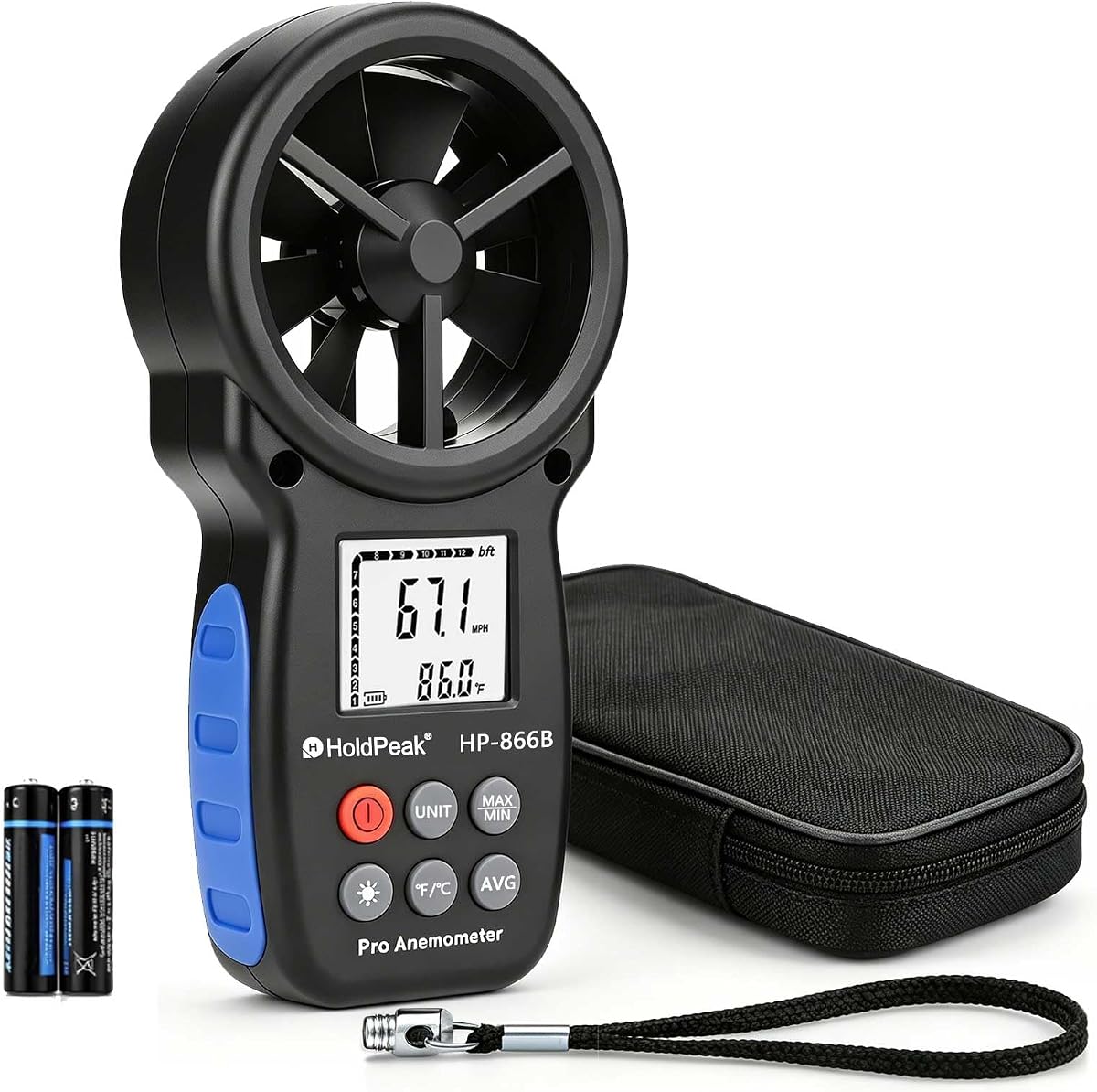
The HoldPeak 866B is a well-rounded handheld meter with a 4.5 rating and a specification profile similar to the BTMETER BT-100. It measures wind speed from 0.67 to 67.1 mph, wind temperature, and wind chill, while offering maximum, minimum, and average wind-speed modes. The stated wind-speed accuracy is plus or minus 2 percent of readings, which gives users a clearer basis for judging its suitability.
We may earn a commission when you buy through this link, at no additional cost to you.
Five speed units are supported: m/s, km/h, ft/min, knots, and mph. Temperature can be shown in Celsius or Fahrenheit. The product also includes a battery-level display, automatic shutdown, and a backlight. These features make it useful in the field and for checking indoor ventilation, where changing readings may need to be recorded or compared.
The included triangular bracket and threaded mounting point allow the anemometer to remain stationary. A hand strap reduces the chance of dropping it, and the carrying pouch offers storage and weather protection. These physical accessories make the HoldPeak particularly well suited to activities such as sailing, boating, kite flying, drone operation, golf, and shooting, as well as HVAC installation and duct-vent checks.
Its trade-offs are the absence of humidity sensing and USB data transfer. The CFM feature is also based on multiplying wind speed by duct cross-sectional area rather than directly measuring complete airflow volume. The HoldPeak is best for users who want flexible readings, strong accessory support, and tripod monitoring, particularly if electronic data logging is not essential.
The hand strap, bracket, batteries, screwdriver, and carrying pouch create a ready-to-use kit. These details are useful when the meter will be used away from a workbench or protected from moisture during storage.
The published CFM formula can help estimate airflow from measured velocity and known duct area. It remains a calculation-based aid rather than a substitute for a dedicated volumetric flow instrument.
We may earn a commission when you buy through this link, at no additional cost to you.
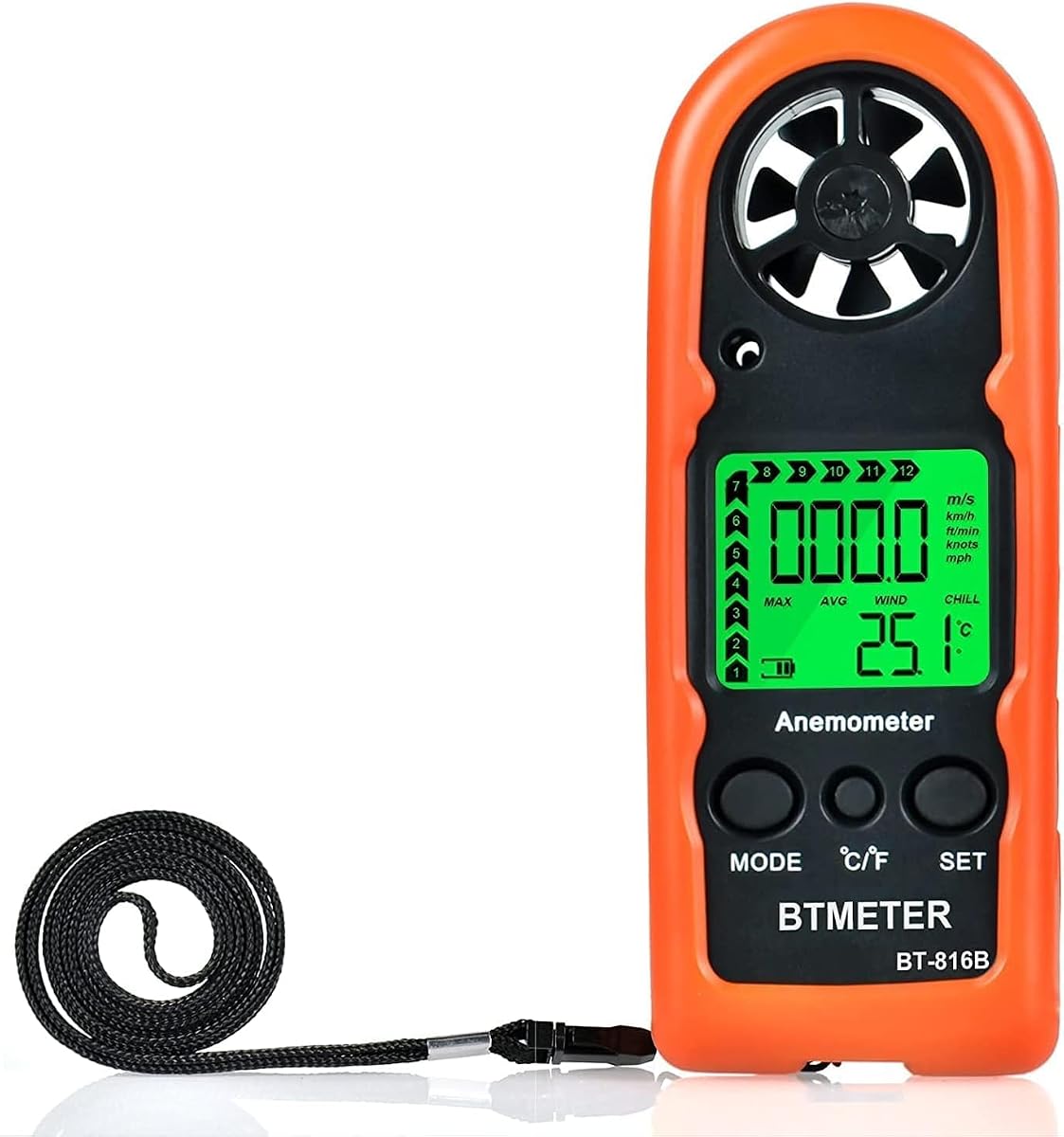
The BTMETER BT-816B is built for portable handheld use, with listed dimensions of 114 by 40 by 18 millimeters and a weight of 53 grams. Its 4.3 rating reflects solid general performance, and it provides wind speed, temperature, and wind chill in a straightforward one-handed design. The compact body is easy to place in a pocket or small outdoor bag.
We may earn a commission when you buy through this link, at no additional cost to you.
Its seven-blade fan and temperature sensor support measurements from 0.3 to 30 m/s, or 59 to 5905 ft/min, with a stated tolerance of plus or minus 5 percent of reading. Wind speed can be shown in m/s, ft/min, knots, km/h, or mph. Current, maximum, and average modes are included, while Celsius and Fahrenheit can be switched for temperature.
The BT-816B also has manual and automatic power-off choices, a low-battery indicator, and a backlit digital display. Wind chill combines temperature and speed into a relevant reading for cold-weather planning. The product is suited to shooting, sailing, mountain climbing, HVAC appliances, electrical-equipment testing, navigation research, and aerial survey, although its stated accuracy is less tight than the plus or minus 2 percent figure published for some other picks.
This is a good choice for readers who prioritize compactness and broad outdoor utility over data logging or elaborate displays. The included lanyard improves security, and the manufacturer lists professional technical support. Buyers wanting formal humidity measurement, USB records, or a tripod setup may need a different model, but for a lightweight field meter with five units and multiple readout modes, the BT-816B is well equipped.
At 53 grams and less than two inches wide, the BT-816B is easy to hold for extended periods. Its compact dimensions make it convenient for hiking, boating, climbing, and equipment checks.
Current, maximum, and average modes help users examine both momentary and retained readings. This is useful when checking whether a short gust represents the prevailing wind.
We may earn a commission when you buy through this link, at no additional cost to you.
The Soonkoda 3-in-1 combines wind speed, wind temperature, and wind level in an affordable handheld format. It has a 4.3 rating and follows the same basic concept as the Mcbazel: the display provides numerical speed, temperature, and a Beaufort-scale interpretation, giving casual users both measured and descriptive information.
We may earn a commission when you buy through this link, at no additional cost to you.
Its listed wind-speed range begins at 0.06 m/s and extends to 30.0 m/s. Five units are offered: m/s, km/h, knots, ft/s, and mph. Temperature can be switched between Celsius and Fahrenheit, while the Beaufort scale runs from 1 to 12. This mix of low-end sensitivity and multiple units makes the meter relevant to indoor ventilation as well as boating, surfing, fishing, shooting, and model-aircraft work.
MAX, MIN, AVG, DATA HOLD, backlight, automatic power-off, and a low-battery indicator provide a useful set of everyday controls. The liquid-crystal double-line display shows wind speed and temperature simultaneously, which is convenient for comparing changing conditions without cycling through a menu. The broad application list also includes electric power, steel, petrochemical, aviation, fan manufacturing, duct ventilation, and underground warehouses.
The principal limitation is the absence of a stated accuracy figure in the supplied information. That matters when deciding between nearly identical budget meters, because low airflow readings can be sensitive to sensor design, obstruction, and technique. The Soonkoda is a reasonable pick for general use and accessible three-way measurements, but technical buyers should prioritize a manufacturer that publishes a clear accuracy specification.
The published minimum of 0.06 m/s is useful for light indoor airflow checks. Consistent technique and an unobstructed sensor remain important when comparing low-speed readings.
The 1–12 wind-level scale gives the numerical reading a more accessible context. It is useful for quick outdoor assessments, while professional users can focus on the exact unit and value.
We may earn a commission when you buy through this link, at no additional cost to you.
The POROMETISTO AEM01S is distinctive because its backlight changes color with the measured wind level. It has a 4.5 rating and is aimed at users who need an immediate visual indication of safe, caution, and danger conditions. Green covers levels 0 through 4, orange covers levels 5 through 7, and red indicates level 8 or above.
We may earn a commission when you buy through this link, at no additional cost to you.
The specified wind-speed range is 0.70 to 30.00 m/s. Accuracy is stated as plus or minus 0.7 m/s below 1.00 m/s and plus or minus 2.0 percent plus 0.5 m/s from 1.00 to 30.00 m/s. Sampling occurs every 0.5 seconds, and the screen displays wind speed and wind level together. That combination of quantified accuracy and rapid updates is particularly appealing for drone flying and other activities where conditions can change quickly.
Six units are available: m/s, km/h, ft/s, ft/min, mph, and knots. A short press of HOLD freezes the current reading, while a long press activates the backlight. Long-pressing MAX records the maximum wind speed. Automatic shutdown after ten minutes of inactivity helps preserve battery power, and a low-battery icon provides a clear reminder.
The tradeoff is that this is focused on wind speed and level rather than a full weather station. It does not list temperature or humidity sensors, so users needing those environmental readings should consider another model. Even so, the AEM01S is a compelling option for drone pilots and other users who benefit from a rapid, color-coded warning that can be understood at a glance. It includes a manual and two AAA batteries.
The green, orange, and red backlight creates an immediate visual warning without requiring users to interpret every number. This makes the meter especially approachable for drone and outdoor use.
The published accuracy varies by speed, and readings update every half second. These details provide a more technical basis for buyers than an unspecified high-precision claim.
We may earn a commission when you buy through this link, at no additional cost to you.
The Caldwell Wind Wizard II is a straightforward, durable wind meter with a 4.6 customer rating, the highest listed rating in this roundup. It focuses on current wind speed rather than a large collection of environmental or data-management features. That specialization makes it easy to understand and attractive to shooters, hunters, and other users who mainly need a quick field reading.
We may earn a commission when you buy through this link, at no additional cost to you.
Current wind speed can be displayed in mph, ft/min, km/h, m/s, or knots. The backlit LCD is designed to make results quick and easy to read, including in outdoor conditions where a non-illuminated display can be difficult to see. An automatic power-off function conserves battery life when the unit is not being used, and the battery is included.
Physical design is a major part of the appeal. The meter measures 2.5 inches wide by 4 inches high by 0.75 inches deep and fits comfortably in one hand. Water-resistant material, a non-slip rubber casing, and the included lanyard add security in field conditions. The simpler feature set means there is no need to navigate temperature, humidity, averaging, or multi-mode controls.
The main limitation is that the Wind Wizard II does not list temperature, wind chill, humidity, data hold, or USB logging. Buyers needing those functions should look elsewhere, while users who simply want current wind speed in several units may appreciate the uncomplicated design. Its limited lifetime warranty adds reassurance and differentiates it from models whose protection is less clearly stated.
Water-resistant material, a rubberized grip, and a lanyard make the meter more practical for shooting, hunting, and other outdoor activities. These physical protections matter when the device may be handled in changing weather.
The meter concentrates on current speed and provides the common metric and imperial units most users need. The backlit screen supports quick reading without a complex menu.
We may earn a commission when you buy through this link, at no additional cost to you.
The Proster Digital Anemometer is a practical choice for users who need more than a wind-speed value. It has a 4.4 rating and lists measurement ranges in m/s, ft/min, km/h, mph, and knots. The device also supports CFM, CMM, and CMS airflow-volume readings, with corresponding area ranges extending to 9.999 square feet or meters.
We may earn a commission when you buy through this link, at no additional cost to you.
That airflow-volume support is the defining feature. Rather than requiring the user to rely solely on a basic velocity-times-area formula, the Proster presents dedicated CFM, CMM, and CMS modes. It is therefore well suited to HVAC, duct, vent, and air-handling work where volume per minute is a familiar operating measure. Reading hold, maximum, and minimum functions are included.
The meter can be used handheld or for fixed measurement, which adds flexibility in a workshop or ventilation setting. A large backlit LCD helps with data collection in dark spaces, while a low-battery indicator and automatic power-off function support reliable operation. It uses a 9V 6F22 battery, and the battery is included in the listed package.
Its limitations are the bulk associated with a 9-volt battery and the lack of USB logging. The available data also focuses on speed and airflow volume rather than temperature, humidity, or wind chill. Nevertheless, the Proster is a specialized and understandable instrument for technicians and serious airflow users. It is less necessary for someone who only wants to check the breeze before flying a kite, but more purposeful for volume-oriented ventilation work.
CFM, CMM, and CMS support make this meter more directly relevant to duct and ventilation assessments. Users should select the area unit that matches the opening being evaluated.
Fixed-measurement support is valuable when monitoring a steady indoor airflow condition. For mobile checks, the large illuminated display helps make the meter easier to read.
We may earn a commission when you buy through this link, at no additional cost to you.
The VEVOR Split Handheld stands apart with its separated sensor, long extendable cord, and USB connectivity. It has a 4.4 rating and measures wind velocity, temperature, airflow, and wind chill. This is the only model in the guide with a listed computer data connection, making it relevant to users who want to transfer readings into a Windows-based workflow.
We may earn a commission when you buy through this link, at no additional cost to you.
The wind-speed range extends from zero to 100.8 mph, the highest upper limit among these picks. Six units are supported: m/s, km/h, ft/min, mph, knots, and Beaufort scale. MAX, MIN, AVG, and current wind-speed modes provide the usual overview of changing values. The temperature range is 14℉ to 140℉, with a stated tolerance of plus or minus 3.6℉.
Its two-meter extendable cord allows the sensing element to be placed away from the display. That separation is useful for measuring inside a duct, near equipment, or at a location where holding the main unit would obstruct airflow. The main unit carries an IP44 waterproof rating, although the vane unit is excluded. Automatic shutdown after five minutes of inactivity, a low-battery alert, an LED backlight, a lanyard, and a storage bag round out the physical package.
The main trade-off is that it is a more elaborate instrument with a separate sensor and cord. Its listed PC compatibility covers Windows 7, XP, and 10, so buyers should verify current software and driver support before purchasing. The waterproof limitation on the sensing head also matters in exposed rain or snow. For users who value remote placement and electronic data, however, it provides capabilities that the other compact meters do not.
The extendable cord lets the sensor sit inside a vent, duct, or away from the display. This is more flexible than a fixed handheld design and can reduce interference from the user's hand.
The USB connection allows readings to be connected to a compatible PC for further exploration. Confirm operating-system and driver compatibility before relying on the data-transfer function.
We may earn a commission when you buy through this link, at no additional cost to you.
The right anemometer depends on whether you need a quick outdoor reading, indoor airflow estimates, environmental context, or recorded measurements. Compare range, accuracy, display, sensors, mounting options, and power requirements before choosing.
Choose a range that covers the airflow you expect to encounter rather than selecting only by the largest advertised number. Compact units commonly reach about 30 m/s, which suits many indoor and moderate outdoor conditions, while the VEVOR lists an upper speed of 100.8 mph for broader gust coverage. Low-end capability matters for vents and ducts, so a meter beginning near 0.06 m/s may be preferable for detecting gentle airflow.
Match the range to the environment and avoid measuring beyond the manufacturer's stated limits. Select a broad range for sailing, exposed outdoor work, or drone operations, but prioritize low-end sensitivity for HVAC and ventilation checks.
Accuracy is more meaningful than vague claims such as high precision. The HoldPeak and BTMETER BT-100 list plus or minus 2 percent of readings, the BT-816B lists plus or minus 5 percent, and the POROMETISTO publishes speed-dependent tolerances. A meter without a stated accuracy figure may still be useful, but it gives less basis for demanding technical work.
Prioritize models with clear tolerances and ensure the test condition falls within the specified range. For professional decisions, verify the current manufacturer documentation before relying on a reading.
Most users need more than one wind-speed unit, especially when comparing boating, aviation, HVAC, or international measurements. The featured models offer five or six units, and several also show Beaufort levels for quick interpretation. Maximum, minimum, average, and data-hold functions are valuable for observing gusts or preserving a relevant reading.
Choose the modes that match your work rather than paying for complexity you will not use. Ensure the selected unit matches the task and that any multiplication or conversion factor shown on the screen is understood.
A backlit screen makes a major difference outdoors, inside ducts, and during early-morning or evening activities. The TopTes TS-301 has a particularly large 2.26-inch display, while the Mcbazel and Soonkoda use double-line layouts to show speed and temperature together. The POROMETISTO adds color-coded green, orange, and red backlighting for quick wind-level awareness.
Prioritize a clear, illuminated screen when conditions are dark or your hands are occupied. Double-line displays are useful for environmental context, while color alarms are best for users who want an immediate visual warning.
Temperature can help explain how wind speed feels, while wind chill is particularly relevant in cold weather. Humidity provides a fuller picture of local conditions and is included with the TopTes TS-301. These extra readings are useful for recreation and weather observation, but they are not necessary for every HVAC or airflow task.
Choose environmental sensors when they influence your decision. Remember that temperature and humidity sensors may need time to stabilize after moving between environments, particularly in a compact handheld unit.
If your work involves ducts, vents, or HVAC systems, look for a direct CFM function or a clearly explained formula based on wind speed and duct area. The Proster provides dedicated CFM, CMM, and CMS ranges, while the BT-100 and HoldPeak explain the basic velocity-times-area calculation. A dedicated mode does not eliminate the need for correct area units and careful sensor placement.
Select a model that supports the volume units used in your work. For general outdoor wind checks, extra airflow functions may be unnecessary, but for ventilation tasks they can be the main reason to choose one meter over another.
Handheld meters should be easy to hold, carry, and use one-handed. Compact models such as the BTMETER BT-816B offer a clear weight and size advantage, while lanyards and rubberized casings help prevent drops. If you need continuous observations, a tripod hole or fixed-measurement support is more useful than a small carrying pouch alone.
Consider the environment, not just the device size. Choose a lanyard for active outdoor use, a pouch for storage, a tripod mount for repeated readings, and a separated remote sensor when the measurement point must be away from the display.
AAA batteries are common in compact models and make replacement straightforward, while the Proster uses an included 9-volt battery. Automatic shutdown, low-battery warnings, and clear power requirements improve reliability. If measurements need to be analyzed later, the VEVOR's USB connection is the most significant option in this group, although buyers should verify software and operating-system support.
Choose standard batteries when convenience matters and a dedicated cable or battery system is acceptable for data analysis. For occasional use, automatic power-off is valuable; for extended monitoring, carry a replacement power source.
Before taking a reading, install the correct batteries, select the desired wind-speed unit, and allow the instrument to adjust to the current environment. Hold the sensor away from your body, vehicles, walls, and other surfaces that could obstruct or disturb airflow. For a standard outdoor measurement, hold the meter at a consistent height in open air and let the fan stabilize before recording the value.
For indoor airflow checks, position the sensor at the center of the opening or directly in the airstream rather than against a grille. If estimating airflow volume, measure the opening's cross-sectional area and use the selected unit consistently. A tripod mount or extended cord is valuable when monitoring a location over time, while data hold and maximum modes help preserve gust readings for later comparison.
Keep the fan and sensor openings free of dust, moisture, salt, and debris, and avoid exposing units beyond their stated water-resistance ratings. Store the meter in its pouch or a dry location, remove batteries during extended storage, and replace a low-battery power source promptly. Temperature and humidity models may need about 30 minutes to stabilize after a major environmental change, so avoid drawing immediate conclusions from transitional readings.
An anemometer measures the speed of moving air and is commonly used to check outdoor wind conditions or airflow through vents and ducts. Many models also measure temperature, relative humidity, wind chill, or Beaufort wind level. The most useful unit depends on your activity: knots for marine conditions, miles per hour for general weather, and meters per second for scientific or technical work.
It can estimate airflow in a vent or duct by measuring air velocity and calculating volume from the cross-sectional area. Some models offer direct CFM, CMM, or CMS modes, while others provide a formula for the calculation. Readings can be affected by grille restrictions, uneven airflow, sensor position, and turbulence, so consistent placement is important.
Wind strength depends on the Beaufort scale, and the meters in this guide display wind levels from 1 through 12. Moderate winds can affect activities such as sailing or drone flight, while higher levels indicate increasingly difficult or potentially unsafe conditions. Users should combine the numerical reading with local forecasts, terrain effects, and the specific safety limits for their activity.
Temperature is valuable when wind speed must be interpreted as wind chill or when cold conditions affect comfort and safety. The BTMETER BT-100, HoldPeak 866B, BT-816B, and VEVOR list temperature-related measurements, while the TopTes TS-301 also measures humidity. A simple wind-speed-only meter is sufficient for checking basic conditions but provides less environmental context.
A tripod connection is useful whenever readings need to remain stable over time. It helps prevent hand movement from changing the value and leaves the user free to operate a drone, monitor a sail, or document airflow. The BTMETER BT-100 and HoldPeak 866B include this feature, while the Proster supports fixed measurement.
Accuracy varies by model, speed range, sensor design, and measurement conditions. Some products in this guide publish tolerances ranging from plus or minus 2 percent to plus or minus 5 percent or a speed-dependent formula. For technical decisions, check the listed specification, keep the sensor unobstructed, and avoid relying on a reading taken while the fan is still stabilizing.
Only if it includes a humidity sensor. The TopTes TS-301 measures relative humidity, temperature, and wind speed, while most of the other featured models focus on wind speed with temperature or wind-chill functions. If humidity is important for sailing, shooting, weather observation, or material handling, verify the sensor specifications before purchasing.
Some models support data transfer, but not all do. The VEVOR Split Handheld has a listed USB connection for connecting to a compatible PC, while the other featured meters primarily display readings on their built-in screens. Before buying for data analysis, confirm the required cable, software, driver, and operating-system compatibility with the manufacturer.
The BTMETER BT-100 is the strongest all-around pick because it combines a broad range, five units, temperature and wind-chill readings, and a tripod mount. The Mcbazel 3-in-1 is a practical budget choice for users who value a simple display, Beaufort level, and data-hold functions, while the TopTes TS-301 offers a large screen and added humidity measurement.
Prioritize the features your work actually requires. Outdoor users may value backlighting, maximum readings, lanyards, and wind levels; HVAC users should look for CFM or airflow-area functions; technical observers may need a remote sensor, data logging, or clearly published accuracy. A simple meter with a readable display and appropriate range is often more useful than a feature-heavy model with controls that are difficult to operate in the field.
Specifications, ratings, accessories, and availability can change over time, and prices are especially prone to fluctuation. Review the current Amazon listing, manufacturer documentation, and warranty terms before purchasing, and verify the unit, range, accuracy, battery requirement, and included accessories against the intended application.
