
Kanto SP6HD Desktop Speaker Stands
4.7Editor score
Heavy steel vibration-dampening design
Two included top plate sizes
Up-to-15-degree positioning adjustment
Built-in hollow cable routing
Desktop speaker stands can improve the placement, stability, and perceived clarity of a listening setup by raising speakers, reducing surface vibration, and helping direct sound toward the listener. The most useful model depends on your desk, speaker dimensions, mounting needs, preferred listening position, and tolerance for installation complexity.
This guide compares ten desktop speaker stands across clamp and freestanding designs, with attention to height adjustment, tilt, rotation, load capacity, platform size, padding, cable routing, and speaker compatibility. It includes compact bookshelf stands, adjustable studio monitor supports, and long-reach options for users who want to keep equipment away from the desk surface.
Each selection highlights a different practical advantage, from budget-friendly elevation to heavy-duty clamping and premium studio features. Product ratings and specifications reflect the supplied listings, while prices can change over time. Readers should confirm current dimensions and compatibility before ordering, especially for irregularly shaped speakers or thick desktops.
4.7Editor score

4.8Editor score
4.9Editor score
As an Amazon Associate we earn from qualifying purchases.
The following comparison covers ten stands with contrasting mounting methods, height ranges, platform designs, and load capacities, helping readers identify the option that best fits their speakers and workspace.
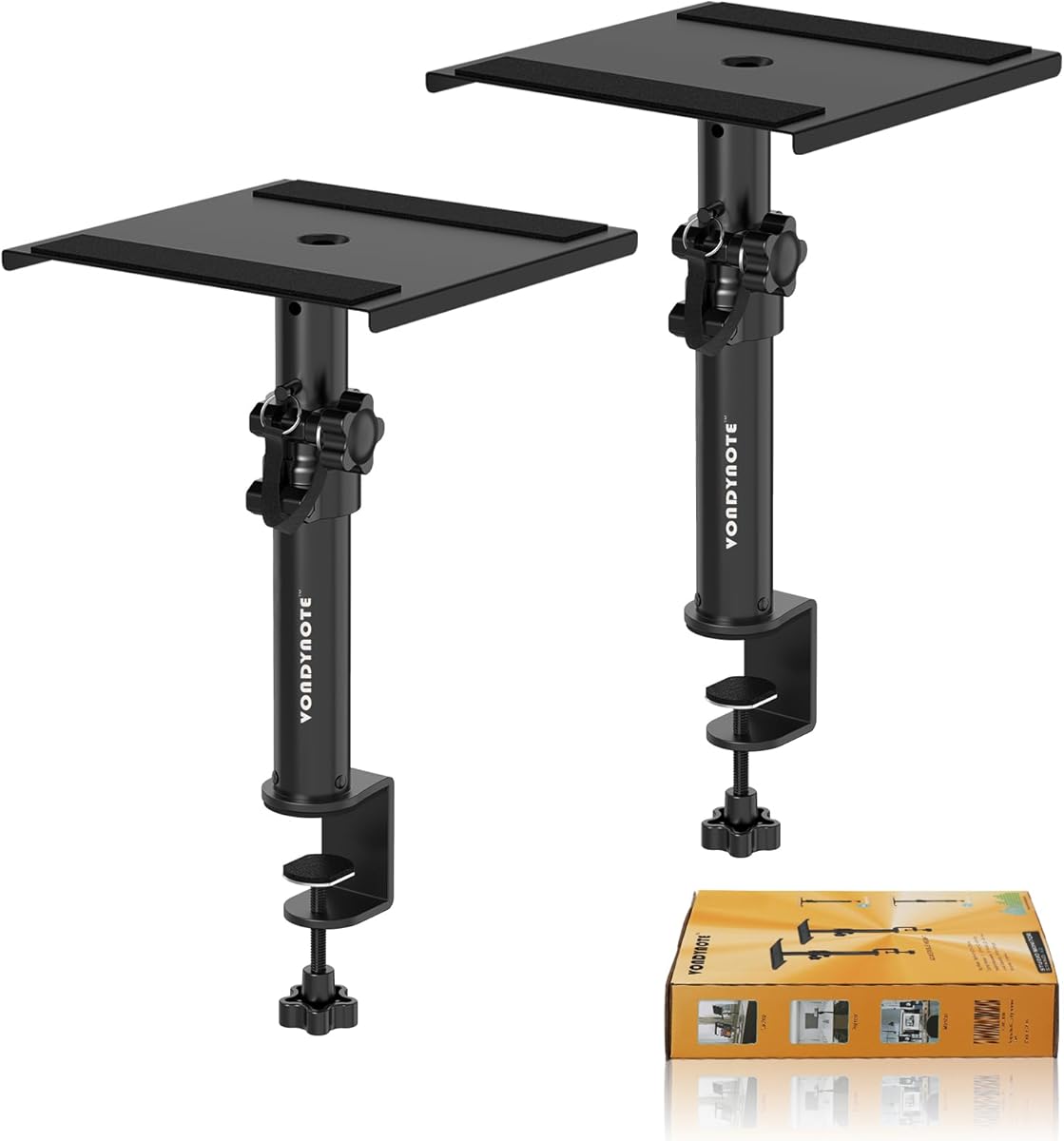


This pair of Vondynote clamp stands provides a compact way to elevate studio monitors, laptops, hi-fi components, CD players, or projectors without occupying a large section of the desk. Its 4.6 rating reflects a generally favorable balance of short height, useful adjustment, sturdy fastening, and space-saving installation.
We may earn a commission when you buy through this link, at no additional cost to you.
The main attraction is the clamping approach. Instead of relying on a broad weighted base, each stand attaches to the edge of the desk, leaving only 32.5 square centimeters of surface in use. The clamp accommodates desktops from zero to 2.6 inches thick and includes a 3 mm EVA pad to reduce the risk of scratches. A 5 mm thickened clamp, grade 8.8 reinforced screws, and four M8 bolts provide a reassuringly substantial connection.
Height can be fixed at 9, 10.6, 12.3, or 14 inches, which gives users several positions without requiring continuous fine adjustment. The 9-inch square metal top plate carries a 2 mm anti-skid pad and supports equipment up to 50 pounds. The trade-offs are a lower maximum height and no built-in tilt or rotation, so this pair is less flexible for demanding studio positioning.
This is a strong choice for a compact workstation where desk area is scarce and the speakers are relatively small. It should appeal to users who value a secure edge-mounted design more than extensive articulation. Measure desk thickness and speaker size before ordering, and ensure the selected height places the tweeters near ear level.
The edge clamp is particularly useful when desktop space is tight. The supports occupy 32.5 square centimeters each, allowing the area beneath the speakers to remain open while still providing a stable 9-inch platform for supported equipment.
A 2 mm EVA pad cushions the speaker against the metal plate, while the padded clamp helps protect the desk. This combination is valuable for listeners trying to reduce unwanted vibration without investing in a much larger support system.
We may earn a commission when you buy through this link, at no additional cost to you.
The Kanto SP6HD pair is designed for medium and large bookshelf speakers as well as 4- to 7-inch studio monitors. Its 4.7 rating and deliberate use of heavy steel, closed-cell foam, and adjustable top plates position it as a premium option for listeners who care about both appearance and carefully directed sound.
We may earn a commission when you buy through this link, at no additional cost to you.
The stands raise compatible speakers six inches, bringing tweeters closer to ear level without the visual bulk of tall studio supports. Each top plate can rotate up to 15 degrees in either direction, making it easier to aim speakers toward a listening position on a desk. Two plate sizes are included, and each has a mounting hole with a quarter-inch 20 screw for securing speakers that support that attachment method.
Cable management is integrated neatly through a hollow support column rather than requiring external clips. The steel construction and closed-cell foam are intended to absorb resonance and reduce the muddy coloration that can result when speakers sit directly on a desk. As a trade-off, height is fixed, and the design is less accommodating of unusual shapes or exceptionally large monitors than some adjustable alternatives.
This pair makes sense for a polished home listening room, compact recording studio, or workstation with 4- to 7-inch monitors. It is especially attractive when the user wants a permanent, organized appearance and a controlled listening angle. Confirm speaker dimensions and bottom-mounting compatibility before installation.
The 15-degree rotation range provides finer directional control than stands with a simple fixed tilt. Users can angle each speaker independently toward the main listening position, which can improve perceived imaging on a compact desktop.
The hollow support columns create a natural route for speaker cables. This keeps wiring less conspicuous and can make it easier to maintain a clean workspace around a permanently installed audio system.
We may earn a commission when you buy through this link, at no additional cost to you.
These Vondynote desk clamp stands combine a compact installation with more adjustment than a basic fixed shelf. The 4.6-rated pair supports most studio monitors up to 60 pounds and can accommodate laptops, CD players, and projectors on its padded 9-by-12-inch platforms.
We may earn a commission when you buy through this link, at no additional cost to you.
Height extends from 10.4 to 15.4 inches and locks into four positions: 10.4, 12, 13.7, and 15.4 inches. A locking knob and security pin help keep the extension stable. The top plate can tilt from zero to 12 degrees, adding directional control that is helpful when speakers sit behind the edge of a desk.
The clamp uses a 3 mm EVA pad to protect the desktop and attaches to surfaces up to 2.6 inches thick. Despite its support rating and adjustment range, each clamp occupies only 32.5 square centimeters of desk space. Limitations include the lack of continuous height adjustment and free horizontal rotation, making it less adaptable than a stand with a rotating plate.
This pair suits users who want substantial studio-monitor support without giving up much desk area. It works especially well for medium-sized monitors that benefit from a slight upward angle. Buyers should verify the available clearance beneath the desktop, the thickness of the desk, and the dimensions of their speakers before installation.
Four secure height positions cover a practical range for near-field listening, while the adjustable tilt helps direct sound toward a seated user. This combination offers more acoustic control than a single-purpose fixed riser.
The padded clamp, reinforced telescopic support, locking knob, and safety pin work together to keep the stand stable. The edge-mounted design also keeps most of the desktop clear for a keyboard, writing area, or other equipment.
We may earn a commission when you buy through this link, at no additional cost to you.
Liquid Stands takes a highly adaptable approach to desktop monitoring, supporting heavy equipment and allowing the top plate to tilt from zero to 20 degrees. Its 4.8 rating is the highest among the ten products in this guide, while the 65-pound capacity and stainless steel construction reinforce its suitability for serious studio setups.
We may earn a commission when you buy through this link, at no additional cost to you.
The 9-by-12.5-inch platform can be used in horizontal or vertical configurations by adjusting the plate and adding or removing the four included lips. Height ranges from 9.5 to 13.5 inches, and the clamp accommodates desks between 0.5 and 2 inches thick. A 4-inch-wide base and 6 mm anti-slip isolation pad help the supports remain stable and reduce unwanted movement.
Its most notable advantage is the combination of load strength, orientation flexibility, and broad tilt adjustment. That makes it a practical choice for studio monitors that need to be aimed carefully or arranged according to available space. The trade-offs are the limited maximum desk thickness and the greater bulk implied by heavy-duty stainless steel construction.
The pair is well suited to music booths, project studios, and serious desktop listening systems. It also fits home users who want one stand design to handle several speaker sizes. Confirm the clamp opening, underside clearance, and the speaker's preferred orientation before installation.
The 20-degree tilt range exceeds that of most competing desktop stands. Combined with vertical or horizontal plate positioning, it gives users more control over monitor direction without moving to a separate floor stand.
Stainless steel, a 65-pound rating, and a wide base provide a stable foundation for substantial monitors. The 6 mm isolation pad adds a physical buffer between the platform and speaker, helping limit transferred movement.
We may earn a commission when you buy through this link, at no additional cost to you.
This Vondynote pair offers a broad combination of height, tilt, and rotation without requiring installation under the desk. It has a 4.6 rating and supports equipment up to 60 pounds, making it suitable for medium and larger studio monitors as well as laptops and projectors.
We may earn a commission when you buy through this link, at no additional cost to you.
Four fixed height positions cover an 11-to-16-inch range, with a knob and locking pin securing the selected height. The platform tilts from zero to 12 degrees and rotates freely, allowing each speaker to be aimed independently. A 9-by-9-inch top plate includes a full-coverage 2 mm EVA pad to reduce resonance and improve grip.
The stand can be configured for vertical or horizontal monitor orientation, and it may also be laid out horizontally in tight spaces. This flexibility is useful for different speaker designs and room layouts. Its main disadvantage compared with a clamp model is the larger 9.5-inch square base, which occupies more of the desktop.
This pair is a good fit for users who want easier installation and more directional freedom than a simple fixed shelf. It can support a bedroom studio, editing workstation, or gaming setup where speakers need careful placement. Users should compare the 16-inch maximum height with their seated ear level and verify that the base fits the available workspace.
Free rotation and adjustable tilt let each stand be aimed separately. This is useful in asymmetric spaces where pointing both speakers directly at one seated position would otherwise be difficult.
Vertical and horizontal configurations accommodate different monitor shapes. The option to set the stand lower and more compactly can also help users fit speakers into a crowded desktop area.
We may earn a commission when you buy through this link, at no additional cost to you.
The Vondynote Bookshelf Speaker Stands are designed primarily to raise larger desktop monitors to a useful listening height. Their 11.6-to-18-inch adjustment range is among the taller ranges in the guide, and the 4.6 rating reflects a generally positive response to their solid construction and straightforward support.
We may earn a commission when you buy through this link, at no additional cost to you.
Four drill-hole positions allow the support tube to be fixed at 12, 14, 16, or 18 inches. A safety-pin locking device helps prevent accidental movement, while a 2 mm EVA pad on the 9-inch square platform reduces slipping and vibration. The matte black steel finish is intended to blend into a studio, office, or home media environment.
Each stand weighs 5.4 pounds and supports up to 50 pounds. The stands can also hold a laptop or projector, not only studio monitors, and they can be disassembled for transport. There is no tilt mechanism, however, so users who need precise vertical aiming may prefer an articulating platform or angled stand.
This pair is best for users whose tweeters need substantial elevation to reach seated ear level. It suits medium-sized bookshelf speakers and studio monitors on a spacious desk. Check underside clearance, make sure the speaker base fits the platform, and consider adding external placement aids if the speakers require a downward angle.
The 18-inch maximum makes the stands appropriate for larger desktop speakers that would otherwise fire below the listener's ears. Four fixed positions simplify selection without introducing a complicated adjustment mechanism.
Steel construction, a broad platform, and a 50-pound capacity provide a stable base for medium and larger speakers. The safety pin adds a second layer of security at the chosen support height.
We may earn a commission when you buy through this link, at no additional cost to you.
The Suptek SDM003MB pair provides straightforward elevation for bookshelf speakers, desktop speakers, studio monitors, and gaming or home audio equipment. Its 4.5 rating reflects a practical design centered on easy assembly, a stable platform, and enough load capacity for common consumer speakers.
We may earn a commission when you buy through this link, at no additional cost to you.
Both stands measure 6.1 inches tall, bringing tweeters closer to ear level without the complexity of adjustable hardware. Each platform measures 7.9 by 6.5 inches and includes an anti-slip mat, while the stated capacity reaches 44 pounds per stand. This makes the pair more substantial than lightweight decorative risers.
The primary benefit is accessibility. Clearly illustrated instructions are designed to support a setup process of approximately ten minutes, and the stands require less adjustment than clamp or telescoping models. The trade-off is that the fixed height and lack of tilt or rotation provide little control over precise acoustic alignment.
These stands are well suited to first-time buyers, home offices, and desktop gaming systems that use medium-sized speakers. They are less appropriate for a studio requiring precise monitor articulation or for users who need a very high listening position. Check the speaker footprint and make sure the platform remains fully supportive.
The fixed design removes the need to learn multiple adjustment systems. Users can concentrate on final placement while the stands provide a consistent six-inch lift and a broad, padded surface.
The 44-pound capacity and wide top plate accommodate more substantial desktop equipment than many small risers. Non-slip material helps limit movement while music, games, or video plays.
We may earn a commission when you buy through this link, at no additional cost to you.
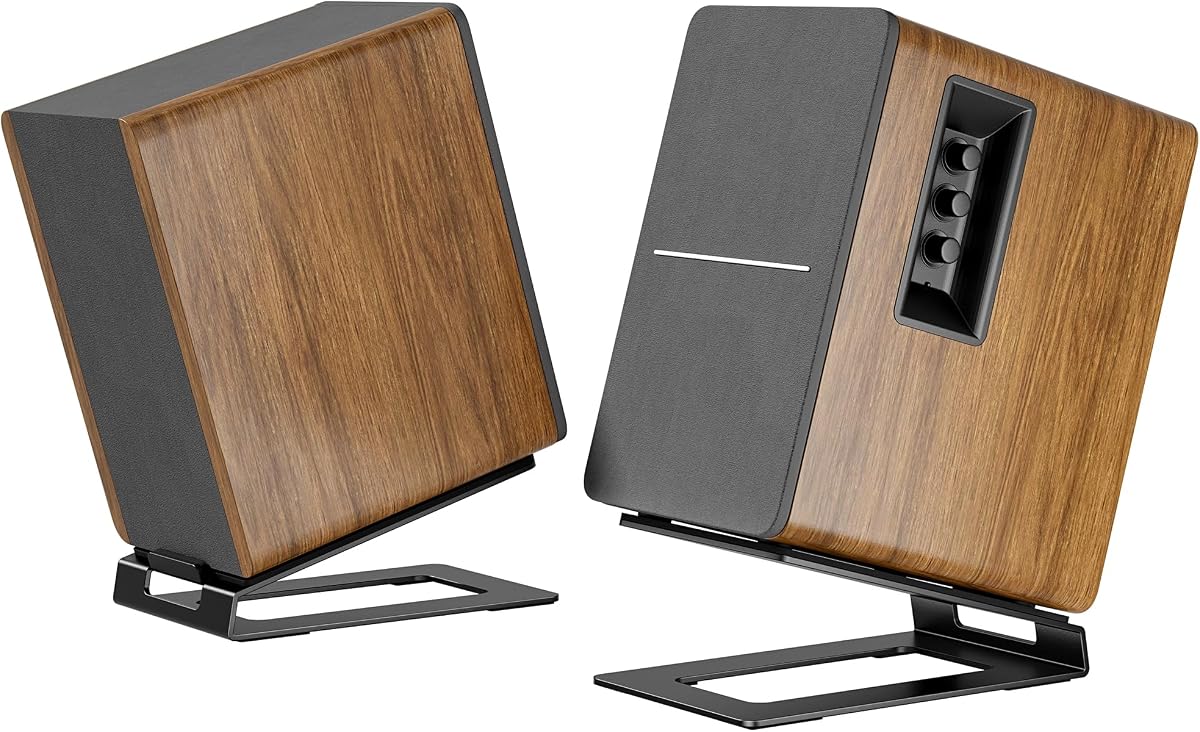
This pair offers one of the most approachable ways to add elevation and an upward angle to a desktop speaker setup. It has a 4.9 rating, the highest listed score in this guide, and its simple 16-degree platform angle is particularly useful for bringing sound toward a seated listener.
We may earn a commission when you buy through this link, at no additional cost to you.
The metal base measures 7.1 by 4.8 inches and supports up to 22 pounds. A protective pad beneath the base helps guard against desk scratches, while an anti-vibration pad on the speaker contact surface reduces unwanted resonance. The stands can be used immediately in a freestanding configuration, with no setup required.
For users with compatible speakers, the platform can also be secured with screws for greater stability. That optional method provides a more permanent installation, while the freestanding format is convenient for renters, temporary setups, and movable workstations. The limitation is the 22-pound rating, which is lower than that of many steel studio stands.
This pair is an excellent fit for small and medium bookshelf speakers in an office, gaming station, or casual listening area. The fixed angle may not suit every speaker or room, so users should compare the platform geometry with the speaker's front face. Screw mounting also requires checking for underside mounting holes.
The 16-degree tilt directs sound upward toward a seated user without requiring a separate wedge. This simple geometry can improve perceived clarity while keeping the speaker footprint compact.
Users can begin with the stands freestanding and move them as needed. Those who want a more permanent arrangement can use the optional screw-mounting method when their speakers have compatible bottom holes.
We may earn a commission when you buy through this link, at no additional cost to you.
The PERLESMITH PSSS2 pair is included because it offers a distinctly different use case from the compact desktop risers. These height-adjustable floor stands can elevate small bookshelf, satellite, studio, and surround speakers from 33.3 to 45.1 inches, providing much more reach for home theater or larger room arrangements.
We may earn a commission when you buy through this link, at no additional cost to you.
Platform width adjusts from 4.5 to 9 inches, helping the stands accommodate different small speaker sizes. A twist-lock mechanism allows height changes without tools, and the solid steel poles, wide bases, deeper threaded connections, and non-slip foot pads provide stability. The pair can carry up to 11 pounds per stand.
Cable management is handled through a 1.18-by-0.59-inch opening in each hollow pole, with hook-and-loop straps included as an alternative when a connector will not pass through. Users should confirm cable dimensions before purchase. The stands are not suitable for round or irregularly shaped speakers, and their floor-based design uses more room than a desktop stand.
This pair is most relevant to users who want to place speakers beside a sofa, entertainment center, or larger workstation without a traditional wall mount. Despite its desktop-focused guide, it is a useful companion for home audio setups that need greater height and distance from the floor. Confirm speaker shape, dimensions, and weight before buying.
Extending to 45.1 inches gives the stands more placement flexibility than any compact desk model in the guide. This makes them useful for arranging speakers around a larger listening area rather than on a single work surface.
The hollow pole can carry certain cables through its opening, while included straps offer an external option. Users should check connector and cable dimensions because both methods have size requirements.
We may earn a commission when you buy through this link, at no additional cost to you.
These cantilevered desktop stands focus on making room beneath the speakers rather than maximizing height or load capacity. Their 4.5 rating reflects a useful design for small and medium bookshelf speakers, computer speakers, and studio monitors that benefit from elevation while leaving part of the desk accessible.
We may earn a commission when you buy through this link, at no additional cost to you.
The platform has a six-degree tilt that aims sound toward the listener. An extendable ledge stopper provides adjustable depth from 5.5 to 7.5 inches, allowing different speaker sizes to sit securely. A preset slot also accommodates speakers with bottom mounting holes, while soft anti-slip EVA pads improve stability and protect the contact surfaces.
The C-shaped frame leaves 5.9 inches of open space beneath the speaker platform. This can accommodate a keyboard edge, papers, a compact display riser, or other lightweight items. The 12-pound capacity is the lowest among the desktop options, however, and the fixed six-degree angle offers only modest directional adjustment.
This pair is a good choice for clutter-conscious users who want the space below each speaker to remain functional. It is less appropriate for heavy studio monitors or large home audio speakers. Measure both the speaker depth and the available under-speaker space, and check whether the speaker has compatible bottom holes if secure attachment is desired.
The cantilevered structure leaves 5.9 inches open below the speaker. That clearance can make a crowded workstation feel less obstructed and offers a place for lightweight everyday items.
An adjustable ledge allows the platform depth to change from 5.5 to 7.5 inches. This is especially useful for shallow and deeper bookshelf speakers, with preset slots available for compatible bottom-mounted hardware.
We may earn a commission when you buy through this link, at no additional cost to you.
The right desktop speaker stand depends on speaker size, desk construction, available clearance, and the degree of placement control required. Comparing these factors before ordering helps prevent stability issues, poor acoustic alignment, and wasted desk space.
A clamp-mounted stand attaches to the edge of the desk and usually leaves more open work surface beneath the speaker. It is especially useful in compact studios, editing desks, and gaming setups where every inch of desktop area matters. The buyer should verify desk thickness, edge accessibility, and the clearance needed for the clamp mechanism. Freestanding stands are easier to install, move, and use with temporary arrangements, although their bases consume more horizontal space. They are often the more practical choice for renters, irregular desk shapes, and users who do not want to drill or tighten hardware beneath a tabletop.
A useful stand should bring the speaker's tweeters close to seated ear level. Fixed stands are sufficient for many compact bookshelf speakers, while adjustable models are valuable for larger monitors, unusual seating positions, and users who change how they sit at the desk. Measure the height of the current speaker, add the intended stand height, and compare the result with your ear position. A tall fixed model may look awkward if it places the tweeters well above the listener, while a low platform may leave the sound firing too low. Always allow room for the desk surface, the speaker feet, and any angled or raised portions of the enclosure.
Tilt changes the vertical angle of a speaker, while rotation changes its horizontal direction. Both can help speakers face a listener on an asymmetrical desk or behind the front edge of a tabletop. Adjustable tilt is especially useful for studio monitors because it lets the user control how much sound reaches the listening position. Freely rotating plates offer even more directional control, although they may take more time to align. A fixed-angle model can still work well when the speakers and listener are centered. Check the product geometry rather than assuming that every stand can aim a speaker in the same way.
The top platform should support the speaker's full footprint without letting it overhang in an unstable manner. Measure both the width and depth of each speaker, including any feet, connectors, and sloping cabinets. Some products include multiple plate sizes or adjustable ledges, which improves compatibility across different models. A platform with a raised stop can be helpful for speakers that benefit from screw mounting, but it may not accommodate a broad, curved base. The listing should also confirm whether the stand is intended for rectangular speakers, since some compact models are not designed for round or irregular enclosures.
Load capacity is a maximum limit, not a target, so the stand should comfortably exceed the weight of each speaker. Steel construction, broad bases, locking pins, and reinforced screws contribute to stability, but desk quality and installation also matter. Heavy monitors should not be placed on a lightweight platform with narrow feet. For clamp models, inspect the desktop material and ensure the clamp can open far enough without damaging the edge. For freestanding models, consider the surface underneath and whether the base could slide. Positioning both speakers on a level surface also helps maintain consistent imaging and prevents accidental tipping.
Anti-skid and vibration-isolation pads can reduce unwanted movement between a speaker, its stand, and the desk. They may also protect painted surfaces and prevent scratches. The thickness and coverage of the padding vary across the guide, so users should consider both the top pad and any pad beneath the base or clamp. A heavily padded setup can improve stability for a small speaker, but it cannot compensate for poor alignment. Overly soft or poorly fitted material may allow the cabinet to rock. Look for full or substantial coverage under the speaker's feet and make sure the cabinet can rest flat.
Clamp stands have a maximum and minimum desktop thickness, and the range can be narrower than expected. Measure the top and underside of the desk rather than estimating from the visible edge. Some desks also have beveled edges, trims, drawer rails, or reinforced supports that prevent a clamp from opening fully. Check the space beneath the desk for knees, drawers, crossbars, and power strips. The supplied bolts and tools should be considered when planning installation, and a properly sized Allen key or screwdriver is preferable to forcing hardware with an improvised tool. Freestanding designs avoid these clearance concerns entirely.
Cable management can influence how clean and practical a speaker setup feels. Hollow columns, openings, clips, and straps can keep wiring away from the listening area and reduce strain on speaker connections. Stand height also affects the length and routing of cables. Some users prefer fully visible cables for easy troubleshooting, while others want a permanent, organized appearance. Before purchasing, consider whether the speaker connectors require extra bend clearance and whether the desk has a cable channel. A management feature is useful only if its opening is large enough for the actual connector or cable.
Begin by removing the speakers and measuring the desk, available clearance, and each speaker's footprint. For a clamp model, loosen the clamp before placing it over the edge, then tighten it gradually while watching the padded contact point. For a freestanding model, position the bases on a level area and confirm that the speaker sits flat without rocking. Install any supplied bolts only after the final height, tilt, and distance are established.
Place the speakers in a symmetrical arrangement and angle them toward the main listening position. Start with a modest tilt rather than an extreme setting, then listen from the intended seat and make small adjustments. Secure compatible speakers with the provided screws or mounting holes when a permanent fit matters. Route cables through any built-in channels, but do not force bulky plugs through openings that are too small. Leave a little slack behind each speaker so tension does not pull the cabinet off center.
For routine care, wipe metal surfaces with a soft, dry cloth and clean EVA pads gently with a slightly damp cloth if the manufacturer permits it. Do not submerge the stand, apply harsh cleaners, or oil adjustment hardware unless specifically instructed. Periodically inspect clamp screws, locking pins, and telescopic tubes for looseness. Recheck the speakers after the first few listening sessions because clamps and weighted bases can settle slightly, and reposition them if the cabinets no longer remain level.
Desktop speaker stands can improve sound quality by reducing direct surface vibration, lifting the tweeters closer to ear level, and helping the speakers face the listening position. Their impact varies with the speakers, room, desk material, and placement. A stand cannot correct poor speaker design or an unsuitable room, but it can provide a more controlled and stable starting point.
Clamped stands can be useful in a permanent studio installation because they save surface space and create a stable mounting point. They require sufficient desk thickness, accessible edges, and safe clearance underneath. Freestanding stands are more convenient when the setup must move often, though they take up more desktop area. Confirm the speaker's weight, dimensions, and mounting needs before deciding.
The goal is to position the tweeters near the listener's ears when seated at the intended listening position. Exact height varies with the speaker cabinet, desk height, chair height, and whether the stand adds tilt. Measure the current tweeter position and compare it with your ears. A slightly elevated placement is often more comfortable than directing a speaker sharply upward or downward.
Compatibility depends on the stand's platform dimensions, weight rating, and the shape of the speaker base. Measure speaker width, depth, height, and weight, including any attached feet or connectors. Also check whether the platform allows a level fit and whether bottom mounting holes are needed. A platform should support the speaker securely without creating an unstable overhang.
A tilt is not always necessary, but it can help when the speakers sit behind the front edge of a desk or below ear level. Fixed-angle stands are sufficient when the user has a centered listening position and a platform at the correct height. Adjustable tilt and rotation provide more control for asymmetrical desks and studio monitoring.
Only if their stated load capacity exceeds the weight of each monitor. Heavy-duty options in this guide support substantially more than many basic stands, often using steel construction, broad bases, and locking hardware. Weight capacity should still be paired with correct platform dimensions, secure installation, and a stable desk. Do not treat the listed maximum as a recommended operating load.
Use a built-in cable opening, hollow column, clip, or strap when one is provided, but check that the connector and cable can pass without force. Leave enough slack at the speaker connection to prevent tension. If a cable must remain outside the stand, secure it gently along the support without creating a sharp bend or pulling the speaker out of position.
Neither design is universally safer. A clamp can be very stable when installed on a suitable desk, but it may damage an edge or fit poorly if the desk is thin, beveled, or crowded underneath. A freestanding base is safer in that it requires no installation, yet it can slide or tip if it is too light, uneven, or overloaded. Match the design to the desk and the speaker weight.
The strongest all-around choice is the Liquid Stands pair because it combines heavy-duty capacity, broad tilt adjustment, multiple platform orientations, and an edge-clamping design. The Kanto SP6HD pair stands out for refined construction, included top plates, precise rotation, and hidden cable routing. For a simpler and more economical approach, the Budget Tilt Bookshelf Stands provide an elevated angle, immediate freestanding use, and optional screw mounting.
The most important decision is to match the stand to the actual workspace. Choose a clamp when preserving desk area is essential, a freestanding model when installation and mobility matter, and an adjustable support when height or monitor direction varies. Platform size, speaker weight, desk thickness, and underside clearance deserve more attention than decorative appearance alone.
Prices and product details can change over time, so shoppers should verify current specifications, availability, and the latest dimensions before purchasing. Checking the speaker footprint, load rating, mounting requirements, and desk construction will help narrow the list to a stand that is both stable and well suited to the intended listening position.