
Revopoint MetroY Ultra 3D Scanner
Up to 90 FPS capture
Five scanning modes
Wi-Fi 6 wireless control
Broad industrial file support
Explore the best 3D scanner for reverse engineering, comparing accuracy, scanning modes, portability, software, and workflow compatibility.
A 3D scanner for reverse engineering turns a physical part into a usable digital model, yet the best results depend on accuracy, surface handling, capture speed, and the software surrounding the device. A scanner that appears powerful on paper may still struggle with reflective metal, deep recesses, fine edges, or large assemblies in a real workshop.
This guide compares ten desktop, portable, handheld, and wireless scanners according to their stated accuracy specifications, laser configurations, tracking methods, object-size limits, compatibility, and reverse-engineering features. It covers options from Revopoint and Creality as well as the portable EinScan Rigil, with attention to the workflows each system supports.
The picks illustrate three distinct priorities: precision-oriented blue laser scanning, portable all-in-one operation, and accessible structured-light workflows. Each selection also includes the trade-offs visible in the supplied specifications. Product availability, software requirements, and system configurations can change, so buyers should verify current compatibility before purchasing.


This side-by-side comparison highlights each scanner's stated accuracy, capture technology, working range, and key workflow considerations for reverse engineering.



The Revopoint MetroX Pro is a blue-laser scanner built for demanding reverse-engineering work, combining a stated single-frame precision of 0.01 mm with several different capture strategies. Its most impressive feature is not a single number but the range of modes available for flat, dark, shiny, detailed, and complex objects. The advanced package also supports automated scanning and RGB capture.
We may earn a commission when you buy through this link, at no additional cost to you.
The 30 cross-line lasers are intended to cover surfaces efficiently, while 15 parallel lines emphasize fine features, edges, and corners. Full-field blue structured light can capture feature-rich objects without markers at up to seven million points per second. Feature tracking, marker tracking, and global marker mode give users several ways to align scans, which is useful when a part combines smooth sections with geometrically distinct areas.
Its ability to scan shiny or dark surfaces without spray is particularly valuable for reverse engineering, where spraying could contaminate a component, obscure a finish, or make repeated inspection inconvenient. The automated dual-axis turntable reduces the demands of complex captures, while the HD RGB camera adds realistic color in automatic mode. Revo Mirror can also stream a PC scan to a phone or tablet, making it easier to inspect the subject from different angles.
The main trade-off is software packaging. Revo Measure and Revo Design are described as separately sold, Windows-only tools, so buyers who need a complete scan-to-CAD path should account for that in their planning. Even so, the MetroX Pro offers the strongest combination of precision, capture versatility, and workflow features in this list. It is the most well-rounded recommendation for users who need to reproduce components, inspect geometry, and create editable models.
The stated 0.01 mm single-frame precision and 0.02 mm single-frame accuracy target the fine edges and dimensional features that matter in reverse engineering. Volumetric accuracy is specified as 0.02 mm plus 0.04 mm multiplied by measurement length, helping users understand how whole-object accuracy changes as coverage expands.
Cross-line, parallel-line, and full-field modes let operators choose the most suitable capture strategy instead of forcing every part into one workflow. This flexibility is valuable for assemblies that combine machined metal, flat panels, recessed areas, and decorative surfaces.
We may earn a commission when you buy through this link, at no additional cost to you.
The Revopoint MetroY Ultra is built around speed, precision, and flexible deployment. It advertises a single-frame precision of 0.01 mm, volumetric accuracy of 0.015 plus 0.04 mm multiplied by length in meters, and scan rates reaching 90 FPS with a supported NVIDIA GPU or 60 FPS with a CPU. Those figures make it especially compelling for users who repeatedly capture assemblies or large industrial components.
We may earn a commission when you buy through this link, at no additional cost to you.
Five modes cover different jobs. Thirty-four laser cross-lines support rapid broad-area capture, 15 parallel lines address fine details, and a single-line mode reaches into deep holes. Full-field blue structured light supports marker-free scans of feature-rich objects, while automatic turntable scanning simplifies a controlled capture around a complete part.
Dark, glossy, and metallic components can be scanned without spray, reducing preparation and avoiding residue on valuable surfaces. The scanner is also designed for outdoor work in bright conditions, with a stated tolerance up to 100,000 lux. Wi-Fi 6 support and the included 5500 mAh battery grip make the system more flexible around a workshop, although the roughly 2.5 hours of stated battery runtime makes charging planning important for long jobs.
Revo Metro provides point-cloud editing, model processing, and alignment tools, with exports to PLY, OBJ, STL, ASC, 3MF, GLTF, and FBX. That broad format support is a major advantage for integration into existing modeling pipelines. For organizations that value acquisition speed and can meet the computer requirements, the MetroY Ultra is a strong premium choice for high-volume reverse-engineering work.
The 90 FPS rate can reduce acquisition time when scanning objects that are difficult to hold still. Cross-line coverage helps minimize repeated passes, while the single-line mode remains useful for narrow cavities and deep holes that wider patterns may not reach effectively.
Wi-Fi 6 allows the scan to be controlled and monitored from a PC, tablet, or mobile device through Revo Mirror. Combined with outdoor capability and the battery grip, this makes the MetroY Ultra useful for field documentation, inherited assets, and large assemblies located away from a permanent workstation.
We may earn a commission when you buy through this link, at no additional cost to you.
The EinScan Rigil is the most unconventional selection because it combines portable scanning hardware with onboard computing and a 6.4-inch 2K AMOLED touchscreen. It supports Standalone, Wireless PC, and Wired PC modes, allowing users to work without a marker-based external computer setup. The stated 0.04 mm accuracy positions it between entry-level structured-light devices and the most precise systems in the guide.
We may earn a commission when you buy through this link, at no additional cost to you.
Its hybrid light source combines blue laser and IR VCSEL technology, with 50 laser lines divided into crossed and parallel configurations. A 5 MP camera adds color texture, which is valuable when the result must resemble the original component rather than only reproduce its geometry. The scanner is designed to handle dark and reflective metal surfaces without spray, a meaningful advantage for automotive parts, prototypes, and sculpture.
The Rigil includes a 2.4 GHz CPU, 32 GB of DDR5 memory, and a 1 TB SSD, so it is a complete portable workstation rather than merely a sensor. Replaceable batteries, sunlight compatibility, Wi-Fi 6, and a carrying case support field use. The package also includes a calibration board, universal holder, reflective markers, charging accessories, and a cleaning cloth.
Its main compromises are portability and maximum precision. It is more substantial than the INSPIRE 2 and Otter Lite Basic, while its stated accuracy does not match the 0.01 mm frame precision claimed by the two Revopoint Metro models. Even so, the standalone capability, hybrid source, color imaging, and generous accessory package make the Rigil an excellent choice for users who need a self-contained reverse-engineering system.
Standalone operation changes the logistics of scanning a part in the field. Instead of relying on a tethered workstation, users can operate the system through its touchscreen and onboard processor, then move or share the resulting data as their workflow requires.
The combination of blue laser and IR VCSEL technology is intended to provide reliable data across different surfaces and geometries. Its support for marker-free scanning of dark or shiny metal is especially useful for automotive reverse engineering, where a broad range of finishes may appear in one component.
We may earn a commission when you buy through this link, at no additional cost to you.
This Creality CR-Scan Raptor Pro combines 22 crossed blue lasers, seven parallel blue lasers, and infrared structured light in a handheld system. Its 24-bit RGB camera produces full-color texture, while the optical configuration supports capture speeds up to 660,000 dots per second. The product also has a 5.0 rating in the supplied data.
We may earn a commission when you buy through this link, at no additional cost to you.
Its stated size range extends from 5 × 5 × 5 mm to 4,000 × 4,000 × 4,000 mm, making it suitable for both tiny engineering details and very large assemblies. The crossed lasers cover medium and large objects, while parallel lines target fine features at up to 0.02 mm accuracy. Infrared structured light supports marker-free work on feature-rich objects.
The scanner can handle black and metallic surfaces without powder. It also includes a temperature-compensation algorithm for stability across high and low temperatures, anti-shock tracking, and separate laser and infrared frame rates. Compatibility with Geomagic, Rhino, ZBrush, Maya, SolidWorks, and other design software makes it easier to incorporate into an established reverse-engineering pipeline.
Users should account for the computer requirements associated with professional color and large-object workflows, as well as the planning required to cover a 4-meter object. Even so, the combination of scale, texture, multiple illumination sources, and established software connections gives this Raptor Pro a broad and practical feature set.
The unusually broad stated working range makes the scanner useful for mixed product catalogs, archives, and engineering collections. Small components and large assemblies can be addressed without moving to an entirely separate scanning platform, provided the operator selects an appropriate mode and manages the required data volume.
The 24-bit RGB camera captures a detailed color layer in addition to the geometric mesh. That is useful for product visualization, 3D-printed replicas, heritage records, and design references where surface appearance matters as much as dimensions.
We may earn a commission when you buy through this link, at no additional cost to you.
The Revopoint INSPIRE 2 is a lightweight mobile scanner aimed at users who need to carry a capable structured-light system between locations. At 190 grams, it is one of the easiest devices in the guide to transport, yet it includes a 6.4-inch 2K AMOLED touchscreen, an RGB camera, eleven infrared laser lines, and an adjustable optical zoom.
We may earn a commission when you buy through this link, at no additional cost to you.
Its stated accuracy reaches 0.05 mm and precision reaches 0.03 mm. A high-precision calibration board is said to improve point-cloud accuracy by 75 percent. Infrared structured light and multi-line laser modes support different materials and object sizes, while the scanner can handle reflective or dark surfaces without spray. The included RGB camera synchronizes color and geometry for realistic product and heritage models.
Wi-Fi 6 supports mobile structured-light capture and real-time PC-to-phone streaming. The adjustable 1.5x or 2x optical magnification can help operators focus projected light for detail across mixed-size subjects. Outdoor use is supported in lighting conditions up to 20,000 lux, and the aerospace-grade aluminum front panel adds durability.
The package is notably complete, including a tripod, markers, mini turntable, calibration board, outdoor filters, cables, documentation, and warranty materials. Revo Design is a separately sold Windows-only application, but Revo Metro covers scanning and post-processing. The INSPIRE 2 is a strong fit for mobile reverse engineering when weight and convenience matter more than sub-0.02-millimeter performance.
The 190-gram housing and included tripod make the INSPIRE 2 practical for scanning away from a fixed bench. The mini turntable and markers broaden the kit for small objects, while outdoor filters and stated sunlight tolerance support field-oriented documentation.
The 1.5x and 2x magnification settings allow the projected pattern to be focused more precisely for different subject sizes. This can help preserve small details while retaining a relatively compact and lightweight instrument.
We may earn a commission when you buy through this link, at no additional cost to you.
The Creality Otter Lite Basic is an approachable handheld scanner for DIY users, educators, makers, and hobbyists who want color and geometry from a compact device. It provides a stated 0.05 mm resolution, captures color texture at up to 30 FPS, and has a 5.0 rating in the supplied information.
We may earn a commission when you buy through this link, at no additional cost to you.
Two distance modes make it adaptable to different objects. Close-range capture covers 100–200 mm and can scan items as small as 20 × 20 × 20 mm, while long-range mode covers 250–1500 mm. RGB and infrared cameras combine geometric information with a full-color texture layer, and OBJ, STL, and PLY exports support printing, animation, virtual-reality content, and reverse-engineering workflows.
At 235 grams, the scanner is easy to carry. Multi-color LED indicators show scan distance and status, helping new users establish a consistent technique. Creality Scan is compatible with both Windows and macOS, while QR-linked tutorials help users get started. The included turntable, calibration board, reflective markers, USB-C adapters, cleaning cloth, and carrying case create a fairly complete first-use bundle.
Its limitations include a relatively small minimum subject size compared with more specialized industrial systems and the need for a USB connection. It is best suited to parts and props within its stated working ranges rather than the largest automotive or architectural assemblies. For accessible reverse engineering and colorful 3D printing, it remains a straightforward, well-supported choice.
Multi-color LED indicators provide immediate feedback about distance and operating status. Combined with QR-linked setup guidance, these cues can shorten the learning period and encourage more consistent scans from first use.
Separate close- and long-range modes make it easier to move between small components and larger objects without continually changing the workflow. The 20 mm minimum and 1,500 mm maximum range provide a practical span for many workshop projects.
We may earn a commission when you buy through this link, at no additional cost to you.
The standard Revopoint MetroX Pro shares the core precision of the advanced version while appearing in a distinct listing. It delivers a stated 0.01 mm single-frame precision, 0.02 mm single-frame accuracy, and volumetric accuracy of 0.02 mm plus 0.04 mm multiplied by length. That makes it attractive for users who prioritize dimensional detail over the most elaborate package configuration.
We may earn a commission when you buy through this link, at no additional cost to you.
Its four modes cover 30 cross-line lasers, 15 parallel lines, 62-line full-field blue structured light, and an automatic turntable. Cross-line and parallel modes can handle shiny or dark surfaces without spray at up to two million points per second. Full-field mode supports marker-free capture of feature-rich subjects, while the RGB camera adds color during automated scanning.
Feature tracking suits objects with rich details, marker tracking supports flat surfaces, and global marker mode improves alignment for complex shapes. PC-to-mobile streaming through Revo Mirror helps users identify missing data without remaining tethered to the laptop. Scan data can move into Revo Measure, Revo Design, or other 3D software for modeling, inspection, and reverse-engineering work.
As with the advanced MetroX Pro, Revo Design and Revo Measure are separately sold Windows-only applications. This standard configuration may suit buyers who already have a suitable CAD or metrology environment, or who mainly need the scanner and Revo Metro. Its combination of high precision, flexible modes, and alignment choices makes it a strong professional option.
Cross-line and parallel modes are specifically positioned for flat, shiny, or dark surfaces. Avoiding spray preserves the original finish and removes a preparation step, which is especially useful for repeat scans and sensitive mechanical components.
The three tracking methods let operators match the alignment process to the subject. Detailed components can rely on features, smooth planes can use markers, and complex forms can use the global approach for added alignment support.
We may earn a commission when you buy through this link, at no additional cost to you.
This Creality Raptor Pro listing emphasizes metrology-oriented performance, with stated measurement accuracy up to 0.02 mm and volumetric accuracy of 0.02 mm plus 0.08 mm per meter. It combines 22 crossed blue lasers, seven parallel blue lasers, and NIR infrared structured light, reaching up to 660,000 points per second. The product carries a 5.0 rating in the supplied data.
We may earn a commission when you buy through this link, at no additional cost to you.
The crossed array provides broad coverage of medium and large objects, while the parallel array targets sharper detail with lines described as fine as 0.1 mm. Infrared structured light supports marker-free scanning of feature-rich parts. The working range covers objects from 5 mm to 4,000 mm, and the scanner is also advertised for body and face capture, with a full-body scan stated at approximately two minutes.
Black, glossy, and metallic surfaces can be captured without powder. Outdoor operation is supported through stated light tolerances of 50,000 lux for the seven-line parallel mode and 100,000 lux for the 22-line crossed mode. Creality Scan provides tutorials, one-click processing, point-cloud editing, global-marker scanning, and dedicated face and body functions.
The main limitation is computing demand. The recommended Windows configuration includes an i7 Gen 10-class processor, an NVIDIA graphics card with 8 GB of video memory, and 32 GB of RAM; a Mac recommendation calls for an M3, M4, or M5 processor with 16 GB of memory. Buyers seeking industrial accuracy and large-object coverage should be prepared to provide a capable computer.
The stated 0.02 mm performance and volume-accuracy formula are aimed at users who need dependable dimensional records. It is especially relevant when a captured component will be measured, compared, modified, or used to create a replacement part.
Crossed blue lasers, parallel blue lasers, and NIR structured light offer complementary ways to interpret shape and surface detail. The ability to change modes makes the scanner more adaptable to mixed materials and varied assembly geometry.
We may earn a commission when you buy through this link, at no additional cost to you.
The Creality Raptor X is a wireless handheld scanner designed around fast acquisition, broad coverage, and mobile operation. It uses 34 crossed blue laser lines, a 2.3-megapixel 3D imaging camera, and NIR structured light. Single-frame accuracy is stated at up to 0.02 mm, with volumetric accuracy of 0.02 mm plus 0.06 mm per meter.
We may earn a commission when you buy through this link, at no additional cost to you.
Wi-Fi 6 transfers data to a computer using a lossless compression algorithm, with a stated transmission rate of 4.7 Gbps and 10 ms latency. The wireless mirroring function can show real-time scanning on a phone. Its 35,400 mWh battery is stated to reach 80 percent charge in 1.5 hours, which supports mobile work around large components and assemblies.
The scanner's size range extends from tiny 5 mm objects to 4,000 mm subjects. Its one-shot 3D imaging approach and natural anti-shake behavior are designed to maintain tracking during repositioning. Feature-rich workpieces can be captured without markers, while black and metallic objects do not require powder. A dedicated face and body algorithm is also included.
The Raptor X is best suited to users who regularly work on large objects and want to move around them without a tether. Its hardware complexity and substantial battery are reasonable for that purpose, but they make it less relevant for a small desk or simple one-off project. For broad industrial and automotive reverse engineering, however, it is one of the most capable mobile options here.
A wireless handle is especially valuable when the subject is too large to comfortably scan from one fixed position. Operators can circle the object, monitor progress on a phone, and reposition without managing a cable around the workspace.
One-shot 3D imaging and the advertised natural anti-shake system are designed to reduce tracking interruptions as the scanner moves. Faster repositioning can improve efficiency on curved automotive panels, molded parts, and complex mechanical assemblies.
We may earn a commission when you buy through this link, at no additional cost to you.
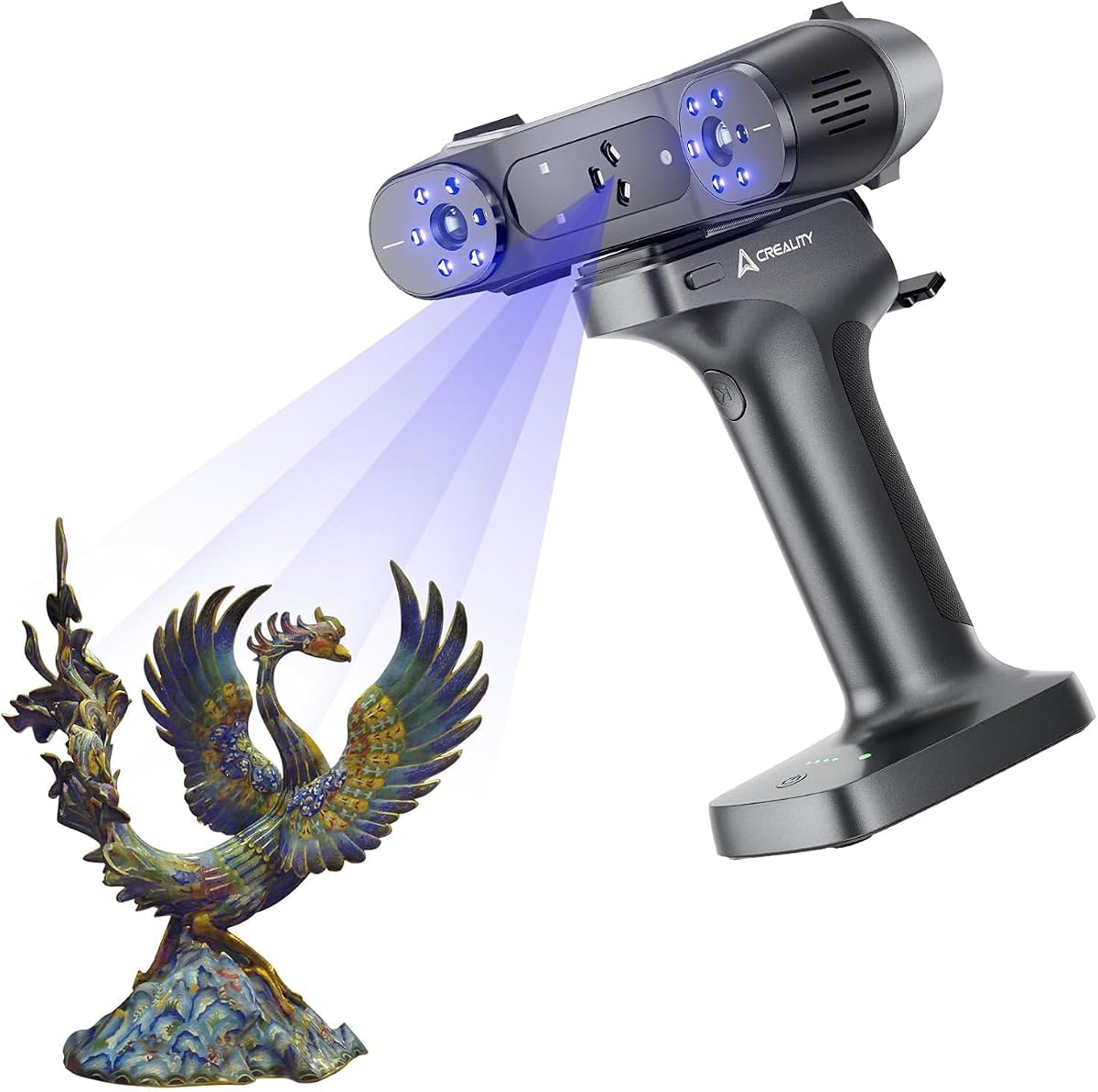
The wireless Creality Raptor Pro combines 22 crossed blue lasers, seven parallel blue lasers, and NIR structured light in a system aimed at industrial inspection and reverse engineering. Its stated accuracy reaches 0.02 mm plus 0.08 mm per meter for volume accuracy, and acquisition speed reaches 660,000 points per second. The working range covers 5 mm to 4,000 mm objects.
We may earn a commission when you buy through this link, at no additional cost to you.
The crossed array provides broad coverage of medium and large subjects, while seven parallel lines focus on partial high-detail scans. Speckle-matching 3D imaging allows marker-free capture of feature-rich workpieces. A dedicated face-mapping algorithm supports body capture, and the product is also positioned for artifact and automotive applications.
Creality Scan supports Windows and macOS, multi-project stitching, real-time preview, 360-degree scanning, and adjustable resolution from 0.05 mm to 2 mm. The recommended Windows setup includes an i7 Gen 10 processor, an NVIDIA card with 8 GB of VRAM, and 32 GB of RAM, while M1, M2, or M3 series Macs with 16 GB of memory are recommended.
This configuration is a practical choice for users who want the Raptor Pro's precision and scale without being limited to one operating system. Its tradeoff is the need for capable hardware and a learning curve across several scan modes. For workshops with mixed Windows and macOS systems, it offers a broad and professionally oriented reverse-engineering workflow.
The 0.05 mm to 2 mm resolution range lets users balance detail against data volume and processing demands. Fine settings suit inspection and small parts, while coarser options can accelerate preliminary capture of large subjects.
Windows and macOS support broadens access for mixed creative and engineering teams. Multi-project stitching and real-time preview are useful when a reverse-engineering job contains several parts, passes, or complementary scan modes.
We may earn a commission when you buy through this link, at no additional cost to you.
The right scanner depends on the geometry, materials, dimensions, and downstream tools involved in your reverse-engineering projects. These are the most important capabilities to compare before making a selection.
Accuracy describes how closely the finished scan agrees with the real object, while precision describes the repeatability of individual measurements. The distinction matters because a visually convincing mesh can still be unsuitable for manufacturing. Review the frame accuracy, volumetric accuracy formula, and the distance over which that formula applies. A quoted result measured over a small distance will not necessarily hold across an entire large assembly.
For precision parts, the Revopoint MetroX Pro and MetroY Ultra list 0.01 mm single-frame precision, while several Creality Raptor models state 0.02 mm performance. The EinScan Rigil lists 0.04 mm accuracy, and the INSPIRE 2 and Otter Lite Basic provide 0.05 mm figures. Compare values using the same definitions rather than assuming every accuracy statement is directly equivalent.
Blue lasers, infrared lines, and full-field structured light behave differently across reflective, dark, textured, and feature-poor surfaces. Cross-line arrays are generally suited to broad, rapid coverage, while parallel lines can concentrate detail around edges and fine geometry. Single-line modes can be useful for deep holes, and speckle matching can reduce marker requirements on detailed surfaces.
A strong system offers several modes rather than relying on one universal pattern. The MetroX Pro provides four, the MetroY Ultra five, and the Raptor Pro combines 22 crossed blue lasers, seven parallel blue lasers, and NIR structured light. This variety makes it easier to adapt to the material and geometry encountered on a real component.
The usable range must cover the smallest feature you need to reproduce and the largest assembly you need to document. The Raptor Pro and Raptor X list ranges from 5 mm to 4,000 mm, while the Otter Lite Basic focuses on 20 mm to 1,500 mm in its two distance modes. The INSPIRE 2 emphasizes portability and mixed-size capture rather than an equally large stated maximum.
Working range does not mean a single capture will handle the entire subject. Large objects usually require multiple passes, careful overlap, alignment, and a suitable workstation. Before purchasing, compare the dimensions of your normal work against the scanner's stated limits and consider the extra processing time involved in capturing large assemblies.
Machined metal, glossy paint, black plastic, and transparent or deeply recessed surfaces can create missing or distorted data. Systems that scan dark and shiny surfaces without spray save preparation time and prevent residue on the part. Cross-line and parallel blue laser modes are prominently positioned for this purpose, while the EinScan Rigil uses a hybrid blue laser and IR VCSEL source.
No-spray capability should still be evaluated against your specific component. Deep cavities, low-contrast edges, and transparent materials may require additional angles, different lighting, or a structured-light mode. The number of available modes matters because a single surface treatment is not equally effective for every finish.
Tracking determines how separate scans are joined and how the scanner follows a surface. Feature tracking works well when an object has distinctive surface detail, markers provide a controlled reference for flat or feature-poor subjects, and global tracking can help with complex shapes. Markerless operation is more convenient but may depend more heavily on suitable geometry and texture.
Look for systems that give you a choice. The MetroX Pro includes feature, marker, and global marker modes, while the Raptor Pro supports global-marker scanning and marker-free NIR capture. For assemblies with several parts, consider whether the software can maintain separate project identities and merge or process scans without manual intervention.
A scanner is only one part of the reverse-engineering workflow. Raw point clouds must be cleaned, aligned, meshed, measured, and converted into editable geometry. Compatibility with tools such as SolidWorks, Rhino, ZBrush, Maya, Geomagic, or other 3D applications can eliminate manual conversion steps and reduce errors.
Also examine licensing and platform restrictions. Revo Metro is included with the Metro systems, but Revo Design and Revo Measure are separately sold and described as Windows-only. Creality Scan supports Windows and macOS in the relevant Raptor and Otter listings, while the Creality Raptor Pro and Raptor X provide broader format support. Check export formats, editing tools, preview quality, and any paid add-ons before choosing.
Portable scanning is useful when components are large, inherited, or located away from a permanent bench. The INSPIRE 2 weighs 190 grams, the Otter Lite Basic weighs 235 grams, and the MetroY Ultra includes a battery grip with about 2.5 hours of stated runtime. The Raptor X uses a 35,400 mWh battery and can recharge to 80 percent in 1.5 hours.
Wireless control and data transfer can make large-part capture more fluid. MetroY Ultra, Raptor X, INSPIRE 2, and EinScan Rigil all feature Wi-Fi capabilities. However, a portable sensor does not eliminate the need for capable processing hardware, especially when color textures, huge point clouds, and multiple stitched scans are involved.
Professional scanners can generate substantial data, and the workstation may determine whether the workflow feels smooth. The EinScan Rigil includes onboard computing with a 2.4 GHz CPU, 32 GB of RAM, and a 1 TB SSD, creating a self-contained system. Creality's Raptor listings recommend substantial graphics memory, 32 GB of system memory on Windows, and current Apple silicon configurations for Mac.
Match the device to the job rather than choosing only by headline accuracy. Hobbyists can use the Otter Lite Basic for small props and printable parts, while automotive, industrial, and heritage projects benefit from large object ranges, no-spray capture, outdoor use, and automatic turntable or global alignment options. Training materials, bundled accessories, calibration aids, and support can also shorten the path to a reliable first scan.
Begin by preparing the work area and the component. Place the object on a stable, matte surface, remove loose dust, and ensure that the scanner can move around all relevant sides without cables or fixtures blocking access. Complete the supplied calibration process before the first capture, and use the same calibration board, tracking mode, and distance conventions for subsequent scans when consistency matters.
Choose the capture mode according to the surface and geometry. Use a broad cross-line pattern for fast coverage, parallel lines for edges and small details, and a full-field or marker-free mode when the object has enough distinct features. Maintain the recommended distance, move smoothly, and overlap passes sufficiently. Monitor the live preview for holes or tracking errors, then rescan the affected area before cleaning or merging the dataset.
After capture, preserve the raw point cloud and work on a copy. Align related passes, crop irrelevant data, remove floating noise, repair holes, and generate the mesh required by your downstream application. Export to the required CAD or mesh format and verify dimensions against the original part. For continued accuracy, store the scanner in its case, protect the lens and emitters, clean the optical surfaces gently, and recalibrate whenever the setup, subject distance, or environment changes substantially.
Small mechanical parts benefit from high stated precision, parallel laser lines, and close-range tracking. The Revopoint MetroX Pro and MetroY Ultra are strong candidates for their stated 0.01 mm single-frame precision, while the Creality Otter Lite Basic is more appropriate for accessible work within its 20 mm minimum size. The correct choice also depends on the part's finish, depth, and required output format.
The featured Revopoint and Creality systems are generally described as capable of scanning dark, glossy, metallic, or reflective surfaces without scanning spray. Results will still vary with surface geometry, ambient light, and the selected mode. Deep cavities and mirror-like surfaces may need multiple lighting conditions, additional passes, or a structured-light mode for the best result.
Accuracy is the closeness of a scan or measurement to the true dimensions of the object. Precision is how closely repeated measurements agree with one another. A scanner can be precise while still being systematically offset, so a reverse-engineering workflow should consider calibration, volumetric accuracy, alignment, and validation against known dimensions.
It depends on the scanner and the subject. The MetroX Pro offers feature, marker, and global marker tracking, while several Creality models support marker-free capture through NIR structured light. Markers can improve alignment on flat or feature-poor surfaces, but they are less convenient for irregular parts or large assemblies. The supplied accessories include markers for systems that need them.
Yes, provided you clean the mesh and select an appropriate file format. Revo Metro exports to formats including PLY, OBJ, STL, ASC, 3MF, GLTF, and FBX, while the Otter Lite Basic supports OBJ, STL, and PLY. For manufacturing, inspect scale, units, wall thickness, overhangs, and dimensional tolerances before sending the file to a printer or machinist.
A capable processor, dedicated graphics memory, and enough system RAM are important for smooth live preview and large point-cloud processing. The Creality Raptor listings recommend an i7 Gen 10-class processor, an NVIDIA card with 8 GB of VRAM, and 32 GB of RAM for Windows, plus current Apple silicon and 16 GB of memory for Mac. The EinScan Rigil avoids some of this dependency through onboard computing.
Wireless operation is usually more convenient around large objects because the operator can move freely without managing a cable. It can also simplify mobile workflows through phone or tablet monitoring. USB can still be useful for stable initial connections, restricted networks, or transfer scenarios where a stable wired link is preferred, and some scanners support both approaches.
The required accuracy depends on what you will do with the model. Visualization and rough replication may need less precision than replacement parts, inspection, or CNC preparation. Compare the scanner's volumetric accuracy over the actual measurement size, establish a repeatable calibration process, and verify important dimensions against the original component before relying on the model.
The Revopoint MetroX Pro stands out as the most balanced overall choice because it combines 0.01 mm stated single-frame precision with four useful scanning modes, difficult-surface handling, flexible tracking, and an automated turntable. The Revopoint MetroY Ultra is the premium option for buyers who prioritize speed, outdoor use, wireless operation, and a broad range of export formats.
The EinScan Rigil offers a different kind of value through standalone computing, hybrid illumination, integrated color, and a complete portable package. For simpler projects, the INSPIRE 2 and Otter Lite Basic prioritize mobility, approachable operation, and full-color capture. Creality's Raptor family is most compelling when large object coverage, no-spray industrial capture, and multiple blue or infrared modes matter.
Before purchasing, verify the scanner's current hardware requirements, included components, software compatibility, and operating-system support. Match its working range and lighting tolerance to the parts you actually scan, and check current availability. The most effective system is not simply the one with the strongest headline specification, but the one that can consistently produce the geometry and file format your reverse-engineering workflow requires.