
Dlyfull Universal Battery Tester
4.4Editor score
Broad household battery support
Capacity and voltage readings
Portable test-lead design
Compare 10 Battery Internal Resistance Tester models across accuracy, voltage range, resistance range, data features, portability, and battery compatibility.
A battery internal resistance tester helps reveal changes in a battery's condition by measuring internal resistance alongside voltage. The most useful models combine accurate low-resistance readings with clear displays, suitable test leads, and compatibility across automotive, lithium, lead-acid, and household batteries.
This guide compares 10 testers based on their published measurement ranges, sensing methods, display functions, data handling, power options, and intended applications. It includes dedicated resistance meters, combined multimeter designs, and vehicle-focused diagnostic tools so readers can distinguish general-purpose instruments from more specialized options.
Each pick highlights a different balance of measurement capability and convenience, from budget-friendly general testing to advanced laboratory features. Ratings and availability can change over time, and current prices should be checked on the product page before purchase, so compare the specifications and functions that match your battery types first.
4.4Editor score

4.4Editor score

5.0Editor score
The table below compares all 10 instruments by their core measurement capabilities, connection method, display, power source, and battery coverage. It makes the differences clear: some are focused internal-resistance meters, while others combine battery diagnostics with multimeter functions or automotive starting and charging analysis.




The FNIRSI HRM-10 is a dedicated battery internal resistance tester designed to measure voltage and internal resistance at the same time. Its standout feature is the customized Kelvin four-wire connection method, which is intended to reduce the influence of lead-wire and contact resistance when evaluating low-resistance batteries.
We may earn a commission when you buy through this link, at no additional cost to you.
Measurement capacity extends to 100V and 200Ω, making the instrument suitable for automotive batteries, household cells, and many rechargeable battery formats. A color TFT display presents the results clearly, while automatic and manually selected voltage and resistance ranges provide flexibility when comparing batteries with different characteristics.
The tester also supports historical records, batch comparison of eight voltage and resistance value sets, and export of measurement tables. These functions add value for users who test multiple batteries regularly, although the product is still more specialized than a general-purpose multimeter and requires a compatible computer workflow for data export.
This is a strong choice for technicians, electronics hobbyists, and battery owners who want a focused internal-resistance instrument without paying for full multimeter capability. It is especially helpful when readings from several batteries need to be compared, stored, or reviewed over time. The combination of two-wire convenience, four-wire accuracy, and recordkeeping gives it broad practical appeal.
The Kelvin four-wire connection separates the current and voltage paths, helping minimize errors caused by contact and lead resistance. That makes the HRM-10 better suited to low-resistance comparisons than a simple two-probe meter with comparable display resolution.
Eight preset data sets and automatic test records make it possible to compare groups of batteries and retain results. Exportable tables can support more detailed analysis when monitoring battery health over time.
We may earn a commission when you buy through this link, at no additional cost to you.
The WESTOBIG HRM-10 combines universal battery testing with a focus on very low resistance readings. Its Kelvin clip test line uses four-terminal sensing, and the listed specifications say it can measure resistance below 0.1Ω while excluding the inherent resistance of the connecting leads from the measurement.
We may earn a commission when you buy through this link, at no additional cost to you.
Users can select automatic voltage and resistance modes or choose specific voltage and resistance ranges. The product supports up to eight saved data sets, allowing standard reference values to be established and batteries checked against those limits. Its stated applications include AA, AAA, button, lithium, lead-acid, and automotive batteries.
Automatic record storage and transfer to a computer through Excel add a level of organization that can be valuable for battery inventories, workshop testing, and comparison projects. The color HD display makes simultaneous results easier to interpret, although the naming and broad marketing claims may not immediately make clear that this is a dedicated battery analyzer.
The WESTOBIG HRM-10 is best suited to users who work with varied battery formats and want configurable ranges plus accessible data export. It is less appropriate for someone who mainly needs general electrical measurements, since the product does not present itself as a full-function multimeter.
The four-terminal Kelvin arrangement is the defining feature, reducing lead and contact effects for readings below 0.1Ω. This is particularly relevant for cells and packs whose internal-resistance differences are relatively small.
Preset reference sets help users rapidly determine whether a battery meets a chosen threshold. Combined with saved records and Excel transfer, the tester can streamline repeated quality-control work.
We may earn a commission when you buy through this link, at no additional cost to you.
The ZOYI ZT-XR1 is a two-in-one instrument that combines a 25,000-count True RMS digital multimeter with a dedicated four-wire internal-resistance tester. That combination makes it more versatile than the other dedicated models in this guide, particularly for electricians, repair technicians, and electronics hobbyists who also need voltage, capacitance, frequency, diode, continuity, and temperature measurements.
We may earn a commission when you buy through this link, at no additional cost to you.
Its battery-testing section supports 0–100V DC measurement and a resistance range from 0.1mΩ to 200Ω, with stated accuracies of ±0.5% for resistance and ±0.2% for voltage. The separate aviation test port is designed to reduce interference between battery and multimeter functions, while the four-wire Kelvin method improves low-resistance measurement integrity.
The instrument includes a rechargeable 2000mAh internal lithium-ion battery, Type-C charging, an adjustable 2.4-inch TFT display, and a configurable 5-to-120-minute power-off timer. It also provides HOLD and relative measurement, MAX, MIN, and AVG displays, waveform curve recording, and a data log function, though this breadth of features may feel excessive for occasional users.
The ZT-XR1 is a compelling option for professionals who want one compact instrument to cover both battery diagnostics and general electronics work. It is less suitable for a shopper whose only goal is a simple battery check, but for a technician or advanced hobbyist, combining two tools in one enclosure can simplify tool selection and storage.
A one-key switch separates the battery analyzer from the 25,000-count multimeter. Users can move from automotive battery diagnostics to general circuit testing without carrying separate instruments.
Waveform recording, MAX, MIN, and AVG values, data logging, HOLD, and relative measurement support deeper analysis. These functions are especially useful for repair work where a single instantaneous reading may not tell the full story.
We may earn a commission when you buy through this link, at no additional cost to you.
The Dlyfull universal battery tester is designed primarily for everyday batteries used in toys, flashlights, controllers, cameras, and other household electronics. It supports common AA, AAA, C, D, and 9V formats, along with Ni-MH, alkaline, lithium-ion, and a wide assortment of button cells.
We may earn a commission when you buy through this link, at no additional cost to you.
Its large LCD provides battery capacity percentage, voltage, and internal-resistance information, helping users decide whether a battery is charged, weakened, or ready for replacement. A rotary dial selects the appropriate voltage, while test leads allow the user to connect directly to the battery terminals without placing it into a dedicated compartment.
The primary trade-off is that it does not use the four-wire Kelvin method found in several other picks. It also lacks the advanced records, data logs, and graph-oriented features of the ZOYI models. As a result, it is more approachable for household users but less appropriate for precision battery-bank analysis or low-ohm research.
This tester is a practical choice for maintaining a collection of common batteries or quickly checking devices that may be failing because of depleted cells. Its broad format compatibility and straightforward display make it particularly accessible, while the included preinstalled AAA batteries add convenience for immediate use.
The unusually broad format list covers cells commonly encountered in remotes, small electronics, flashlights, and hobby equipment. A single tester can therefore serve several battery-checking tasks rather than a single chemistry.
Showing capacity percentage alongside voltage and resistance offers an immediate indication of remaining usability. This can reduce unnecessary battery replacement and help users identify weak cells before they cause device problems.
We may earn a commission when you buy through this link, at no additional cost to you.
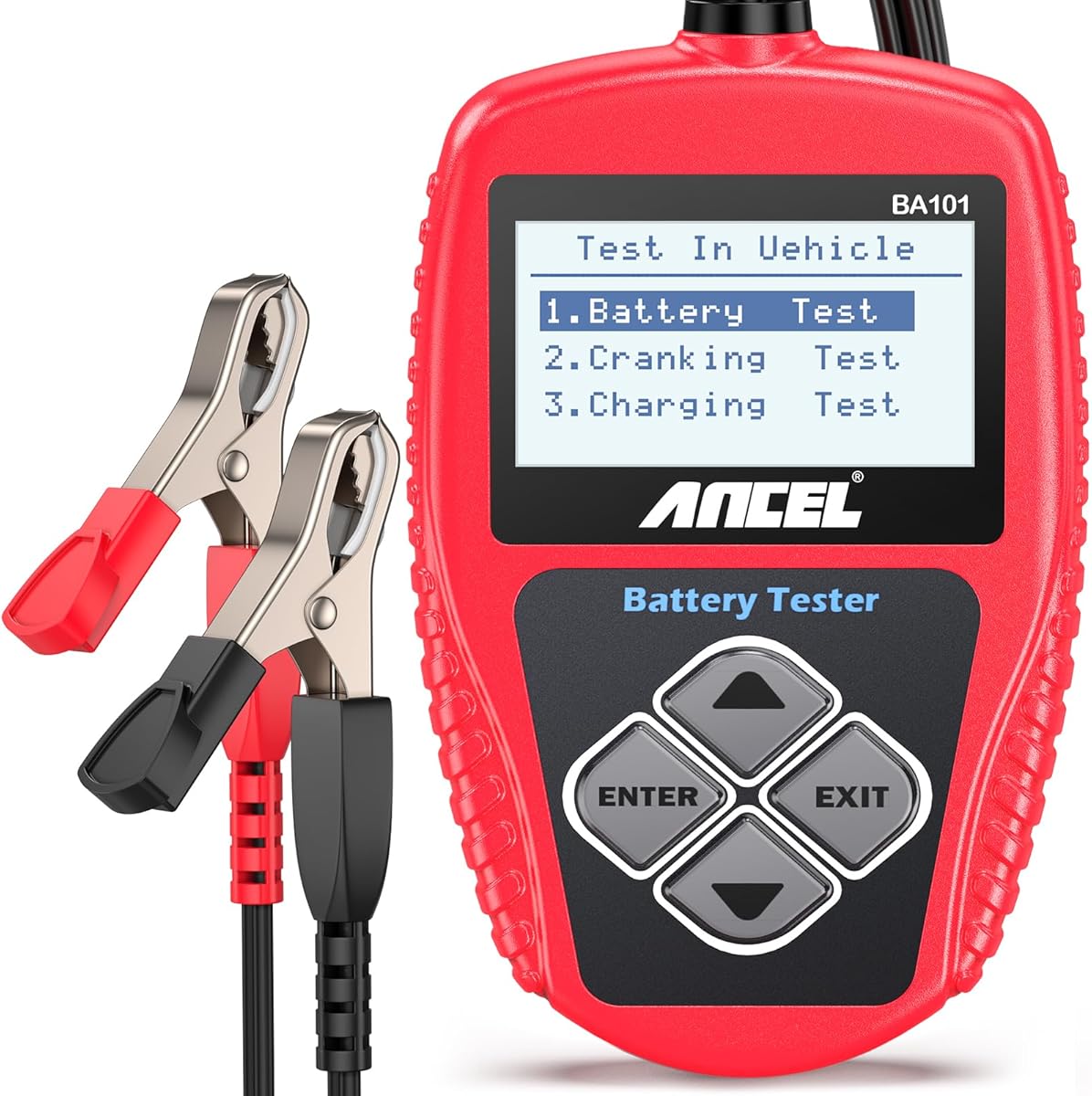
The ANCEL BA101 is a vehicle-battery diagnostic tool rather than a general-purpose internal-resistance meter. It evaluates 12V automotive batteries and provides State of Health, State of Charge, voltage, current, and cold-cranking-amp information, with additional tests for the starting and charging systems.
We may earn a commission when you buy through this link, at no additional cost to you.
Its 100–2000 CCA range supports a variety of cars, trucks, boats, recreational vehicles, ATVs, lawnmowers, golf carts, and motorbikes using batteries over 30Ah. Flooded, AGM, GEL, and EFB battery types are supported under several international standards, including JIS, EN, DIN, SAE, BCI, GB, CA, MCA, and IEC.
The tester draws power directly from the vehicle battery, eliminating the need for internal batteries. A black-and-white display, adjustable contrast, and white backlight support use in different lighting conditions. Protection against reverse polarity, short circuits, overcurrent, and overvoltage improves safety during hands-on automotive work.
The BA101 is ideal for diagnosing a starting or charging problem and checking the condition of supported 12V lead-acid batteries. It is not the right choice for lithium cells, 6V or 8V systems, 24V systems, or motorcycle batteries below the stated 30Ah capacity threshold, so its compatibility limits should be checked before purchase.
Cranking and charging tests help distinguish a weak battery from an alternator or starter problem. That broader diagnostic scope makes the BA101 especially useful for vehicle troubleshooting.
State of Health, State of Charge, CCA, voltage, and current are presented on a simple backlit screen. Entering the battery's correct type, rating, and temperature helps align the reading with the battery label.
We may earn a commission when you buy through this link, at no additional cost to you.
The ZOYI XR1 combines simultaneous battery voltage and internal-resistance measurement with a 25,000-count digital multimeter. Its battery mode supports resistance from 0.1mΩ to 200Ω and voltage up to 100V, making it suitable for small cells, rechargeable packs, and vehicle batteries.
We may earn a commission when you buy through this link, at no additional cost to you.
Four-wire Kelvin clips are used to minimize the influence of lead and contact resistance, an important consideration when comparing healthy and degraded batteries. The display offers adjustable brightness from 10% to 100%, while the user can select measurement ranges manually or rely on automatic adjustment.
The integrated multimeter handles AC and DC voltage, resistance, capacitance, frequency, temperature, diode testing, and continuity checks. This expands the tool beyond battery work, but the specification list does not provide the same level of detail about waveform recording, data logging, battery runtime, or advanced protective ratings as the ZOYI ZT-XR1 listing does.
The XR1 is a good fit for users who want a portable battery tester and a general multimeter in one device. It is less compelling than the more fully described ZT-XR1 for professional electronics work, but it may offer a simpler path for household technicians and advanced hobbyists who primarily need battery diagnostics.
The multimeter functions make it possible to check surrounding components without purchasing a separate meter. One-key access to battery testing keeps the device practical for mixed repair tasks.
A 0.1mΩ starting point and Kelvin clip connection support detailed cell and pack comparisons. The wide 200Ω upper range also accommodates higher-resistance batteries.
We may earn a commission when you buy through this link, at no additional cost to you.
The RC3563 is a handheld analyzer for internal resistance and voltage measurement. It uses a Kelvin four-wire test clamp to reduce the influence of contact and wire resistance, supporting more accurate comparisons than a basic two-lead battery checker.
We may earn a commission when you buy through this link, at no additional cost to you.
The product combines intelligent control, a liquid-crystal display, and a stated Kalman filter mathematical algorithm. Its portable format and internal 1000mAh lithium battery make it suitable for battery production, maintenance, laboratory research, and field service, with 5V charging from a suitable phone charger.
Beyond batteries, the instrument can measure the AC resistance of low-resistance capacitors and resistors. That secondary capability may be valuable in electronics education and component evaluation, although it should not be mistaken for a complete general-purpose LCR meter or a full automotive diagnostic analyzer.
The RC3563 is well suited to users who need portable, repeatable resistance testing across lithium or nickel-cadmium batteries. Its main limitation is that the supplied specifications do not state precise voltage or resistance limits, so buyers needing known boundaries or formal data logging should confirm compatibility before committing.
The ability to test low-resistance capacitors and resistors extends the instrument's usefulness for basic component analysis. It is a practical companion for repair benches and technical education.
A built-in lithium battery and handheld enclosure support mobile work without a continuous external power connection. The five-volt charging arrangement fits common charging setups.
We may earn a commission when you buy through this link, at no additional cost to you.
The YR1035+ Digital Battery Internal Resistance Tester is a focused instrument for measuring internal resistance and voltage simultaneously. Its true four-wire testing system is the central feature, providing a dedicated approach to battery diagnostics where lead and contact effects can distort ordinary resistance measurements.
We may earn a commission when you buy through this link, at no additional cost to you.
A large LCD presents the live voltage and resistance values in a straightforward format. The product listing describes it as suitable for performance testing, battery screening, and configuration across multiple battery types, making it relevant for users who want a portable tool without a full digital multimeter interface.
The combination includes both probes and clips, allowing users to choose a convenient connection method for different terminals or contact surfaces. Its compact, lightweight construction supports field work as well as bench testing, although the supplied details do not state exact voltage and resistance limits.
The YR1035+ is a focused choice for battery users who prioritize the sensing method and simultaneous readings over broad multimeter functionality. It is particularly attractive for screening and comparison tasks, but buyers should confirm battery-format compatibility and measurement limits for their specific cells.
Including both probes and clips gives users options for reaching terminals or attaching to larger battery lugs. This is useful when a single permanent test-contact arrangement would be inconvenient.
Showing voltage and resistance together makes it easier to interpret a battery's condition in context. The large LCD is appropriate for quick field checks and routine bench comparisons.
We may earn a commission when you buy through this link, at no additional cost to you.
The T-685 is a high-precision analyzer aimed at lithium battery packs, supercapacitors, and detailed laboratory or field analysis. Its resistance range begins at 1μΩ and extends to 200Ω, while its voltage range spans 1mV to ±100V DC, giving it specifications suited to very small resistance values.
We may earn a commission when you buy through this link, at no additional cost to you.
The instrument can measure both AC and DC resistance, automatically switch ranges, and offers six resistance gears plus three voltage gears. A stated testing pace of five times per second supports faster analysis of changing or multi-cell systems, while a balanced input-measurement system and LCR Kelvin four-wire clamp probes support measurement accuracy.
Additional professional features include USB computer connectivity and a bilingual Chinese and English interface. The meter is powered from AC110V or AC220V, so it is not as convenient for remote work as the battery-powered models in this list. Its customer rating is also noticeably lower than those of the other products, so prospective buyers should weigh the detailed features against the comparatively limited customer feedback.
The T-685 is most appropriate for a laboratory, battery workshop, or technically experienced user who needs micromohm-level measurement and AC/DC resistance analysis. For ordinary household batteries or mobile automotive checks, a smaller dedicated meter will usually be easier to use.
The 1μΩ lower limit distinguishes the T-685 from typical consumer-oriented testers. That range is useful for evaluating large cells, packs, and supercapacitors where small resistance changes matter.
Fast sampling, selectable gears, and USB connectivity support a more structured testing workflow. These features favor users who want to collect and examine more than a simple pass-or-fail reading.
We may earn a commission when you buy through this link, at no additional cost to you.
The YR1035+ square accessories combination is designed for voltage and internal-resistance testing across lead-acid, lithium, nickel-metal hydride, nickel-cadmium, and button batteries. Its voltage range extends to 99.999V, while resistance measurement covers 0 to 200Ω.
We may earn a commission when you buy through this link, at no additional cost to you.
The defining accessory is a Kelvin clamp that can be attached to positive and negative electrodes while leaving the user's hands free. It is also suitable for measuring lead ends and sheet-electrode lugs, giving it relevance for battery production, pack assembly, and workshop analysis.
A Type-C charging interface provides a convenient way to replenish the device, and the combination's square form factor is intended for portable use. Compared with more data-heavy instruments, the supplied description does not mention record storage, computer exports, or graph-based analysis, so its strongest appeal is direct measurement and connection flexibility.
This option suits users working with several battery formats who want direct contact at terminals or lugs without holding probes in place. Buyers should verify that the complete combination includes the main tester and all necessary leads, and should check its exact physical interface if they already own a related YR1035+ configuration.
The Kelvin clamp maintains contact across battery electrodes while leaving both hands available. This is helpful during production checks, pack diagnostics, and repeated comparisons.
Support for lithium, lead-acid, nickel-based, iron-phosphate, and button batteries makes the combination useful for mixed collections. The voltage and resistance limits cover common workshop and hobby applications.
We may earn a commission when you buy through this link, at no additional cost to you.
The right internal-resistance tester depends on the battery chemistries, terminal arrangements, precision requirements, and amount of data you need. Start with the measurement range, then consider four-wire sensing, display quality, power, records, and the type of work you will perform.
A useful tester must cover the voltage of every battery you intend to diagnose. The FNIRSI HRM-10, WESTOBIG HRM-10, ZOYI ZT-XR1, ZOYI XR1, and T-685 support measurements up to 100V, while the YR1035+ accessories combination reaches 99.999V. These limits are appropriate for many single cells, multi-cell packs, and 12V or 24V vehicle batteries. A tester with a lower maximum may still work for AA or household cells, but it could be unsuitable for automotive starter batteries or larger packs.
Choose a voltage range that comfortably covers your largest expected battery, not merely the smallest. Always confirm whether the maximum refers to DC, AC, or both, and follow the stated prohibition on AC input where applicable.
Resistance range determines the types of battery and component you can evaluate. Many general-purpose choices cover 0–200Ω, which accommodates a wide range of cells and packs. The ZOYI ZT-XR1 and XR1 begin at 0.1mΩ, the T-685 extends down to 1μΩ, and the WESTOBIG HRM-10 is described as capable of measuring resistance below 0.1Ω. Lower limits matter when resolving small differences between healthy and degraded high-current cells.
For routine household testing, a broad midrange is usually enough. For laboratory work, battery-pack screening, or supercapacitor ESR analysis, look for a low starting limit and clearly stated measurement accuracy.
A conventional two-wire measurement includes the resistance of the test leads and the contact points between probes or clips and the battery. A four-wire Kelvin design separates the current path from the voltage-sensing path, which helps remove these unwanted influences from the result. The FNIRSI, WESTOBIG, ZOYI ZT-XR1, ZOYI XR1, RC3563, T-685, and YR1035+ combinations all use or emphasize four-wire sensing.
Four-wire sensing is especially valuable for low-ohm batteries and packs with large terminal lugs. If your work involves close comparisons rather than a rough condition check, this connection method deserves more attention than a basic battery bay or two-lead design.
The term battery covers many shapes and chemistries with very different electrical behavior. The Dlyfull model supports common household formats from AA and AAA through C, D, 9V, lithium-ion cells, and button batteries. The ZOYI ZT-XR1 is listed for lithium, 18650, LiPo, LiFePO4, lead-acid, NiMH, alkaline, and supercapacitor testing. The ANCEL BA101 focuses on 12V flooded, AGM, GEL, and EFB automotive batteries and explicitly does not support lithium systems.
List your actual battery sizes and chemistries before choosing. A tester that covers only one format may appear specialized, while broad compatibility can simplify a mixed household, workshop, or collection. Always observe model-specific exclusions.
A dedicated battery tester focuses on voltage and resistance, while a 2-in-1 instrument can also handle general electrical work. The ZOYI ZT-XR1 and XR1 provide multimeter functions such as AC/DC voltage, resistance, capacitance, frequency, diode testing, continuity, and temperature. The ANCEL BA101 takes a different route with cranking and charging-system analysis, State of Health, State of Charge, current, and CCA measurements.
Choose a dedicated model for simple battery screening or a combined model when troubleshooting circuits, verifying components, and checking starting systems. Extra functions add versatility but can also increase cost, complexity, and the need to study the interface.
A clear display makes it easier to read voltage and resistance without transcription errors. The FNIRSI, WESTOBIG, and both ZOYI two-in-one models use color TFT screens, while the RC3563 uses a liquid-crystal display and the YR1035+ Digital Tester uses a large LCD. The ZOYI ZT-XR1 and XR1 provide adjustable brightness, which is useful in bright workspaces and when conducting detailed measurements.
Consider legibility, menu structure, units, and how the device presents simultaneous readings. A simple display is often better for occasional users, while graphs, MAX/MIN/AVG values, logs, and waveform curves serve users who need deeper analysis.
Recordkeeping can be more important than display features when batteries are tested repeatedly. The FNIRSI and WESTOBIG HRM-10 models support historical records, preset comparison groups, and export to a computer using spreadsheet-compatible tables. The ZOYI ZT-XR1 adds MAX/MIN/AVG values, a data log, and waveform curve recording, while the T-685 includes a USB port for computer connectivity.
If you maintain a battery inventory, monitor a growing collection, or need to document declining performance, data export adds meaningful value. For occasional spot checks, a model without records may be sufficient and easier to operate.
Power requirements affect where a tester can be used. The ZOYI ZT-XR1 has a rechargeable 2000mAh battery with a stated six-to-ten-hour runtime, the RC3563 includes a 1000mAh internal battery, and the YR1035+ combination uses Type-C charging. The ANCEL BA101 draws power from the connected vehicle battery, while the T-685 requires AC mains power and is therefore better suited to fixed workspaces.
Check the enclosure, weight, display visibility, connection accessories, and protective features as well. The ANCEL includes reverse-polarity, short-circuit, overcurrent, and overvoltage protection, while the ZT-XR1 lists CAT safety ratings. Portable and bench tools require different priorities, so choose based on where most testing will occur.
Before testing, identify the battery chemistry, rated voltage, and terminal arrangement, then select the appropriate measurement mode and range. Inspect the leads, clips, or probes for damaged insulation and clean contacts. For automotive testing with the ANCEL BA101, connect according to the instructions and enter the correct battery type, rating, and temperature from the battery label.
Connect the instrument directly across the battery's positive and negative terminals. With a Kelvin tester, attach the current and voltage contacts correctly and ensure that clips sit on clean conductive surfaces rather than insulating seals. Allow the reading to stabilize, record the voltage and resistance, and repeat the measurement in a consistent position to reduce variation caused by contact pressure.
After use, disconnect the tester before switching the battery off or removing it from a vehicle. Store the device in a dry area away from extreme heat, moisture, and corrosive chemicals, and recharge integrated batteries as needed. Clean the clips and probes with a dry or lightly dampened cloth, avoid abrasive cleaners, and periodically verify that the display and connections remain in good condition.
It measures the opposition to current flow inside a battery, usually alongside the battery's voltage. A rising internal resistance can indicate aging, damage, poor connections, or a loss of usable capacity. The result is most useful when compared with a healthy reference or when tracked repeatedly under similar conditions.
Generally, a lower reading is more favorable when comparing like batteries, but the value must be interpreted in context. Temperature, chemistry, charge state, terminal condition, and test method can all affect the result. A reading should not be treated as a universal pass-or-fail number without a manufacturer specification or a known baseline.
A four-wire design separates the current-carrying and voltage-sensing paths. This reduces the influence of test-lead resistance and contact resistance, which can otherwise dominate the measurement of a low-ohm battery. The improvement is especially noticeable when comparing cells whose internal resistance differs by only a small amount.
Some can, provided their voltage and resistance ranges cover both formats. The Dlyfull model is strongest for common household and button cells, while several FNIRSI, WESTOBIG, ZOYI, and YR1035+ options support automotive batteries and larger packs. Check the stated limits and battery-type exclusions before use.
A dedicated battery tester concentrates on voltage, internal resistance, and sometimes capacity or vehicle starting performance. A multimeter measures broader electrical properties such as voltage, resistance, continuity, capacitance, and frequency. The ZOYI ZT-XR1 and XR1 combine both categories, while the other focused models do not.
No. The BA101 is designed for compatible 12V flooded, AGM, GEL, and EFB lead-acid batteries. It also excludes 6V, 8V, and 24V systems and motorcycle batteries below its stated capacity threshold. A different model should be selected for lithium packs or other battery chemistries.
The correct procedure depends on the tester and battery type. Some automotive diagnostic tools are designed to assess a battery in its current state, while laboratory comparisons may require controlled charge levels. For the most consistent internal-resistance results, keep the battery's state of charge, temperature, and connection method consistent across tests.
Store it in a clean, dry place with moderate temperature and away from direct sunlight or corrosive materials. Protect the display and contacts from impact, coil cables loosely rather than sharply bending them, and keep the contacts clean and dry. Recharge models with built-in batteries periodically according to the manufacturer's guidance.
The FNIRSI HRM-10 stands out as the most balanced dedicated choice because it combines simultaneous readings, Kelvin four-wire sensing, a color display, and historical comparison tools. The Dlyfull universal tester is a more approachable option for everyday household batteries, while the YR1035+ Digital Tester provides a focused four-wire system with useful probe and clip options.
Prioritize the factors that match your work: voltage limit, resistance resolution, battery chemistry, connection method, and data needs. Technicians who also need electrical troubleshooting may prefer a ZOYI two-in-one model, while automotive users should consider the ANCEL BA101 for starting and charging analysis. Laboratory specialists can examine the T-685 for its unusually low resistance range and AC/DC measurement support.
Ratings, availability, and current prices can change, so check the latest product page before buying. Most importantly, verify the measurement range and exclusions for the specific batteries in your collection, and use consistent terminals, contact pressure, and test conditions so the readings can be compared meaningfully.