
Bose TV Speaker
4.3Editor score
Compact all-in-one sound bar
Enhanced vocal reproduction
Three wired device inputs
Our guide compares 10 external wireless TV speakers, covering sound quality, wireless range, connection options, portability, and features for clearer
External wireless TV speakers can make dialogue easier to hear, add room-filling sound to a small television, or provide private listening without wearing uncomfortable headphones. The right model depends on whether you want a compact sound bar, a portable personal speaker, a Roku-compatible surround system, or a flexible 2.1-channel home theater setup.
The ten products in this guide were compared using their supplied specifications, compatibility details, connection methods, wireless technology, portability, voice-clarity features, and user ratings. The list covers full-size sound bars, wireless speaker pairs, hearing-assistance systems, and portable receivers designed to bring television sound closer to the listener.
Each review identifies the strongest benefit and the most important trade-offs, while the comparison table makes the main differences easier to scan. Ratings and product availability can change over time, and current prices fluctuate, so readers should verify the latest listing details and TV compatibility before making a purchase.
4.3Editor score

4.6Editor score
4.3Editor score
This side-by-side comparison highlights the differences in product type, TV compatibility, wireless performance, connection flexibility, and portability, making it easier to identify the speaker system that matches your room and listening needs.


This detachable sound bar is a flexible all-in-one option for users who want more presence from modest television speakers. It carries a 4.1 rating and emphasizes practical flexibility: the enclosure can be positioned horizontally, vertically, on a tabletop, or wall-mounted, while four drivers provide the stated basis for its 80W output. Its strongest appeal is the ability to adapt the physical layout to different rooms rather than forcing one fixed arrangement.
We may earn a commission when you buy through this link, at no additional cost to you.
Automatic volume boost is useful when dialogue becomes difficult to hear, and the three equalizer modes simplify the choice between movie, music, and news listening. Bluetooth 5.0 permits convenient streaming from a phone or computer, while ARC, optical, and AUX connections cover common television and media-device outputs. In ARC mode, the included instructions are intended to let a television remote control the sound bar, reducing the need to reach for a separate controller.
The trade-off is that this remains a sound bar rather than a discrete surround or hearing-assistance system. Its detachable design and mode-based processing cannot be expected to provide the same directional separation as a full speaker array, and the stated power figure does not reveal everything about sound quality in a particular room. Nevertheless, the variety of placement options, multiple input paths, and three listening profiles make it unusually adaptable within the category.
This is a compelling choice for apartment dwellers, gamers, older adults, and anyone who wants a single speaker to serve television, computer, projector, and music playback. Choose it when flexible placement, straightforward connectivity, and automatic dialogue assistance matter more than a specialized home theater ecosystem. It is our most versatile pick, even though its rating trails some more specialized alternatives.
Rotating or separating the two sections can help distribute sound in a compact room. Horizontal placement favors a conventional front-facing sound-bar presentation, while vertical placement can help the enclosure direct audio across a larger listening area.
Bluetooth handles convenient wireless streaming, while ARC, optical, and AUX support a broader range of televisions and source components. That combination makes the system useful well beyond a single modern smart-TV setup.
We may earn a commission when you buy through this link, at no additional cost to you.
The Roku Wireless Speakers pair offers the most polished upgrade path for anyone already using a compatible Roku television or Roku audio product. Its 4.6 rating is the highest among the ten options presented here. The two speakers are engineered to create full, clear sound with high frequencies, dynamic bass, crisp dialogue, and synchronized audio and video, making the system especially appealing for viewers who want a surround-like experience without running cables around the room.
We may earn a commission when you buy through this link, at no additional cost to you.
Roku integration is the defining advantage. The speakers work with Roku TVs, the Roku Streambar, the Roku Streambar Pro, and the Roku Smart Soundbar, although the Streambar SE is not supported and non-Roku televisions and general Roku players are outside the stated compatibility. That limitation keeps the product focused, but it also means buyers should confirm their existing hardware before choosing it. Within the right ecosystem, the setup experience is direct: power the speakers and connect them wirelessly.
Speech Clarity helps lift voices, Volume Leveling reduces the abruptness of loud commercials, and Night Mode supports quieter viewing. Bluetooth also expands the system beyond television audio, allowing music to be streamed from a compatible phone. The main compromise is ecosystem dependence, and the lack of a traditional optical, AUX, or ARC path means this pair is not a universal solution for other televisions and audio systems.
For households centered on Roku, this is the strongest overall recommendation because it combines effortless wireless setup, useful dialogue controls, and a high user rating. It is less appropriate for owners of Samsung, LG, Sony, Vizio, or other non-Roku displays unless they are prepared to change their streaming hardware. For compatible users, the speakers deliver a clear and unusually convenient upgrade.
The speakers connect directly to compatible Roku displays and streaming devices, reducing cable clutter and menu configuration. Automatic synchronization supports a more natural relationship between on-screen action and dialogue.
Speech Clarity emphasizes voices, Volume Leveling moderates inconsistent commercial loudness, and Night Mode reduces the need to raise the overall television volume. Together, these controls are particularly useful after bedtime.
We may earn a commission when you buy through this link, at no additional cost to you.
The Bose TV Speaker is a compact, conventional sound bar designed around one central objective: making television sound clearer. Its 4.3 rating reflects a favorable balance of dialogue enhancement, natural-sounding output, and straightforward operation. Two angled full-range drivers spread sound outward to create a wider presentation than the slim enclosure might suggest, while the product's dialogue emphasis helps vocals and pronunciation stand out in films, news, and scripted programs.
We may earn a commission when you buy through this link, at no additional cost to you.
The connection options are familiar and practical. HDMI, optical, and AUX inputs support up to three devices, with the first powered-on source selected automatically. Bluetooth provides a separate route for music and podcasts, and the included remote offers a dialogue mode plus a bass boost. The optical cable is included, while an HDMI cable and optional wall-mount hardware are sold separately, so shoppers should account for those potential extras.
At just over two inches tall, the speaker is easy to position in front of a television or mount near it without overwhelming the screen. It can also work with the Bose Bass Module 500 or 700, but the required connection cable or a standard 3.5mm audio cable is sold separately. This makes the basic system complete as a TV speaker while leaving room for a more elaborate audio build later.
This model is best for viewers who want a recognizable, compact sound-bar design and value vocal clarity without navigating a large setup. It also suits anyone who might add a compatible Bose bass module later. It is less suitable for people seeking a complete wireless surround package or a portable receiver, but as a premium upgrade for a conventional television, it is refined and thoughtfully equipped.
The remote's dialogue mode complements the sound bar's vocal focus, giving viewers another way to improve speech in movies, interviews, and news. It can be especially helpful when the original soundtrack mixes dialogue with effects.
The low-profile enclosure works well beneath a television, on a narrow console, or near a wall. Its angled drivers preserve an open soundstage despite the modest footprint.
We may earn a commission when you buy through this link, at no additional cost to you.
The SIMOLIO 621D is a personal wireless TV speaker built specifically for seniors, hard-of-hearing viewers, and households that want a comfortable alternative to wearing television headphones. It receives audio through 2.4GHz technology and reproduces stereo sound without requiring the listener to sit directly in front of the television. Voice clarity technology, automatic gain control, and equalization adjustments help dialogue stand apart from background effects.
We may earn a commission when you buy through this link, at no additional cost to you.
The supplied headphone connection adds another layer of flexibility. Users can listen through the room-filling speaker or attach the included lightweight, noise-isolating stethoscope-style headset for private viewing with the television muted. The speaker also has its own large volume control, which avoids repeatedly changing the TV's main volume and disturbing other people in the room.
Its rechargeable battery supports up to eight hours of continuous operation. It can charge on its base or operate from a wall power adapter, making it easy to move between a living room, bedroom, kitchen, or another space. Two or more systems can operate simultaneously in separate rooms with the stated goal of avoiding crosstalk. Compatibility covers optical, RCA, and AUX outputs, and a bypass function is available when the TV's optical port is occupied.
This is a practical choice when bringing television sound closer is the main goal, especially for users who find conventional over-ear headphones uncomfortable. It is not a full-room home theater system, and HDMI ARC users need a separate converter. For its intended audience, however, the accessible controls, portable form, and personal-listening options make it one of the most purpose-built choices in the guide.
A receiver placed near the listener can deliver stronger, more intelligible television sound without forcing the whole room to a high volume. The included headset supports private viewing when even a portable speaker would be disruptive.
Automatic gain control, equalization, and voice clarity work together to make speech easier to distinguish. These features are more useful than simple volume amplification when background effects and music are the main problem.
We may earn a commission when you buy through this link, at no additional cost to you.
The SEREONIC system is designed to move television sound to wherever the listener is most comfortable. Its portable speaker uses a custom-tuned RF connection with a stated range of 100 feet, giving it more reach than several competing personal-speaker systems. The receiver can be carried between a bedroom, kitchen, den, or outdoor area, making it useful for viewers who do not want to remain directly in front of a screen.
We may earn a commission when you buy through this link, at no additional cost to you.
The base is compatible with RCA, 3.5mm auxiliary, and digital optical outputs. It supports all digital audio formats identified by the manufacturer, including Dolby and PCM, and does not require an audio converter when connected through a supported output. An HDMI converter is needed for HDMI-only sources. Because the base must still be physically connected to the television, the product is wireless between the base and speaker rather than entirely wireless from the source.
Audio output is stated at up to 95dB, and the rechargeable system operates for up to eight hours after roughly three hours of charging on the USB-powered base. The speaker can also use a standard charger directly. These specifications make it convenient for a portable television setup, although actual battery duration will depend on use and operating conditions.
The SEREONIC is a strong match for seniors, hard-of-hearing viewers, and households with a very large TV in a distant viewing area. It is not ideal for someone who needs a true surround sound field or wants the television connection itself to be wireless. Within its portable personal-audio niche, it combines useful range, broad source compatibility, and straightforward charging.
A 100-foot operating range allows the receiver to move beyond a conventional seating arrangement. It is useful in open-plan homes, for a bedroom television, or when the listener wants to follow ordinary activities while following the program.
Compatibility with Dolby and PCM audio means the base can work directly with many supported television outputs. This avoids the extra converter required by some competing portable systems.
We may earn a commission when you buy through this link, at no additional cost to you.
This renewed version of the Roku Wireless Speakers gives compatible users another route into a wireless two-speaker Roku audio setup. It retains the defining strengths of the platform: room-filling presentation, clear dialogue, dynamic bass, synchronized sound and picture, and cable-free connection to a compatible Roku TV, Streambar, or Smart Soundbar. Its 4.2 rating is slightly below that of the new pair but still solid.
We may earn a commission when you buy through this link, at no additional cost to you.
The setup is refreshingly simple. Once the speakers have power, they connect wirelessly to the supported Roku source, avoiding cables stretched around a media console. Bluetooth opens the speakers to music and podcast streaming, while Speech Clarity, Volume Leveling, and Night Mode improve speech, commercial consistency, and late-night comfort. Automatic software updates also keep the system current without requiring manual maintenance.
Renewed status is the key consideration. A refurbished listing may involve prior use, visible wear, or a different packaging and accessory condition, so buyers should review the seller's description and return terms carefully. As with the new version, compatibility is narrow: it does not work with other televisions, general Roku players, or unrelated sound systems, and the required Roku hardware is sold separately.
This option is most appealing to a Roku household seeking the core benefits of the platform at a lower outlay than the new product. Choose it when you are comfortable with a renewed unit and have confirmed the seller's condition standards. It remains a strong option for adding convenient, dialogue-focused wireless sound without a complicated wiring project.
Condition details can vary between renewed inventory, so shoppers should examine photographs, included accessories, cosmetic expectations, and warranty information. The underlying platform features remain attractive even when the purchase is value-oriented.
The speakers connect wirelessly to supported Roku hardware, making it easier to place each unit on opposite sides of a room. That flexibility can improve the sense of space without running long audio cables.
We may earn a commission when you buy through this link, at no additional cost to you.
The ULTIMEA 2.1 system is the most ambitious home-theater package in the guide, pairing a sound bar with a dedicated wireless subwoofer. Its 4.3 rating reflects a feature-rich approach designed to deliver stronger low-frequency output, clearer dialogue, and flexible placement. The subwoofer connects without an audio cable, allowing it to sit along a side wall, behind a sofa, or in another suitable position without limiting the arrangement to one spot.
We may earn a commission when you buy through this link, at no additional cost to you.
The system advertises 240W peak output across a 2.1-channel design, a frequency response of 45Hz to 18kHz, and a maximum sound pressure level of 95dB. The subwoofer uses an 18mm high-excursion driver within a 6.5L tuned cabinet. BassMX technology focuses on the 45–150Hz range, while VoiceMX isolates and enhances vocal frequencies in real time using adaptive equalization and gain control.
Control is more involved than on a basic sound bar, but that can be an advantage. The Ultimea app provides a ten-band equalizer and 121 preset EQ matrices for movies, music, and games, with over-the-air updates included. Bluetooth 6.0 supports fast pairing and stable streaming from phones, tablets, and laptops. The physical system is larger and more complex than the compact alternatives because it includes a separate subwoofer.
This is a strong recommendation for a dedicated living room, gaming area, or home theater where impactful bass and user-adjustable tuning are priorities. It is less appropriate for someone wanting a tiny speaker with minimal setup, and the app adds a layer of configuration that some buyers may not want. For those willing to tune the system, it offers considerable control and a well-rounded 2.1 presentation.
A ten-band equalizer and extensive preset library make it possible to adjust the system for different program types or room characteristics. The result is more control than a simple three-mode sound bar can provide.
Without a subwoofer cable crossing the floor, the low-frequency unit can be positioned for the room and the seating arrangement. The dedicated 6.5L cabinet also gives the bass driver more volume than a compact all-in-one bar can provide.
We may earn a commission when you buy through this link, at no additional cost to you.
The VigorKeeper 5.8GHz system focuses on making television dialogue easier for seniors and hard-of-hearing viewers. It amplifies audio and can also act as an external replacement when built-in television speakers are unsatisfactory. The speaker supports a stated 50-foot wireless range and uses 5.8GHz transmission, with automatic linking intended to remove complicated pairing steps. Its 3.5 rating is the lowest in this selection, so buyers should examine the complete specification and compatibility details carefully.
We may earn a commission when you buy through this link, at no additional cost to you.
Source flexibility is one of its strongest attributes. The base supports ARC, AUX, RCA, coaxial, and optical connections, and the product description states that the necessary cables are included. Voice Mode is intended to enhance dialogue and reduce background noise, while a large two-in-one power and volume knob keeps routine operation simple for older users.
The speaker is portable enough to move between the kitchen, bedroom, or patio, which allows a listener to bring sound closer without turning up the television for everyone else. It does not share the extended range of the SEREONIC or ANSTEN systems, and its actual performance in a home will depend on walls, furniture, and the television's output behavior. Compatibility is not universal, so confirming the available ports is essential.
This product is most useful for an older viewer who values simple controls and broad wired source options more than advanced app tuning or multi-speaker surround sound. Its low rating warrants caution, but the targeted design remains compelling for a household seeking a straightforward personal television speaker. Prospective buyers should check their television model and ensure the listed connections align with the available outputs.
The base and receiver are designed to connect after the base is powered, avoiding a more involved pairing process. This simplicity is valuable for users who want clearer television audio without navigating complicated network settings.
ARC, AUX, RCA, coaxial, and optical connections cover many television outputs and legacy media devices. The range of options makes the system less dependent on one particular television brand or model.
We may earn a commission when you buy through this link, at no additional cost to you.
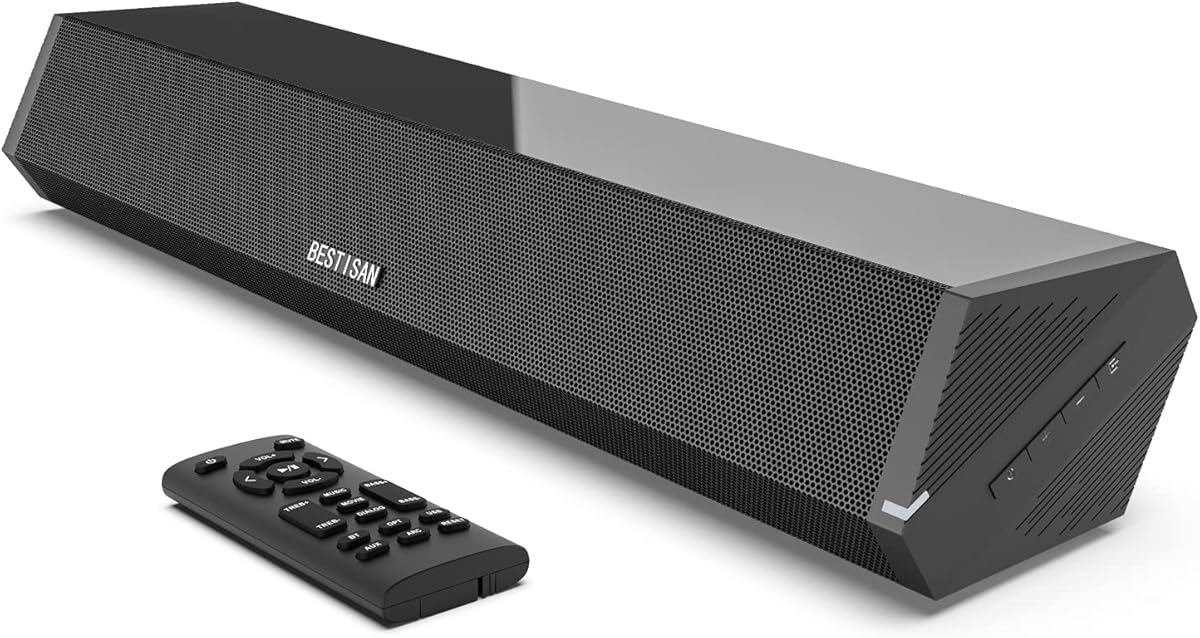
The Bestisan 16-inch sound bar is a straightforward upgrade for a smaller television, bedroom, office, kitchen, or dorm room. It combines two full-range drivers with two U-style tubes and states up to 50W peak output, while its 4.3 rating suggests that buyers can expect a worthwhile improvement over basic built-in television audio. The low profile is one of its most important practical advantages.
We may earn a commission when you buy through this link, at no additional cost to you.
DSP processing and three equalizer modes let users tailor the output for movies, music, or news. HDMI ARC and optical inputs handle television audio, while Bluetooth 5.3 permits streaming from a phone, tablet, computer, or projector. AUX, USB, and subwoofer output expand the system's versatility further. HDMI CEC can also allow a television remote to control basic sound bar functions, depending on the television and selected connection.
The enclosure is only 16 inches long, yet the manufacturer positions it for room-filling sound in small spaces. That claim should be considered in context: a compact bar cannot reproduce the scale of a larger home theater system or true surround system, but it can make dialogue more present and music more enjoyable where such a large speaker would be impractical. Its rubber feet help maintain stability on a tabletop, and the bar can also be wall-mounted.
This is our best budget recommendation because it covers the essential functions without requiring a specific television ecosystem or an app. It is an especially good match for users who want HDMI ARC, Bluetooth, and multiple sound modes in a small footprint. The trade-off is that the sound bar is intended to supplement or replace built-in speakers, not to create a fully immersive multi-channel home theater.
The short enclosure can sit beneath a modest television without dominating the console. It is also practical for offices, kitchens, and dorm rooms where space and visual bulk are important concerns.
HDMI ARC, optical, AUX, USB, Bluetooth, and subwoofer output provide several ways to connect. The variety is unusually helpful for a compact entry-level bar, especially if the television's available ports differ from newer models.
We may earn a commission when you buy through this link, at no additional cost to you.
The ANSTEN portable speaker combines television-audio delivery with a 100-foot wireless range, voice-highlighting tools, and an emergency alarm. Its 4.0 rating places it among the stronger options for older users and hard-of-hearing viewers who want sound delivered closer to the listener. The result is intended to improve dialogue without requiring the entire household to listen at an uncomfortable television volume.
We may earn a commission when you buy through this link, at no additional cost to you.
The speaker uses 2.4GHz wireless technology for low-latency audio, while the base connects through optical, RCA, or 3.5mm auxiliary output. All three audio cables are included according to the supplied information. Television models with only HDMI require an external converter, and an optical splitter may be needed if the optical output is already in use. These compatibility details should be confirmed before ordering.
Its battery supports up to ten hours of continuous playback, the longest stated runtime among the portable systems in the guide. Users can recharge the speaker on the included base or connect it directly to a wall adapter. A headphone jack offers private listening, although headphones are not included. The ergonomic handle and broad range make it easy to carry throughout the home, and the SOS switch activates an audible alarm for emergency situations.
The alarm adds a distinctive safety function for seniors and anyone who may need to call for help from another room. It does not replace a medical alert system, and buyers should understand it as an additional alert feature. The speaker is a good fit for private listening, portable television viewing, and long-range household use, but it is less suitable for shoppers seeking a conventional sound bar or a multi-speaker home theater experience.
The prominent SOS switch can sound an alarm nearby when a user needs assistance. It adds a distinct layer of usefulness for seniors and caregivers, although it should not be treated as a substitute for a dedicated medical alert service.
With a stated range of 100 feet, the receiver can move from a living room to a kitchen, bedroom, or other area. The long battery life and included charging base make that flexibility easier to maintain.
We may earn a commission when you buy through this link, at no additional cost to you.
The right external wireless TV speaker depends on your television, room, listening priorities, and tolerance for setup. Connection compatibility, speech enhancement, wireless range, battery life, and sound format should all be considered before choosing.
Start with the outputs available on your television. Some systems depend on optical, RCA, or 3.5mm audio connections, while others are designed exclusively for a Roku television or Roku audio product. ARC, HDMI ARC, and optical are common TV options, but the terminology and availability vary by model. A television that only provides HDMI may require an external converter, and a sound bar or optical splitter may be needed if that port is already occupied.
Choose only a system whose stated source requirements match your setup. Compatibility is more important than a headline wireless range or a large power figure because a speaker cannot solve a connection mismatch.
A sound bar is designed to improve sound for everyone in a room, generally producing a broad front soundstage from a single enclosure. A personal or portable speaker is meant to bring television audio closer to one listener, often with a rechargeable receiver and a long wireless range. Wireless speaker pairs add left-right placement but may require a particular television ecosystem.
Choose a sound bar for shared viewing and home theater, or a personal speaker for individual listening, mobility, and hearing accessibility. A two-speaker system is best when your existing television and streaming platform support it directly.
Dialogue-focused processing can include voice highlighting, dialogue modes, automatic gain control, treble adjustment, or speech clarity. These tools are useful when actors are difficult to understand, commercials vary sharply in loudness, or late-night viewing requires a lower overall level. They are not identical to professional dialogue repair, but they can make everyday television easier to follow.
Prioritize models with a dedicated voice or dialogue control when speech clarity is the main concern. For a shared room, look for automatic leveling as well so the difference between programs and advertisements becomes less distracting.
Wireless specifications vary from 2.4GHz and 5.8GHz personal systems to RF transmission and ecosystem-based speaker connections. A stated range of 50 to 100 feet can be useful in large homes, although walls, furniture, appliances, and the placement of the base affect real-world performance. Low latency matters because sound that arrives after the picture feels disconnected from the action.
Treat maximum range as a potential rather than a guarantee. Check whether the system uses a dedicated base, requires the base to remain connected, and is designed for synchronized audio and video.
Portable television speakers are useful when the main screen is too far away, when a viewer wants to listen in another room, or when built-in television audio is inadequate. Stated runtimes in this guide range up to eight or ten hours, with charging bases providing convenient storage and power. A handle, lightweight enclosure, and direct wall-power option improve daily usability.
Check the charging method and expected use pattern before buying. If the speaker will remain beside one television, a wired sound bar may be simpler. If it will travel around the home, prioritize battery life, a stable base, and simple controls.
Compact sound bars are best suited to bedrooms, offices, kitchens, dorm rooms, and smaller apartments. Larger 2.1-channel systems with a separate subwoofer can provide more low-frequency impact and greater placement flexibility in a dedicated living room. Claimed peak wattage is useful for comparing format classes, but it does not reveal sensitivity, distortion, frequency balance, or perceived loudness.
Consider speaker dimensions, furniture placement, and the television size before focusing on output numbers. A physically well-positioned compact system can sound more convincing than a larger product crowded against a wall.
Wired inputs provide stable television audio, while Bluetooth allows music and podcasts from a phone or computer. Some products support HDMI, optical, AUX, RCA, coaxial, USB, and subwoofer output simultaneously. Others offer only ecosystem-based wireless audio and Bluetooth streaming. More connections increase flexibility but can also make setup less simple.
List the sources you actually use. If the system will serve a television and a phone, Bluetooth is worth prioritizing. If it will also handle a game console, projector, or disc source, make sure the appropriate wired output is present.
Remote controls, large volume knobs, app-based equalizers, night modes, wall mounting, and private headphone outputs can meaningfully improve usability. App control offers fine-grained adjustment but may be unnecessary for a simple television setup. A headphone jack provides private listening, although the required headphones may not be included. Emergency alert switches may be valuable for some senior users.
Choose extras that solve a problem in your home rather than simply increasing the feature count. Easy controls, included cables, and a useful charging base often matter more than elaborate presets.
Begin by identifying the correct audio output on the television and connecting the supplied base, sound bar, or receiver. For an ARC or HDMI ARC setup, enable the appropriate television audio setting and select the matching input on the speaker. When using optical, RCA, coaxial, or AUX connections, match the connector type and remove the protective caps from optical cables before insertion. Wireless speaker pairs should be placed on opposite sides of the listening area, while personal receivers belong near the person who needs clearer sound.
After the source is working, adjust the television's own volume downward and use the speaker's volume control for the preferred level. Select a dialogue, news, or voice mode for spoken content, a movie mode for mixed entertainment, and a music mode when appropriate. On systems with app equalization, make small changes and listen to familiar dialogue before making large adjustments. For portable units, charge the receiver on its base or use the supplied power adapter, and avoid leaving a depleted battery connected for long periods.
For best results, place the sound bar at ear level or near television height, keep the subwoofer away from walls if bass becomes boomy, and allow the portable receiver to remain in an open area. Clean the enclosure with a soft, dry cloth rather than liquid cleaners, and keep ports and speaker openings free from dust. If a wireless link becomes unstable, move the receiver away from dense obstructions, reboot the base, and recheck the source selection. Always follow the manufacturer's charging, battery, and medical-device guidance included with the product.
Not every wireless TV speaker works with every television. Personal systems commonly use optical, RCA, or 3.5mm audio outputs, while some sound bars support HDMI ARC. Roku Wireless Speakers require compatible Roku TVs or Roku audio hardware. Check both the output type and any restrictions listed in the product description before purchasing.
It depends on the television's audio outputs and the speaker system's input options. Many televisions provide optical, RCA, or headphone outputs, and newer models may include HDMI ARC. A system that uses a proprietary wireless base connects to the television through a compatible wired output, so the base may still require a cable even though the portable speaker does not.
Personal wireless speakers with voice highlighting, automatic gain control, and a large independent volume control are often the most practical. They bring sound closer to the listener without requiring the whole household to raise its volume. A private headset output can also help when even a portable speaker would disturb other people.
A sound bar is a single or detachable enclosure intended to project sound toward a shared audience. Wireless TV speakers may refer to a left-right pair that connects to compatible television hardware or a portable receiver designed for one listener. The former is usually better for a living room, while the latter emphasizes mobility, extended range, and personal listening.
No. A wireless subwoofer avoids the audio cable that would normally run between it and the sound bar, but the main sound bar and any wireless base may still need power and a connection to the television or source device. The exact wiring depends on the system's supported inputs and installation.
The products in this guide use wireless methods intended to minimize delay, and some specifically state zero-lag or low-latency transmission. Actual performance can vary with interference, distance, obstacles, and the selected connection. Keeping the receiver in the open and within the intended range helps maintain synchronization.
Many of the listed systems support Bluetooth streaming from a phone, tablet, or computer. The Roku speakers also emphasize Bluetooth music streaming, and several sound bars offer wireless playback for mobile devices. A television-connected personal speaker may require switching from its base source to Bluetooth before using another device.
It depends on the television and the selected model. Optical, RCA, and AUX systems often include their necessary cables, while HDMI-only televisions may require an external HDMI converter. A sound bar may also need an HDMI cable or wall brackets if those accessories are not included. Review the package contents and port list before ordering.
The Roku Wireless Speakers stand out as the strongest overall option for compatible households, offering cable-free placement, useful speech controls, and the highest rating in the guide. The Bose TV Speaker serves as a polished premium choice for a conventional television, while the Bestisan compact bar offers broad essential connections and multiple sound modes in a space-saving design.
The right alternative depends on the problem being solved. Choose a portable system for one listener, long wireless reach, and quieter household viewing; choose a 2.1-channel system for deeper bass and app-based tuning; and verify platform restrictions before buying a Roku-specific pair. Dialogue tools, compatible outputs, and room size should take priority over headline power or maximum range.
Ratings, stock, bundle contents, and prices can change, and television port configurations vary by model. Review the current listing, manufacturer instructions, and compatibility notes before ordering. With those checks completed, the right external wireless TV speaker can make evening television easier to hear, more engaging, and better suited to the room.