
HGLRC Mini M100 GPS Module
4.6Editor score
Suited for 2–7-inch drones
Broad 3.3–5V input
Compact ceramic-antenna design
Power and PPS indicators
This expert guide compares 10 GPS modules for drones by satellite support, compass accuracy, protocol compatibility, update rate, and installation ease for
GPS modules give drones reliable position data, satellite-based navigation, return-to-home support, and the directional awareness needed for autonomous missions. A suitable module should do more than acquire a signal: it must work with your flight controller, suit the aircraft’s weight and mounting limits, and provide accurate heading information.
We compared all ten options using the supplied specifications, including GNSS support, chipset generation, compass integration, protocol compatibility, refresh rate, dimensions, power requirements, mounting approach, and intended drone type. The list covers compact racing modules, fixed-wing units, and platform-oriented receivers for Pixhawk, PX4, INAV, and other flight systems.
Each pick reveals where it fits best in a real build, whether that means lightweight FPV installation, multi-constellation coverage, dedicated compass support, or straightforward return-to-home integration. Ratings reflect the listed customer feedback, while specifications can change with firmware and revisions. Prices and availability also change, so confirm current details before ordering.
4.6Editor score
4.8Editor score

The table below compares the ten modules by positioning platform, navigation features, compass integration, electrical or protocol details, and their most appropriate drone applications.




The HGLRC M100 Pro combines an upgraded 10th-generation positioning chip with a QMC5883L compass in a package intended for FPV fixed-wing UAVs. Its listed customer rating is 4.6 out of 5, placing it among the well-regarded options in this guide. The defining feature is the expanded 120-channel receiver, which gives the module broader satellite-acquisition potential than a basic single-purpose GPS design.
We may earn a commission when you buy through this link, at no additional cost to you.
Its integrated compass is especially relevant to fixed-wing aircraft, where heading data can influence navigation, return-to-home behavior, and general flight stability. Combining the GPS receiver and magnetic compass in one compact module can also reduce the number of separate components that need to be positioned around the airframe. That matters because antenna and compass placement can be just as important as the chip itself.
The supplied specifications do not state the exact supported flight-controller protocols, voltage range, dimensions, or update frequency. Consequently, pilots should not assume universal compatibility merely from the FPV fixed-wing description. They should verify the connector, serial settings, and navigation features required by their flight controller before installation.
This module is a sensible choice for builders who want an updated receiver, extensive channel support, and an integrated compass in a fixed-wing FPV aircraft. It is especially appealing when reducing external components is a priority. Confirm electrical and protocol requirements first, but the M100 Pro offers a focused and practical feature set for the intended platform.
The expanded 120-channel receiver is designed to improve the range of satellites the module can work with during acquisition and tracking. That can be useful in open-sky environments, although real-world performance also depends on antenna placement and surrounding interference.
The QMC5883L compass supplies magnetic heading data without requiring a separate compass module. Pilots still need to install the unit away from motors, power wiring, and carbon fiber where possible.
We may earn a commission when you buy through this link, at no additional cost to you.
The HGLRC M100-5883 is a compact 10th-generation GPS and compass module designed for FPV fixed-wing UAVs. It carries a 4.5 customer rating and pairs a ceramic antenna with an externally expanded PCB for satellite reception. Its compact dimensions and low weight make it more approachable for small aircraft than a larger platform receiver.
We may earn a commission when you buy through this link, at no additional cost to you.
GPS, Galileo, and BeiDou positioning provide several satellite systems for acquisition and navigation. The QMC5883 compass is intended to identify direction quickly and support accurate positioning. This combination gives a fixed-wing builder the two major references needed for autonomous navigation: a global position and a magnetic heading.
At 21mm square and 7.73g, the module is easy to incorporate into a compact airframe, though its actual connector arrangement and mounting method should be checked before cutting carbon fiber. The supplied information does not list supported protocol types, supply voltage, or refresh rate, so compatibility with a particular flight controller remains the main buying question.
Choose the M100-5883 when a pilot wants a light, compact fixed-wing GPS with integrated compass and multi-system reception. It is a particularly useful option for builds where every gram and millimeter matters, provided its electrical connection matches the selected flight controller and navigation setup.
Support for GPS, Galileo, and BeiDou broadens the available satellite network. Combined with the ceramic antenna and expanded PCB, this positioning system is well suited to fixed-wing aircraft that regularly travel beyond dense urban areas.
The 21mm dimensions and 7.73g weight are practical for compact UAVs. Keeping the module light preserves room for batteries and other equipment while making the installation less conspicuous.
We may earn a commission when you buy through this link, at no additional cost to you.
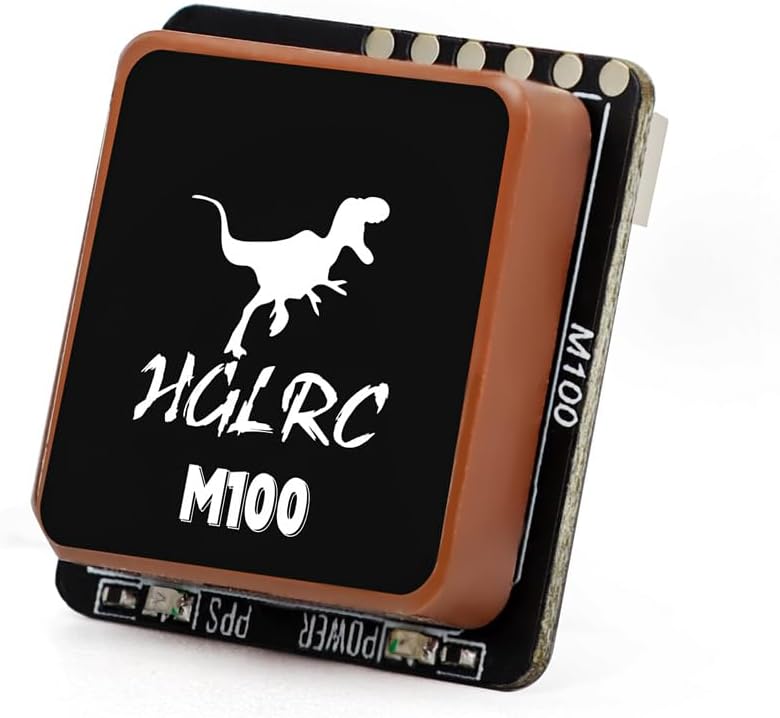
The HGLRC Mini M100 is built for the practical needs of 2- through 7-inch FPV and traversal drones. Its listed 4.6 rating indicates solid customer reception, while the compact ceramic antenna and expanded PCB keep the module suitable for size-sensitive builds. It is one of the most approachable options for racers adding location awareness to an existing platform.
We may earn a commission when you buy through this link, at no additional cost to you.
The module accepts 3.3–5V DC input, giving builders some flexibility when working with different flight-controller power systems. Onboard power and PPS indicator lights provide immediate visual feedback about operating status, which is useful during initial setup when a compact build leaves little room for an external display.
Unlike several other products in this list, the Mini M100 description does not mention an integrated magnetic compass. If the flight controller or aircraft requires heading data, pilots may need a separate compass or a navigation setup that already provides one. Protocol support and update frequency also are not stated in the supplied data.
The Mini M100 is a good budget-oriented choice for small FPV and traversal aircraft where a lightweight receiver and broad input range matter most. It is best for pilots who already understand their flight controller’s GPS and compass configuration and can confirm that the provided connector and data format meet the build’s requirements.
The stated support for 2- to 7-inch drones makes this module a flexible option for a wide collection of FPV platforms. Its suitability still depends on available mounting space, connector orientation, and the airframe’s navigation requirements.
Separate power and PPS indicators make it easier to determine whether the module is powered and receiving timing information. This reduces guesswork during bench testing and initial outdoor setup.
We may earn a commission when you buy through this link, at no additional cost to you.
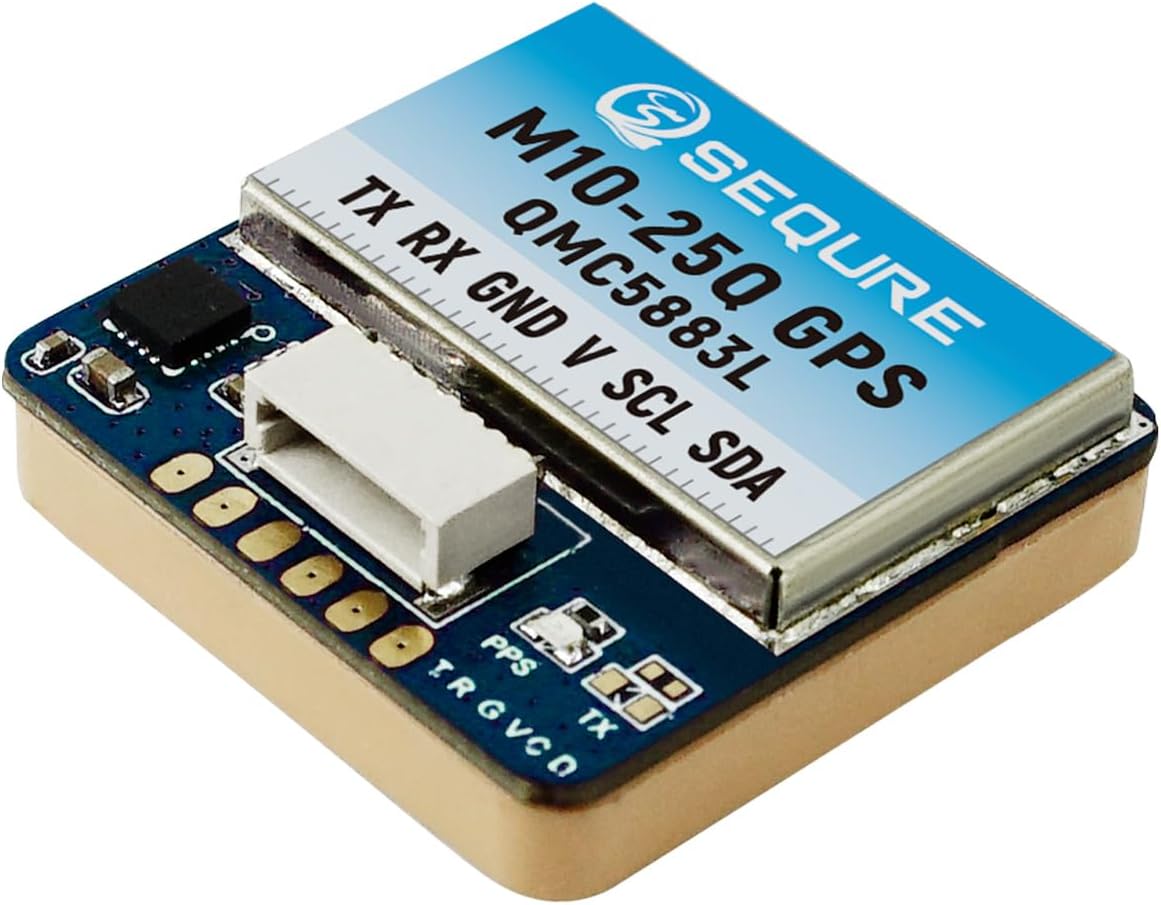
The SEQURE M10-25Q is the most complete all-around package in this guide, earning a 4.8 customer rating. It uses an upgraded 10th-generation chip for the Ublox protocol, offers 10Hz output, and includes a QMC5883L compass. Most importantly for FPV builders, it supports GPS, GLONASS, BDS, GALILEO, SBAS, and QZSS.
We may earn a commission when you buy through this link, at no additional cost to you.
The six-system support creates a particularly strong acquisition case for fixed-wing, long-range, and racing drones that may travel across different regions. A 10Hz output frequency provides a frequent stream of position updates, while the listed lower power consumption is helpful for airborne platforms. The ceramic antenna and expanded PCB are designed to maintain effective satellite reception.
Installation is flexible because the module offers two connection methods: a plug-and-play arrangement and a soldering option. That gives new builders a simpler path while preserving access to a permanent connection for experienced pilots. The stated target is compatible with 5-inch and larger UAVs, so pilots with especially tiny frames may need to check dimensions before choosing it.
This is the top overall recommendation for a pilot who values broad GNSS support, frequent updates, flexible wiring, and an integrated compass. It combines several features that are usually separated across competing modules, and its strong customer rating reinforces its value. Verify physical clearance and confirm the appropriate flight-controller settings before final installation.
GPS, GLONASS, BDS, GALILEO, SBAS, and QZSS support gives the module access to a broad collection of navigation signals. More available systems can improve acquisition opportunities and make the receiver better suited to varied flight locations.
The 10Hz output frequency refreshes position data ten times per second, which is useful for responsive navigation. Lower power consumption is another important advantage on a drone where every electrical component affects the overall flight endurance.
We may earn a commission when you buy through this link, at no additional cost to you.
The JeeFly M8N is a premium-featured GNSS receiver built around a high-sensitivity, 72-channel Ublox M8N chip. It supports GPS, GLONASS, BeiDou, and QZSS simultaneously, with tracking of 26 or more satellites. The stated positional accuracy is 0.5 meters, improving to 30 centimeters under ideal conditions, making it a compelling option for platform-oriented drone builds.
We may earn a commission when you buy through this link, at no additional cost to you.
Its 10Hz refresh rate supports real-time navigation, autonomous flight, and return-to-home behavior. The integrated compass handles heading control, while a blue LED indicates lock status and a red LED shows power. A 270mm cable with power, ground, serial, and I2C connections is included along with a mounting base, making the package more complete than a bare receiver board.
Compatibility is broad but not universal. The module works with Pixhawk, PX4, and F4 or F7 flight controllers, while APM is explicitly unsupported. Some Pixhawk models require a firmware update, and pilots should also account for the relatively large antenna mount compared with the smallest racing modules.
The M8N is best for serious autonomous, mapping, or long-range platforms where multi-GNSS reception, rapid updates, and a built-in compass justify the larger installation. It is less suitable for a tightly packed micro-drone or a build that cannot accommodate the included cable and mount. Confirm flight-controller hardware, connector pinout, and firmware before installation.
The 72-channel receiver and simultaneous use of four satellite systems create a strong foundation for autonomous aircraft. The reported 0.5-meter accuracy is useful for navigation, although ideal-condition figures should not be confused with guaranteed real-world performance.
The 270mm cable and mounting base simplify integration into larger airframes. Clearly separated GPS and I2C connections support both position data and compass communication, while status LEDs make initial lock checks straightforward.
We may earn a commission when you buy through this link, at no additional cost to you.
The Readytosky M10 is designed specifically for the Pixhawk 2.4.8 flight controller and includes an external compass and GPS holder. Its 4.2 rating is the lowest numeric score among the rated products in the guide, but the narrow platform focus may make it highly relevant for builders with that exact controller. It is not a general-purpose module for interchangeable flight stacks.
We may earn a commission when you buy through this link, at no additional cost to you.
The M10 receiver is described as a new-generation solution with low power consumption and high precision. Its stated ideal-environment positioning accuracy is 1.5 meters CEP. Onboard flash preserves configuration changes after power is removed, reducing the need to restore settings whenever the aircraft is rebooted.
The separate external compass gives pilots more freedom to position the magnetometer away from motors, ESCs, batteries, and current-carrying wires. The included holder assists with mounting, but the overall package still requires a compatible Pixhawk 2.4.8 and correct serial connection.
Choose the Readytosky M10 if you already use the specified Pixhawk hardware and want a matched GPS-and-compass package. Its saved configuration and external compass are useful features for repeatable autonomous builds. It is a poor choice for an F4 racing stack or a different flight controller, so compatibility must come first.
A separate compass can be mounted away from interference sources, which may improve heading reliability. The mounting holder included with the module supports this more flexible physical arrangement.
Onboard flash stores settings after they are configured. This is convenient for autonomous or repeatable builds because the module does not need to be reconfigured each time its power is removed.
We may earn a commission when you buy through this link, at no additional cost to you.
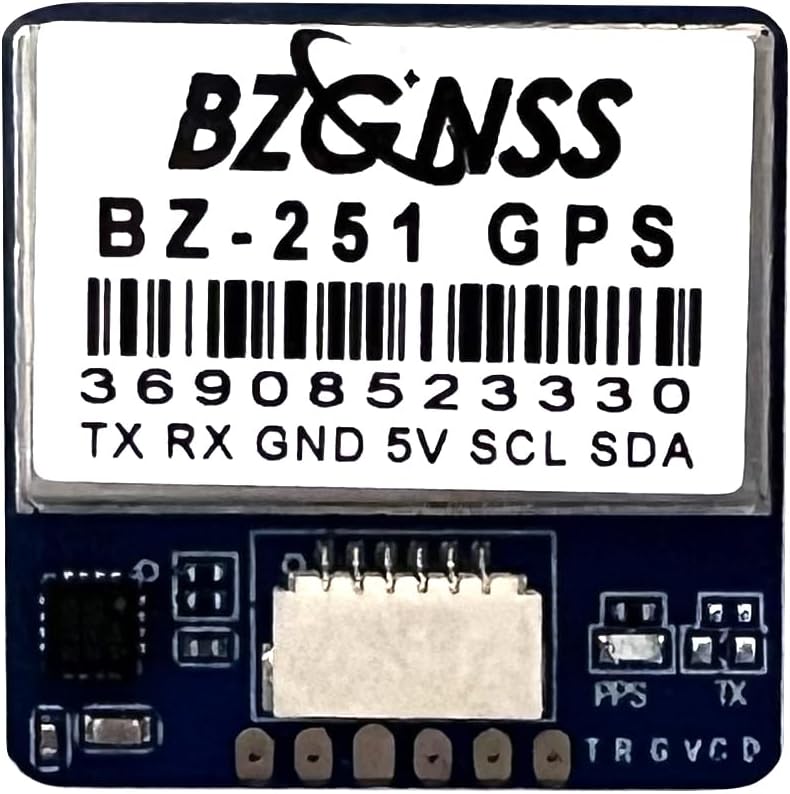
The BZGNSS BZ-251 Dual Protocol module is a strong choice for fixed-wing and RC aircraft that need dependable navigation for failsafe and rescue workflows. It holds a 5.0 customer rating, the highest numeric score in this guide. The module uses a 10th-generation Ublox M10 chipset to acquire satellites quickly and maintain a stable position in complex signal environments.
We may earn a commission when you buy through this link, at no additional cost to you.
Protocol flexibility is its defining technical strength. Support for both NMEA and UBX lets builders match the receiver to different flight-controller configurations without relying on a single communication format. It can also provide up to a 10Hz refresh rate, and its default GPS, GLONASS, and BeiDou joint positioning searches across three satellite systems.
The stated high two-dimensional positioning accuracy is 1.5 meters, while the oil-sprayed ceramic antenna is designed to resist scratching and oxidation. These are useful qualities for a module expected to remain installed through repeated flights. The description focuses on positioning and does not state that a magnetic compass is built in, so heading support may require another component.
This BZ-251 is best for fixed-wing pilots who value protocol choice, rapid updates, and explicit failsafe return-to-home integration. Its F4 and F7 compatibility broadens its appeal among modern FPV controllers. Before buying, verify the required flight-controller settings, connector, and whether your navigation system needs a separate compass.
NMEA and UBX support makes the module useful across flight-controller configurations that favor different data formats. This dual-protocol approach reduces the need to compromise when choosing a receiver for a mixed FPV or autonomous build.
Reliable location information is essential when a flight controller enters failsafe and needs to return the aircraft home. The module’s 10Hz support and three-system GNSS search are designed to keep that location data current.
We may earn a commission when you buy through this link, at no additional cost to you.
The BZGNSS BZ-251 M10 is a dual-protocol receiver designed for RC FPV racing drones, fixed-wing aircraft, and long-range builds. Its listed 4.4 rating reflects generally favorable customer feedback. The module combines an M10 positioning system with both NMEA and UBX protocol support, making it a versatile option for controllers that can use either format.
We may earn a commission when you buy through this link, at no additional cost to you.
BDS satellite support expands the available positioning networks, while the compact, lightweight construction suits a range of airframes. A built-in battery is included to eliminate problems associated with poor battery connections. That feature also suggests the module can retain its configuration during brief power interruptions, though the supplied information does not specify battery capacity or charging requirements.
The product is specifically noted as compatible with F405 and F722 flight controllers, giving pilots a clear target for installation. It is described as easy to mount on an RC airplane or FPV fixed-wing aircraft, and its engine is intended to acquire satellite signals quickly even in challenging environments.
This module is a good match for long-range and fixed-wing pilots who want M10 positioning, dual-protocol flexibility, and battery-backed configuration retention. It is less universal than options supporting INAV, PX4, or ArduPilot, and the built-in battery introduces another component that must be maintained. Confirm the connector and controller settings before purchase.
The integrated battery helps the receiver avoid losing its setup when the aircraft’s main power connection is interrupted. This can reduce repeated configuration work across multiple flights or maintenance sessions.
Support for racing drones, RC aircraft, fixed-wing models, and long-range flight makes this a practical shared module. F405 and F722 compatibility provides clear guidance for pilots building on those common FPV controller platforms.
We may earn a commission when you buy through this link, at no additional cost to you.
The AERO SELFIE FK-C1 combines a 9th-generation M9 positioning chip with an integrated IST8310 magnetic compass in a very small package. Measuring 20mm by 20mm by 8mm and weighing 7g, it is designed for FPV and racing drones where space and weight are important. It supports GPS, GLONASS, Galileo, and BeiDou, with capacity for up to 32 satellites.
We may earn a commission when you buy through this link, at no additional cost to you.
The integrated compass provides heading data for directional control and waypoint navigation. The module’s stated 80mA power consumption is another useful characteristic for battery-powered aircraft, while the blue LED blinks at 1Hz after a three-dimensional GNSS fix, making acquisition status easy to recognize.
Its operating range of -20°C to 80°C supports use across a broad range of environmental conditions. However, the supplied specifications do not identify the serial protocols, maximum update rate, or exact flight-controller compatibility. Those omissions make bench verification especially important for pilots who need a guaranteed configuration.
The FK-C1 is a strong candidate for a compact racing or FPV build that needs both position and heading data without a large platform receiver. Its small size, low weight, and four-system GNSS support are the major advantages. Confirm protocol settings and installation clearance before committing to it.
GPS, GLONASS, Galileo, and BeiDou support gives the FK-C1 access to multiple satellite networks. Its 20mm footprint makes that capability practical for small aircraft where a full-size GPS mount would be intrusive.
The blue LED blinks at 1Hz when a three-dimensional GNSS fix is established. This feedback helps pilots confirm the receiver’s operational state before relying on it for navigation.
We may earn a commission when you buy through this link, at no additional cost to you.
The FK-D1 is a 10th-generation GNSS module designed for drones and robotics, with a 10Hz update rate and support for up to 32 satellites. It uses the M10 chip to track GPS, GLONASS, BeiDou, and Galileo signals. The module weighs 12g and communicates through a UART interface, giving it a useful combination of modern positioning and straightforward serial integration.
We may earn a commission when you buy through this link, at no additional cost to you.
An integrated QMC5883L magnetic compass supports orientation accuracy and motion tracking in dynamic platforms. The included 25mm by 25mm by 4mm high-gain antenna is designed to improve reception in urban settings and under dense natural cover, where sky visibility may be limited.
One of the strongest compatibility features is support for INAV, Betaflight, ArduPilot, and PX4. This makes the FK-D1 broader than modules tied to one flight-controller family. Onboard flash saves user settings after power cycles, reducing repeated configuration work. Pilots should still verify the exact serial settings and wiring arrangement required by their chosen platform.
The FK-D1 is a good choice for drone and robotics builders who need a flexible flight-system combination, frequent updates, and integrated heading data. Its larger antenna is less attractive for the smallest racing frames, but it remains practical for FPV builds, autonomous aircraft, and ground robots. Verify mounting clearance and configuration before installation.
Support for INAV, Betaflight, ArduPilot, and PX4 gives the module a wider appeal than controller-specific alternatives. This is useful for builders who move between platforms or want a reusable receiver for multiple projects.
The 25mm high-gain antenna is designed to improve signal reception where the sky is partly obstructed. That makes the module more practical for urban flight, woodland operations, and other partially blocked environments.
We may earn a commission when you buy through this link, at no additional cost to you.
Choosing a drone GPS module requires balancing receiver capability, compass integration, physical fit, electrical requirements, and flight-controller compatibility. The most important first step is matching the module to the navigation platform rather than comparing satellite counts alone.
Match the receiver to your controller first. Compatibility includes protocol, wiring, and configuration.
Prefer broad constellation support for varied environments, but prioritize a clear-sky installation and correct setup.
Choose an integrated compass for simplicity or an external one for placement flexibility. Keep either away from interference.
A 10Hz rate helps fast and autonomous platforms. Confirm the controller can process it.
Measure the airframe and antenna clearance first. Small racers need compact modules; larger platforms can accommodate cable routing.
Verify protocol, baud rate, and firmware settings. A compatible connector alone does not guarantee communication.
Match voltage and current requirements to the aircraft. Remember that battery-backed features require occasional charging and care.
For RTH and missions, test acquisition, home-point capture, compass calibration, and failsafe logic before relying on the system.
Begin by confirming the receiver’s voltage, connector, protocol, and flight-controller settings. Mount the module in an orientation that leaves the ceramic antenna facing away from carbon fiber, batteries, and metal components. If it includes a compass, keep that sensor as far as practical from motors, ESCs, speakers, and high-current wiring. Secure the cable so it cannot tug on the connector or move during a hard landing.
Power the aircraft on the bench, verify that the flight controller detects the receiver, and check the reported number of satellites and fix quality. Allow the module to acquire a clear outdoor fix before testing navigation. Then calibrate the compass in the orientation it will use in the aircraft, configure the requested refresh rate and protocols, and confirm the home point through the proper sequence specified by the flight controller.
Care for the module by keeping the antenna clean and undamaged, avoiding prolonged storage in extreme conditions, and protecting the connector from dust and moisture. Before every flight, inspect the mounting point, cable routing, status lights, satellite count, compass heading, and home position. Update firmware only when compatibility is confirmed, and preserve the module’s configuration or backup files before making significant changes.
A GPS or GNSS module supplies the flight controller with position data derived from satellites. That information can support navigation, waypoint missions, failsafe return-to-home functions, position display, and other location-aware features. The exact features available depend on the flight controller, navigation software, and the receiver’s protocol compatibility.
No. Several compact modules include a QMC5883L, QMC5883, or IST8310 compass, but others are GPS receivers without an integrated magnetometer. The Readytosky M10 includes a separate external compass. Pilots should verify whether their flight controller requires heading data and whether a separate compass is needed.
A 10Hz update rate provides position data ten times per second and can be useful for fast aircraft, autonomous flight, and reliable return-to-home behavior. It is not the only factor that determines flight quality, and many recreational builds do not need maximum refresh rates. The flight controller and navigation software must also be configured to use the supported rate.
Place the antenna where it has the clearest possible view of the sky and keep it away from carbon fiber, batteries, metal hardware, and dense wiring. For a module with an integrated compass, move the entire unit away from motors and high-current cables. A stable, unobstructed installation is often more valuable than a small change in chipset specification.
Only if the module supports that controller electrically and its communication protocol is supported by the flight controller or navigation software. Some products are narrowly dedicated to one platform, such as the Readytosky M10 for Pixhawk 2.4.8, while others cover several popular systems. Always check pinouts, voltage, baud rate, protocol, and firmware requirements before purchase.
A failed lock can result from an indoor location, obstructed sky view, poor antenna placement, incorrect wiring, mismatched serial settings, or insufficient startup time. Check the power voltage and connector first, then move the aircraft outdoors with a clear sky view. Confirm the flight controller recognizes the receiver and that the configured protocol and baud rate match the module.
A GPS receiver adds some electrical consumption, although several compact modules are designed for low power use. A module with a larger antenna or additional compass may consume more than a basic receiver. Overall endurance also depends on battery capacity, motor efficiency, payload, flying style, and weather, so a GNSS receiver should be considered alongside the entire power budget.
A full recalibration is commonly needed after moving the aircraft, changing its configuration, or significantly altering the magnetic environment around the compass. Follow the calibration procedure required by the flight controller and navigator. Because motors and current-carrying wires can affect heading readings, also make sure the module remains mounted in the same position and orientation.
The SEQURE M10-25Q is the strongest all-around selection, combining a 4.8 customer rating, 10Hz output, six GNSS systems, an integrated QMC5883L compass, and flexible connection methods. The HGLRC Mini M100 stands out as a budget pick for small FPV and traversal drones, while the feature-rich JeeFly M8N is the premium choice for Pixhawk, PX4, and F4 or F7 platform builders.
Your priorities should determine the rest of the list. Choose the Readytosky M10 only for its dedicated Pixhawk 2.4.8 platform, the BZGNSS options for protocol choice and rescue-oriented FPV navigation, or the FK-C1 for a compact compass-equipped package. The FK-D1 is especially versatile for drone and robotics projects using INAV, Betaflight, ArduPilot, or PX4.
Before ordering, verify the flight controller, protocol, connector, voltage, antenna dimensions, and compass requirements. Check the manufacturer listing for current firmware notes, availability, and configuration details. Product prices and seller conditions change frequently, so review the current listing even after choosing a favorite.