TASCAM DR-05XP
4.2Editor score
32-bit float recording
Omnidirectional condenser microphones
USB-C audio interface
Up to 17.5-hour battery life
Our guide compares handheld recorders for journalists, covering microphones, recording formats, connectivity, battery life, and field-ready audio capture.
A dependable handheld recorder lets a journalist capture interviews, press conferences, ambient sound, and breaking news without relying on a phone that may ring, receive notifications, or run out of power. The right unit balances sensitive microphones, reliable controls, flexible storage, durable construction, and enough battery life to cover a full assignment.
We compared these recorders by examining their stated microphone configurations, supported recording formats, sample rates, input options, USB and wireless capabilities, storage methods, playback features, and intended uses. The list covers dedicated professional recorders, compact voice recorders, and an AI-assisted device designed to turn conversations and calls into organized notes.
Each review identifies the features that matter most for reporting work, along with practical trade-offs. The top picks represent different priorities: capable value, polished professional recording, and advanced field versatility. Product availability and pricing can change, so confirm the current specifications and deal before purchasing.
4.2Editor score

4.7Editor score

4.4Editor score
This side-by-side comparison highlights the microphones, recording capabilities, inputs, storage options, and connectivity that distinguish each model. It also shows where compact voice recorders differ from dedicated professional field recorders designed for interviews, ambient sound, video production, and live coverage.




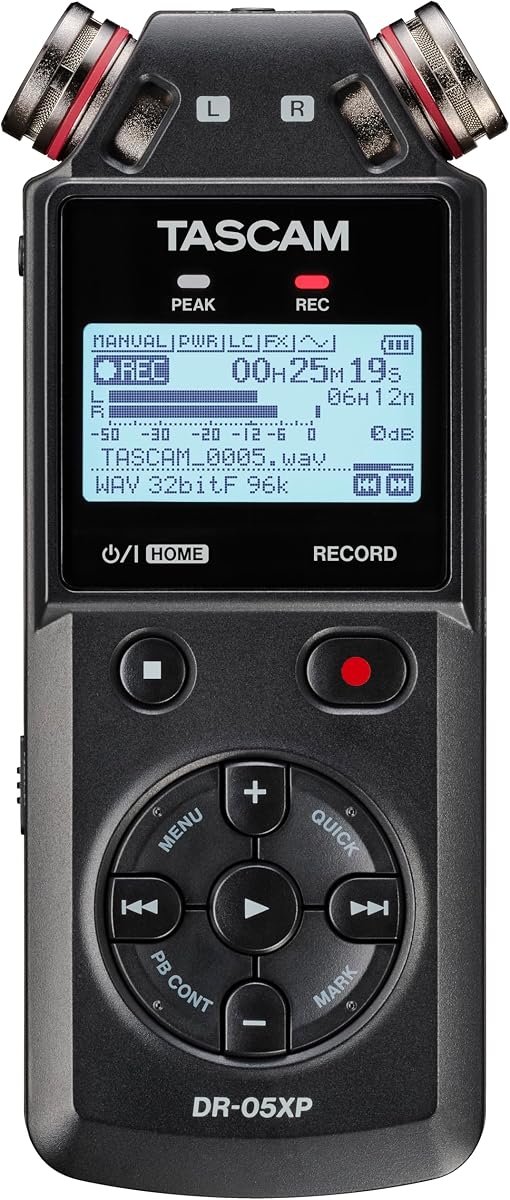
The TASCAM DR-05XP earns a place at the top of this guide because it combines a genuinely useful professional recording format, sturdy handheld proportions, and a feature set that maps closely to everyday journalism. Its 4.2 rating reflects a well-rounded option for interviews, voice recording, meetings, and production audio. The 32-bit float mode is its most consequential feature because it can preserve a recording when an unexpected loud sound arrives.
We may earn a commission when you buy through this link, at no additional cost to you.
Its built-in omnidirectional condenser microphones are rated to handle sources up to 125dB SPL, making the unit relevant for press events, environmental sound, and interviews in uncontrolled spaces. Recording choices include 32-bit float, 24-bit, and 16-bit, with 96kHz, 48kHz, and 44.1kHz sampling options plus MP3. That flexibility lets a reporter choose high-resolution WAV capture for careful work or compressed files where storage efficiency matters.
The DR-05XP also functions as a two-input, two-output USB-C audio interface for direct computer recording. This is useful for a reporter building a remote broadcast package, while the claimed battery runtime of up to 17.5 hours provides comfort for long reporting days. The trade-offs are practical rather than fundamental: an SD card and batteries are not included, and its built-in microphone arrangement offers less directional control than a model with multiple selectable patterns.
Choose the DR-05XP if you want professional-grade essentials without moving to a larger multi-input field system. It is a particularly strong starting point for a student reporter, freelancer, or podcast producer who values 32-bit float capture and USB-C integration. For interviews where isolation is critical, adding a compatible external microphone through the audio interface would be an important part of the setup.
The 32-bit float format is particularly valuable at press conferences, on streets, and around unexpected machinery. It gives the recorder more room to preserve a sudden peak, which can make a difficult recording easier to edit without excessive distortion.
Its two-in, two-out USB-C interface allows the DR-05XP to function as a recording path for a computer. That makes it easier to move between a quick handheld capture and a more involved editing or streaming workflow.
We may earn a commission when you buy through this link, at no additional cost to you.
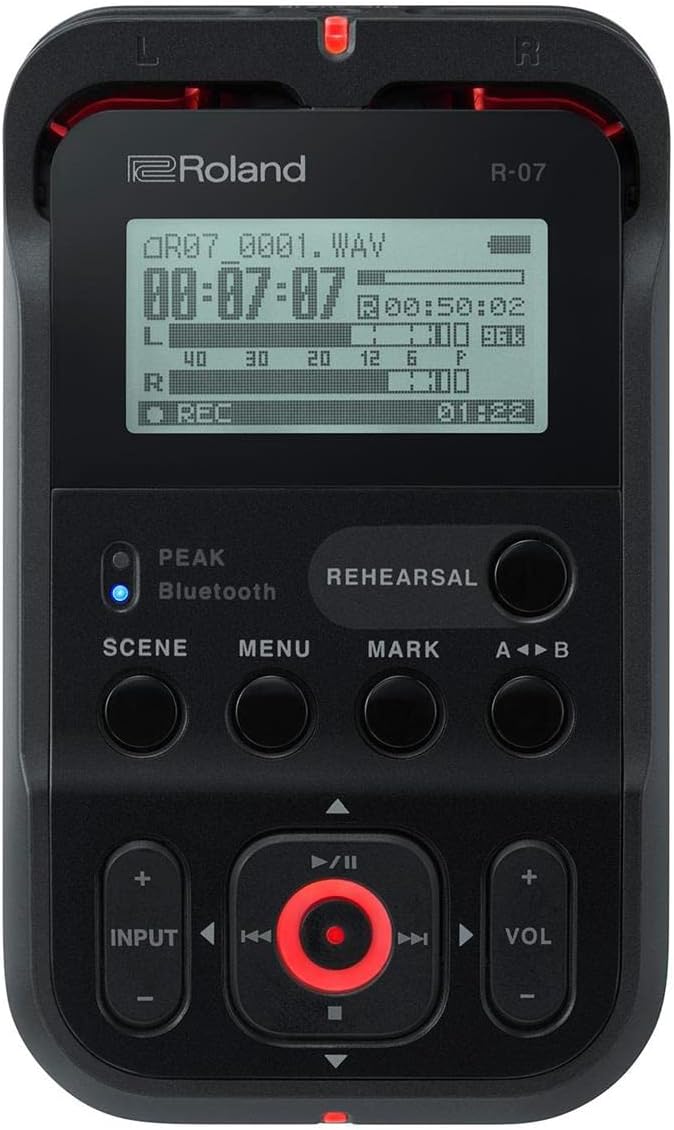
The Roland R-07 is a compact high-resolution recorder designed for users who want serious capture without the complexity of a larger production machine. Its 4.2 rating and long list of workflow features make it attractive for interviews, meetings, rehearsals, and documentary sound gathering. The integrated stereo microphones provide immediate recording capability without requiring a separate capsule or field microphone.
We may earn a commission when you buy through this link, at no additional cost to you.
Recording can be handled in WAV at 44.1, 48, 88.2, or 96kHz and 16- or 24-bit, while simultaneous MP3 recording supports a broad selection of bitrates. That combination is useful for a reporter who may need a high-quality master alongside smaller files for quick transmission. One-touch templates are intended to simplify setup, and the graphic LCD with a white backlight helps make menus easier to read in the field.
Wireless features distinguish the R-07 from simpler recorders. Qualcomm aptX playback, Bluetooth control, and low-latency wireless monitoring let supported smart devices or Bluetooth speakers handle playback or remote operation. The built-in speaker is also convenient for checking a take, while the mic/aux input and headphone output broaden the range of compatible sources and monitoring options.
The main limitation is that the supplied specifications do not list multi-track recording, a major advantage for reporters covering several simultaneous sources. Two AA batteries provide up to 16 hours of continuous recording, and the unit can also run on USB bus power. The R-07 is a strong choice for a mobile journalist who values portability, polished playback, and high-resolution stereo capture over simultaneous isolated tracks.
One-touch recording templates reduce the number of decisions required before a take. For a reporter arriving at an interview or public event, this can mean capturing the moment faster while still applying a consistent setup.
Bluetooth control and low-latency wireless monitoring give supported devices more flexibility during review and listening. The feature is particularly useful when a journalist wants to move around a location without remaining close to the recorder.
We may earn a commission when you buy through this link, at no additional cost to you.
The EVISTR L357 is a small digital dictaphone built around a simple premise: a journalist should be able to start a recording almost immediately and organize the result later. Its 4.2 rating reflects a capable voice recorder with generous storage, flexible recording formats, and simple controls. The body measures only 3.86 by 1.2 by 0.47 inches, making it easy to keep in a pocket or carry alongside a notebook.
We may earn a commission when you buy through this link, at no additional cost to you.
The included 64GB memory provides substantial room for interviews, lectures, meetings, and field notes. Audio can be recorded in WAV or MP3, and seven adjustable gain levels help the user adapt to different source levels and distances. The dynamic noise-reduction microphone and PCM intelligent noise-reduction technology are intended to improve clarity, while the device can capture sound across a 360-degree field of view.
Voice activation is the feature most likely to matter in lengthy conversations. It can begin and stop recording according to detected speech, reducing silent sections and making later review more efficient. Scheduled recording, playback, rewind, variable-speed playback, and A-B repeat add flexibility, while timestamp-based file names provide a logical way to identify recordings.
The trade-off is that this is a voice recorder rather than a modular field recorder with professional XLR inputs or interchangeable capsules. Its USB-C transfer works with Windows and Mac computers, and the 500mAh battery is stated to support up to 32 hours of continuous recording. It is best for reporters who prioritize simple operation, long storage, and voice-activated capture rather than advanced microphone control.
Voice activation can stop capturing extended silences and restart when speech returns. That reduces playback time and file clutter during meetings, interviews, and public appearances where much of the recording may contain pauses.
Files are named according to year, month, day, hour, minute, and second, which makes them easier to locate after a busy assignment. Direct transfer through the included USB-C cable also supports a straightforward Windows or Mac editing workflow.
We may earn a commission when you buy through this link, at no additional cost to you.
The Tonfarb 64GB recorder is built for fast, uncomplicated capture, making it useful for journalists who want a recording to begin before a conversation develops. It has a 4.0 rating and a compact set of functions centered on one-click operation. Moving the side control upward starts recording, while pushing it down saves the file, and the side control can apparently initiate recording even when the unit is powered off.
We may earn a commission when you buy through this link, at no additional cost to you.
WAV recording is available at up to 1536kbps PCM quality, while automatic noise reduction is included to reduce background sound during capture. Voice activation starts and stops the recorder as sound reaches a selected level, saving battery and storage when the source falls silent. A 1.44-inch screen makes menus easier to navigate than on ultra-minimal recorders, and password protection adds useful security for sensitive interviews or confidential notes.
The built-in 64GB TF card can hold up to 4,600 hours of recordings when using 32kbps MP3, and the 600mAh battery is stated to provide up to 48 hours of continuous use in that mode. Internal and external recording, file segmentation, scheduled recording, bookmarking, A-B loop playback, and MP3 playback broaden its usefulness beyond one task.
This model is best for reporters who value immediate access, large storage, and a readable display over studio-level microphone selection. No professional microphone inputs or high-resolution multi-track recording are listed, so it should not be confused with a dedicated field recorder. The recorder can also function as a USB storage device and MP3 player, which may be convenient for moving files without a separate card reader.
The one-click side control reduces friction when a reporter needs to capture a spontaneous exchange. Starting from a powered-off state is especially useful for authentic ambient sound and unscripted interview moments.
A built-in 64GB card removes the need to manage a removable memory card during routine assignments. Password protection adds a simple layer of protection for recordings that may contain sensitive or unpublished material.
We may earn a commission when you buy through this link, at no additional cost to you.
The Zoom H5 is the most capable all-around field recorder in this group and the recipient of the Editor's Choice award. Its 4.7 rating is the highest among the listed products. It offers four-track simultaneous recording, interchangeable microphones, professional connectors, and multiple safety options, giving journalists a flexible tool for one-person interviews, multi-source events, and production sound.
We may earn a commission when you buy through this link, at no additional cost to you.
The detachable X/Y capsule comes with shock-mounted microphones to help reduce handling noise, while the interchangeable capsule system allows the recording configuration to change with the assignment. Two mic/line inputs use XLR/TRS combo connectors, offer selectable phantom power, and include a -20dB pad. These features make the H5 useful when a reporter needs to add a lavalier, handheld microphone, or line-level source rather than relying entirely on the built-in stereo pair.
A useful audio safety net is included to help protect recordings, while direct recording to SD or SDHC cards keeps production separate from a computer workflow. The H5 also supports multichannel and stereo USB operation for PC, Mac, and iPad, including a Loop Back function. These options help it move from field capture to editing, streaming, or supplemental recording without changing devices.
The H5 is larger and more involved than a pocket dictaphone, and its listed card capacity tops out at 32GB. It also requires a separate capsule if a reporter wants a configuration other than the included X/Y arrangement. Even so, its input flexibility, simultaneous track count, safety features, and strong rating make it the most complete choice for a working journalist who may cover more than simple speech.
Interchangeable capsules make it possible to adapt the microphone arrangement without replacing the entire recorder. The included X/Y setup supports stereo capture, while external microphones can be connected through the professional inputs for interviews and event coverage.
Four-track simultaneous recording can preserve a wider scene than a single stereo pair. Even if one source is poorly positioned, additional tracks may provide an alternative angle for editing or verification.
We may earn a commission when you buy through this link, at no additional cost to you.
The Tascam dr 40 is a silver portable digital recorder positioned around four-track capture, and its 4.6 rating indicates strong user satisfaction. It appeals to journalists who recognize the Tascam name and want a dedicated portable device rather than a general-purpose voice recorder. The product description supplied for this roundup is brief, however, so its wider feature set should be confirmed before purchase.
We may earn a commission when you buy through this link, at no additional cost to you.
Its defining stated characteristic is portable four-track digital recording. That format is useful for capturing more than one source or for maintaining additional recorded material during an interview or live event. The silver enclosure and portable form make it more visually distinct than the tiny button-driven dictaphones in this list while remaining within the handheld field-recorder category.
The supplied information identifies the product type as a voice recorder and gives package dimensions of 20.32 by 8.382 by 13.97 centimeters. It does not specify microphone configuration, connector types, supported file formats, storage method, USB functionality, or battery life. Those omissions make a detailed technical comparison with the other models impossible without checking the current product listing and manual.
For a buyer, the dr 40 is most compelling when four-track capability and a strong rating justify further investigation. It is less suitable as a first choice based on documentation alone because important information such as inputs and recording formats is not provided here. Treat this review as a concise identification of the product's stated strengths rather than a complete specification summary.
The dr 40 sits within Tascam's portable recorder range, which may appeal to users who already understand the brand's recording ecosystem. Its stated four-track design provides a clear point of difference from basic single-purpose dictaphones.
The available listing emphasizes portability, digital recording, and four-track capability but omits core details. Checking connector layout, storage support, microphone options, and power requirements will help buyers assess compatibility with their reporting setup.
We may earn a commission when you buy through this link, at no additional cost to you.
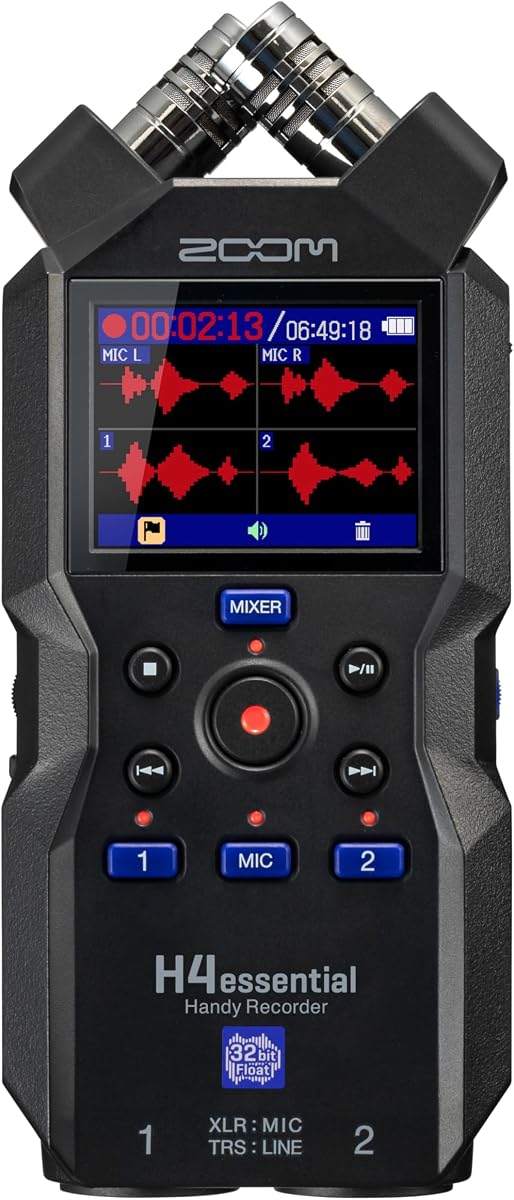
The Zoom H4 Essential combines four-track flexibility with a design intended to be approachable for creators who do not need a complex studio interface. Its 4.4 rating indicates a well-received model with broad applications in interviews, podcasts, video production, music, and live performance. For a journalist, its combination of built-in stereo microphones and two external inputs is especially adaptable.
We may earn a commission when you buy through this link, at no additional cost to you.
The built-in microphones can handle immediate stereo capture, while the two XLR/TRS inputs accept external microphones, instruments, a mixer, or a soundboard. The stated aim is clear recording across quiet dialogue and louder performances, with a four-track format that helps protect the integrity of a take. A reporter can therefore begin with the internal pair and add a dedicated interview microphone when the assignment demands it.
USB-C connectivity allows recording or streaming to a phone, tablet, or computer, while an SD card can provide a simultaneous backup. That dual workflow is valuable for a journalist who wants a safety copy before transferring files or needs a USB microphone for a live call and remote assignment. Spoken menu guidance also makes the recorder more accessible to visually impaired users and easier for anyone who prefers spoken navigation.
The H4 Essential is more involved than a dedicated voice recorder, and simultaneous computer and card workflows require adequate storage and sensible file management. It does not offer the interchangeable capsule system of the Zoom H5 in the supplied information. Even so, its four tracks, external inputs, guided operation, and backup options make it a strong professional choice for a reporter who wants more than a single stereo file.
The internal stereo microphones make the recorder useful immediately, while the XLR and TRS inputs expand the recording options. This combination suits quick location work and more carefully planned interviews without requiring a different device.
Recording to an SD card at the same time as streaming or recording to a computer provides a useful redundancy. A journalist can maintain an immediate working file while protecting a card-based copy against an interrupted transfer.
We may earn a commission when you buy through this link, at no additional cost to you.
The Pocket AI Voice Recorder takes a different approach from conventional field recorders by focusing on conversation capture, transcription, and organization. Its 4.6 rating reflects a feature set aimed at meetings, calls, and personal notes rather than location sound. For a journalist covering an interview, a press call, or a recorded conversation, the ability to turn audio into summaries and action items may be the central attraction.
We may earn a commission when you buy through this link, at no additional cost to you.
One-tap recording starts the process without requiring typing, while the AI assistant can transcribe meetings and calls, create summaries, identify key action items, and build structured conversation maps. The Ask Pocket feature allows questions to be answered from the recordings and can generate insights or next steps. These functions are intended to reduce the time spent replaying long interviews and manually extracting quotes or themes.
The MagSafe-compatible design allows Pocket to attach to an iPhone or another compatible device for hands-free use, which is helpful when taking notes or conducting a conversation. Its stated battery life reaches up to four days on one charge, making it a practical everyday productivity device. Core features are included, although some advanced tools are available only through an optional subscription.
This is not a conventional microphone-first field recorder, and the supplied specifications do not describe professional XLR inputs, interchangeable capsules, high-resolution recording modes, or removable storage. Journalists who need pristine production sound will still require a dedicated audio recorder. Pocket is best for reporters whose workflow emphasizes rapid transcription, concise summaries, and organized evidence from spoken conversations.
Automatic transcription and structured maps can make a long interview easier to navigate. The ability to ask questions across saved recordings may help users locate a theme or revisit a specific exchange without listening to the entire recording again.
MagSafe compatibility keeps the recorder attached to a compatible phone instead of requiring it to be held. That leaves the user's hands available for note-taking, a video call, or another task during a recorded conversation.
We may earn a commission when you buy through this link, at no additional cost to you.
The Zoom H1 Essential is a compact stereo recorder for journalists and content creators who want a straightforward way to improve on phone audio. Its 4.0 rating reflects a practical device aimed at interviews, videos, tutorials, voiceovers, meetings, and natural sound. The built-in stereo microphones allow a reporter to begin recording immediately without carrying additional microphones for basic assignments.
We may earn a commission when you buy through this link, at no additional cost to you.
The stated focus is clear, detailed stereo capture for dialogue, ambience, room tone, sound effects, travel audio, and everyday environments. This makes the H1 Essential useful for documenting a location, recording a short interview, or gathering sound that can be placed beneath narration. It can also handle songwriting, rehearsals, acoustic performances, and lessons when a journalist is covering creative activity.
USB-C expands the role of the recorder by allowing it to serve as a microphone for livestreams, remote meetings, video calls, voiceovers, podcasts, and desktop or mobile recording. The result is a compact tool that can support both field documentation and remote communication without forcing the user to rely on a computer's built-in microphone.
The H1 Essential does not list the multiple external inputs or simultaneous track recording available on larger Zoom models. It is therefore most appropriate for a solo reporter working with one stereo source or a straightforward interview setup. Its strengths lie in portability, immediate operation, and flexible USB use rather than advanced multi-source control.
Dedicated stereo capture can provide a more polished foundation for interviews and video narration. The H1 Essential is designed for creators who want a simple upgrade without navigating a large field recorder.
USB-C microphone support lets the same device join livestreams, calls, and recording sessions on a phone or computer. That flexibility is valuable for a reporter moving between a location shoot and a remote assignment.
We may earn a commission when you buy through this link, at no additional cost to you.
The Zoom H2 Essential is the most versatile premium choice in this roundup, earning a spot for its three-microphone system, nine recording patterns, high-resolution float capture, and wireless synchronization. Its 4.4 rating indicates a well-regarded model. For journalists, the ability to change capture configurations without carrying multiple recorders is especially valuable when moving between close interviews, two-person conversations, and wide environmental sound.
We may earn a commission when you buy through this link, at no additional cost to you.
The three built-in microphones can create intimate interview recordings, wide stereo soundscapes, and other spatial arrangements selected from nine patterns. Recording reaches 32-bit float at up to 96kHz, and the automatic gain function is designed to capture clip-free audio without constant level adjustment. This combination gives a reporter more confidence around unpredictable sources without removing manual control from the workflow entirely.
Connected to a computer, phone, or tablet, the recorder works as a high-quality USB microphone while also saving the session to an SD card. That simultaneous workflow creates an immediate backup and supports editing on another device. Bluetooth timecode can control and synchronize multiple H2 Essential units, providing a useful foundation for coordinated recordings when sound must be captured from separate positions.
The larger number of microphone patterns and the multi-unit timecode system create a steeper learning curve than a basic dictaphone. Journalists working alone will gain less from synchronization but can still benefit from flexible patterns and automatic gain. For a reporter who regularly handles interviews and location sound, the H2 Essential offers a persuasive mix of premium capture, compactness, and workflow flexibility.
Nine patterns allow the capture method to follow the reporting situation. A close interview can use a narrow configuration, while a larger scene can use a wider stereo approach, all from the same built-in microphone system.
Bluetooth timecode provides a practical way to align multiple H2 Essential units. When two reporters cover different sides of an event, synchronized recordings can simplify the later editing process.
We may earn a commission when you buy through this link, at no additional cost to you.
The right recorder depends on the kind of reporting you do, the sound you need to capture, and how you move audio into an editing workflow. These are the most important features to compare before committing to a model.
Built-in microphone design determines how naturally a recorder captures a one-on-one interview, a crowded press conference, or an environmental sound. Omnidirectional and stereo configurations can provide a broad, natural pickup, while selectable patterns and multiple microphones offer greater control over direction and proximity. Journalists who regularly work alone should prioritize a unit that can move quickly from a person's voice to the wider scene without changing hardware.
WAV capture at 16 or 24-bit preserves more detail than compressed MP3 and is usually preferable for interviews, archival material, and source audio that will be edited. 32-bit float provides additional headroom when levels cannot be controlled consistently, reducing the risk of clipping during a sudden loud sound. Sampling rate options up to 48 or 96kHz offer greater resolution, though workflow complexity and storage use also increase. A recorder with simultaneous compressed and high-resolution capture can provide both a backup and a manageable sharing file.
External microphone inputs are important when the built-in microphones cannot provide sufficient isolation, control, or source quality. XLR/TRS combo connectors support professional microphones, line sources, mixers, and soundboards, while a -20dB pad can help manage unusually strong signals. Four-track simultaneous recording is valuable for capturing multiple sources at once, but it also requires more storage and a clearer understanding of channel behavior. A single stereo recorder may be sufficient for a solo digital reporter, while field producers and video journalists gain more from multiple inputs.
A reliable recorder should make files easy to retrieve and protect against accidental loss. Removable SD cards offer broad control over capacity, while built-in memory can make a voice recorder extremely simple to carry and use. USB-C transfer is convenient, and simultaneous recording to a computer and memory card provides a valuable safety net. Journalists should also consider file naming, time-stamped organization, segmentation, and whether WAV files will fit comfortably on the selected card or device.
A full reporting day can involve long interviews, travel, and continuous ambient recording, so battery endurance should be evaluated realistically. AA battery models are easy to recharge or replace in the field, while built-in rechargeable batteries can be more convenient for everyday productivity use. USB bus power or USB charging adds flexibility when a reporter is near a power source, although it may not be available during every assignment. A stated runtime is most useful when the manufacturer identifies the recording format and operating conditions involved.
Headphone output, a built-in speaker, level meters, and clear controls help a reporter verify a take before leaving a location. Bluetooth monitoring can add convenience, although compatibility and latency should be considered. Playback features such as rewind, variable speed, A-B repeat, bookmarking, and file segmentation save time during review. For a working journalist, efficient playback can be as valuable as capture quality because it determines how quickly a usable quote or usable scene can be located.
A recorder that is difficult to operate quickly can be worse than no dedicated device at all. Pocket dictaphones prioritize simple buttons and compact size, while professional field recorders offer more inputs, pattern controls, and track management. Journalists should choose a size they can hold securely and operate without looking, especially during spontaneous interviews. A clear display, readable menu, and accessible spoken guidance can reduce mistakes, especially in noisy or poorly lit environments.
Some reporting workflows benefit from more than raw audio capture. USB microphone mode supports remote interviews, livestreams, and calls, while AI transcription can accelerate the conversion of meetings and conversations into searchable notes. Bluetooth timecode can synchronize multiple recorders placed around an event. These specialized features are valuable only when they support a recurring task; otherwise, fundamentals such as microphone quality, reliable storage, and accurate file transfer should carry more weight.
Before a recording, insert a correctly formatted memory card if the recorder uses removable storage, install fresh batteries, and confirm that the date, time, recording format, sample rate, and input level are appropriate. A short test recording is essential. Listen through headphones, check the microphones for obstruction, and confirm that the resulting files transfer correctly to the computer used for editing.
During an interview, place the recorder in a consistent location rather than moving it unnecessarily. Speak at a natural distance, avoid touching the microphones, and leave enough space around the device for the sound to develop. When using voice activation, test its sensitivity in the actual environment so it does not cut off quiet speakers or react to unrelated background noise. For multi-track work, monitor levels and record a useful reference tone only when the production workflow requires it.
After the assignment, stop recording before changing inputs or removing storage, then copy the files to more than one location. Review critical takes for clipping, noise, incomplete files, and incorrect time stamps. Keep batteries and memory cards in a dry case, clean the exterior gently, and follow the manual for storage or firmware guidance. Treating transfer and backup as part of the recording process protects the work more effectively than relying on the device alone.
A dedicated recorder usually provides more consistent microphone capture, physical controls, longer battery options, and fewer distractions from calls or notifications. A smartphone remains useful for quick reference and integration with apps, but a dedicated unit is generally safer for extended interviews and location sound. The right choice depends on the reporting environment and how much redundancy the user needs.
32-bit float recording provides additional headroom for unexpected loud sounds, reducing the chance that a clipped peak becomes unusable. It can be particularly helpful at press conferences, live events, and outdoor locations where levels change quickly. It does not replace good microphone placement or disciplined gain management, but it adds a valuable margin of safety.
WAV is generally the better primary format for interviews and production audio because it preserves more detail and gives an editor greater flexibility. MP3 can be useful for quick transmission, long-duration notes, or simultaneous backup files. A recorder that captures both formats at once provides a high-quality master and a more compact file, but storage requirements should be checked beforehand.
One carefully placed stereo pair may be enough for a quiet one-on-one interview, while separate tracks can protect a conversation from unexpected movement or overlapping sources. Four-track recorders are also useful for events, panels, and production sound. More tracks do not automatically produce a better result; microphone quality, placement, and monitoring remain more important.
Several models support USB audio input or multichannel output, allowing them to serve as a microphone for a computer, phone, or tablet. The Zoom H1 Essential is highlighted for streaming and calls, the H2 Essential for simultaneous USB and SD capture, and the TASCAM DR-05XP for two-in, two-out operation. Check the required platform and app before relying on a specific connection method.
They can be, especially when long pauses are common or when fast file organization is valuable. The EVISTR L357 and Tonfarb recorder both provide adjustable voice activation, and they can reduce silent sections during meetings or lectures. Sensitivity should be tested in advance, and voice activation should never be the only recording strategy for a critical interview.
Begin transferring files as soon as possible and preserve the original folder structure and filenames. Save a working copy, create a separate archive, and add a simple note containing the date, location, participants, and relevant recording details. Timestamp-based names and bookmarking features can make long files easier to navigate later.
The TASCAM DR-05XP offers professional recording formats and USB-C integration in a relatively conventional handheld design, while the EVISTR L357 and Tonfarb models are even more direct and voice-focused. The Zoom H4 Essential provides guided menu operation for users who want more inputs without a steep learning curve. The best choice depends on whether simplicity or professional expansion matters more.
The TASCAM DR-05XP stands out as the best budget option because it combines 32-bit float capture, solid microphone specifications, and USB-C recording in a portable package. The Zoom H5 earns the Editor's Choice award for journalists who need professional inputs, four-track recording, interchangeable capsules, and a flexible path from field capture to computer production. The Zoom H2 Essential is the premium selection for users who value multiple microphone patterns, high-resolution float recording, and synchronized multi-device workflows.
The right choice should begin with the assignment rather than the specification list. Solo reporters may need only a dependable stereo microphone and simple controls, while field producers may prioritize XLR inputs, multiple tracks, and backup recording. Those who routinely record calls and meetings may find AI transcription more valuable than high-resolution field capture, while a video-focused journalist may prioritize USB microphone support and simultaneous local storage.
Before buying, verify the current specifications, storage requirements, included accessories, power options, and compatibility with your editing and publishing workflow. Product features and pricing can change, so check the latest listing carefully. With the right recorder secured and a reliable backup process in place, a journalist can focus on the interview rather than worrying about whether the important words were captured.