
ProCase Kids Noise Cancelling Headphones
4.6Editor score
24 dB NRR protection
Ages 3 through 15
Compact folding design
Our expert guide compares the 10 best headphones for autistic kids, covering noise reduction, comfort, fit, portability, hearing safety, and everyday usability
Headphones for autistic kids should make noisy environments feel more manageable without adding pressure, distraction, or another source of sensory discomfort. The most useful pair balances dependable noise reduction with a comfortable fit, durable construction, and controls that work for children. Depending on the situation, a child may need passive hearing protection, wireless entertainment, or a combination of both.
We compared the ten products using their stated noise-reduction specifications, age guidance, fit features, portability, wireless functions, volume controls, and durability details. The list covers compact earmuffs for concerts and travel as well as Bluetooth models for music, games, videos, and longer journeys. It also distinguishes between certified hearing protectors and general-purpose entertainment headphones.
Each review explains the product's strongest benefits, practical limitations, and most suitable environment. The top three picks represent the strongest options for budget-conscious buyers, all-around use, and premium features. Ratings and specifications may change over time, and product prices also fluctuate, so readers should confirm current availability and details before purchasing.
4.6Editor score

4.5Editor score

4.2Editor score
The comparison below highlights the major differences among compact passive earmuffs, wireless entertainment headphones, active noise-cancelling models, and multipack options. Attention is paid to stated protection levels, age ranges, portability, controls, and the type of environment each pair is best suited to.


The ProCase Kids Noise Cancelling Headphones Ear Hearing Protection, Red combines passive noise attenuation with a child-focused fit and a broadly stated age range of three to 15. Its 4.6 rating reflects a strong balance of protective features, comfort, portability, and construction. This is a practical pair for families seeking dependable hearing protection without the complexity of wireless controls.
We may earn a commission when you buy through this link, at no additional cost to you.
The earmuffs use a solid ABS shell and thickened noise-dampening foam, with a listed NRR of 24 dB and ANSI S3.19 and CE EN352-1 certification. Retractable stainless steel arms and 360-degree rotating cups allow the fit to accommodate different head sizes. A padded headband and soft foam ear cushions make the product more practical for travel, fireworks, movie theaters, sporting events, and other predictable high-noise situations.
The main limitation is that these are passive hearing protectors rather than wireless entertainment headphones. They are designed to reduce surrounding noise, not play music or deliver active noise cancellation. Because protection and comfort vary by head shape and the severity of the child's sensory response, a parent should still introduce them gradually and check for pressure, heat, or an unwanted seal.
This is an excellent general-purpose pick for autistic children who need portable protection at school, home, or family events. It is especially useful for children who want a simpler product without buttons, cables, charging, or app-based features. Among certified earmuffs, it offers a convincing combination of flexibility, compact storage, and stated protection.
Retractable stainless steel arms and rotating ear cups help distribute pressure across different head sizes, while the padded band and soft cushions provide a more comfortable seal. These features make the earmuffs adaptable to children from toddler age through the teenage years.
With no battery or wireless connection to manage, the folding design is straightforward to carry to concerts, airports, theaters, and sporting events. The child can focus on the environment rather than operating electronic controls.
We may earn a commission when you buy through this link, at no additional cost to you.
The iClever BTH20 Active Noise Cancelling Headphones for Kids Toddler Travel is the most versatile pick in the guide. It combines active and passive noise reduction, Bluetooth 5.4, a wired option, an 80 dBA volume limit, and a stated maximum reduction depth of 40 dB. The 4.5 rating reflects a feature-rich product designed for children aged three and up.
We may earn a commission when you buy through this link, at no additional cost to you.
Two noise-reduction modes address an important sensory distinction. A gentler mode reduces ear pressure for children who are sensitive to that sensation, while the stronger mode is intended to block engines and other mechanical noise. The stated battery life reaches 35 hours with active cancellation on and 60 hours with it off. A 10-minute USB-C charge is listed as providing another five hours of use, and the included 3.5 mm cable provides a wired alternative.
The trade-off is that active noise cancellation does not operate over the wired connection, and the number of modes, buttons, and charging routines may be excessive for a young child. The 40 dB figure is a maximum in the product's specified configuration rather than a guarantee of equal reduction in every environment. Individual comfort and sensory response still require real-world trial.
Choose the BTH20 for flights, road trips, waiting rooms, and other settings where a child may benefit from both media and environmental noise management. It is also a strong choice for families who want one pair to serve as headphones and hearing-protective travel gear. Its broad feature set makes it the most complete option for many itineraries.
The gentle mode is intended for children who dislike the pressure sensation associated with stronger cancellation. Giving families a choice makes it easier to match the headphones to a child's response without starting with the most aggressive setting.
The stated 35-hour active-cancellation battery and quick-charging support reduce interruptions during long trips. The wired 3.5 mm option is useful when battery life or wireless connection is not practical.
We may earn a commission when you buy through this link, at no additional cost to you.
The Floriogra Noise Cancelling Headphones for Kids/Toddler 28dB SNR Ear Muffs are designed specifically for autistic and noise-sensitive children. They have a 4.5 rating and an advertised 28 dB SNR, placing them among the higher stated passive-protection figures in this list. Their appeal comes from certified attenuation, padded comfort, and a straightforward folding format.
We may earn a commission when you buy through this link, at no additional cost to you.
The listed ANSI S3.19 and CE EN 352-1 standards provide a clearer certification framework than vague sound-blocking claims. The earmuffs use a generously padded headband, soft ear pads, and 360-degree swivel cushions to improve fit and comfort. Their stated uses include concerts, fireworks, travel, sporting events, yard work, reading, playing, and studying, allowing the same pair to serve several sensory needs.
They are passive protectors, not wireless headphones, so users should not expect to listen to music or instructions through them. The 28 dB SNR figure describes an engineered reduction level under specified testing conditions rather than a promise of silence. Pressure can also vary depending on the child's head and the duration of wear, so gradual introduction remains sensible.
This Floriogra model is well suited to families prioritizing a high stated SNR and certified passive protection without electronics. It works particularly well for children who need environmental sound reduction during a predictable noisy outing. The easy folding construction also makes it convenient to keep in a school bag or travel bag.
The listed ANSI and CE certifications allow buyers to compare the product with other certified protectors. A stated 28 dB SNR indicates a strong level of passive attenuation for situations such as fireworks, concerts, and travel.
A padded headband and soft swivel cushions help the earmuffs sit more comfortably around the ears. The design can be especially useful for children who resist over-ear accessories because of pressure or irritation.
We may earn a commission when you buy through this link, at no additional cost to you.
The iClever EM01 Noise Cancelling Headphones for Kids Adults, SNR 29dB EarMuffs combine a 29 dB stated SNR with an adjustable, unusually durable frame. Their 4.6 rating and focus on children with autism or sensory sensitivities make them a practical option for repeated use. The stated 46 dB reduction in certain scenarios should be distinguished from the standard SNR specification.
We may earn a commission when you buy through this link, at no additional cost to you.
The ear cushions use 18 mm of slow-rebound acoustic foam beneath skin-friendly leather, while the headband is designed to create less pressure than average earmuffs. A holeless pivot helps prevent hair from becoming caught, a detail that can matter for longer wear. Telescoping arms extend by 38 mm on each side, and 301 stainless steel with 2 mm steel bars is intended to withstand twisting and bending.
The listed minimum age is five, so younger children should consider another model. Although the title mentions adults, its strongest case is as a durable, long-term fit for growing children. The product provides passive protection and does not play audio, making it less versatile for a child who uses headphones regularly for music or schoolwork.
Families looking for a sturdy pair that can remain in use as a child grows should give the EM01 strong consideration. Its combination of certified protection, broad adjustment, and low-pressure construction is particularly suitable for children who wear hearing protection at school, home, and recurring events.
Steel components and reinforced framing are intended to reduce damage from common drops, twists, and folds. This makes the EM01 a practical option for children who tend to remove or mishandle headphones.
Telescoping arms that extend 38 mm per side accommodate growth, reducing the need to replace earmuffs as quickly. The holeless swivel design also improves usability for children with longer hair.
We may earn a commission when you buy through this link, at no additional cost to you.
The iClever BTH12 Kids Bluetooth Headphones 85H Playtime with LED Lights Travel prioritize entertainment, long battery life, and child-friendly styling. It carries a 4.6 rating and includes 40 mm drivers, Bluetooth 5.2, a built-in microphone, and four LED lighting modes. It is a strong option when the goal is predictable access to music, games, videos, or lessons.
We may earn a commission when you buy through this link, at no additional cost to you.
The stated 85-hour playback time is the headline feature, with a 10-minute charge listed as adding seven hours. Volume can be limited to 74 or 85 dBA using combination keys, reducing the chance of accidental changes. The lights can be switched off in Bluetooth mode to conserve battery, which also gives parents a way to reduce visual stimulation.
This is not a certified hearing-protection model, and its sound output is intended for entertainment rather than environmental noise attenuation. The LED effects may be engaging for some children but distracting or unwelcome for others. A child who needs sensory support during travel may be better served by passive earmuffs or active cancellation without decorative lighting.
The BTH12 is best for children who want a reliable wireless headphone for long sessions and who enjoy having control over lighting and music. Its broad playback time, volume-limit choices, and simple one-button call controls make it convenient for road trips, quiet play, homework, and everyday listening.
The stated 85-hour playtime makes the BTH12 useful for trips and extended listening periods. USB-C charging and quick-charge support help the family maintain a ready-to-use pair without frequent battery interruptions.
Two selectable limits of 74 and 85 dBA support safer listening habits, while combination-key activation helps prevent accidental changes. The built-in microphone also allows hands-free calls for study or communication.
We may earn a commission when you buy through this link, at no additional cost to you.
The Floriogra 2 Pack Noise Canceling Headphones for Kids provides two pairs of passive hearing protectors, a format that is unusually useful for school and home use. The 4.6 rating is supported by a stated 26 dB SNR, ANSI S3.19 and CE EN 352 certification, padded headbands, and 360-degree rotating ear cups.
We may earn a commission when you buy through this link, at no additional cost to you.
Keeping one earmuff set in a school backpack and another at home solves a common practical problem: children may be unable to take unfamiliar equipment to school, or a family may need a separate pair for a loud family event. Both sets offer the same construction and protection. They are positioned for toddlers, children, and teens and are intended to reduce sensory triggers around concerts, fireworks, travel, and sporting events.
The product does not offer electronic noise cancellation, Bluetooth audio, or a volume limit because it is a passive earmuff. Two sets require more storage than a single pair, although the foldable format still helps with portability. As with all passive protection, the real-world effect depends on the child's fit and the characteristics of the surrounding noise.
The Floriogra two-pack is an excellent choice for families who want a dedicated school set and a home or travel set. It removes the risk of forgetting the protective earmuffs and gives caregivers an easy way to maintain consistency across environments.
A second set lets a child use the same type of hearing protection at school and at home. Familiar equipment can be easier for a sensory-sensitive child to accept than switching between unfamiliar styles.
The listed ANSI and CE standards and 26 dB SNR make the pair suitable for common high-noise situations. Soft pads and rotating cups help preserve comfort during concerts, fireworks, air shows, and other busy environments.
We may earn a commission when you buy through this link, at no additional cost to you.
The ProCase Noise Cancelling Headphones for Kids/Toddlers SNR 27dB Ear Muffs are a well-established passive protector with a 4.6 rating. The product uses an ABS shell and thickened sound-absorbing foam, with a listed 27 dB SNR and ANSI S3.19 and CE EN352-1 certification. It is positioned for children with autism or sensory issues as well as general hearing protection.
We may earn a commission when you buy through this link, at no additional cost to you.
A pressure-diffusing padded headband, soft ear cushions, and 360-degree rotating cups support longer wear. The telescoping arms extend up to 32 mm on each side, accommodating a range of child head sizes. Its compact folding design makes it easy to place in a backpack and carry to concerts, movie theaters, airports, fireworks displays, and sporting events.
The manufacturer notes that the earmuffs may feel tight before initial use and suggests placing them over a box or similar object briefly to stretch the band. That is an important consideration for children who interpret pressure as pain or sensory distress. These are also passive protectors, not headphones for music or video.
This ProCase model is a strong general pick for families already familiar with the brand's form and fit, particularly when a child responds well to a close but comfortable seal. The combination of certification, solid construction, and simple portability makes it useful for recurring sensory-support needs.
The close-fitting design is intended to improve isolation, but it may initially feel tight. Gradually stretching the headband can make the first few uses more comfortable for a pressure-sensitive child.
The earcups fold into the headband for compact storage. This makes the pair easy to move between home, school, and outdoor events without adding unnecessary bulk.
We may earn a commission when you buy through this link, at no additional cost to you.
The ZOHAN Kids Ear Protection 2 Pack is designed to support sensory-sensitive children at both school and home. It has a 4.4 rating, a stated 25 dB NRR, ANSI S3.19 and CE EN 352.1 certification, and two color options in the set. The primary advantage is organizational: one pair can remain in a school backpack while the other stays at home.
We may earn a commission when you buy through this link, at no additional cost to you.
The construction uses high-quality ABS and soft, lightweight foam, while a metal-free design is intended to avoid a heavy head-squeeze feeling. The product details also mention reinforced ear-cushion bonding to withstand rough play and daily storage. These characteristics may appeal to families whose child tends to remove earmuffs frequently or has a history of damaging inexpensive accessories.
The two-pack provides passive hearing protection rather than media playback, so it cannot replace wireless headphones for music or educational audio. Its 25 dB NRR sits below the highest stated SNR figures in the guide, and the two lower-rated user feedback reflects that this is not the strongest consensus choice. Still, certification, comfort materials, and separate home-and-school placement are meaningful benefits.
Choose the ZOHAN set when the main goal is dependable sensory support with convenient placement at two locations. The blue and green earmuffs may also help a child visually distinguish the school pair from the home pair, reducing confusion.
Two earmuff sets remove the need to transfer a single pair between locations. Having a dedicated school set may make the routine more predictable for both the child and caregiver.
The metal-free ABS construction keeps the headset light, while ultra-soft foam is intended to reduce pressure. These details support all-day use in less structured environments.
We may earn a commission when you buy through this link, at no additional cost to you.
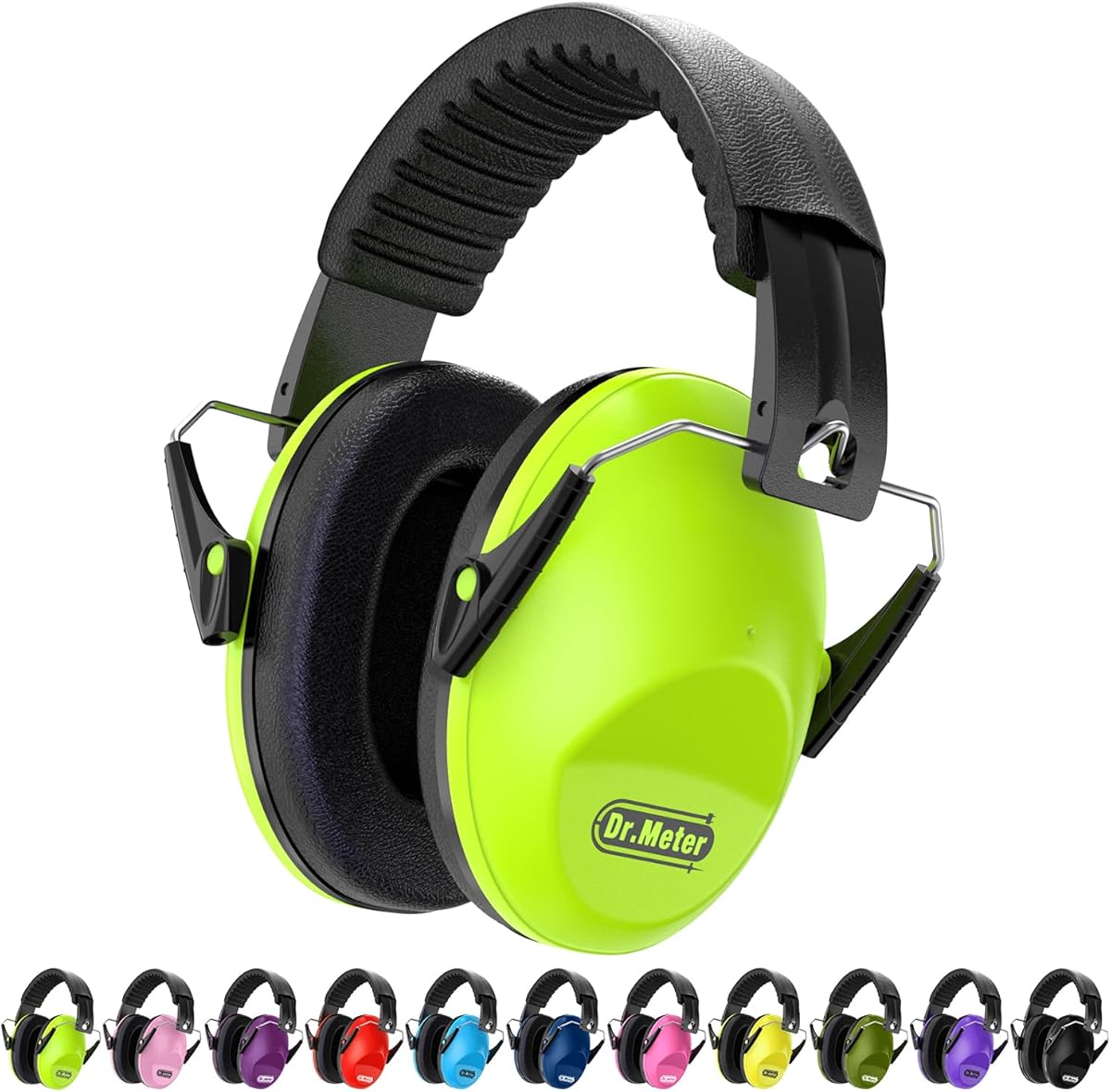
The Dr.meter EM100 Noise Cancelling Headphones for Kids Adults, Ear Muffs offer a 4.6 rating and a distinctive 27.4 dB SNR with a stated 20 dB NRR. The product is designed to reduce noise without muting it completely, preserving voices while lowering the intensity of environmental sound. That balance is useful for children who want relief from noise without complete isolation.
We may earn a commission when you buy through this link, at no additional cost to you.
Memory foam cores and PU leather padding create a soft seal, while the ABS shell and triple-layer sound-dampening foam provide the stated attenuation. The headband adjusts for toddlers, children, teenagers, and adults. For school study, air shows, fireworks, monster-truck events, and concerts, this broad fit can help one pair serve several family members. ANSI S3.19-1974 and CE EN 352-1 certification are also listed.
The manufacturer suggests placing the earmuff over a box or similarly sized object for several hours if the first fit feels tight. That adjustment period may be challenging for a child who wants to remove an uncomfortable item immediately. The product is passive and cannot deliver music, calls, or instructional audio.
The EM100 is a strong option for families seeking one adjustable hearing protector that can transition from a child's use to adult use. It is particularly compelling where reduced but recognizable sound is preferable to total silence, and where a cushioned, broad-fit design can improve comfort.
The product is explicitly positioned to reduce rather than fully eliminate sound. That approach can help children remain aware of nearby voices and instructions while lowering the sensory intensity of louder surroundings.
A wide adjustment range allows the same earmuff to fit children, teenagers, and adults. This can be useful for family outings where a shared spare pair is needed.
We may earn a commission when you buy through this link, at no additional cost to you.
The Puro Sound Labs Kids Headphones, Volume-Limiting 85dB, BT2200 Plus, Teal is the premium entertainment option in this guide. It has a 4.2 rating, which is lower than the ratings of the passive hearing protectors, but it differentiates itself with Puro's Balanced Response Curve, rich bass, clear vocals, and a volume limit set at 85 dB.
We may earn a commission when you buy through this link, at no additional cost to you.
The headphones support Bluetooth listening for up to 20 hours and include a 3.5 mm connection for wired use. Interchangeable earcups allow switching between on-ear and over-ear cushions, which can be valuable when a child's preferred pressure level changes. A protective hard case improves travel storage, and an included daisy-chain cable allows two headphones to share one source for shared listening or individual volume control.
This model is not a certified hearing protector and does not actively cancel environmental noise. Its 4.2 rating also places it behind the other options in the list, so buyers should not infer that it provides the same noise attenuation as an SNR- or NRR-rated earmuff. Some children may find the multiple cushion and connection options more complicated than they need.
The BT2200 Plus is best for families that prioritize audio quality, build versatility, and premium comfort for music, films, games, and travel. It works particularly well for a child who wants engaging personal audio but does not need environmental hearing protection in high-noise settings.
Interchangeable on-ear and over-ear cushions let the child change the seal and pressure profile. This flexibility is valuable when a pair works well for reading but feels too warm during active play.
The Balanced Response Curve, 40 mm-class personal audio experience, and volume limitation are oriented toward enjoyable everyday entertainment. Wired and wireless connections add flexibility at home and while traveling.
We may earn a commission when you buy through this link, at no additional cost to you.
The right choice depends on whether the child needs environmental hearing protection, entertainment audio, or a combination of both. Sound sensitivity, age, hair, head shape, commute length, and tolerance for electronic controls should all influence the decision.
Passive earmuffs use physical foam and cup construction to reduce external sound without electronics. They are often simpler, lighter in operation, and immediately ready for use at concerts, fireworks, airports, or school. Active noise-cancelling headphones add battery-powered circuitry to reduce steady mechanical sounds such as engines and air-conditioning. For an autistic child, either approach can be helpful, but sensitivity to ear pressure may make the gentler passive option more comfortable. The child's response should take priority over a preference for technology.
SNR and NRR are related but not identical measurements, so buyers should read the complete product description rather than compare the numbers as if they were interchangeable. Higher figures generally indicate more attenuation under specified test conditions, but real environments contain many frequencies and sudden peaks. Certification under ANSI S3.19 and CE EN 352-1 adds useful context, yet it does not guarantee that every child will experience the same comfort or benefit. A product that fits correctly and feels acceptable is often more useful than a model with the highest headline figure.
Many autistic children are sensitive to pressure, heat, fabric texture, or having objects close to their ears. Soft ear cushions, a padded headband, swivel cups, and a light construction can reduce discomfort. Hair-catching pivots and rigid seams may also cause resistance. The fit should feel secure without being painful, and the earmuffs may need a gradual break-in period. Parents should allow the child to handle the product, adjust it, and remove it without conflict whenever possible.
Children grow quickly, and a pair that is too small can be ineffective or uncomfortable. Adjustable telescoping arms, retractable stainless steel bands, and rotating cups help accommodate different head sizes. The stated age range provides a starting point, but head circumference and the shape around the ears matter more than age alone. Families should also check whether the cushions press against glasses, hearing aids, or other devices the child uses.
Bluetooth headphones add music, games, video, calls, and educational audio, but they also introduce charging, pairing, controls, and possible connection interruptions. Large buttons and simplified operation can help younger children. Volume limits offer protection during personal listening, while active cancellation may be unavailable in wired mode. A child who benefits from predictable entertainment during travel may prefer wireless features, whereas a child who dislikes device sounds may prefer a completely passive product.
Travel and school routines make compactness a practical requirement. Folding earmuffs can fit into a backpack, while a protective case helps protect premium wireless headphones from impact. Parents should consider where the product will live during the day and whether a child needs a dedicated pair at school. A two-pack can be convenient when one set is kept at home and another at school, although it requires more storage and may create a preference for one color or set.
Reinforced shells, steel components, improved bonding, and stronger cushions can extend the life of a frequently handled product. The relevant type of rough use varies by age: a toddler may twist the cups, while an older child may fold or drop the headset repeatedly. Check whether replacement parts are available, whether ear pads can be cleaned, and whether the stated materials tolerate repeated moisture or skin contact. Durability should not come at the expense of a comfortable, lightweight fit.
Volume limiting is important for wireless entertainment headphones, but it is not equivalent to certified environmental hearing protection. The Puro BT2200 Plus limits playback to 85 dB, the BTH12 offers 74 or 85 dBA settings, and the BTH20 uses an 80 dBA limit with its Sound Refiner technology. Parents should still supervise listening duration and device settings, particularly when children use headphones for extended school, gaming, or travel sessions.
Introduce the product gradually. Before the first outing, let the child examine the earmuffs, touch the cushions, and practice putting them on and taking them off. Begin with a short, low-stress period in a quiet room, then move to a moderately noisy setting before attempting a major event. If the child reports pressure, itching, heat, pain, or an unwanted blocked feeling, stop and adjust rather than forcing continued use.
For passive protectors, place the cups so that they sit evenly around the ears and verify that the headband is neither too tight nor too loose. For wireless models, pair the device before leaving, select an appropriate volume limit, and confirm that the child understands how to play, pause, answer a call, and turn off optional lights. In active cancellation mode, start with the gentler setting and move to stronger reduction only if the child remains comfortable.
Clean the ear cushions and headband according to the manufacturer's instructions, and avoid immersing electronic components unless the product explicitly permits it. Wipe sweat and dirt promptly, allow cushions to dry fully, and keep connectors free of debris. Check hinges, telescoping arms, buttons, battery function, and cushion attachment regularly so worn or loose parts are addressed before use.
They can be. The most useful products for sensory support usually emphasize effective noise reduction, soft materials, adjustable fit, and limited physical pressure. General kids' headphones may provide volume control and wireless audio without certified environmental noise protection. The right choice depends on whether the child's main need is hearing protection, entertainment, or both.
Neither approach is automatically better for every child. Passive earmuffs are simple, require no charging, and can work well in loud environments, while active cancellation is especially useful against steady travel noise. Some children dislike the pressure created by active cancellation, so trying a gentle mode or a passive pair first may be helpful.
No. Even certified hearing protectors reduce rather than eliminate all sound, and actual performance depends on the noise frequencies, the fit, and the product design. The stated SNR and NRR figures describe tested attenuation under specific conditions. Several products in this guide are deliberately designed to leave voices recognizable while lowering surrounding noise.
Age guidance differs across the list, with several models intended for children aged three and up and the iClever EM01 listed for ages five and older. More important than the label is whether the child can wear the device comfortably and safely. A fit that leaves marks, causes pain, or creates excessive pressure is not appropriate merely because the product is marketed for children.
Start by adjusting the headband gradually and checking that the earmuffs are not angled or pulled tightly over the ears. Some manufacturers suggest placing the headband over a box or similar object for a short period to stretch it. If discomfort persists, discontinue use and consider a model with softer cushions, a wider adjustment range, or a different design.
A volume limit can make everyday personal listening more responsible, but it does not replace adult supervision or regular breaks. Children should avoid extremely long sessions, and caregivers should confirm that the actual playback level is appropriate. Certified hearing protectors are the more relevant choice for concerts, fireworks, construction noise, or other environmental hazards.
A two-pack is useful when the child needs protection in two regular locations, such as school and home. It reduces the chance of forgetting a pair and provides a backup if one is damaged. A single folding pair may be more economical for occasional travel or family events, provided the child can reliably transport it.
Soft, breathable cushions, a light frame, even weight distribution, and a seal that does not pinch are the most important physical features. Rounded edges, simple controls, and a design that avoids catching hair can further reduce stress. Because comfort varies by child, choosing a model with generous adjustment and a gradual break-in period is usually wise.
The ProCase Kids Noise Cancelling Headphones Ear Hearing Protection, Red offers the strongest overall value, with certified passive protection, a broad stated age range, and a compact folding design. The iClever BTH20 stands out for travel because it combines active and passive cancellation with wireless audio, two reduction modes, volume limiting, and long battery life. For families prioritizing premium personal audio, the Puro Sound Labs BT2200 Plus provides refined sound, interchangeable cushions, and thoughtful travel accessories.
The most important choice is the one that matches the child's environment and sensory profile. Certified passive earmuffs are best when reliable protection, simple operation, and no charging matter. Active cancellation can help with steady mechanical sounds, while Bluetooth entertainment headphones are useful for calm, focused listening rather than protection from environmental noise. A child who dislikes pressure, warmth, or electronics may need a simpler design than a feature-rich model.
Product details, ratings, and prices can change, and a comfortable fit may vary even between two children of the same age. Before buying, verify the current specifications, age guidance, certification details, volume controls, and return terms. Current prices should also be checked so the selected model remains appropriate for the family's budget and intended use.