
Swann MaxRanger4K Solar System
Up to 2000-foot range
Three-camera kit
Solar power
Compare the best long range outdoor WiFi cameras for wide properties, featuring 4K video, solar power, long-range hubs, zoom, night vision, and smart detection.
Long range outdoor WiFi cameras help property owners monitor driveways, farms, warehouses, gates, yards, and other distant areas without relying on a nearby outlet or conventional Wi-Fi signal. The strongest models combine extended wireless coverage, sharp image sensors, useful night vision, intelligent detection, and dependable outdoor construction.
The products in this guide were compared using the specifications and features supplied for each model, including advertised wireless distance, resolution, power options, detection capabilities, recording choices, weather resistance, and system requirements. The list covers standalone cameras, add-on cameras, complete camera systems, and one networking device designed to extend a home connection.
Each review explains where a product fits best, along with the compromises a buyer should understand before ordering. Range figures are advertised under particular conditions, so walls, trees, terrain, and router placement can affect real results. Product availability and pricing change frequently, making it wise to confirm the current listing and compatible accessories before purchase.
4.4Editor score

4.1Editor score
The table below compares all ten options by their most important characteristics, including advertised range, image quality, power design, detection features, and system or network requirements. It includes both complete systems and add-on products, so buyers should verify compatibility before choosing a camera that requires a hub or NVR.




The BU-H900 4K PTZ WiFi Outdoor Security Camera has a 4.0 rating and stands apart from the other selections through its 50X optical zoom. That magnification makes it especially useful when a buyer wants to identify distant vehicles, wildlife, ships, stadium activity, or people across a large property without relying entirely on digital cropping.
We may earn a commission when you buy through this link, at no additional cost to you.
Its mechanical movement is another major strength. The camera supports 360-degree pan and 90-degree tilt at speeds ranging from 1.4 to 200 degrees per second, allowing it to scan broad locations and then center on a particular area through the CamHipro app. Four super infrared LEDs and four additional infrared LEDs are advertised for night vision as far as 1,200 feet, while four bright floodlights provide color illumination up to 130 feet.
The third-generation AI recognition chip can distinguish people, vehicles, and pets, and human tracking is intended to keep a detected person centered. Customizable detection zones, sensitivity, and schedules can help limit unwanted alerts. The IP66 aluminum housing supports continuous 24/7 recording to a microSD card of up to 128GB, although the card itself is not included, and no cloud-storage charge is required for that local recording function.
This is the strongest choice for a buyer whose main requirement is seeing small or distant subjects rather than simply covering the nearest yard. It is less convenient for remote locations because it needs a reliable power source and conventional Wi-Fi access, but the combination of optical zoom, rapid PTZ movement, and powerful infrared illumination makes it the most specialized surveillance tool in this guide.
The 50X autofocus lens preserves magnification in a way that digital zoom cannot, making the BU-H900 useful for identifying fine details in faraway scenes. It is the feature that most clearly separates this model from conventional fixed-view outdoor cameras.
Rapid pan and tilt movement expands coverage across barns, warehouses, parking lots, and open yards. Infrared illumination reaches an advertised 1,200 feet, while the floodlights offer a shorter but brighter color option for closer nighttime scenes.
We may earn a commission when you buy through this link, at no additional cost to you.
The CYVIO 4K Solar Wireless Security Camera has a 3.6 rating and is designed as an add-on for a compatible NVR rather than a standalone camera. Its headline attraction is the advertised 700-meter long-range Wi-Fi connection, which may appeal to buyers covering large farms, commercial lots, or other properties with widely separated monitoring points.
We may earn a commission when you buy through this link, at no additional cost to you.
The camera combines 4K resolution with a 130-degree wide-angle lens, DWDR backlight handling, and full-color night vision. PIR motion detection combines with AI recognition of people and vehicles, while a spotlight and siren provide active deterrence. Real-time phone alerts, remote monitoring, and full-duplex two-way audio are available after the associated app is linked to the NVR.
Its IP66 enclosure is designed to withstand rain, wind, sand, ice, and snow, and solar power removes the need to run a cable to a distant location. The major limitation is structural: the NVR is not included, and the camera cannot work by itself. Buyers must already own a compatible CYVIO NVR or confirm that the seller supports the camera with their system before ordering.
This model is a good fit for someone extending an existing compatible NVR installation to a remote corner of a property. Its lower rating and mandatory hub dependency make it less convenient as a first purchase, but the combination of 4K video, solar operation, and 700-meter advertised open-area transmission is well suited to professionally planned, multi-point coverage.
The requirement for a compatible NVR is the decisive buying condition. It should be verified before purchase, because a camera designed to communicate with a hub cannot deliver its full range of functions as a conventional Wi-Fi camera.
Solar power is especially valuable where running electricity or Ethernet would be inconvenient. The wide field of view, color night vision, and person and vehicle detection help the camera cover a large remote area without a nearby connection.
We may earn a commission when you buy through this link, at no additional cost to you.
The Swann MaxRanger4K Wireless Solar Security Add-On Camera has a 4.2 rating and is built around Wi-Fi HaLow, a low-frequency wireless approach that the product claims can reach as far as 2,000 feet in open air. That makes it one of the strongest choices in the guide for extending surveillance across large properties, farms, and business grounds.
We may earn a commission when you buy through this link, at no additional cost to you.
It records in 4K Ultra HD and provides color night vision with built-in spotlights up to 100 feet, plus black-and-white visibility up to 130 feet. True Detect combines heat and motion sensing to trigger alerts, the spotlights, and a built-in siren. Integrated solar charging supports continuous operation, and the built-in microphone and speaker allow two-way communication through the Swann Security app.
The product is explicitly an add-on for an existing Swann MaxRanger4K Hub, so compatibility is essential. Pairing uses a QR code, and the manufacturer states that the system has no monthly fees. Its reliance on a separate hub means it is less attractive to someone who wants a simple standalone camera, but it is highly practical for expanding a larger installation without replacing the central system.
Choose this camera when you need impressive advertised range, solar power, and active deterrence across a large outdoor area. It is a particularly strong fit for owners of the MaxRanger4K ecosystem who want a dedicated camera for a gate, field, driveway, or another point that lies well beyond ordinary router coverage.
The key advantage is the 2,000-foot open-air claim and the ability of the signal to penetrate walls, trees, and other obstacles better than typical Wi-Fi. Actual performance still depends on local conditions and hub placement.
Integrated charging reduces battery-maintenance demands, while spotlights and the siren add an active response when motion is detected. Two-way talk provides a convenient way to communicate with someone near the camera.
We may earn a commission when you buy through this link, at no additional cost to you.
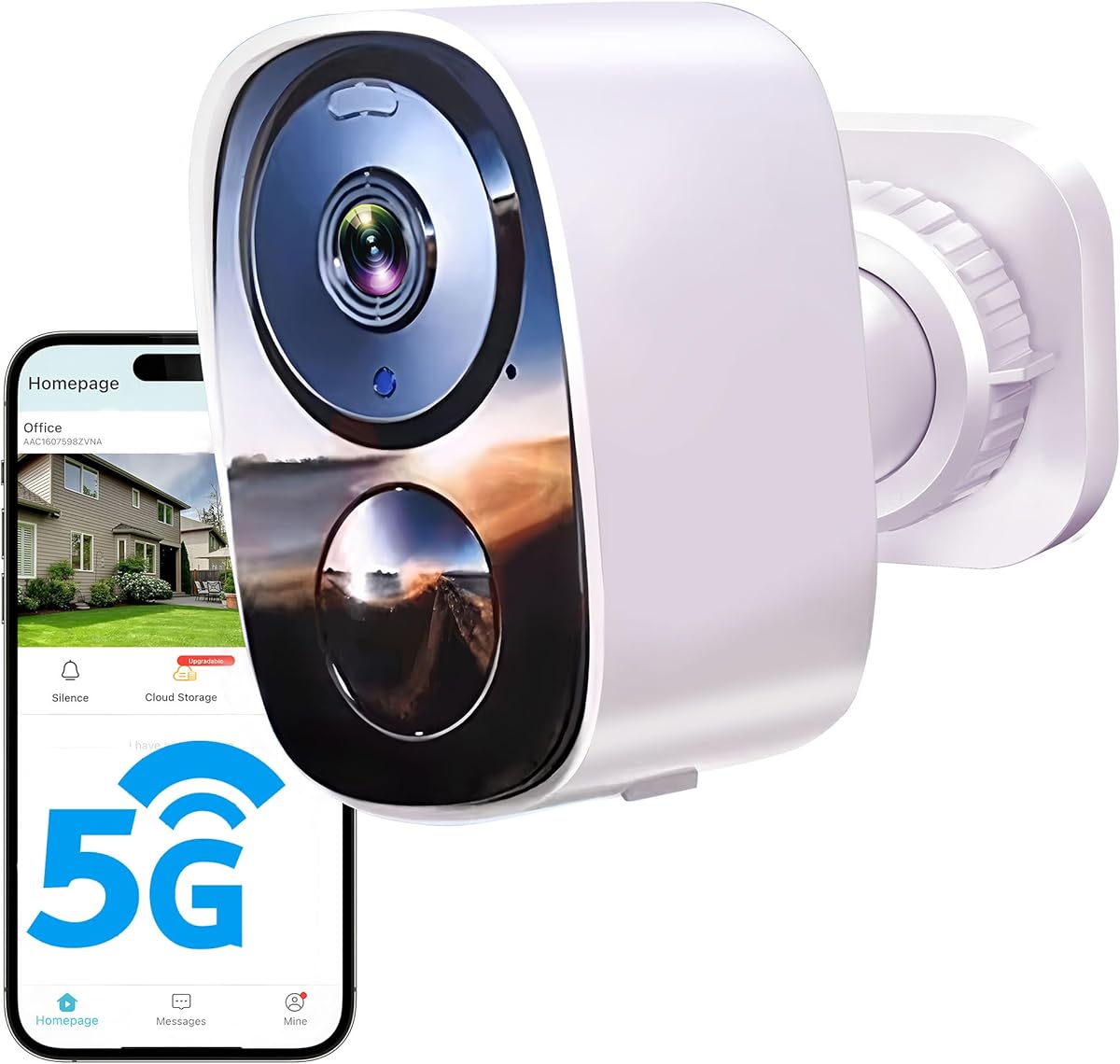
The 2026 Upgraded 2K Security Camera has a 4.3 rating and offers a practical mix of features for buyers who do not need a hub-based system. It supports both 2.4GHz and 5GHz Wi-Fi, uses a rechargeable battery, and carries an IP66 dustproof and waterproof rating, making it a straightforward option for patios, gates, sheds, and other moderately distant locations.
We may earn a commission when you buy through this link, at no additional cost to you.
Its image quality is 2K rather than 4K, but full-color night vision, built-in LED lights, and digital zoom support a useful picture in many ordinary conditions. AI motion detection sends phone notifications, while two-way audio allows a homeowner to speak with visitors or warn someone away. The spotlight and siren add active deterrence, and compatibility with Alexa broadens the available control options.
Storage can be handled through a free cloud tier or a local microSD card up to 256GB, although the card is not included. The free plan provides SD-quality footage, while HD access requires a paid plan. Battery life is advertised at up to six months, but the stated engineering test ran 60 days with 100 motion triggers each day; lower trigger frequency, temperature, recording mode, and usage conditions can materially change the result.
This is the best budget-oriented standalone camera in the group, particularly for buyers who value dual-band connectivity, local storage, and flexible viewing without a proprietary hub. It falls short of the specialized optical zoom and kilometer-scale links offered elsewhere, but its broad feature set and low entry cost make it a sensible general-purpose choice.
The combination of a free cloud tier and local microSD support gives buyers more than one way to retain recordings. Anyone expecting high-resolution cloud video should account for the distinction between the free SD-quality plan and paid HD access.
The advertised six-month maximum is most realistic when activity is infrequent and power-saving settings are used. Busy driveways, cold weather, frequent recording, and constant alerts can reduce runtime considerably.
We may earn a commission when you buy through this link, at no additional cost to you.
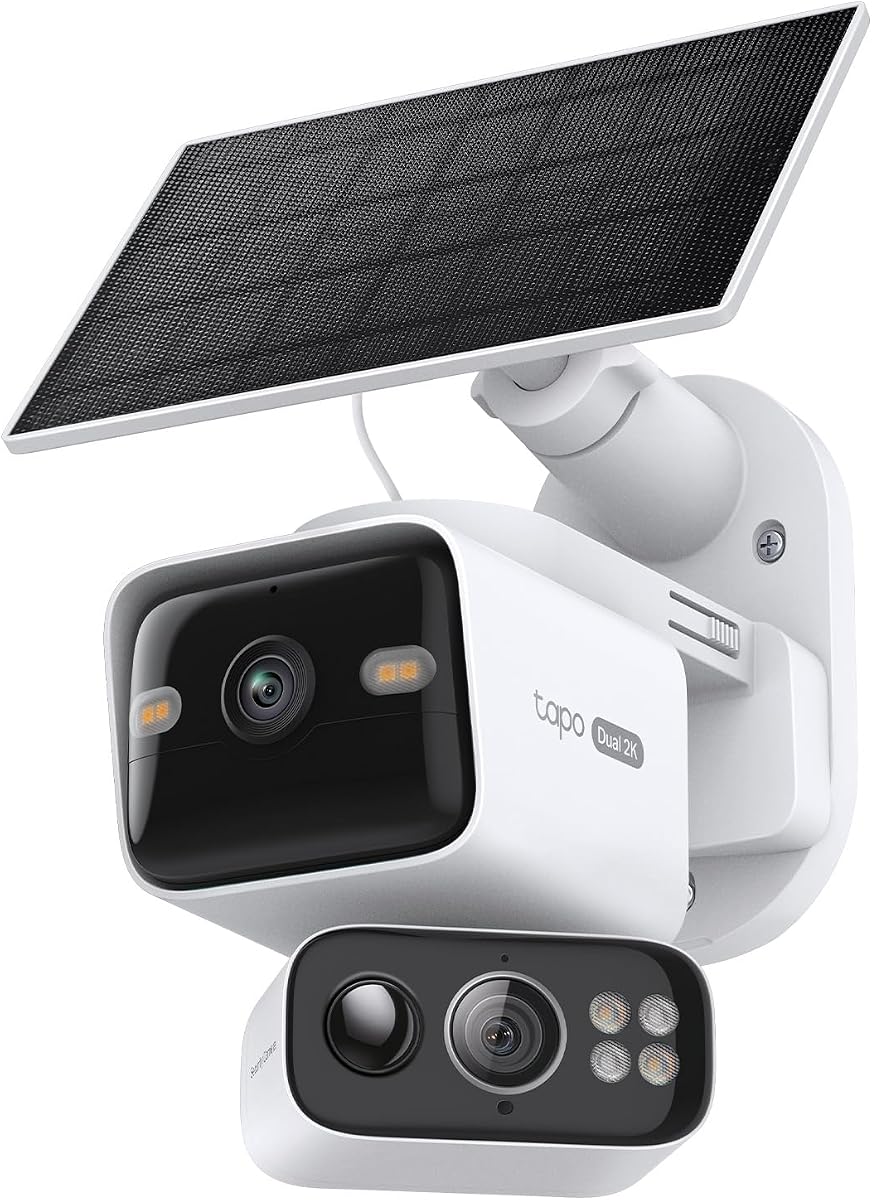
The Tapo C645D KIT has a 4.4 rating and is the most versatile conventional camera in the guide. It combines a fixed 2K ultra-wide lens with a separate 2K pan-and-tilt telephoto lens, allowing it to watch a broad area while retaining a separate moving view for tracking. The camera was also identified as a USA TODAY Top Pick at CES 2026.
We may earn a commission when you buy through this link, at no additional cost to you.
Its 165-degree fixed lens covers one area continuously, while the pan/tilt lens provides a 360-degree horizontal view of another. The two images can work together, and the movable lens can automatically follow motion detected by the fixed camera. People, vehicles, and pets can be identified without a subscription, which helps limit unnecessary alerts.
Power comes from a built-in solar panel and a 10,000mAh battery. One hour of direct sunlight is stated to power a full day of use, while the battery can last up to four months on one charge during cloudy weather. Solar charging requires temperatures above 32 degrees, so cold-season placement needs consideration. Full-color spotlight night vision and infrared night vision can be selected according to the situation.
This is the Editor's Choice because it balances panoramic awareness, detailed tracking, flexible power, and sophisticated detection without requiring a proprietary base station. It is ideal for a buyer who wants two distinct views from one location, particularly when a single fixed camera would leave gaps or a single moving camera might lose awareness of a second area.
The fixed ultra-wide lens maintains context while the telephoto lens follows movement and provides closer detail. This dual-view arrangement reduces the chance that a moving subject leaves the frame or that one lens must compromise between broad coverage and magnification.
Solar charging offers continuous daytime replenishment, while the large battery bridges cloudy periods. Cold conditions limit solar performance, making the stored battery an important part of the overall design.
We may earn a commission when you buy through this link, at no additional cost to you.
The Swann MaxRanger4K Mini system has a 4.1 rating and includes three 4K cameras, a base station, and a 32GB microSD card. It is a complete starting point for buyers who want long-range wireless coverage without assembling a system from separate cameras, a hub, and storage.
We may earn a commission when you buy through this link, at no additional cost to you.
The cameras use 900MHz Wi-Fi HaLow, with advertised placement up to 1,000 feet in line of sight or 330 feet through obstacles. Each camera has a 110-degree viewing angle and supports battery power, USB-C charging, and optional solar charging. Night2Day color night vision and infrared night vision provide day-and-night monitoring, while True Detect+ recognizes heat, motion, people, and vehicles.
The included base station stores footage locally, and its 32GB microSD card can be expanded to 512GB. This local approach avoids subscription fees, while the Swann Security app provides remote access on iOS and Android. Built-in sirens, sensor lights, and two-way audio add deterrence and communication. The cameras can be used indoors or outdoors, although outdoor range still depends on placement and obstructions.
This is the Best Budget pick among the complete long-range systems because it includes three cameras and local storage. It offers less maximum range than the larger 2,000-foot Swann options, but its lower advertised cost, generous camera count, and 330-foot through-obstacle figure make it an excellent starting point for a medium-to-large property.
The package removes much of the complexity involved in matching add-on cameras to a compatible hub. It also includes local storage, so the basic system is ready for recording without a recurring storage subscription.
The 900MHz connection is designed to carry video farther than ordinary Wi-Fi, with the supplied data noting 330 feet through obstacles. Buildings, dense vegetation, terrain, and interference can still reduce actual performance.
We may earn a commission when you buy through this link, at no additional cost to you.
The Swann Max Ranger 4K Wi-Fi NVR Add-on Camera has a 4.4 rating and targets owners of a compatible MaxRanger4K hub. It is built to cover an additional distant point with 4K color video while using 900MHz Wi-Fi for a claimed range of up to 2,000 feet, depending on local conditions.
We may earn a commission when you buy through this link, at no additional cost to you.
A built-in solar panel supports the wire-free design, and True Detect plus AI can sense heat, motion, people, and vehicles to initiate recording and alerts. The 4K sensor is intended to preserve useful detail during daytime surveillance and through color night vision. Its strongest use is filling a coverage gap without adding another cable run to a remote part of the property.
The hub requirement prevents it from operating as a normal Wi-Fi camera, and buyers should confirm exact system compatibility before placing an order. The claimed range is also a maximum figure rather than a guarantee in every environment. Even so, the 900MHz signal is described as stronger through walls and obstacles than ordinary Wi-Fi, which is a meaningful advantage on a sprawling property.
This is a compelling expansion camera for anyone who already relies on the Swann MaxRanger4K ecosystem. The combination of solar power, 4K recording, intelligent detection, and no monthly fee is especially useful for a distant gate, field, driveway, or parking area that ordinary Wi-Fi would struggle to reach.
Adding this unit to an existing hub lets buyers extend a long-range architecture to a new point on the property. That is more practical than replacing the central system or installing a conventional camera at the end of a long Ethernet run.
Recognizing heat, motion, people, and vehicles allows the camera to react intelligently to relevant activity. Buyers can configure the resulting recording and alert behavior through their compatible Swann system.
We may earn a commission when you buy through this link, at no additional cost to you.
The Swann MaxRanger4K Solar Wireless Security Camera System is a three-camera package built for extensive property coverage. Although the supplied product data does not include a customer rating, its specifications place it among the most capable premium options: 4K Ultra HD video, up to 2,000 feet of open-air wireless range, and a 64GB microSD card for local recording.
We may earn a commission when you buy through this link, at no additional cost to you.
The system advertises 650 feet of typical-use range while claiming that its wireless technology penetrates walls, trees, and obstacles with fewer dropouts than traditional Wi-Fi. Each outdoor camera has a built-in solar panel and an IP66 weatherproof rating. Color night vision, sensor lights, and visibility up to 100 feet support nighttime monitoring around large homes, farms, and businesses.
True Detect+ identifies heat, motion, people, and vehicles, then can trigger recording, mobile alerts, spotlights, sirens, and two-way audio. Footage can be retained on the included 64GB card, described as supporting as many as 12 months of rolling local recordings, or through cloud backup without monthly fees. The Swann Security app provides monitoring, playback, talk, and system management.
This is the Best Premium pick for a buyer who wants a full solar system rather than a single trial camera. Three cameras, generous local storage, active deterrence, and the largest advertised range in the guide make it an ambitious solution. Confirm hub compatibility, network placement, and the intended recording setup before installing the system around a large property.
The three-camera package provides a practical starting configuration for a large estate, farm, or business. Buyers can position units around separate boundaries and manage them through the same app and local recording infrastructure.
Built-in solar panels remove the need for power cables at each camera, and the included card provides substantial local recording capacity. Cloud backup is also available without a recurring monthly fee, according to the supplied product information.
We may earn a commission when you buy through this link, at no additional cost to you.
The Outdoor AX1800 WiFi Extender has the highest listed rating in the guide at 4.8, but it serves a different purpose from the ten camera products. It is a networking device designed to extend a home connection into a backyard, garage, farm, pool area, or other outdoor space where standard Wi-Fi becomes weak.
We may earn a commission when you buy through this link, at no additional cost to you.
Using Wi-Fi 6, the extender provides advertised aggregate speeds of 574Mbps on 2.4GHz and 1,201Mbps on 5GHz. Six high-gain antennas are designed to support a stable outdoor signal, while a Gigabit Ethernet port allows a camera to be connected by wire. Repeater, router, and access-point modes offer different ways to integrate it with an existing network.
The IP65 enclosure is built for outdoor use and is described as resistant to rain, dust, and extreme temperatures. It supports a 24V DC adapter or Power over Ethernet, and the supplied listing mentions a vertical or horizontal mounting option and compatibility with most routers. This makes it useful as the network foundation for conventional Wi-Fi security cameras placed around an outdoor property.
The buyer should not mistake this product for a camera or recorder. It cannot capture footage, issue person or vehicle alerts, or provide night vision. It is best chosen when the problem is a weak network connection, not a lack of surveillance hardware, and when the intended camera supports ordinary 2.4GHz or 5GHz Wi-Fi.
A stable network can improve the live-view experience and reduce interruptions for cameras designed for standard Wi-Fi. Six antennas, dual-band operation, and a Gigabit Ethernet option provide several ways to strengthen coverage.
Repeater, router, and access-point modes make the device adaptable to different homes and yards. PoE is particularly useful for installations where a wired network connection is preferred near the camera.
We may earn a commission when you buy through this link, at no additional cost to you.
The Blink Outdoor 4 XR is a four-camera system with a 4.0 rating. Its Sync Module XR acts as a dedicated hub, allowing cameras to operate up to 1,000 feet away in open air or 400 feet in typical use, according to the supplied product information.
We may earn a commission when you buy through this link, at no additional cost to you.
The XR platform uses the 900MHz band, which the listing says avoids typical Wi-Fi congestion. It delivers live view 20 percent faster and produces up to 70 percent fewer disconnects than cameras operating over standard Wi-Fi. That makes the system well suited to properties where multiple cameras would otherwise compete for an ordinary home network.
The package includes four Outdoor 4 cameras, the Sync Module XR, eight Energizer lithium AA batteries, mounting kits, a USB-C cable, and a power adapter. The patented chip technology is advertised to deliver up to two years of battery life when used with the hub and the included lithium batteries. The Blink app can control up to 10 Blink devices, and Alexa support adds voice-operated routines.
This system is a strong fit for a buyer who wants four cameras and a dedicated long-range hub without assembling the network from separate parts. Local storage is possible through a microSD card of up to 256GB, sold separately, while cloud event storage comes with a free 30-day trial of the subscription plan. Buyers should compare local and cloud costs before deciding which storage route best fits their needs.
The Sync Module XR reduces reliance on crowded standard Wi-Fi and provides a specialized long-range network for outdoor cameras. Its shorter typical-use figure of 400 feet is more meaningful for many properties than the open-air maximum.
Four cameras, eight lithium batteries, mounting hardware, and the hub provide a broad starting package. Additional Blink devices can be added and grouped through the app, up to the stated ten-device control limit.
We may earn a commission when you buy through this link, at no additional cost to you.
The most useful camera is the one that can maintain a stable connection at the intended location, capture the activity you need to identify, operate through expected weather, and record footage in a way that suits your privacy and budget priorities. Compare range claims with field of view, power requirements, storage, and system compatibility before ordering.
Advertised range is usually a maximum achieved under favorable conditions, such as an open line of sight. Walls, trees, metal structures, terrain, nearby wireless equipment, and the position of the hub or router can reduce actual performance. Models using 900MHz or Wi-Fi HaLow are designed to travel farther through obstacles than many conventional 2.4GHz or 5GHz systems, while dedicated extenders can help standard Wi-Fi cameras reach a more suitable outdoor location.
A wide-angle lens is useful for covering a gate, yard, or parking area, but narrow subjects can be difficult to identify at a distance. PTZ cameras can scan and zoom toward specific targets, and dedicated telephoto lenses can preserve fine detail. The BU-H900's 50X optical zoom is the most specialized magnification in this group, while the Tapo C645D combines a 165-degree fixed lens with a separate pan-and-tilt telephoto lens.
Battery, solar, and wired designs each suit different properties. Solar cameras are useful at remote locations where running power is difficult, but panel orientation and weather matter. A backup battery helps bridge cloudy periods. Wired cameras offer consistent power but require cable access. IP66 and IP65 ratings indicate resistance to dust and water ingress, while cold temperatures can limit battery or solar performance.
Some cameras connect directly to a phone app and household network, while others require a proprietary NVR, base station, or hub. Hub-based systems often provide more consistent long-range links and central local recording. Add-on cameras can be less expensive within an existing ecosystem, but they cannot operate independently. Before buying, verify the required base station, matching model, pairing process, and app support.
Local microSD storage can support continuous recording without a recurring cloud charge, while cloud backup may be convenient for remote access and sharing. Included cards provide a useful starting capacity but may fill quickly with several high-resolution cameras. Some free cloud tiers retain lower-resolution footage, and some advanced features require a paid plan. Compare continuous recording, event clips, retention, card limits, and subscription requirements.
Basic motion alerts can produce unwanted notifications from moving branches, shadows, animals, or passing vehicles. AI detection for people, vehicles, and pets helps refine alerts, while customizable zones, sensitivity, and schedules provide further control. Active deterrence includes spotlights, sirens, and two-way audio. These features can be valuable, but accurate classification depends on the scene, lighting, camera angle, and the sensitivity of the selected settings.
Resolution alone does not determine whether a distant face or vehicle can be identified. Sensor quality, lens choice, digital zoom, infrared illumination, floodlights, and color night vision all contribute to usable footage. The BU-H900 combines 4K video, 50X optical zoom, infrared illumination advertised to 1,200 feet, and floodlights for color images up to 130 feet. Other systems emphasize wide color views and active deterrence.
The app determines how easily a buyer can view live footage, review clips, talk to visitors, adjust detection zones, and manage recordings. Smart-home support such as Alexa may improve convenience, but compatibility varies among brands. Dedicated hubs can be limiting if a future camera uses a different ecosystem, while standard dual-band Wi-Fi offers broader interoperability. Check the listed requirements and whether firmware updates are available through the manufacturer app.
Begin by mapping the entire property and identifying the specific areas that need to be seen. Walk or view each target from the intended camera position, note nearby walls and vegetation, and decide whether the requirement is broad monitoring, close detail, or both. Place the hub, NVR, router, or extender before mounting cameras so the cameras can be installed where images are needed rather than where the network happens to be strongest.
Follow the manufacturer's mounting and weatherproofing instructions, and aim each lens away from direct sunlight, reflective windows, and moving branches when practical. For solar cameras, choose a panel position with unobstructed sunlight and use the specified battery, adapter, or Ethernet arrangement. Configure detection zones, sensitivity, recording schedules, alert preferences, and firmware updates before relying on the system for security coverage.
Check live and recorded footage after installation, particularly at night and during heavy rain. Confirm that distant subjects remain visible, alerts are relevant, audio works, and recordings can be retrieved from the intended storage location. Periodically clean lenses, inspect solar panels and mounts, check battery condition, verify that storage remains available, and update the app or camera firmware when the manufacturer provides an update.
The usable distance depends on the camera, router, hub, and environment. Open-air claims of 1,000 to 2,000 feet describe ideal conditions, while walls, trees, terrain, and interference can reduce the signal substantially. Check the typical-use figure as well as the maximum, and position the hub where the camera has a clear path to it.
Lower-frequency wireless systems are generally designed to cover longer distances and penetrate obstacles more effectively than standard 2.4GHz or 5GHz Wi-Fi. They still need a compatible hub and proper placement. For a smaller property, a standard dual-band camera may be simpler, while a large estate can benefit from the more specialized long-range architecture.
Some models, including the Tapo C645D KIT and the 2026 Upgraded 2K Camera, are designed to work as standalone cameras. Several Swann and CYVIO options require a compatible base station, hub, or NVR. These add-on cameras cannot provide their advertised remote functions independently, so confirm compatibility before buying.
Solar charging depends on daylight, panel orientation, weather, and temperature. The Tapo C645D KIT specifically states that solar charging requires temperatures above 32 degrees, and battery capacity can also decline in cold conditions. A sufficiently sized solar panel and backup battery help, but exposed or frequently shaded locations may need additional charging options.
4K offers more image detail than 2K and can be valuable for faces, vehicles, and license plates, particularly when combined with optical zoom or a telephoto lens. A wide 2K camera may still be sufficient for general yard or driveway awareness. Resolution should be considered alongside lens magnification, lighting, sensor quality, and the distance to the subject.
That depends on the camera and storage method. Several products offer local microSD recording without a monthly fee, while the 2026 Upgraded 2K Camera includes a free cloud tier that stores SD-quality rather than HD footage. Blink offers a free 30-day subscription trial and local storage through a separately sold card. Check current service terms before selecting a recording plan.
Yes, when the camera supports the extender's 2.4GHz or 5GHz network and the extender is installed where it can receive a strong upstream signal. The Outdoor AX1800 extender can also provide a Gigabit Ethernet connection for a compatible wired camera. It is a network accessory and does not record footage or provide detection features itself.
The supported number depends on the hub or app. The Blink system described here can control up to 10 Blink devices, while Swann packages and add-on cameras are designed for expansion through a compatible MaxRanger4K hub. Check the manufacturer app and hub limits before adding cameras, particularly if you plan to cover several widely separated areas.
The Tapo C645D KIT is the most balanced individual camera because its dual lenses combine a wide fixed view with a moving telephoto view, while solar power, a large battery, dual-band Wi-Fi, and subscription-free detection round out the package. The Swann MaxRanger4K Solar Kit is the premium complete system for buyers who need three solar cameras, generous local storage, and up to 2,000 feet of advertised open-air range. The Swann MaxRanger4K Mini offers the strongest budget-oriented complete-system value.
The right priority depends on the property. Choose optical zoom when distant identification matters, use a solar hub system for remote gates and fields, select dual lenses for two areas viewed at once, and consider a network extender when ordinary Wi-Fi is the underlying problem. Also verify storage, night illumination, detection behavior, hub compatibility, and the realistic rather than maximum range before finalizing a purchase.
Availability, package contents, service plans, and prices can change, so check the current product listing and manufacturer support pages before buying. A long range camera is most effective when it is placed where the required view, signal path, power source, and environmental conditions all support the advertised features.