
Adjustable 8X Magnifying Eyeglasses
3.4Editor score
Eight-times magnification
Adjustable focus mechanism
Hands-free wearable design
Our expert guide compares the best magnifying glasses for watching TV, evaluating magnification, focus, comfort, field of view, portability, and low-vision
Magnifying glasses for watching TV can make subtitles, faces, and on-screen details easier to see, especially when conventional corrective lenses are not designed for the viewing distance. The most useful pair balances magnification, adjustable focus, a comfortable fit, and a field of view broad enough to preserve an enjoyable television experience.
We compared all ten products using the information supplied for each listing, including optical design, magnification, focus controls, weight, intended use, and important limitations. The guide covers clip-on, full-frame, headband, and wearable designs for myopia, hyperopia, presbyopia, and general low-vision needs.
Each pick highlights a different reason to consider it, from a budget-friendly headband option to premium, individually adjustable television eyewear. Ratings and product details can change over time, while prices and promotions fluctuate, so readers should confirm current information on the linked product pages before purchasing.
3.4Editor score

4.0Editor score

5.0Editor score
The comparison below highlights the main differences in magnification, focus control, frame style, portability, and optical features. It is designed to help readers identify the most practical television magnifier for their specific vision needs and viewing habits.




The 2.1X Eschenbach Max TV Glasses offer a traditional full-frame television magnifier with a 3.5 rating. Their most impressive attributes are the individually focusable objective lenses, bright 20-degree field of view, and flexible 49-gram frame. This combination makes them suitable for users who need more control than a simple fixed-distance magnifier provides.
We may earn a commission when you buy through this link, at no additional cost to you.
Each objective lens can be focused independently to compensate for up to plus or minus three diopters of spherical correction or adjusted across a focal range from 10 feet to infinity. That adjustability is particularly valuable when a television is not positioned at a perfectly consistent distance. The Galilean design also supports a relatively broad viewing area, while the frosted housing helps suppress distracting reflections from surrounding light sources.
The main trade-off is the user rating of 3.5, which indicates that some buyers may not have found the viewing experience as satisfying as they hoped. These glasses may also be unsuitable for people with macular degeneration or severe vision loss. Although the flexible temples and low weight improve comfort, the design still cannot compensate for every form of visual impairment.
This is a strong choice for someone who wants a full pair of television glasses, adjustable focus, and a lightweight frame rather than a minimal headband solution. It is particularly appropriate when the user can wear conventional eyeglass-style frames and needs a generous but not enormous field of view. Among the products in this guide, it offers one of the most balanced feature sets.
Independent objective-lens adjustment is the feature that most distinguishes this model. It can help accommodate different refractive needs while also allowing the focal setting to be refined for a television positioned about 10 feet away.
At only 49 grams, the flexible-temple frame is light enough for regular television sessions. Its full-frame form can also feel more natural than a headband or clip-on arrangement for many users.
We may earn a commission when you buy through this link, at no additional cost to you.
The HongDee Dual Lenses Magnifying Glasses are aimed at seniors with low vision who want assistance with distance viewing and independent living. The product has a 2.4 rating, the lowest among the listed options, but its curved-lens construction, broad stated working distance, and adjustment for individual vision remain relevant benefits.
We may earn a commission when you buy through this link, at no additional cost to you.
The listing describes far-view operation from 1.6 to 65 inches, making the glasses more versatile than products intended solely for one television distance. Curved lenses may help provide a more natural view than conventional flat or spherical designs, while the user-adjustable aspect allows the wearer to fine-tune the image according to personal vision needs.
The low rating is an important consideration and may reflect differences in optical performance, comfort, or expectations. The product is explicitly not designed for severe low vision, and its distance-viewing purpose means it is not suitable for reading at distances shorter than 0.5 meters. The listing also warns that individual vision status and the progression of macular degeneration can affect whether it works for a particular user.
This option may be worth considering for a person with mild to moderate low vision who wants a lightweight pair for television and other distance activities. It is less suitable for someone seeking a premium optical system, very strong magnification, or assurance of compatibility with severe macular degeneration. Checking the return policy and testing it on the intended television is advisable.
The stated 1.6-to-65-inch working range gives these glasses more flexibility than a model dedicated to a single screen position. That makes them useful for televisions located in different rooms and at varying distances.
Because low-vision needs differ considerably, the adjustable design can be more useful than a completely fixed magnifier. The wearer still needs to confirm that the available magnification is appropriate for the intended viewing condition.
We may earn a commission when you buy through this link, at no additional cost to you.
The Jojomis 2.1X Max TV Headband combines a 4.0 rating with a straightforward 2.1X magnification system. It is designed for myopic users who want a portable way to enlarge television images. Its easy-grip focusing wheel and adjustable headband make it appealing as a flexible alternative to full-frame glasses.
We may earn a commission when you buy through this link, at no additional cost to you.
The product is intended for a recommended observation distance of approximately three meters and provides a visual range from zero to 300 degrees, according to the supplied listing. Rather than being limited strictly to television, the glasses are also presented as useful for reading, research, electronics repair, and jewelry appraisal. That versatility adds value for users who want one magnifier for several activities.
The headband format may not offer the same polished appearance or stable optical alignment as a full-frame model. It is also explicitly positioned for myopia with a listed refraction range of zero to negative three, so people with hyperopia or more complex prescriptions should not assume it is suitable. The image is described as having natural distortion, which can become more noticeable at the edges.
This is a practical choice for a myopic television viewer who values portability, straightforward adjustment, and the highest customer rating among the ten products. It is especially helpful for someone who also wants magnification for hands-free close work. Buyers should position the television near the recommended three-meter distance and check the field of view for comfort.
The easy-grip focusing wheel allows the user to refine the image without removing the glasses. That convenience is valuable during long sessions or when a user is still learning what focal setting feels best.
Besides television, the listing identifies reading, research, repair work, and jewelry appraisal as possible uses. That makes the headband easier to justify for regular daily tasks than a product limited to one screen.
We may earn a commission when you buy through this link, at no additional cost to you.
These 2.1X Hyperopia Magnifying Glasses are explicitly designed for people who have difficulty seeing distant objects and want assistance while watching television. The product has no available rating in the supplied data, so its buyer feedback cannot be evaluated, and its listing places the strongest emphasis on portability and ergonomic construction.
We may earn a commission when you buy through this link, at no additional cost to you.
The glasses provide 2.1X magnification for distance viewing and are marketed as useful for outdoor activities as well as television. Their lightweight, compact form should be easy to carry in a bag or pocket, while the ergonomic design is intended to remain comfortable during longer viewing sessions. The frosted objective-lens housing found on many comparable models helps limit distracting reflections.
The limited specification is the main drawback. The supplied information does not identify an individual focus-adjustment range, field of view, exact weight, or whether prescription-equivalent correction is available. That makes it harder to compare the product directly with individually adjustable alternatives. A missing rating also removes an important signal about real-world comfort and optical performance.
The product is best suited to a hyperopic viewer seeking a simple, portable 2.1X television aid. It may be particularly convenient for travel or occasional viewing away from home. Consumers should examine the current listing closely, confirm the frame dimensions and focusing behavior, and ensure the magnification level matches their specific distance-vision needs.
The hyperopia-specific positioning makes this option more targeted than a general magnifier. It is intended to help users with a specific type of distance-vision difficulty rather than providing a universal solution for every low-vision condition.
The compact, lightweight construction suits viewers who travel or want to keep a magnifier handy outside the living room. Portability can encourage more consistent use than a larger model that is difficult to store near every television.
We may earn a commission when you buy through this link, at no additional cost to you.
The HongDee Far View Magnifier Glasses are a lightweight distance-viewing option with a 3.2 rating. Their standout specification is the stated 1.6-to-65-inch working range, which supports television viewing at several distances. The curved dual-lens design and adjustment for individual vision add flexibility to a product otherwise described in broad terms.
We may earn a commission when you buy through this link, at no additional cost to you.
The listing positions the glasses around ophthalmic and optometric design principles, while the curved lens arrangement differentiates it from products using spherical lenses. Users can adjust the device to suit their own vision, and its compact structure is intended to fit different head sizes without the weight of a larger full-frame system.
A rating of 3.2 suggests mixed experiences, and the absence of a clearly stated magnification value makes comparison more difficult. There is no explicit warning about severe low vision in the supplied description, yet a general far-view magnifier should not be assumed to address advanced conditions. The user also needs to confirm that a 1.6-inch working distance is realistic for their specific needs and that the viewing arrangement does not become uncomfortable.
This product is most appropriate for a low-vision user who values a wide working range and a simple adjustable design. It may work well for televisions in compact rooms or for people who move between viewing positions. Prospective buyers should compare its actual lens specifications with the current listing and avoid treating it as a substitute for professional low-vision care.
A 1.6-to-65-inch working range offers useful flexibility for small televisions, larger displays, and different room layouts. It can reduce the need for a separate magnifier for each viewing position.
The compact, lightweight structure is intended to fit different head sizes. That focus on adaptable fit may be more useful than extra features for a user whose main requirement is a consistently usable television aid.
We may earn a commission when you buy through this link, at no additional cost to you.
The Max TV Clip On Magnifying Glasses provide 2X magnification in a compact format that can attach to an existing pair of eyeglasses. With a 3.9 rating, they rank among the better-reviewed options and offer a practical alternative for viewers who do not want to replace their everyday glasses with a full-frame magnifier.
We may earn a commission when you buy through this link, at no additional cost to you.
The clip-on unit weighs approximately 28.6 grams and measures about 1.3 by 4.1 by 1.6 inches. Its aspherical PXM optical resin lenses are designed for a focal length of approximately 6.6 feet and beyond. A stainless-steel body adds durability, while the included case makes it easier to store and transport.
The principal limitation is the compatible pupillary-distance range of 60 to 68 millimeters. Not every eyeglass frame will accommodate the clip-on unit, and users may need to check the dimensions before buying. Two-times magnification is also gentler than the 4X, 8X, or other systems represented in this guide, making it more suitable for mild difficulty viewing distant screens.
This model is a sensible choice for a television viewer who already wears prescription glasses and wants a discreet optical aid. It is less suitable for someone with severe distance-vision loss or a need for substantial magnification. Buyers should confirm frame compatibility, sit about 6.6 feet from the television, and verify that the clip-on does not interfere with their primary eyewear.
The clip-on format is one of the most practical options for a regular glasses wearer. It preserves the user's familiar correction while adding magnification for television viewing.
Aspherical PXM optical resin lenses, a stainless-steel body, and a weight of only 28.6 grams create a compact magnifier intended for convenient storage. The dedicated case adds further portability.
We may earn a commission when you buy through this link, at no additional cost to you.
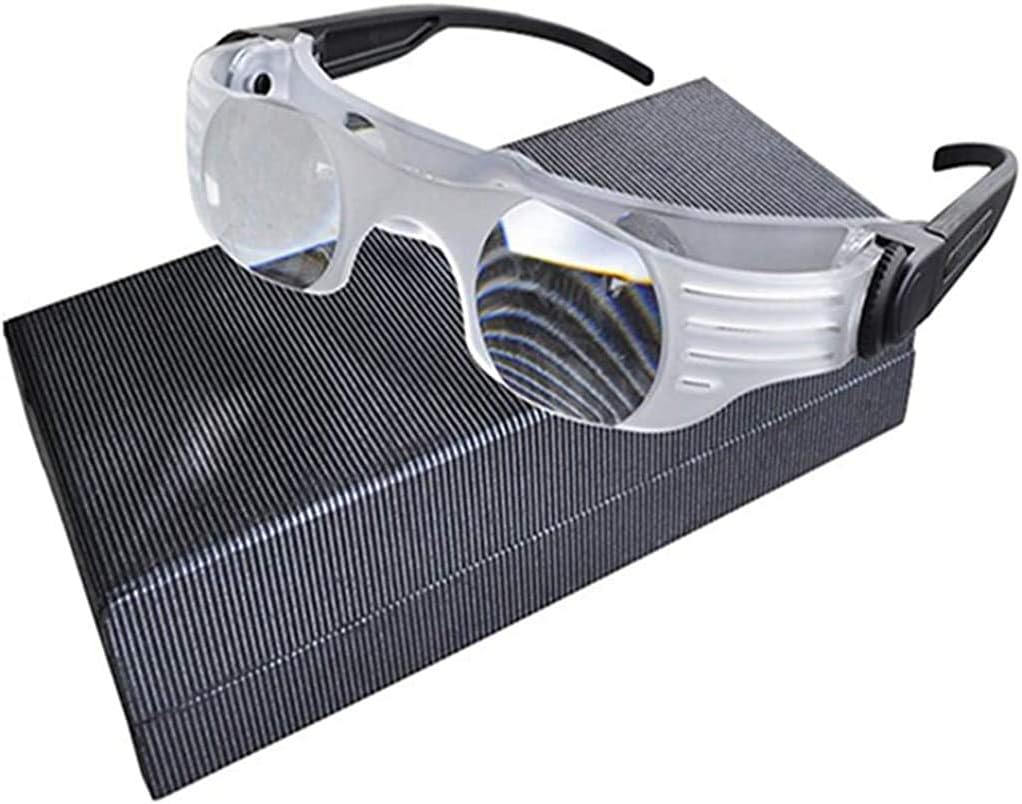
The Adjustable 8X Magnifying Glasses deliver one of the strongest magnification levels in this guide, with a listed rating of 3.4. Their wearable design, adjustable focus, and large nose pads make them suitable for users who need substantial enlargement for television, reading, fishing, or crafts.
We may earn a commission when you buy through this link, at no additional cost to you.
The glasses combine 8X magnification with an adjustable-focus design and polarized lenses. Their hands-free construction leaves the wearer free to handle a remote control, fishing rod, or craft project. A large nose pad is intended to distribute weight and improve stability, while the frosted objective housing reduces reflections that could otherwise interrupt the view.
Eight-times magnification is not automatically better for television. A powerful optic can reduce the visible field, make peripheral content disappear, and require more practice to use comfortably. The 3.4 rating indicates that some users may have found the experience less than ideal. The listing also places particular emphasis on fishing, suggesting that the product may be less purpose-built for prolonged television viewing than specialist distance glasses.
This is a good budget-oriented choice for a person who wants one wearable magnifier for both near and far tasks, especially if a milder 2.1X system does not provide enough enlargement. A new user should begin with the lowest practical setting, move slowly, and check the television image at the intended distance. It is less attractive for someone who needs a broad, natural view of the whole screen.
The high magnification can reveal small text, line work, or distant objects that are difficult to see unaided. Adjustability gives users some control over how much enlargement they use for a particular task.
Wearable eyeglass construction keeps both hands available for fishing, reading, crafting, and television controls. The large nose pad also helps keep the optical unit in a consistent position.
We may earn a commission when you buy through this link, at no additional cost to you.
The 2.1X Eschenbach Max TV Glasses are full-frame distance viewers with a 3.4 rating. Their core strengths are a bright 20-degree field of view, independently focused objective lenses, and a molded bridge designed to remain comfortable during extended wear. They are engineered for users with binocular pupillary distances between 60 and 68 millimeters.
We may earn a commission when you buy through this link, at no additional cost to you.
The Galilean optical design provides 2.1X magnification while retaining a wider view than many compact magnifiers. Each objective lens can compensate for plus or minus three diopters of spherical correction, and focal length can be adjusted from 10 feet to infinity. A frosted objective housing limits reflections, while the molded bridge avoids sharp edges that could create pressure points.
The specified pupillary-distance range is important because these glasses are not designed to fit every head. The product also carries an explicit warning that it may not work for people with age-related macular degeneration or other severe vision loss. Its 3.4 rating leaves some uncertainty about satisfaction, and the Galilean field, while broad, will not display an entire large television at once.
This model is a strong fit for an adult with ordinary distance-vision difficulty who values independent focus adjustment and a natural eyeglass appearance. It is less suitable for severe low vision or for users whose pupillary distance falls outside the stated range. Confirm the fit carefully and compare the viewing field with the size of the intended screen before making a final choice.
The 20-degree field of view balances magnification with a useful amount of surrounding context. It offers a more television-like experience than an extremely narrow close-focus magnifier, although the visible area remains smaller than an unaided screen.
Independent objective-lens focusing can balance differences between the two eyes. The plus-or-minus three-diopter range and flexible focal setting make the glasses adaptable to more than one television arrangement.
We may earn a commission when you buy through this link, at no additional cost to you.
The Adjustable 4X Magnifying Eyewear is a wearable option for seniors with presbyopia or low vision who want stronger enlargement than a mild television viewer. No customer rating is available in the supplied data, so user satisfaction is difficult to assess. The product's strongest features are its four-times magnification, focusing wheel, large nose bridge, and anti-glare housing.
We may earn a commission when you buy through this link, at no additional cost to you.
The 4X system enlarges the television image while the easy-grip wheel enables focus changes. Individually focusable objective lenses are described as compensating for plus or minus three diopters of spherical correction, although the listed focal-distance wording is incomplete. The 85-degree large nose bridge is intended to reduce pressure, and the molded, edge-free design is intended to support longer wear.
A four-times magnification level is likely to make small text more visible, but it can also make the field of view substantially narrower than normal. That trade-off may be uncomfortable for a viewer who wants to see an entire large screen without moving their head. Since no rating is available and some specifications are incomplete, potential buyers should review the current listing and return terms carefully.
The eyewear is a reasonable middle ground between the 2.1X television models and the 8X wearable option. It suits a user who wants noticeable enlargement for reading or television but does not need the strongest option. It also supports activities such as crafting and fishing, making it a potential all-purpose low-vision aid.
Four-times magnification offers more enlargement than mild 2.1X viewers while remaining less extreme than the 8X alternative. This middle range can suit people who need to read subtitles but do not want the most restricted field.
The large, zero-pressure nose bridge and molded design aim to reduce discomfort. These comfort features are especially relevant when magnification encourages longer viewing sessions.
We may earn a commission when you buy through this link, at no additional cost to you.
The Eschenbach MaxTV Glasses 2.1x are the strongest overall match for a viewer seeking refined television magnification with a 5.0 rating. They combine hands-free eyeglass wear, 2.1X magnification, individually adjustable focus, a 20-degree field of view, and a notably light 1.7-ounce frame.
We may earn a commission when you buy through this link, at no additional cost to you.
The objective lenses can be fine-tuned across plus or minus three diopters for each eye, making the glasses adaptable to differing vision needs. They are intended to make screens and distant objects appear clearer from about 10 feet to infinity, while the balanced 20-degree field preserves a practical amount of peripheral context. Flexible temples support comfort during extended viewing.
The main drawback is that 2.1X may be insufficient for a person with substantial distance-vision difficulty. The glasses are designed for distance viewing rather than close reading, and the supplied information does not make a specific claim for severe vision loss. Although the included zippered case improves portability, it also makes the package feel more oriented toward buyers seeking a complete premium system.
This is the ideal pick for someone who wants a natural, hands-free television aid with independently adjustable focus and a lightweight full-frame design. It is equally relevant to viewers of sports, theater, or other distant events who want a compact optical aid. For mild to moderate distance-vision difficulty, its combination of features and 5.0 rating makes it the most persuasive all-around option here.
Independent plus-or-minus three-diopter adjustment gives users a more precise way to balance the image. This is especially useful when refractive needs differ between eyes or the television is farther away than the normal focal setting.
A frame weighing only 1.7 ounces reduces the burden of wearing magnification for an entire film or sports broadcast. Flexible temples and an ergonomic fit are central to that hands-free comfort.
We may earn a commission when you buy through this link, at no additional cost to you.
The best television magnifier is not simply the model with the highest number. A useful purchase must match the viewer's diagnosis, preferred magnification, television size and distance, comfort requirements, and willingness to adjust the optics.
Magnification determines how much larger the television image appears. Products in this guide range from 2X and 2.1X to 4X and 8X, with a trade-off between apparent size and viewing field. Milder magnification generally feels more natural and preserves more of the screen, while stronger magnification can make small text easier to see but requires more head movement and may cause disorientation. The 2.1X systems are positioned for television distance, whereas the 4X and 8X products also accommodate close tasks such as reading, fishing, and crafts.
Some models specifically target myopia, while others are marketed for hyperopia, presbyopia, or low vision generally. This distinction matters because a magnifier does not automatically correct every refractive condition. The Jojomis headband is described for myopia with a listed refraction range of zero to negative three, while the Hyperopia model is intended for people with difficulty focusing on distant objects. The Eschenbach models include individual focus adjustment, but users with macular degeneration or severe vision loss may still find them unsuitable.
Adjustable focus can make a much larger difference than a small difference in nominal magnification. The two Eschenbach full-frame models allow individual objective-lens adjustment and focus across a broad distance range, while the Jojomis and 4X products use an easy-grip focusing wheel. A fixed model may be adequate when the television always remains in the same position. Adjustable optics are more useful when screens are viewed at different distances, when the user's prescription changes, or when one eye requires a different focus from the other.
Magnification narrows the portion of the scene that can be seen at one time. The Eschenbach products specify a 20-degree field of view, which balances enlargement with peripheral context, while very strong systems may offer a more restricted view. A person watching a very large television may need to scan the screen more often, while subtitles and a smaller central picture may be easier to follow with a narrow field. The clip-on and headband formats also differ in how naturally they let the user move between magnified and normal views.
Comfort determines whether the glasses will be used regularly. Relevant details include total weight, temple flexibility, nose-pad design, bridge construction, and the stability of the frame or headband. The Eschenbach MaxTV 2.1x weighs only 1.7 ounces, the first Eschenbach model is listed at 49 grams, and the clip-on model weighs approximately 28.6 grams. Headband styles should be checked for unwanted pressure, while full-frame and clip-on models require attention to frame fit and pupillary distance.
Full-frame glasses are self-contained, stable, and often more suitable for extended viewing. They can also accommodate individual focus settings more precisely, as seen in the Eschenbach options. A clip-on magnifier is convenient for someone who already wears glasses and wants to add magnification temporarily, although it must match the user's pupillary distance and frame geometry. The Max TV Clip On is restricted to 60-to-68-millimeter pupillary distances, so not every existing pair will be compatible.
A product that is easy to store is more likely to remain available when the user needs it. The compact HongDee models, lightweight headband, portable clip-on, and included cases all support transport around the home or to another location. The latest Eschenbach MaxTV listing includes a zippered protective case, while the clip-on product also includes a dedicated case and instruction manual. Portability matters especially for people who travel, use televisions in multiple rooms, or want to visit family and friends.
Consumer television magnifiers are assistive viewing tools, not a substitute for professional diagnosis, prescription lenses, or low-vision rehabilitation. Several listings explicitly warn that results depend on personal vision, the degree of macular degeneration, and the viewing environment. A stronger optic can improve apparent size without correcting underlying disease or restoring missing visual detail. Anyone with rapid vision changes, pain, distortion, or significant impairment should speak with an optometrist or ophthalmologist before relying on a magnifier as a long-term solution.
Begin by placing the television at a comfortable viewing distance and putting on the magnifier before adjusting its controls. For models with a focusing wheel, turn it gradually while looking at a familiar object such as a subtitle or clock. For individually adjustable objective lenses, set one eye at a time, allowing each lens to be refined without disrupting the other.
Give your eyes time to adapt to the enlarged and brighter image. If the picture feels warped, the edges seem unclear, or the field of view is uncomfortable, reset the focus and make small adjustments to your viewing angle. Sit in a stable position and move the head slowly when following the screen. Avoid staring at a bright reflection source, and use appropriate room lighting so that the television remains visible without excessive glare.
Store the glasses in their case or in a clean, padded container where they cannot be crushed. Use a soft microfiber cloth to remove fingerprints, and avoid household cleaners, paper towels, or water unless the manufacturer specifically permits them. Periodically check the nose pads, hinges, headband, clip mechanism, and lens surfaces for looseness or damage.
Most television-focused models use 2X or 2.1X magnification because that offers a natural balance between enlarged detail and a usable field of view. Higher magnification can make subtitles easier to see but usually narrows the visible area and may require more head movement. The right level also depends on the size of the television, viewing distance, and the severity of the user's distance-vision difficulty.
They may provide useful magnification for some people, but they do not correct macular degeneration or restore lost visual detail. Several products in this guide explicitly warn that they may not work for macular degeneration or severe vision loss. A low-vision specialist can help determine whether magnification alone is appropriate and may recommend other aids or specialized viewing systems.
A headband is portable and easy to adjust, making it useful for travel or several activities. A clip-on model is convenient for people who already wear prescription glasses, although frame and pupillary-distance compatibility must be checked. Full-frame glasses provide a stable, self-contained option and are often the most natural choice for regular television viewing.
That depends on the model and its intended working distance. The 2.1X television systems are primarily designed for distant screens, while the 4X and 8X products are also marketed for reading and detailed close work. Even a multifunctional product should be checked for its stated minimum working distance because some distance-focused models are not intended for very close viewing.
The image may not be focused correctly, the lenses may not be aligned with the eyes, or the viewer may be outside the product's intended working distance. Stronger magnification also tends to reduce peripheral sharpness. Start with the recommended distance, clean the lenses, and make gradual focusing adjustments before assuming the model is unsuitable.
Check the manufacturer's stated pupil-distance range, frame dimensions, and any fit information before ordering. Clip-on products are especially sensitive to frame compatibility, while headbands and full-frame glasses must not pinch the nose or temples. A pair that feels stable without pressure is more likely to remain correctly aligned during a long broadcast.
That depends on the design. Full-frame television glasses are worn instead of ordinary glasses, while clip-on magnifiers attach to an existing pair. Some wearable systems can accommodate different needs, but users should confirm the manufacturer's compatibility instructions. Incorrect spacing can produce edge distortion, eye strain, or an unstable image.
Magnifying lenses gather and enlarge incoming light, but the actual perceived brightness depends on lens design, coatings, room lighting, and screen settings. A dark room can make the image seem harder to see even when the magnified area appears brighter. Moderate ambient lighting generally produces a more comfortable viewing experience than a completely dark room or direct glare.
The Jojomis 2.1X Max TV Headband is the most practical all-round value for a myopic viewer who wants easy focusing and portability. The Adjustable 8X Eyeglasses offer stronger magnification and multiple uses, while the Eschenbach MaxTV 2.1x stands out as the premium option with independent focus, a 20-degree field, a 5.0 rating, and a lightweight frame.
Before buying, prioritize the type of vision difficulty, the television's size and distance, and the balance between magnification and field of view. Adjustable focus is valuable when viewing conditions vary, but comfort and stability determine whether the glasses will be used consistently. Avoid selecting solely by magnification, since an overly strong optic can be harder to use than a milder, wider view.
Finally, verify the current product specifications, customer feedback, compatibility details, and return terms on the retailer page. Product designs, ratings, promotions, and prices can change, so the linked listing is the best source for current availability and purchasing information.