
Mcbazel 3-in-1 Digital Anemometer
4.5Editor score
Wind speed and temperature
Five selectable speed units
Backlit double-line display
Our Marine Anemometers guide compares ten handheld, mounted, display, and replacement wind instruments by features, accuracy, usability, marine suitability
Marine anemometers help boaters, anglers, sailors, and marine technicians measure wind speed, direction, temperature, and related conditions. The right instrument depends on whether you need portable readings, a fixed masthead system, an integrated display, or replacement components for existing marine equipment.
We compared the ten products in this guide by examining their stated measurement functions, mounting options, display features, included accessories, environmental suitability, and practical applications. The list covers handheld meters, instrument displays, complete wind systems, masthead assemblies, and specialized replacement parts.
Each pick reveals the capabilities that make it useful in its intended marine setting while acknowledging the limitations of the available product information. Ratings and availability can change, as can product prices and configurations, so readers should verify current listing details before making a purchase.
4.5Editor score

4.4Editor score
This side-by-side comparison highlights ten distinct approaches to marine wind measurement, ranging from pocket-sized handheld instruments to permanent masthead systems, integrated displays, and replacement assemblies.



The BTMETER BT-100 is a compact handheld anemometer designed for people who need a quick reading of wind speed, temperature, or wind chill in a wide range of settings. It carries a 4.5 rating and is especially relevant to boaters, sailors, anglers, and outdoor users who want a simple instrument without a permanently mounted system. Its stated wind-speed range covers 0.67 to 67.1 mph, while the temperature range is 14 to 113 degrees Fahrenheit.
We may earn a commission when you buy through this link, at no additional cost to you.
One of the BT-100's strongest features is its versatility. It measures wind speed in m/s, km/h, ft/min, knots, and mph, and includes a wind-chill reading, a low-battery indicator, and a backlit LCD screen. The metal threaded hole underneath permits tripod mounting, allowing continuous monitoring while the user handles a boat, fishing rod, kite, remote-control aircraft, or another task. The product also includes two AAA batteries and a carrying case.
The principal trade-off is that this is a handheld air-measurement tool rather than a dedicated marine masthead instrument. It does not directly report wind direction, and its list of boat-specific data is limited compared with the Raymarine systems. The display is also less elaborate than those on larger digital meters. For boaters who need occasional readings while sailing, evaluating launching conditions, or checking conditions at the dock, however, these limitations are often reasonable.
Choose the BT-100 when portability, multiple units, temperature, and wind chill matter more than permanent installation. It is a particularly good companion for smaller craft and anyone who wants to check a localized condition without installing a masthead sensor. The BT-100 stands out in this list as the most balanced budget handheld option, with enough features to make it useful well beyond a single-purpose wind-speed check.
The combination of wind speed and wind temperature gives boaters more context than a bare speed reading. Whether preparing for a sail, casting off, or judging conditions near the shore, the multiple unit options also make the reading easier to interpret.
The bottom mounting thread turns a handheld meter into a temporary fixed instrument. It can be positioned away from immediate airflow obstructions when continuous readings are more useful than constant handling.
We may earn a commission when you buy through this link, at no additional cost to you.
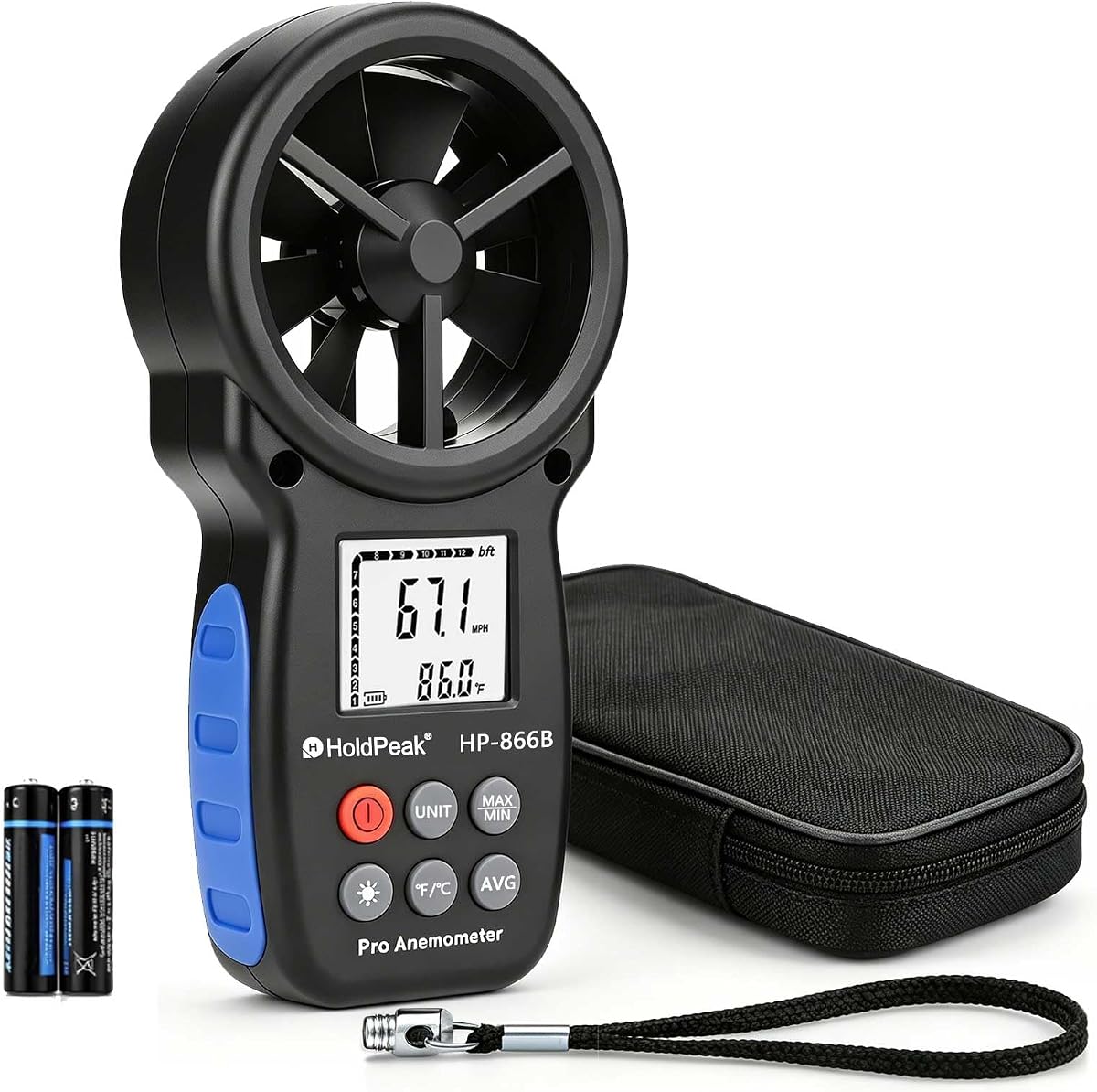
The HoldPeak 866B is a digital handheld anemometer that pairs portable construction with a broad set of measurement and memory functions. Its 4.5 rating reflects a product positioned for sailing, surfing, boating, drone flying, golf, and low-flow HVAC checks. It measures wind speed from 0.67 to 67.1 mph and also reports wind temperature, wind chill, maximum, minimum, and average wind speed.
We may earn a commission when you buy through this link, at no additional cost to you.
Its dual temperature sensors, eight vanes, and smooth fan shaft are intended to support sensitive readings, including low air movement around vents and ducts. Wind speed can be displayed in m/s, km/h, ft/min, knots, or mph, while temperature can switch between Celsius and Fahrenheit. Additional conveniences include a battery-level indicator, automatic shutoff, a backlight, a hand strap, and a bottom tripod hole. A waterproof carrying pouch helps protect the meter during damp outdoor conditions.
Compared with the BTMETER BT-100, the HoldPeak is more explicitly oriented toward outdoor enthusiasts and includes maximum, minimum, and average functions as standard. The tradeoff is a slightly more complex feature set that may take more time to master, especially when changing units or reviewing stored data. It still does not provide a separate direction reading or integrate directly with a boat's electronics, so buyers should not treat it as a substitute for a masthead wind system.
The HoldPeak 866B is an appealing choice for sailors, anglers, and watersports users who want temperature and wind-chill information alongside speed. It also suits anyone who expects to use the meter across boating, flying, and household airflow tasks. Its carrying pouch, strap, and tripod support make it easy to organize for outdoor use, while the recorded data functions improve its value for repeated field observations.
Maximum, minimum, and average readings are useful when wind conditions vary during a trip or outing. These functions provide a broader picture than a momentary speed reading and help identify whether conditions are building or settling.
The included waterproof pouch adds a practical layer of protection during sailing, boating, and other exposed activities. The hand strap also reduces the chance of dropping the meter while it is being read or repositioned.
We may earn a commission when you buy through this link, at no additional cost to you.
The Inspeed Magnetic Mount Anemometer is the highest-rated product in this group, with a 4.7 rating. Unlike the handheld meters, it is presented as a calibrated, magnetically mounted instrument for fixed-position use. That distinction makes it relevant to marine users who want repeatable readings without holding a meter or operating a conventional display unit.
We may earn a commission when you buy through this link, at no additional cost to you.
The magnetic mounting approach is the product's clearest convenience. A compatible steel or otherwise suitable mounting surface can provide a convenient way to position the anemometer where readings can be observed consistently. The listing identifies it as calibrated, which is an important detail when comparing an instrument intended for ongoing measurement with generic wind-speed readers.
The supplied product information is limited, so this review does not assume details that are not stated. No specific unit range, display format, temperature measurement, wind-direction function, or included installation hardware is described in the provided data. Buyers should therefore check the current listing and manufacturer documentation for those specifications before assuming compatibility with a particular vessel or display.
The Inspeed is best considered when a simple magnetic, calibrated installation is more important than a broad collection of digital functions. It may be especially useful for a temporary fixed setup or a dedicated monitoring location. Its strong rating and straightforward mounting concept are positives, but compatibility should be confirmed before purchase because the published product details in this roundup are brief.
A magnetically mounted sensor can remain in one location, avoiding repeated differences caused by holding the instrument at different heights or angles. That consistency is valuable when conditions are being monitored over time.
The stated calibrated status gives this model a useful foundation for measurement work. Confirming the intended mounting position and any applicable operating limits will help users interpret those readings correctly.
We may earn a commission when you buy through this link, at no additional cost to you.
The Raymarine Instrument Wind i60 Display Only is a dedicated marine display rather than a handheld meter. It carries a 3.9 rating, the lowest listed rating among the ten products, but that figure should be interpreted in light of what it is: a replacement or upgrade component for an existing Raymarine wind setup. It is not a complete sensing system.
We may earn a commission when you buy through this link, at no additional cost to you.
The display-only format is the defining feature. Owners who already have a compatible masthead transducer, cable, and associated system can replace or upgrade the visible instrument without buying every external component again. Its black and grey finish gives it a conventional marine-instrument appearance suited to a helm or dashboard arrangement.
The significant drawback is obvious: buyers without compatible equipment cannot use this display as a standalone anemometer. The provided information does not state the exact data fields, backlighting, power requirements, or connector details, so the user should verify those points against the current Raymarine documentation. Installation should also be matched to the vessel's electrical system and existing sensor network.
Choose this product when the wind-sensing hardware is already aboard and only the Raymarine i60 display needs replacing. It is less suitable for a first-time buyer seeking a complete marine anemometer. The low listed rating may reflect the limited nature of this package rather than a broad inability to serve its narrower purpose, but compatibility is the decisive issue.
When the masthead sensor and cabling are serviceable, replacing only the display can be the most targeted solution. It avoids replacing functioning components that are outside the scope of the purchased item.
A display-only package must match the vessel's existing Raymarine wind equipment. Reviewing connector type, supported sensor generation, power requirements, and mounting space can prevent an incompatible purchase.
We may earn a commission when you buy through this link, at no additional cost to you.
The TopTes TS-301 combines a 4.6 rating with a 2.26-inch backlit LCD, making readability one of its most visible selling points. It is a handheld wind meter intended for sailors, surfers, boaters, drone pilots, golfers, and HVAC users. Unlike basic speed-only devices, it adds temperature and relative-humidity measurements.
We may earn a commission when you buy through this link, at no additional cost to you.
The fan-based meter supports six speed units: feet per minute, feet per second, miles per hour, knots, kilometers per hour, and meters per second. The screen is easy to read in daylight and has a backlight for low-light use. Temperature range is stated as -4 to 140 degrees Fahrenheit, while relative humidity covers 0.0 to 99.9 percent. The product also shuts off automatically after ten minutes of inactivity to conserve power.
There are two important qualifications. First, the temperature and humidity sensors may require at least 30 minutes to adjust after entering a new environment, so early readings should not be treated as instantly stabilized values. Second, the TS-301 does not provide a masthead-style wind direction reading. It also remains a handheld air-speed instrument rather than a permanent marine system.
The TS-301 is a strong match for users who want a larger, more informative screen than a minimal handheld meter. The added humidity reading is especially convenient for understanding broader coastal or weather conditions, while six unit choices improve compatibility with different activities. For sailors and boaters who value visibility and immediate portability, it is one of the most approachable choices in the roundup.
The large screen reduces the effort required to interpret a reading while moving around a deck or handling other equipment. Backlighting also supports early-morning, dusk, and low-light use.
Temperature and humidity readings can shift as the internal sensors adapt after relocation. Allowing the stated adjustment period produces a more representative result when comparing conditions across different locations.
We may earn a commission when you buy through this link, at no additional cost to you.
The Raymarine E28081 Weather and Bowls is a replacement anemometer bowl and vane assembly for Raymarine ST50, ST60, and ST80 equipment. Its 4.1 rating reflects a useful but specialized component. It is worth considering only when an owner already has a compatible masthead unit and needs to restore or replace its moving sensor parts.
We may earn a commission when you buy through this link, at no additional cost to you.
The package includes the vane, counterweight, speed plates, fixing screws, and an Allen key. That list is important because a repair can be frustrating when a small piece is missing. Having the principal replacement components together makes the installation more practical and reduces the need to source separate hardware.
This product does not function as a complete anemometer or display, so it will not help someone starting from nothing. It also cannot be assumed to work with the i60 systems in this guide merely because they share the Raymarine name. Buyers should verify the original equipment model and inspect the existing masthead assembly before ordering. Wind direction, speed, and system performance also depend on correct alignment and installation.
The E28081 is a sensible maintenance purchase for owners of the specified ST-series equipment. It may be particularly useful after a cup or vane is damaged by severe weather or normal wear. For everyone else, the broader i60 wind systems are more relevant starting points. Within its narrow repair category, the included hardware and vane assembly make this a convenient all-in-one replacement option.
A damaged vane or speed assembly can impair an otherwise functional instrument. Replacing these moving parts restores the sensing head without requiring the owner to replace the entire installation.
Compatibility is limited to the listed ST50, ST60, and ST80 products. Checking the model markings and existing components is essential before ordering this repair assembly.
We may earn a commission when you buy through this link, at no additional cost to you.
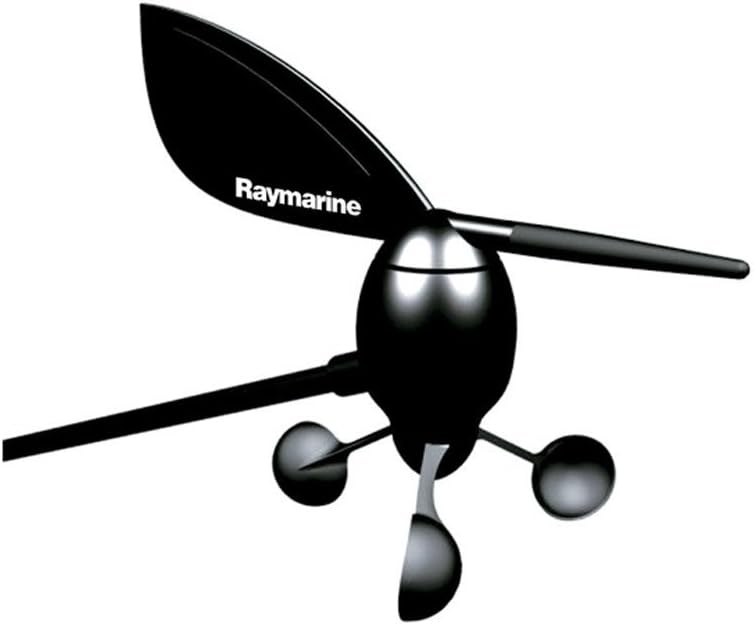
The Raymarine Masthead Wind Arm is a masthead-only assembly containing the wind vane and cups. It has a 4.4 rating and sits between a complete instrument package and a small repair kit. The product can renew the sensing end of a compatible installation while leaving the existing display and supporting electronics in place.
We may earn a commission when you buy through this link, at no additional cost to you.
A masthead sensor has a different role from a handheld anemometer. It is intended to remain in the airflow above the vessel and send information through the boat's system to a display. This arrangement can provide a more representative picture of conditions experienced by the craft, particularly when the display is placed where the skipper can read it easily.
The trade-off is that this is not an all-in-one solution. No display, cable length, base, or detailed measurement range is provided in the supplied information. Compatibility with the intended Raymarine system must therefore be confirmed. The installation also requires attention to alignment, secure attachment, and the avoidance of obstructions around the rotating sensor components.
This masthead arm is best for a boat owner who wants to replace or modernize the sensing head while retaining a compatible onboard display. It is less appropriate for a new vessel requiring a complete wind system. As an intermediate option, it offers useful flexibility, but only after the buyer confirms electrical, mechanical, and software compatibility with the existing instrumentation.
Mounting the sensing head at the masthead exposes it to airflow closer to the vessel's operating environment. This can make the instrument more useful for underway observation than a meter held by a crew member.
A masthead arm still needs a compatible display, connection, mounting support, and power arrangement. Treat it as one component in a coordinated marine system rather than a standalone anemometer.
We may earn a commission when you buy through this link, at no additional cost to you.
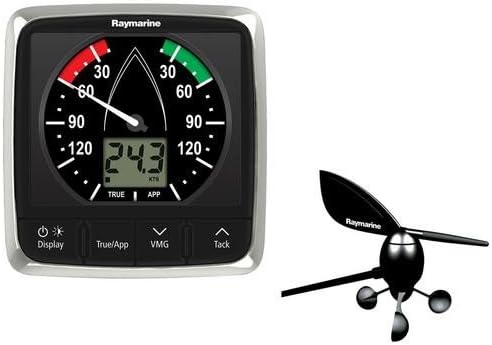
The Raymarine i60 Wind System with Masthead is a complete fixed-installation solution and one of the strongest choices for a boat that needs continuous wind data. Its 4.4 rating reflects a well-defined marine system that includes a masthead transducer, a 30-meter cable, a base, and the familiar i60 analog display format.
We may earn a commission when you buy through this link, at no additional cost to you.
The display is designed to show wind speed, direction, Beaufort scale, maximum wind speed, VMG, and tack information. That range makes it relevant to sailing workflows where direction, progression, and gust information can be as important as the instantaneous speed. The easy-to-read analog dial, high-contrast graphics, and red nighttime backlighting improve usability in different conditions, while low power consumption suits continued operation aboard.
Installation is the main commitment. The masthead transducer must be positioned correctly, the cable routed to the display, and the base connected to the vessel's power and system. The unit's stated footprint of 110 by 115 millimeters is identical to older Raymarine ST60+ instrumentation, which is useful for owners considering a familiar layout or replacement arrangement. Unlike a handheld model, it cannot conveniently move between vessels or serve as a quick spot check.
This is our Editor's Choice because it balances a complete package with a broad set of sailing-specific readouts. It is a strong recommendation for owners who want permanent, at-a-glance wind information at the helm. Buyers should still confirm the vessel's mounting space, electrical arrangement, and complete Raymarine compatibility before ordering.
Direction, Beaufort, maximum wind speed, VMG, and tack information make the display more useful for active sailing decisions. The information is organized around how a navigator evaluates conditions underway rather than around a single general-purpose speed number.
The stated footprint matches older Raymarine ST60+ instrumentation. That dimensional continuity can be helpful when a skipper is comparing instruments or planning a helm-layout change.
We may earn a commission when you buy through this link, at no additional cost to you.
The Raymarine i60 Wind Display System with Masthead Wind Vane Transducer is a premium, purpose-built marine wind package. It provides a digital display and a masthead transducer designed to supply live wind speed and direction. The supplied listing does not include a numerical customer rating, so this review does not assign one; the product's value is instead evaluated from its stated marine functionality.
We may earn a commission when you buy through this link, at no additional cost to you.
The centerpiece is the masthead wind vane transducer, which is described as engineered for harsh marine conditions and saltwater exposure. It captures wind speed and direction from the masthead, while the onboard display presents current speed, apparent wind angle, true wind angle, and additional information. Users can select different screen configurations and data fields so the most relevant readings remain prominent.
Adjustable backlighting and intuitive menu controls improve usability across daylight and nighttime conditions. The sophisticated presentation distinguishes this system from a portable meter and from the analog i60 package reviewed elsewhere in the guide. Its main disadvantage is that permanent installation and system integration are more involved. Owners also need enough room for the display, proper routing for the masthead connection, and a secure, correctly aligned transducer position.
This is the Best Premium pick for a boat owner who prioritizes detailed, configurable wind information in a dedicated marine system. It is especially compelling for sailors who want both apparent and true wind angles presented at the helm. Compatibility, installation requirements, and the current availability of all included components should be verified before purchase.
Displaying both apparent and true wind angles supports a more complete understanding of the airflow around a moving vessel. This is particularly valuable when a sailor needs to evaluate the relationship between vessel movement, wind direction, and sailing progress.
Customizable screen configurations let users prioritize the fields they use most. Adjustable backlighting keeps the information legible as lighting conditions change from daylight to darkness.
We may earn a commission when you buy through this link, at no additional cost to you.
The Mcbazel 3-in-1 is an affordable handheld meter that combines wind speed, wind temperature, and Beaufort scale in one compact device. Its 4.5 rating places it alongside the strongest-rated products in the roundup, although its simple handheld format serves a different purpose from the permanent Raymarine installations.
We may earn a commission when you buy through this link, at no additional cost to you.
Wind speed can be shown in meters per second, kilometers per hour, knots, feet per second, and miles per hour. Temperature is available in Celsius and Fahrenheit, while the Beaufort scale provides a quick scale from 1 through 12. The backlit double-line LCD shows speed and temperature simultaneously, making it convenient to compare the two readings without waiting for a display change.
Additional features include maximum, minimum, and average functions, a data-hold mode, automatic power-off, and a low-battery indicator. These make the meter more capable than a basic one-function gauge. The limitations are that batteries are not included and there is no integrated direction sensor. It should not be confused with a full wind system that can report apparent and true wind angles.
The Mcbazel is a strong choice for anglers, sailors, boaters, and general users who need an inexpensive portable reading without purchasing a fixed marine instrument. The Beaufort scale adds useful context that a basic wind-speed meter may lack, while data hold assists with taking a reading when the meter cannot be viewed continuously. It is the Best Budget choice in this guide for its broad feature set and approachable format.
The Beaufort scale translates wind speed into a familiar descriptive level. That can help anglers, sailors, and casual users understand how significant the current reading is without concentrating on a precise number alone.
Data hold keeps the current figures visible while the user shifts attention, writes down a result, or checks another instrument. The double-line layout reduces screen changes and supports faster interpretation.
We may earn a commission when you buy through this link, at no additional cost to you.
The right marine anemometer depends on measurement goals, installation constraints, display preferences, and the type of vessel. Portable meters offer flexibility, while complete systems provide permanent wind direction and sailing-related information.
Begin by deciding whether the instrument must travel with the user or remain connected to a vessel. Handheld meters are useful for quick checks at the dock, while launching, fishing, and during varied outings. Their screens often show speed and temperature, and some add humidity, wind chill, recorded averages, or a Beaufort scale. A permanent system is better suited to ongoing observation from the helm, particularly when direction, apparent wind, true wind, or VMG is required.
In short, choose portability for flexibility and select a fixed system for continuous, integrated wind information.
Many handheld anemometers measure speed but not direction. A masthead vane-and-cup arrangement can provide both speed and directional data, while a dedicated display translates that information into navigation-related fields. Sailors should consider whether they need apparent wind angle, true wind angle, Beaufort scale, maximum speed, VMG, or tack information rather than choosing solely on wind-speed range.
If direction is important, select a complete marine wind system or a masthead assembly designed to feed a compatible display.
Compare the lowest and highest wind speeds the instrument can measure against the conditions normally encountered. The BTMETER BT-100 and HoldPeak 866B are stated to cover 0.67 to 67.1 mph, while the TopTes adds humidity and temperature information. For sensitive indoor airflow work, a low-end capability can matter as much as the maximum reading.
Match stated range and resolution to the intended use instead of assuming that a larger number of units automatically improves the instrument.
A backlit screen is important in early morning, dusk, or shaded cockpit conditions. Large displays such as the TopTes TS-301's 2.26-inch screen may be easier to read at a glance, while dual-line layouts can keep wind speed and temperature visible simultaneously. Larger fixed displays may also support customizable fields, analog dials, and information organized around sailing tasks.
Prioritize a display that presents the data you actually need in a layout that remains legible from the helm or during handheld use.
A tripod hole or magnetic base can provide temporary fixed monitoring without a full marine installation. Permanent systems require a secure masthead sensor, proper cable routing, a compatible display base, electrical power, and careful alignment. A masthead arm or display-only module can be appropriate for an upgrade, but only when it matches the existing equipment.
Check physical dimensions, connection standards, cable length, mounting hardware, and available dashboard space before ordering.
A fixed sensor is continuously exposed to sun, spray, wind, vibration, and salt. The Raymarine systems in this guide are intended for marine use, while a waterproof carrying pouch can help protect a handheld meter between outings. Carrying cases and straps improve handling but do not make a non-marine instrument suitable for permanent exposure.
Evaluate the stated environmental suitability and include a protective case when using a portable device around a wet cockpit or exposed deck.
Marine instruments often belong to a broader ecosystem of sensors, cables, displays, and power connections. The E28081 is a replacement bowl-and-vane assembly for specified ST-series equipment, while the Raymarine Wind i60 display is sold by itself. A masthead-only wind arm similarly requires compatible electronics. These products can be efficient upgrades but are not suitable first purchases for an unprepared boat.
Confirm the existing model, connector type, supported functions, and required accessories before selecting a component-only solution.
Useful accessories can materially improve a handheld instrument. A hand strap reduces drops, a carrying pouch protects against moisture and impact, and batteries included with the product help it be ready for immediate use. Digital functions such as maximum, minimum, average, data hold, and unit switching add value when readings are recorded or compared over time.
Look for the accessories and memory functions that match how often the instrument will be used rather than adding complexity for features you will never need.
Before taking a reading, verify that the instrument is operating correctly, the battery level is adequate, and the selected units match the task. For a handheld meter, hold it in open airflow away from the body, canopy, rigging, and other obstructions. Allow a few seconds for the fan or vanes to stabilize, and record the result only after the displayed value stops changing noticeably.
For a masthead system, correct positioning is essential. Keep the sensor clear of antennas, sails, rigging, and other equipment that could disturb airflow or cause vibration. Follow the manufacturer's instructions for securing the transducer, routing the cable, connecting the base, and aligning the vane. After installation, verify that the displayed direction agrees with the actual position of the vane and that the system's readings behave plausibly underway.
Care differs by model. Keep handheld units dry when possible, protect their openings from dust and salt residue, and store them in the included pouch or a suitable dry case. For fixed systems, inspect mounting fasteners, cable connections, and moving parts on a regular schedule, especially after severe weather. Replace damaged cups or vanes promptly because damaged sensors can produce misleading readings even when the display continues to operate.
A handheld anemometer is portable and usually measures wind speed, temperature, and sometimes humidity or wind chill. A masthead system remains mounted above the vessel and commonly adds wind direction and sailing-specific data. Handheld models suit quick checks, while masthead systems are better for continuous monitoring from the helm.
Wind direction can be useful even when speed is the main concern, especially during docking, launching, and changing weather. It becomes particularly important for sailors because apparent and true wind angles influence course and sailing decisions. An ordinary handheld meter may not provide direction, so a masthead vane system is usually the more appropriate option.
A handheld meter can be used outdoors, but its reliability and safety may be limited by water exposure, wind pressure, and the difficulty of reading it with one hand. A protective pouch can help during storage and transport, while a fixed marine system is generally better suited to continuous operation in harsh conditions.
The Beaufort scale expresses wind conditions using a numbered category from 1 through 12. It provides a quick way to interpret the effect of the measured speed rather than relying only on a numerical value. The Mcbazel 3-in-1 displays this scale alongside wind speed and temperature.
No compatibility should be assumed based only on the Raymarine brand name. The E28081 is specifically listed for ST50, ST60, and ST80 equipment, while the other products concern i60 components. Check the original model, connectors, cable arrangement, supported data, and installation requirements before buying a replacement assembly.
The product information states that the temperature and humidity sensors may require at least 30 minutes to adjust after moving to a new environment. Reading them immediately can produce values that have not yet stabilized. Allowing the adjustment period helps the readings better represent the new location.
Accuracy varies by design, sensor type, installation, and airflow around the instrument. Some listings state a tolerance of plus or minus 2 percent of readings, while the Inspeed is identified as calibrated. For navigation or engineering decisions, confirm the manufacturer's specification and consider whether a certified marine instrument is required.
The full Raymarine i60 systems are the products in this guide that specifically describe apparent wind angle, true wind angle, VMG, and related sailing data. Basic handheld meters generally focus on wind speed and environmental readings. The selected display must also be connected to a compatible masthead sensor to provide those functions.
The Raymarine i60 Wind System with Masthead is the most complete choice for continuous sailing information, while the Mcbazel 3-in-1 offers the most economical way to check speed, temperature, and Beaufort conditions. The BTMETER BT-100 and HoldPeak 866B are versatile handheld alternatives for boaters who need temperature, multiple units, and portable monitoring without a permanent installation.
The right priority depends on the task. Choose a handheld model for flexibility and occasional readings, a magnetic or tripod-mounted instrument for temporary fixed observation, and a complete i60 system for integrated direction and sailing data. If replacing an existing installation, verify model compatibility before considering a display-only unit, masthead arm, or bowl-and-vane repair kit.
Product configurations, ratings, availability, and prices can change over time. Before purchasing, confirm the current listing, included components, measurement specifications, mounting requirements, and compatibility with your vessel. Those checks are especially important for component-only Raymarine products and for permanent systems that require careful installation.