
Pyle PP999
4.3Editor score
Magnetic cartridge signal conversion
Stereo RCA input and output
Low-noise operational amplifiers
Explore the best phono preamps for record players, comparing gain, cartridge support, noise control, connectivity, build, and ease of use.
A phono preamp is the bridge between the tiny signal produced by a record player cartridge and modern amplifiers, powered speakers, computers, and headphones. The right model must provide correct RIAA equalization, suitable gain, low noise, and compatibility with your cartridge while fitting your system and listening preferences.
This guide compares ten phono preamps using the information supplied for each product, including cartridge support, gain controls, connection options, filtering, tube or solid-state design, and physical construction. It covers compact plug-and-play units, dedicated high-fidelity models, adjustable solid-state preamps, and feature-rich vacuum-tube designs for different vinyl setups.
The selections show where a simple preamp can handle common magnetic-cartridge turntables, where moving-coil support becomes important, and when headphone outputs, tone controls, or replaceable tubes add genuine value. Product details and availability can change, so confirm the current specifications and connector layout before making a final choice.
4.3Editor score

4.6Editor score

4.4Editor score
The comparison highlights cartridge compatibility, gain flexibility, output options, and notable design features across all ten models, helping vinyl listeners narrow the field before purchasing.


The Pyle PP999 is a compact, uncomplicated phono preamp for listeners who want to connect a magnetic-cartridge turntable to equipment without a dedicated phono input. Its 4.3 rating reflects a generally practical approach, and the supplied specifications highlight low-noise operation, straightforward RCA connectivity, and the ability to feed speakers, receivers, computers, or laptops.
We may earn a commission when you buy through this link, at no additional cost to you.
The core job is signal conversion. According to the product information, the PP999 accommodates magnetic pickups with an input sensitivity of 3mV at 50K ohms and raises the phono signal to line level, with a maximum output of 2V peak-to-peak at 10K ohms. Low-noise audio operational amplifiers support clean amplification, while stereo RCA inputs and outputs make it easy to integrate with a typical turntable and amplifier or powered speakers.
Its main limitation is specialization. The listed specifications do not identify a moving-coil mode or adjustable gain, so it is best suited to a turntable with a compatible magnetic pickup. There is also no listed headphone output or tone control. Those omissions keep the feature set focused but mean the PP999 will not satisfy a listener seeking a more versatile control center.
This is a sensible choice for a first record-player setup, a secondary vinyl system, or anyone who wants a familiar RCA-based route between a turntable and modern equipment. Connect the turntable, its grounding wire, and the preamp carefully, then use the outputs to reach the amplifier. For users with a moving-coil cartridge or a desire for direct headphone listening, a more specialized model is the better fit.
The PP999 focuses on the essential path from magnetic pickup to line-level output. That restraint makes it useful for listeners who want fewer controls and a quick setup rather than cartridge-specific adjustment or extensive tone shaping.
With standard stereo RCA connections and a grounding post, the preamp can sit between a turntable and a receiver, powered speakers, or another line-level destination. Its low-noise design and compact enclosure suit space-conscious secondary systems.
We may earn a commission when you buy through this link, at no additional cost to you.
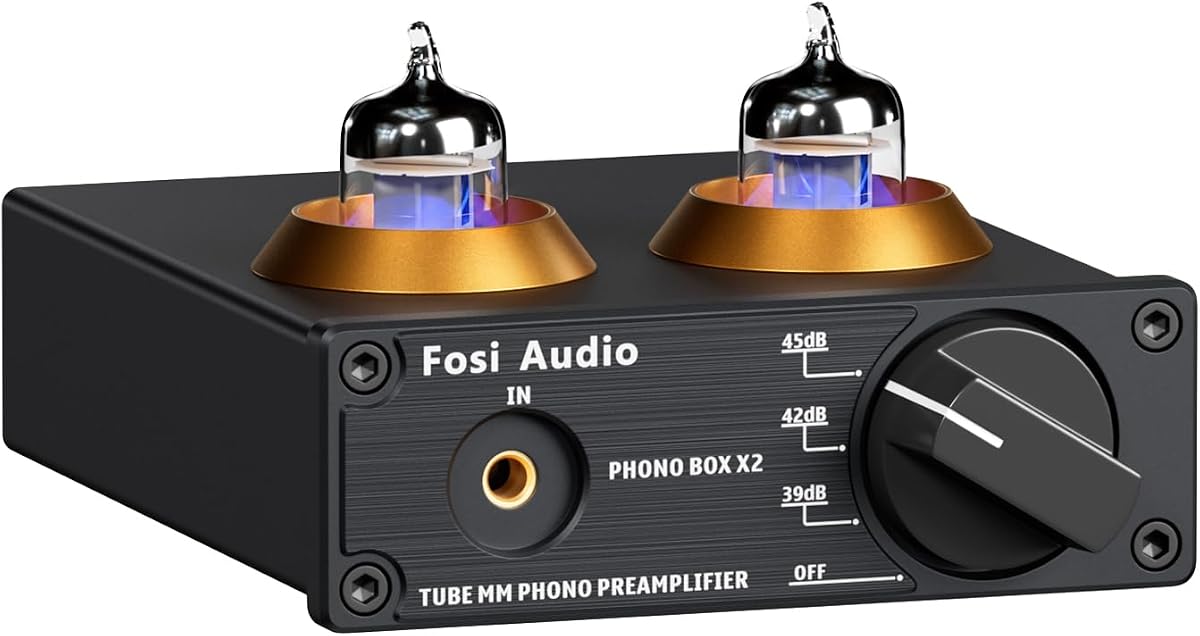
The Fosi Audio Box X2 combines a 4.5 rating with a distinctive tube-based design and several gain choices. It is aimed at MM turntable owners who appreciate the idea of a warm, smooth preamp but also want more control than a basic fixed-gain box can provide.
We may earn a commission when you buy through this link, at no additional cost to you.
Its three switchable gain modes—39, 42, and 45dB—provide meaningful flexibility within MM territory. The phono stage converts the cartridge signal to line level, removes low-frequency noise, and uses low-noise integrated circuits. A grounding post is included to help protect the turntable and establish the correct connection, while a 3.5mm auxiliary input lets the unit function as a general tube preamp as well.
Tube flexibility is the Box X2's defining attraction. The product data identifies compatible models including 6K4, 6J1, 6J4, GE5654, 6AK5, and 66, allowing listeners to experiment with different sound characteristics. That option is appealing for hobbyists, though it also adds a more involved setup than a sealed solid-state unit. The package includes two vacuum tubes, an RCA cable, a power adapter, and a manual.
The Box X2 is a strong match for an MM-equipped record player and listeners who enjoy hands-on tube choices. Its 39, 42, and 45dB settings make it more adaptable than many entry-level preamps, and the auxiliary input broadens its usefulness. It is less suitable for a moving-coil cartridge, and anyone wanting a dedicated amplified headphone stage should choose a model that explicitly includes one.
Replaceable tubes turn the Box X2 into more than a fixed component. Listeners can compare compatible tube types and decide whether they prefer a particular tonal presentation, provided they understand the need to power down and handle the tubes safely.
The three gain positions help adapt the preamp to different MM cartridges and system levels. This is especially useful when a turntable's output level and the connected amplifier's input sensitivity do not form an ideal match.
We may earn a commission when you buy through this link, at no additional cost to you.
The Fosi Audio Box X5 is the most specification-focused solid-state model in this roundup. Its 4.5 rating, MM and MC compatibility, and four selectable gain levels make it a compelling premium option for listeners who want one preamp to serve different cartridges and turntables.
We may earn a commission when you buy through this link, at no additional cost to you.
Gain can be set to 38, 48, 56, or 66dB, giving the unit room to handle both popular cartridge types. A dedicated toggle switches between MC and MM operation, while precise RIAA equalization restores the tonal balance required for vinyl playback. The stated component package is extensive: 2% precision polyester film capacitors, green-sleeve copper lead audio capacitors, 0.1% high-precision film resistors, an OPA1612 op-amp, and gold-plated RCA jacks.
The chassis is described as a minimalist all-aluminum-alloy design, with a one-touch power button, gain control, cartridge toggle, and grounding port. Those controls give it a more refined appearance than a basic plastic utility box. The lack of a specified headphone output keeps it focused as a line-level preamp, while the need to manually change cartridge modes is understandable given its dual MM/MC design.
This preamp is well suited to a serious vinyl setup involving multiple cartridges, especially when the listener wants selectable gain and a stated emphasis on component quality. It also fits a system built around the Fosi Audio V3 stereo amplifier, as the product information suggests. Buyers who require direct headphone listening should examine a headphone-equipped alternative, while committed MM/MC listeners can treat the X5 as a versatile centerpiece.
Separate MM and MC modes, combined with gains from 38 to 66dB, make the Box X5 adaptable to a changing collection of turntables and cartridges. The mode switch is essential to configure the unit correctly rather than treating every cartridge identically.
The listed precision capacitors, resistors, op-amp, gold-plated jacks, and aluminum-alloy chassis suggest attention to both electrical performance and durability. These details are particularly relevant when the preamp serves as the central signal component in a carefully assembled vinyl system.
We may earn a commission when you buy through this link, at no additional cost to you.
The Pyle PP444 is a compact preamp designed around the basic task of connecting a record player to a receiver or amplifier through RCA connections. It carries a 4.3 rating and is the most direct expression of the miniature utility preamp concept in this list.
We may earn a commission when you buy through this link, at no additional cost to you.
Its selling point is simplicity rather than an extensive control panel. The supplied title identifies RCA input and output, while the product description focuses on turntable, receiver, and amplifier use. That makes the PP444 relevant for a small listening area, a secondary setup, or a user who wants a dedicated phono-to-line converter without additional features such as a headphone jack, cartridge switch, or tone controls.
The main drawback is limited information. Unlike several other products here, the supplied data does not specify input sensitivity, gain levels, cartridge compatibility, grounding details, or included accessories. It would therefore be prudent to confirm the full technical specification and connector arrangement before purchase, especially for a moving-coil cartridge or a particularly quiet listening environment.
For a conventional magnetic-cartridge turntable feeding an amplifier with RCA inputs, the PP444's compact form may be enough. It appeals to users who value a small footprint and uncomplicated hookup over advanced gain selection. Listeners seeking assured specifications, multiple cartridge modes, or more control should examine a better-documented option, but the PP444 remains a practical minimalist candidate.
The ultra-compact form is useful near a turntable, on a small equipment shelf, or in a secondary listening area. A compact preamp can also help keep the source connection short, which is beneficial in systems vulnerable to interference.
The PP444 is most attractive when the required path is simply turntable to preamp to receiver or amplifier. Users seeking a direct headphone solution, detailed cartridge selection, or advanced gain control will need a more fully specified model.
We may earn a commission when you buy through this link, at no additional cost to you.
The Pyle PP777 is a straightforward magnetic-cartridge preamp with a 4.2 rating. Like the PP999, it prioritizes phono-to-line conversion, low-noise operation, and a simple RCA connection path, making it relevant to common turntable setups that do not require moving-coil support.
We may earn a commission when you buy through this link, at no additional cost to you.
The stated input sensitivity is 3mV at 50K ohms, with output reaching 2V peak-to-peak at 10K ohms. Low-noise operational amplifiers handle the amplification stage, while stereo RCA inputs and outputs allow the turntable to feed a receiver, speakers, computer, or laptop. The grounding connection is an essential part of setup, and the supplied 12V DC adapter powers the unit.
Compared with more elaborate preamps, the PP777 does not offer selectable cartridge modes, adjustable gain, headphone amplification, or tone shaping. Those limitations should be accepted rather than overlooked. A compatible magnetic cartridge and adequately configured line-level destination are therefore central to a positive result.
The product is a sensible pick for a first or secondary vinyl system, especially when a listener values low noise and uncomplicated installation over specialized controls. It also comes with a stated one-year manufacturer guarantee and a 30-day return policy, adding some reassurance. For moving-coil users, those wanting headphones, or those with complex gain requirements, one of the adjustable or dual-cartridge models will be more appropriate.
Low-noise operational amplifiers are the PP777's strongest stated technical feature. Positioned close to the turntable, the preamp can convert the small cartridge signal before it travels through longer interconnects, helping reduce opportunities for hum and interference.
Stereo RCA input and output make the PP777 adaptable to receivers, powered speakers, computers, and laptops. The included power adapter and straightforward grounding process help keep installation uncomplicated.
We may earn a commission when you buy through this link, at no additional cost to you.
The Fluence PA10 earns the Editor's Choice position with a 4.6 rating, accurate RIAA equalization, and a design centered on low-noise, high-fidelity phono amplification. It is a focused choice for MM turntable users who want a dedicated preamp rather than a general-purpose feature box.
We may earn a commission when you buy through this link, at no additional cost to you.
Its main strength is a carefully specified signal path. High-accuracy components, a low-noise power supply, and a low-impedance output stage are intended to improve gain accuracy, RIAA conformance, and distortion performance. Separate left and right operational amplifiers promote channel separation and minimize crosstalk, while an internal metal shield is designed to block electromagnetic interference and electronic noise.
A selectable high-pass filter rolls off frequencies below 20Hz with a gradual slope. This can help control subsonic feedback and reduce unwanted rumble at higher listening levels without imposing an abrupt cutoff. The trade-off is that the product focuses on MM cartridges and does not list a moving-coil switch, adjustable gain, headphone output, or tone controls.
The PA10 is a strong recommendation for an MM-based system that prioritizes accurate playback, clean output, and restrained design. It also makes sense for listeners who have encountered excessive hum or rumble and want a purpose-built shielded enclosure. Buyers should accept its narrower feature set, but for a straightforward high-fidelity phono stage, the combination of RIAA accuracy and channel discipline is compelling.
RIAA equalization is essential because record players produce a frequency response that must be corrected before playback through a conventional amplifier. The PA10 emphasizes high-accuracy frequency response and precision components to support faithful reproduction.
The shielded enclosure, low-noise power supply, low-impedance output stage, and independent channel amplifiers all target interference and crosstalk reduction. These features help the preamp deliver a cleaner line-level signal to the next component.
The selectable filter addresses low-frequency feedback below 20Hz. Keeping it available rather than permanently engaged gives listeners the option to manage rumble according to their turntable, speakers, and room.
We may earn a commission when you buy through this link, at no additional cost to you.
The Douk Audio T9 is the most feature-rich traditional preamp in the list. Its 4.4 rating reflects a model that combines MM and MC cartridge support, a tube-based signal path, independent headphone amplification, tone controls, and a visual signal-level display in a compact metal enclosure.
We may earn a commission when you buy through this link, at no additional cost to you.
Two 6E2 tubes provide a dynamic signal-level indication through the included magic-eye display, while two 6A2 tubes form the toneful signal path. The pluggable tube sockets allow alternatives such as 6K4, EF93, 6BA6, and W727, enabling listeners to explore different tonal characters. Its robust metal case and CNC aluminum panel are designed to limit interference, and the listed gold-plated interfaces support reliable connections.
Input versatility is excellent. Phono inputs cover MM and MC cartridges, while RCA inputs accommodate a phone, tablet, computer, or other source. The dedicated 3.5mm headphone output has its own amplification circuit and is specified for 16–300 ohm headphones. Independent treble and bass controls add room to adapt the output to different speakers or headphones, though those controls should be used judiciously to preserve tonal balance.
The T9 is appropriate for a listener who wants a visually engaging, hands-on centerpiece for a home audio system. It can serve a turntable, act as a general preamp, or provide private headphone listening. The trade-offs are its greater complexity, the space required for tube equipment, and the need to let tubes warm before judging performance. Its breadth makes it one of the strongest choices for adaptable vinyl listening.
The independent headphone circuit is a meaningful distinction from preamps that merely pass a line signal to headphones. With support specified from 16 to 300 ohms, it is suitable for a broad range of common headphone impedances.
Replaceable sockets turn tube selection into an adjustable part of the system. Listeners can compare different compatible models, though results depend on the rest of the chain and should be judged after proper warm-up.
The auxiliary RCA inputs make the T9 useful with phones, tablets, computers, and music players. A magic-eye level display, adjustable backlight, and tone controls also give it a more engaging role as a central home-audio component.
We may earn a commission when you buy through this link, at no additional cost to you.
The Jancane Mini Phono Preamp stands out through its output flexibility, offering stereo RCA and TRS outputs in addition to stereo RCA inputs. Its 4.4 rating and plug-and-play positioning make it a useful bridge between a turntable and several kinds of line-level equipment.
We may earn a commission when you buy through this link, at no additional cost to you.
The phono stage converts the turntable's low-level signal to line level, while low-noise operational amplifiers support the amplification process. A turntable connects through the stereo RCA inputs, and the preamp can then feed an amplifier or receiver through either RCA or TRS connections. This makes the unit less dependent on a specific destination interface and potentially useful with equipment that accepts balanced-style TRS connections, although the exact electrical compatibility should be confirmed.
The lack of a specified moving-coil mode or gain selector is the main limitation. The product appears designed for straightforward magnetic-cartridge use, and its included 12V DC adapter reduces setup friction. A one-year manufacturer guarantee and 30-day return policy are also listed, providing some buyer reassurance.
Choose this preamp when a turntable lacks a phono input and the desired destination offers either RCA or TRS. It is less appropriate for moving-coil users or listeners seeking direct powered headphone output. Its strongest advantage is connector choice combined with uncomplicated, low-noise conversion.
RCA and TRS outputs broaden the range of compatible destinations. This is useful when an amplifier or interface lacks the exact connector preferred by another device, provided the destination's input requirements are checked.
The included power adapter and familiar stereo RCA inputs keep the setup direct. The preamp is best positioned close to the turntable, where the small cartridge signal can be converted before traveling through additional wiring.
We may earn a commission when you buy through this link, at no additional cost to you.
The Pyle Mini Phono Preamp is a compact signal converter for magnetic pickups, receivers, speakers, and other modern audio devices. Its 4.2 rating reflects a basic, accessible design centered on low-noise phono-to-line conversion and uncomplicated connectivity.
We may earn a commission when you buy through this link, at no additional cost to you.
The supplied specifications state a 3mV input sensitivity at 50K ohms and a maximum output of 2V peak-to-peak at 10K ohms. Low-noise operational amplifiers perform the conversion, while stereo RCA inputs and outputs connect the turntable and destination. A 12V DC adapter is included, and the stated setup involves connecting the turntable, attaching its ground wire, and linking the preamp output to an amplifier.
Its strengths are simple installation and flexibility at the output end. The preamp can feed a receiver, powered speakers, or a laptop, making it useful for exploring vinyl playback without replacing an entire system. However, the product does not list selectable gain, moving-coil compatibility, a headphone output, or tone controls, so setup depends on a compatible magnetic cartridge and a suitable line-level destination.
A one-year manufacturer warranty and 30-day money-back guarantee are listed. This model is most suitable for a straightforward secondary setup or a listener who wants a dedicated converter without extra controls. Those needing more headroom, cartridge switching, or private headphone listening should choose a more advanced model.
The preamp's RCA output can feed receivers, speakers, and computers, providing an easy way to compare vinyl playback across different destinations. This flexibility is useful for a compact or temporary listening arrangement.
As with any small-signal preamp, keeping it close to the turntable limits the distance over which the raw cartridge signal must travel. The low-noise design supports this approach, while proper grounding remains essential.
We may earn a commission when you buy through this link, at no additional cost to you.
The Douk Audio T14-EQ is a compact solid-state preamp distinguished by USB 5V power, MM and MC support, a headphone output, and adjustable tone controls. Its 4.2 rating and broad connection options make it an interesting choice for portable or flexible vinyl listening arrangements.
We may earn a commission when you buy through this link, at no additional cost to you.
A built-in low-noise RIAA circuit handles phono equalization, while a switch allows operation with either MM or MC cartridges. Stereo RCA outputs feed amplifiers or powered speakers, and a 3.5mm headphone jack provides direct private listening. The specified headphone range is 16–200 ohms, narrower than the 16–300 ohm range stated for the Douk Audio T9, but still broad enough for many common headphones.
Independent bass and treble controls each provide plus or minus 5dB of adjustment. These can help accommodate different speakers or headphones, although accurate vinyl playback normally depends on leaving the tone controls near a neutral setting. A power-isolation module is included to reduce common ground-loop noise, and the aluminum shell is intended to shield against interference.
Powering from a wall charger, computer, or power bank gives the T14-EQ unusual portability. That makes it useful for a desk setup, temporary system, or listener without a nearby dedicated power outlet. The trade-off is that USB power and a solid-state design do not offer the tube experimentation or broader headphone range of the T9. Overall, it is a versatile and practical choice for portable MM or MC use.
The ability to draw 5V power from a wall adapter, computer, or power bank makes this preamp easy to relocate. It is particularly appealing for desktop listening and temporary setups where access to a conventional preamp power outlet is limited.
The T14-EQ can feed stereo RCA equipment or a compatible pair of headphones from 16 to 200 ohms. That makes it a useful bridge for listeners who want both amplified speakers and private listening without purchasing two separate boxes.
The plus or minus 5dB bass and treble adjustments can compensate for noticeable speaker or headphone differences. For the most faithful result, begin with both controls centered and make small changes based on careful listening.
We may earn a commission when you buy through this link, at no additional cost to you.
The right preamp depends on your cartridge, destination equipment, noise tolerance, and preferred level of control. Review cartridge compatibility and gain before considering extras, because those requirements determine which models can work correctly in your system.
A moving-magnet, or MM, cartridge generally produces a higher output than a moving-coil, or MC, cartridge. Many simple preamps are designed only for MM cartridges, while dual-mode models add an MC switch and more gain. The Box X5 supports both, while the Douk Audio T9 and T14-EQ also provide MM/MC selection. Confirming cartridge type prevents weak output, excessive distortion, or an incorrect input setting before listening.
Choose a model that explicitly supports your cartridge. Do not assume a general preamp can handle a low-output moving-coil cartridge.
The preamp must raise the cartridge's small signal to an appropriate line level without overloading the connected amplifier. Fixed-gain units can work adequately with compatible MM cartridges, but selectable gain offers more control when output levels differ. The Fosi Audio Box X2 offers three gain modes, while the Box X5 provides four levels spanning a wider range for both MM and MC use.
Match gain to cartridge output and downstream input sensitivity. More control is useful, but the correct mode matters more than the number of settings.
Vinyl records require inverse-RIAA equalization to restore a balanced frequency response. A preamp with a precise RIAA curve is especially important for listeners who notice differences in bass, treble, or midrange balance. The Fluence PA10 emphasizes high-accuracy RIAA response, while the Box X5 and T14-EQ also list built-in or precise RIAA equalization.
Prioritize a correctly implemented RIAA stage over decorative tone controls. The preamp should correct the signal, while adjustments should remain subtle.
Low-noise amplification helps preserve quiet musical passages, while a shielded enclosure can reduce electromagnetic interference. Ground loops are a common source of hum, so the turntable's ground wire should be connected correctly and the preamp should be placed close to the turntable when practical. The PA10 uses an internal metal shield, while the T14-EQ lists a power-isolation module intended to reduce ground-loop noise.
A quiet design is valuable, but correct grounding and placement remain essential. If hum persists, check the connection before blaming the preamp.
Stereo RCA output is the standard destination for an amplifier or powered speakers. Some models also offer TRS outputs, a dedicated headphone jack, or auxiliary inputs for phones and computers. The Jancane preamp includes RCA and TRS outputs, while the T9 and T14-EQ provide amplified headphone connections. Headphone output specifications matter because not every preamp can drive higher-impedance headphones effectively.
List every intended destination before choosing. A model with a headphone jack may still be unsuitable if its specified impedance range does not match your headphones.
Tube designs can provide a warm or smooth presentation, but the sound also depends on the tubes and the rest of the system. The Fosi Audio Box X2 and Douk Audio T9 use replaceable tubes, allowing experimentation. Solid-state models such as the PA10, Box X5, and T14-EQ typically prioritize consistent, compact operation. Tone controls can improve compatibility with different speakers, though they are not substitutes for correct setup.
Choose tube or solid-state construction according to system goals and personal preference. Do not expect a tone knob to correct a fundamentally mismatched cartridge or gain setting.
A compact preamp fits easily near a turntable and can shorten the path carrying the tiny cartridge signal. The PP444 is explicitly ultra compact, while the Box X5 uses an aluminum-alloy chassis and the T9 has a metal case with a CNC aluminum panel. Physical design also affects cooling, tube access, headphone comfort, and the ease of operating controls.
Choose a layout that suits your shelf and listening habits. A feature-rich preamp is more useful when its controls and connections are convenient to reach.
A low-frequency filter can help suppress subsonic rumble and feedback, particularly with less stable turntables or powerful speakers. The PA10 offers a selectable high-pass filter below 20Hz. Other practical extras include grounding posts, one-touch power buttons, auxiliary inputs, visual tube-level displays, and included power supplies. These should support the core signal path rather than distract from it.
Prioritize filtering only when rumble is present, and treat extras as secondary to cartridge support, gain, RIAA accuracy, and noise control.
Begin by confirming that the preamp supports your turntable's cartridge type. Turn off and unplug the turntable, amplifier, and preamp. Connect the turntable's left and right output cables to the corresponding preamp inputs, then secure the turntable's grounding wire to the preamp's ground terminal. Avoid connecting a ground wire to an RCA signal terminal.
Next, connect the preamp outputs to the amplifier, powered speakers, computer, or headphones. Use the correct MM or MC setting and choose an appropriate gain level. Connect the specified power adapter, allow tube models to warm up, and then start playback at a low volume. If there is no sound, check cable orientation, input selection, grounding, and cartridge mode before changing settings.
For maintenance, keep the unit ventilated, especially if it contains tubes, and avoid placing it directly on top of a heat-producing amplifier. Handle tube preamps carefully and power them down before replacing tubes. Keep the enclosure dry, use soft cloth for cleaning, and periodically inspect RCA connections for looseness. If hum or distortion appears, test one connection at a time and confirm that the amplifier's phono input is not also active.
A phono preamp converts the very small electrical signal from a record player's cartridge into a line-level signal that an amplifier or powered speakers can handle. It also applies the required RIAA equalization curve. Without this stage, vinyl playback may sound quiet, thin, overly bright, or distorted, particularly when connected to an input designed for CD or another line-level source.
Yes, as long as the amplifier or powered speakers provide an appropriate line-level input. Connect the turntable to the phono preamp and the preamp to the amplifier using the correct output connectors. Turn the amplifier's separate phono input off if it is available, because using both stages would apply RIAA equalization twice and distort the frequency response.
A moving-coil cartridge usually needs more gain and a compatible low-noise input stage. A basic preamp designed only for moving-magnet cartridges may not provide enough output or may not support that cartridge's impedance. Choose a model explicitly listing MC support and the correct gain range, such as the Box X5, Douk Audio T9, or T14-EQ.
There is no universally better choice. Tube models can offer a particular tonal presentation and tube experimentation, while solid-state designs often emphasize compactness, consistent behavior, and straightforward operation. The most important considerations remain cartridge compatibility, RIAA accuracy, gain, and low noise. Personal system matching matters more than the label attached to the design.
Hum is commonly caused by an incomplete ground connection, a loose RCA cable, or a ground loop. Turn off the equipment, reconnect the turntable's ground wire to the designated ground post, and check that the preamp is not connected through a phono input on the amplifier. Placing the preamp closer to the turntable can also reduce interference on the small cartridge signal.
Only when the preamp includes a headphone amplifier. The Douk Audio T9 and T14-EQ are the models in this guide with dedicated 3.5mm headphone outputs, and their supported impedance ranges differ. Connecting ordinary headphones to a standard RCA line output will not produce normal headphone volume and may permanently damage the headphones.
Most turntables include a separate grounding lead for the preamp, and it should be connected to the preamp's ground terminal. The supplied information specifically mentions grounding on several models and gives general connection guidance for others. Check the manual and connector labels because the proper termination point varies; never attach the ground lead to a signal RCA jack.
The preamp should generally be placed relatively close to the turntable because the cartridge signal is very small and more vulnerable to hum and interference. The exact distance is less important than using short, secure cables and maintaining a proper ground. Leave enough room for ventilation, especially with a tube preamp, and ensure the power adapter does not create a hum-producing connection.
The Pyle PP999 stands out as a straightforward budget-oriented choice for a compatible magnetic-cartridge turntable, while the Fluence PA10 is the most focused high-fidelity option with accurate RIAA equalization, channel separation, shielding, and selectable rumble filtering. The Douk Audio T9 takes the premium feature-rich approach with MM/MC support, replaceable tubes, a dedicated headphone stage, tone controls, and additional inputs.
Before choosing, identify the cartridge, destination equipment, headphone requirements, and tolerance for setup complexity. A fixed-gain MM preamp is enough for many uncomplicated systems, but a dual-cartridge model with selectable gain provides more flexibility. Prioritize correct RIAA implementation, low noise, reliable grounding, and compatible outputs; extras such as tube replacement and tone controls should support those fundamentals.
Finally, check the current product specifications, included accessories, warranty details, and connector requirements before ordering. Product information and availability can change, and the most suitable preamp is the one that matches the turntable and amplifier in your particular listening environment.