
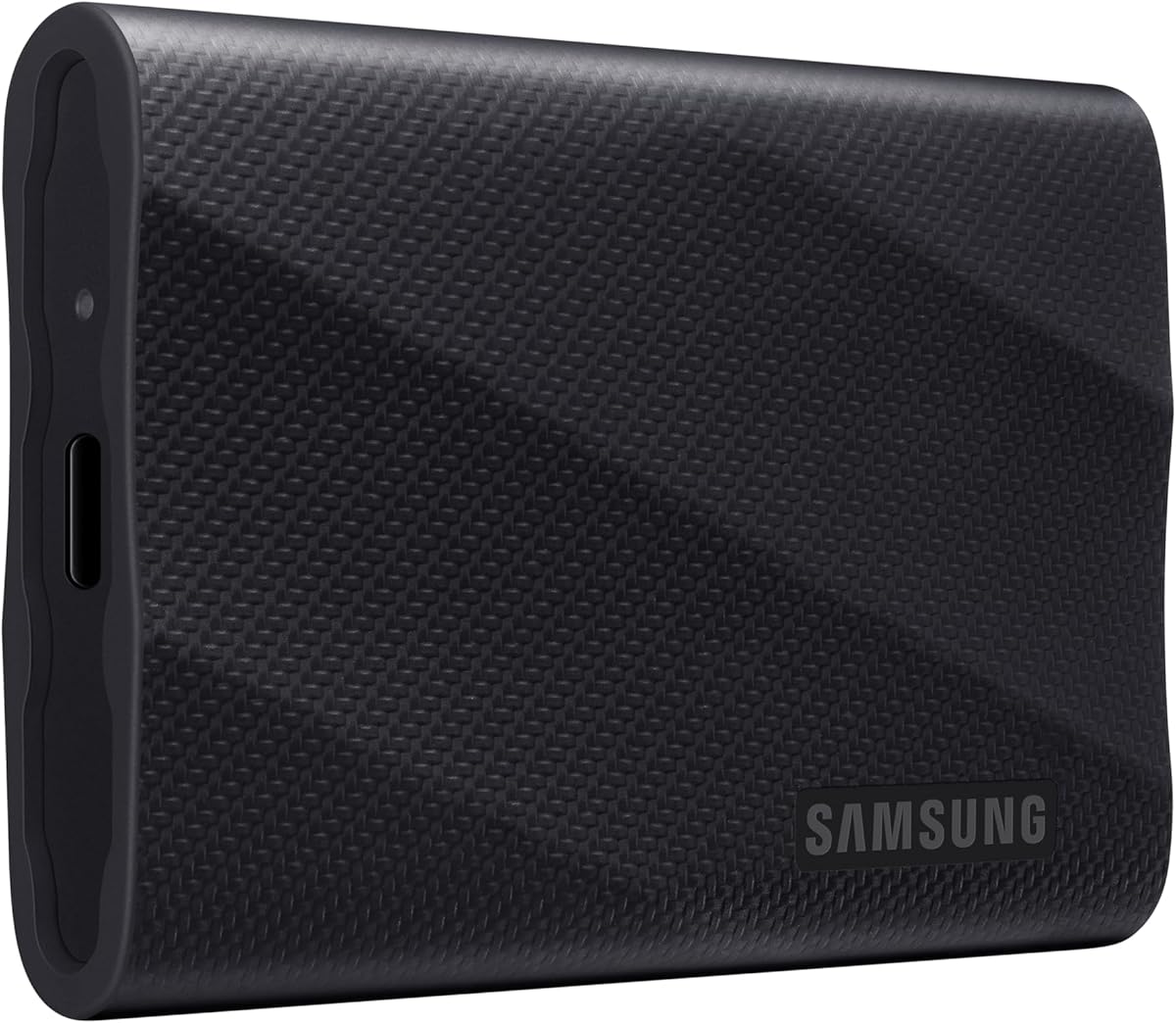
Samsung T7 Shield Portable SSD 1TB
4.7Editor score
Up to 1050MB/s read speed
IP65 water and dust resistance
Drop protection up to 9.8 feet
Our Military Grade Rugged External SSD guide compares 10 portable SSDs for durability, speed, capacity, encryption, portability, and device compatibility.
A rugged external SSD should do more than resist an occasional scratch. It should tolerate demanding travel, frequent handling, dust, moisture, and unexpected impacts while preserving access to important files. This guide examines ten portable solid-state drives with rugged construction, high transfer speeds, useful capacities, and features suited to creators, field workers, travelers, and mobile users.
The products were compared using the specifications and feature descriptions supplied for each drive. The analysis considers physical protection, read and write performance, capacity, encryption, thermal management, attachment options, software support, and compatibility with computers, cameras, consoles, and smartphones. It also considers how each model differs within otherwise similar product families rather than treating every high-capacity option as interchangeable.
Each review explains the strongest use case, notable specifications, and practical trade-offs for the selected Military Grade Rugged External SSD. The list includes current and older SanDisk Extreme models, Samsung T7 Shield and T9 drives, the Lexar magnetic ES5, and the latest SanDisk Extreme PRO. Product availability and pricing can change, so readers should verify current listings and compatibility before purchasing.
4.7Editor score

4.6Editor score
4.6Editor score
This side-by-side comparison covers all ten drives, emphasizing stated speed, rugged protection, capacity, encryption, and the workflows each model is designed to support.


The SanDisk Extreme Portable SSD 2TB is a balanced choice for buyers who want a generous amount of portable storage without moving to the latest interface generation. It carries a 4.6 rating and is specified to deliver read speeds up to 1050MB/s and write speeds up to 1000MB/s. Its USB-C connection and USB 3.2 Gen 2 interface suit everyday creative storage, field backups, and moving large media libraries between compatible devices.
We may earn a commission when you buy through this link, at no additional cost to you.
Physical protection is one of the drive's strongest features. It has an IP65 rating for water and dust resistance, along with protection for drops up to three meters. A built-in carabiner loop makes it easier to attach to a backpack, belt loop, or other carrying point. The included password-protected encryption uses 256-bit AES hardware encryption, adding a valuable security layer for confidential documents, client footage, and work files.
The main compromise is its speed relative to newer alternatives in this list. Drives using USB 3.2 Gen 2×2 or newer configurations can offer substantially higher transfer rates. In addition, the stated performance is based on internal testing and may be lower depending on the host device and other factors. Buyers with older computers may never reach the advertised maximum even if the SSD itself is performing as designed.
This model is a strong recommendation for travel-oriented creators, photographers, and professionals who value the familiar SanDisk Extreme design, 2TB capacity, attachment loop, and hardware encryption. It is particularly appealing when a drive near 1050MB/s is enough and maximum transfer speed is not the primary concern. Those wanting the newest speed should compare the new Extreme generation, while those seeking stronger field handling may also consider the T7 Shield.
The IP65 rating and three-meter drop protection make this drive a practical companion for bags, field kits, and busy work environments. It should still be handled as an electronic device, but it is designed to tolerate significantly more than a conventional consumer enclosure.
Hardware-backed 256-bit AES encryption helps protect stored files, while the carabiner loop reduces the chance of leaving the drive behind. Together, these details make the 2TB Extreme practical for sensitive work carried between locations.
We may earn a commission when you buy through this link, at no additional cost to you.
The new SanDisk Extreme Portable SSD 1TB stands out as the most complete package in the guide. It combines a 4.6 rating with transfer speeds up to 2000MB/s, an IP65 water and dust rating, and protection for drops up to three meters. Its stated performance is nearly twice that of the previous Extreme generation, making it especially attractive for photographers, video editors, and other users who routinely transfer large batches of media.
We may earn a commission when you buy through this link, at no additional cost to you.
The drive is described as pocket-sized, which helps offset the limited capacity of a single terabyte. It can hold substantial high-resolution photo collections, compressed video projects, and working files while remaining easy to carry. SanDisk states that 1,000 high-resolution photos can be moved in under 60 seconds under specified conditions, while 256-bit AES encryption helps protect private content with password-based access.
The 1TB capacity is the clearest limitation. Users working with 4K, 8K, high-frame-rate, or uncompressed formats may need to divide large sessions across multiple drives or choose a higher-capacity model. Maximum speed also depends on the source device, destination, cable, file sizes, and workload. The stated 2000MB/s figure should therefore be treated as a peak capability rather than a guarantee for every transfer.
Despite those constraints, this is the strongest overall recommendation for someone seeking a compact military-grade-style portable SSD without giving up modern speed. It combines current transfer capability, environmental sealing, drop resistance, and encryption in a portable form. Buyers who routinely exceed one terabyte should select the 2TB or 4TB version of the new Extreme model instead.
An advertised transfer speed of up to 2000MB/s reduces waiting during large photo imports, project copies, and asset transfers. The greatest benefit appears with compatible USB 3.2 Gen 2×2 or newer systems, large files, and SSDs that avoid becoming the bottleneck.
The new Extreme retains the familiar combination of IP65 sealing and three-meter drop protection. Its pocket-sized design makes those protections relevant for people who move between locations rather than leaving the drive stationary beside a computer.
We may earn a commission when you buy through this link, at no additional cost to you.
The 4TB SanDisk Extreme Portable SSD is built for users who want a single rugged drive to contain large creative libraries. It has a 4.6 rating and shares the new Extreme family's stated transfer speed of up to 2000MB/s. That combination of capacity and speed is unusual in a portable enclosure and makes the drive useful for extensive photo archives, 4K video, project media, and files that would otherwise require several smaller devices.
We may earn a commission when you buy through this link, at no additional cost to you.
The same physical safeguards apply: an IP65 rating for water and dust resistance and protection from drops up to three meters. The enclosure remains pocket-sized according to the supplied information despite offering four terabytes of storage. Buyers also receive 256-bit AES encryption for password-protected private files, which is especially relevant when an entire working archive travels in a bag.
Capacity does not eliminate the need for sensible backups. A larger drive can make it tempting to retain many valuable files in one place, yet physical protection is not the same as guaranteed data retention. Users should still maintain another copy and avoid treating a rugged rating as permission to ignore routine transfers, monitoring, or safe handling.
This is the best fit for editors, archivists, drone operators, and field teams who want ample room in a compact package. If the workload regularly exceeds one or two terabytes, the extra capacity can prevent constant file management. For lighter travel use, however, the 1TB or 2TB versions are easier to justify and easier to keep backed up.
Four terabytes reduces the need to divide active projects across several SSDs. It also gives photographers and videographers room to retain originals, exports, and working assets together while remaining mobile.
The up-to-2000MB/s transfer capability is particularly relevant when the drive is used as a working library rather than only a temporary backup. Compatible host hardware remains important for reaching the stated maximum.
We may earn a commission when you buy through this link, at no additional cost to you.
The new 2TB SanDisk Extreme is a flexible middle ground between the compact 1TB model and the spacious 4TB version. It retains the 4.6 rating, up-to-2000MB/s transfer capability, IP65 sealing, and three-meter drop protection. For many photographers, editors, and developers, two terabytes provides enough room for active assets without making the drive unnecessarily difficult to organize.
We may earn a commission when you buy through this link, at no additional cost to you.
SanDisk positions the new Extreme family as suitable for high-resolution clips, photo edits, and AI content. Its stated ability to move 1,000 high-resolution photos in under 60 seconds is especially relevant to working photographers who regularly clear memory cards and transfer large image batches. The pocket-sized format keeps the drive useful during location work, while its physical protection supports more demanding carrying conditions.
The advertised transfer figure is only one part of system performance. Source-device limitations, cable quality, file fragmentation, background processes, and sustained workload demands can all affect results. The encryption feature also adds a responsibility to readers: passwords should be stored securely and not left only in a file on the encrypted drive itself.
For most creative professionals, this is the most versatile capacity in the updated SanDisk range. It is a compelling choice for people who want more freedom than a 1TB model but do not need a four-terabyte archive. It also serves well as a shuttle drive, scratch disk, or portable project library for compatible USB 3.2 Gen 2×2 systems.
Two terabytes is large enough for a substantial active project while remaining small enough for everyday transport. It gives users room to keep source media, exports, and working documents together without immediately running out of space.
Support for high-resolution photo, edited clips, and AI-related workflows makes this model relevant where file sizes rise quickly. The 2000MB/s ceiling helps when the host device and connected drive can both sustain fast transfers.
We may earn a commission when you buy through this link, at no additional cost to you.
The Samsung T7 Shield 1TB earns a 4.7 rating, the highest among the rugged portable options in this roundup, and is built around clear physical protection. Its stated read and write speeds reach 1050MB/s and 1000MB/s. More distinctive is the drop-resistance claim of up to 9.8 feet, which exceeds the three-meter figure associated with the featured SanDisk Extreme models.
We may earn a commission when you buy through this link, at no additional cost to you.
The T7 Shield is also rated IP65 for water and dust resistance, making it suitable for travel, outdoor work, and other environments where ordinary storage enclosures may be vulnerable. It supports PC, Mac, Android devices, gaming consoles, and other compatible products through USB 3.2 Gen 2. The supplied information also notes support for iPhone 15 Pro 4K at 60fps video when used with the recommended included SSD cable.
Its main technical limitation is the older interface relative to USB 3.2 Gen 2×2 alternatives. Drives such as the Samsung T9 and updated SanDisk Extreme models advertise transfer speeds around 2000MB/s, so the T7 Shield is better suited to users who prioritize ruggedness over peak throughput. One terabyte may also be modest for a professional media archive.
For buyers who want a refined, rugged drive with an especially strong stated drop rating and broad platform support, the T7 Shield is an excellent choice. It works particularly well for travelers, mobile professionals, and hybrid workers. Users with consistently large files and newer host systems should compare its interface with the faster T9 before finalizing their selection.
Protection for falls up to 9.8 feet gives the T7 Shield a distinctive durability advantage. That makes it a logical choice for gear bags and field kits where the SSD may be attached to equipment and handled in transit.
Samsung Magician supports drive-health monitoring, firmware updates, data-protection options, and LED configuration. These software functions make the drive easier to maintain and provide more visibility into its condition over time.
We may earn a commission when you buy through this link, at no additional cost to you.
The Samsung T9 2TB is a speed-focused portable SSD aimed at creators who repeatedly load, edit, and transfer large files. It has a 4.6 rating and is specified to sustain read and write speeds of up to 2000MB/s through a USB 3.2 Gen 2×2 connection. The stated ability to remain fast during longer processes makes it more relevant to demanding work than a drive that only reaches its maximum during brief bursts.
We may earn a commission when you buy through this link, at no additional cost to you.
Thermal management is a major part of that design. The Dynamic Thermal Guard system is intended to control heat and keep the drive near ideal temperatures during heavy use. That matters for editors, developers, and other users who may transfer large volumes continuously. Samsung Magician also provides drive-health monitoring, firmware updates, encryption options, and other maintenance functions.
Unlike the T7 Shield, the T9 is not described as having an IP65 water and dust rating. Buyers who require a specifically sealed enclosure for harsh conditions should not assume that high performance alone provides the same physical protection. Maximum speed also depends on a compatible host interface, and the supplied listing notes compatibility with computers, cameras, gaming consoles, and other heavy-use devices.
The 2TB T9 is an excellent choice for creators who prioritize throughput, sustained workloads, and thermal control over a stated environmental rating. Its capacity is well suited to active project media, and the 4K iPhone support noted in the product information is useful for mobile creators working with a compatible phone and the recommended cable.
The emphasis on sustained performance makes the T9 more appropriate for long media imports and repeated project cycles. It should appeal to users whose host system includes the required USB 3.2 Gen 2×2 interface.
Dynamic Thermal Guard is designed to manage heat during extended use. Combined with Samsung Magician monitoring, it gives power users tools intended to support stable performance and ongoing drive management.
We may earn a commission when you buy through this link, at no additional cost to you.
The 1TB Samsung T9 is the most accessible entry in this roundup for users who want modern speed without opting into a larger-capacity model. It carries a 4.6 rating and promises sustained read and write speeds of up to 2000MB/s over USB 3.2 Gen 2×2. One terabyte remains a useful amount of storage for a working drive, a backup device, or a compact media library.
We may earn a commission when you buy through this link, at no additional cost to you.
The Dynamic Thermal Guard system is especially important to this recommendation because the T9 is designed for longer, heavy transfers. A drive that advertises a high peak speed but overheats quickly may be less useful for creators. The T9's cooling approach and continued performance during extended processes make it more compelling for sustained work, while Samsung Magician supports health monitoring and firmware updates.
The important caveat is that the T9 does not carry the stated IP65 protection found on the T7 Shield and several SanDisk models. Buyers using it outdoors, around construction sites, or in other wet or dusty settings should consider a protective pouch and keep the drive away from standing water. Peak performance also requires a host with the appropriate interface.
For everyday users seeking speed, compactness, and useful capacity, this T9 configuration is a strong value. It is also well suited to compatible cameras, consoles, desktops, and mobile creative workflows. Those who require a sealed exterior should pay closer attention to the T7 Shield or updated SanDisk Extreme options instead.
The 1TB T9 provides enough space for many active projects without the bulk of a larger capacity. Its high transfer rate benefits users who frequently move large photo, video, or project folders between compatible systems.
The T9 focuses on high throughput, sustained transfer behavior, and thermal control rather than a sealed enclosure. That makes it a versatile companion for creators who work in controlled or semi-controlled environments.
We may earn a commission when you buy through this link, at no additional cost to you.
The Lexar ES5 2TB stands apart through its integration with compatible mobile devices. Its magnetic design attaches directly to MagSafe-compatible smartphones, while an included metal ring gives other devices a magnetic surface. The 4.5-rated drive is specified for read and write speeds up to 2000MB/s, combining fast transfer with a different approach to portable storage.
We may earn a commission when you buy through this link, at no additional cost to you.
Its most compelling feature is support for modern mobile recording. The supplied information lists Apple ProRes at 4K 120fps and Samsung Pro Video at 8K 30fps. That makes it relevant to smartphone creators who need more space, faster transfers, and a way to keep high-resolution recordings separate from limited internal storage. The free Lexar App supports automatic media backup and mobile storage expansion.
Ruggedness is addressed through an IP65 water and dust rating, drop resistance up to three meters, and a liquid silicone build designed to provide grip. A cable organizer doubles as a lanyard, adding another way to keep the small drive with its accessories. Thermal control is included to help maintain performance, though systems that do not support USB 3.2 Gen 2×2 will deliver lower results.
This is the best choice in the list for a creator whose priority is direct smartphone integration rather than a conventional cable-first workflow. It also appeals to users who want both rugged protection and high read and write performance. Buyers should confirm that their phone, operating system, and intended recording application support the desired format and storage workflow.
Direct attachment to a compatible smartphone reduces the need to carry a separate mounting arrangement. The metal ring expands the magnetic option for devices that lack a built-in magnetic surface.
Specified support for Apple ProRes 4K 120fps and Samsung Pro Video 8K 30fps targets demanding capture workflows. App-assisted backup and storage expansion make the drive more useful beyond simply receiving finished files.
We may earn a commission when you buy through this link, at no additional cost to you.
This earlier 2TB SanDisk Extreme remains a capable portable SSD for users who already understand the original Extreme platform. It has a 4.6 rating and delivers the familiar performance ceiling of up to 1050MB/s reads and 1000MB/s writes. Its USB-C connection and USB 3.2 Gen 2 interface remain useful for compatible computers and compatible mobile devices.
We may earn a commission when you buy through this link, at no additional cost to you.
Physical specifications are also familiar but well suited to field use. The drive carries an IP65 water and dust rating, protection for drops up to three meters, and a carabiner loop for attachment to a belt loop or backpack. Password-protected 256-bit AES hardware encryption provides file security, while SanDisk Memory Zone supports file management and automatic space freeing.
Its central disadvantage is generational speed. The updated Extreme models in this guide advertise transfer speeds up to 2000MB/s, nearly twice the stated maximum of the prior generation. Users moving large media libraries between modern systems may see a meaningful difference, particularly with a compatible USB 3.2 Gen 2×2 host. Otherwise, the older model can remain a practical choice for standard portable storage and backups.
The listing is most attractive for someone who values the proven Extreme form factor, familiar app support, and two-terabyte capacity while prioritizing the physical and security features over the latest interface. It is also a sensible option when a compatible older laptop lacks USB 3.2 Gen 2×2, since paying for a newer interface may not improve that setup.
The combination of IP65 sealing, three-meter drop protection, and a carabiner loop has already become a recognizable part of the Extreme portable range. It offers a practical balance for travel and everyday field carry.
If the primary computer only supports the older interface, the newer Extreme generation may not deliver its headline speed. In that situation, the established model's 1050MB/s capability can provide a more appropriate performance match.
We may earn a commission when you buy through this link, at no additional cost to you.
The 2TB SanDisk Extreme PRO is the performance flagship in this guide. It has a perfect 5.0 rating and advertises transfer speeds up to 4000MB/s, far beyond every other featured portable SSD. The stated ability to move up to ten minutes of 12K video in under a minute demonstrates the scale of files and modern systems for which this drive is intended.
We may earn a commission when you buy through this link, at no additional cost to you.
Sustained performance is the distinguishing detail. The 2TB model is listed with an average sustained write speed of 3100MB/s across the stated 2TB-to-4TB model range. That matters for long transfers, rendering workflows, and other heavy operations where a brief peak speed is less useful than consistent throughput. The drive is also positioned for AI-enhanced editing, rendering, and post-production.
Rugged features have not been sacrificed. The Extreme PRO retains an IP65 rating for water and dust resistance and protection for drops up to three meters. Password-protected 256-bit AES encryption helps protect private files. As with the faster SanDisk Extreme models, achieving headline performance depends on the host device, connection, workload, and other factors rather than occurring automatically with every computer.
This is the recommendation for professional creators with compatible high-speed hardware who regularly move 12K footage, large AI datasets, or extensive project libraries. The 2TB capacity prevents it from being purely a speed demonstration. Buyers with older or limited interfaces should choose a Gen 2×2 or lower-speed model, because raw headline numbers will not produce the same real-world result on every system.
The up-to-4000MB/s transfer rate and 3100MB/s sustained write figure are designed for workflows involving 12K footage and other very large files. Compatible high-speed hardware is essential for turning those specifications into meaningful time savings.
Consistent write performance is particularly valuable during long exports, data migrations, and rendering tasks. The stated sustained rate makes this drive more relevant to a demanding professional process than a simple file shuttle.
We may earn a commission when you buy through this link, at no additional cost to you.
The right rugged external SSD depends on more than maximum transfer speed. Capacity, environmental sealing, drop resistance, encryption, thermal behavior, host interfaces, and mobile integration should be matched to the way and where the drive will be used.
In this roundup, the most useful ruggedness indicators are specific environmental and mechanical ratings rather than broad marketing language. An IP65 rating means the product is specified to resist dust and water under defined test conditions, while stated drop figures indicate the height from which the manufacturer qualifies protection. These protections reduce risk but do not make an SSD immune to damage, and readers should distinguish standardized ratings from vague terms such as shockproof or military inspired.
Capacity should reflect both active projects and realistic backup needs. A 1TB drive is convenient for travel and a focused media set, while 2TB is more flexible for editors working with original footage, exports, and project files. The 4TB option is better for large archives or users who want fewer device changes. High-resolution video and AI datasets can consume considerable space, so a small drive may fill quickly even when it is technically adequate for documents and compressed files.
The fastest SSD cannot outperform a slow host connection. The updated SanDisk Extreme models, Samsung T9, Lexar ES5, and SanDisk Extreme PRO rely on recent high-speed USB capabilities for their highest stated results. The original SanDisk Extreme and Samsung T7 Shield use USB 3.2 Gen 2, while USB 3.2 Gen 2×2 is associated with the newer 2000MB/s-class products. A device may also need a compatible port, cable, and current system software to negotiate the intended speed.
Read speed affects opening, copying, and accessing existing files, while write speed influences recording, exporting, backups, and saving new data. Creator-focused drives should offer credible write performance, not just a high read figure. The Extreme PRO emphasizes sustained writes, and the T9 advertises sustained read and write performance during extended work. These details are more meaningful than a peak number for people who regularly move large files.
Portable SSDs transfer large blocks of data quickly, which creates heat. Thermal management matters when a drive must remain fast throughout long transfers, repeated saves, or other extended workloads. The Samsung T9 explicitly uses Dynamic Thermal Guard to control heat, while the Lexar ES5 includes a thermal-control design. Buyers should also avoid leaving any SSD in direct sun or a sealed vehicle and should provide airflow around it during demanding work.
Portable drives are more likely to be lost or borrowed, making encryption a practical security layer. The featured SanDisk models include password protection based on 256-bit AES hardware encryption, while the Samsung T9 is supported by Magician software with additional encryption and drive-health features. Passwords should be stored separately from the encrypted drive. Management software can also help update firmware, inspect health, and manage files, but the drive should remain useful even if a companion application is unavailable.
A connector is not the only way to use an external SSD. The Lexar ES5 uses a MagSafe-compatible magnetic design, includes a metal ring for devices without a magnetic surface, and offers app-assisted backup and storage expansion. SanDisk and Samsung models use conventional USB-C connections, which are broadly convenient and straightforward. Mobile creators should confirm phone compatibility, recording-format support, and whether an appropriate cable is included or recommended.
A rugged enclosure reduces physical risk, but it cannot guarantee that data will survive every event. Secure SSDs can fail, files can be deleted accidentally, and a single drive can be lost. The prudent approach is to maintain at least one additional copy of important material, use safe eject procedures, verify transfers, and keep critical archives synchronized with a separate system. Encryption is not a substitute for backup because it protects confidentiality rather than availability.
Before transferring important files, confirm that the device, cable, and SSD support the intended interface, format the drive for the systems you plan to use, and enable the available encryption or password protection. A single encrypted setup is important to remember because losing the password can make the files inaccessible. For camera or mobile recording, verify the required file format and confirm that the drive has enough free space before beginning a session.
During use, attach the drive securely and keep the port and enclosure free of dirt, moisture, and debris. Avoid abrupt removal, do not move the device while files are actively transferring, and use the operating system's safe eject command before unplugging it. Give a heavily loaded drive adequate ventilation, especially during long transfers or rendering. Although the drives are designed for demanding conditions, keeping them away from standing water and excessive heat preserves their useful lifespan.
Periodically check drive-health information when the manufacturer provides monitoring software, install relevant firmware updates, and confirm that important files are backed up elsewhere. A rugged rating reduces the consequences of ordinary knocks and environmental exposure, but it does not replace careful handling. After heavy field use, inspect the connector and enclosure for cracks, debris, or moisture before reconnecting the drive, and retire the device if physical damage is visible.
An IP65 rating demonstrates specified resistance to dust and water, while some drives also provide a stated drop-protection level. These specifications make a portable SSD suitable for demanding field use, but they do not necessarily constitute formal military certification. Buyers should check the exact rating and supporting terms instead of relying on the phrase military grade alone.
The Samsung T9 and updated SanDisk Extreme models are strong choices because they advertise transfer speeds up to 2000MB/s, and the T9 emphasizes sustained performance with thermal management. The SanDisk Extreme PRO offers the highest stated speed and sustained writes for the most demanding compatible systems. Actual results depend on the host, media format, and file workload.
Compatibility depends on the phone, operating system, connector, and intended workflow. The Lexar ES5 is explicitly designed with a MagSafe-compatible magnetic attachment and includes app-based backup and mobile storage features. Other USB-C portable SSDs may work with compatible devices, but users should verify the required format, port, and cable before purchasing.
No. Fast SSDs can generate heat during large transfers and sustained writes, and their cooling systems are important. The Samsung T9 uses Dynamic Thermal Guard, while the Lexar ES5 includes thermal-control design. Even with those features, good airflow and sensible operating temperatures help maintain consistent performance.
Capacity depends on the codec, resolution, frame rate, and length of your recordings, but high-resolution footage can fill smaller drives quickly. A 1TB drive is useful for focused work, while 2TB or 4TB provides more room for originals, edits, and exports. Estimating a few shoot days of footage and retaining a separate backup is more practical than choosing solely by file count.
Encryption is strongly advisable when the drive contains confidential client files, personal records, unpublished media, or business documents. The featured SanDisk drives include 256-bit AES hardware encryption, and the Samsung T9 supports encryption through its management software. Store passwords separately so the drive remains recoverable.
No. Maximum speed depends on the host port, interface generation, cable, source device, file sizes, background activity, and thermal conditions. Newer Gen 2×2 or high-speed USB systems are necessary to approach the fastest ratings. The original SanDisk Extreme and Samsung T7 Shield may be more realistic choices for older USB 3.2 Gen 2 systems.
Important data should exist in at least two places, with one copy kept separately from the portable SSD. Rugged construction protects against some drops, spills, and dust exposure, but it cannot prevent electronic failure, accidental deletion, theft, or loss. A second copy also allows recovery if a drive is damaged during a field assignment.
The new SanDisk Extreme Portable SSD 1TB is the strongest overall recommendation because it combines up-to-2000MB/s transfer capability, IP65 protection, three-meter drop resistance, and 256-bit AES encryption in a pocket-sized format. The Samsung T7 Shield stands out as the premium rugged choice, offering the highest product rating in the guide, an IP65 rating, and stated drop protection of up to 9.8 feet.
For buyers who need maximum storage, the new 4TB SanDisk Extreme balances modern speed with a large portable capacity, while the 2TB version is the most versatile option for many creative workflows. The Samsung T9 is an excellent high-speed generalist with thermal management, and the Lexar ES5 is the most distinctive option for compatible mobile creators. Choose based on the interface your equipment supports and the level of physical protection your work environment truly requires.
Product listings and prices change frequently, so verify the current model, capacity, interface, included accessories, warranty information, and compatibility at the time of purchase. Above all, use the drive as part of a safe storage routine: keep important data backed up elsewhere, protect the connector, enable encryption for private files, and allow the enclosure to cool during extended transfers.